REVIEW 4 major objections 5 minor 49 references
Plasma instability in the front of ejected energetic electrons and Type III solar radiobursts
T0 review · 4 major / 5 minor · reviewed 2026-08-06 · deepseek-v4-flash
Pith's one-line read Type III radio bursts can start from a time-of-flight cutoff in the electron distribution, not from a beam instability.
desk verdict A plausible but unproven replacement for the beam-plasma mechanism in Type III bursts; the linear instability math is mostly sound, but the central claim rests on an untested quasilinear back-reaction assumption. read the letter →
The pith
A machine-rendered reading of the paper's core claim, the machinery that carries it, and where it could break.
The reading
What carries the argument
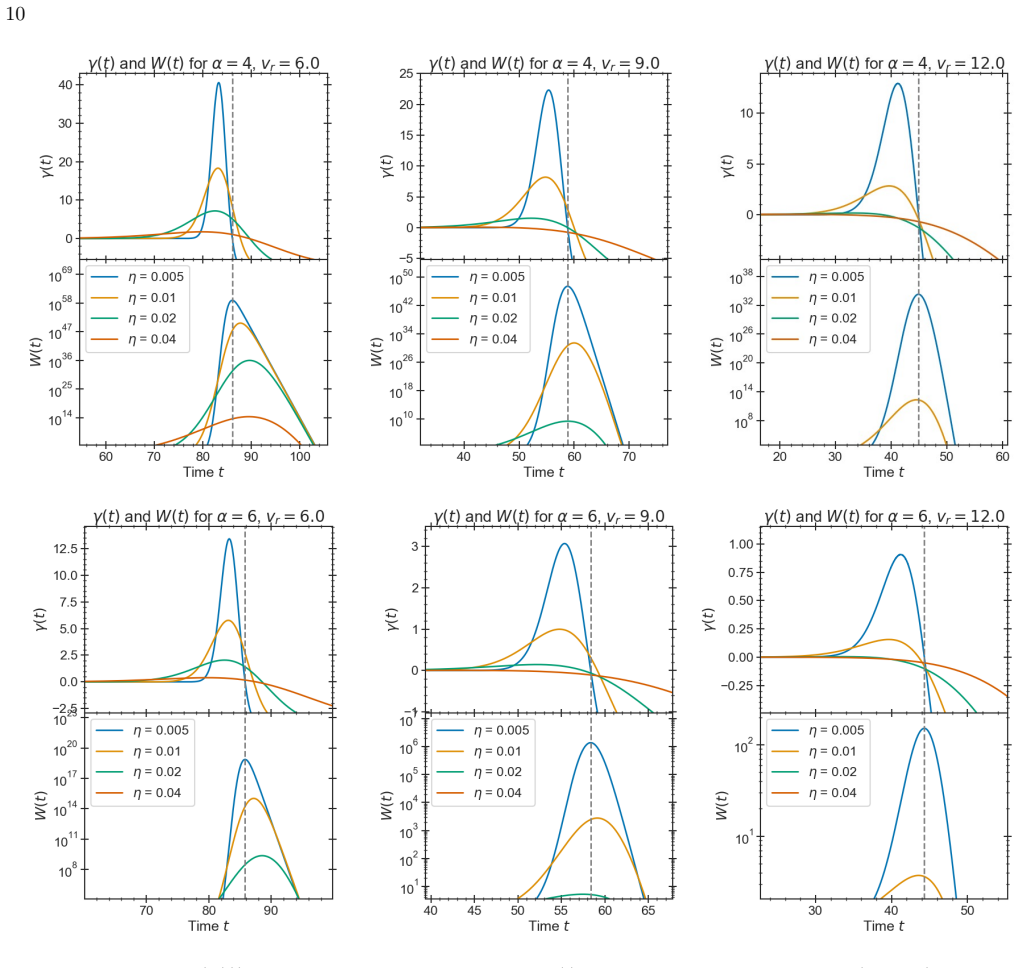
The central object is the time-of-flight-truncated electron distribution, $F_b(v,L,t) = (\alpha-1)/v_{\min}\,(v_{\min}/v)^\alpha$ for $v \ge L/t$ and $0$ for $v < L/t$, with the cutoff velocity $U=L/t$ decreasing as slower electrons arrive. The calculation is carried inside the probabilistic beam-plasma model, where random solar-wind density fluctuations smear the wave phase velocity into a probability distribution $P_\omega(V)$, taken Gaussian in the qualitative analysis or derived from a Gaussian density-fluctuation distribution in the numerical part. The load-bearing identity is the growth-rate expression in Equation 7, whose second term, $U^2 P_\omega(U)\,(\alpha-1)/v_{\min}\,(v_{\min}/U)^\alpha$, is the destabilizing contribution from the step jump, and whose first term is ordinary Landau damping. From it follow the threshold $V_r > \alpha\sqrt{\pi}\,\Delta V$, the Gaussian-in-time approximation for the growth rate near its maximum, and the constant damping rate $\nu = -\pi\,\omega_p\,(n_b/n_e)\,\alpha(\alpha-1)\,(v_{\min}/V_r)^{\alpha-1}$ that sets the exponential decay.
What would settle it
Simultaneous high-cadence electron and Langmuir-wave measurements at the leading edge of a Type III burst would settle it: if waves grow while the measured electron distribution is smooth and plateau-like, with no jump at $v = L/t$, or if a positive slope appears at the moment of growth, the cutoff mechanism is not the source. A numerical version of the same test is to integrate the quasilinear equations with the source term and check whether the sharp cutoff survives long enough for the instability to reach the predicted amplitudes.
Extended reading notes
Core claim
On the paper's own terms, the discovery is that the primary Langmuir waves of Type III bursts are generated by a cutoff instability rather than by the conventional bump-on-tail or beam-plasma instability. At a fixed distance $L$ from the injection site, the energetic-electron distribution is a power law in velocity for $v \ge L/t$ and zero below, so it has a step-like jump at the boundary velocity $U = L/t$. Substituting this distribution into the growth-rate integral splits the growth rate into a negative Landau-damping term from the monotonically falling part of the distribution and a positive boundary term proportional to $U^2 P_\omega(U)$; when the resonant phase velocity $V_r$ is close to $U$ and the velocity spread $\Delta V$ of the resonant waves is narrow enough, the positive term wins. The maximum growth rate exists only above the threshold $V_r > \alpha\sqrt{\pi}\,\Delta V$, where $\alpha$ is the spectral index of the injected power law. Because the boundary velocity sweeps downward in time as slower particles arrive, the growth rate first rises, peaks, then turns into a constant damping rate produced by the slower electrons, giving the exponential decay observed in the burst profiles. The analysis is deliberately linear and does not include the back-reaction of the waves on the electron distribution.
Load-bearing premise
The whole mechanism rests on the sharp step at the front of the arriving electron stream—faster electrons present, slower ones not yet arrived—remaining sharp at the location where the waves grow; if anything smooths that step before the instability has time to develop, the extra wave growth disappears.
Editorial extensions
If this is right
- If this mechanism is right, the absence of a measurable positive slope (beam feature) in solar-wind electron distributions no longer contradicts Langmuir wave generation during Type III bursts; the sharp front itself is the free-energy source.
- At any fixed frequency, Langmuir-wave energy should first grow as $\exp(\gamma_{\max}\,\tau_\gamma\,\operatorname{erf}((t-t_0)/\tau_\gamma))$ and then decay at a constant rate, reproducing the fast-rise/slow-decay asymmetry of fundamental Type III profiles.
- The asymmetry of the profile is a local property of the emission process: it is controlled by the width of the phase-velocity distribution (equivalently, the level of density fluctuations) and by the spectral index $\alpha$, with no intrinsic frequency dependence.
- The instability is stronger for shallower power laws (smaller $\alpha$), for lower resonant velocities $V_r$, and for narrower velocity spreads $\Delta V$.
- The second-step conversion of Langmuir waves into fundamental electromagnetic emission via scattering on density inhomogeneities remains, so the main revision is entirely in the first step; the harmonic emission mechanism is unchanged.
Reading between the lines
- Beyond the paper, an observational test is to measure the electron distribution at sub-second cadence while Langmuir waves peak during a Type III burst: one should see the cutoff velocity $L/t$ sweep through the resonant phase velocity with no positive slope at the moment of growth; if a plateau is present instead, the cutoff mechanism is not operating.
- Beyond the paper, the model implies a quantitative link that is not computed here: the fitted rise and decay parameters of a burst should correlate with the local density-fluctuation level $\delta n/n_e$ and the spectral index $\alpha$, so multi-spacecraft radio-plus-plasma observations could test the predicted ratio of damping to maximum growth.
- Beyond the paper, including quasilinear relaxation in a numerical solution of the same equations may partially erase the very jump that drives the instability; such a simulation would show whether the predicted burst profile survives when the back-reaction of waves on particles is switched on.
- Beyond the paper, the same front-truncation mechanism could operate for any impulsive injection of a power-law particle distribution into a plasma with resonant waves, not only solar Type III bursts; the paper itself notes a related but distinct time-of-flight case at coronal shock fronts.
Editorial analysis
A structured set of objections, weighed in public.
Referee Report
Summary. The manuscript proposes a revision of the standard two-step theory of Type III radio bursts. It argues that a time-of-flight-truncated power-law distribution of energetic electrons (Eq. 4) is linearly unstable to Langmuir waves when the wave phase-velocity distribution is broadened by random density fluctuations. The authors derive an analytic growth rate (Eqs. 7, 10, 12), a threshold condition (Eq. 13), and a wave-intensity evolution (Eqs. 9, 16), and support the calculation with numerical examples (Figs. 4, 6, 7). They compare the resulting asymmetric growth/decay profiles to exponentially modified Gaussian fits of PSP/RFS observations (Fig. 1) and claim qualitative agreement. The paper explicitly restricts itself to the linear regime and does not model the back-reaction of waves on the electron distribution.
Significance. If the proposed mechanism operates, it would replace the bump-on-tail/beam instability as the primary Langmuir-wave generation process for Type III bursts, providing a natural explanation for both the rarity of measured positive-slope beam distributions and the observed asymmetry of fundamental-burst time profiles. The paper's strengths are its explicit analytical increment derivation, its incorporation of random density fluctuations through a probabilistic phase-velocity distribution, and its falsifiable qualitative predictions (stronger growth for shallower alpha, lower Vr, and narrower DeltaV). It also honestly identifies its linear-regime limitation. At present, however, the conclusion rests on a linear calculation whose consistency with the quasilinear back-reaction is not established and on a qualitative, non-quantified comparison with observations.
major comments (4)
- [Section 2 (Eqs. 1, 4, 9)] The central claim is that the time-of-flight cutoff instability can amplify Langmuir waves to Type III intensities, but the paper never checks that the cutoff survives long enough. Eq. (1) already contains the quasilinear diffusion operator (partial/partial v)[W P_omega partial F/partial v], which acts on exactly the same velocity-space gradient that produces the boundary contribution in Eq. (7). As soon as W rises above the noise level, this term smooths the step at v = L/t at the same location x = L; the restriction to 'distances that are not very large' in Section 2 concerns propagation effects, not this local back-reaction. A calculation that exponentiates gamma(t) via Eq. (9) while keeping F fixed is self-consistent only if the growth time is much shorter than the local diffusion time, and no estimate of this ratio or a coupled quasilinear calculation is given. Without such an estimate, the mechanism is not demonstrated to be the one operating in Type III bursts.
- [Section 2.1 and Appendix C (Eqs. 12, 13, C30)] The evaluation of the damping integral for a narrow Gaussian P_omega at U = Vr misses a factor of 1/2. For a normalized Gaussian centered at Vr, the integral in the first term of Eq. (7) is approximately (1/2)(vmin/Vr)^{alpha-1} when the slowly varying factor (vmin/V)^{alpha-1} is pulled out of the integral, because the lower limit sits at the center of the Gaussian. The negative term in the bracket of Eq. (12) and Eq. (C30) should therefore be -(alpha/2)(vmin/Vr), not -alpha(vmin/Vr). Correspondingly, the threshold condition (13) should read Vr > (alpha/2) sqrt(pi) DeltaV, and Eq. (18) changes accordingly. This arithmetic issue affects the numerical values of gamma_max and the resulting W(t) shown in Figures 4, 6, and 7, and it should be corrected before the quantitative claims are relied upon.
- [Sections 1 and 4 (Figs. 1, 3-7)] The claimed agreement with Type III observations is not quantified. The observed profiles in Fig. 1 are fitted with an exponentially modified Gaussian, and the model W(t) in Figs. 3, 4, 6, and 7 is calculated with hand-picked dimensionless parameters (alpha, Vr, DeltaV/Vr, eta; L = 500, omega_p = nb/ne = 1), but the model curves are never overlaid on the data, no residuals or goodness-of-fit statistics are reported, and W0 in Eq. (9) is left arbitrary. The abstract states that the intensity-time profiles 'closely match' observations; as written, this is a qualitative shape claim, not a demonstrated quantitative match. At minimum, one representative event should be compared with the model on a common axis, with the noise level W0 and the physical time scale specified.
- [Section 3 and Appendix B (Eqs. 22, B24)] The non-Gaussian P_omega(V) used for the numerical results appears inconsistent with the expression derived in Appendix B. With eta = delta_n/(2n_e), the arguments of the error functions in Eq. (22) contain 3/eta = 6n_e/delta_n, whereas the corresponding arguments in Eq. (B24) contain 3n_e/delta_n (with v_T^2 factors restored). Since Figure 6 and the accompanying discussion depend on Eq. (22), the authors should either reconcile the two expressions or explain why they differ by a factor of 2; the numerical results in Section 3 cannot be assessed until this discrepancy is resolved.
minor comments (5)
- [Figure 5 caption] The caption says the non-Gaussian P_omega(V) is 'given by Equation 3', but it should refer to Eq. (22).
- [Section 2.1] The text contains the typo 'occurexist' in the sentence introducing the threshold condition; it should read 'occur: exist' or be reworded.
- [Appendix B (Eq. B8)] Eq. (B8) has a dimensionally inconsistent prefactor 1/(sqrt(pi) delta_n) and later uses the ratio delta_n/delta_n inside an integral; these expressions should be corrected, since the normalization of the density-fluctuation distribution underpins the derivation of P_omega(V).
- [Eqs. (7) and (C28)] The same damping integral is written in two algebraically equivalent but visually different forms; unifying them would reduce the risk of reader error.
- [Eq. (21)] The quantities zeta and Lambda in the relaxation-time estimate are not defined in the text; please define them or cite the specific source.
Circularity Check
No significant circularity: the cutoff-instability growth rate and the asymmetric Type III time profile are computed from the quasilinear equations on a free-flight-truncated power-law distribution, with model parameters chosen from observations rather than fitted to the target radio profiles.
full rationale
The derivation is self-contained and no load-bearing step reduces to its own input. The growth rate is computed from the standard quasilinear expression (Eq. 6) applied to the free-flight-truncated power-law distribution (Eq. 4), and the wave intensity follows by exponentiation (Eq. 9); no parameter is fitted to the target radio time profiles. The inputs (alpha = 4 and 6 from Krucker et al. 2007; Vr = 6-12 vT; DeltaV/Vr = 0.005-0.04; L = 500) are observationally motivated choices, and the EMG fit parameters of the observed profiles (mu, sigma, lambda, r) are never used to construct the model's W(t). The predicted rise-peak-exponential-decay shape is a mathematical consequence of a Gaussian resonance P_omega(V) being swept by the monotonically decreasing cutoff velocity U = L/t, followed by constant Landau damping (Eq. 17); it is not imposed by the data. The probabilistic beam-plasma model underlying Eqs. 1-2 is attributed to the authors' prior work (Voshchepynets et al. 2015; Voshchepynets & Krasnoselskikh 2015), but the paper re-derives the velocity probability distribution in Appendix B from an explicitly declared Gaussian density-fluctuation hypothesis, and Eq. 6 reduces to the homogeneous-plasma growth rate when P_omega -> delta(V - Vr); the self-citation is therefore supporting context, not the logical load. The paper's own stated limitation - neglecting the quasilinear back-reaction of waves on the cutoff distribution (Abstract; Section 2: 'we restrict ourselves to distances that are not very large') - is a validity concern (the cutoff may be smoothed before waves reach observable amplitudes), not a circularity, because the calculation does not assume its conclusion. No uniqueness theorem is imported, and the time-of-flight mechanism is explicitly traced to the external Zheleznyakov & Zaitsev (1970) idea rather than presented as a newly renamed result. Overall: no significant circularity; the central claim has independent content.
Assumptions & free parameters
free parameters (7)
- alpha (power-law spectral index) =
4 and 6 in Figure 4; 4, 6, 8 in Figure 7
- Vr (resonant phase velocity) =
6, 9, 12 vT
- DeltaV/Vr (relative width of Gaussian phase-velocity distribution) =
0.005, 0.01, 0.02, 0.04
- eta = delta_n / (2 n_e) (density fluctuation level) =
0.005, 0.01, 0.02, 0.04
- n_b / n_e (beam density ratio) =
1 (dimensionless)
- L (distance from source) =
500 (dimensionless)
- v_min (minimum electron velocity) =
unspecified, set by normalization
assumptions (7)
- domain assumption Quasilinear equations (1)-(2) with a probabilistic Pomega(V) describe wave-particle interaction in a randomly inhomogeneous plasma
- domain assumption The electron distribution at location L is the source power law with a sharp cutoff at v = L/t and no quasilinear relaxation along the path
- domain assumption Linear approximation: no back-reaction of waves on the electron distribution
- domain assumption Background plasma density varies monotonically and slowly, allowing local treatment
- domain assumption Weak magnetic field and 1D approximation
- domain assumption Point source at x = 0 switched on at t = 0 and operating continuously
- domain assumption Pomega(V) is a narrow Gaussian with DeltaV << Vr for the analytic threshold (Eq. 12)
Cite this review
Pith. "Pith review of Plasma instability in the front of ejected energetic electrons and Type III solar radiobursts." pith.science (2026). https://pith.science/paper/V5LTPBPR
@misc{pith2026250708437,
  author       = {Pith},
  title        = {Pith review of: Plasma instability in the front of ejected energetic electrons and Type III solar radiobursts},
  year         = {2026},
  howpublished = {\url{https://pith.science/paper/V5LTPBPR}},
  note         = {Machine review of arXiv:2507.08437}
}
read the original abstract
Type III radio bursts are a signature of the flux of near-relativistic electrons ejected during solar flares. These bursts are frequently observed by spacecraft such as the Parker Solar Probe. It is traditionally believed that these electron beams generate Langmuir waves through the two-stream instability, which are then converted into electromagnetic waves. In this study, we revise that model by examining how the electron distribution becomes truncated due to the "time-of-flight" effect as the beam travels through a randomly inhomogeneous, and gently varying solar-wind plasma. Rather than the two-stream instability, this truncation destabilizes the distribution and leads to the generation of Langmuir waves via a linear instability; we confine our analysis to this linear regime and do not take into account the back reaction of the generated Langmuir waves on the electron distribution, which is nonlinear. The instability grows until slower electrons arrive and dampen the waves. Our qualitative analysis shows that the resulting wave intensity growth and decay closely match the intensity-time profile of observed Type III radio bursts at the fundamental frequency, supporting this modified theory.
Figures


Figures from the paper (4 more)



Reference graph
Works this paper leans on
-
[1]
1972, Astronomy and Astrophysics, 19, 343
Aubier, M., & Boischot, A. 1972, Astronomy and Astrophysics, 19, 343
work page 1972
-
[2]
Bale, S. D., Goetz, K., Harvey, P. R., et al. 2016, SSRv, 204, 49, doi: 10.1007/s11214-016-0244-5
-
[3]
1983, Astronomy and Astrophysics, 126, 293
Kemp, M. 1983, Astronomy and Astrophysics, 126, 293
work page 1983
-
[4]
Chen, C. H. K., Howes, G. G., Bonnell, J. W., et al. 2013, in American Institute of Physics Conference Series, Vol. 1539, Solar Wind 13, ed. G. P. Zank, J. Borovsky, R. Bruno, J. Cirtain, S. Cranmer, H. Elliott, J. Giacalone, W. Gonzalez, G. Li, E. Marsch, E. Moebius, N. Pogorelov, J. Spann, & O. Verkhoglyadova, 143–146, doi: 10.1063/1.4811008
-
[5]
2024, The Astrophysical Journal Letters, 975, L37
Chen, L., Ma, B., Wu, D., et al. 2024, The Astrophysical Journal Letters, 975, L37
work page 2024
-
[6]
2021, The Astrophysical Journal Letters, 915, L22, doi: 10.3847/2041-8213/ac0b43
Chen, L., Ma, B., Wu, D., et al. 2021, The Astrophysical Journal Letters, 915, L22, doi: 10.3847/2041-8213/ac0b43
-
[7]
2021, Astronomy and Astrophysics, 654, A92, doi: 10.1051/0004-6361/202141365
Dresing, N., Warmuth, A., Effenberger, F., et al. 2021, Astronomy and Astrophysics, 654, A92, doi: 10.1051/0004-6361/202141365
-
[8]
Fox, N. J., Velli, M. C., Bale, S. D., et al. 2016, SSRv, 204, 7, doi: 10.1007/s11214-015-0211-6
Show all 49 references
-
[9]
C., et al
Gerekos, C., Steinbr¨ ugge, G., Jebaraj, I. C., et al. 2024, Astronomy and Astrophysics, 683, A56, doi: 10.1051/0004-6361/202347900
2024 doi
-
[10]
L., & Zhelezniakov, V
Ginzburg, V. L., & Zhelezniakov, V. V. 1958, Soviet Ast., 2, 653
1958
-
[11]
E., Fried, B
Hinkel-Lipsker, D. E., Fried, B. D., & Morales, G. J. 1992, Physics of Fluids B, 4, 559, doi: 10.1063/1.860255
1992 doi
-
[12]
C., Krasnoselskikh, V., Pulupa, M., Magdalenic, J., & Bale, S
Jebaraj, I. C., Krasnoselskikh, V., Pulupa, M., Magdalenic, J., & Bale, S. D. 2023a, The Astrophysical Journal Letters, 955, L20, doi: 10.3847/2041-8213/acf857
-
[13]
C., Krasnoselskikh, V., Voshchepynets, A., et al
Jebaraj, I. C., Krasnoselskikh, V., Voshchepynets, A., et al. 2024, in AGU Fall Meeting Abstracts, Vol. 2024, SH21E–2882
2024
-
[14]
C., Magdalenic, J., Krasnoselskikh, V., Krupar, V., & Poedts, S
Jebaraj, I. C., Magdalenic, J., Krasnoselskikh, V., Krupar, V., & Poedts, S. 2023b, Astronomy and Astrophysics, 670, doi: 10.1051/0004-6361/202243494
-
[15]
C., Kouloumvakos, A., Dresing, N., et al
Jebaraj, I. C., Kouloumvakos, A., Dresing, N., et al. 2023c, Astronomy and Astrophysics, 675, A27, doi: 10.1051/0004-6361/202245716
-
[16]
Kaiser, M. L. 2005, Advances in Space Research, 36, 1483, doi: 10.1016/j.asr.2004.12.066
2005 doi
-
[17]
J., & Horbury, T
Kellogg, P. J., & Horbury, T. S. 2005, Annales Geophysicae, 23, 3765, doi: 10.5194/angeo-23-3765-2005
2005 doi
-
[18]
2015, Astronomy and Astrophysics, 580, A80, doi: 10.1051/0004-6361/201424397
Kouloumvakos, A., Nindos, A., Valtonen, E., et al. 2015, Astronomy and Astrophysics, 580, A80, doi: 10.1051/0004-6361/201424397
2015 doi
-
[19]
2022, The Astrophysical Journal Letters, 924, L24, doi: 10.3847/2041-8213/ac46a7
Krafft, C., & Savoini, P. 2022, The Astrophysical Journal Letters, 924, L24, doi: 10.3847/2041-8213/ac46a7
2022 doi
-
[20]
Krafft, C., & Volokitin, A. S. 2016, The Astrophysical Journal, 821, 99, doi: 10.3847/0004-637X/821/2/99
2016 doi
-
[21]
S., & Krasnoselskikh, V
Krafft, C., Volokitin, A. S., & Krasnoselskikh, V. V. 2013, The Astrophysical Journal, 778, 111, doi: 10.1088/0004-637X/778/2/111 —. 2015, The Astrophysical Journal, 809, 176, doi: 10.1088/0004-637X/809/2/176
2013 doi
-
[22]
2019, The Astrophysical Journal, 879, 51, doi: 10.3847/1538-4357/ab22bf
Krasnoselskikh, V., Voshchepynets, A., & Maksimovic, M. 2019, The Astrophysical Journal, 879, 51, doi: 10.3847/1538-4357/ab22bf
2019 doi
-
[23]
P., Christe, S., & Lin, R
Krucker, S., Kontar, E. P., Christe, S., & Lin, R. P. 2007, The Astrophysical Journal Letters, 663, L109, doi: 10.1086/519373
2007 doi
-
[24]
2010, in American Institute of Physics Conference Series, Vol
Lemaire, J. 2010, in American Institute of Physics Conference Series, Vol. 1216, Twelfth International Solar Wind Conference, ed. M. Maksimovic, K. Issautier, N. Meyer-Vernet, M. Moncuquet, & F. Pantellini (AIP), 8–13, doi: 10.1063/1.3395971
2010 doi
-
[25]
Scarf, F. L. 1986, The Astrophysical Journal, 308, 954, doi: 10.1086/164563
1986 doi
-
[26]
P., Potter, D
Lin, R. P., Potter, D. W., Gurnett, D. A., & Scarf, F. L. 1981, The Astrophysical Journal, 251, 364, doi: 10.1086/159471
1981 doi
-
[27]
Y., Reid, H
Lorfing, C. Y., Reid, H. A. S., G´ omez-Herrero, R., et al. 2023, The Astrophysical Journal, 959, 128, doi: 10.3847/1538-4357/ad0be3
2023 doi
-
[28]
Maksimovic, M., Pierrard, V., & Lemaire, J. F. 1997, A&A, 324, 725
1997
-
[29]
Melrose, D. B. 1970, Australian Journal of Physics, 23, 871 —. 2017, Reviews of Modern Plasma Physics, 1, 5, doi: 10.1007/s41614-017-0007-0
1970 doi
-
[30]
G., Christian, E
Mitchell, J. G., Christian, E. R., de Nolfo, G. A., et al. 2025, The Astrophysical Journal, 980, 96, doi: 10.3847/1538-4357/adaa7c 20
2025 doi
-
[31]
S., Agapitov, O., Bale, S
Mozer, F. S., Agapitov, O., Bale, S. D., et al. 2024, Astronomy and Astrophysics, 690, L6, doi: 10.1051/0004-6361/202451134
2024 doi
-
[32]
W., von Rosenvinge, T., & Durney, A
Ogilvie, K. W., von Rosenvinge, T., & Durney, A. C. 1977, Science, 198, 131, doi: 10.1126/science.198.4313.131
1977 doi
-
[33]
Pierrard, V., & Lemaire, J. 1996, J. Geophys. Res., 101, 7923, doi: 10.1029/95JA03802
1996 doi
- [34]
-
[35]
D., Bonnell, J
Pulupa, M., Bale, S. D., Bonnell, J. W., et al. 2017, Journal of Geophysical Research (Space Physics), 122, 2836, doi: 10.1002/2016JA023345
2017 doi
-
[36]
D., Badman, S
Pulupa, M., Bale, S. D., Badman, S. T., et al. 2020, The Astrophysical Journal Supplements, 246, 49, doi: 10.3847/1538-4365/ab5dc0
2020 doi
-
[37]
Scudder, J. D. 1992, ApJ, 398, 319, doi: 10.1086/171859
1992 doi
-
[38]
D., & Karimabadi, H
Scudder, J. D., & Karimabadi, H. 2013, ApJ, 770, 26, doi: 10.1088/0004-637X/770/1/26
2013 doi
-
[39]
P., Jebaraj, I
Sishtla, C. P., Jebaraj, I. C., Pomoell, J., et al. 2023, The Astrophysical Journal Letters, 959, L33, doi: 10.3847/2041-8213/ad137e
2023 doi
-
[40]
1971, Astronomy and Astrophysics, 10, 362
Boischot, A. 1971, Astronomy and Astrophysics, 10, 362
1971
-
[41]
D., Dresing, N., Kollhoff, A., & Br¨ udern, M
Strauss, R. D., Dresing, N., Kollhoff, A., & Br¨ udern, M. 2020, The Astrophysical Journal, 897, 24, doi: 10.3847/1538-4357/ab91b0
2020 doi
-
[42]
Suzuki, S., & Dulk, G. A. 1985, in Solar Radiophysics: Studies of Emission from the Sun at Metre Wavelengths, ed. D. J. McLean & N. R. Labrum (Cambridge University Press), 289–332
1985
-
[43]
2021, The Astrophysical Journal, 908, 126, doi: 10.3847/1538-4357/abd2bd
Tkachenko, A., Krasnoselskikh, V., & Voshchepynets, A. 2021, The Astrophysical Journal, 908, 126, doi: 10.3847/1538-4357/abd2bd
2021 doi
-
[44]
S., & Krafft, C
Volokitin, A. S., & Krafft, C. 2018, The Astrophysical Journal, 868, 104, doi: 10.3847/1538-4357/aae7cc
2018 doi
-
[45]
2015, Journal of Geophysical Research (Space Physics), 120, 10,139, doi: 10.1002/2015JA021705
Voshchepynets, A., & Krasnoselskikh, V. 2015, Journal of Geophysical Research (Space Physics), 120, 10,139, doi: 10.1002/2015JA021705
2015 doi
-
[46]
2015, The Astrophysical Journal, 807, 38, doi: 10.1088/0004-637X/807/1/38
Volokitin, A. 2015, The Astrophysical Journal, 807, 38, doi: 10.1088/0004-637X/807/1/38
2015 doi
-
[47]
J., Robinson, P
Willes, A. J., Robinson, P. A., & Melrose, D. B. 1996, Physics of Plasmas, 3, 149, doi: 10.1063/1.871841
1996 doi
-
[48]
1974, Soviet Astronomy, 18, 147
Zaitsev, V., Kunilov, M., Mityakov, N., & Rapoport, V. 1974, Soviet Astronomy, 18, 147
1974
-
[49]
1970, Soviet Astronomy, 14, 47
Zheleznyakov, V., & Zaitsev, V. 1970, Soviet Astronomy, 14, 47
1970
Reviewed August 6, 2026 · model on record in the stance chip above.
Discussion (0). Continue with ORCID to comment.