REVIEW 3 major objections 5 minor 90 references
Recursive Reward Aggregation
T0 review · 3 major / 5 minor · reviewed 2026-08-06 · deepseek-v4-flash
Pith's one-line read This paper shows that the standard discounted-sum Bellman equations generalize to any recursively computed reward aggregation—max, min, mean, variance, and Sharpe ratio—so RL agents can optimize these objectives directly without touching…
desk verdict Elegant fold-based framework for policy evaluation, but the Bellman optimality theorem fails for non-monotone aggregations like variance; the value-based optimization claims are overbroad. read the letter →
The pith
A machine-rendered reading of the paper's core claim, the machinery that carries it, and where it could break.
The reading
What carries the argument
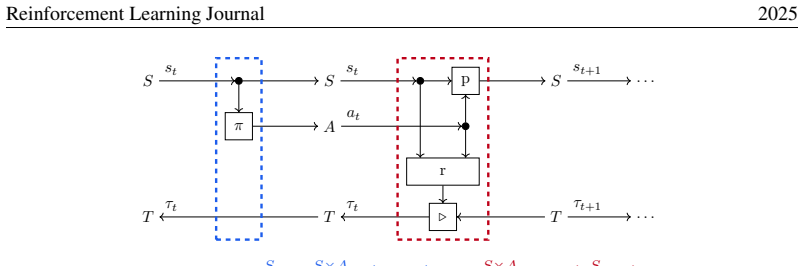
The central object is the recursive statistic aggregation $\mathrm{agg}_{\mathrm{init},\triangleright}$: a fold over reward lists defined by an initial statistic $\mathrm{init} \in T$, an update function $\triangleright : R \times T \to T$, and a post-processing function $\mathrm{post} : T \to R$ that extracts a scalar value (Definition 3.1). The machinery that carries the argument is algebra fusion: composing the coalgebra that generates rewards one step at a time (the step function $\mathrm{step}_\pi$) with this fold as a catamorphism collapses the two recursions into one, yielding the Bellman equation $\tau_\pi(s) = r_\pi(s) \triangleright \tau_\pi(p_\pi(s))$ for the state statistic function. This single recursive identity lets a Q-learning, PPO, or TD3 update target compute any listed aggregation by replacing the scalar "discounted addition" with the appropriate update rule.
What would settle it
In a two-step MDP where the objective is variance (or a variance-penalized sum), compute the optimal trajectory by exhaustive enumeration and compare it with the policy produced by the Bellman optimality update $\tau_*(s) = \sup_a (r(s,a) \triangleright \tau_*(p(s,a)))$ using the paper's variance update; different outcomes would show Theorem 3.8 does not hold for that aggregation.
Extended reading notes
Core claim
The central claim is that the Bellman equation is a fusion of two recursive structures: an MDP generates a reward list recursively through a step function, and a recursive statistic aggregation consumes that list through an update function $\triangleright$ and an initial statistic. For any such aggregation (Definition 3.1), the composed state statistic function $\tau_\pi$ satisfies $\tau_\pi(s) = \mathrm{init}$ at terminal states and $\tau_\pi(s) = r_\pi(s) \triangleright \tau_\pi(p_\pi(s))$ elsewhere (Theorem 3.2), and the analogous optimality equation holds with a supremum over actions (Theorem 3.8). This reproduces the standard discounted sum while also covering discounted max, discounted min, log-sum-exp, range, mean, variance, and top-k, each with an explicit update rule in Table 1; the Sharpe ratio follows because it is post-processed from recursively maintained mean and variance statistics. The paper further shows the generalized Bellman operator has unique fixed points when the update function is contractive (Theorem 3.6), and it extends the recursion to stochastic transitions as a distributional Bellman equation.
Load-bearing premise
Picking the best-looking next step at every state is assumed to add up to the best whole trajectory, but that holds only when the update rule and the way statistics are compared are aligned (order-preserving), which is not guaranteed for objectives like variance.
Editorial extensions
If this is right
- Value-based algorithms (Q-learning, DQN) and actor-critic algorithms (PPO, TD3) can optimize any objective expressible as a recursive aggregation by swapping the Bellman update, with no change to state space or reward function.
- Objectives that previously required state augmentation or approximate reward shaping—discounted max, worst-case min, mean, range, and variance-regularized sums—become direct training objectives with the same per-step computational cost.
- The Sharpe ratio can be optimized exactly, rather than through an approximate differential surrogate, by maintaining mean and variance statistics recursively; the portfolio experiment suggests this improves test Sharpe ratio.
- In stochastic settings, the recursion yields a distributional Bellman equation for any recursive aggregation, so distributional RL methods extend beyond discounted sums.
- The contractive-update condition (Theorem 3.6) guarantees uniqueness of the fixed point of the generalized Bellman operator, supporting iterative policy evaluation.
Reading between the lines
- A direct test of Theorem 3.8's scope would compare the policy from the Bellman optimality update against an exhaustive trajectory search in a small MDP for a non-monotone objective like variance; a mismatch would show the pointwise-maximization step requires an order-preservation assumption the paper does not state.
- The framework opens a design axis where the aggregation function itself could be learned from data (e.g., a parameterized $\triangleright$), rather than hand-picked, which the paper lists only as future work.
- Non-recursive objectives like the median and CVaR fall outside the exact framework (the paper says so); sketching approximations might still combine with the same Bellman structure, but the per-step approximation error would need to be controlled.
- The same fold-and-fuse lens applies beyond rewards to any per-step quantity—costs, constraint violations, or information signals—potentially unifying risk measures and constrained control within one Bellman-style recursion.
Editorial analysis
A structured set of objections, weighed in public.
Referee Report
Summary. The paper proposes an algebraic framework for reinforcement learning in which the standard discounted-sum return is replaced by a recursive reward aggregation defined by an initial statistic init, an update function ▷, and a post-processing function post. The central claim is that composing a recursively generated reward sequence with such an aggregation yields a generalized Bellman equation for the state statistic function (Theorem 3.2), that fixed points of the associated Bellman operator are unique under a contractiveness condition (Theorem 3.6), and that an analogous Bellman optimality equation holds for optimal policies (Theorem 3.8). The authors extend the framework to state-action statistics, stochastic transitions, and actor-critic and value-based algorithms, and they report experiments in grid-world, continuous control, and portfolio optimization, including optimization of discounted max, min, mean, variance-regularized sum, and Sharpe ratio objectives.
Significance. The policy-evaluation side of the paper is elegant and potentially useful: the fusion perspective gives a clean derivation of a generalized Bellman equation for a large class of recursive aggregations, and the fixed-point uniqueness result is a natural generalization of the classical contraction argument. The paper also makes a welcome effort to provide explicit recursive formulations, a table of aggregations, and empirical validation, all of which contribute to reproducibility. However, the policy-optimization claim is not supported as stated: Theorem 3.8's Bellman optimality equation is false for non-monotone aggregations such as variance, mean, range, and Sharpe ratio, which are precisely among the paper's advertised examples. This is a load-bearing gap because value-based algorithms (Q-learning, DQN) and the grid-world experiments rely on that theorem. The stochastic/portfolio claims are also weaker than stated because the PPO implementation optimizes aggregated expected rewards rather than expected aggregated rewards.
major comments (3)
- [Section 3.3, Theorem 3.8 and Eq. (12)] The step labelled 'pointwise maximization' in the proof (the line marked as (99) in Appendix F) is valid only if the update function satisfies a monotonicity condition with respect to the preorder ≤T: for every reward r, τ1 ≤T τ2 must imply r ▷ τ1 ≤T r ▷ τ2. This assumption is not stated in Theorem 3.8, and it fails for several aggregations in Table 1, including variance, mean, range, and Sharpe ratio. Concretely, consider the variance aggregation with lower variance preferred, so that sup in the preorder means minimum variance. Let states s, u, v1, v2 with transitions s→u (reward 0), u→v1 (reward 100) then v1→T (reward −100), and u→v2 (reward 1000) then v2 terminal. From u, the suffixes [100,−100] and [1000] have variances 10,000 and 0, respectively, so [1000] is better at u; from s, the full trajectories [0,100,−100] and [0,1000] have variances 6,666.7 and 250,000, respectively, so [100,−100] is better at s. Hence no stationary policy is optimal at both states, τ* is not well-defined, and Eq. (12) fails because the right-hand side using the optimal statistic at u gives variance 250,000 rather than the true optimal value 6,666.7. The theorem can be repaired by adding the missing monotonicity assumption and restricting the value-based claims to aggregations that satisfy it, but as stated the theorem is false.
- [Section 4, Appendix H.2, and Section 5.4] The stochastic and portfolio claims are weaker than the text suggests. Equation (13) is a distributional recursion for the distribution of the aggregated statistic, but the PPO implementation in Algorithm 2 uses a point-valued critic and sampled transitions, which computes the statistic of expected rewards (aggregated expected rewards) rather than the expected aggregated statistic. The paper itself acknowledges in Appendix H.2 that this differs from the expected aggregated rewards. Therefore the statement in Section 5.4 that the method estimates and optimizes the exact Sharpe ratio over the entire trajectory is not justified for the stochastic PPO setting: expectation does not commute with the Sharpe ratio, so the optimized objective is not the expected Sharpe ratio. The deterministic policy-evaluation results are unaffected, but the stochastic and portfolio claims need to be reworded and the experiments re-described accordingly.
- [Appendix G.1, Algorithm 1] The Q-learning update τ(s,a) ← τ(s,a) + α(max_{a′} r ▷ τ(s′,a′) − τ(s,a)) is not well-defined for most of the statistics in Table 1. For the mean aggregation, T = N × R, so τ(s,a) is a pair (length, sum) and the expression τ(s,a) + α(·) is undefined; similar problems arise for variance, range, and top-k buffers. The paper does not specify the vector-space structure on T or an alternative update for these cases. As written, Algorithm 1 supports only aggregations whose statistic space is a vector space, such as the discounted sum. The grid-world experiments in Section 5.1 therefore need either a concrete definition of the statistic space and the addition operation used in the implementation, or a different update rule.
minor comments (5)
- [Appendix A.3, Theorem A.1] The theorem statement says the state-action statistic function has type τ S×Aπ : S → T, but the equation below it and the surrounding text use S × A → T; the domain should be S × A.
- [Definition 3.1] There is a typo in the definition: 'a recursive statistic aggregation function agginit,▷ : [R] → T of is defined' should read 'is defined'.
- [Appendix F, Lemma D.7] The proof of Lemma D.7 uses arg sup_{a∈A} f(a), which need not be unique; the argument can be repaired by choosing witnesses or by proving the two inequalities directly without naming an argmax.
- [Section 4, Eq. (13)] In Eq. (13), the notation r ▷ τ′ is used with r and τ′ as random variables, but the joint distribution and measurability conditions on the stochastic update are not specified; please define the pushforward of the product measure explicitly.
- [Table 1 and Section 5.4] The Sharpe ratio is advertised as a key example, but Table 1 does not contain an explicit Sharpe-ratio row; the paper only says that mean and variance are recursive. Adding the explicit statistic, update function, and post-processing for the Sharpe ratio would make the example precise.
Circularity Check
No significant circularity; the Bellman recursion is a direct consequence of the recursive aggregation definition, and the main theoretical gap is a missing monotonicity assumption, not a circular fit.
full rationale
The paper's central derivation is not circular in the sense that matters. Theorem 3.2 (Eq. 10) is obtained by composing the recursive reward generation function (Eq. 4) with the recursive aggregation function (Definition 3.1, Eq. 8); the proof in Appendix F explicitly unfolds gen and agg, so the Bellman equation for the state statistic function is a definition-tracking fold/fusion result rather than a fitted parameter renamed as a prediction. No term in the Bellman equation is estimated from data, and the portfolio experiment evaluates the Sharpe ratio on a separate test period against external baselines (DiffSharpe, NCMDP), so the empirical claims are not self-confirming. The self-citations present (e.g., Morimura et al. 2010a,b and Ackermann et al. 2024) are contextual and are not load-bearing for the main claim. The one serious issue is Theorem 3.8: the proof's 'pointwise maximization' step (Eq. 99) requires that r(s,a) ▷ tau*(p(s,a)) be monotone with respect to the preorder on statistics, an assumption that is not stated and that fails for variance/mean-type aggregations; however, a missing assumption or false theorem is a correctness concern, not circularity. Accordingly, the circularity pass finds no reduction of a claimed prediction to its own inputs, and the score is low, reflecting only minor non-load-bearing self-citations.
Assumptions & free parameters
assumptions (4)
- standard math Fusion law for recursive coalgebras/algebras (Hinze et al. 2010, Section 4)
- domain assumption Contractiveness of the update function ▷ with respect to a premetric dT (Definition 3.5)
- ad hoc to paper Monotonicity (order-preservation) of ▷ with respect to the preorder <=T for the Bellman optimality equation
- domain assumption Objectives expressible as recursive aggregations with bounded-size accumulators
Cite this review
Pith. "Pith review of Recursive Reward Aggregation." pith.science (2026). https://pith.science/paper/2LZ4GKND
@misc{pith2026250708537,
  author       = {Pith},
  title        = {Pith review of: Recursive Reward Aggregation},
  year         = {2026},
  howpublished = {\url{https://pith.science/paper/2LZ4GKND}},
  note         = {Machine review of arXiv:2507.08537}
}
read the original abstract
In reinforcement learning (RL), aligning agent behavior with specific objectives typically requires careful design of the reward function, which can be challenging when the desired objectives are complex. In this work, we propose an alternative approach for flexible behavior alignment that eliminates the need to modify the reward function by selecting appropriate reward aggregation functions. By introducing an algebraic perspective on Markov decision processes (MDPs), we show that the Bellman equations naturally emerge from the recursive generation and aggregation of rewards, allowing for the generalization of the standard discounted sum to other recursive aggregations, such as discounted max and Sharpe ratio. Our approach applies to both deterministic and stochastic settings and integrates seamlessly with value-based and actor-critic algorithms. Experimental results demonstrate that our approach effectively optimizes diverse objectives, highlighting its versatility and potential for real-world applications.
Figures


Figures from the paper (14 more)




Reference graph
Works this paper leans on
-
[1]
Constrained policy optimization
Joshua Achiam, David Held, Aviv Tamar, and Pieter Abbeel. Constrained policy optimization. In International Conference on Machine Learning, 2017. URL https://proceedings.mlr.press/v70/achiam17a.html
2017
-
[2]
Offline reinforcement learning from datasets with structured non-stationarity
Johannes Ackermann, Takayuki Osa, and Masashi Sugiyama. Offline reinforcement learning from datasets with structured non-stationarity. In Reinforcement Learning Conference, 2024. URL https://openreview.net/forum?id=qowNlhKcPw
2024
-
[3]
Concrete problems in AI safety
Dario Amodei, Chris Olah, Jacob Steinhardt, Paul Christiano, John Schulman, and Dan Man \'e . Concrete problems in AI safety. arXiv preprint, 2016. URL https://arxiv.org/abs/1606.06565
arXiv 2016
-
[4]
Hindsight experience replay
Marcin Andrychowicz, Filip Wolski, Alex Ray, Jonas Schneider, Rachel Fong, Peter Welinder, Bob McGrew, Josh Tobin, OpenAI Pieter Abbeel, and Wojciech Zaremba. Hindsight experience replay. In Neural Information Processing Systems, 2017. URL https://proceedings.neurips.cc/paper/2017/hash/453fadbd8a1a3af50a9df4df899537b5-Abstract.html
2017
-
[5]
A survey of inverse reinforcement learning: Challenges, methods and progress
Saurabh Arora and Prashant Doshi. A survey of inverse reinforcement learning: Challenges, methods and progress. Artificial Intelligence, 297: 0 103500, 2021. URL https://doi.org/10.1016/j.artint.2021.103500
arXiv 2021
-
[6]
The probability of backtest overfitting
David H Bailey, Jonathan Borwein, Marcos Lopez de Prado, and Qiji Jim Zhu. The probability of backtest overfitting. Journal of Computational Finance (Risk Journals), 2015. URL https://dx.doi.org/10.2139/ssrn.2326253
- [7]
-
[8]
Andrew G. Barto, Richard S. Sutton, and Charles W. Anderson. Neuronlike adaptive elements that can solve difficult learning control problems. IEEE Transactions on Systems, Man, and Cybernetics, SMC-13 0 (5): 0 834--846, 1983. URL https://doi.org/10.1109/TSMC.1983.6313077
arXiv 1983
Show all 90 references
-
[9]
A distributional perspective on reinforcement learning
Marc G Bellemare, Will Dabney, and R \'e mi Munos. A distributional perspective on reinforcement learning. In International Conference on Machine Learning, 2017. URL https://proceedings.mlr.press/v70/bellemare17a.html
2017
-
[10]
Distributional Reinforcement Learning
Marc G Bellemare, Will Dabney, and Mark Rowland. Distributional Reinforcement Learning. MIT Press, 2023. URL https://doi.org/10.7551/mitpress/14207.001.0001
2023 doi
-
[11]
Dynamic programming
Richard Bellman. Dynamic programming. Science, 153 0 (3731): 0 34--37, 1966. URL https://doi.org/10.1126/science.153.3731.34
1966 doi
-
[12]
Abstract Dynamic Programming
Dimitri Bertsekas. Abstract Dynamic Programming. Athena Scientific, 2022
2022
-
[13]
Algebra of Programming
Richard Bird and Oege de Moor. Algebra of Programming. Prentice Hall, 1997
1997
-
[14]
Investments
Zvi Bodie, Alex Kane, and Alan J Marcus. Investments. McGraw-hill, 2011
2011
-
[15]
Settling the reward hypothesis
Michael Bowling, John D Martin, David Abel, and Will Dabney. Settling the reward hypothesis. In International Conference on Machine Learning, 2023. URL https://proceedings.mlr.press/v202/bowling23a.html
2023
-
[16]
JAX : composable transformations of Python + NumPy programs, 2018
James Bradbury, Roy Frostig, Peter Hawkins, Matthew James Johnson, Chris Leary, Dougal Maclaurin, George Necula, Adam Paszke, Jake Vander P las, Skye Wanderman- M ilne, and Qiao Zhang. JAX : composable transformations of Python + NumPy programs, 2018. URL http://github.com/jax-ml/jax
2018
-
[17]
OpenAI Gym
Greg Brockman, Vicki Cheung, Ludwig Pettersson, Jonas Schneider, John Schulman, Jie Tang, and Wojciech Zaremba. OpenAI Gym . arXiv preprint, 2016. URL https://arxiv.org/abs/1606.01540
2016 arXiv
-
[18]
Deep reinforcement learning from human preferences
Paul F Christiano, Jan Leike, Tom Brown, Miljan Martic, Shane Legg, and Dario Amodei. Deep reinforcement learning from human preferences. In Neural Information Processing Systems, volume 30, 2017. URL https://proceedings.neurips.cc/paper/2017/hash/d5e2c0adad503c91f91df240d0cd4...
2017
-
[19]
Categorical foundations of gradient-based learning
Geoffrey SH Cruttwell, Bruno Gavranovi \'c , Neil Ghani, Paul Wilson, and Fabio Zanasi. Categorical foundations of gradient-based learning. In European Symposium on Programming, pp.\ 1--28, 2022. URL https://doi.org/10.1007/978-3-030-99336-8_1
2022 doi
-
[20]
Reinforcement learning with non-cumulative objective
Wei Cui and Wei Yu. Reinforcement learning with non-cumulative objective. IEEE Transactions on Machine Learning in Communications and Networking, 1: 0 124--137, 2023. URL https://doi.org/10.1109/TMLCN.2023.3285543
2023
-
[21]
Categories, relations and dynamic programming
Oege De Moor. Categories, relations and dynamic programming. Mathematical Structures in Computer Science, 4 0 (1): 0 33--69, 1994. URL https://doi.org/10.1017/S0960129500000360
1994 doi
-
[22]
Goal misgeneralization in deep reinforcement learning
Lauro Langosco Di Langosco, Jack Koch, Lee D Sharkey, Jacob Pfau, and David Krueger. Goal misgeneralization in deep reinforcement learning. In International Conference on Machine Learning, 2022. URL https://proceedings.mlr.press/v162/langosco22a.html
2022
-
[23]
Offline meta reinforcement learning -- identifiability challenges and effective data collection strategies
Ron Dorfman, Idan Shenfeld, and Aviv Tamar. Offline meta reinforcement learning -- identifiability challenges and effective data collection strategies. In Neural Information Processing Systems, 2021. URL https://openreview.net/forum?id=IBdEfhLveS
2021
-
[24]
Infinite-horizon model predictive control for periodic tasks with contacts
Tom Erez, Yuval Tassa, and Emanuel Todorov. Infinite-horizon model predictive control for periodic tasks with contacts. In Robotics: Science and Systems VII. The MIT Press, 2012. URL https://doi.org/10.7551/mitpress/9481.003.0015
2012 doi
-
[25]
Lenses and learners
Brendan Fong and Michael Johnson. Lenses and learners. In International Workshop on Bidirectional Transformations, 2019. URL https://arxiv.org/abs/1903.03671
2019 arXiv
-
[26]
A synthetic approach to Markov kernels, conditional independence and theorems on sufficient statistics
Tobias Fritz. A synthetic approach to Markov kernels, conditional independence and theorems on sufficient statistics. Advances in Mathematics, 370: 0 107239, 2020. URL https://doi.org/10.1016/j.aim.2020.107239. https://arxiv.org/abs/1908.07021
2020
-
[27]
Addressing function approximation error in actor-critic methods
Scott Fujimoto, Herke Hoof, and David Meger. Addressing function approximation error in actor-critic methods. In International Conference on Machine Learning, 2018. URL https://proceedings.mlr.press/v80/fujimoto18a.html
2018
-
[28]
Reinforcement learning for constrained Markov decision processes
Ather Gattami, Qinbo Bai, and Vaneet Aggarwal. Reinforcement learning for constrained Markov decision processes. In International Conference on Artificial Intelligence and Statistics, 2021. URL https://proceedings.mlr.press/v130/gattami21a.html
2021
-
[29]
Space-time tradeoffs of lenses and optics via higher category theory
Bruno Gavranovi \'c . Space-time tradeoffs of lenses and optics via higher category theory. arXiv preprint, 2022. URL https://arxiv.org/abs/2209.09351
2022 arXiv
-
[30]
A categorical approach to probability theory
Mich \`e le Giry. A categorical approach to probability theory. Categorical Aspects of Topology and Analysis, pp.\ 68--85, 1982. URL https://doi.org/10.1007/BFb0092872
1982 doi
-
[31]
What every computer scientist should know about floating-point arithmetic
David Goldberg. What every computer scientist should know about floating-point arithmetic. ACM computing surveys (CSUR), 23 0 (1): 0 5--48, 1991. URL https://doi.org/10.1145/103162.103163
1991
-
[32]
Maximum reward formulation in reinforcement learning
Sai Krishna Gottipati, Yashaswi Pathak, Rohan Nuttall, Raviteja Chunduru, Ahmed Touati, Sriram Ganapathi Subramanian, Matthew E Taylor, and Sarath Chandar. Maximum reward formulation in reinforcement learning. arXiv preprint, 2020. URL https://arxiv.org/abs/2010.03744
2020 arXiv
-
[33]
Space-efficient online computation of quantile summaries
Michael Greenwald and Sanjeev Khanna. Space-efficient online computation of quantile summaries. ACM SIGMOD Record, 30 0 (2): 0 58--66, 2001. URL https://doi.org/10.1145/376284.375670
2001
-
[34]
Guss, Brandon Houghton, Nicholay Topin, Phillip Wang, Cayden Codel, Manuela Veloso, and Ruslan Salakhutdinov
William H. Guss, Brandon Houghton, Nicholay Topin, Phillip Wang, Cayden Codel, Manuela Veloso, and Ruslan Salakhutdinov. MineRL : A large-scale dataset of Minecraft demonstrations. In Proceedings of the Twenty-Eighth International Joint Conference on Artificial Intelligence, 2...
2019 doi
-
[35]
Soft Actor-Critic : Off-policy maximum entropy deep reinforcement learning with a stochastic actor
Tuomas Haarnoja, Aurick Zhou, Pieter Abbeel, and Sergey Levine. Soft Actor-Critic : Off-policy maximum entropy deep reinforcement learning with a stochastic actor. In International Conference on Machine Learning, 2018. URL https://proceedings.mlr.press/v80/haarnoja18b.html
2018
-
[36]
The off-switch game
Dylan Hadfield-Menell, Anca Dragan, Pieter Abbeel, and Stuart Russell. The off-switch game. In Workshop on AI, Ethics, and Society at the Thirty-First AAAI Conference on Artificial Intelligence, 2017. URL https://arxiv.org/abs/1611.08219
2017 arXiv
-
[37]
Harris, K
Charles R. Harris, K. Jarrod Millman, St \' e fan J. van der Walt, Ralf Gommers, Pauli Virtanen, David Cournapeau, Eric Wieser, Julian Taylor, Sebastian Berg, Nathaniel J. Smith, Robert Kern, Matti Picus, Stephan Hoyer, Marten H. van Kerkwijk, Matthew Brett, Allan Haldane, Jai...
2020
-
[38]
Value iteration is optic composition
Jules Hedges and Riu Rodr \' guez Sakamoto. Value iteration is optic composition. In International Conference on Applied Category Theory, 2022. URL https://arxiv.org/abs/2206.04547
2022 arXiv
-
[39]
Ralf Hinze, Thomas Harper, and Daniel W. H. James. Theory and practice of fusion. In Symposium on Implementation and Application of Functional Languages, pp.\ 19--37, 2010. URL https://doi.org/10.1007/978-3-642-24276-2_2
2010 doi
-
[40]
Imitation learning: A survey of learning methods
Ahmed Hussein, Mohamed Medhat Gaber, Eyad Elyan, and Chrisina Jayne. Imitation learning: A survey of learning methods. ACM Computing Surveys (CSUR), 50 0 (2): 0 1--35, 2017. URL https://doi.org/10.1145/3054912
2017 doi
-
[41]
A tutorial on the universality and expressiveness of fold
Graham Hutton. A tutorial on the universality and expressiveness of fold. Journal of Functional Programming, 9 0 (4): 0 355--372, 1999. URL https://doi.org/10.1017/S0956796899003500
1999 doi
-
[42]
AI alignment: A comprehensive survey
Jiaming Ji, Tianyi Qiu, Boyuan Chen, Borong Zhang, Hantao Lou, Kaile Wang, Yawen Duan, Zhonghao He, Jiayi Zhou, Zhaowei Zhang, Fanzhi Zeng, Kwan Yee Ng, Juntao Dai, Xuehai Pan, Aidan O'Gara, Yingshan Lei, Hua Xu, Brian Tse, Jie Fu, Stephen McAleer, Yaodong Yang, Yizhou Wang, S...
2023 arXiv
-
[43]
Deep reinforcement learning approach for trading automation in the stock market
Taylan Kabbani and Ekrem Duman. Deep reinforcement learning approach for trading automation in the stock market. IEEE Access, 10: 0 93564--93574, 2022. URL https://doi.org/10.1109/ACCESS.2022.3203697
2022
-
[44]
Deep reinforcement learning for autonomous driving: A survey
B Ravi Kiran, Ibrahim Sobh, Victor Talpaert, Patrick Mannion, Ahmad A Al Sallab, Senthil Yogamani, and Patrick P \'e rez. Deep reinforcement learning for autonomous driving: A survey. IEEE Transactions on Intelligent Transportation Systems, 23 0 (6): 0 4909--4926, 2021. URL ht...
2021
-
[45]
Reinforcement learning in robotics: A survey
Jens Kober, J Andrew Bagnell, and Jan Peters. Reinforcement learning in robotics: A survey. The International Journal of Robotics Research, 32 0 (11): 0 1238--1274, 2013. URL https://doi.org/10.1177/0278364913495721
2013 doi
-
[46]
gymnax : A JAX -based reinforcement learning environment library, 2022
Robert Tjarko Lange. gymnax : A JAX -based reinforcement learning environment library, 2022. URL http://github.com/RobertTLange/gymnax
2022
-
[47]
AI safety gridworlds
Jan Leike, Miljan Martic, Victoria Krakovna, Pedro A Ortega, Tom Everitt, Andrew Lefrancq, Laurent Orseau, and Shane Legg. AI safety gridworlds. arXiv preprint, 2017. URL https://arxiv.org/abs/1711.09883
2017 arXiv
-
[48]
Dynamic datasets and market environments for financial reinforcement learning
Xiao-Yang Liu, Ziyi Xia, Hongyang Yang, Jiechao Gao, Daochen Zha, Ming Zhu, Christina Dan Wang, Zhaoran Wang, and Jian Guo. Dynamic datasets and market environments for financial reinforcement learning. Machine Learning, 113 0 (5): 0 2795--2839, 2024. URL https://doi.org/10.10...
2024 arXiv
-
[49]
Mean-variance optimization in Markov decision processes
Shie Mannor and John Tsitsiklis. Mean-variance optimization in Markov decision processes. In International Conference on Machine Learning, 2011. URL https://dl.acm.org/doi/abs/10.5555/3104482.3104505. https://icml.cc/2011/papers/156_icmlpaper.pdf
2011
-
[50]
Functional programming with bananas, lenses, envelopes and barbed wire
Erik Meijer, Maarten Fokkinga, and Ross Paterson. Functional programming with bananas, lenses, envelopes and barbed wire. In Conference on Functional Programming Languages and Computer Architecture, pp.\ 124--144, 1991. URL https://doi.org/10.1007/3540543961_7
1991 doi
-
[51]
Playing Atari with deep reinforcement learning
Volodymyr Mnih, Koray Kavukcuoglu, David Silver, Alex Graves, Ioannis Antonoglou, Daan Wierstra, and Martin Riedmiller. Playing Atari with deep reinforcement learning. arXiv preprint, 2013. URL https://arxiv.org/abs/1312.5602
2013 arXiv
-
[52]
Rusu, Joel Veness, Marc G
Volodymyr Mnih, Koray Kavukcuoglu, David Silver, Andrei A. Rusu, Joel Veness, Marc G. Bellemare, Alex Graves, Martin Riedmiller, Andreas K. Fidjeland, Georg Ostrovski, Stig Petersen, Charles Beattie, Amir Sadik, Ioannis Antonoglou, Helen King, Dharshan Kumaran, Daan Wierstra, ...
2015 doi
-
[53]
Asynchronous methods for deep reinforcement learning
Volodymyr Mnih, Adria Puigdomenech Badia, Mehdi Mirza, Alex Graves, Timothy Lillicrap, Tim Harley, David Silver, and Koray Kavukcuoglu. Asynchronous methods for deep reinforcement learning. In International Conference on Machine Learning, 2016. URL https://proceedings.mlr.pres...
2016
-
[54]
Learning to trade via direct reinforcement
John Moody and Matthew Saffell. Learning to trade via direct reinforcement. IEEE transactions on neural Networks, 12 0 (4): 0 875--889, 2001. URL https://doi.org/10.1109/72.935097
2001 doi
-
[55]
Performance functions and reinforcement learning for trading systems and portfolios
John Moody, Lizhong Wu, Yuansong Liao, and Matthew Saffell. Performance functions and reinforcement learning for trading systems and portfolios. Journal of forecasting, 17 0 (5-6): 0 441--470, 1998. URL https://doi.org/10.1002/(SICI)1099-131X(1998090)17:5/6
1998 doi
-
[56]
Nonparametric return distribution approximation for reinforcement learning
Tetsuro Morimura, Masashi Sugiyama, Hisashi Kashima, Hirotaka Hachiya, and Toshiyuki Tanaka. Nonparametric return distribution approximation for reinforcement learning. In International Conference on Machine Learning, 2010 a . URL https://dblp.org/rec/conf/icml/MorimuraSKHT10....
2010
-
[57]
Parametric return density estimation for reinforcement learning
Tetsuro Morimura, Masashi Sugiyama, Hisashi Kashima, Hirotaka Hachiya, and Toshiyuki Tanaka. Parametric return density estimation for reinforcement learning. In Conference on Uncertainty in Artificial Intelligence, 2010 b . URL https://dblp.org/rec/conf/uai/MorimuraSKHT10.html...
2010
-
[58]
Handbook of floating-point arithmetic, volume 1
Jean-Michel Muller, Nicolas Brunie, Florent De Dinechin, Claude-Pierre Jeannerod, Mioara Joldes, Vincent Lef \`e vre, Guillaume Melquiond, Nathalie Revol, and Serge Torres. Handbook of floating-point arithmetic, volume 1. Springer, 2018. URL https://doi.org/10.1007/978-3-319-76526-6
2018 doi
-
[59]
Reinforcement learning: An overview
Kevin Murphy. Reinforcement learning: An overview. arXiv preprint, 2024. URL https://arxiv.org/abs/2412.05265
2024
-
[60]
a gele, Jan Olle, Thomas F \
Maximilian N \"a gele, Jan Olle, Thomas F \"o sel, Remmy Zen, and Florian Marquardt. Tackling decision processes with non-cumulative objectives using reinforcement learning. arXiv preprint, 2024. URL https://arxiv.org/abs/2405.13609
2024 arXiv
-
[61]
Ng, Daishi Harada, and Stuart J
Andrew Y. Ng, Daishi Harada, and Stuart J. Russell. Policy invariance under reward transformations: Theory and application to reward shaping. In International Conference on Machine Learning, 1999. URL https://dl.acm.org/doi/10.5555/645528.657613
1999
-
[62]
Learnable commutative monoids for graph neural networks
Euan Ong and Petar Veli c kovi \'c . Learnable commutative monoids for graph neural networks. In Learning on Graphs Conference, 2022. URL https://proceedings.mlr.press/v198/ong22a.html
2022
-
[63]
Compositional computational systems
Aleksandar Petrov. Compositional computational systems. Master's thesis, ETH Zurich, 2020. URL https://doi.org/10.3929/ethz-b-000463467
2020 doi
-
[64]
Consistent aggregation of objectives with diverse time preferences requires non-Markovian rewards
Silviu Pitis. Consistent aggregation of objectives with diverse time preferences requires non-Markovian rewards. Advances in Neural Information Processing Systems, 2023. URL https://proceedings.neurips.cc/paper/2023/hash/08342dc6ab69f23167b4123086ad4d38-Abstract.html
2023
-
[65]
Puterman
Martin L. Puterman. Markov Decision Processes: Discrete Stochastic Dynamic Programming. John Wiley & Sons, Inc., 1994. URL https://doi.org/10.1002/9780470316887
1994 doi
-
[66]
Maximum reward reinforcement learning: A non-cumulative reward criterion
Kian Hong Quah and Chai Quek. Maximum reward reinforcement learning: A non-cumulative reward criterion. Expert Systems with Applications, 31 0 (2): 0 351--359, 2006. URL https://doi.org/10.1016/j.eswa.2005.09.054
2006 doi
-
[67]
Stable-Baselines3 : Reliable reinforcement learning implementations
Antonin Raffin, Ashley Hill, Adam Gleave, Anssi Kanervisto, Maximilian Ernestus, and Noah Dormann. Stable-Baselines3 : Reliable reinforcement learning implementations. Journal of Machine Learning Research, 22 0 (268): 0 1--8, 2021. URL http://jmlr.org/papers/v22/20-1364.html. ...
2021
-
[68]
Categories of optics
Mitchell Riley. Categories of optics. arXiv preprint, 2018. URL https://arxiv.org/abs/1809.00738
2018 arXiv
-
[69]
Jordan, and Pieter Abbeel
John Schulman, Philipp Moritz, Sergey Levine, Michael I. Jordan, and Pieter Abbeel. High-dimensional continuous control using generalized advantage estimation. In International Conference on Learning Representations, 2016. URL https://arxiv.org/abs/1506.02438
2016 arXiv
-
[70]
Proximal policy optimization algorithms
John Schulman, Filip Wolski, Prafulla Dhariwal, Alec Radford, and Oleg Klimov. Proximal policy optimization algorithms. arXiv preprint, 2017. URL https://arxiv.org/abs/1707.06347
2017 arXiv
-
[71]
William F. Sharpe. Mutual fund performance. The Journal of Business, 39 0 (1): 0 119--138, 1966. URL http://www.jstor.org/stable/2351741
1966
-
[72]
A general reinforcement learning algorithm that masters chess, shogi, and Go through self-play
David Silver, Thomas Hubert, Julian Schrittwieser, Ioannis Antonoglou, Matthew Lai, Arthur Guez, Marc Lanctot, Laurent Sifre, Dharshan Kumaran, Thore Graepel, Timothy Lillicrap, Karen Simonyan, and Demis Hassabis. A general reinforcement learning algorithm that masters chess, ...
2018 doi
-
[73]
Clere Smithe
Toby St. Clere Smithe. Bayesian updates compose optically. arXiv preprint, 2020. URL https://arxiv.org/abs/2006.01631
2020 arXiv
-
[74]
Matthew J. Sobel. The variance of discounted Markov decision processes. Journal of Applied Probability, 19 0 (4): 0 794--802, 1982. URL https://doi.org/10.2307/3213832
1982 doi
-
[75]
Deep reinforcement learning for optimal portfolio allocation: A comparative study with mean-variance optimization
Srijan Sood, Kassiani Papasotiriou, Marius Vaiciulis, and Tucker Balch. Deep reinforcement learning for optimal portfolio allocation: A comparative study with mean-variance optimization. FinPlan, pp.\ 21, 2023. URL https://icaps23.icaps-conference.org/papers/finplan/FinPlan23_...
2023
-
[76]
Sutton and Andrew G
Richard S. Sutton and Andrew G. Barto. Reinforcement Learning: An Introduction. The MIT Press, 1998. URL http://incompleteideas.net/book/the-book.html
1998
-
[77]
Policy gradients with variance related risk criteria
Aviv Tamar, Dotan Di Castro, and Shie Mannor. Policy gradients with variance related risk criteria. In International Conference on Machine Learning, 2012. URL https://dl.acm.org/doi/10.5555/3042573.3042784. https://icml.cc/2012/papers/489.pdf
2012
-
[78]
MuJoCo : A physics engine for model-based control
Emanuel Todorov, Tom Erez, and Yuval Tassa. MuJoCo : A physics engine for model-based control. In 2012 IEEE/RSJ International Conference on Intelligent Robots and Systems, 2012. URL https://doi.org/10.1109/IROS.2012.6386109
2012
-
[79]
To the max: Reinventing reward in reinforcement learning
Grigorii Veviurko, Wendelin B \"o hmer, and Mathijs de Weerdt. To the max: Reinventing reward in reinforcement learning. In International Conference on Machine Learning, 2024. URL https://proceedings.mlr.press/v235/veviurko24a.html
2024
-
[80]
A survey of constraint formulations in safe reinforcement learning
Akifumi Wachi, Xun Shen, and Yanan Sui. A survey of constraint formulations in safe reinforcement learning. In International Joint Conference on Artificial Intelligence, 2024. URL https://doi.org/10.24963/ijcai.2024/913
2024 doi
-
[81]
Planning with general objective functions: Going beyond total rewards
Ruosong Wang, Peilin Zhong, Simon S Du, Russ R Salakhutdinov, and Lin Yang. Planning with general objective functions: Going beyond total rewards. In Neural Information Processing Systems, 2020. URL https://proceedings.neurips.cc/paper/2020/hash/a6a767bbb2e3513233f942e0ff24272...
2020
-
[82]
Christopher J. C. H. Watkins and Peter Dayan. Q-learning. Machine Learning, 8: 0 279--292, 1992. URL https://doi.org/10.1007/BF00992698
1992 doi
-
[83]
Learning from delayed rewards
Christopher John Cornish Hellaby Watkins. Learning from delayed rewards. PhD thesis, King's College, Cambridge United Kingdom, 1989. URL http://www.cs.rhul.ac.uk/ chrisw/new_thesis.pdf
1989
-
[84]
Note on a method for calculating corrected sums of squares and products
Barry Payne Welford. Note on a method for calculating corrected sums of squares and products. Technometrics, 4 0 (3): 0 419--420, 1962. URL https://doi.org/10.1080/00401706.1962.10490022
1962
-
[85]
Foundations of multivariate distributional reinforcement learning
Harley Wiltzer, Jesse Farebrother, Arthur Gretton, and Mark Rowland. Foundations of multivariate distributional reinforcement learning. In Neural Information Processing Systems, 2024. URL https://proceedings.neurips.cc/paper/2024/hash/b76bec34ef5e0c0ceedff6edfbefc9f5-Abstract.html
2024
-
[86]
Adaptive stock trading strategies with deep reinforcement learning methods
Xing Wu, Haolei Chen, Jianjia Wang, Luigi Troiano, Vincenzo Loia, and Hamido Fujita. Adaptive stock trading strategies with deep reinforcement learning methods. Information Sciences, 538: 0 142--158, 2020. URL https://doi.org/10.1016/j.ins.2020.05.066
2020 doi
-
[87]
Fantastic morphisms and where to find them: A guide to recursion schemes
Zhixuan Yang and Nicolas Wu. Fantastic morphisms and where to find them: A guide to recursion schemes. In International Conference on Mathematics of Program Construction, pp.\ 222--267, 2022. URL https://doi.org/10.1007/978-3-031-16912-0_9
2022 doi
-
[88]
Deep sets
Manzil Zaheer, Satwik Kottur, Siamak Ravanbakhsh, Barnabas Poczos, Russ R Salakhutdinov, and Alexander J Smola. Deep sets. In Neural Information Processing Systems, 2017. URL https://proceedings.neurips.cc/paper/2017/hash/f22e4747da1aa27e363d86d40ff442fe-Abstract.html
2017
-
[89]
Safe, efficient, and comfortable velocity control based on reinforcement learning for autonomous driving
Meixin Zhu, Yinhai Wang, Ziyuan Pu, Jingyun Hu, Xuesong Wang, and Ruimin Ke. Safe, efficient, and comfortable velocity control based on reinforcement learning for autonomous driving. Transportation Research Part C: Emerging Technologies, 117: 0 102662, 2020. URL https://doi.or...
2020
-
[90]
Ziebart, Andrew Maas, J
Brian D. Ziebart, Andrew Maas, J. Andrew Bagnell, and Anind K. Dey. Maximum entropy inverse reinforcement learning. In National Conference on Artificial Intelligence, 2008. URL https://dl.acm.org/doi/abs/10.5555/1620270.1620297
2008
Reviewed August 6, 2026 · model on record in the stance chip above.
Discussion (0). Sign in to comment.