REVIEW 4 major objections 7 minor 37 references
Photonic processor benchmarking for variational quantum process tomography
T0 review · 4 major / 7 minor · reviewed 2026-08-06 · deepseek-v4-flash
Pith's one-line read A cross-platform benchmark shows photonic processors reaching 0.8 process fidelity for variational quantum process tomography while superconducting processors plateau near 0.42.
desk verdict Useful first cross-platform benchmark of variational quantum process tomography, but the optical fidelity numbers rest on an unexplained phase-recovery step that is load-bearing. read the letter →
The pith
A machine-rendered reading of the paper's core claim, the machinery that carries it, and where it could break.
The reading
What carries the argument
The load-bearing objects are the one-hot encoding and the unitary decomposition that lets a single laser-powered mesh realize the whole variational circuit. In one-hot encoding, each logical $n$-qubit basis state is mapped to a single occupied mode among $2^n$ optical modes; for a single photon, the linear-optical scattering matrix equals the quantum transformation, so a coherent-state experiment can stand in for a single-photon one. The Clements decomposition factorizes the joint unitary into tunable beam-splitter and phase-shifter angles, and the optimizer uses a four-term shift rule on the cost function $C(\hat\theta) = \frac{1}{2^{n-1}}\sum_i \left(1 - \Re \langle \Psi^{tr}_i | \Psi^{pr}_i \rangle\right)$ (Eq. 1). Process fidelity is then evaluated as $F_{\text{process}} = \operatorname{Tr}(\chi_E^{\text{actual}} \chi_E^{\text{ideal}})$ (Eq. 3) between the implemented and ideal process matrices.
What would settle it
Recalculate the optical processors' process fidelity using phase-resolving measurements—for instance, interfering each output mode with a reference beam to recover complex amplitudes—for the same Haar-random unitaries and iteration counts. If the phase-sensitive fidelity for the local optical processor falls below the superconducting platforms' values (about 0.42 or lower at depth 6), the paper's central claim is refuted.
Extended reading notes
Core claim
The central discovery reported is that variational quantum process tomography—fitting an unknown two-qubit process with a parametrized circuit—runs more accurately and with better convergence on photonic processors than on superconducting ones. Using a joint unitary that combines the target Haar-random process with the variational ansatz, the local optical processor compiles the circuit onto tunable beam splitters and phase shifters, measures only output intensities, and updates parameters via a four-parameter-shift rule. The reported process fidelity reaches 0.8 at depth 6 after nine iterations for both the local classical-light processor and the 12-mode quantum photonic processor, whereas the superconducting platforms start around 0.42 and do not improve beyond four iterations at depth 3. The paper also reports that increasing circuit depth helps the optical platforms but not the superconducting ones, and that thermal noise in the phase shifters, rather than single-photon effects such as dark counts or mode mismatch, dominates the optical platform's error budget.
Load-bearing premise
The optical-processor fidelities are computed from intensity-only measurements, so the central comparison assumes that the missing phase information either does not affect the fidelity metric or can be recovered from the known unitary design; if that fails, the reported photonic advantage is not measuring the true implemented process.
Editorial extensions
If this is right
- If the benchmark is correct, photonic processors—both classical one-hot and quantum—are currently the better NISQ platform for variational circuits that repeatedly execute shallow two-qubit unitaries.
- The one-hot classical encoding reproduces the quantum photonic results within uncertainty, meaning laser-based setups can prototype photonic algorithms before single-photon sources are deployed.
- Increasing VQC depth from 3 to 6 helps optical platforms but not superconducting ones, so the fidelity gap likely grows with circuit width and depth.
- The same benchmarking framework and VQC loop is claimed to extend beyond process tomography to algorithms such as QAOA and VQE.
- The local optical processor's processing time per iteration (up to about 400 seconds) is an order of magnitude shorter than the noisiest superconducting platform's (up to 4400 seconds), because intensity measurements directly yield amplitudes without sampling.
Reading between the lines
- An editor's inference: the comparison does not equalize calibration drift, transpilation, or error-mitigation choices, so the reported favorability to photonics could be platform-specific rather than a general photonics-vs-superconducting law.
- Since the optical fidelity is derived from intensity-only data, a phase-sensitive variant of the same benchmark would be the natural stress test; if phases matter, the 0.8 fidelity may be an upper bound rather than the true process fidelity.
- The protocol currently assumes the target unitary is known when constructing the joint unitary, so it is not yet blind tomography; implementing the target and the ansatz on two separate processors, as the paper suggests, would make the result a genuine unknown-process benchmark.
- One could extend the benchmark to an ion or neutral-atom processor, which the paper notes were unavailable, to test whether the optical advantage holds against a third hardware family.
Editorial analysis
A structured set of objections, weighed in public.
Referee Report
Summary. The manuscript benchmarks a variational quantum process tomography algorithm on a local 8-mode classical optical processor using one-hot encoding with coherent light, and compares it against Quandela's Ascella photonic processor, IBM Sherbrooke, and QuTech Tuna-5 at circuit depths d=3 and d=6. The central quantitative claim is that the optical processors achieve process fidelities up to 0.8 and outperform the superconducting processors by 0.10–0.22. The paper also attributes the dominant noise in the local processor to thermal phase-shifter noise. The experimental setup is described in detail, but the fidelity extraction from intensity-only data is not specified.
Significance. If the reported fidelities were valid, this would provide a useful cross-platform benchmark for variational algorithms on photonic hardware and would support the practical value of one-hot encoding for small-scale variational circuits. The paper's strengths are its detailed description of the optical hardware, the one-hot encoding rationale, and the attempt to compare multiple publicly accessible platforms. However, the validity of the principal result hinges entirely on the process-fidelity extraction, which is not established; as it stands, the main quantitative conclusion is not supported.
major comments (4)
- [Sec. VIE/VIF, Eq. (3)] The process fidelity values for the local optical processor cannot be computed from the data described. The measurement yields a normalized intensity distribution, i.e., the squared moduli |U_ij|^2, and Sec. VIE states that the square root of the intensity corresponds to the probability amplitude only "up to the sign." Eq. (3) requires the complex process matrix chi_actual, whose off-diagonal phase information is not available from these measurements. Moreover, Sec. VI.A notes that the output phase row (the diagonal matrix D in the Clements decomposition) cannot be set, so the implemented unitary is defined only up to an unknown diagonal phase matrix; that D cancels in intensities but enters directly into Tr(chi_actual chi_ideal). No Hadamard-test, ancilla, or interferometric phase-extraction step is described. The optimizer is fed "probabilities" (Sec. VIF) rather than complex amplitudes, so the cost function of Eq. (1), which contains Re<Psi_tr|Psi_pr>, is not the true overlap. Consequently, the reported fidelities of 0.71–0.80 and the 0.10–0.22 gap against superconducting devices are unsupported by the described experimental procedure.
- [Sec. VIF and Conclusions] The experimental protocol assumes the target unitary U is known and uses it to construct the composite unitary. This makes the experiment a variational compilation or benchmarking task with a known target, not a process tomography experiment, in which U must be unknown. The title and abstract's claim of "variational quantum process tomography" is therefore overstated. The assumption is disclosed in Sec. VIF and in the Conclusions, but it changes the interpretation of the benchmark: the results do not demonstrate tomography of an unknown process, and the term "tomography" should be either justified or replaced with a more accurate description such as "variational unitary compilation."
- [Sec. VII and abstract] The statement that "thermal noise in the phase-shifters dominates over other optical imperfections, such as mode mismatch and dark counts from single-photon sources" is not supported by any measurement or model presented in the paper. The comparison between the local optical processor and Ascella does not isolate thermal phase-shifter noise from other classical or quantum error sources; no thermal noise characterization, such as phase-drift or heater-stability measurements, is reported. This attribution should be removed or substantiated with explicit experimental evidence.
- [Sec. VII] The cross-platform comparison is based on only three Haar-random unitaries for the fidelity and cost-function uncertainties and only five optimization iterations on the quantum hardware (ten on the local processor and the simulation). With three samples, the reported 0.10–0.22 fidelity gap may be within statistical uncertainty, and the abstract's claim about convergence behavior for superconducting devices is inferred from a truncated run. The paper should provide explicit error bars and justify that five iterations are sufficient for the convergence comparison, or restrict the convergence claims to the devices that were run for the full ten iterations.
minor comments (7)
- [Throughout] Decimal commas (e.g., "0,71" and "0,10") are used inconsistently with the English text; decimal points should be used for consistency.
- [Sec. VI.A] The phrase "up to relative phase differences on the modes" should be stated as an explicit limitation on the implementable unitary set; this is directly relevant to the phase-recovery issue raised in the major comments.
- [Sec. VI.E] The phrase "up to the sign" is ambiguous for complex probability amplitudes; the missing information is a phase, not merely a sign, and the wording should be corrected accordingly.
- [Abstract] The combination of "quantum-analogous" with "classical one-hot encoding" is confusing; the local device operates with coherent light and is a classical stand-in, and this should be stated directly in the abstract.
- [Sec. IV] The phrase "Haar measurement" should be "Haar measure."
- [Sec. VII] The sentence "the local optical processor and the 5-qubit Tuna processor, which exhibit significantly shorter and longer processing times of up to 400 s and 4400 s, respectively" is grammatically unclear and should be rewritten for readability.
- [Fig. 3 caption] The caption should specify what the shaded regions represent (e.g., standard deviation or confidence interval) and how many samples are used for each data point.
Circularity Check
No circularity found: the cross-platform benchmark is empirical, and the disclosed assumptions (known target unitary; intensity-only phase ambiguity) are limitations or correctness risks, not definitional reductions.
full rationale
The paper's central claim is an empirical benchmark: measured cost functions, process fidelities, and iteration times on four platforms, with uncertainties from multiple Haar-random unitaries. No fitted parameter is renamed as a prediction. The variational algorithm and the choice of d=6 are adopted from the authors' prior work [19], but the reported optical-versus-superconducting comparison is not forced by that citation: it is a direct measurement on each device, and [19] is an externally published, falsifiable source for the algorithm and depth choice. The known-target assumption (Sec. VIF) is explicitly disclosed as a limitation, not disguised as blind tomography. The intensity-only reconstruction (Sec. VIE: square root of normalized intensity is the amplitude 'up to the sign') is a potential validity gap for the local processor's process fidelity, but it is a correctness/calibration concern, not a circularity: Eq.1 and Eq.3 are not defined in terms of the measured data in a way that makes the conclusion true by construction.
Assumptions & free parameters
free parameters (3)
- Adam hyperparameters beta1, beta2 =
beta1=0.8, beta2=0.999
- Number of optimization iterations =
10 local, 5 hardware
- Circuit depth d=6 as optimal =
6
assumptions (4)
- domain assumption Classical one-hot encoding with coherent light and intensity detection reproduces single-photon linear-optical transformation.
- domain assumption Missing output phase-shifter row (D matrix) does not corrupt cost function evaluation.
- domain assumption Process fidelity can be estimated from intensity-only measurements.
- ad hoc to paper The unknown unitary U may be assumed known for constructing the composite circuit.
Cite this review
Pith. "Pith review of Photonic processor benchmarking for variational quantum process tomography." pith.science (2026). https://pith.science/paper/QYIOQAOD
@misc{pith2026250708570,
  author       = {Pith},
  title        = {Pith review of: Photonic processor benchmarking for variational quantum process tomography},
  year         = {2026},
  howpublished = {\url{https://pith.science/paper/QYIOQAOD}},
  note         = {Machine review of arXiv:2507.08570}
}
abstract
We present a quantum-analogous experimental demonstration of variational quantum process tomography using an optical processor. This approach leverages classical one-hot encoding and unitary decomposition to perform the variational quantum algorithm on a photonic platform. We create the first benchmark for variational quantum process tomography evaluating the performance of the quantum-analogous experiment on the optical processor against several publicly accessible quantum computing platforms, including IBM's 127-qubit Sherbrooke processor, QuTech's 5-qubit Tuna-5 processor, and Quandela's 12-mode Ascella quantum optical processor. We evaluate each method using process fidelity, cost function convergence, and processing time per iteration for variational quantum circuit depths of $d=3$ and $d=6$. Our results indicate that the optical processors outperform their superconducting counterparts in terms of fidelity and convergence behavior reaching fidelities of $0.8$ after $9$ iterations, particularly at higher depths, where the noise of decoherence and dephasing affect the superconducting processors significantly. We further investigate the influence of any additional quantum optical effects in our platform relative to the classical one-hot encoding. From the process fidelity results it shows that the (classical) thermal noise in the phase-shifters dominates over other optical imperfections, such as mode mismatch and dark counts from single-photon sources. The benchmarking framework and experimental results demonstrate that photonic processors are strong contenders for near-term quantum algorithm deployment, particularly in hybrid variational contexts. This analysis is valuable not only for state and process tomography but also for a wide range of applications involving variational quantum circuit based algorithms.
Figures


Figures from the paper (3 more)


Reference graph
Works this paper leans on
-
[1]
With the calibration data shown in Table I
IBM-Sherbrooke For IBM superconducting processor, we select the first three qubits from the coupling map as seen in Fig.4. With the calibration data shown in Table I. Here P (1/0 → 0/1) is the probability that a qubit prepared in state 1/0 is measured in the state0/1 respectively. T1 and T2 correspond to the qubit decoherence and dephas- ing times, respectively
-
[2]
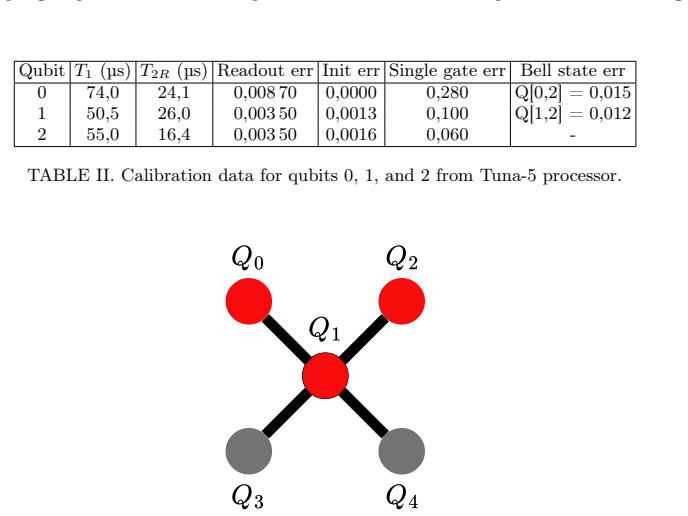
Tuna-5 QuTech Similarly, for the Tuna-5 superconducting processor, we select the first three qubits from its coupling map, as shown in Fig. 5. The corresponding calibration data is provided in Table II. Equivalently to the IBM processor, T2R denotes the Ramsey decoherence time
-
[3]
Ascella QPU Quandela The Ascella calibration does not directly provide noise parameters beyond those related to state initial- ization, specifically photon indistinguishability (HOM) and multi-photon emission probability (g2). The proces- sor architecture is identical to that of our local system shown in Fig.2, but scaled to support 12 optical modes, of w...
-
[4]
C. Taballione, R. van der Meer, H. J. Snijders, P. Hooi- jschuur, J. P. Epping, M. de Goede, B. Kassenberg, P.Venderbosch, C.Toebes, H.vandenVlekkert, P.W.H. Pinkse, and J. J. Renema, A universal fully reconfig- urable 12-mode quantum photonic processor, Materials for Quantum Technology1, 035002 (2021)
work page 2021
-
[5]
M. Liu, R. Shaydulin, P. Niroula, M. DeCross, S.-H. Hung, W. Y. Kon, E. Cervero-Martín, K. Chakraborty, O. Amer, S. Aaronson, A. Acharya, Y. Alexeev, K. J. Berg, S. Chakrabarti, F. J. Curchod, J. M. Dreiling, N. Erickson, C. Foltz, M. Foss-Feig, D. Hayes, T. S. Humble, N. Kumar, J. Larson, D. Lykov, M. Mills, S. A. Moses, B. Neyenhuis, S. Eloul, P. Siegfr...
work page 2025
-
[6]
F. Arute, K. Arya, R. Babbush, D. Bacon, J. C. Bardin, R. Barends, R. Biswas, S. Boixo, F. G. S. L. Brandao, D. A. Buell, B. Burkett, Y. Chen, Z. Chen, B. Chiaro, R. Collins, W. Courtney, A. Dunsworth, E. Farhi, B. Foxen, A. Fowler, C. Gidney, M. Giustina, R. Graff, K. Guerin, S. Habegger, M. P. Harrigan, M. J. Hartmann, A. Ho, M. Hoffmann, T. Huang, T. S...
work page 2019
-
[7]
Bluvstein, S
D. Bluvstein, S. J. Evered, A. A. Geim, S. H. Li, H. Zhou, T. Manovitz, S. Ebadi, M. Cain, M. Kali- nowski, D. Hangleiter, J. P. Bonilla Ataides, N. Maskara, I. Cong, X. Gao, P. Sales Rodriguez, T. Karolyshyn, G. Semeghini, M. J. Gullans, M. Greiner, V. Vuletić, and M. D. Lukin, Logical quantum processor based on reconfigurable atom arrays, Nature626, 58 (2024)
2024
-
[8]
L.S.Madsen, F.Laudenbach, M.F.Askarani, F.Rortais, T. Vincent, J. F. F. Bulmer, F. M. Miatto, L. Neuhaus, L. G. Helt, M. J. Collins, A. E. Lita, T. Gerrits, S. W. Nam, V. D. Vaidya, M. Menotti, I. Dhand, Z. Vernon, N. Quesada, and J. Lavoie, Quantum computational ad- vantage with aprogrammable photonicprocessor,Nature 606, 75 (2022)
work page 2022
Show all 37 references
-
[9]
D. C. McKay, I. Hincks, E. J. Pritchett, M. Car- roll, L. C. G. Govia, and S. T. Merkel, Benchmark- ing quantum processor performance at scale (2023), arXiv:2311.05933 [quant-ph]
2023 arXiv
-
[10]
de Goede, H
M. de Goede, H. Snijders, P. Venderbosch, B. Kassen- berg, N. Kannan, D. H. Smith, C. Taballione, J. P. Ep- ping, H. van den Vlekkert, and J. J. Renema, High fi- delity 12-mode quantum photonic processor operating at ingaasquantumdotwavelength(2022),arXiv:2204.05768 [quant-ph]
2022 arXiv
-
[11]
M. V. Larsen, J. E. Bourassa, S. Kocsis, J. F. Tasker, R. S. Chadwick, C. González-Arciniegas, J. Hastrup, C. E. Lopetegui-González, F. M. Miatto, A. Motamedi, R. Noro, G. Roeland, R. Baby, H. Chen, P. Contu, I. Di Luch, C. Drago, M. Giesbrecht, T. Grainge, I. Krasnokutska, M....
2025
-
[12]
Farhi, J
E. Farhi, J. Goldstone, and S. Gutmann, A quan- tum approximate optimization algorithm (2014), arXiv:1411.4028 [quant-ph]
2014 arXiv
-
[13]
S. Abel, M. Spannowsky, and S. Williams, Simulating quantum field theories on continuous-variable quantum computers, Phys. Rev. A110, 012607 (2024)
2024
-
[14]
K. Beer, D. Bondarenko, T. Farrelly, T. J. Osborne, R. Salzmann, D. Scheiermann, and R. Wolf, Training deep quantum neural networks, Nature Communications 11, 808 (2020)
2020
-
[15]
Jerbi, L
S. Jerbi, L. J. Fiderer, H. Poulsen Nautrup, J. M. Kübler, H. J. Briegel, and V. Dunjko, Quantum machine learning beyond kernel methods, Nature Communications14, 517 (2023)
2023
-
[16]
R. O. Vianna, A. Crespi, R. Ramponi, R. Osellame, L. Sansoni, G. Milani, P. Mataloni, and F. Sciarrino, Variational quantum process tomography of two-qubit maps, Phys. Rev. A87, 032304 (2013)
2013
-
[17]
Tilly, H
J. Tilly, H. Chen, S. Cao, D. Picozzi, K. Setia, Y. Li, E. Grant, L. Wossnig, I. Rungger, G. H. Booth, and J. Tennyson, The variational quantum eigensolver: A re- view of methods and best practices, Physics Reports986, 1–128 (2022)
2022
-
[18]
Landman, S
J. Landman, S. Thabet, C. Dalyac, H. Mhiri, and E. Kashefi, Classically approximating variational quan- tum machine learning with random fourier features (2022), arXiv:2210.13200 [quant-ph]
2022 arXiv
-
[19]
That only means it implements the correct inten- sity distribution on the output when fed with light at the inputs
as it evaluates the unknown unitaries up to a global phase. That only means it implements the correct inten- sity distribution on the output when fed with light at the inputs. As we cannot implement a full unitary with dif- ferent phases on the full chip due to the inactive PS...
-
[20]
Mohseni, A
M. Mohseni, A. T. Rezakhani, and D. A. Lidar, Quantum-process tomography: Resource analysis of dif- ferent strategies, Phys. Rev. A77, 032322 (2008)
2008
-
[21]
Carolan, M
J. Carolan, M. Mohseni, J. P. Olson, M. Prabhu, C. Chen, D. Bunandar, M. Y. Niu, N. C. Harris, F. N. C. Wong, M. Hochberg, S. Lloyd, and D. Englund, Varia- tional quantum unsampling on a quantum photonic pro- cessor, Nature Physics16, 322–327 (2020)
2020
-
[22]
S. Xue, Y. Wang, J. Zhan, Y. Wang, R. Zeng, J. Ding, W. Shi, Y. Liu, Y. Liu, A. Huang, G. Huang, C. Yu, D. Wang, X. Fu, X. Qiang, P. Xu, M. Deng, X. Yang, and J. Wu, Variational entanglement-assisted quantum pro- cess tomography with arbitrary ancillary qubits, Phys. Rev. Lett...
2022
-
[23]
Galetsky, P
V. Galetsky, P. Julià Farré, S. Ghosh, C. Deppe, and R. Ferrara, Optimal depth and a novel approach to vari- ational unitary quantum process tomography, New Jour- nal of Physics26, 073017 (2024)
2024
-
[24]
Vallés-Sanclemente, T
S. Vallés-Sanclemente, T. H. F. Vroomans, T. R. van Ab- swoude, F. Brulleman, T. Stavenga, S. L. M. van der Meer, Y. Xin, A. Lawrence, V. Singh, M. A. Rol, and L. DiCarlo, Optimizing the frequency positioning of tunable couplers in a circuit qed processor to mit- igate spectat...
2025 arXiv
-
[25]
Maring, A
N. Maring, A. Fyrillas, M. Pont, E. Ivanov, P. Stepanov, N. Margaria, W. Hease, A. Pishchagin, A. Lemaître, I. Sagnes, T. H. Au, S. Boissier, E. Bertasi, A. Baert, M. Valdivia, M. Billard, O. Acar, A. Brieussel, R. Mezher, S. C. Wein, A. Salavrakos, P. Sinnott, D. A. Fioretto,...
2024
-
[26]
P. P. Rohde and T. C. Ralph, Error models for mode mismatch in linear optics quantum computing, Physical Review A73, 10.1103/physreva.73.062312 (2006)
2006 doi
-
[27]
D. A. O. Roberts and L. R. Roberts, Qr and lq decom- position matrix backpropagation algorithms for square, wide, and deep – real or complex – matrices and their software implementation (2020), arXiv:2009.10071 [math.NA]
2020 arXiv
-
[28]
J. A. Jones, Controlling nmr spin systems for quantum computation, Progress in Nuclear Magnetic Resonance Spectroscopy 140–141, 49–85 (2024)
2024
-
[29]
J. M. Arrazola, V. Bergholm, K. Brádler, T. R. Brom- ley, M. J. Collins, I. Dhand, A. Fumagalli, T. Gerrits, A. Goussev, L. G. Helt, J. Hundal, T. Isacsson, R. B. Israel, J. Izaac, S. Jahangiri, R. Janik, N. Killoran, S. P. Kumar, J. Lavoie, A. E. Lita, D. H. Mahler, M. Menott...
2021
-
[30]
W. R. Clements, P. C. Humphreys, B. J. Metcalf, W. S. Kolthammer, and I. A. Walmsley, Optimal design for uni- versal multiport interferometers, Optica3, 1460 (2016)
2016
-
[31]
J. J. Moyano-Fernández and J. C. Garcia-Escartin, Lin- ear optics only allows every possible quantum operation for one photon or one port, Optics Communications382, 237 (2017)
2017
-
[32]
J. C. Garcia-Escartin, V. Gimeno, and J. J. Moyano- Fernández, Method to determine which quantum opera- tions can be realized with linear optics with a construc- tive implementation recipe, Phys. Rev. A100, 022301 (2019)
2019
-
[33]
Elmas, I
G. Elmas, I. A. Litvin, P. Kohl, and J. Nötzel, Modeling and analysis of phase instability in a photonic processor, Applied Optics64, 3995 (2025)
2025
-
[34]
Knill, R
E. Knill, R. Laflamme, and G. J. Milburn, A scheme for efficient quantum computation with linear optics, Nature 409, 46 (2001)
2001
-
[35]
P. Kok, W. J. Munro, K. Nemoto, T. C. Ralph, J. P. Dowling, and G. J. Milburn, Linear optical quantum computing with photonic qubits, Rev. Mod. Phys.79, 135 (2007)
2007
-
[36]
J. C. Garcia-Escartin, V. Gimeno, and J. J. Moyano- Fernández, Optimal approximation to unitary quantum operators with linear optics, Quantum Information Pro- cessing 20, 314 (2021)
2021
-
[37]
Skaar, J
J. Skaar, J. C. García Escartín, and H. Lan- dro, Quantum mechanical description of linear optics, American Journal of Physics 72, 1385 (2004), https://pubs.aip.org/aapt/ajp/article- pdf/72/11/1385/7530985/1385_1_online.pdf. 10 FIG. 3. Benchmarking results comparing the local ...
2004
Reviewed August 6, 2026 · model on record in the stance chip above.
Discussion (0). Sign in to comment.