REVIEW 4 major objections 6 minor 1 cited by
BayesTTA: Continual-Temporal Test-Time Adaptation for Vision-Language Models via Gaussian Discriminant Analysis
T0 review · 4 major / 6 minor · reviewed 2026-08-06 · deepseek-v4-flash
Pith's one-line read Modeling each CLIP class as a drifting Gaussian lets a vision-language model adapt to gradual test-time drift without storing data.
desk verdict Real gains on gradual-shift benchmarks, but the 'adaptive' covariance test runs only once at t=1—worth a serious referee, not a desk reject. read the letter →
The pith
A machine-rendered reading of the paper's core claim, the machinery that carries it, and where it could break.
The reading
What carries the argument
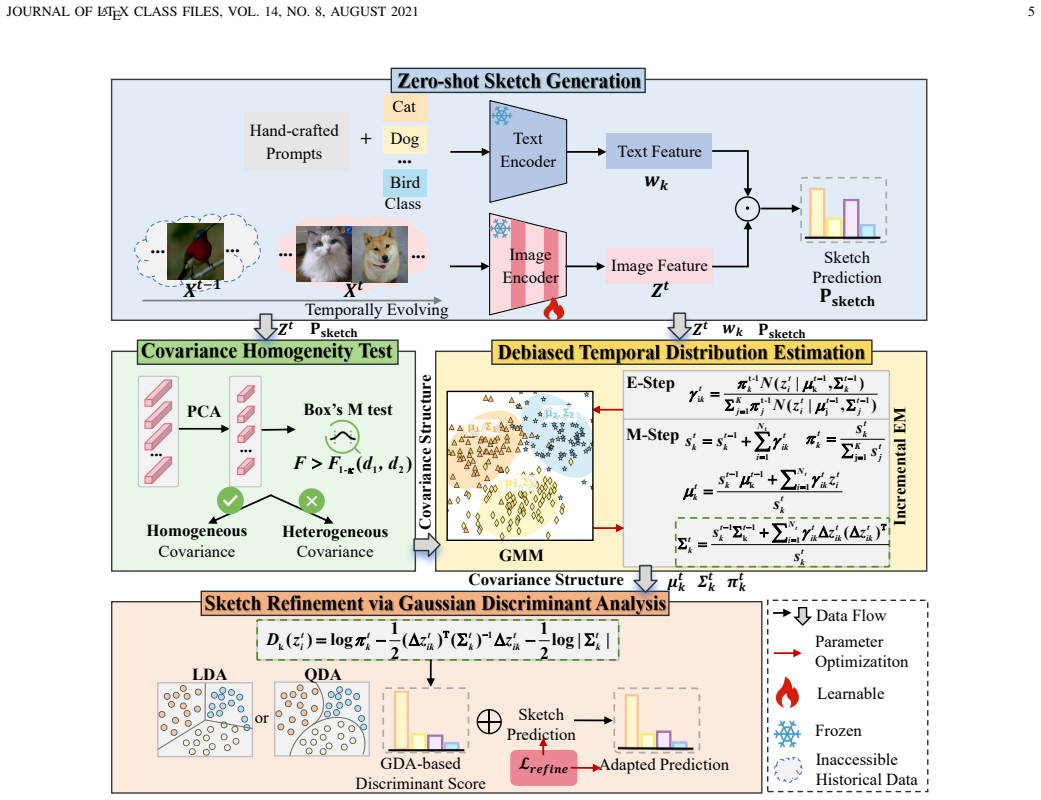
The load-bearing object is the online class-conditional Gaussian mixture on CLIP visual embeddings, $p_t(z\mid Y=k)=\mathcal{N}(\mu_t^k,\Sigma_t^k)$ (Eq. 4), with the GDA posterior $P_t(Y=k\mid z_i^t)\propto \mathcal{N}(z_i^t\mid\mu_t^k,\Sigma_t^k)\pi_t^k$ used for calibration. Incremental EM propagates the sufficient statistics $s_t^k$, $\mu_t^k$, $\Sigma_t^k$, and $\pi_t^k$ (Eqs. 19-24), so historical information survives without memory replay. A PCA-projected, F-corrected Box's M test (Eqs. 10-14) decides homogeneous versus heterogeneous covariance, hence LDA versus QDA discriminant scores (Eq. 25); those are fused with CLIP sketch logits as $\ell^{\text{adapt}}_k(z)=\ell^{\text{sketch}}_k(z)+\alpha D_k(z)$ (Eq. 27). Final pseudo-labels minimize soft cross-entropy (Eq. 29) over normalization-layer parameters only, with EMA smoothing (Eq. 30). The mechanism is that calibrated generative pseudo-labels replace entropy heuristics, sufficient statistics replace caches, and normalization-layer updates replace full-model tuning.
What would settle it
On fMoW and Yearbook, compute per-class CLIP feature embeddings and run a multivariate normality test based on skewness and kurtosis statistics for each temporal domain; if the Gaussian assumption is strongly rejected at many timesteps and BayesTTA still beats cache- and entropy-based baselines by the claimed margins, then the accuracy gains cannot be attributed to the GDA calibration and some other component, such as logit fusion or normalization-layer adaptation, is doing the work. Alternatively, run BayesTTA on a deliberately multimodal test stream, such as CIFAR10-C with interleaved corruption types, where the per-class feature densities are clearly non-Gaussian; a sharp collapse in accuracy would confirm the assumption is load-bearing.
Extended reading notes
Core claim
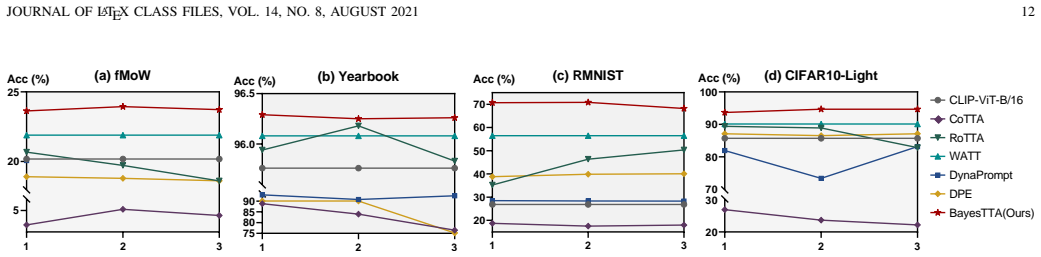
The central claim, stated on the paper's own terms, is that BayesTTA lets a frozen CLIP backbone track a changing test distribution by maintaining a time-varying generative model of its own embeddings. Each class is represented by a Gaussian with a drifting mean and covariance; incremental EM updates the sufficient statistics from each new batch without ever storing image data, which is what preserves long-range memory. A covariance homogeneity test, built on PCA and a regularized Box's M statistic, decides between one shared covariance (LDA) and per-class covariances (QDA), so the model is not locked into the identity-covariance assumption of earlier baselines. The resulting GDA discriminant scores are fused with CLIP's zero-shot text-similarity logits into pseudo-labels, and those pseudo-labels supervise a soft cross-entropy update applied only to LayerNorm or BatchNorm parameters, smoothed by an exponential moving average. The paper reports that this closed loop largely prevents error accumulation and forgetting: on fMoW, Yearbook, RMNIST, and CIFAR10-Light it consistently beats state-of-the-art CTTA and TTA baselines and stays stable across three consecutive long-term adaptation rounds.
Load-bearing premise
BayesTTA's gains rest on the premise that CLIP's visual embeddings for each class are reasonably close to a multivariate Gaussian, so the GDA posterior used to generate pseudo-labels remains calibrated; the paper cites prior support for this but provides no per-dataset normality diagnostics on the hardest domains, fMoW and Yearbook.
Editorial extensions
If this is right
- On gradual-drift streams, cache-based and per-batch-reset adapters should underperform methods that carry long-range sufficient statistics, because memory is the binding constraint.
- Entropy-based confidence is not the only viable supervision signal; a generative posterior fused with zero-shot logits can yield more reliable pseudo-labels under temporal drift.
- A very small parameter footprint (normalization layers only, under 0.05% of ViT-B/16) suffices to realign VLM representations when the supervision is well-calibrated, making online adaptation practical on a single GPU.
- The CT-TTA benchmark with weighted temporal-domain accuracy and multi-round evaluation provides a reproducible way to compare methods on long-horizon drift rather than single abrupt corruption.
- The method's gains on ten standard TTA datasets imply the same Gaussian-mixture and GDA machinery transfers beyond the gradually-evolving setting to ordinary test-time adaptation.
Reading between the lines
- Editorial extension: if the class-conditional Gaussian assumption is the real source of the gains, then datasets whose classes are strongly multimodal should expose it; a direct normality diagnostic on fMoW and Yearbook embeddings would tell whether the mechanism or the fusion is doing the work.
- Editorial extension: because only normalization layers are updated, BayesTTA is complementary to prompt-based adaptation and could be stacked with textual prompt tuning rather than compared against it.
- Editorial extension: the bounded-drift formulation suggests a theoretical route the paper does not take—bounding the regret of incremental EM under a KL drift budget and linking the covariance homogeneity test to model-selection guarantees.
- Editorial extension: a natural testable extension is to apply BayesTTA to sudden-switch sequences such as CIFAR10-C, where the homogeneous or heterogeneous covariance test and the Gaussian assumption are least likely to hold; if it still holds up there, the method is more general than its motivation suggests.
Editorial analysis
A structured set of objections, weighed in public.
Referee Report
Summary. The paper introduces Continual-Temporal Test-Time Adaptation (CT-TTA), a formulation for gradually evolving distribution shifts, and proposes BayesTTA, which models CLIP visual embeddings as class-conditional Gaussians via incremental EM, adaptively selects covariance structures through PCA plus Box's M test, and uses Gaussian discriminant analysis (GDA) to produce pseudo-labels that supervise lightweight updates of normalization layers. The authors construct a CT-TTA benchmark from fMoW, Yearbook, RMNIST, and CIFAR10-Light, and also evaluate on ten standard TTA datasets, reporting consistent gains over prior TTA/CTTA methods and substantially lower inference cost than prompt-tuning baselines.
Significance. If the reported results hold, this is a useful contribution: it formalizes a realistic temporal-drift setting, provides a public benchmark and code, and demonstrates that a lightweight GDA-based adaptation loop can outperform prompt-tuning and cache-based baselines on gradual shifts. The paper is commendable for its breadth of experiments, ablations, and efficiency analysis. The central novelty is the claim of adaptive covariance-structure selection, and that claim is currently undermined by an implementation detail: the covariance homogeneity test is executed only at the first time step. The experimental support would also be substantially stronger with multi-seed error bars, given that the gains on fMoW and Yearbook are small. These issues are fixable within the manuscript's scope.
major comments (4)
- [Algorithm 1, lines 6–8; Section IV-D] The covariance homogeneity test is performed only when t=1 (Algorithm 1, lines 6–8), so the LDA/QDA structure is fixed after the first batch and never re-evaluated as the test distribution evolves. This contradicts the abstract and Section IV-D, which promise that BayesTTA "adaptively selects covariance structures through statistical hypothesis testing" and "aligns its generative assumptions with the empirical structure of incoming test data." The ablation in Table VI shows the test is load-bearing: removing it drops RMNIST accuracy from 75.07% to 17.58% and fMoW from 15.39% to 14.33%. To support the adaptive claim, the test should be re-run periodically or on a sliding window, or the paper must justify why a one-time decision suffices under temporal drift; the authors should also report which covariance structure is selected for each dataset and backbone and show that the decision is stable over time.
- [Section IV-D; Table I] On fMoW, the t=1 decision is made from a single batch of 128 images over 62 classes, i.e., roughly two soft samples per class. Box's M test relies on per-class covariance estimates, and with such small effective sample sizes the test outcome may be unstable or arbitrary even after PCA truncation to d=10. The paper provides no diagnostic for this. Please report per-class effective sample sizes and a sensitivity analysis (e.g., bootstrapping the first batch, varying the significance level κ, or varying the number of PCA components d) to demonstrate that the covariance-structure decision is statistically reliable and that the final accuracies do not hinge on a lucky first batch.
- [Tables I–IV] All main accuracy tables report single-run results without standard deviations or number of seeds. Some of the headline gains are small: on fMoW the improvement over the strongest baseline is +1.81% (ResNet-50) and +1.74% (ViT-B/16), and on Yearbook the gain over WATT is +0.92% (ResNet-50) and +0.21% (ViT-B/16). These margins are within plausible run-to-run noise for online adaptation with SGD and EMA updates. Please report mean±std over at least three seeds for the main CT-TTA comparisons, or specify why the pipeline is fully deterministic and seed-insensitive.
- [Section IV-B, Eq. (4)] The entire pseudo-labeling and adaptation loop rests on the assumption that CLIP visual embeddings follow class-conditional Gaussian mixtures. This assumption is cited from prior work but is not validated for the datasets where the method is claimed to work, especially fMoW and Yearbook, where the domain gap is severe and the Gaussianity premise is least obvious. The paper would be much stronger with per-dataset diagnostics: e.g., multivariate normality tests on a held-out subset, calibration curves of GDA posteriors against oracle labels, or a sensitivity study in which the Gaussian density in Eq. (4) is replaced by a heavier-tailed or nonparametric alternative to show that the gains are not an artifact of the Gaussian assumption.
minor comments (6)
- [Appendix references] The text refers to Appendix A for the derivation of Eq. (25) and Appendix B for dataset summaries and samples, but these appendices are not present in the submitted version; please include them.
- [Eq. (13)] The formula for d2 is ambiguous: "d2 = d1 + 2 λ + ε" could be read as d2 = d1 + 2λ + ε or d2 = d1 + 2/(λ+ε). Please clarify the intended expression, since it directly affects the F-distribution degrees of freedom used in the test.
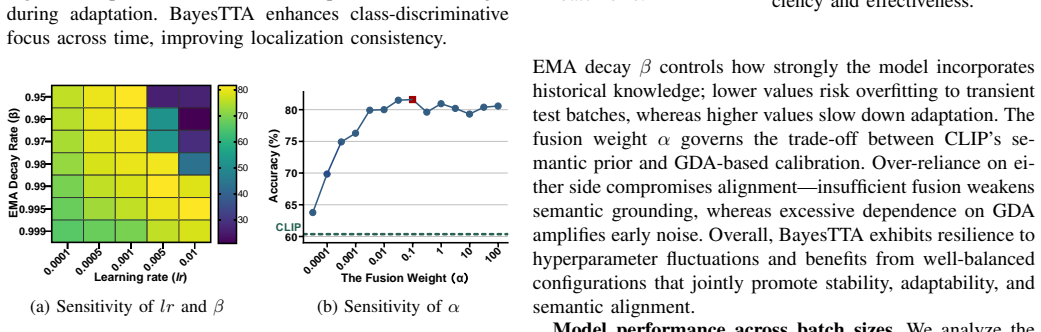
- [Section V-D, Figure 7] The sensitivity analysis covers lr, β, and α, but two key hyperparameters of the covariance homogeneity test, d (number of PCA components) and κ (significance level), are fixed without any ablation. Please add experiments or justify these choices.
- [Section V-A] The experimental protocol does not specify how batches are sampled from each temporal domain (e.g., how many batches per year/angle/light level) and whether the model is evaluated on the same batch it just adapted on; a precise protocol description would improve reproducibility.
- [Table V] Results for DOTA, HisTPT, and BCA are reported "as presented in their original publications"; please confirm that those numbers were obtained with the same backbone, prompt template, batch size, and evaluation protocol used for the other baselines, or note any discrepancies.
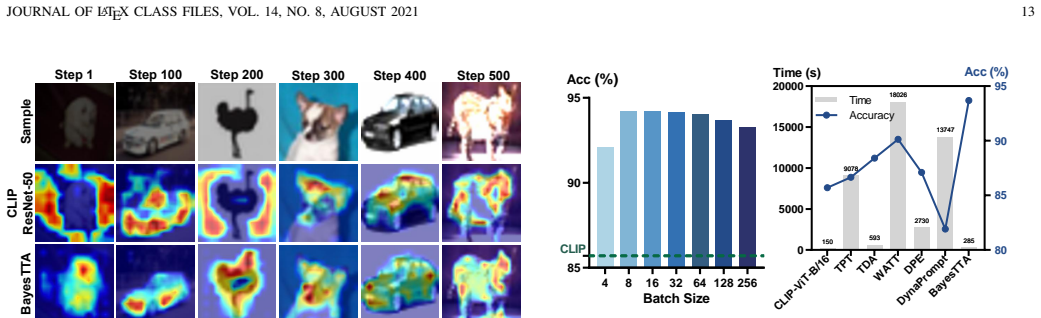
- [Fig. 9] The efficiency comparison mixes batch size 128 for CLIP, WATT, and BayesTTA with batch size 1 for TPT, TDA, DPE, and DynaPrompt; the text acknowledges this, but the "32x faster" claim would be clearer with a per-image or per-epoch cost breakdown in addition to total wall-clock time.
Circularity Check
No significant circularity: the evaluation is external and the central Gaussian-mixture assumption is a stated modeling premise supported by external references, not a self-referential reduction.
full rationale
BayesTTA's central modeling premise is the class-conditional Gaussian assumption (Eq. 4, Sec. IV-B), introduced explicitly as an assumption and supported by external textbook and prior-method citations ([25], [28], [29]); it is not derived from the paper's own outputs. The GDA parameters are estimated online from unlabeled test features via incremental EM with soft responsibilities (Eqs. 18-22), which is a standard self-training loop in test-time adaptation and is not presented as a derivation of ground truth. Final accuracies are measured against held-out labels on fMoW, Yearbook, RMNIST, CIFAR10-Light, and ten standard TTA datasets, so the evaluation is external and not forced by construction. No equation reduces a predicted quantity to a fitted parameter or to a self-citation chain. One implementation detail—Algorithm 1 runs the covariance homogeneity test only at t=1 (lines 6-8)—weakens the claim of adaptive covariance selection and is a legitimate correctness/engineering concern, but it is not a circularity because the test decision is not the quantity being evaluated against ground truth. Accordingly, no step in the derivation chain is equivalent to its own inputs by definition.
Assumptions & free parameters
free parameters (7)
- alpha (fusion weight, Eq. 27) =
not stated; sensitivity analysis on CIFAR10-Light
- lr (learning rate for self-paced optimization) =
not stated; sensitivity around 0.005
- beta (EMA decay rate, Eq. 30) =
not stated; sensitivity around 0.99
- sigma^2_prior (Eq. 23) =
0.1
- epsilon (Eq. 23) =
not stated
- d (number of PCA components, Section IV-D) =
10
- kappa (significance level, Section IV-D) =
0.05
assumptions (5)
- domain assumption Class-conditional visual embeddings follow Gaussian mixture distributions (Eq. 4, Section IV-B).
- domain assumption Bounded KL drift between consecutive test distributions (Eq. 2, Section IV-A).
- standard math Box's M test with F-approximation is valid in the small-sample, high-dimensional PCA subspace.
- domain assumption Online EM converges and tracks non-stationary distributions under gradual drift (Section IV-E).
- ad hoc to paper PCA truncation to d=10 components preserves the class-discriminative structure needed for GDA.
Cite this review
Pith. "Pith review of BayesTTA: Continual-Temporal Test-Time Adaptation for Vision-Language Models via Gaussian Discriminant Analysis." pith.science (2026). https://pith.science/paper/OECYDTR5
@misc{pith2026250708607,
  author       = {Pith},
  title        = {Pith review of: BayesTTA: Continual-Temporal Test-Time Adaptation for Vision-Language Models via Gaussian Discriminant Analysis},
  year         = {2026},
  howpublished = {\url{https://pith.science/paper/OECYDTR5}},
  note         = {Machine review of arXiv:2507.08607}
}
read the original abstract
Vision-language models (VLMs) such as CLIP achieve strong zero-shot recognition but degrade significantly under \textit{temporally evolving distribution shifts} common in real-world scenarios (e.g., gradual illumination or seasonal changes). Existing continual test-time adaptation (CTTA) methods are typically built around sudden and severe distribution shifts and neglect temporal continuity, leading to three core defects: limited memory cache restricts long-range distribution modeling, causing catastrophic forgetting; entropy-based confidence becomes unreliable under temporal drift, worsening error accumulation; and static visual representations misalign with evolving inputs. We formalize this practical problem as \textit{Continual-Temporal Test-Time Adaptation (CT-TTA)}, where test distributions evolve gradually over time. To address it, we propose \textit{BayesTTA}, a Bayesian adaptation framework that enforces temporally consistent predictions and dynamically aligns visual representations. Specifically, BayesTTA incrementally estimates class-conditional Gaussian mixture distributions without storing raw data, adaptively selects covariance structures through statistical hypothesis testing, and performs calibrated inference using Gaussian discriminant analysis (GDA). These calibrated predictions supervise self-paced adaptation of normalization layers, ensuring efficient and stable representation alignment. We establish a comprehensive CT-TTA benchmark across four temporally evolving datasets and further evaluate generalization on ten standard TTA datasets. Extensive experiments show that BayesTTA consistently outperforms state-of-the-art methods, achieving significant gains while maintaining efficiency. Code is available at \href{https://github.com/cuishuang99/BayesTTA}{https://github.com/cuishuang99/BayesTTA}.
Figures


Figures from the paper (4 more)
Forward citations
Cited by 1 Pith paper
-
Adapting Vision-Language Models Without Labels: A Comprehensive Survey
A survey that organizes unsupervised vision-language model adaptation by unlabeled-data availability into four paradigms: data-free transfer, domain transfer, episodic test-time, and online test-time adaptation.
Reference graph
Works this paper leans on
-
[1]
Learning transferable visual models from natural language supervision,
A. Radford, J. W. Kim, C. Hallacy, A. Ramesh, G. Goh, S. Agarwal, G. Sastry, A. Askell, P. Mishkin, J. Clark et al., “Learning transferable visual models from natural language supervision,” in International conference on machine learning . PMLR, 2021, pp. 8748–8763
2021
-
[2]
Scaling up visual and vision-language representation learning with noisy text supervision,
C. Jia, Y . Yang, Y . Xia, Y .-T. Chen, Z. Parekh, H. Pham, Q. Le, Y .-H. Sung, Z. Li, and T. Duerig, “Scaling up visual and vision-language representation learning with noisy text supervision,” in International conference on machine learning . PMLR, 2021, pp. 4904–4916
2021
-
[3]
Laion-400m: Open dataset of clip-filtered 400 million image-text pairs,
C. Schuhmann, R. Vencu, R. Beaumont, R. Kaczmarczyk, C. Mullis, A. Katta, T. Coombes, J. Jitsev, and A. Komatsuzaki, “Laion-400m: Open dataset of clip-filtered 400 million image-text pairs,”arXiv preprint arXiv:2111.02114, 2021
arXiv 2021
-
[4]
Laion- 5b: An open large-scale dataset for training next generation image-text models,
C. Schuhmann, R. Beaumont, R. Vencu, C. Gordon, R. Wightman, M. Cherti, T. Coombes, A. Katta, C. Mullis, M. Wortsmanet al., “Laion- 5b: An open large-scale dataset for training next generation image-text models,” Advances in Neural Information Processing Systems , vol. 35, pp. 25 278–25 294, 2022
2022
-
[5]
Learning to prompt for vision- language models,
K. Zhou, J. Yang, C. C. Loy, and Z. Liu, “Learning to prompt for vision- language models,” International Journal of Computer Vision , vol. 130, no. 9, pp. 2337–2348, 2022
2022
-
[6]
Vision-language models for vision tasks: A survey,
J. Zhang, J. Huang, S. Jin, and S. Lu, “Vision-language models for vision tasks: A survey,” IEEE Transactions on Pattern Analysis and Machine Intelligence, 2024
2024
-
[7]
Tent: Fully test-time adaptation by entropy minimization,
D. Wang, E. Shelhamer, S. Liu, B. Olshausen, and T. Darrell, “Tent: Fully test-time adaptation by entropy minimization,” in International Conference on Learning Representations , 2021
2021
-
[8]
Continual test-time domain adaptation,
Q. Wang, O. Fink, L. Van Gool, and D. Dai, “Continual test-time domain adaptation,” in Proceedings of the IEEE/CVF Conference on Computer Vision and Pattern Recognition , 2022, pp. 7201–7211
work page 2022
Show all 86 references
-
[9]
Towards stable test-time adaptation in dynamic wild world,
S. Niu, J. Wu, Y . Zhang, Z. Wen, Y . Chen, P. Zhao, and M. Tan, “Towards stable test-time adaptation in dynamic wild world,” in The Eleventh International Conference on Learning Representations , 2023
2023
-
[10]
Robust test-time adaptation in dynamic scenarios,
L. Yuan, B. Xie, and S. Li, “Robust test-time adaptation in dynamic scenarios,” in Proceedings of the IEEE/CVF Conference on Computer Vision and Pattern Recognition , 2023, pp. 15 922–15 932
2023
-
[11]
Uncertainty-calibrated test-time model adaptation without forgetting,
M. Tan, G. Chen, J. Wu, Y . Zhang, Y . Chen, P. Zhao, and S. Niu, “Uncertainty-calibrated test-time model adaptation without forgetting,” IEEE Transactions on Pattern Analysis and Machine Intelligence , 2025
2025
-
[12]
A comprehensive survey on test-time adaptation under distribution shifts,
J. Liang, R. He, and T. Tan, “A comprehensive survey on test-time adaptation under distribution shifts,” International Journal of Computer Vision, vol. 133, no. 1, pp. 31–64, 2025
2025
-
[13]
Historical test- time prompt tuning for vision foundation models,
J. Zhang, J. Huang, X. Zhang, L. Shao, and S. Lu, “Historical test- time prompt tuning for vision foundation models,” in The Thirty-eighth Annual Conference on Neural Information Processing Systems , 2024
2024
-
[14]
Dynaprompt: Dynamic test-time prompt tuning,
Z. Xiao, S. Yan, J. Hong, J. Cai, X. Jiang, Y . Hu, J. Shen, C. Wang, and C. G. M. Snoek, “Dynaprompt: Dynamic test-time prompt tuning,” in The Thirteenth International Conference on Learning Representations , 2025
2025
-
[15]
Benchmarking neural network ro- bustness to common corruptions and perturbations,
D. Hendrycks and T. Dietterich, “Benchmarking neural network ro- bustness to common corruptions and perturbations,” in International Conference on Learning Representations , 2019
2019
-
[16]
Chemical gas sensor drift compensation using classifier ensembles,
A. Vergara, S. Vembu, T. Ayhan, M. A. Ryan, M. L. Homer, and R. Huerta, “Chemical gas sensor drift compensation using classifier ensembles,” Sensors and Actuators B: Chemical , vol. 166, pp. 320–329, 2012
2012
-
[17]
Continuous manifold based adaptation for evolving visual domains,
J. Hoffman, T. Darrell, and K. Saenko, “Continuous manifold based adaptation for evolving visual domains,” in Proceedings of the IEEE conference on computer vision and pattern recognition , 2014, pp. 867– 874
2014
-
[18]
Wild- time: A benchmark of in-the-wild distribution shift over time,
H. Yao, C. Choi, B. Cao, Y . Lee, P. W. W. Koh, and C. Finn, “Wild- time: A benchmark of in-the-wild distribution shift over time,” Advances in Neural Information Processing Systems , vol. 35, pp. 10 309–10 324, 2022
2022
-
[19]
Evolving standardization for continual domain generalization over temporal drift,
M. Xie, S. Li, L. Yuan, C. Liu, and Z. Dai, “Evolving standardization for continual domain generalization over temporal drift,” Advances in Neural Information Processing Systems , vol. 36, pp. 21 983–22 002, 2023
2023
-
[20]
Foresee what you will learn: data augmentation for domain generalization in non- stationary environment,
Q. Zeng, W. Wang, F. Zhou, C. Ling, and B. Wang, “Foresee what you will learn: data augmentation for domain generalization in non- stationary environment,” in Proceedings of the AAAI conference on artificial intelligence, vol. 37, no. 9, 2023, pp. 11 147–11 155
2023
-
[21]
E. O. Brigham, The fast Fourier transform and its applications . Prentice-Hall, Inc., 1988
1988
-
[22]
Learning multiple layers of features from tiny images,
A. Krizhevsky, G. Hinton et al. , “Learning multiple layers of features from tiny images,” Citeseer, Toronto, ON, Canada, Technical Report, 2009
2009
-
[23]
Efficient test-time adaptation of vision-language models,
A. Karmanov, D. Guan, S. Lu, A. El Saddik, and E. Xing, “Efficient test-time adaptation of vision-language models,” in Proceedings of the IEEE/CVF Conference on Computer Vision and Pattern Recognition , 2024, pp. 14 162–14 171
2024
-
[24]
Hastie, R
T. Hastie, R. Tibshirani, and J. Friedman, The Elements of Statistical Learning: Data Mining, Inference, and Prediction , 2nd ed. Springer, 2009
2009
-
[25]
C. M. Bishop and N. M. Nasrabadi, Pattern recognition and machine learning. Springer, 2006, vol. 4, no. 4. JOURNAL OF LATEX CLASS FILES, VOL. 14, NO. 8, AUGUST 2021 15
2006
-
[26]
I. T. Jolliffe, Principal component analysis for special types of data . Springer, 2002
2002
-
[27]
A general distribution theory for a class of likelihood criteria,
G. E. Box, “A general distribution theory for a class of likelihood criteria,” Biometrika, vol. 36, no. 3/4, pp. 317–346, 1949
1949
-
[28]
A hard- to-beat baseline for training-free clip-based adaptation,
Z. Wang, J. Liang, L. Sheng, R. He, Z. Wang, and T. Tan, “A hard- to-beat baseline for training-free clip-based adaptation,” in The Twelfth International Conference on Learning Representations , 2024
2024
-
[29]
Dota: Distributional test-time adaptation of vision-language models,
Z. Han, J. Yang, J. Li, Q. Hu, Q. Xu, M. Z. Shou, and C. Zhang, “Dota: Distributional test-time adaptation of vision-language models,” arXiv preprint arXiv:2409.19375 , 2024
2024
-
[30]
Free on the fly: Enhancing flexibility in test-time adaptation with online em,
Q. Dai and S. Yang, “Free on the fly: Enhancing flexibility in test-time adaptation with online em,” in Proceedings of the Computer Vision and Pattern Recognition Conference, 2025, pp. 9538–9548
2025
-
[31]
Cris: Clip-driven referring image segmentation,
Z. Wang, Y . Lu, Q. Li, X. Tao, Y . Guo, M. Gong, and T. Liu, “Cris: Clip-driven referring image segmentation,” in Proceedings of the IEEE/CVF conference on computer vision and pattern recognition, 2022, pp. 11 686–11 695
2022
-
[32]
Zegclip: Towards adapting clip for zero-shot semantic segmentation,
Z. Zhou, Y . Lei, B. Zhang, L. Liu, and Y . Liu, “Zegclip: Towards adapting clip for zero-shot semantic segmentation,” in Proceedings of the IEEE/CVF Conference on Computer Vision and Pattern Recognition, 2023, pp. 11 175–11 185
2023
-
[33]
Actionclip: Adapting language-image pretrained models for video action recognition,
M. Wang, J. Xing, J. Mei, Y . Liu, and Y . Jiang, “Actionclip: Adapting language-image pretrained models for video action recognition,” IEEE Transactions on Neural Networks and Learning Systems , 2023
2023
-
[34]
Clip-guided prototype modulating for few-shot action recognition,
X. Wang, S. Zhang, J. Cen, C. Gao, Y . Zhang, D. Zhao, and N. Sang, “Clip-guided prototype modulating for few-shot action recognition,” International Journal of Computer Vision , vol. 132, no. 6, pp. 1899– 1912, 2024
1912
-
[35]
Conditional prompt learning for vision-language models,
K. Zhou, J. Yang, C. C. Loy, and Z. Liu, “Conditional prompt learning for vision-language models,” in Proceedings of the IEEE/CVF Confer- ence on Computer Vision and Pattern Recognition (CVPR) , June 2022, pp. 16 816–16 825
2022
-
[36]
Maple: Multi-modal prompt learning,
M. U. Khattak, H. Rasheed, M. Maaz, S. Khan, and F. S. Khan, “Maple: Multi-modal prompt learning,” in Proceedings of the IEEE/CVF conference on computer vision and pattern recognition , 2023, pp. 19 113–19 122
2023
-
[37]
Clip-adapter: Better vision-language models with feature adapters,
P. Gao, S. Geng, R. Zhang, T. Ma, R. Fang, Y . Zhang, H. Li, and Y . Qiao, “Clip-adapter: Better vision-language models with feature adapters,” International Journal of Computer Vision , vol. 132, no. 2, pp. 581–595, 2024
2024
-
[38]
Tip-adapter: Training-free adaption of clip for few-shot classification,
R. Zhang, W. Zhang, R. Fang, P. Gao, K. Li, J. Dai, Y . Qiao, and H. Li, “Tip-adapter: Training-free adaption of clip for few-shot classification,” in European conference on computer vision . Springer, 2022, pp. 493– 510
2022
-
[39]
Delta: Degradation-free fully test- time adaptation,
B. Zhao, C. Chen, and S.-T. Xia, “Delta: Degradation-free fully test- time adaptation,” in The Eleventh International Conference on Learning Representations, 2022
2022
-
[40]
Memo: Test time robustness via adaptation and augmentation,
M. Zhang, S. Levine, and C. Finn, “Memo: Test time robustness via adaptation and augmentation,” Advances in Neural Information Processing Systems, vol. 35, pp. 38 629–38 642, 2022
2022
-
[41]
Ef- ficient test-time model adaptation without forgetting,
S. Niu, J. Wu, Y . Zhang, Y . Chen, S. Zheng, P. Zhao, and M. Tan, “Ef- ficient test-time model adaptation without forgetting,” in International conference on machine learning . PMLR, 2022, pp. 16 888–16 905
2022
-
[42]
Domainadaptor: A novel approach to test-time adaptation,
J. Zhang, L. Qi, Y . Shi, and Y . Gao, “Domainadaptor: A novel approach to test-time adaptation,” in Proceedings of the IEEE/CVF International Conference on Computer Vision , 2023, pp. 18 971–18 981
2023
-
[43]
Test time adaptation for blind image quality assessment,
S. Roy, S. Mitra, S. Biswas, and R. Soundararajan, “Test time adaptation for blind image quality assessment,” in Proceedings of the IEEE/CVF International Conference on Computer Vision, 2023, pp. 16 742–16 751
2023
-
[44]
Entropy is not enough for test-time adaptation: From the perspective of disentangled factors,
J. Lee, D. Jung, S. Lee, J. Park, J. Shin, U. Hwang, and S. Yoon, “Entropy is not enough for test-time adaptation: From the perspective of disentangled factors,” in The Twelfth International Conference on Learning Representations, 2024
2024
-
[45]
Test-time prompt tuning for zero-shot generalization in vision-language models,
M. Shu, W. Nie, D.-A. Huang, Z. Yu, T. Goldstein, A. Anandkumar, and C. Xiao, “Test-time prompt tuning for zero-shot generalization in vision-language models,” Advances in Neural Information Processing Systems, vol. 35, pp. 14 274–14 289, 2022
2022
-
[46]
Robust test-time adaptation for zero-shot prompt tuning,
D.-C. Zhang, Z. Zhou, and Y .-F. Li, “Robust test-time adaptation for zero-shot prompt tuning,” in Proceedings of the AAAI Conference on Artificial Intelligence, vol. 38, no. 15, 2024, pp. 16 714–16 722
2024
-
[47]
Towards robustness prompt tuning with fully test-time adaptation for clip’s zero-shot generalization,
R. Wang, H. Zuo, Z. Fang, and J. Lu, “Towards robustness prompt tuning with fully test-time adaptation for clip’s zero-shot generalization,” in Proceedings of the 32nd ACM International Conference on Multimedia , 2024, pp. 8604–8612
2024
-
[48]
W ATT: Weight average test time adaptation of CLIP,
D. OSOWIECHI, M. Noori, G. A. V . Hakim, M. Yazdanpanah, A. Bahri, M. Cheraghalikhani, S. Dastani, F. Beizaee, I. B. Ayed, and C. Desrosiers, “W ATT: Weight average test time adaptation of CLIP,” in The Thirty-eighth Annual Conference on Neural Information Processing Systems, 2024
2024
-
[49]
Dual prototype evolving for test-time generalization of vision-language models,
C. Zhang, S. Stepputtis, K. Sycara, and Y . Xie, “Dual prototype evolving for test-time generalization of vision-language models,” Advances in Neural Information Processing Systems , vol. 37, pp. 32 111–32 136, 2024
2024
-
[50]
Bayesian test-time adaptation for vision-language models,
L. Zhou, M. Ye, S. Li, N. Li, X. Zhu, L. Deng, H. Liu, and Z. Lei, “Bayesian test-time adaptation for vision-language models,” in Proceed- ings of the Computer Vision and Pattern Recognition Conference , 2025, pp. 29 999–30 009
2025
-
[51]
Robust mean teacher for continual and gradual test-time adaptation,
M. D ¨obler, R. A. Marsden, and B. Yang, “Robust mean teacher for continual and gradual test-time adaptation,” in Proceedings of the IEEE/CVF Conference on Computer Vision and Pattern Recognition , 2023, pp. 7704–7714
2023
-
[52]
Decorate the newcomers: Visual domain prompt for continual test time adaptation,
Y . Gan, Y . Bai, Y . Lou, X. Ma, R. Zhang, N. Shi, and L. Luo, “Decorate the newcomers: Visual domain prompt for continual test time adaptation,” in Proceedings of the AAAI Conference on Artificial Intelligence, vol. 37, no. 6, 2023, pp. 7595–7603
2023
-
[53]
Ecotta: Memory-efficient continual test-time adaptation via self-distilled regularization,
J. Song, J. Lee, I. S. Kweon, and S. Choi, “Ecotta: Memory-efficient continual test-time adaptation via self-distilled regularization,” in Pro- ceedings of the IEEE/CVF Conference on Computer Vision and Pattern Recognition, 2023, pp. 11 920–11 929
2023
-
[54]
ViDA: Homeostatic visual domain adapter for continual test time adaptation,
J. Liu, S. Yang, P. Jia, R. Zhang, M. Lu, Y . Guo, W. Xue, and S. Zhang, “ViDA: Homeostatic visual domain adapter for continual test time adaptation,” in The Twelfth International Conference on Learning Representations, 2024
2024
-
[55]
Dynamic domains, dynamic solutions: Dpcore for continual test-time adaptation,
Y . Zhang, A. Mehra, and J. Hamm, “Dynamic domains, dynamic solutions: Dpcore for continual test-time adaptation,” arXiv preprint arXiv:2406.10737, 2024
2024 arXiv
-
[56]
Training for the future: A simple gradient interpolation loss to generalize along time,
A. Nasery, S. Thakur, V . Piratla, A. De, and S. Sarawagi, “Training for the future: A simple gradient interpolation loss to generalize along time,” Advances in Neural Information Processing Systems , vol. 34, pp. 19 198–19 209, 2021
2021
-
[57]
Temporal domain generalization with drift-aware dynamic neural networks,
G. Bai, C. Ling, and L. Zhao, “Temporal domain generalization with drift-aware dynamic neural networks,” in The Eleventh International Conference on Learning Representations , 2023
2023
-
[58]
Generalizing to evolving domains with latent structure-aware sequential autoencoder,
T. Qin, S. Wang, and H. Li, “Generalizing to evolving domains with latent structure-aware sequential autoencoder,” in International Confer- ence on Machine Learning . PMLR, 2022, pp. 18 062–18 082
2022
-
[59]
Enhancing evolving domain generalization through dynamic latent representations,
B. Xie, Y . Chen, J. Wang, K. Zhou, B. Han, W. Meng, and J. Cheng, “Enhancing evolving domain generalization through dynamic latent representations,” in Proceedings of the AAAI Conference on Artificial Intelligence, vol. 38, no. 14, 2024, pp. 16 040–16 048
2024
-
[60]
Latent trajectory learning for limited timestamps under distribution shift over time,
Q. Zeng, C. Shui, L.-K. Huang, P. Liu, X. Chen, C. Ling, and B. Wang, “Latent trajectory learning for limited timestamps under distribution shift over time,” in The Twelfth International Conference on Learning Representations, 2024
2024
-
[61]
Weight diffusion for future: Learn to generalize in non-stationary environments,
M. Xie, S. Li, B. Xie, C. Liu, J. Liang, Z. Sun, K. Feng, and C. Zhu, “Weight diffusion for future: Learn to generalize in non-stationary environments,” Advances in Neural Information Processing Systems , vol. 37, pp. 6367–6392, 2024
2024
-
[62]
Kullback, Information theory and statistics
S. Kullback, Information theory and statistics . Courier Corporation, 1997
1997
-
[63]
An extension of box’s results on the use of the f distribution in multivariate analysis,
S. Geisser and S. W. Greenhouse, “An extension of box’s results on the use of the f distribution in multivariate analysis,” The Annals of Mathematical Statistics, pp. 885–891, 1958
1958
-
[64]
On-line expectation–maximization algo- rithm for latent data models,
O. Capp ´e and E. Moulines, “On-line expectation–maximization algo- rithm for latent data models,” Journal of the Royal Statistical Society Series B: Statistical Methodology , vol. 71, no. 3, pp. 593–613, 2009
2009
-
[65]
A generalized inverse for matrices,
R. Penrose, “A generalized inverse for matrices,” in Mathematical proceedings of the Cambridge philosophical society , vol. 51, no. 3. Cambridge University Press, 1955, pp. 406–413
1955
-
[66]
Layer normalization,
J. L. Ba, J. R. Kiros, and G. E. Hinton, “Layer normalization,” arXiv preprint arXiv:1607.06450, 2016
2016 arXiv
-
[67]
Batch normalization: Accelerating deep network training by reducing internal covariate shift,
S. Ioffe and C. Szegedy, “Batch normalization: Accelerating deep network training by reducing internal covariate shift,” in International conference on machine learning . pmlr, 2015, pp. 448–456
2015
-
[68]
Acceleration of stochastic approxima- tion by averaging,
B. T. Polyak and A. B. Juditsky, “Acceleration of stochastic approxima- tion by averaging,” SIAM journal on control and optimization , vol. 30, no. 4, pp. 838–855, 1992
1992
-
[69]
A century of portraits: A visual historical record of american high school yearbooks,
S. Ginosar, K. Rakelly, S. Sachs, B. Yin, and A. A. Efros, “A century of portraits: A visual historical record of american high school yearbooks,” in Proceedings of the IEEE International Conference on Computer Vision Workshops, 2015, pp. 1–7
2015
-
[70]
The mnist database of handwritten digit images for machine learning research [best of the web],
L. Deng, “The mnist database of handwritten digit images for machine learning research [best of the web],” IEEE signal processing magazine , vol. 29, no. 6, pp. 141–142, 2012. JOURNAL OF LATEX CLASS FILES, VOL. 14, NO. 8, AUGUST 2021 16
2012
-
[71]
Fine- grained visual classification of aircraft,
S. Maji, E. Rahtu, J. Kannala, M. Blaschko, and A. Vedaldi, “Fine- grained visual classification of aircraft,” arXiv preprint arXiv:1306.5151, 2013
2013 arXiv
-
[72]
Learning generative visual models from few training examples: An incremental bayesian approach tested on 101 object categories,
L. Fei-Fei, R. Fergus, and P. Perona, “Learning generative visual models from few training examples: An incremental bayesian approach tested on 101 object categories,” in 2004 conference on computer vision and pattern recognition workshop . IEEE, 2004, pp. 178–178
2004
-
[73]
3d object representations for fine-grained categorization,
J. Krause, M. Stark, J. Deng, and L. Fei-Fei, “3d object representations for fine-grained categorization,” in Proceedings of the IEEE interna- tional conference on computer vision workshops , 2013, pp. 554–561
2013
-
[74]
Describing textures in the wild,
M. Cimpoi, S. Maji, I. Kokkinos, S. Mohamed, and A. Vedaldi, “Describing textures in the wild,” in Proceedings of the IEEE conference on computer vision and pattern recognition , 2014, pp. 3606–3613
2014
-
[75]
Eurosat: A novel dataset and deep learning benchmark for land use and land cover classi- fication,
P. Helber, B. Bischke, A. Dengel, and D. Borth, “Eurosat: A novel dataset and deep learning benchmark for land use and land cover classi- fication,” IEEE Journal of Selected Topics in Applied Earth Observations and Remote Sensing , vol. 12, no. 7, pp. 2217–2226, 2019
2019
-
[76]
Automated flower classification over a large number of classes,
M.-E. Nilsback and A. Zisserman, “Automated flower classification over a large number of classes,” in 2008 Sixth Indian conference on computer vision, graphics & image processing . IEEE, 2008, pp. 722–729
2008
-
[77]
Food-101–mining discriminative components with random forests,
L. Bossard, M. Guillaumin, and L. Van Gool, “Food-101–mining discriminative components with random forests,” in Computer vision– ECCV 2014: 13th European conference, zurich, Switzerland, September 6-12, 2014, proceedings, part VI 13 . Springer, 2014, pp. 446–461
2014
-
[78]
Cats and dogs,
O. M. Parkhi, A. Vedaldi, A. Zisserman, and C. Jawahar, “Cats and dogs,” in 2012 IEEE conference on computer vision and pattern recog- nition. IEEE, 2012, pp. 3498–3505
2012
-
[79]
Sun database: Large-scale scene recognition from abbey to zoo,
J. Xiao, J. Hays, K. A. Ehinger, A. Oliva, and A. Torralba, “Sun database: Large-scale scene recognition from abbey to zoo,” in 2010 IEEE computer society conference on computer vision and pattern recognition. IEEE, 2010, pp. 3485–3492
2010
-
[80]
Ucf101: A dataset of 101 human actions classes from videos in the wild,
K. Soomro, A. R. Zamir, and M. Shah, “Ucf101: A dataset of 101 human actions classes from videos in the wild,”arXiv preprint arXiv:1212.0402, 2012
2012 arXiv
-
[81]
Deep residual learning for image recognition,
K. He, X. Zhang, S. Ren, and J. Sun, “Deep residual learning for image recognition,” in Proceedings of the IEEE conference on computer vision and pattern recognition , 2016, pp. 770–778
2016
-
[82]
An image is worth 16x16 words: Transformers for image recognition at scale,
A. Dosovitskiy, L. Beyer, A. Kolesnikov, D. Weissenborn, X. Zhai, T. Unterthiner, M. Dehghani, M. Minderer, G. Heigold, S. Gelly et al., “An image is worth 16x16 words: Transformers for image recognition at scale,” in International Conference on Learning Representations , 2021
2021
-
[83]
Attention is all you need,
A. Vaswani, N. Shazeer, N. Parmar, J. Uszkoreit, L. Jones, A. N. Gomez, Ł. Kaiser, and I. Polosukhin, “Attention is all you need,” Advances in Neural Information Processing Systems , vol. 30, 2017
2017
-
[84]
Visualizing data using t-sne
L. Van der Maaten and G. Hinton, “Visualizing data using t-sne.” Journal of machine learning research , vol. 9, no. 11, 2008
2008
-
[85]
Grad-cam: Visual explanations from deep networks via gradient-based localization,
R. R. Selvaraju, M. Cogswell, A. Das, R. Vedantam, D. Parikh, and D. Batra, “Grad-cam: Visual explanations from deep networks via gradient-based localization,” in Proceedings of the IEEE international conference on computer vision , 2017, pp. 618–626. Shuang Cui received the B...
2017
-
[2013]
With extensive experience in optical simulation calculations and optical software devel- opment, she has actively engaged in research and development in this field
She currently holds the position of vice pro- fessor at the Institute of Software, Chinese Academy of Sciences. With extensive experience in optical simulation calculations and optical software devel- opment, she has actively engaged in research and development in this field. ...
2013
Reviewed August 6, 2026 · model on record in the stance chip above.
Discussion (0). Sign in to comment.