REVIEW 4 major objections 4 minor 51 references
Learning human-to-robot handovers through 3D scene reconstruction
T0 review · 4 major / 4 minor · reviewed 2026-08-06 · deepseek-v4-flash
Pith's one-line read A robot can learn handovers from a metric-scale Gaussian Splatting scene, with no real-robot training or data collection.
desk verdict A plausible pipeline for training handover policies on rendered Gaussian Splatting views, but the evaluation overstates certainty: metric-scale transfer is unvalidated and real-robot trial counts are missing. read the letter →
The pith
A machine-rendered reading of the paper's core claim, the machinery that carries it, and where it could break.
The reading
What carries the argument
The load-bearing object is a metric-scale sparse-view Gaussian Splatting scene with a virtual hand-eye camera. Gaussian Splatting is an explicit radiance-field representation whose 3D Gaussians are splatted and alpha-blended into photorealistic images; initializing the reconstruction from depth maps fixes the point cloud to metric scale, so camera translations inside the scene correspond to gripper translations on the robot. The pipeline renders $(I, M, T, Cls)$ demonstration tuples along sampled trajectories from initial poses to a pre-grasp pose, then supervises a policy network to predict the next pose transformation and the pre-grasp decision from the RGB image and masks.
What would settle it
Measure the reconstruction's metric-scale error by comparing a known distance in the rendered point cloud with its real measured length, then deploy the policy on the real robot; a scale error of a few percent should shift the predicted pre-grasp pose so the gripper consistently stops short of or beyond the object. Alternatively, training the same pipeline without depth-initialized scale should make the deployed policy fail, because the action labels would no longer correspond to real gripper motion.
Extended reading notes
Core claim
On the paper's own terms, the central discovery is that human-to-robot handover can be formulated as a supervised image-to-action problem whose training set is produced entirely inside a sparse-view Gaussian Splatting reconstruction. The authors show that initializing the reconstruction from depth maps fixes the point cloud to metric scale, so the 6-DOF pose changes of a virtual hand-eye camera in the reconstructed scene are equivalent to the gripper pose changes of a real robot. Grasp poses are chosen with a 6-DOF grasp generator on the object point cloud, then trajectory sampling produces reach-to-pregrasp demonstrations; each training tuple contains the rendered hand-eye image, hand-object masks, the next camera transformation, and a pregrasp label. A policy network trained with MSE on these tuples is reported to reach the pregrasp pose at about 0.4 meters from the object in simulation and to complete real handovers with higher success and safety than a mask-centroid visual servoing baseline, including objects not seen in training.
Load-bearing premise
The assumption is that a Gaussian Splatting scene built from a few RGB-D views is accurate and metric enough that its rendered hand-eye images and pose shifts are a faithful proxy for what the real gripper camera will see and do, even in a different environment and with objects not used in training.
Editorial extensions
If this is right
- Training a handover policy for a new object or workspace reduces to capturing a small set of RGB-D views and rendering demonstrations, with no real-robot trials, resets, or safety supervision.
- Because action labels come from known camera poses in a metric scene, the policy is trained with direct supervision instead of reward shaping or sim-to-real domain adaptation.
- At deployment the policy needs only a hand-eye RGB image and hand-object masks; no calibration information is required.
- The real-robot experiments show higher grasp success and safety than a mask-centroid visual servoing baseline on household objects, including objects not seen during training.
Reading between the lines
- I infer the same pipeline transfers to other reaching-and-grasping tasks: any goal expressible as a target end-effector pose in a metric Gaussian Splatting scene could generate its own image-action demonstrations, so pick-and-place or tool-use policies might be trained with zero real-robot data using the same recipe.
- The method's ceiling is set by reconstruction and mask quality: transparent, reflective, or deformable objects and moving hands would need more views or dynamic scene modeling, and poor inference-time masks would degrade the policy even when rendering is good.
- A testable extension is to randomize lighting, background, and Gaussian attributes during rendering, effectively adding domain randomization inside the reconstructed scene to improve robustness to novel real environments.
Editorial analysis
A structured set of objections, weighed in public.
Referee Report
Summary. Secs. I-III propose H2RH-SGS, a supervised policy-learning pipeline for human-to-robot handovers that avoids real-robot training data. A sparse-view Gaussian Splatting scene is reconstructed from RGB-D images of a human holding an object; a grasp pose is selected from GraspNet on annotated point clouds; scripted camera trajectories from sampled initial poses to a pre-grasp pose (s = 0.3 m, Eq. 7) are used to render hand-eye images and masks; a policy is trained to predict incremental SE(3) transformations and a pre-grasp classification. Sec. IV evaluates the policy in the reconstructed scene and on a UR5 with a Robotiq gripper, comparing against an IBVS baseline.
Significance. If the transfer claim is established, this is a useful step toward learning manipulation policies from high-fidelity reconstructed scenes without real-robot exploration, and the inclusion of real-robot experiments and a public code/video release is a strength. The paper is careful to include a hand-safety filter in grasp selection and reports both success and safety. However, the central 'direct deployment' claim is currently supported by tables with substantial reporting gaps: the simulation success band conflicts with several reported means, and the real-robot comparisons lack trial counts. These issues must be resolved before the result is fully convincing.
major comments (4)
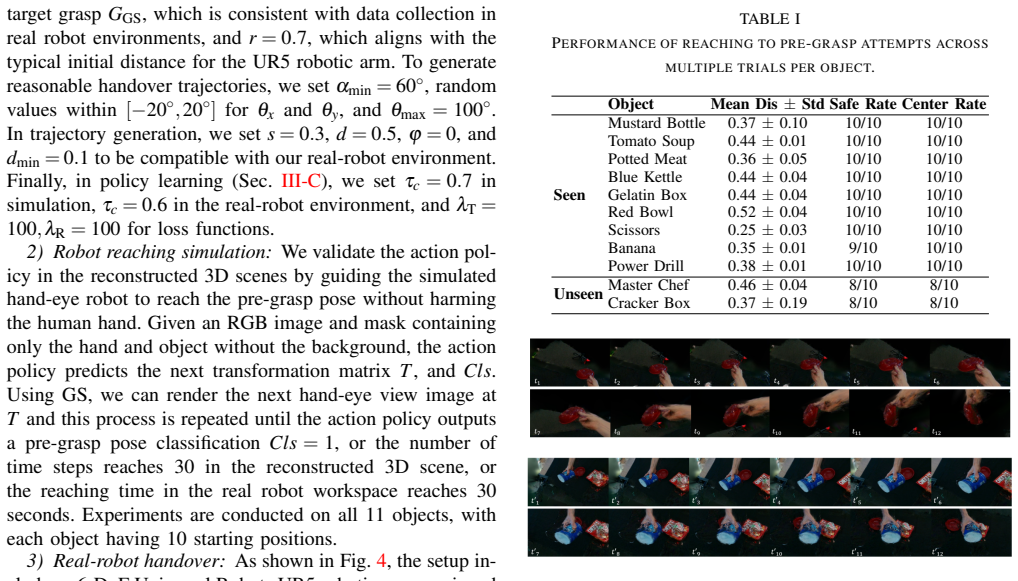
- [IV-B1, Table I] The simulation success criterion is stated as maintaining a distance to the object between 0.35 and 0.45 m, yet several reported mean distances fall outside this band: Scissors 0.25 ± 0.03, Red Bowl 0.52 ± 0.04, Master Chef 0.46 ± 0.04, and Tomato Soup 0.44 ± 0.01 is at the boundary. These rows nevertheless report 10/10 or 8/10 safe and center rates. Please clarify how a trial can satisfy the success band while the mean distance is outside it, and report the distance-based success rate separately. In addition, because the demonstrations are generated by the scripted trajectory of Sec. III-B that always terminates at s = 0.3 (Eq. 7), high simulation scores are partly expected; the simulation evaluation should include a quantitative test of generalization to initial poses and object configurations not produced by the same script.
- [IV-A3, Table II] Table II reports success and safety rates as real numbers without any trial count. The text says six test objects, but the table contains seven columns; please reconcile. To make the central deployment result statistically interpretable, specify the number of trials per object and per participant/position, and report confidence intervals or exact counts (e.g., 0.93 = 14/15). Without this, the comparison with IBVS-MASK cannot be evaluated.
- [III-A] The direct-deployment claim rests on the statement in Sec. III-A that depth-initialized point clouds make the reconstruction metric-scale, so camera transformations in the reconstructed scene translate directly to real gripper transformations. No quantitative validation of the reconstruction is provided: no scale error, depth error, or novel-view rendering accuracy on the actual scenes. Please report these numbers and show that the error is small relative to the pre-grasp offset s = 0.3 (Eq. 7). A bias of a few centimeters in reconstruction scale would shift the learned distance-to-action mapping and could explain discrepancies in Table I.
- [Abstract, III-A] The claim of learning 'solely from RGB images' conflicts with the method description: Sec. III-A states the input is sparse-view RGB-D images and uses depth maps to initialize metric-scale point clouds, and the training pipeline uses annotated object/hand point clouds and masks. Clarify what inputs are used for training versus deployment, and whether 'no real-robot data collection' excludes the use of pre-existing RGB-D human handover datasets with annotations.
minor comments (4)
- [Section II] The sentence 'Hence, they do guarantee human safety during robotic grasping' appears to be a typo and should read 'do not guarantee'; as written it contradicts the surrounding argument.
- [III-B, Eq. (2)] Subtracting a mean position from an SE(3) pose is not well-defined; please specify the coordinate frames and define the operation as a translation in the scene frame.
- [III-B, Eq. (12)] The update rule for Rupdate is not defined; please provide the explicit formula or remove the equation.
- [IV-C (policy learning)] The policy network architecture, optimizer, training epochs, and data-set sizes (number of demonstrations and image-action pairs) are not described; please add these details for reproducibility.
Circularity Check
No significant circularity: the central transfer claim is grounded by external real-robot experiments; the simulation check is a self-consistency test rather than a reduced prediction.
full rationale
The training pipeline fits the policy to rendered image-action pairs whose target transformations are generated from scripted trajectories (Eqs. 7-13), and the simulation success band (0.35-0.45 m) is close to the designed pre-grasp offset (s=0.3 m), so the simulation experiment is best read as a self-consistency check rather than an independent prediction. This does not make the derivation circular, because no parameter of the policy is fitted to that success band or to the real-robot outcomes, and the paper's load-bearing claim is the direct real-robot deployment, which is evaluated against an external IBVS-MASK baseline in Table II. The metric-scale premise in Sec. III-A, where depth-initialized point clouds replace the non-metric COLMAP initialization, is not quantitatively validated and is a correctness risk, not a circular step: the claim that 'the transformations of the camera in the reconstructed scene can be directly translated to the robot gripper transformations' is an input assumption, not an output re-derived from the policy. Table II also reports success rates without trial counts, which is a reporting limitation but not circularity. The self-citations (OHPL [17], RL-GSBridge [14]) appear only in related-work comparisons and do not supply any load-bearing premise. Consequently, no specific equation or fitted parameter can be exhibited as a prediction that reduces by construction to its inputs.
Assumptions & free parameters
free parameters (12)
- pre-grasp distance s =
0.3 m
- phase-2 distance threshold d =
0.5 m
- initial pose sampling radius r =
0.7 m
- opposite-side angle alpha_min =
60 deg
- maximum pose angle theta_max =
100 deg
- grasp safety threshold d_s =
0.1 m
- gripper clearance d_min =
0.1 m
- pre-grasp classification threshold tau_c =
0.7 sim, 0.6 real
- loss weights lambda_T and lambda_R =
100 and 100
- number of sampled initial poses k =
15
- random angular offset for theta_x and theta_y =
[-20, +20] deg
- orientation alignment threshold phi =
0 deg
assumptions (6)
- domain assumption FSGS reconstructs a metric-scale, photorealistic Gaussian Splatting scene from sparse-view RGB-D images.
- domain assumption Virtual camera pose changes in the reconstructed scene translate directly to real gripper pose changes.
- domain assumption Rendered hand-eye images plus hand/object masks are a sufficient proxy for real hand-eye camera images and masks at inference.
- domain assumption Annotated point clouds of the object and hand are available for grasp generation.
- domain assumption A pre-grasp pose defined 30 cm along the grasp z-axis is a sufficient intermediate goal for safe grasping.
- standard math Linear interpolation and SLERP produce physically reasonable robot trajectories.
Cite this review
Pith. "Pith review of Learning human-to-robot handovers through 3D scene reconstruction." pith.science (2026). https://pith.science/paper/QQ7U4GVW
@misc{pith2026250708726,
  author       = {Pith},
  title        = {Pith review of: Learning human-to-robot handovers through 3D scene reconstruction},
  year         = {2026},
  howpublished = {\url{https://pith.science/paper/QQ7U4GVW}},
  note         = {Machine review of arXiv:2507.08726}
}
read the original abstract
Learning robot manipulation policies from raw, real-world image data requires a large number of robot-action trials in the physical environment. Although training using simulations offers a cost-effective alternative, the visual domain gap between simulation and robot workspace remains a major limitation. Gaussian Splatting visual reconstruction methods have recently provided new directions for robot manipulation by generating realistic environments. In this paper, we propose the first method for learning supervised-based robot handovers solely from RGB images without the need of real-robot training or real-robot data collection. The proposed policy learner, Human-to-Robot Handover using Sparse-View Gaussian Splatting (H2RH-SGS), leverages sparse-view Gaussian Splatting reconstruction of human-to-robot handover scenes to generate robot demonstrations containing image-action pairs captured with a camera mounted on the robot gripper. As a result, the simulated camera pose changes in the reconstructed scene can be directly translated into gripper pose changes. We train a robot policy on demonstrations collected with 16 household objects and {\em directly} deploy this policy in the real environment. Experiments in both Gaussian Splatting reconstructed scene and real-world human-to-robot handover experiments demonstrate that H2RH-SGS serves as a new and effective representation for the human-to-robot handover task.
Figures


Figures from the paper (3 more)


Reference graph
Works this paper leans on
-
[1]
DROID: A large-scale in-the-wild robot manipulation dataset,
A. Khazatsky, K. Pertsch, S. Nair, A. Balakrishna, S. Dasari, S. Karam- cheti, S. Nasiriany, M. K. Srirama, L. Y . Chen, K. Ellis, et al. , “DROID: A large-scale in-the-wild robot manipulation dataset,” 2024, arXiv:2403.129457 [cs.RO]
arXiv 2024
-
[2]
A survey of sim-to-real methods in RL: Progress, prospects and challenges with foundation models,
L. Da, J. Turnau, T. P. Kutralingam, A. Velasquez, P. Shakarian, and H. Wei, “A survey of sim-to-real methods in RL: Progress, prospects and challenges with foundation models,” 2025, arXiv:2502.13187 [cs.LG]
arXiv 2025
-
[4]
Sim-to-real robot learning from pixels with progressive nets,
A. A. Rusu, M. Ve ˇcer´ık, T. Roth ¨orl, N. Heess, R. Pascanu, and R. Hadsell, “Sim-to-real robot learning from pixels with progressive nets,” in Conf. Robot Learning , 2017
work page 2017
-
[5]
S. James, P. Wohlhart, M. Kalakrishnan, D. Kalashnikov, A. Irpan, J. Ibarz, S. Levine, R. Hadsell, and K. Bousmalis, “Sim-to-real via sim- to-sim: Data-efficient robotic grasping via randomized-to-canonical adaptation networks,” in Conf. Comput. Vis. Pattern Recognit. , 2019
work page 2019
-
[6]
D. Lowd and C. Meek, “Adversarial learning,” in Proc. ACM SIGKDD Int. Conf. Knowl. Discov. Data Min. , 2005
work page 2005
-
[7]
Progressive feature alignment for unsupervised domain adaptation,
C. Chen, W. Xie, W. Huang, Y . Rong, X. Ding, Y . Huang, T. Xu, and J. Huang, “Progressive feature alignment for unsupervised domain adaptation,” in Conf. Comput. Vis. Pattern Recognit. , 2019
work page 2019
-
[8]
RL-CycleGAN: Reinforcement learning aware simulation-to-real,
K. Rao, C. Harris, A. Irpan, S. Levine, J. Ibarz, and M. Khansari, “RL-CycleGAN: Reinforcement learning aware simulation-to-real,” in Conf. Comput. Vis. Pattern Recognit. , 2020
work page 2020
-
[9]
Unpaired image-to-image translation using cycle-consistent adversarial networks,
J.-Y . Zhu, T. Park, P. Isola, and A. A. Efros, “Unpaired image-to-image translation using cycle-consistent adversarial networks,” in Int. Conf. Comput. Vis., 2017
work page 2017
Show all 51 references
-
[10]
CyCADA: Cycle-consistent adversarial domain adaptation,
J. Hoffman, E. Tzeng, T. Park, J.-Y . Zhu, P. Isola, K. Saenko, A. Efros, and T. Darrell, “CyCADA: Cycle-consistent adversarial domain adaptation,” in Proc. Int. Conf. Machine Learning , 2018
2018
-
[11]
Learning to read braille: Bridging the tactile reality gap with diffusion models,
C. Higuera, B. Boots, and M. Mukadam, “Learning to read braille: Bridging the tactile reality gap with diffusion models,” 2023, arXiv:2304.01182 [cs.RO]
2023 arXiv
-
[12]
Sim2real bilevel adaptation for object surface classification using vision-based tactile sensors,
G. M. Caddeo, A. Maracani, P. D. Alfano, N. A. Piga, L. Rosasco, and L. Natale, “Sim2real bilevel adaptation for object surface classification using vision-based tactile sensors,” in IEEE Int. Conf. Robotics Autom., 2024
2024
-
[13]
Crossing the reality gap: A survey on sim-to-real transferability of robot controllers in reinforcement learning,
E. Salvato, G. Fenu, E. Medvet, and F. A. Pellegrino, “Crossing the reality gap: A survey on sim-to-real transferability of robot controllers in reinforcement learning,” IEEE Access, vol. 9, pp. 153 171–153 187, 2021
2021
-
[14]
RL-GSBridge: 3d gaussian splatting based real2sim2real method for robotic manipulation learning,
Y . Wu, L. Pan, W. Wu, G. Wang, Y . Miao, F. Xu, and H. Wang, “RL-GSBridge: 3d gaussian splatting based real2sim2real method for robotic manipulation learning,” 2024, arXiv:2409.20291 [cs.RO]
2024 arXiv
-
[15]
NeRF2Real: Sim2real transfer of vision-guided bipedal motion skills using neural radiance fields,
A. Byravan, J. Humplik, L. Hasenclever, A. Brussee, F. Nori, T. Haarnoja, B. Moran, S. Bohez, F. Sadeghi, B. Vujatovic, et al. , “NeRF2Real: Sim2real transfer of vision-guided bipedal motion skills using neural radiance fields,” in IEEE Int. Conf. Robotics Autom. , 2023
2023
-
[16]
Learning to see by moving,
P. Agrawal, J. Carreira, and J. Malik, “Learning to see by moving,” in Int. Conf. Comput. Vis. , 2015
2015
-
[17]
OHPL: One-shot hand-eye policy learner,
C. Oh, Y . L. Pang, and A. Cavallaro, “OHPL: One-shot hand-eye policy learner,” in IEEE/RSJ Int. Conf. Intell. Robot Syst. , 2021
2021
-
[18]
HandoverSim: A simulation framework and benchmark for human-to-robot object handovers,
Y .-W. Chao, C. Paxton, Y . Xiang, W. Yang, B. Sundaralingam, T. Chen, A. Murali, M. Cakmak, and D. Fox, “HandoverSim: A simulation framework and benchmark for human-to-robot object handovers,” in IEEE Int. Conf. Robotics Autom. , 2022
2022
-
[19]
Learning human-to-robot handovers from point clouds,
S. Christen, W. Yang, C. P ´erez-D’Arpino, O. Hilliges, D. Fox, and Y .-W. Chao, “Learning human-to-robot handovers from point clouds,” in Conf. Comput. Vis. Pattern Recognit. , 2023
2023
-
[20]
GenH2R: Learning generalizable human-to-robot handover via scalable simu- lation demonstration and imitation,
Z. Wang, J. Chen, Z. Chen, P. Xie, R. Chen, and L. Yi, “GenH2R: Learning generalizable human-to-robot handover via scalable simu- lation demonstration and imitation,” in Conf. Comput. Vis. Pattern Recognit., 2024
2024
-
[21]
DNGaussian: Optimizing sparse-view 3d gaussian radiance fields with global-local depth normalization,
J. Li, J. Zhang, X. Bai, J. Zheng, X. Ning, J. Zhou, and L. Gu, “DNGaussian: Optimizing sparse-view 3d gaussian radiance fields with global-local depth normalization,” in Conf. Comput. Vis. Pattern Recognit., 2024
2024
-
[22]
CoherentGS: Sparse novel view synthesis with coherent 3d gaussians,
A. Paliwal, W. Ye, J. Xiong, D. Kotovenko, R. Ranjan, V . Chandra, and N. K. Kalantari, “CoherentGS: Sparse novel view synthesis with coherent 3d gaussians,” in Eur . Conf. Comput. Vis., 2024
2024
-
[23]
FSGS: Real-time few-shot view synthesis using gaussian splatting,
Z. Zhu, Z. Fan, Y . Jiang, and Z. Wang, “FSGS: Real-time few-shot view synthesis using gaussian splatting,” in Eur . Conf. Comput. Vis. , 2024
2024
-
[24]
MVPGS: Excavating multi-view priors for gaussian splatting from sparse input views,
W. Xu, H. Gao, S. Shen, R. Peng, J. Jiao, and R. Wang, “MVPGS: Excavating multi-view priors for gaussian splatting from sparse input views,” in Eur . Conf. Comput. Vis., 2024
2024
-
[25]
3d gaussian splatting for real-time radiance field rendering
B. Kerbl, G. Kopanas, T. Leimk ¨uhler, and G. Drettakis, “3d gaussian splatting for real-time radiance field rendering.” ACM Trans. Graph. , vol. 42, no. 4, 2023
2023
-
[26]
ManiGaussian: Dynamic gaussian splatting for multi-task robotic manipulation,
G. Lu, S. Zhang, Z. Wang, C. Liu, J. Lu, and Y . Tang, “ManiGaussian: Dynamic gaussian splatting for multi-task robotic manipulation,” in Eur . Conf. Comput. Vis., 2024
2024
-
[27]
GraspSplat: Efficient manipulation with 3d feature splatting,
M. Ji, R.-Z. Qiu, X. Zou, and X. Wang, “GraspSplat: Efficient manipulation with 3d feature splatting,” in Proc. Int. Conf. Robot Learning, 2024
2024
-
[28]
Splat-MOVER: Multi-stage, open- vocabulary robotic manipulation via editable gaussian splatting,
O. Shorinwa, J. Tucker, A. Smith, A. Swann, T. Chen, R. Firoozi, M. Kennedy III, and M. Schwager, “Splat-MOVER: Multi-stage, open- vocabulary robotic manipulation via editable gaussian splatting,” in Proc. Int. Conf. Robot Learning , 2024
2024
-
[29]
Splat-Nav: Safe real-time robot naviga- tion in gaussian splatting maps,
T. Chen, O. Shorinwa, J. Bruno, A. Swann, J. Yu, W. Zeng, K. Nagami, P. Dames, and M. Schwager, “Splat-Nav: Safe real-time robot naviga- tion in gaussian splatting maps,” IEEE Trans. Robotics , 2025
2025
-
[30]
What matters in on-policy reinforcement learning? a large-scale empirical study,
M. Andrychowicz, A. Raichuk, P. Sta ´nczyk, M. Orsini, S. Girgin, R. Marinier, L. Hussenot, M. Geist, O. Pietquin, M. Michalski, et al., “What matters in on-policy reinforcement learning? a large-scale empirical study,” 2020, arXiv:2006.05990 [cs.LG]
2020 arXiv
-
[31]
End-to-end reinforcement learning for time-optimal quadcopter flight,
R. Ferede, C. De Wagter, D. Izzo, and G. C. De Croon, “End-to-end reinforcement learning for time-optimal quadcopter flight,” in IEEE Int. Conf. Robotics Autom. , 2024
2024
-
[32]
Scalable deep reinforcement learning for vision-based robotic manipulation,
D. Kalashnikov, A. Irpan, P. Pastor, J. Ibarz, A. Herzog, E. Jang, D. Quillen, E. Holly, M. Kalakrishnan, V . Vanhoucke,et al., “Scalable deep reinforcement learning for vision-based robotic manipulation,” in Conf. Robot Learning , 2018
2018
-
[33]
Soft actor-critic: Off- policy maximum entropy deep reinforcement learning with a stochastic actor,
T. Haarnoja, A. Zhou, P. Abbeel, and S. Levine, “Soft actor-critic: Off- policy maximum entropy deep reinforcement learning with a stochastic actor,” in Proc. Int. Conf. Machine Learning , 2018
2018
-
[34]
Closing the sim-to-real loop: Adapting simulation randomization with real world experience,
Y . Chebotar, A. Handa, V . Makoviychuk, M. Macklin, J. Issac, N. Ratliff, and D. Fox, “Closing the sim-to-real loop: Adapting simulation randomization with real world experience,” in IEEE Int. Conf. Robotics Autom. , 2019
2019
-
[35]
Domain randomization for transferring deep neural networks from simulation to the real world,
J. Tobin, R. Fong, A. Ray, J. Schneider, W. Zaremba, and P. Abbeel, “Domain randomization for transferring deep neural networks from simulation to the real world,” in IEEE/RSJ Int. Conf. Intell. Robot Syst., 2017
2017
-
[36]
Sim-to- real transfer of robotic control with dynamics randomization,
X. B. Peng, M. Andrychowicz, W. Zaremba, and P. Abbeel, “Sim-to- real transfer of robotic control with dynamics randomization,” in IEEE Int. Conf. Robotics Autom. , 2018
2018
-
[37]
Generative adversarial imitation learning,
J. Ho and S. Ermon, “Generative adversarial imitation learning,” in Adv. Neural Inf. Process. Syst. , 2016
2016
-
[38]
Deep imitation learning for bimanual robotic manipulation,
F. Xie, A. Chowdhury, M. De Paolis Kaluza, L. Zhao, L. Wong, and R. Yu, “Deep imitation learning for bimanual robotic manipulation,” in Adv. Neural Inf. Process. Syst. , 2020
2020
-
[39]
Algorithms for inverse reinforcement learning
A. Y . Ng, S. Russell, et al. , “Algorithms for inverse reinforcement learning.” in Proc. Int. Conf. Machine Learning , 2000
2000
-
[40]
Neural inverse reinforcement learning in autonomous navigation,
C. Xia and A. El Kamel, “Neural inverse reinforcement learning in autonomous navigation,” Robot. Auton. Syst. , vol. 84, pp. 1–14, 2016
2016
-
[41]
Recent advances in robot learning from demonstration,
H. Ravichandar, A. S. Polydoros, S. Chernova, and A. Billard, “Recent advances in robot learning from demonstration,” Annual Review of Control, Robotics, and Autonomous Systems , vol. 3, no. 1, pp. 297– 330, 2020
2020
-
[42]
Trail: Near-optimal imitation learning with suboptimal data,
M. Yang, S. Levine, and O. Nachum, “Trail: Near-optimal imitation learning with suboptimal data,” 2021, arXiv:2110.1477 [cs.LG]
2021
-
[43]
Cross-domain imitation learning via optimal transport,
A. Fickinger, S. Cohen, S. Russell, and B. Amos, “Cross-domain imitation learning via optimal transport,” 2021, arXiv:2110.03684 [cs.LG]
2021
-
[44]
Learning hand-eye coordination for robotic grasping with deep learning and large-scale data collection,
S. Levine, P. Pastor, A. Krizhevsky, J. Ibarz, and D. Quillen, “Learning hand-eye coordination for robotic grasping with deep learning and large-scale data collection,” Int. J. Robot. Res. , vol. 37, no. 4-5, pp. 421–436, 2018
2018
-
[45]
Generalization through hand-eye coordination: An action space for learning spatially-invariant visuomotor control,
C. Wang, R. Wang, A. Mandlekar, L. Fei-Fei, S. Savarese, and D. Xu, “Generalization through hand-eye coordination: An action space for learning spatially-invariant visuomotor control,” in IEEE/RSJ Int. Conf. Intell. Robot Syst. , 2021
2021
-
[46]
ARCap: Collecting high-quality human demonstrations for robot learning with augmented reality feedback,
S. Chen, C. Wang, K. Nguyen, L. Fei-Fei, and C. K. Liu, “ARCap: Collecting high-quality human demonstrations for robot learning with augmented reality feedback,” 2024, arXiv:2410.08464 [cs.RO]
2024 arXiv
-
[47]
6-DOF GraspNet: Variational grasp generation for object manipulation,
A. Mousavian, C. Eppner, and D. Fox, “6-DOF GraspNet: Variational grasp generation for object manipulation,” in Int. Conf. Comput. Vis. , 2019
2019
-
[48]
Understanding human hands in contact at internet scale,
D. Shan, J. Geng, M. Shu, and D. F. Fouhey, “Understanding human hands in contact at internet scale,” in Conf. Comput. Vis. Pattern Recognit., 2020
2020
-
[49]
Fast segment anything,
X. Zhao, W. Ding, Y . An, Y . Du, T. Yu, M. Li, M. Tang, and J. Wang, “Fast segment anything,” arXiv preprint arXiv:2306.12156 , 2023
2023 arXiv
-
[50]
FrankMocap: A monocular 3d whole-body pose estimation system via regression and integration,
Y . Rong, T. Shiratori, and H. Joo, “FrankMocap: A monocular 3d whole-body pose estimation system via regression and integration,” in Int. Conf. Comput. Vis. , 2021
2021
-
[51]
VTON-HandFit: Virtual try-on for arbitrary hand pose guided by hand priors embedding,
Y . Liang, X. Hu, B. Jiang, D. Luo, K. Wu, W. Han, T. Jin, and C. Wang, “VTON-HandFit: Virtual try-on for arbitrary hand pose guided by hand priors embedding,” 2024, arXiv:2408.12340 [cs.CV]
2024 arXiv
-
[52]
Cosmos world foundation model platform for physical AI,
N. Agarwal, A. Ali, M. Bala, Y . Balaji, E. Barker, T. Cai, P. Chat- topadhyay, Y . Chen, Y . Cui, Y . Ding,et al., “Cosmos world foundation model platform for physical AI,” 2025, arXiv:2501.03575v2 [cs.CV]
2025 arXiv
Reviewed August 6, 2026 · model on record in the stance chip above.
Discussion (0). Sign in to comment.