REVIEW 6 minor 64 references
Routing Quantum Control of Causal Order
T0 review · 0 major / 6 minor · reviewed 2026-08-06 · deepseek-v4-flash
Pith's one-line read This paper proves that every quantum circuit with quantum control of causal order can be obtained by fleshing out one generic routed graph per number of parties, giving all QC-QCs a routed circuit decomposition.
desk verdict This paper delivers a real structural result—every N-slot QC-QC has a routed circuit decomposition from one generic graph—and the proof is detailed enough to check; the main caveat is inherited reliance on the routed-circuit framework's central theorem. read the letter →
The pith
A machine-rendered reading of the paper's core claim, the machinery that carries it, and where it could break.
The reading
What carries the argument
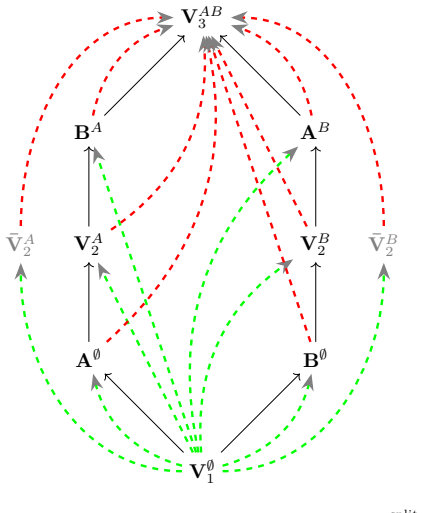
The load-bearing object is the generic routed graph $G_{\mathrm{QC-QC}}(N)$ of Definition 4.2: a directed graph whose nodes are the $N$ agent slots $A_k$ and the $N+1$ internal-operation slots $V_{n+1}$, with arrows labelled by index values $X^k_n$ that are either a subset $K_n$ of agents containing $k$ or the null value. A route at each node is a relation constraining which index combinations may pass through that node, and the global index constraints require that a consistent assignment encodes one full ordering of the agents. The argument then shows the graph is valid, meaning bi-univocal with no non-weak loops in its branch graph, so the routed-circuit framework's main theorem certifies that its skeletal supermap is a routed superunitary. Fleshing out means filling each slot with a compatible routed operation; the paper's specific fleshing out uses isomorphisms $J^{\mathrm{in/out}}$ to translate between the graph's sectorised wires and the QC-QC's systems, and then plugs in the internal isometries and one-slot agent supermaps.
What would settle it
Take a specific $N$-slot QC-QC specified by its internal isometries, compute the Choi vector obtained by the paper's fleshing out of $G_{\mathrm{QC-QC}}(N)$ with those isometries, and compare it with the QC-QC process vector computed directly from the definition; a single mismatch would disprove Theorem 4.1. A more pointed test is the appendix's Zurich process for $N=4$, which the paper shows cannot be represented by the compact internal-node-free graph, so checking whether the full generic graph does represent it exercises exactly the part of the claim that goes beyond earlier examples.
Extended reading notes
Core claim
The paper's central claim is Theorem 4.1: any $N$-slot quantum circuit with quantum control of causal order (QC-QC) can be implemented by fleshing out the skeletal supermap associated with the generic routed graph $G_{\mathrm{QC-QC}}(N)$. The graph has two kinds of nodes, agent slots $A_k$ and internal isometry slots $V_{n+1}$, and its arrows carry index values $X^k_n$ that record which subset of agents has already acted and which agent acts at time $n$. The routes at the nodes enforce that each agent acts exactly once and exactly one agent acts per time slot. The paper shows this graph is bi-univocal and its branch graph has no loops, so the routed-circuit framework's main theorem applies and the skeletal supermap is a routed superunitary. The authors then give explicit isomorphisms that insert the QC-QC's internal isometries and agent operations into the slots and compose the resulting Choi vectors with the link product, recovering exactly the QC-QC process vector; tracing out a final ancillary system extends the argument to mixed QC-QCs.
Load-bearing premise
The load-bearing premise is the routed-circuit framework's guarantee that a graph satisfying its validity conditions, namely bi-univocality and only harmless loops, yields a valid quantum process; the paper relies on that guarantee, and on the standard decomposition of a QC-QC into internal isometries, without reproving either.
Editorial extensions
If this is right
- Every pure $N$-slot QC-QC, not just previously studied examples, acquires a routed circuit decomposition based on the single graph $G_{\mathrm{QC-QC}}(N)$.
- Mixed QC-QCs are covered too: tracing out a final ancillary subsystem of the global future space turns the pure construction into the mixed process matrix.
- The validity of $G_{\mathrm{QC-QC}}(N)$ independently certifies, through the routed-circuit framework, that QC-QCs are legitimate quantum processes.
- The alternative graphs obtained by splitting and merging nodes recover the earlier routed decompositions of the quantum switch and the Grenoble process as special cases of the generic construction.
- For more than three parties, the fully compact representation without internal V-nodes is generally impossible, so the generic graph is not just a convenience but a necessary level of description.
Reading between the lines
- If the theorem holds, the subclass structure of QC-QCs, such as superpositions of fixed orders, classical control, and non-influenceable causal orders, could be read off as additional index constraints on the same routed graph, a programme the paper sketches but does not complete.
- Combined with the belief that QC-QCs exhaust the processes realisable in a fixed spacetime, the result lends support to the conjecture that every such process has a routed circuit decomposition from a valid routed graph.
- The index bookkeeping in $G_{\mathrm{QC-QC}}(N)$ suggests a design test for proposed causal-control processes: a structure is routable if its causal bookkeeping can be encoded as index constraints on a valid routed graph, which may help in searching for new indefinite-causal-order processes.
Editorial analysis
A structured set of objections, weighed in public.
Referee Report
Summary. The manuscript connects the routed quantum circuit framework of Vanrietvelde et al. with the QC-QC framework of Wechs et al. It proposes, for each N, a generic routed graph G_QC-QC(N) and proves that every N-slot QC-QC, pure or mixed, can be obtained by fleshing out the associated skeletal supermap. Sections 2 and 3 review both frameworks; Section 4 gives the construction, proves bi-univocality, checks that the branch graph is loop-free, and computes the Choi vector of the fleshed-out supermap, showing that it equals the QC-QC process vector. Section 5 discusses alternative routed graph descriptions, including recovery of earlier decompositions of the quantum switch and the Grenoble process. Appendices A-D contain the detailed calculations behind the main construction.
Significance. If the central result holds, this is a substantial step: it upgrades the routed circuit framework from a handful of examples to the entire QC-QC class, and it provides a concrete template for studying subclasses and open problems. The proof is constructive and largely self-contained, with explicit derivations of the choice function (Appendix A), branch graph acyclicity (Section 4.2), and the equivalence of the fleshed-out circuit to |w_QC-QC> (Appendix B). No fitted parameters or circular assumptions are involved. The main residual risk is the reliance on the external validity theorem (Theorem 2.23 of Ref. [39]) for the routed-graph-to-routed-superunitary step; the direct equality in Eq. (4.34) provides independent evidence for the concrete construction. Overall, this is a strong and useful contribution to the literature on indefinite causal order.
minor comments (6)
- [Section 2.6, Theorem 2.23] The paper relies on Theorem 2.23 of Ref. [39] to certify that a valid routed graph yields a routed superunitary, but the framework presented here is a simplified variant of the original one. Please add an explicit remark stating that Theorem 2.23 is quoted from Ref. [39] and confirming that the simplified definitions in Section 2 satisfy the hypotheses of the original theorem, or provide a short proof sketch of the transfer. This would remove a residual unclarity about the central validity certificate.
- [Section 4.1.4] Bi-univocality of the adjoint graph is justified by a compact "self-adjoint up to relabelling" argument. Since univocality of the adjoint is load-bearing for bi-univocality, please give the explicit involution on nodes, arrows, and index values that maps G_QC-QC(N) to its adjoint, and indicate why the associated choice relations are isomorphic. The current presentation is plausible but too terse for a formal proof.
- [Section 4.3.3, Eq. (4.30)] The notation (H_{\bar\alpha}\otimes H_{\bar C(k)})_{\mathrm{prac}} and the "dropping" of one-dimensional tensor factors in the practical subspaces deserve a clearer formal statement. Please specify explicitly that the identification is via the canonical isomorphism between a Hilbert space and its tensor product with one-dimensional spaces, and that this identification is compatible with the route relations at the corresponding nodes.
- [Section 5.1] When direct arrows V_n \to V_{n+1} are added to obtain G^\alpha_{\mathrm{QC-QC}}(N), the routes at the affected V-nodes are not explicitly updated. Please specify how the added index value \alpha_n enters the domain and codomain of \lambda_{V_n} and \lambda_{V_{n+1}}, and why the resulting routed graph remains valid under the stated conventions.
- [Section 5.3, Proposition 5.6] The proof of the forward direction of Proposition 5.6, especially the G_{\mathrm{merge}\downarrow} case, is sketched rather than fully argued. In particular, the claim that the restriction to a routed unitary at V is "without loss of generality" needs a more explicit construction showing how an arbitrary routed isometry at V is recovered from a routed unitary and a state preparation at the merged node, without violating the no-ancilla convention of Definition 2.26.
- [Section 6.3 and general presentation] There are several minor typographical and formatting issues, including "admissable" for "admissible" in Section 6.3 and various LaTeX rendering artifacts in equations. A careful copyedit would improve readability, especially in the appendices and figure captions.
Circularity Check
No significant circularity: the generic routed graph is defined independently, and the proof of Theorem 4.1 is an explicit composition check that recovers the QC-QC process vector.
full rationale
I examined the derivation chain from Definition 4.2 through Theorem 4.1. The routed graph G_QC-QC(N) is defined combinatorially, with A-nodes, V-nodes, arrows labelled by subsets K_n, and route constraints such as requiring exactly one non-null index and imposing X_ell^{n+1} = X_k^n union ell; these conditions do not reference a particular QC-QC process vector or assume the target supermap. Bi-univocality and the absence of loops in the branch graph are checked directly in Sections 4.1.4 and 4.2.3. The fleshing out in Sections 4.3.2 through 4.3.3 inserts the QC-QC's own internal isometries and agent operations behind explicitly introduced isomorphisms J^{in/out}, and the calculation in Eq. (4.34), with the detailed derivation in Appendix B, links these ingredients to obtain exactly the QC-QC process vector |w_QC-QC> of Eq. (3.7). This is an existence proof by explicit construction, not a prediction that reduces to its input. The one load-bearing imported ingredient is Theorem 2.23 of Ref. [39], restated in Section 2.6, which certifies that a valid routed graph yields a routed superunitary; that theorem is stated and proved in the cited prior work, does not assume the present conclusion, and therefore counts as independent mathematical support rather than circularity. The self-citations to Refs. [34] and [39] reflect the authors' prior roles in developing both frameworks, but the paper does not use those citations to assume Theorem 4.1. Residual concerns, such as the fact that the simplified restatement of the routed-circuit framework in Section 2 deviates slightly from Ref. [39] without re-proving Theorem 2.23 under the new definitions, are correctness or robustness risks rather than circularity.
Assumptions & free parameters
assumptions (3)
- domain assumption Valid routed graphs yield routed superunitaries (Theorem 2.23 of [39])
- domain assumption QC-QC process vectors have the form of Eq. (3.7) in terms of internal isometries \tilde V_{n+1}
- standard math Finite-dimensional Hilbert spaces and standard linear algebra
Cite this review
Pith. "Pith review of Routing Quantum Control of Causal Order." pith.science (2026). https://pith.science/paper/QFNFV6OH
@misc{pith2026250708781,
  author       = {Pith},
  title        = {Pith review of: Routing Quantum Control of Causal Order},
  year         = {2026},
  howpublished = {\url{https://pith.science/paper/QFNFV6OH}},
  note         = {Machine review of arXiv:2507.08781}
}
abstract
In recent years, various frameworks have been proposed for the study of quantum processes with indefinite causal order. In particular, quantum circuits with quantum control of causal order (QC-QCs) form a broad class of physical supermaps obtained from a bottom-up construction and are believed to represent all quantum processes physically realisable in a fixed spacetime. Complementarily, the formalism of routed quantum circuits introduces quantum operations constrained by "routes" to represent processes in terms of a more fine-grained routed circuit decomposition. This decomposition, formalised using a so-called routed graph, represents the information flow within the respective process. However, the existence of routed circuit decompositions has only been established for a small set of processes so far, including both certain specific QC-QCs and more exotic processes as examples. In this work, we remedy this fact by connecting these two frameworks. We prove that for any given $N$, one can use a single routed graph to systematically obtain a routed circuit decomposition for any QC-QC with $N$ parties. We detail this construction explicitly and contrast it with other routed circuit decompositions of QC-QCs, which we obtain from alternative routed graphs. We conclude by pointing out how this connection can be useful to tackle various open problems in the field of indefinite causal order, particularly establishing circuit representations of subclasses of QC-QCs.
Figures


Figures from the paper (38 more)




Reference graph
Works this paper leans on
-
[39]
Consistent circuits for indefinite causal order
Augustin Vanrietvelde, Nick Ormrod, Hlér Kristjánsson, and Jonathan Barrett. “Consistent circuits for indefinite causal order” (2023). arXiv:2206.10042
arXiv 2023
-
[1]
Hans Reichenbach. “The direction of time”. University of California Press. Berkeley (1956)
work page 1956
-
[2]
Causation, prediction, and search
Peter Spirtes, Clark Glymour, and Richard Scheines. “Causation, prediction, and search”. Springer New York. NY (1993)
work page 1993
-
[3]
Causality: Models, reasoning and inference
Judea Pearl. “Causality: Models, reasoning and inference”. Cambridge University Press. (2009). 2nd edition. 51However, this alone does not imply the ability to interpret each (valid) skeletal supermap as a blueprint for a non-routed process! 49
work page 2009
-
[4]
Christopher J. Wood and Robert W. Spekkens. “The lesson of causal discovery algorithms for quantum correlations: Causal explanations of Bell-inequality violations require fine-tuning”. New J. Phys.17, 033002 (2015)
work page 2015
-
[5]
Quantum common causes and quantum causal models
John-Mark A. Allen, Jonathan Barrett, Dominic C. Horsman, Ciarán M. Lee, and Robert W. Spekkens. “Quantum common causes and quantum causal models”. Phys. Rev. X 7, 031021 (2017)
work page 2017
-
[6]
Jonathan Barrett, Robin Lorenz, and Ognyan Oreshkov. “Quantum causal models” (2019). arXiv:1906.10726
arXiv 2019
-
[7]
Quantum gravity computers: On the theory of computation with indefinite causal structure
Lucien Hardy. “Quantum gravity computers: On the theory of computation with indefinite causal structure”. Pages 379–401. Springer Netherlands. (2009). arXiv:quant-ph/0701019
work page Pith review arXiv 2009
Show all 64 references
-
[8]
Bounding quantum correlations with indefinite causal order
Časlav Brukner. “Bounding quantum correlations with indefinite causal order”. New J. Phys. 17, 083034 (2015)
2015
-
[9]
Quantum causal modelling
Fabio Costa and Sally Shrapnel. “Quantum causal modelling”. New J. Phys.18, 063032 (2016)
2016
-
[10]
Cyclic quantum causal models
Jonathan Barrett, Robin Lorenz, and Ognyan Oreshkov. “Cyclic quantum causal models”. Nature Commun.12 (2021)
2021
-
[11]
Embedding cyclic information-theoretic structures in acyclic space-times: No-go results for indefinite causality
V. Vilasini and Renato Renner. “Embedding cyclic information-theoretic structures in acyclic space-times: No-go results for indefinite causality”. Phys. Rev. A 110, 022227 (2024). arXiv:2203.11245
2024 arXiv
-
[12]
Is there causation in fundamental physics? New insights from process matrices and quantum causal modelling
Emily Adlam. “Is there causation in fundamental physics? New insights from process matrices and quantum causal modelling”. Synthese201, 152 (2023)
2023
-
[13]
Fundamental limits for realizing quantum processes in space- time
V. Vilasini and Renato Renner. “Fundamental limits for realizing quantum processes in space- time”. Phys. Rev. Lett.133, 080201 (2024). arXiv:2408.13387
2024 arXiv
-
[14]
Transforming quantum operations: Quantum supermaps
Giulio Chiribella, Giacomo Mauro D’Ariano, and Paulo Perinotti. “Transforming quantum operations: Quantum supermaps”. Europhys. Lett.83, 30004 (2008). arXiv:0804.0180
2008 arXiv
-
[15]
Quantum correlations with no causal order
Ognyan Oreshkov, Fabio Costa, and Časlav Brukner. “Quantum correlations with no causal order”. Nature Commun.3, 1092 (2012). arXiv:1105.4464
2012 arXiv
-
[16]
Bell’stheoremfortemporal order
MagdalenaZych, FabioCosta, IgorPikovski, andČaslavBrukner. “Bell’stheoremfortemporal order”. Nature Commun.10, 3772 (2019)
2019
-
[17]
Quantum switch in the gravity of earth
Natália S. Móller, Bruna Sahdo, and Nelson Yokomizo. “Quantum switch in the gravity of earth”. Phys. Rev. A104, 042414 (2021). arXiv:2012.03989
2021 arXiv
-
[18]
Noncausal Page-Wootters circuits
Veronika Baumann, Marius Krumm, Philippe Allard Guérin, and Časlav Brukner. “Noncausal Page-Wootters circuits”. Phys. Rev. Res.4, 013180 (2022)
2022
-
[19]
Quantum diffeomorphisms cannot make indefinite causal order definite
Anne-Catherine de la Hamette, Viktoria Kabel, Marios Christodoulou, and Časlav Brukner. “Quantum diffeomorphisms cannot make indefinite causal order definite” (2024). arXiv:2211.15685
2024
-
[20]
Indefinite order in the interface of quantum mechanics and gravity
Bruna Sahdo. “Indefinite order in the interface of quantum mechanics and gravity”. Master’s thesis. Federal University of Minas Gerais. (2023). arXiv:2310.02290
2023 arXiv
-
[21]
Quan- tum computations without definite causal structure
Giulio Chiribella, Giacomo Mauro D’Ariano, Paolo Perinotti, and Benoit Valiron. “Quan- tum computations without definite causal structure”. Phys. Rev. A 88, 022318 (2013). arXiv:0912.0195
2013 arXiv
-
[22]
A purification postulate for quantum mechanics with indefinite causal order
Mateus Araújo, Adrien Feix, Miguel Navascués, and Časlav Brukner. “A purification postulate for quantum mechanics with indefinite causal order”. Quantum1, 10 (2017)
2017
-
[23]
Maximal incompatibility of locally classical behavior and global causal order in multiparty scenarios
Ämin Baumeler, Adrien Feix, and Stefan Wolf. “Maximal incompatibility of locally classical behavior and global causal order in multiparty scenarios”. Phys. Rev. A90, 042106 (2014). arXiv:1403.7333
2014 arXiv
-
[24]
The space of logically consistent classical processes without causal order
Ämin Baumeler and Stefan Wolf. “The space of logically consistent classical processes without causal order”. New J. Phys.18, 013036 (2016)
2016
-
[25]
Perfect discrimination of no-signalling channels via quantum superposition of causal structures
Giulio Chiribella. “Perfect discrimination of no-signalling channels via quantum superposition of causal structures”. Phys. Rev. A86, 040301 (2012). arXiv:1109.5154
2012 arXiv
-
[26]
Quantum superposition of the order of parties as a communication resource
Adrien Feix, Mateus Araújo, and Časlav Brukner. “Quantum superposition of the order of parties as a communication resource”. Phys. Rev. A92, 052326 (2015). arXiv:1508.07840
2015 arXiv
-
[27]
Exponential communication complexity advantage from quantum superposition of the direction of com- munication
Philippe Allard Guérin, Adrien Feix, Mateus Araújo, and Časlav Brukner. “Exponential communication complexity advantage from quantum superposition of the direction of com- munication”. Phys. Rev. Lett.117, 100502 (2016). arXiv:1605.07372. 50
2016 arXiv
-
[28]
Quan- tum computation with programmable connections between gates
Timoteo Colnaghi, Giacomo Mauro D’Ariano, Stefano Facchini, and Paolo Perinotti. “Quan- tum computation with programmable connections between gates”. Phys. Lett. A376, 2940– 2943 (2012). arXiv:1109.5987
2012 arXiv
-
[29]
Quantum circuits for the unitary permutation problem
Stefano Facchini and Simon Perdrix. “Quantum circuits for the unitary permutation problem”. In Theory and Applications of Models of Computation. Pages 324–331. Springer International Publishing (2015). arXiv:1405.5205
2015 arXiv
-
[30]
Computational advantage from quantum- controlled ordering of gates
Mateus Araújo, Fabio Costa, and Časlav Brukner. “Computational advantage from quantum- controlled ordering of gates”. Phys. Rev. Lett.113, 250402 (2014). arXiv:1401.8127
2014 arXiv
-
[31]
Computational advantage from the quantum superposition of multiple temporal orders of photonic gates
Márcio M. Taddei, Jaime Cariñe, Daniel Martínez, Tania García, Nayda Guerrero, Alastair A. Abbott, Mateus Araújo, Cyril Branciard, Esteban S. Gómez, Stephen P. Walborn, Leandro Aolita, and Gustavo Lima. “Computational advantage from the quantum superposition of multiple tempor...
2021
-
[32]
Classical and quantum query com- plexity of Boolean functions under indefinite causal order
Alastair A. Abbott, Mehdi Mhalla, and Pierre Pocreau. “Classical and quantum query com- plexity of Boolean functions under indefinite causal order”. In Proc. 22nd Int. Conf. Quantum Phys. Log. (QPL 2025). to appear in EPTCS (2025). arXiv:2506.05187
2025 arXiv
-
[33]
Causal boxes: Quantum information-processing systems closed under composition
Christopher Portmann, Christian Matt, Ueli Maurer, Renato Renner, and Björn Tackmann. “Causal boxes: Quantum information-processing systems closed under composition”. IEEE Trans. Inf. Theory63, 3277–3305 (2017). arXiv:1512.02240
2017 arXiv
-
[34]
Quantum cir- cuits with classical versus quantum control of causal order
Julian Wechs, Hippolyte Dourdent, Alastair A. Abbott, and Cyril Branciard. “Quantum cir- cuits with classical versus quantum control of causal order”. PRX Quantum2, 030335 (2021)
2021
-
[35]
PBS-calculus: A graphical language for coher- ent control of quantum computations
Alexandre Clément and Simon Perdrix. “PBS-calculus: A graphical language for coher- ent control of quantum computations”. In 45th International Symposium on Mathematical Foundations of Computer Science (MFCS 2020). Volume 170 of Leibniz International Pro- ceedings in Informati...
2020 arXiv
-
[36]
Coherentcontroland distinguishability of quantum channels via PBS-diagrams
CyrilBranciard, AlexandreClément, MehdiMhalla, andSimonPerdrix. “Coherentcontroland distinguishability of quantum channels via PBS-diagrams”. In 46th International Symposium on Mathematical Foundations of Computer Science (MFCS 2021). Leibniz International Pro- ceedings in Inf...
2021 arXiv
-
[37]
Quantum theory cannot violate a causal inequality
Tom Purves and Anthony J. Short. “Quantum theory cannot violate a causal inequality”. Phys. Rev. Lett.127, 110402 (2021). arXiv:2101.09107
2021 arXiv
-
[38]
Ad- dressable quantum gates
Pablo Arrighi, Christopher Cedzich, Marin Costes, Ulysse Rémond, and Benoît Valiron. “Ad- dressable quantum gates”. ACM Trans. Quantum Comput. (2023). arXiv:2109.08050
2023
-
[40]
The Many-Worlds Calculus
Kostia Chardonnet, Marc de Visme, Benoît Valiron, and Renaud Vilmart. “The Many-Worlds Calculus”. Log. Methods Comput. Sci21, 2 (2025)
2025
-
[41]
Connecting indefinite causal order processes to composable quantum pro- tocols in a spacetime
Matthias Salzger. “Connecting indefinite causal order processes to composable quantum pro- tocols in a spacetime”. Master’s thesis. ETH Zurich. (2022). arXiv:2304.06735
2022 arXiv
-
[42]
Mapping indefinite causal order processes to composable quantum protocols in a spacetime
Matthias Salzger and V Vilasini. “Mapping indefinite causal order processes to composable quantum protocols in a spacetime”. New J. Phys.27, 023002 (2025)
2025
-
[43]
Routed quantum circuits
Augustin Vanrietvelde, Hlér Kristjánsson, and Jonathan Barrett. “Routed quantum circuits”. Quantum 5, 503 (2021)
2021
-
[44]
Quantum Shannon theory with superpositions of trajectories
Giulio Chiribella and Hlér Kristjánsson. “Quantum Shannon theory with superpositions of trajectories”. Proc. Roy. Soc. A475, 20180903 (2019)
2019
-
[45]
Quantum circuit architecture
G. Chiribella, G. M. D’Ariano, and P. Perinotti. “Quantum circuit architecture”. Phys. Rev. Lett. 101, 060401 (2008). arXiv:0712.1325
2008 arXiv
-
[46]
Theoretical framework for quantum networks
Giulio Chiribella, Giacomo Mauro D’Ariano, and Paolo Perinotti. “Theoretical framework for quantum networks”. Phys. Rev. A80, 022339 (2009). arXiv:0904.4483
2009 arXiv
-
[47]
Picturing quantum processes: A first course in quantum theory and diagrammatic reasoning
Bob Coecke and Aleks Kissinger. “Picturing quantum processes: A first course in quantum theory and diagrammatic reasoning”. Cambridge University Press. (2017)
2017
-
[48]
Unilateral determination of causal order in a cyclic process
Ilyass Mejdoub and Augustin Vanrietvelde. “Unilateral determination of causal order in a cyclic process” (2025). arXiv:2506.18540
2025 arXiv
-
[49]
Completely positive linear maps on complex matrices
Man-Duen Choi. “Completely positive linear maps on complex matrices”. Linear Algebra Appl. 10, 285–290 (1975). 51
1975
-
[50]
Scalable quantum control of causal order with single use of operations
Fabio Costa and Lee Rozema. “Scalable quantum control of causal order with single use of operations” (2025). In preparation; presented at Relativistic Quantum Information - North 2024
2025
-
[51]
Causal structure in the presence of sectorial constraints, with application to the quantum switch
Nick Ormrod, Augustin Vanrietvelde, and Jonathan Barrett. “Causal structure in the presence of sectorial constraints, with application to the quantum switch”. Quantum7, 1028 (2023)
2023
-
[52]
Operational causality in the Page-Wootters framework
Lukas Schmitt. “Operational causality in the Page-Wootters framework”. Master’s thesis. ETH Zurich. (2023)
2023
-
[53]
What an event is not: unravelling the identity of events in quantum theory and gravity
Anne-Catherine de la Hamette, Viktoria Kabel, and Časlav Brukner. “What an event is not: unravelling the identity of events in quantum theory and gravity” (2024). arXiv:2404.00159
2024 arXiv
-
[54]
Optimal strategies of quantum metrology with a strict hierarchy
Qiushi Liu, Zihao Hu, Haidong Yuan, and Yuxiang Yang. “Optimal strategies of quantum metrology with a strict hierarchy”. Phys. Rev. Lett.130, 070803 (2023). arXiv:2203.09758
2023 arXiv
-
[55]
Reassessing the advantage of indefinite causal orders for quantum metrology
Raphaël Mothe, Cyril Branciard, and Alastair A. Abbott. “Reassessing the advantage of indefinite causal orders for quantum metrology”. Phys. Rev. A 109, 062435 (2024). arXiv:2312.12172
2024 arXiv
-
[56]
Correlations and quantum circuits with dynamical causal order
Raphaël Mothe, Alastair A. Abbott, and Cyril Branciard. “Correlations and quantum circuits with dynamical causal order” (2025). arXiv:2507.07992
2025
-
[57]
A decompositional framework for process theories in spacetime
Matthias Salzger and John H. Selby. “A decompositional framework for process theories in spacetime” (2025). arXiv:2411.08266
2025
-
[58]
A fine-grained perspective on indefinite causal order: Modelling agents in spacetime
Emilien de Bank, V. Vilasini, and Cyril Branciard. “A fine-grained perspective on indefinite causal order: Modelling agents in spacetime” (2025). In preparation
2025
-
[59]
Causal and compositional structure of unitary trans- formations
Robin Lorenz and Jonathan Barrett. “Causal and compositional structure of unitary trans- formations”. Quantum5, 511 (2021)
2021
-
[60]
Causal decompositions of 1D quantum cellular automata
Augustin Vanrietvelde, Octave Mestoudjian, and Pablo Arrighi. “Causal decompositions of 1D quantum cellular automata” (2025). arXiv:2506.22219
2025 arXiv
-
[61]
A complete logic for causal consistency
Will Simmons and Aleks Kissinger. “A complete logic for causal consistency” (2024). arXiv:2403.09297
2024 arXiv
-
[62]
A categorical semantics for causal structure
Aleks Kissinger and Sander Uijlen. “A categorical semantics for causal structure”. Log. Meth- ods Comput. Sci.15, 3 (2019)
2019
-
[63]
Admissible causal structures and correla- tions
Eleftherios-Ermis Tselentis and Ämin Baumeler. “Admissible causal structures and correla- tions”. PRX Quantum4, 040307 (2023)
2023
-
[64]
No-signalling constrains quantum computation with indefinite causal structure
Luca Apadula, Alessandro Bisio, and Paolo Perinotti. “No-signalling constrains quantum computation with indefinite causal structure”. Quantum8, 1241 (2024). 52 Appendix A Derivation of the choice function forGQC−QC(N) Here we will evaluate explicitly the choice relationΛGQC-QC...
2024
Reviewed August 6, 2026 · model on record in the stance chip above.
Discussion (0). Sign in to comment.