REVIEW 4 major objections 7 minor 11 references
A Hybrid Machine Learning Framework for Optimizing Crop Selection via Agronomic and Economic Forecasting
T0 review · 4 major / 7 minor · reviewed 2026-08-06 · deepseek-v4-flash
Pith's one-line read A two-stage model recommends the most profitable among the crops that will actually grow, delivered by voice in Kannada.
desk verdict A coherent prototype with an honest limitations section, but the profitability claim is unsupported: price forecasts are validated only at one month while the system recommends at 4–9 month horizons, and 'profit' means price. read the letter →
The pith
A machine-rendered reading of the paper's core claim, the machinery that carries it, and where it could break.
The reading
What carries the argument
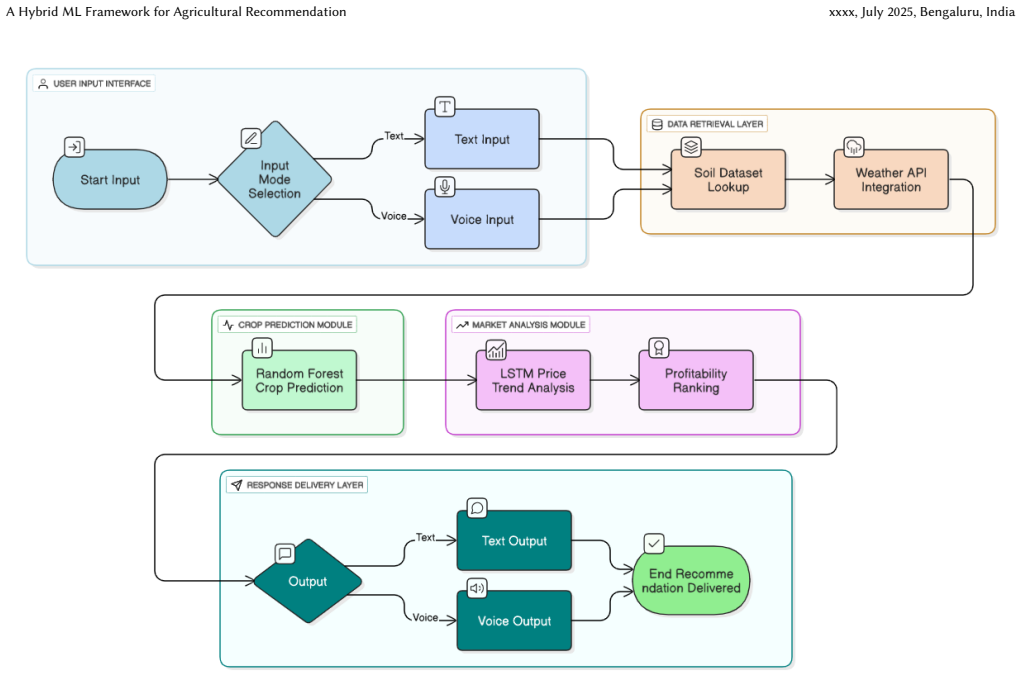
The load-bearing mechanism is the two-stage cascade: a Random Forest classifier that turns soil nutrients (N, P, K, pH), temperature, humidity, and rainfall into suitability probabilities, and an LSTM (long short-term memory) network that consumes six months of price history and iteratively predicts the harvest-time price for each candidate crop. The selection rule connecting them is deliberately simple—choose the suitable crop with the highest predicted price. A voice interaction layer, built from a Kannada speech-recognition model for input and a high-fidelity Kannada text-to-speech model for output, carries the recommendation to a low-literacy user. This combination of a cheap filtering stage and a targeted forecasting stage is what makes the end-to-end recommendation tractable.
What would settle it
Measure the realized net income of farms that planted the system's recommended crop (for example, pepper in the Hassan case) against farms that planted the runner-up crop in the same season, using actual yield and cost records; if the recommended crop does not yield the highest net profit, or if the LSTM's multi-month forecast error exceeds the price gap between the top candidates, the central claim would be refuted.
Extended reading notes
Core claim
The central claim is that joining agronomic and economic forecasting in one engine yields recommendations that are simultaneously viable and profitable. The engine first narrows the field to the top three crops by agronomic probability, then applies an LSTM to each candidate's historical price series to predict the price at the expected harvest date; the highest forecast price wins. Profitability in the current system is therefore represented solely by expected price per kilogram, not by net profit after cultivation costs and yield. The authors present the component accuracy numbers and the Hassan case study as evidence that the pipeline produces an economically meaningful, deliverable recommendation.
Load-bearing premise
The load-bearing premise is that the crop with the highest forecast harvest price is the most profitable crop; the system models no cultivation costs, yields, or input prices, so if price diverges from profit, the final recommendation is not economically optimized even when both component models perform well.
Editorial extensions
If this is right
- A farmer could speak a question in Kannada and receive a spoken recommendation naming the most economically promising crop for their soil and weather, with no reading required.
- The system changes the framing of crop advice from purely agronomic to economic, which the authors argue helps farmers mitigate income risk from volatile markets.
- Because forecasting runs only on the few crops that pass the suitability filter, the pipeline needs only a handful of LSTM models per query, keeping the system computationally practical.
- The reported component performance (98.5% suitability accuracy, about 5.8% one-month price MAPE) suggests the pieces are strong enough to support an end-to-end service, pending field validation.
- The modular design means the same pipeline could be retrained for other districts or languages, offering a scalable model for advisory systems in other low-literacy agricultural regions.
Reading between the lines
- The paper treats forecast price as the definition of profitability; factoring in cultivation costs, expected yield per acre, and input price changes would likely alter the ranking, so the recommendations are best read as price-optimized rather than profit-optimized.
- Because the LSTM iterates over multi-month growth horizons, its 5.8% one-month MAPE understates the uncertainty at, say, the nine-month coffee horizon; that error growth is not quantified in the paper.
- A direct test of economic value would compare realized net income of farms using the system's advice against farms using agronomic-only recommendations; the paper does not report such a comparison.
- The monoculture risk the authors flag could be addressed by adding a diversification term that penalizes repeated recommendations of the same crop, turning a system limitation into a design feature.
Editorial analysis
A structured set of objections, weighed in public.
Referee Report
Summary. The paper proposes a two-stage crop recommendation system for farmers in Karnataka, India: a Random Forest classifier selects agronomically suitable crops, an LSTM network forecasts their market prices at harvest, and a Kannada voice interface delivers the final recommendation to low-literacy users. The authors report 98.5% accuracy for the Random Forest model and a 5.8% MAPE for one-month-ahead LSTM price forecasts, and they illustrate the pipeline with a case study in Hassan district recommending pepper over coffee and maize. The paper claims that the integrated system provides recommendations that are both viable and profitable.
Significance. If fully supported, the combination of agronomic suitability, price forecasting, and a voice-based interface in Kannada would be a socially valuable contribution to digital agriculture for low-literacy farming communities. The system architecture is modular and the authors are transparent about several limitations and about their planned future work, including a cost-of-cultivation model and a randomized controlled trial. However, as submitted, the central claim of profitability is not substantiated: the LSTM is validated only at a one-month horizon while the system recommends at four-to-nine-month horizons, profitability is equated with forecast price rather than net profit, and the end-to-end evaluation is a single anecdotal case study. The contribution is therefore a promising proof-of-concept rather than a validated decision-support system.
major comments (4)
- [§3.2.2 and §4.1/§4.2] The only quantitative evaluation of the LSTM is a one-month-ahead forecast task, reporting RMSE of 3.50 and MAPE of 5.8%, yet the system uses the model to forecast harvest-time prices at horizons of 4, 6, and 9 months (as in the Section 4.2 case study) through iterative prediction. No multi-step or long-horizon evaluation is reported, so the claim that the system forecasts harvest-time prices with low error is unsupported; error accumulation over iterative multi-step forecasting is a known concern and must be measured at the actual recommendation horizons.
- [§3.2.2 and §4.2] The recommendation stage equates profitability with the highest forecast price per kilogram; it does not model cultivation cost, yield, input prices, or price-yield interactions. The case study recommends pepper solely because its forecast price (₹480/kg) exceeds coffee (₹255/kg) and maize (₹22/kg), with no net-profit calculation. The Section 5 conclusion that the system delivers 'profitable' recommendations is therefore not supported, and the paper itself acknowledges in Section 5 that a cost-of-cultivation model is future work.
- [§4.1] The quantitative evaluation lacks essential reporting: dataset sizes, train/validation/test split details, number of crop classes, per-class precision/recall/F1 with support, standard deviations, and comparisons against baselines such as logistic regression, SVM, or ARIMA. Without these details, the reported 98.5% accuracy and 5.8% MAPE cannot be assessed for reliability, class balance, or generalization to new districts and seasons.
- [§4.2] The end-to-end validation is a single qualitative case study that does not compare the forecast prices with actually realized harvest prices, nor does it measure whether a farmer following the recommendation would have earned higher net income. This does not validate the central claim that the system produces economically optimal recommendations.
minor comments (7)
- [Table 1] The datasets (e.g., CROPP.csv, dataset2.csv) are listed without provenance, citation, or public availability; please provide sources or accession details so the experiments can be reproduced.
- [Throughout text] The currency symbol is rendered inconsistently as '|' (e.g., '|255/kg'); please use a consistent notation for Indian rupees.
- [§4.1] The sentence reporting precision/recall/F1 'for most crop classes' above 0.95 is vague; please include the full classification report and identify which classes fall below that threshold.
- [§3.3] The ASR model is said to be fine-tuned on 'a corpus of Kannada speech data', but no corpus size, source, or ASR evaluation metrics are provided; please add these details.
- [Figures 1 and 2] Both figures are referenced in the text but are not included in the manuscript; please ensure all figures are present, legible, and properly captioned.
- [§2.2] The claim that LSTM networks are 'state-of-the-art' for agricultural price forecasting is too strong without citing recent comparative studies; consider softening the wording.
- [General] The manuscript does not include a reproducibility or data-availability statement; adding one would strengthen the paper.
Circularity Check
The 'profitable' recommendation is defined as the highest LSTM price forecast; no net-profit calculation enters, making the economic-optimization claim self-definitional rather than empirically derived.
-
self definitional
[Section 3.2.2 (Stage 2) and Section 4.2 (case study, final recommendation)]
"Stage 2: Economic Profitability Forecasting. This stage forecasts the future market price for each suitable crop. We employ an LSTM network. ... The LSTM models forecast prices based on their respective growth periods: ... Final Recommendation: The system recommends Pepper as it has the highest predicted price. ... This case study highlights the system’s core value: it moves beyond simple suitability to provide a financially optimized recommendation."
The 'profitability' outcome is the LSTM price forecast, renamed. Stage 2, despite its title 'Economic Profitability Forecasting', fits and predicts only market price; the final recommendation is the crop with the largest forecast price. Therefore the concluding claim that recommendations are 'profitable'/'financially optimized' holds by construction of the argmax rule, not because net profitability was derived or measured. The future-work sentence — 'we will enhance the engine by incorporating a cost-of-cultivation model to provide net profit forecasts' — concedes that cost, yield, and net returns are absent. No external benchmark links forecast price to realized profit, so the economic claim cannot fail independently of the LSTM's own ranking.
full rationale
The two machine-learning stages are evaluated on held-out data: the Random Forest achieves 98.5% accuracy on a 20% held-out test set, and the LSTM is tested on a one-month-ahead forecast task (RMSE 3.50/kg, MAPE 5.8%). These results are genuine empirical evidence for the component models and are not produced by the paper's conclusions; there are no load-bearing self-citations or imported uniqueness claims. The remaining circular element is semantic: 'profitability' is never modeled or measured. Stage 2 is titled economic profitability forecasting but predicts price; Section 4.2's 'financially optimized' recommendation is simply the highest forecast price. Thus the economic-optimization claim is true by definition of the selection rule, not by an independent profit calculation — a partial, self-definitional circularity that does not invalidate the agronomic or price-forecasting components. The section 4.1 evaluation horizon (one month) versus the 4–9 month recommendation horizons is a separate robustness/correctness concern, not a circularity.
Assumptions & free parameters
free parameters (6)
- Random Forest hyperparameters =
n_estimators=100, max_depth=20, min_samples_leaf=1, criterion=gini
- LSTM look-back period =
6 months
- LSTM units and dropout =
64, 32, dropout 0.2
- Top-k crop candidates =
3
- KNN geocoding k =
1
- Trained RF and LSTM weights =
not disclosed
assumptions (5)
- domain assumption Future market trends resemble historical price patterns
- domain assumption Input datasets are accurate and representative
- ad hoc to paper Highest forecast price identifies the most profitable crop
- domain assumption The agronomic feature set is sufficient for suitability
- domain assumption Voice interface is usable and trusted by low-literacy farmers
Cite this review
Pith. "Pith review of A Hybrid Machine Learning Framework for Optimizing Crop Selection via Agronomic and Economic Forecasting." pith.science (2026). https://pith.science/paper/KUJC2LG3
@misc{pith2026250708832,
  author       = {Pith},
  title        = {Pith review of: A Hybrid Machine Learning Framework for Optimizing Crop Selection via Agronomic and Economic Forecasting},
  year         = {2026},
  howpublished = {\url{https://pith.science/paper/KUJC2LG3}},
  note         = {Machine review of arXiv:2507.08832}
}
read the original abstract
Farmers in developing regions like Karnataka, India, face a dual challenge: navigating extreme market and climate volatility while being excluded from the digital revolution due to literacy barriers. This paper presents a novel decision support system that addresses both challenges through a unique synthesis of machine learning and human-computer interaction. We propose a hybrid recommendation engine that integrates two predictive models: a Random Forest classifier to assess agronomic suitability based on soil, climate, and real-time weather data, and a Long Short-Term Memory (LSTM) network to forecast market prices for agronomically viable crops. This integrated approach shifts the paradigm from "what can grow?" to "what is most profitable to grow?", providing a significant advantage in mitigating economic risk. The system is delivered through an end-to-end, voice-based interface in the local Kannada language, leveraging fine-tuned speech recognition and high-fidelity speech synthesis models to ensure accessibility for low-literacy users. Our results show that the Random Forest model achieves 98.5% accuracy in suitability prediction, while the LSTM model forecasts harvest-time prices with a low margin of error. By providing data-driven, economically optimized recommendations through an inclusive interface, this work offers a scalable and impactful solution to enhance the financial resilience of marginalized farming communities.
Figures

Reference graph
Works this paper leans on
-
[1]
Leo Breiman. 2001. Random forests. Machine learning, 45, 1, 5-32
work page 2001
-
[2]
S. Mahendra Dev. 2012. Small farmers in India: Challenges and opportunities. Indira Gandhi Institute of Development Research, Mumbai , WP-2012-014
work page 2012
-
[3]
Girish Kumar Jha and Rashmi Sinha. 2019. Time series analysis of agricultural commodity prices: a review. Journal of Agricultural Science and Technology , 21, 6, 1437-1450
work page 2019
-
[4]
Jakub Konečný, H. Brendan McMahan, Felix X. Yu, Peter Richtárik, Ananda Theertha Suresh, and Dave Bacon. 2016. Federated learning: Strategies for im- proving communication efficiency. arXiv preprint arXiv:1610.05492
arXiv 2016
-
[5]
Guillermo Medero, and Santiago M. Genti. 2021. The digital divide in the context of digital agriculture. Agronomy, 11, 10, 2044
work page 2021
-
[6]
R. K. Paul, S. S. Panwar, and A. Kumar. 2014. A new approach for forecasting agricultural commodity prices using ARIMA with GARCH model. Journal of the Indian Society of Agricultural Statistics , 68, 2, 245-254
work page 2014
-
[7]
Vineel Pratap, et al. 2023. Scaling Speech Technology to 1,000+ Languages. arXiv preprint arXiv:2305.13516
arXiv 2023
-
[8]
S. Pudumalar, P. Raman, E. Kirubakaran, and S. M. Sindhu. 2016. Crop recommen- dation system for precision agriculture. In 2016 Eighth International Conference on Advanced Computing (ICoAC). IEEE, 32-36
work page 2016
Show all 11 references
-
[9]
Alec Radford, et al. 2023. Robust speech recognition via large-scale weak super- vision. In International Conference on Machine Learning . PMLR, 1-14
2023
-
[10]
Javed Sherwani, N. Ali, S. B. Z. Ali, and R. Rosenfeld. 2009. Speech-based services for low-literate users. Information Technology and International Development , 5, 4, 1-17
2009
-
[11]
Alex Sherstinsky. 2020. Fundamentals of recurrent neural network (RNN) and long short-term memory (LSTM) network. Physica D: Nonlinear Phenomena , 404, 132306
2020
Reviewed August 6, 2026 · model on record in the stance chip above.
Discussion (0). Sign in to comment.