REVIEW 5 major objections 4 minor 47 references
Spatial ModernBERT: Spatial-Aware Transformer for Table and Key-Value Extraction in Financial Documents at Scale
T0 review · 5 major / 4 minor · reviewed 2026-08-06 · deepseek-v4-flash
Pith's one-line read A single encoder-only transformer with spatial embeddings can extract tables and key-value pairs from financial documents by classifying each token, the paper argues, reaching 95.49 F1 on CORD and 98.09% TEDS on FinTabNet.
desk verdict A competent engineering paper with a couple of genuinely useful ideas, but the headline performance claims are contradicted by its own tables and the key-value extraction is never actually evaluated. read the letter →
The pith
A machine-rendered reading of the paper's core claim, the machinery that carries it, and where it could break.
The reading
What carries the argument
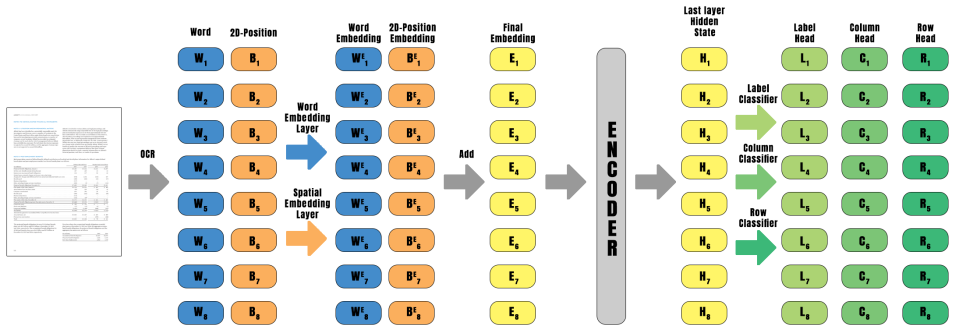
The mechanism that carries the argument is the spatial embedding plus three parallel classification heads. The spatial embedding encodes each of the six box quantities xmin, ymin, xmax, ymax, width, and height into a 128-dimensional vector each, concatenated into a 768-dimensional vector and added to the token embedding, so layout information enters every transformer layer. Around this, the label, column, and row heads convert structure recovery into classification, while the B-I-IB tag vocabulary ('begin', 'inside', 'inside-below') is what lets multi-line values be merged into one segment in post-processing. The auxiliary bounding-box regression head, the column consistency loss, and the 60/30/10 loss weighting are the components the ablation credits for generalization to unseen layouts.
What would settle it
Run the standard PubTabNet TEDS evaluator on the model's complex-table predictions without flattening rowspan and colspan, and compare the complex-subset score against the reported 96.70% and against MuTabNet's 95.53% and Ly and Takasu's 95.42%; a drop below those baselines would show that the flattened evaluation, not the model, produced the leading score.
Extended reading notes
Core claim
The paper's central claim is that table and key-value extraction can be reduced to multi-headed token classification once the encoder sees where each word sits on the page. Spatial ModernBERT embeds each token's bounding box and dimensions into a 768-dimensional vector, adds that to the ModernBERT text embedding, and runs three classification heads: a label head (PO Number, Item Description, Quantity, and so on), a column head (indices 0-9 with cycling), and a row head (item row vs header row). A B-I-IB tag scheme adds an 'inside-below' tag so multi-line fields stay single segments. After pretraining the column and row heads on PubTables-1M and fine-tuning all heads on a proprietary financial-document dataset, the predictions are merged into a table grid plus key-value pairs, giving the reported CORD F1, PubTabNet TEDS, and FinTabNet TEDS scores. The authors present classification instead of generation as the reason the model is fast (about 60,000 tokens per second) and does not hallucinate structure.
Load-bearing premise
The load-bearing premise is the paper's own Section IV.D assumption that scoring complex tables as simple, by ignoring merged cells that span rows or columns and labeling them by their starting cell, still yields TEDS scores comparable to span-aware methods; the paper explicitly warns that results on complex tables 'may not be directly comparable to other methods.'
Editorial extensions
If this is right
- If the reported numbers hold, decoder-free token classification can match or beat specialized table-recognition models on financial tables, so document pipelines could drop generative decoding for this task.
- The same forward pass yields both the table grid and the key-value pairs, because the label, column, and row heads run in parallel on shared encoder states.
- At roughly 151 million parameters and near 60,000 tokens per second, the approach is plausibly deployable on CPUs and modest GPUs for high-volume invoice processing.
- The B-I-IB tagging scheme provides a concrete mechanism for keeping multi-line fields such as item descriptions contiguous, which ordinary BIO tagging would split at line breaks.
Reading between the lines
- If the complex-table simplification were removed, the PubTabNet complex score of 96.70% would likely drop relative to span-aware systems, so the claimed edge over models such as MuTabNet may rest on the flattened evaluation rather than on better structure recovery.
- The same three-head recipe should transfer to other structured documents, such as forms, contracts, or receipts in other languages, by swapping the label vocabulary and fine-tuning, which the paper does not demonstrate.
- Because output is classification, the extracted grid could be handed to a small language model for natural-language querying, combining non-hallucinating structure recovery with flexible generation.
- The ablation's finding that width and height embeddings help cell boundaries suggests that size cues, not just absolute position, carry table structure; this could be tested in other layout-aware encoders.
Editorial analysis
A structured set of objections, weighed in public.
Referee Report
Summary. The paper proposes Spatial ModernBERT, an encoder-only transformer that treats table and key-value extraction as three simultaneous token-classification tasks (label, column, row), with spatial embeddings added to ModernBERT and a B-I-IB tagging scheme for multi-line fields. The model is pretrained on PubTables-1M and fine-tuned on a proprietary financial document dataset, then evaluated on CORD, FUNSD, PubTabNet, and FinTabNet. The authors claim superior performance over existing methods and report throughput benchmarks; an ablation section describes many design choices and a vision-integration study that was ultimately excluded.
Significance. If the reported results were valid, the paper would offer a practical, efficient encoder-only alternative to generative document parsers. The system is clearly engineered and the throughput measurements are concrete; the authors also provide a public code link and a large ablation list. However, the central comparative claims are not supported by the paper's own tables, and the PubTabNet evaluation uses a non-standard protocol that the authors themselves concede is not directly comparable. The methodological components are mostly standard combinations of existing techniques, and the proprietary training data limits independent verification. The significance, therefore, depends entirely on correcting the evaluation and reframing the claims.
major comments (5)
- [Abstract, §I, Table II] The abstract and Contribution 1 state that the approach 'achieves an F1 score of 95.49 on CORD ... demonstrating superior performance over existing methods.' Table II contradicts this: LayoutLMv3 (96.56), DocFormer (96.33), LiLT (96.07), and BROS (95.73) all exceed 95.49, and the FUNSD score (73.41) is far below all listed systems. Because the headline contribution is a comparative performance claim, this internal contradiction is load-bearing and must be resolved by either re-running the evaluations or removing the superiority claim.
- [§IV.D, Table IV] The PubTabNet result is obtained under a modified protocol: 'we treat complex tables as simple by ignoring their column span and rowspan values and labeling them with their starting column and row indices,' followed by the admission that 'our results on complex tables may not be directly comparable to other methods.' Since TEDS is computed on tree representations of table structure, dropping span information changes the objects being scored and can only make complex tables easier to match. The All-TEDS 96.91 therefore cannot be compared with published numbers, and the Abstract's citation of this number as evidence of superiority is unsupported. The authors should report standard TEDS with spans or restrict the comparison to the simple-table subset and say so clearly.
- [§IV.D, Table III] The text calls the FinTabNet result 'state-of-the-art performance ... surpassing most previous methods,' but the same table lists VAST at 98.21% versus 98.09% for the proposed model. Since VAST is a previous method, the model does not surpass all listed methods and the SOTA characterization is inaccurate. Moreover, no confidence intervals or significance tests are reported for any of the benchmark differences, several of which are within 0.1–0.5 points.
- [§IV.E] The 'comprehensive ablation study' described in Contribution 4 is presented without any quantitative results. Claims such as 'modest but consistent performance gains' for width/height embeddings, 'significant improvements on out-of-domain documents' for the consistency loss, and the comparison of sinusoidal versus random initialization are not supported by any table, figure, or number. Since these design choices are the paper's methodological contribution, the ablation claims are unverifiable as written. A table with token-level F1 and TEDS for each ablated configuration is needed.
- [§IV.A–IV.B] The proprietary Financial Document Dataset is not characterized beyond a generic description: no size, document-type distribution, annotation statistics, or split details are given, and the fine-tuning stage mixes 30% of PubTables-1M with this data without specifying how. It is also unclear how the model is applied to the public benchmarks (which OCR engine produced the tokens, how coordinates were normalized, and whether the preprocessing matches the benchmark creators' protocol). These omissions prevent reproduction and make it difficult to interpret the benchmark numbers.
minor comments (4)
- [References] References [37] and [39] are the same paper (Zhong et al., ECCV 2020) and should be merged or given distinct labels.
- [Throughout] There are several typographical issues, including 'LLaV A' in Section I, 'V AST' in Tables III–IV, 'Following an approaches similar' in Section IV.E.6, and 'T EDS' in Eq. (4).
- [§III.A.4] The B-I-IB tagging scheme is never formally defined with an example; adding a short example of B/I/IB transitions for a multi-line field would improve clarity.
- [Figures 1 and 3] Figure 3 describes a vision variant that is ultimately excluded from the final model, which may confuse readers; the caption should state this explicitly.
Circularity Check
No significant circularity: benchmark results come from external datasets and external prior work; the protocol caveat for complex tables is a comparability issue, not a circular derivation.
full rationale
The paper's derivation chain is empirical rather than definitional: the model is pretrained on PubTables-1M, fine-tuned on a proprietary financial-document dataset, and evaluated on the external CORD, PubTabNet, FinTabNet, and FUNSD benchmarks. The reported F1 and TEDS numbers are outputs of model evaluation, not quantities that were fitted into the model or defined in terms of the claimed results. Citations to ModernBERT, LayoutLMv3, and other prior work are external sources, and the paper contains no load-bearing self-citation chain or uniqueness argument imported from the authors' own prior papers. The main caveat is the PubTabNet complex-table protocol, where the paper states that it 'treat complex tables as simple by ignoring their column span and rowspan values and labeling them with their starting column and row indices' and concedes that 'our results on complex tables may not be directly comparable to other methods.' That is a real limitation on the comparative claim, and the abstract's unqualified 'superior performance' wording is further undercut by Table II, where the CORD score of 95.49 is below several listed baselines (BROS, LiLT, DocFormer, LayoutLMv3). These are correctness and comparability problems, not circularity: the benchmark score is still computed from a model trained on separate data, and the simplified evaluation does not feed the benchmark answer back into the model or define the model in terms of the metric. No step in the derivation reduces, by construction or by self-citation, to its own inputs, so the appropriate circularity score is 0.
Assumptions & free parameters
free parameters (5)
- Head loss weights =
0.6 column, 0.3 label, 0.1 row
- Spatial embedding dimensions =
128 per coordinate (xmin, ymin, xmax, ymax, width, height)
- Column index cap =
9 (columns beyond 9 cycle back to 0)
- Gaussian noise sigma for spatial augmentation =
5
- Text augmentation rates =
mask 0-20%, dropout 0.1, scaling 0.8-1.2
assumptions (4)
- domain assumption Bounding box coordinates are normalized to [0, 1000] and available for every token
- domain assumption Pre-training on PubTables-1M transfers to financial documents and to PubTabNet/FinTabNet evaluation
- ad hoc to paper Ignoring column span and rowspan values yields TEDS scores comparable to methods that model spans
- domain assumption Post-processing heuristics for row and column assignment correctly reconstruct the table layout
Cite this review
Pith. "Pith review of Spatial ModernBERT: Spatial-Aware Transformer for Table and Key-Value Extraction in Financial Documents at Scale." pith.science (2026). https://pith.science/paper/WMJCTDHD
@misc{pith2026250708865,
  author       = {Pith},
  title        = {Pith review of: Spatial ModernBERT: Spatial-Aware Transformer for Table and Key-Value Extraction in Financial Documents at Scale},
  year         = {2026},
  howpublished = {\url{https://pith.science/paper/WMJCTDHD}},
  note         = {Machine review of arXiv:2507.08865}
}
read the original abstract
Extracting tables and key-value pairs from financial documents is essential for business workflows such as auditing, data analytics, and automated invoice processing. In this work, we introduce Spatial ModernBERT-a transformer-based model augmented with spatial embeddings-to accurately detect and extract tabular data and key-value fields from complex financial documents. We cast the extraction task as token classification across three heads: (1) Label Head, classifying each token as a label (e.g., PO Number, PO Date, Item Description, Quantity, Base Cost, MRP, etc.); (2) Column Head, predicting column indices; (3) Row Head, distinguishing the start of item rows and header rows. The model is pretrained on the PubTables-1M dataset, then fine-tuned on a financial document dataset, achieving robust performance through cross-entropy loss on each classification head. We propose a post-processing method to merge tokens using B-I-IB tagging, reconstruct the tabular layout, and extract key-value pairs. Empirical evaluation shows that Spatial ModernBERT effectively leverages both textual and spatial cues, facilitating highly accurate table and key-value extraction in real-world financial documents.
Figures


Reference graph
Works this paper leans on
-
[1]
Faster R-CNN: Towards Real-Time Object Detection with Region Proposal Networks,
S. Ren, K. He, R. Girshick, and J. Sun, “Faster R-CNN: Towards Real-Time Object Detection with Region Proposal Networks,” IEEE Transactions on Pattern Analysis and Machine Intelligence, vol. 39, no. 6, pp. 1137–1149, 2016
work page 2016
-
[2]
S. S. Paliwal, V . D, R. Rahul, M. Sharma, and L. Vig, “TableNet: Deep Learning Model for End-to-end Table Detection and Tabular Data Extraction from Scanned Document Images,” in 2019 International Conference on Document Analysis and Recognition (ICDAR), 2019, pp. 128-133
work page 2019
-
[3]
DeepDeSRT: Deep Learning for Detection and Structure Recognition of Tables in Document Images,
S. Schreiber, S. Agne, I. Wolf, A. Dengel, and S. Ahmed, “DeepDeSRT: Deep Learning for Detection and Structure Recognition of Tables in Document Images,” in 2017 14th IAPR International Conference on Document Analysis and Recognition (ICDAR), 2017, vol. 01, pp. 1162- 1167
work page 2017
-
[4]
D. Prasad, A. Gadpal, K. Kapadni, M. Visave, and K. Sultanpure, “CascadeTabNet: An approach for end to end table detection and structure recognition from image-based documents,” in 2020 IEEE/CVF Conference on Computer Vision and Pattern Recognition Workshops (CVPRW), 2020, pp. 2439-2447
work page 2020
-
[5]
OCR-Free Document Understanding Transformer,
G. Kim, T. Hong, M. Yim, J. Nam, J. Park, J. Yim, W. Hwang, S. Yun, D. Han, and S. Park, “OCR-Free Document Understanding Transformer,” in European Conference on Computer Vision 2022, 2021, pp. 498–517
work page 2022
-
[6]
S. Bai et al., “Qwen2.5-VL Technical Report,” arXiv preprint arXiv:2502.13923, 2024
arXiv 2024
-
[7]
Improved Baselines with Visual Instruction Tuning,
H. Liu, C. Li, Y . Li, and Y . J. Lee, “Improved Baselines with Visual Instruction Tuning,” in 2024 IEEE/CVF Conference on Computer Vision and Pattern Recognition (CVPR), 2024, pp. 26286-26296
work page 2024
-
[8]
ReS2TIM: Reconstruct Syntactic Structures from Table Images,
W. Xue, Q. Li, and D. Tao, “ReS2TIM: Reconstruct Syntactic Structures from Table Images,” in 2019 International Conference on Document Analysis and Recognition (ICDAR), 2019, pp. 749-755
work page 2019
Show all 47 references
-
[9]
TableFormer: Table Structure Understanding With Transformers,
A. Nassar, N. Livathinos, M. Lysak, and P. Staar, “TableFormer: Table Structure Understanding With Transformers,” in Proceedings of the IEEE/CVF Conference on Computer Vision and Pattern Recognition (CVPR), 2022, pp. 4614-4623
2022
-
[10]
Show, Read and Reason: Table Structure Recognition with Flexible Context Aggregator,
H. Liu, X. Li, B. Liu, D. Jiang, Y . Liu, B. Ren, and R. Ji, “Show, Read and Reason: Table Structure Recognition with Flexible Context Aggregator,” in Proceedings of the 29th ACM International Conference on Multimedia, 2021, no. 9, pp. 1084–1092
2021
-
[11]
Complicated Table Structure Recognition,
Z. Chi, H. Huang, H. Xu, H. Yu, W. Yin, and X. Mao, “Complicated Table Structure Recognition,” arXiv preprint arXiv:1908.04729, 2019
1908 arXiv
-
[12]
LayoutLMv3: Pre-training for Document AI with Unified Text and Image Masking,
Y . Huang, T. Lv, L. Cui, Y . Lu, and F. Wei, “LayoutLMv3: Pre-training for Document AI with Unified Text and Image Masking,” in Proceedings of the 30th ACM International Conference on Multimedia, 2022, no. 9, pp. 4083–4091
2022
-
[13]
A Survey on Hough Transform, Theory, Techniques and Applications,
A. S. Hassanein, S. Mohammad, M. Sameer, and M. E. Ragab, “A Survey on Hough Transform, Theory, Techniques and Applications,” arXiv preprint arXiv:1502.02160, 2015
2015 arXiv
-
[14]
End-to-End Object Detection with Transformers,
N. Carion, F. Massa, G. Synnaeve, N. Usunier, A. Kirillov, and S. Zagoruyko, “End-to-End Object Detection with Transformers,” in Com- puter Vision – ECCV 2020 (Springer International Publishing), 2020, pp. 213–229
2020
-
[16]
Split, Embed and Merge: An accurate table structure recognizer,
Z. Zhang, J. Zhang, J. Du, and F. Wang, “Split, Embed and Merge: An accurate table structure recognizer,” Pattern Recognition, vol. 126, pp. 108565, 2022
2022
-
[17]
SpaDE: Improving Sparse Representations using a Dual Document Encoder for First-stage Retrieval,
E. Choi, S. Lee, M. Choi, H. Ko, Y . Song, and J. Lee, “SpaDE: Improving Sparse Representations using a Dual Document Encoder for First-stage Retrieval,” in Proceedings of the 31st ACM International Conference on Information & Knowledge Management, 2022, no. 11, pp. 272–282
2022
-
[18]
FUNSD: A Dataset for Form Understanding in Noisy Scanned Documents,
G. Jaume, H. Kemal Ekenel, and J. Thiran, “FUNSD: A Dataset for Form Understanding in Noisy Scanned Documents,” in 2019 Interna- tional Conference on Document Analysis and Recognition Workshops (ICDARW), 2019, vol. 2, pp. 1-6
2019
-
[19]
LayoutLM: Pre-training of Text and Layout for Document Image Understanding,
Y . Xu, M. Li, L. Cui, S. Huang, F. Wei, and M. Zhou, “LayoutLM: Pre-training of Text and Layout for Document Image Understanding,” in Proceedings of the 26th ACM SIGKDD International Conference on Knowledge Discovery & Data Mining, 2020, no. 9, pp. 1192–1200
2020
-
[20]
LayoutLMv2: Multi-modal Pre-training for Visually-Rich Document Understanding,
Y . Xu et al., “LayoutLMv2: Multi-modal Pre-training for Visually-Rich Document Understanding,” arXiv preprint arXiv:2012.14740, 2022
2012 arXiv
-
[21]
BROS: A Pre-trained Language Model Focusing on Text and Layout for Better Key Information Extraction from Documents,
T. Hong, D. Kim, M. Ji, W. Hwang, D. Nam, and S. Park, “BROS: A Pre-trained Language Model Focusing on Text and Layout for Better Key Information Extraction from Documents,” in Proceedings of the AAAI Conference on Artificial Intelligence, 2022, vol. 36, no. 10, pp. 10767-10775
2022
-
[22]
DocFormer: End-to-End Transformer for Document Understanding,
S. Appalaraju, B. Jasani, B. U. Kota, Y . Xie, and R. Manmatha, “DocFormer: End-to-End Transformer for Document Understanding,” in 2021 IEEE/CVF International Conference on Computer Vision (ICCV), 2021, pp. 973-983
2021
-
[23]
SelfDoc: Self-Supervised Document Representation Learn- ing,
P. Li, J. Gu, J. Kuen, V . I. Morariu, H. Zhao, R. Jain, V . Manjunatha, and H. Liu, “SelfDoc: Self-Supervised Document Representation Learn- ing,” in 2021 IEEE/CVF Conference on Computer Vision and Pattern Recognition (CVPR), 2021, pp. 5648-5656
2021
-
[24]
Going Full-TILT Boogie on Document Understanding with Text-Image-Layout Transformer,
R. Powalski, Ł. Borchmann, D. Jurkiewicz, T. Dwojak, M. Pietruszka, and G. Pałka, “Going Full-TILT Boogie on Document Understanding with Text-Image-Layout Transformer,” arXiv preprint arXiv:2102.09550, 2021
2021 arXiv
-
[25]
XY- LayoutLM: Towards Layout-Aware Multimodal Networks For Visually- Rich Document Understanding,
Z. Gu, C. Meng, K. Wang, J. Lan, W. Wang, M. Gu, and L. Zhang, “XY- LayoutLM: Towards Layout-Aware Multimodal Networks For Visually- Rich Document Understanding,” in 2022 IEEE/CVF Conference on Computer Vision and Pattern Recognition (CVPR), 2022, pp. 4573-4582
2022
-
[26]
LiLT: A Simple yet Effective Language- Independent Layout Transformer for Structured Document Understand- ing,
J. Wang, L. Jin, and K. Ding, “LiLT: A Simple yet Effective Language- Independent Layout Transformer for Structured Document Understand- ing,” arXiv preprint arXiv:2202.13669, 2022
2022 arXiv
-
[27]
DiT: Self-supervised Pre-training for Document Image Transformer,
J. Li, Y . Xu, T. Lv, L. Cui, C. Zhang, and F. Wei, “DiT: Self-supervised Pre-training for Document Image Transformer,” in Proceedings of the 30th ACM International Conference on Multimedia, 2022, no. 10, pp. 3530–3539
2022
-
[28]
BEiT: BERT Pre-Training of Image Transformers,
H. Bao, L. Dong, S. Piao, and F. Wei, “BEiT: BERT Pre-Training of Image Transformers,” arXiv preprint arXiv:2106.08254, 2022
2022 arXiv
-
[29]
StrucTexT: Structured Text Understanding with Multi- Modal Transformers,
Y . Li, Y . Qian, Y . Yu, X. Qin, C. Zhang, Y . Liu, K. Yao, J. Han, J. Liu, and E. Ding, “StrucTexT: Structured Text Understanding with Multi- Modal Transformers,” in Proceedings of the 29th ACM International Conference on Multimedia, 2021, no. 9, pp. 1912–1920
2021
-
[30]
UniDoc: Unified Pretraining Framework for Doc- ument Understanding,
J. Gu, J. Kuen, V . I. Morariu, H. Zhao, R. Jain, N. Barmpalios, A. Nenkova, and T. Sun, “UniDoc: Unified Pretraining Framework for Doc- ument Understanding,” in Advances in Neural Information Processing Systems 34 (NeurIPS 2021), 2021, vol. 34, pp. 39–50
2021
-
[31]
Pix2Struct: Screenshot Parsing as Pretraining for Visual Language Understanding,
K. Lee et al., “Pix2Struct: Screenshot Parsing as Pretraining for Visual Language Understanding,” in Proceedings of the 40th International Conference on Machine Learning, 2023, pp. 18893–18912
2023
-
[32]
Smarter, Better, Faster, Longer: A Modern Bidirec- tional Encoder for Fast, Memory Efficient, and Long Context Finetuning and Inference,
B. Warner et al., “Smarter, Better, Faster, Longer: A Modern Bidirec- tional Encoder for Fast, Memory Efficient, and Long Context Finetuning and Inference,” arXiv preprint arXiv:2412.13663, 2024
2024 arXiv
-
[33]
PubTables-1M: Towards comprehensive table extraction from unstructured documents,
B. Smock, R. Pesala, and R. Abraham, “PubTables-1M: Towards comprehensive table extraction from unstructured documents,” in 2022 IEEE/CVF Conference on Computer Vision and Pattern Recognition (CVPR), 2022, pp. 4624-4632
2022
-
[34]
BERT: Pre-training of Deep Bidirectional Transformers for Language Understanding,
J. Devlin, M. Chang, K. Lee, and K. Toutanova, “BERT: Pre-training of Deep Bidirectional Transformers for Language Understanding,” in Proceedings of the 2019 Conference of the North American Chapter of the Association for Computational Linguistics: Human Language Technologies,...
2019
-
[35]
RoBERTa: A Robustly Optimized BERT Pretraining Approach,
Y . Liu, M. Ott, N. Goyal, J. Du, M. Joshi, D. Chen, O. Levy, M. Lewis, L. Zettlemoyer, and V . Stoyanov, “RoBERTa: A Robustly Optimized BERT Pretraining Approach,” arXiv preprint arXiv:1907.11692, 2019
1907 arXiv
-
[36]
CORD: A Consolidated Receipt Dataset for Post-OCR Parsing,
S. Park, S. Shin, B. Lee, J. Lee, J. Surh, M. Seo, and H. Lee, “CORD: A Consolidated Receipt Dataset for Post-OCR Parsing,” in Workshop on Document Intelligence at NeurIPS 2019, 2019
2019
-
[38]
Aligning benchmark datasets for table structure recognition,
B. Smock, R. Pesala, and R. Abraham, “Aligning benchmark datasets for table structure recognition,” in Document Analysis and Recognition - ICDAR 2023, 2023, pp. 371–386
2023
-
[39]
Image-based table recognition: data, model, and evaluation,
X. Zhong, E. ShafieiBavani, and A. Jimeno Yepes, “Image-based table recognition: data, model, and evaluation,” in Computer Vision – ECCV 2020, 2020, pp. 564–580
2020
-
[40]
Improving Table Structure Recognition with Visual-Alignment Sequential Coordinate Modeling,
Y . Huang, N. Lu, D. Chen, Y . Li, Z. Xie, S. Zhu, L. Gao, and W. Peng, “Improving Table Structure Recognition with Visual-Alignment Sequential Coordinate Modeling,” in 2023 IEEE/CVF Conference on Computer Vision and Pattern Recognition (CVPR), 2023, pp. 11134- 11143
2023
-
[41]
Rethinking image-based table recognition using weakly supervised methods,
N. T. Ly, A. Takasu, P. Nguyen, and H. Takeda, “Rethinking image-based table recognition using weakly supervised methods,” in International Conference on Pattern Recognition Applications and Methods, 2023, pp. 872–880
2023
-
[42]
An End-to-End Local Attention Based Model for Table Recognition,
N. T. Ly and A. Takasu, “An End-to-End Local Attention Based Model for Table Recognition,” in Document Analysis and Recognition - ICDAR, 2023, pp. 20–36
2023
-
[43]
Multi-cell Decoder and Mutual Learning for Table Struc- ture and Character Recognition,
T. Kawakatsu, “Multi-cell Decoder and Mutual Learning for Table Struc- ture and Character Recognition,” in Document Analysis and Recognition - ICDAR 2024, 2024, pp. 389–405
2024
-
[44]
LGPMA: Complicated Table Structure Recognition with Local and Global Pyramid Mask Alignment,
L. Qiao, Z. Li, Z. Cheng, P. Zhang, S. Pu, Y . Niu, W. Ren, W. Tan, and F. Wu, “LGPMA: Complicated Table Structure Recognition with Local and Global Pyramid Mask Alignment,” in Document Analysis and Recognition – ICDAR 2021, 2021, pp. 99–114
2021
-
[45]
Neural Collaborative Graph Machines for Table Structure Recognition,
H. Liu, X. Li, B. Liu, D. Jiang, Y . Liu, and B. Ren, “Neural Collaborative Graph Machines for Table Structure Recognition,” in 2022 IEEE/CVF Conference on Computer Vision and Pattern Recognition (CVPR), 2022, pp. 4523-4532
2022
-
[46]
TRUST: An Accurate and End-to-End Table struc- ture Recognizer Using Splitting-based Transformers,
Z. Guo, Y . Yu, P. Lv, C. Zhang, H. Li, Z. Wang, K. Yao, J. Liu, and J. Wang, “TRUST: An Accurate and End-to-End Table struc- ture Recognizer Using Splitting-based Transformers,” arXiv preprint arXiv:2208.14687, 2022
2022 arXiv
-
[47]
GridFormer: Towards Accurate Table Structure Recognition via Grid Prediction,
P. Lyu, W. Ma, H. Wang, Y . Yu, C. Zhang, K. Yao, Y . Xue, and J. Wang, “GridFormer: Towards Accurate Table Structure Recognition via Grid Prediction,” in Proceedings of the 31st ACM International Conference on Multimedia, 2023, no. 11, pp. 7747–7757
2023
-
[48]
SigLIP 2: Multilingual Vision-Language Encoders with Improved Semantic Understanding, Localization, and Dense Fea- tures,
M. Tschannen et al., “SigLIP 2: Multilingual Vision-Language Encoders with Improved Semantic Understanding, Localization, and Dense Fea- tures,” arXiv preprint arXiv:2502.14786, 2024
2024 arXiv
-
[49]
YOLOX: Exceeding YOLO Series in 2021,
Z. Ge, S. Liu, F. Wang, Z. Li, and J. Sun, “YOLOX: Exceeding YOLO Series in 2021,” arXiv preprint arXiv:2107.08430, 2021
2021 arXiv
Reviewed August 6, 2026 · model on record in the stance chip above.
Discussion (0). Sign in to comment.