REVIEW 4 major objections 5 minor 1 cited by
Are Betting Markets Better than Polling in Predicting Political Elections?
T0 review · 4 major / 5 minor · reviewed 2026-08-06 · deepseek-v4-flash
Pith's one-line read The paper claims that Polymarket's daily betting prices predicted the 2024 U.S. presidential election outcome better than traditional polling, nationally and in most swing states.
desk verdict A well-written case study undone by comparing raw polling averages to market win probabilities on the same axis; the claimed Polymarket superiority is largely an artifact. read the letter →
The pith
A machine-rendered reading of the paper's core claim, the machinery that carries it, and where it could break.
The reading
What carries the argument
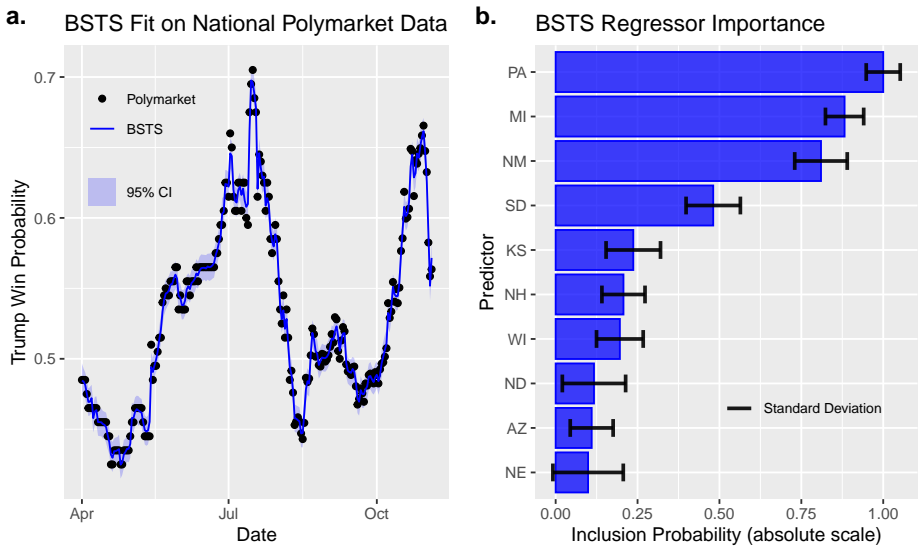
The analysis runs through a date-aligned pair of daily time series: Polymarket's closing price on the Trump full-ballot contract, treated as an implied win probability, and the average of all available polls from FiveThirtyEight, treated the same way. The predictive engine is a Bayesian structural time series model with a local-level state equation, fitted with spike-and-slab priors on regressors, which identifies Pennsylvania and Michigan as the state markets driving the national market and produces rolling forecasts with 95 percent predictive intervals. The model's fitted variance terms let the paper describe the market series as a random walk and the polling series as noise around a fixed mean, which is the formal reason the market forecasts are wider but more accurate.
What would settle it
Re-run the comparison on the 2016 or 2020 elections using the same daily market and polling series and the same BSTS forecasting protocol: if the market's mid-October lead over polling does not reproduce in either election, or disappears once both sources are converted to a common outcome space, the 2024 result alone is too weak to carry the paper's general conclusion.
Extended reading notes
Core claim
The central claim is that Polymarket was superior to polling in predicting the 2024 presidential election, both nationally and in five of the seven swing states, with Michigan and Wisconsin too close to call in either source. The market's daily contract price, read as the probability Donald Trump would win the presidency, called the winner early and stayed on the right side of the 50 percent decision boundary from mid-October onward. The polling average, built from preference questions, not only failed to call the result but got the direction wrong on Election Day. The paper presents this as the first systematic comparison of Polymarket data against traditional polls, and reads the result as support for the idea that a crowd wagering money can aggregate expectations more accurately than a crowd answering survey questions.
Load-bearing premise
The comparison assumes that a poll's vote-preference average can be plotted on the same 'Trump win probability' axis as a Polymarket contract that actually pays out on who wins the Electoral College, and if those quantities measure different things, the market's apparent advantage is an artifact.
Editorial extensions
If this is right
- Campaigns and media could treat daily market prices as an early-warning signal for where resources should go, since the market saw Georgia and North Carolina as unwinnable for Harris months before the polls did.
- Forecasters could use market data to measure how events move the race hour by hour, a granularity most polls cannot offer.
- If markets are adopted as forecasting tools, regulators and platforms would need identity checks and anti-manipulation rules, because a single large bettor or wash trades can shift prices.
- The 2024 election becomes a test case for wisdom-of-crowds theory, turning a stochastic market into a calibration point for collective judgment.
Reading between the lines
- The strongest hidden comparison would be to map poll vote shares into win probabilities with an electoral-college model; on that common scale, the market's edge may shrink, and the paper does not run that test.
- Michigan and Wisconsin, where the market added no clear signal, suggest the market's value may be limited to races with an identifiable structural lean, not genuinely tied states.
- Adding a direct 'who do you think will win' question to standard polls could isolate whether the market's advantage is expectations rather than money, without relying on a crypto platform that was legally restricted inside the United States.
- A single election is a sample of one; before recommending betting markets, the same protocol should be run across many political and non-political binary events to see if the superiority generalizes.
Editorial analysis
A structured set of objections, weighed in public.
Referee Report
Summary. The paper compares daily Polymarket contract prices with daily polling averages from FiveThirtyEight for the 2024 U.S. presidential election, at the national level and in seven swing states, using descriptive time-series plots and Bayesian Structural Time Series (BSTS) models. The authors conclude that Polymarket was superior to polling in predicting the outcome, particularly in swing states, and suggest that betting markets could be used to predict elections and other events. The manuscript includes model fits, variable importance analysis, rolling forecasts, and an extensive limitations discussion, and states that code and data are available in supplementary materials.
Significance. If the comparison were valid, the paper would be a useful contribution to the ongoing debate on prediction markets versus traditional polls, adding a large-market, state-level case study with Bayesian uncertainty quantification. The authors also deserve credit for acknowledging market-manipulation concerns and for making code and data available. However, the central comparison is compromised by the fact that the two series measure different quantities, and the evaluative claims rest on informal visual criteria and a single election; in its current form the paper does not establish that betting markets are better predictors.
major comments (4)
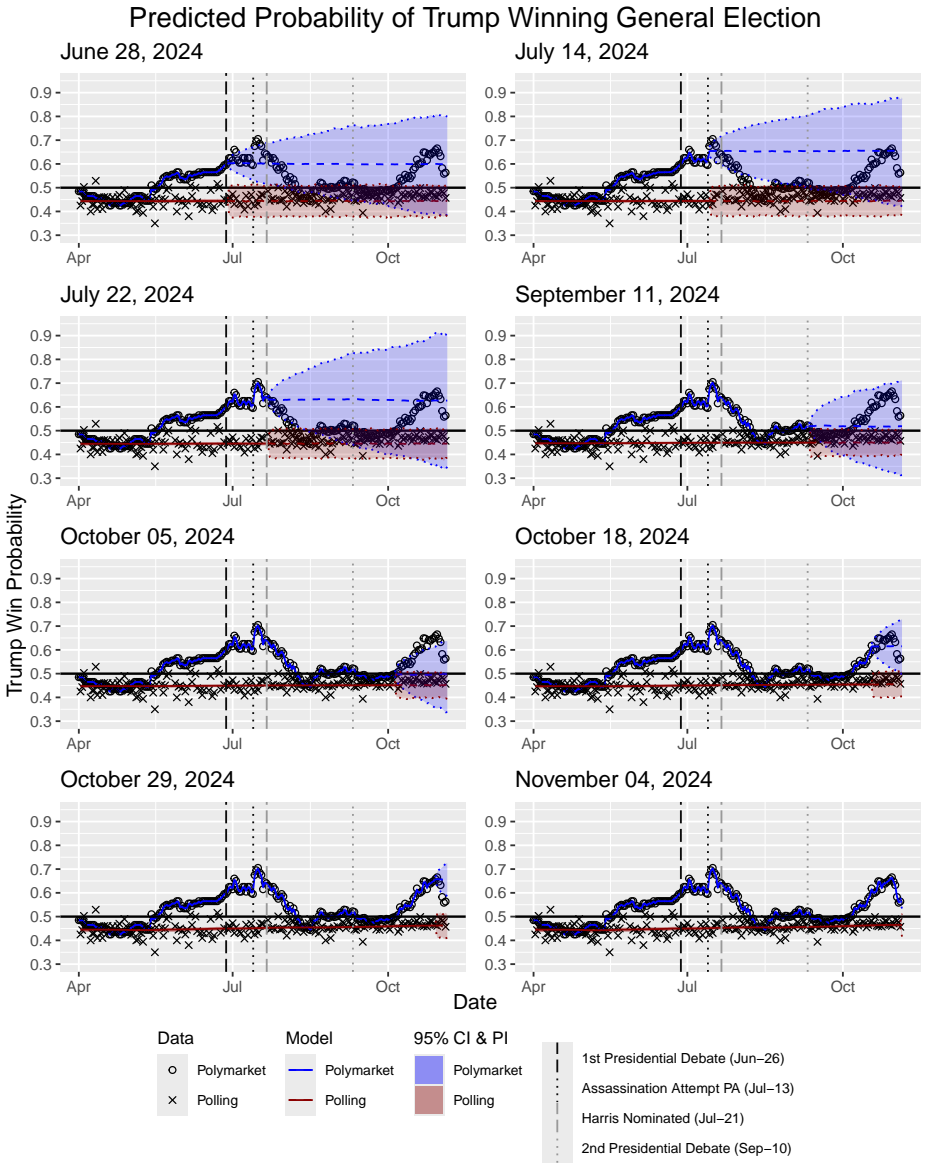
- [2.1, Figures 1–2, Figure 4] The polling data plotted as 'Trump Win Probability' are raw or averaged two-candidate vote shares (preference estimates), not probabilities of winning the Electoral College. A 45% vote share does not correspond to a 45% win probability; the mapping depends on the distribution of polling error and the correlation of state errors. Because the BSTS forecasting model in Equations (5)–(6) is applied directly to this vote-share series, the claim in Section 3 that 'almost all polling predictions favor Harris' is an artifact of comparing a vote-share quantity to a market-implied win probability, not evidence of inferior predictive skill. A valid comparison requires converting poll margins into win probabilities through a state-level forecast model with an explicit error structure before scoring.
- [3, Section 4.2, Figure 4] The conclusion that Polymarket was 'superior' is based on visual inspection of whether posterior predictive intervals fall above 50% at selected horizons, not on any proper scoring rule (e.g., Brier score, logarithmic score, calibration test). With one election, seven states, and eight evaluation time points, no adjustment for multiple comparisons or selection is made, and no statistical significance test is reported. The paper should compare the two forecasts using a pre-specified proper scoring rule and an appropriate test of equal predictive ability, rather than interpreting plotted intervals after the outcome is known.
- [4.1, 4.3, 4.4] The authors acknowledge that a single trader placed large pro-Trump bets across many accounts and that Polymarket was subject to wash-trading accusations during the exact period in which the market separated from the polls (October 2024). Given that a prediction-market price can be moved by capital as well as information, the headline claim of superiority requires robustness analysis: the comparison should at least be repeated excluding or downweighting the potentially manipulated post-October period, or with an adjustment for the large trader's positions.
- [2.4, Figure 3b] The BSTS variable-importance analysis for the national market uses state-level Polymarket prices as regressors for the national Polymarket price. This is a within-market decomposition, not an independent validation of market predictive power, and it does not address whether market prices added information beyond polls. The discussion should not present this analysis as evidence of superiority over polling.
minor comments (5)
- [1.2, References] The text contains several typos: 'Hilary Clinton' should be 'Hillary Clinton', the reference 'Fried and and Harris' has a duplicated 'and', and 'real-word data' in Section 4.4 should be 'real-world data'.
- [2.4, Results] Several equations and inline symbols are garbled: 'If 20, then t is constant' appears to have missing symbols for the variance parameters, and the Results section contains 'corroborate this notion (2)' and '(0 and ¿0)' where the estimated variance components are intended; these should be typeset correctly.
- [Figures 1–4] The legends in Figures 1–4 include 'Standard Deviation' without explaining that it refers to the standard deviation of the polling average on that day; the captions should state this explicitly.
- [Discussion and Figure 4] The manuscript states 'election day on November 4th, 2024' and Figure 4 labels 'November 04, 2024'; the 2024 U.S. presidential election was held on November 5, 2024, so the date is incorrect in both places.
- [Appendix A] The list of pollsters is extensive, but no information is given about the aggregation method, weighting, or inclusion criteria for the FiveThirtyEight polling averages; a brief description would help readers assess the comparability of the polling series.
Circularity Check
The comparison of polling to Polymarket is partly self-definitional: a vote-share poll average is relabeled as 'Trump Win Probability' and then forecast, so the conclusion that polls 'incorrectly predict Harris' is built into the axis rather than derived from evidence.
-
self definitional
[Section 2.1 (Data), Section 2.5 (Forecasting and Dynamic Comparison), Figure 4, Section 4.2 (Predictive Results)]
"This study analyzed daily data on the probability of Donald Trump winning the 2024 U.S. presidential election using two primary sources: betting market data from Polymarket and public opinion polling data from multiple established polling aggregators. ... BSTS models were also trained on national and state level data up to various intermediate time points prior to the election and then projected forward to election day. ..."
The 'polling data' series is a daily mean of vote-intention polls, a vote-share estimate, not a win probability. Equations (5)-(6) fit a local-level BSTS model to that mean and extrapolate it; the forecast is an extrapolation of the vote-share series itself. Figure 4 labels that forecast 'Trump Win Probability' and the paper treats its position relative to 0.50 as evidence that 'the mean of the polling data never showed Trump as the winner' and that 'polling data incorrectly predicts Harris as the winner.' Since a two-party vote share below 50% does not equal a below-50% win probability, the conclusion follows by construction from the label/axis, not from any estimated relationship between poll margins and outcomes.
full rationale
The paper contains no load-bearing self-citations: its methods cite standard BSTS references (Brodersen et al., Scott and Varian) and its data are external, so self-citation patterns do not arise. The central problem is pattern 1 (self-definitional construction). The polling series is built from mean vote-intention estimates, yet it is analyzed and displayed as 'Trump Win Probability'; the BSTS forecast of that series is then read against a 50 percent decision boundary to declare that polling 'predicted Harris.' That declaration is an artifact of labeling a vote-share forecast as a win-probability forecast. The BSTS models themselves do produce genuine out-of-sample extrapolations, so the paper is not wholly tautological; however, the headline comparative conclusion depends on the relabeling step rather than on an independent conversion of poll margins into election win probabilities. This makes the central comparative claim partially circular, warranting a score of 6 rather than a higher score. The retrospective use of the known 2024 outcome to judge forecast accuracy is normal forecast evaluation, not circularity per se; the circularity is specifically the unacknowledged scale change imposed on the polling input.
Assumptions & free parameters
free parameters (3)
- BSTS local-level observation variance (sigma^2) =
not reported
- BSTS local-level state variance (tau^2) =
not reported
- Spike-and-slab prior hyperparameters =
not reported
assumptions (5)
- domain assumption Polymarket daily closing price equals an implied probability of Trump winning.
- domain assumption Polling averages can be directly compared with win probabilities.
- domain assumption The 2024 election outcome is the sole correct ground truth for evaluating forecasting accuracy.
- domain assumption The BSTS local-level model is appropriate for both series and extrapolation to Election Day is valid.
- domain assumption Wisdom of Crowds explains the market result.
Cite this review
Pith. "Pith review of Are Betting Markets Better than Polling in Predicting Political Elections?." pith.science (2026). https://pith.science/paper/XZRDHLNH
@misc{pith2026250708921,
  author       = {Pith},
  title        = {Pith review of: Are Betting Markets Better than Polling in Predicting Political Elections?},
  year         = {2026},
  howpublished = {\url{https://pith.science/paper/XZRDHLNH}},
  note         = {Machine review of arXiv:2507.08921}
}
read the original abstract
Political elections are one of the most significant aspects of what constitutes the fabric of the United States. In recent history, typical polling estimates have largely lacked precision in predicting election outcomes, which has not only caused uncertainty for American voters, but has also impacted campaign strategies, spending, and fundraising efforts. One intriguing aspect of traditional polling is the types of questions that are asked -- the questions largely focus on asking individuals who they intend to vote for. However, they don't always probe who voters think will win -- regardless of who they want to win. In contrast, online betting markets allow individuals to wager money on who they expect to win, which may capture who individuals think will win in an especially salient manner. The current study used both descriptive and predictive analytics to determine whether data from Polymarket, the world's largest online betting market, provided insights that differed from traditional presidential polling. Overall, findings suggest that Polymarket was superior to polling in predicting the outcome of the 2024 presidential election, particularly in swing states. Results are in alignment with research on ''Wisdom of Crowds'' theory, which suggests a large group of people are often accurate in predicting outcomes, even if they are not necessarily experts or closely aligned with the issue at hand. Overall, our results suggest that betting markets, such as Polymarket, could be employed to predict presidential elections and/or other real-world events. However, future investigations are needed to fully unpack and understand the current study's intriguing results, including alignment with Wisdom of Crowds theory and portability to other events.
Figures


Figures from the paper (1 more)
Forward citations
Cited by 1 Pith paper
-
Unlocking the Forecasting Economy: A Suite of Datasets for the Full Lifecycle of Prediction Market: [Experiments \& Analysis]
A unified relational dataset suite for Polymarket prediction markets integrating over 770k markets, 943M trades, and 2M oracle events with a reproducible collection pipeline.
Reference graph
Works this paper leans on
-
[1]
Polymarket 2024 us election state data
Pedro Andrade. Polymarket 2024 us election state data. Dataset on Kaggle, 2024. URL https://www.kaggle.com/datasets/pbizil/polymarket-2024-us-election-state-data. Accessed 2025-07-07
2024
-
[2]
Michael A Bailey. A new paradigm for polling. Harvard Data Science Review, 5 0 (3), 2023. doi:10.1162/99608f92.9898eede
-
[3]
Results from a dozen years of election futures markets research
Joyce Berg, Robert Forsythe, Forrest Nelson, and Thomas Rietz. Results from a dozen years of election futures markets research. In Charles R. Plott and Vernon L. Smith, editors, Handbook of Experimental Economics Results, volume 1, pages 742--751. Elsevier, 2008. doi:10.1016/S1574-0722(07)00080-7
-
[4]
Us traders flock to an election-betting site they're banned from
Lydia Beyoud and Sridhar Natarajan. Us traders flock to an election-betting site they're banned from. Bloomberg.com, August 2024. URL https://www.bloomberg.com/news/articles/2024-08-01/polymarket-rides-election-betting-frenzy-that-defies-a-us-ban
work page 2024
-
[5]
2025 cryptocurrency adoption and consumer sentiment report
Tom Blackstone. 2025 cryptocurrency adoption and consumer sentiment report. Security.org, January 2025. URL https://www.security.org/digital-security/cryptocurrency-annual-consumer-report/
work page 2025
-
[6]
Brodersen, Florian Gallusser, Jim Koehler, Nicolas Remy, and Steven L
Kay H. Brodersen, Florian Gallusser, Jim Koehler, Nicolas Remy, and Steven L. Scott. Inferring causal impact using bayesian structural time-series models. The Annals of Applied Statistics, 9: 0 247--274, 2015. doi:10.1214/14-AOAS788
-
[7]
David V. Budescu. Confidence in aggregation of opinions from multiple sources. In Klaus Fiedler and Peter Juslin, editors, Information Sampling and Adaptive Cognition, pages 327--352. Cambridge University Press, Cambridge, 2005. ISBN 978-0-521-53933-3. doi:10.1017/CBO9780511614576.014. URL https://www.cambridge.org/core/books/information-sampling-and-adap...
-
[8]
Gregory A. Caldeira. Expert judgment versus statistical models: Explanation versus prediction. Perspectives on Politics, 2 0 (4): 0 777--780, December 2004. ISSN 1541-0986, 1537-5927. doi:10.1017/S1537592704040526. URL https://www.cambridge.org/core/journals/perspectives-on-politics/article/expert-judgment-versus-statistical-models-explanation-versus-pred...
Show all 81 references
-
[9]
Joseph Campbell
W. Joseph Campbell. Misfires and surprises: Polling embarrassments in recent u.s. presidential elections. American Behavioral Scientist, August 2022. ISSN 0002-7642. doi:10.1177/00027642221118901. URL https://doi.org/10.1177/00027642221118901
2022 doi
-
[10]
What Killed Intrade? The New Yorker, March 2013
John Cassidy. What Killed Intrade? The New Yorker, March 2013. ISSN 0028-792X. URL https://www.newyorker.com/news/john-cassidy/what-killed-intrade
2013
-
[11]
Cftc orders event-based binary options markets operator to pay \ 1.4 million penalty
CFTC . Cftc orders event-based binary options markets operator to pay \ 1.4 million penalty. Technical Report 8478-22, Commodity Futures Trading Commission, Washington, D.C., January 2022. URL https://www.cftc.gov/PressRoom/PressReleases/8478-22
2022
-
[12]
Polling Paradox: What Actually Shapes the Numbers? Good Authority, October 2024
Josh Clinton. Polling Paradox: What Actually Shapes the Numbers? Good Authority, October 2024. URL https://goodauthority.org/news/election-poll-vote2024-data-pollster-choices-weighting/
2024
-
[13]
A lot of state poll results show ties
Josh Clinton and John Lapinski. A lot of state poll results show ties. so are they tied because of voters --- or pollsters? NBC News, October 2024. URL https://www.nbcnews.com/politics/2024-election/state-poll-results-show-ties-are-tied-voters-pollsters-rcna177703
2024
-
[14]
Aapor task force on 2020 pre-election polls: Performance of the polls in the democratic primaries
Josh Clinton, Jennifer Agiesta, Megan Brenan, Camille Burge, Marjorie Connelly, Ariel Edwards-Levy, Bernard Fraga, Emily Guskin, Sunshine Hillygus, Chris Jackson, Jeff Jones, Scott Keeter, Kabir Khanna, John Lapinski, Lydia Saad, Daron Shaw, Andrew Smith, David Wilson, and Chr...
2020
-
[15]
Polymarket plans u.s
Jacqueline Corba. Polymarket plans u.s. return after signaling trump election win, founder says. CNBC, November 2024. URL https://www.cnbc.com/2024/11/07/polymarket-plans-to-return-to-the-us-founder-says-.html
2024
-
[16]
Paul S. P. Cowpertwait and Andrew V. Metcalfe. Introductory Time Series with R. Springer, 2009. doi:10.1007/978-0-387-88698-5. URL https://doi.org/10.1007/978-0-387-88698-5
2009 doi
-
[17]
The Politics of Resentment: Rural Consciousness in Wisconsin and the Rise of Scott Walker
Katherine J Cramer. The Politics of Resentment: Rural Consciousness in Wisconsin and the Rise of Scott Walker. The University of Chicago Press, March 2016
2016
-
[18]
A. M. Crossley. Straw polls in 1936. Public Opinion Quarterly, 1 0 (1): 0 24--35, January 1937. ISSN 0033-362X. doi:10.1086/265035. URL https://doi.org/10.1086/265035
1936 doi
-
[19]
Davis-Stober , David V
Clintin P. Davis-Stober , David V. Budescu, Jason Dana, and Stephen B. Broomell. When Is a Crowd Wise? Decision, 1 0 (2): 0 79--101, 2014. ISSN 2325-9973. doi:10.1037/dec0000004
2014 doi
-
[20]
Republicans were into crypto long before trump
Daniel de Vis \'e . Republicans were into crypto long before trump. here's why. USA Today, January 2025. URL https://www.usatoday.com/story/money/2025/01/07/republicans-liked-crypto-before-trump-did/77398253007/
2025
-
[21]
First votes in 'digest's' 1936 poll
Literary Digest. First votes in 'digest's' 1936 poll. Literary Digest, 122: 0 7--8, 1936
1936
-
[22]
Political poll news site 538 to close amid larger shuttering across abc and disney
Marina Dunbar. Political poll news site 538 to close amid larger shuttering across abc and disney. The Guardian, 2025-03-05. URL https://www.theguardian.com/us-news/2025/mar/05/abc-news-538-shut-down
2025
-
[23]
October national poll: Biden with five-point lead one week out
Emerson College Polling . October national poll: Biden with five-point lead one week out. News Nation, October 2020. URL https://emersonpolling.reportablenews.com/pr/october-national-poll-biden-with-five-point-lead-one-week-out
2020
-
[24]
Erikson and Christopher Wlezien
Robert S. Erikson and Christopher Wlezien. Are Political Markets Really Superior to Polls as Election Predictors? Public Opinion Quarterly, 72 0 (2): 0 190--215, January 2008. ISSN 0033-362X. doi:10.1093/poq/nfn010. URL https://doi.org/10.1093/poq/nfn010
2008 doi
-
[25]
and Harris
Amy Fried and Douglas B. and Harris . Governing with the polls. The Historian, 72 0 (2): 0 321--353, June 2010. ISSN 0018-2370. doi:10.1111/j.1540-6563.2010.00264.x. URL https://doi.org/10.1111/j.1540-6563.2010.00264.x
2010
-
[26]
G. H. Gallup. The Gallup Poll: Public Opinion, 1935--1971. Rowman & Littlefield Publishers, 1972
1935
-
[27]
Public Opinion and Polling around the World: A Historical Encyclopedia, volume 2
John Gray Geer, editor. Public Opinion and Polling around the World: A Historical Encyclopedia, volume 2. ABC-CLIO, Santa Barbara, Calif, 2004. ISBN 978-1-57607-911-9
2004
-
[28]
Getting it right: The art and science of competent polling
Martin Goldfarb. Getting it right: The art and science of competent polling. Policy Magazine, 2013
2013
-
[29]
How Do People in the U.S
John Gramlich. How Do People in the U.S. Take Pew Research Center Surveys, Anyway? Pew Research Center, June 2024. URL https://www.pewresearch.org/short-reads/2024/06/26/how-do-people-in-the-us-take-pew-research-center-surveys-anyway/
2024
-
[30]
Economic impact of united states presidential election years: A comparative analysis, September 2024
Shaan Guru. Economic impact of united states presidential election years: A comparative analysis, September 2024. URL https://papers.ssrn.com/abstract=4956582
2024
-
[31]
Biases of Online Political Polls: Who Participates? Socius, 4: 0 2378023118791080, January 2018
Eszter Hargittai and Gokce Karaoglu. Biases of Online Political Polls: Who Participates? Socius, 4: 0 2378023118791080, January 2018. ISSN 2378-0231. doi:10.1177/2378023118791080. URL https://doi.org/10.1177/2378023118791080
2018 doi
-
[32]
Sunshine Hillygus
D. Sunshine Hillygus. The evolution of election polling in the united states. Public Opinion Quarterly, 75 0 (5): 0 962--981, December 2011. ISSN 0033-362X. doi:10.1093/poq/nfr054. URL https://doi.org/10.1093/poq/nfr054
2011 doi
-
[33]
Sunshine Hillygus and Todd G
D. Sunshine Hillygus and Todd G. Shields. The Persuadable Voter : Wedge Issues in Presidential Campaigns. Princeton University Press, 2014. URL https://www.torrossa.com/en/resources/an/5579435
2014
-
[34]
Elections insights: Why iowa markets are beating polls in 2024 predictions
Jeff Hulett. Elections insights: Why iowa markets are beating polls in 2024 predictions. The Curiosity Vine, October 2024. URL https://www.thecuriosityvine.com/post/the-iowa-markets-know-more-about-2024-than-the-polls-here-s-why
2024
-
[35]
Behind biden's 2020 victory
Ruth Igielnik, Scott Keeter, and Hannah Hartig. Behind biden's 2020 victory. Pew Research Center, June 2021. URL https://www.pewresearch.org/politics/2021/06/30/behind-bidens-2020-victory/
2020
-
[36]
Wash trades as a stock market manipulation tool
Serkan Imisiker and Bedri Kamil Onur Tas. Wash trades as a stock market manipulation tool. Journal of Behavioral and Experimental Finance, 20: 0 92--98, December 2018. ISSN 2214-6350. doi:10.1016/j.jbef.2018.08.004. URL https://www.sciencedirect.com/science/article/pii/S221463...
2018 doi
-
[37]
Veikko Isotalo, Petteri Saari, Maria Paasivaara, Anton Steineker, and Peter A. Gloor. Predicting 2016 us presidential election polls with online and media variables. In Matth \"a us P. Zylka, Hauke Fuehres, Andrea Fronzetti Colladon, and Peter A. Gloor, editors, Designing Netw...
2016
-
[38]
Jacobs and Robert Y
Lawrence R. Jacobs and Robert Y. Shapiro. Polling politics, media, and election campaigns. Public Opinion Quarterly, 69 0 (5): 0 635--641, January 2005. ISSN 0033-362X. doi:10.1093/poq/nfi068. URL https://doi.org/10.1093/poq/nfi068
2005 doi
-
[39]
\ 16 billion will be spent in the 2024 election
Jaclyn Jeffrey-Wilensky. \ 16 billion will be spent in the 2024 election. where's it all going? US News & World Report, November 2024. URL https://www.usnews.com/news/national-news/articles/2024-11-01/16-billion-will-be-spent-in-the-2024-election-wheres-it-all-going
2024
-
[40]
Election polling errors across time and space
Will Jennings and Christopher Wlezien. Election polling errors across time and space. Nature Human Behaviour, 2 0 (4): 0 276--283, April 2018. ISSN 2397-3374. doi:10.1038/s41562-018-0315-6. URL https://www.nature.com/articles/s41562-018-0315-6
2018 doi
-
[41]
Response rates in telephone surveys have resumed their decline
Courtney Kennedy and Hannah Hartig. Response rates in telephone surveys have resumed their decline. Pew Research Center, February 2019. URL https://www.pewresearch.org/short-reads/2019/02/27/response-rates-in-telephone-surveys-have-resumed-their-decline/
2019
-
[42]
Key things to know about u.s
Courtney Kennedy and Scott Keeter. Key things to know about u.s. election polling in 2024. Pew Research Center, August 2024. URL https://www.pewresearch.org/short-reads/2024/08/28/key-things-to-know-about-us-election-polling-in-2024/
2024
-
[43]
An evaluation of the 2016 election polls in the united states
Courtney Kennedy, Mark Blumenthal, Scott Clement, Joshua D Clinton, Claire Durand, Charles Franklin, Kyley McGeeney, Lee Miringoff, Kristen Olson, Douglas Rivers, Lydia Saad, G Evans Witt, and Christopher Wlezien. An evaluation of the 2016 election polls in the united states. ...
2016 doi
-
[44]
How public polling has changed in the 21st century
Courtney Kennedy, Dana Popky, and Scott Keeter. How public polling has changed in the 21st century. Pew Research Center, April 2023. URL https://www.pewresearch.org/methods/2023/04/19/how-public-polling-has-changed-in-the-21st-century/
2023
-
[45]
How money affects elections
Maggie Koerth. How money affects elections. FiveThirtyEight, September 2018. URL https://fivethirtyeight.com/features/money-and-elections-a-complicated-love-story/
2018
-
[46]
Larrick, Albert E
Richard P. Larrick, Albert E. Mannes, and Jack B. Soll. The social psychology of the wisdom of crowds. In Social Judgement and Decision Making, page 16. Psychology Press, 1 edition, 2012. URL https://www.taylorfrancis.com/chapters/edit/10.4324/9780203854150-17/social-psycholog...
2012 doi
-
[47]
Lauderdale, Delia Bailey, Jack Blumenau, and Douglas Rivers
Benjamin E. Lauderdale, Delia Bailey, Jack Blumenau, and Douglas Rivers. Model-based pre-election polling for national and sub-national outcomes in the us and uk. International Journal of Forecasting, 36 0 (2): 0 399--413, April 2020. ISSN 0169-2070. doi:10.1016/j.ijforecast.2...
2020 doi
-
[48]
Money in Politics: How Does It Affect Election Outcomes? SAGE Open, 14 0 (4): 0 21582440241279659, October 2024
Thanh Le, Ilke Onur, Rubayat Sarwar, and Erkan Yalcin. Money in Politics: How Does It Affect Election Outcomes? SAGE Open, 14 0 (4): 0 21582440241279659, October 2024. ISSN 2158-2440. doi:10.1177/21582440241279659. URL https://doi.org/10.1177/21582440241279659
2024 doi
-
[49]
Donald trump and kamala harris spend \ 3.5bn in most expensive presidential election
Sam Learner. Donald trump and kamala harris spend \ 3.5bn in most expensive presidential election. Financial Times, November 2024. URL https://www.ft.com/content/c3613e1b-c15d-47b8-a502-400c4114c09e
2024
-
[50]
Analyzing the effect of regional modality in polling surveys: A case study of the 2020 u.s
Eric Levy, ERIC Chiang, and Ting Levy. Analyzing the effect of regional modality in polling surveys: A case study of the 2020 u.s. presidential election results in florida. American Behavioral Scientist, page 00027642231166879, May 2023. ISSN 0002-7642. doi:10.1177/00027642231...
2020 doi
-
[51]
The presidential election, us social policy, and whether canadians should care
Ted Marmor. The presidential election, us social policy, and whether canadians should care. Policy Options, pages 37--41, 2004
2004
-
[52]
Survey reveals 1 in 5 americans own crypto, with 76\ CryptoSlate, April 2025
Gino Matos. Survey reveals 1 in 5 americans own crypto, with 76\ CryptoSlate, April 2025. URL https://cryptoslate.com/survey-reveals-1-in-5-americans-own-crypto-with-76-reporting-personal-benefits/
2025
-
[53]
Us appeals court clears kalshi to restart elections betting
Laura Matthews. Us appeals court clears kalshi to restart elections betting. Reuters, October 2024. URL https://www.reuters.com/legal/us-federal-court-upholds-ruling-letting-kalshiex-list-election-betting-contracts-2024-10-02/
2024
-
[54]
Calling the 2024 presidential race state by state
Nicole Meir. Calling the 2024 presidential race state by state. The Associated Press, November 2024. URL https://www.ap.org/the-definitive-source/behind-the-news/calling-the-2024-presidential-race-state-by-state/
2024
-
[55]
Psychological strategies for winning a geopolitical forecasting tournament
Barbara Mellers, Lyle Ungar, Jonathan Baron, Jaime Ramos, Burcu Gurcay, Katrina Fincher, Sydney E Scott, Don Moore, Pavel Atanasov, Samuel A Swift, Terry Murray, Eric Stone, and Phillip E Tetlock. Psychological strategies for winning a geopolitical forecasting tournament. Psyc...
2014
-
[56]
Comparing two types of online survey samples
Andrew Mercer and Arnold Lau. Comparing two types of online survey samples. Pew Research Center, September 2023. URL https://www.pewresearch.org/methods/2023/09/07/comparing-two-types-of-online-survey-samples/
2023
-
[57]
Online opt-in polls can produce misleading results, especially for young people and hispanic adults
Andrew Mercer, Courtney Kennedy, and Scott Keeter. Online opt-in polls can produce misleading results, especially for young people and hispanic adults. Pew Research Center, March 2024. URL https://www.pewresearch.org/short-reads/2024/03/05/online-opt-in-polls-can-produce-misle...
2024
-
[58]
Granger Morgan
M. Granger Morgan. Use (and abuse) of expert elicitation in support of decision making for public policy. Proceedings of the National Academy of Sciences, 111 0 (20): 0 7176--7184, May 2014. doi:10.1073/pnas.1319946111. URL https://www.pnas.org/doi/abs/10.1073/pnas.1319946111
2014 doi
-
[59]
How prediction markets saw something the polls and pundits didn't cnn business
Allison Morrow. How prediction markets saw something the polls and pundits didn't cnn business. CNN Business, November 2024. URL https://www.cnn.com/2024/11/08/business/polymarket-election-trump-nightcap
2024
-
[60]
The polls and their context
Roger Mortimore and Anthony Wells. The polls and their context. In Dominic Wring, Roger Mortimore, and Simon Atkinson, editors, Political Communication in Britain: Polling, Campaigning and Media in the 2015 General Election, pages 19--38. Springer International Publishing, Cham, 2017
2015
-
[61]
How the u.s
Erica Moser. How the u.s. presidential campaigns are targeting digital ads by zip code. Penn Today, October 2024. URL https://penntoday.upenn.edu/news/pores-andrew-arenge-how-us-presidential-campaigns-are-targeting-digital-ads-zip-code
2024
-
[62]
Porter, and Paul Freedman
Moeen Mostafavi, Maria Phillips, Yichen Jiang, Michael D. Porter, and Paul Freedman. A tale of two metrics: Polling and financial contributions as a measure of performance. In IEEE International Systems Conference, March 2021
2021
-
[63]
Jd vance says cryptocurrency can help everyday americans
Joe Murphy. Jd vance says cryptocurrency can help everyday americans. here's how many actually use it. NBC News, May 2025. URL https://www.nbcnews.com/data-graphics/crypto-how-many-americans-use-jd-vance-bitcoin-rcna209463
2025
-
[64]
What the 2024 polls got right --- and what they got wrong
Mark Murray. What the 2024 polls got right --- and what they got wrong. NBC News, November 2024. URL https://www.nbcnews.com/politics/2024-election/2024-polls-got-right-got-wrong-trump-harris-rcna181105
2024
-
[65]
Henrik Olsson, W. B. de Bruin , M. Galesic, and D. Prelec. Harvesting the wisdom of crowds for election predictions using the bayesian truth serum, 2019, December 27
2019
-
[66]
A mystery \ 30 million wave of pro-trump bets has moved a popular prediction market, 2024
Alexander Osipovich. A mystery \ 30 million wave of pro-trump bets has moved a popular prediction market, 2024. URL https://www.wsj.com/finance/betting-election-pro-trump-ad74aa71
2024
-
[67]
Three things to look for in any election poll
Kaleigh Rogers. Three things to look for in any election poll. The New York Times, September 2024. ISSN 0362-4331. URL https://www.nytimes.com/2024/09/28/us/elections/election-polls.html
2024
-
[68]
Ban the polls: Uk election strategists slam `inaccurate' voter surveys
Tim Ross. Ban the polls: Uk election strategists slam `inaccurate' voter surveys. POLITICO, November 2024. URL https://www.politico.eu/article/ban-polls-uk-election-strategists-slam-inaccurate-voter-surveys-morgan-mcsweeney-keir-starmer-isaac-levido/
2024
-
[69]
Political bias in prediction markets: Evidence from the u.s
Saman Saama. Political bias in prediction markets: Evidence from the u.s. 2024 presidential elections. Master's thesis, Aalto Universit School of Business, March 2025
2024
-
[70]
Trump's polymarket odds spike as elon musk touts presidential betting predictor
Derek Saul. Trump's polymarket odds spike as elon musk touts presidential betting predictor. Forbes, October 2024. URL https://www.forbes.com/sites/dereksaul/2024/10/07/trumps-election-odds-spike-on-polymarket-as-musk-touts-election-betting-site/
2024
-
[71]
D. G. Schwartz. Roll the Bones: The History of Gambling, volume 494. Gotham Books, New York, 2006
2006
-
[72]
Exclusive: Election betting site polymarket gives trump a 67\ Fortune Crypto, October 2024
Leo Schwartz. Exclusive: Election betting site polymarket gives trump a 67\ Fortune Crypto, October 2024. URL https://fortune.com/crypto/2024/10/30/polymarket-trump-election-crypto-wash-trading-researchers/
2024
-
[73]
Scott and Hal R
Steven L. Scott and Hal R. Varian. Predicting the present with bayesian structural time series. International Journal of Mathematical Modelling and Numerical Optimisation, 2013
2013
-
[74]
What's behind Trump's Surge in Prediction Markets? Silver Bulletin, October 2024
Nate Silver. What's behind Trump's Surge in Prediction Markets? Silver Bulletin, October 2024. URL https://www.natesilver.net/p/whats-behind-trumps-surge-in-prediction
2024
-
[75]
Final silver bulletin 2024 presidential election forecast
Nate Silver and Eli McKown-Dawson . Final silver bulletin 2024 presidential election forecast. Silver Bulletin, November 2024. URL https://www.natesilver.net/p/nate-silver-2024-president-election-polls-model
2024
-
[76]
Soll and Richard P
Jack B. Soll and Richard P. Larrick. Strategies for revising judgment: How (and how well) people use others' opinions. Journal of Experimental Psychology: Learning, Memory, and Cognition, 35 0 (3): 0 780--805, 2009. ISSN 1939-1285. doi:10.1037/a0015145
2009 doi
-
[77]
Polymarket nailed the 2024 election call---then came the fbi
Janya Sundar. Polymarket nailed the 2024 election call---then came the fbi. Fast Company, November 2024. URL https://www.fastcompany.com/91229325/fbi-raid-polymarket-election-betting-market-manipulation-us
2024
-
[78]
The Wisdom of Crowds: Why the Many Are Smarter than the Few and How Collective Wisdom Shapes Business, Economies, Societies, and Nations
James Surowiecki. The Wisdom of Crowds: Why the Many Are Smarter than the Few and How Collective Wisdom Shapes Business, Economies, Societies, and Nations. Random House, New York, NY, 2004
2004
-
[79]
Public opinion polling by newspapers in the presidential election campaign of 1824
James W Tankard, Jr. Public opinion polling by newspapers in the presidential election campaign of 1824. Journalism Quarterly, 49 0 (2): 0 361--365, June 1972. ISSN 0022-5533. doi:10.1177/107769907204900219. URL https://doi.org/10.1177/107769907204900219
1972 doi
-
[80]
Prediction markets
Justin Wolfers and Eric Zitzewitz. Prediction markets. Journal of Economic Perspectives, 18 0 (2): 0 107--126, June 2004. ISSN 0895-3309. doi:10.1257/0895330041371321
2004 doi
-
[81]
The us presidential election shows the limits of the `science' of polling - impact of social sciences
Jeanna Sheehan Zaino. The us presidential election shows the limits of the `science' of polling - impact of social sciences. London School of Economics and Political Science Impact Blog, January 2025. URL https://blogs.lse.ac.uk/impactofsocialsciences/2025/01/16/the-us-preside...
2025
Reviewed August 6, 2026 · model on record in the stance chip above.
Discussion (0). Sign in to comment.