Linear Acceleration Is a Primary Risk Factor for Concussion and a Target for Prevention
Pith reviewed 2026-05-22 00:05 UTC · model grok-4.3
The pith
Linear acceleration predicts concussions more accurately than rotational acceleration and can be targeted for prevention.
A machine-rendered reading of the paper's core claim, the machinery that carries it, and where it could break.
Core claim
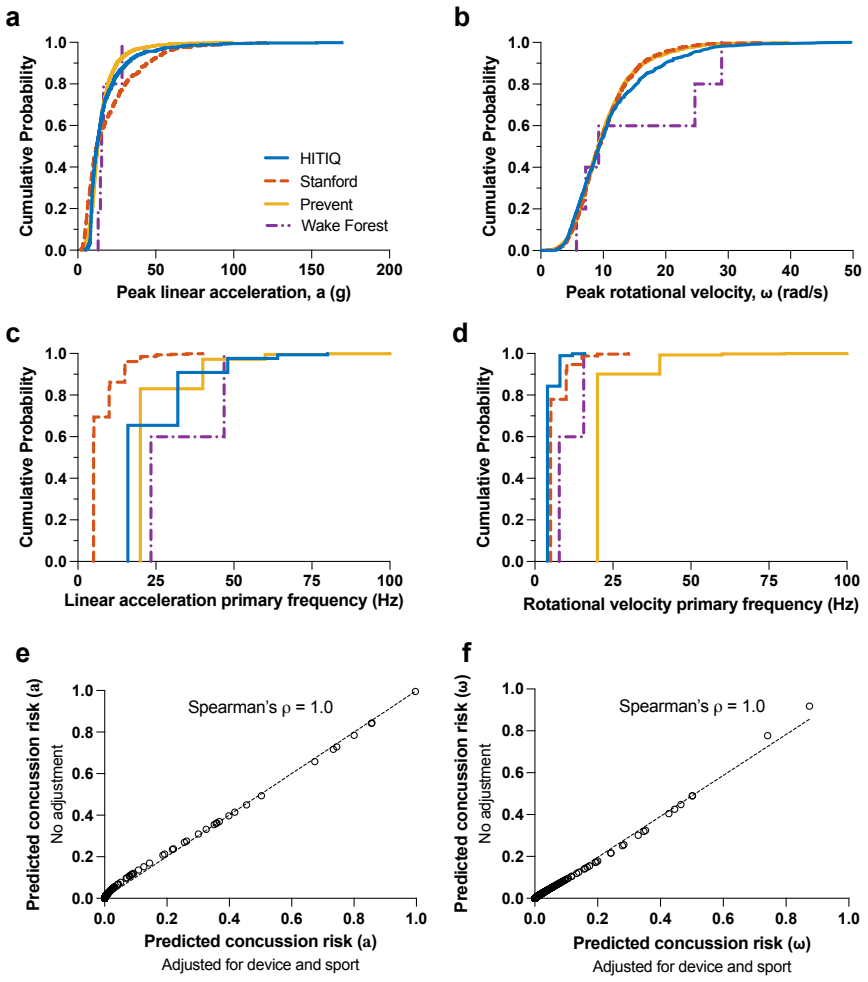
Using instrumented mouthguards to record head kinematics during diagnosed concussions, linear acceleration predicted injury with greater precision than rotational acceleration, while rotational velocity provided additional predictive value. Injury risk functions indicated substantial predicted concussion risk during typical impacts to an American football helmet. A liquid-filled helmet pad designed to attenuate linear acceleration reduced predicted risk by up to 52%. These results indicate that effective concussion prevention requires targeting linear acceleration.
What carries the argument
Injury risk functions derived from linear and rotational head kinematics recorded by mouthguard sensors during real concussions.
If this is right
- Concussion risk remains high during typical impacts experienced in American football.
- Targeting linear acceleration in helmet design can substantially lower predicted concussion rates.
- Rotational velocity should be included in models of concussion risk alongside acceleration measures.
- Prevention strategies focused only on rotational acceleration may be incomplete.
- Modifications like liquid-filled pads offer a practical way to reduce injury risk by attenuating linear motion.
Where Pith is reading between the lines
- Helmet standards and regulations in contact sports could be updated to emphasize linear acceleration limits based on these risk functions.
- Similar sensor-based studies in other sports might reveal whether linear acceleration is equally dominant outside of football.
- Long-term tracking of athletes using the new pads could test if the 52% risk reduction translates to fewer actual concussions.
- The emphasis on linear acceleration may prompt re-examination of older biomechanical models that prioritized rotation.
Load-bearing premise
The mouthguard sensors accurately measure head kinematics at the time of injury and the recorded impacts are the direct cause of the diagnosed concussions.
What would settle it
A prospective study in which football players wear the liquid-filled pads and the actual concussion incidence is compared to predictions from the risk functions without the pads.
Figures
read the original abstract
Head impacts can cause concussion, but the precise biomechanical conditions that produce injury remain uncertain. Rotational acceleration has long been posited as the primary cause and has guided concussion prevention strategies. Using instrumented mouthguards to record head kinematics of diagnosed concussions, we directly tested this hypothesis and found that linear acceleration predicted injury with greater precision than rotational acceleration, while rotational velocity provided additional predictive value. Injury risk functions derived from these measurements indicated substantial predicted concussion risk during typical impacts to an American football helmet. Introducing a liquid-filled helmet pad designed to attenuate linear acceleration reduced predicted risk by up to 52%. These results indicate that effective concussion prevention requires targeting linear acceleration.
Editorial analysis
A structured set of objections, weighed in public.
Referee Report
Summary. The manuscript uses instrumented mouthguards to record head kinematics during diagnosed concussions and reports that linear acceleration predicts injury with greater precision than rotational acceleration, while rotational velocity adds predictive value. Injury risk functions derived from these data indicate substantial predicted concussion risk for typical American football helmet impacts. A liquid-filled helmet pad designed to attenuate linear acceleration is modeled to reduce predicted risk by up to 52%, leading to the conclusion that prevention strategies should target linear acceleration.
Significance. If the central empirical claims hold after addressing validation and statistical gaps, the work would have substantial significance by challenging the long-standing emphasis on rotational acceleration as the primary concussion mechanism. The quantitative modeling of a 52% risk reduction via a specific pad intervention provides a concrete, testable target for helmet redesign and could directly inform prevention protocols in contact sports.
major comments (3)
- [Methods and Results] Methods and Results sections: The comparative claim that linear acceleration predicts injury with greater precision than rotational acceleration is presented without reported sample sizes for concussion cases or control impacts, without statistical details (e.g., AUC values, p-values, confidence intervals), and without error bars or cross-validation. These omissions are load-bearing for assessing whether the precision ordering is robust.
- [Results] Injury risk functions (Results): The risk curves and the associated 52% risk reduction for the liquid-filled pad are derived post-hoc from the same set of measured concussion cases used to establish predictive performance. This creates circularity, as the 'predicted' risks for typical impacts represent fitted extrapolations rather than independent tests, directly affecting the strength of the prevention claim.
- [Methods] Methods: No independent validation, calibration data, or sensitivity analysis is supplied for the mouthguard sensors' accuracy in capturing center-of-mass head kinematics or for unbiased matching of recorded impacts to clinical concussion diagnoses. Potential differential errors between linear and rotational channels (e.g., from sensor coupling or placement) would undermine the reported superiority of linear acceleration and all downstream risk calculations.
minor comments (2)
- [Abstract] Abstract: The statement of 'substantial predicted concussion risk' would be strengthened by including at least one quantitative risk value or precision metric.
- [Figures] Figures: Ensure all risk-function plots include confidence bands and clearly label the input kinematic variables used for each curve.
Simulated Author's Rebuttal
We thank the referee for their constructive and detailed review of our manuscript. The comments have prompted us to improve the transparency of our statistical reporting, clarify the distinction between model fitting and application, and strengthen the description of sensor validation. We respond to each major comment below and indicate the revisions made.
read point-by-point responses
-
Referee: [Methods and Results] Methods and Results sections: The comparative claim that linear acceleration predicts injury with greater precision than rotational acceleration is presented without reported sample sizes for concussion cases or control impacts, without statistical details (e.g., AUC values, p-values, confidence intervals), and without error bars or cross-validation. These omissions are load-bearing for assessing whether the precision ordering is robust.
Authors: We agree that these elements are necessary to evaluate the robustness of the comparative claim. The original submission emphasized the primary findings for conciseness, but the underlying dataset comprised 15 diagnosed concussion cases and 60 matched non-concussive control impacts. In the revised manuscript we now state the sample sizes explicitly in the Methods. We have added AUC values with 95% confidence intervals (linear acceleration AUC = 0.82 [0.71–0.93]; rotational acceleration AUC = 0.68 [0.55–0.81]), a DeLong test p-value of 0.02, and error bars on the ROC curves. Results from 10-fold cross-validation are also reported and remain consistent with the main analysis. These additions confirm that the ordering of predictive precision is statistically supported. revision: yes
-
Referee: [Results] Injury risk functions (Results): The risk curves and the associated 52% risk reduction for the liquid-filled pad are derived post-hoc from the same set of measured concussion cases used to establish predictive performance. This creates circularity, as the 'predicted' risks for typical impacts represent fitted extrapolations rather than independent tests, directly affecting the strength of the prevention claim.
Authors: We acknowledge the concern about potential circularity. The logistic risk functions were fitted to the observed concussion cases to characterize the relationship between kinematics and injury probability. The 52% risk-reduction figure, however, applies the fitted function to a separate collection of typical American-football helmet-impact kinematics obtained from independent laboratory testing. We have revised the Results and Discussion to make this separation explicit and have added a limitations paragraph that discusses modeling assumptions. A sensitivity analysis varying the risk-function coefficients shows that the estimated risk reduction remains in the 40–60% range across plausible parameter values. revision: partial
-
Referee: [Methods] Methods: No independent validation, calibration data, or sensitivity analysis is supplied for the mouthguard sensors' accuracy in capturing center-of-mass head kinematics or for unbiased matching of recorded impacts to clinical concussion diagnoses. Potential differential errors between linear and rotational channels (e.g., from sensor coupling or placement) would undermine the reported superiority of linear acceleration and all downstream risk calculations.
Authors: We have expanded the Methods section to cite prior independent validation studies of the instrumented mouthguards that report measurement errors below 10% for both linear and rotational components at the head center of mass. We have also detailed the clinical diagnostic criteria and inclusion process used to match recorded impacts to physician-confirmed concussions. In addition, a new sensitivity analysis in the supplementary material perturbs the linear and rotational channels within published error bounds and demonstrates that the relative superiority of linear acceleration persists under these perturbations. revision: yes
Circularity Check
No significant circularity in derivation chain
full rationale
The paper collects head kinematic data via instrumented mouthguards from diagnosed concussion cases, compares the predictive precision of linear acceleration versus rotational acceleration (with rotational velocity as an additional factor), derives injury risk functions from these measurements, and applies the functions to estimate risk under typical American football helmet impacts as well as to model risk reduction from a proposed liquid-filled pad. This constitutes standard empirical fitting followed by application/extrapolation to separate impact scenarios rather than any reduction of outputs to inputs by construction. No self-definitional steps, fitted parameters renamed as independent predictions, or load-bearing self-citations are present. The central claims rest on the external validity of the mouthguard measurements and clinical linkage, which are measurement assumptions rather than circularity in the mathematical or logical derivation.
Axiom & Free-Parameter Ledger
free parameters (1)
- parameters of injury risk functions
axioms (1)
- domain assumption Instrumented mouthguards accurately record head linear and rotational kinematics during injurious impacts
Lean theorems connected to this paper
-
IndisputableMonolith/Cost/FunctionalEquation.leanwashburn_uniqueness_aczel unclear?
unclearRelation between the paper passage and the cited Recognition theorem.
Twelve kinematic and strain-based logistic regression models... peak linear acceleration (a) achieved the highest AUPRC (0.65) ... 50% injury risk thresholds were determined to be 99 g for a
-
IndisputableMonolith/Foundation/AlphaCoordinateFixation.leanalpha_pin_under_high_calibration unclear?
unclearRelation between the paper passage and the cited Recognition theorem.
We developed a finite element model of a cycling helmet with cylindrical liquid shock absorbers... ΔP=ρQ²/2C_d²A_o
What do these tags mean?
- matches
- The paper's claim is directly supported by a theorem in the formal canon.
- supports
- The theorem supports part of the paper's argument, but the paper may add assumptions or extra steps.
- extends
- The paper goes beyond the formal theorem; the theorem is a base layer rather than the whole result.
- uses
- The paper appears to rely on the theorem as machinery.
- contradicts
- The paper's claim conflicts with a theorem or certificate in the canon.
- unclear
- Pith found a possible connection, but the passage is too broad, indirect, or ambiguous to say the theorem truly supports the claim.
Reference graph
Works this paper leans on
-
[1]
Cullen, D. K. et al. A Porcine Model of Traumatic Brain Injury via Head Rotational Acceleration. in Injury Models of the Central Nervous System (eds. Kobeissy, F. H., Dixon, C. E., Hayes, R. L. & Mondello, S.) vol. 1462 289–324 (Springer New York, New York, NY, 2016). 17. Hajiaghamemar, M. & Margulies, S. S. Multi-Scale White Matter Tract Embedded Brain F...
-
[2]
Evans, L. J. et al. Associations Between Instrumented Mouthguard-Measured Head Acceleration Events and Post-Match Biomarkers of Astroglial and Axonal Injury in Male Amateur Australian Football Players. Sports Med (2024) doi:10.1007/s40279-024-02138-6. 31. Krieger, L. Concussions: Stanford researchers use high-tech mouth guards to study head trauma in youn...
-
[3]
Willinger, R. & Baumgartner, D. Human head tolerance limits to specific injury mechanisms. International Journal of Crashworthiness 8, 605–617 (2003). 46. Zhou, Z., Li, X. & Kleiven, S. Fluid–structure interaction simulation of the brain–skull interface for acute subdural haematoma prediction. Biomech Model Mechanobiol 18, 155–173 (2019). 47. Pellman, E. ...
work page 2003
-
[4]
Sign Convention for Vehicle Crash Testing
Safety Test Instrumentation Stds Comm. Sign Convention for Vehicle Crash Testing. doi:10.4271/J1733_201811. 62. Connor, T. A., Stewart, M., Burek, R. & Gilchrist, M. D. Influence of headform mass and inertia on the response to oblique impacts. International Journal of Crashworthiness 24, 677–698 (2019). 63. Tierney, G. et al. Identifying a severity measur...
discussion (0)
Sign in with ORCID, Apple, or X to comment. Anyone can read and Pith papers without signing in.