REVIEW 4 major objections 4 minor 58 references
THYME: Temporal Hierarchical-Cyclic Interactivity Modeling for Video Scene Graphs in Aerial Footage
T0 review · 4 major / 4 minor · reviewed 2026-08-06 · deepseek-v4-flash
Pith's one-line read THYME combines hierarchical spatial aggregation with cyclic temporal attention to improve video scene graph generation on both ground and aerial benchmarks.
desk verdict A plausible incremental combination of the authors' own modules with a useful dataset extension, but the temporal refinement step silently assumes DETR slots are stable object identities, and the experimental reporting needs tightening. read the letter →
The pith
A machine-rendered reading of the paper's core claim, the machinery that carries it, and where it could break.
The reading
What carries the argument
Two mechanisms carry the argument. Hierarchical feature aggregation updates each object's feature by attention-weighted sums over all objects in the same frame, for several levels, so single-frame graphs are built at multiple spatial scales. Cyclic temporal attention then joins each object's sequence of high-level features into a ring by indexing time with modulo arithmetic, allowing every time step, including the last, to attend to every other step; this is the mechanism the paper credits for long-range coherence and for surviving occlusions and re-entry. The five interactivity types in the AeroEye-v1.0 dataset also function as machinery, because the paper uses them to define the predicate vocabulary that both anchors and evaluates the method.
What would settle it
Take a video, shuffle the order of the detected object queries in a single frame while leaving all visual content unchanged, and rerun THYME; if recall or mean recall changes materially, the temporal stage is responding to slot identity rather than object identity, which would put the claimed temporal-coherence benefit in question.
Extended reading notes
Core claim
On its own terms, the paper's central claim is that integrating hierarchical feature aggregation with cyclic temporal refinement yields video scene graphs that are simultaneously more spatially detailed and more temporally coherent than either component alone. The model extracts DETR object-query embeddings per frame, refines them through multiple levels of attention-based aggregation over all objects in the frame, and then, for each object Si, builds the temporal sequence X_t'(Si) = $F^{{Lh}}$_t'(Si) and applies cyclic attention in which the attention weight for time offset τ uses indices (t'+τ) mod T'. The refined features feed a gated relation decoder that predicts predicates for every object pair, and focal loss is summed over hierarchical levels. The paper reports this design outperforms HIG, CYCLO, STTran, TEMPURA, and other baselines on ASPIRe and AeroEye-v1.0, with the largest gains on double-actor predicates such as position, interaction, and relation.
Load-bearing premise
The temporal stage assumes that the same detector query slot keeps referring to the same physical object across frames, but the paper does not describe any tracking, matching, or identity-preservation step to guarantee that.
Editorial extensions
If this is right
- If THYME is correct, video scene graph models can combine fine-grained per-frame spatial reasoning with long-range temporal coherence in one architecture, removing the frame-level versus video-level tradeoff.
- Cyclic attention would reduce predicate flicker and keep relationships stable when objects disappear and reappear, since the sequence wraps and preserves historical context.
- AeroEye-v1.0 gives the field a drone-captured benchmark with all five interactivity types, so aerial scene understanding can be measured separately from ground-view performance.
- The reported 2 to 3 percent recall and mean recall gains on ASPIRe and AeroEye-v1.0 imply the combined mechanism transfers across viewpoints and predicate vocabularies.
Reading between the lines
- The paper does not say this, but the cyclic temporal stage is only as good as the slot-to-object correspondence: because no tracking or association step is described, an explicit re-identification module inserted before cyclic attention is a natural extension that could strengthen the same reported gains.
- A testable extension would be to apply the same hierarchy-plus-cycle recipe to other sequence tasks, such as action recognition or trajectory prediction, where short-lived interactions and long-range context also compete.
- The dataset's long-tail predicate statistics suggest the model's mean-recall improvements may be driven by better handling of rare predicates; an ablation that re-weights or removes rare predicates would show whether the gain is specifically a long-tail effect.
Editorial analysis
A structured set of objections, weighed in public.
Referee Report
Summary. The paper introduces THYME, a video scene graph generation method that combines hierarchical intra-frame feature aggregation with cyclic temporal attention, and simultaneously introduces AeroEye-v1.0, a new aerial video dataset annotated with five interactivity types (appearance, situation, position, interaction, relation). The authors evaluate THYME on ASPIRe and AeroEye-v1.0, reporting state-of-the-art results with claimed 2-3% improvements in recall and mean recall over prior methods, and they provide ablations on hierarchical depth, attention type, and temporal window size.
Significance. If the results hold, the paper offers a practically relevant architecture that directly combines two previously separate ideas, and the AeroEye-v1.0 dataset could fill a real gap in aerial-view video scene graph benchmarks. The manuscript is explicit in its model equations, includes comparative tables with several baselines, and reports ablations that help localize the contribution of hierarchical aggregation and cyclic attention. However, the central temporal-coherence claim depends on an unstated cross-frame identity assumption, one experimental table directly contradicts its accompanying text, and the stated 2-3% improvement is not supported for mean recall. These issues need to be resolved before the performance claims can be accepted.
major comments (4)
- [Section IV-C, Eqs. (3)-(5)] The temporal refinement stage constructs, for each "tracked object" S_i, a sequence {X_t'(S_i)} whose elements are F^(L_h)_t'(S_i), but no cross-frame association, tracking, or re-identification step is described that would make the DETR query index i correspond to the same physical object over time. DETR queries are per-frame detection slots and are assigned by a per-frame matching process; they are not tracklets, and the paper's own qualitative examples (Figs. 5 and 6) show objects leaving and re-entering. Without an explicit association mechanism, or at least a clear statement of the temporal pooling that defines T' and handles missing frames, the sequences fed to cyclic attention may mix features from different objects, and the reported temporal gains cannot be attributed to coherent object trajectories. Please specify this association step or provide evidence that query indices are identity-stable.
- [Section VI-B-3, Table IV] The text and Table IV are inconsistent: the text says the 3/4 window gives Appearance 16.22 R@20 / 0.67 mR@20 and Position 15.22 / 1.03, while the full window gives 16.52 / 0.68 and 15.52 / 1.05; Table IV instead lists 3/4 as 16.52 / 0.68 and 15.52 / 1.05 and Full as 16.22 / 0.67 and 15.22 / 1.03. The text also refers to the smallest window as "1" although the table labels it "1/2". Please correct this mismatch and state explicitly which window size is used in the main comparisons, since the current contradiction undermines the temporal-window ablation.
- [Abstract and contribution list] The claimed "consistent improvements of 2 to 3% in recall and mean recall" is not supported by the reported mR values. In Table VI (AeroEye-v1.0), the mR@20 differences between THYME and CYCLO are 0.30 (Position), 0.02 (Interaction), and 0.12 (Relation); Table V shows similarly small mR margins. The 2-3% margin holds approximately for some R@20 values on double-actor predicates, but not for mean recall. Please rephrase the claim to be specific about the metric and the predicate types, or report the mean-recall margins accurately.
- [Sections V and VI-C-2] AeroEye-v1.0 is introduced and evaluated by the same authors in this paper, and the main SOTA claim rests partly on it, yet Section V provides only aggregate statistics and no train/validation/test split, annotation agreement, or release plan. Please describe the dataset splits, annotation protocol, and availability so that Table VI can be reproduced and so that the use of an in-house benchmark does not make the comparison circular.
minor comments (4)
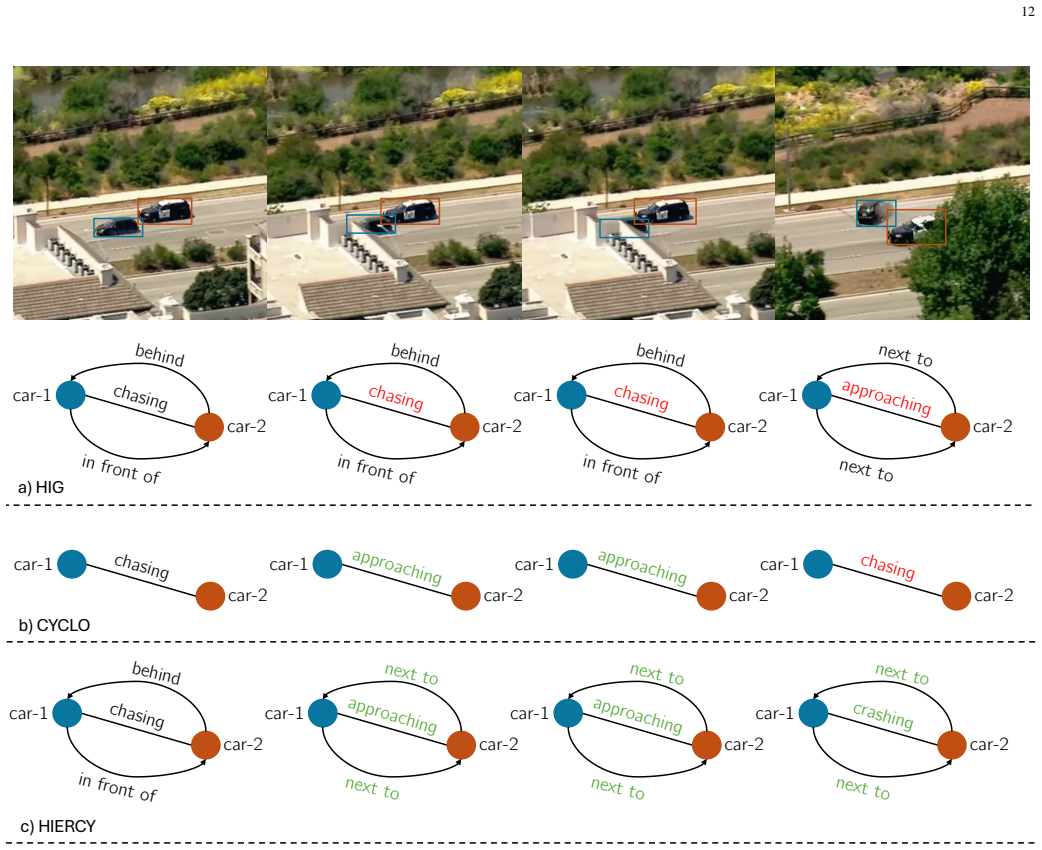
- [Figures 5 and 6] The proposed method is labeled "HIERCY" in both qualitative figures, while the paper consistently calls it THYME; please correct the figure labels.
- [Table II and Section VI-B-1] The table header "factor size" and the section title "Number of Hierarchical Levels" are inconsistent; please define what the 1/4, 1/2, 3/4, and Full entries mean in terms of L_h.
- [Section VI-B-3] Please clarify whether the temporal window size is a fraction of the video length or a number of frames, and how the pooled time steps T' in Eq. (3) are obtained from the original frame count T.
- [Captions of Figures 5 and 6] The caption text "red edges is incorrect predictions" should be corrected to "red edges denote incorrect predictions," and the qualitative claims about tracking should be made consistent with the actual mechanism described in Section IV.
Circularity Check
No significant circularity: THYME integrates two self-cited modules but specifies them fully with equations and ablations; the self-authored benchmark is an external-validity concern, not a derivation-level circularity.
full rationale
The paper does not contain a prediction that is equivalent to its inputs by construction. The two core components, hierarchical feature aggregation and cyclic temporal attention, are adopted from the authors' prior work [32, 33], but the present paper states the full equations (Eqs. 1-5) and tests them in ablations (Tables II-IV), so the self-citations are not the only support for the mechanism. No uniqueness theorem is imported, and no ansatz is smuggled solely through citation. The AeroEye-v1.0 benchmark is self-authored and self-evaluated, which limits independent verification of the 'state-of-the-art' claim, but a self-created dataset is a contribution rather than a circular derivation. The temporal-refinement stage (Sec. IV-C) assumes that DETR query index i corresponds to the same physical object across frames without describing tracking or association; this is an unverified modeling assumption that threatens attribution of the temporal gains, but it is not a circularity of the kind where the output is defined in terms of the input. Because the central empirical claim rests on measurements rather than on a chain of definitions, the appropriate finding is no significant circularity.
Assumptions & free parameters
free parameters (3)
- hierarchical aggregation depth Lh =
not reported (ablated as 1/4, 1/2, 3/4, Full in Table II)
- temporal window size T' =
not reported (ablated as 1/2, 3/4, Full in Table IV)
- focal loss coefficients alpha_t, gamma =
not reported (adopted from HIG [32])
assumptions (4)
- domain assumption DETR query embeddings preserve object identity across frames
- domain assumption The five interactivity types are separable and consistently annotatable
- domain assumption Fixed temporal windows are sufficient for interaction durations
- standard math Standard dot-product attention and transformer blocks are correct
invented entities (1)
-
AeroEye-v1.0 dataset
Cite this review
Pith. "Pith review of THYME: Temporal Hierarchical-Cyclic Interactivity Modeling for Video Scene Graphs in Aerial Footage." pith.science (2026). https://pith.science/paper/TOXMCC7X
@misc{pith2026250709200,
  author       = {Pith},
  title        = {Pith review of: THYME: Temporal Hierarchical-Cyclic Interactivity Modeling for Video Scene Graphs in Aerial Footage},
  year         = {2026},
  howpublished = {\url{https://pith.science/paper/TOXMCC7X}},
  note         = {Machine review of arXiv:2507.09200}
}
read the original abstract
The rapid proliferation of video in applications such as autonomous driving, surveillance, and sports analytics necessitates robust methods for dynamic scene understanding. Despite advances in static scene graph generation and early attempts at video scene graph generation, previous methods often suffer from fragmented representations, failing to capture fine-grained spatial details and long-range temporal dependencies simultaneously. To address these limitations, we introduce the Temporal Hierarchical Cyclic Scene Graph (THYME) approach, which synergistically integrates hierarchical feature aggregation with cyclic temporal refinement to address these limitations. In particular, THYME effectively models multi-scale spatial context and enforces temporal consistency across frames, yielding more accurate and coherent scene graphs. In addition, we present AeroEye-v1.0, a novel aerial video dataset enriched with five types of interactivity that overcome the constraints of existing datasets and provide a comprehensive benchmark for dynamic scene graph generation. Empirically, extensive experiments on ASPIRe and AeroEye-v1.0 demonstrate that the proposed THYME approach outperforms state-of-the-art methods, offering improved scene understanding in ground-view and aerial scenarios.
Figures


Figures from the paper (3 more)


Reference graph
Works this paper leans on
-
[1]
End-to-end object detection with transformers
Nicolas Carion, Francisco Massa, Gabriel Synnaeve, Nicolas Usunier, Alexander Kirillov, and Sergey Zagoruyko. End-to-end object detection with transformers. In European conference on computer vision , pages 213–229. Springer, 2020. 6
work page 2020
-
[2]
Unifying short and long-term tracking with graph hierarchies
Orcun Cetintas, Guillem Brasó, and Laura Leal-Taixé. Unifying short and long-term tracking with graph hierarchies. In Proceedings of the IEEE/CVF Conference on Computer Vision and Pattern Recognition , pages 22877–22887, 2023. 2
work page 2023
-
[3]
More knowledge, less bias: Unbiasing scene graph generation with explicit ontological adjustment
Zhanwen Chen, Saed Rezayi, and Sheng Li. More knowledge, less bias: Unbiasing scene graph generation with explicit ontological adjustment. In Proceedings of the IEEE/CVF Winter Conference on Applications of Computer Vision, pages 4023–4032, 2023. 3
work page 2023
-
[4]
Spatial-temporal transformer for dynamic scene graph generation
Yuren Cong, Wentong Liao, Hanno Ackermann, Bodo Rosenhahn, and Michael Ying Yang. Spatial-temporal transformer for dynamic scene graph generation. In Proceedings of the IEEE/CVF international conference on computer vision , pages 16372–16382, 2021. 3
work page 2021
-
[5]
Reltr: Relation transformer for scene graph generation
Yuren Cong, Michael Ying Yang, and Bodo Rosenhahn. Reltr: Relation transformer for scene graph generation. IEEE Transactions on Pattern Analysis and Machine Intelligence , 45(9):11169–11183, 2023. 2, 4
work page 2023
-
[6]
Rescaling egocentric vision: Collection, pipeline and challenges for epic-kitchens-100
Dima Damen, Hazel Doughty, Giovanni Maria Farinella, Antonino Furnari, Evangelos Kazakos, Jian Ma, Davide Moltisanti, Jonathan Munro, Toby Perrett, Will Price, et al. Rescaling egocentric vision: Collection, pipeline and challenges for epic-kitchens-100. International Journal of Computer Vision, pages 1–23, 2022. 3
work page 2022
-
[7]
Hierarchical Object-oriented Spatio-Temporal Reasoning for Video Question Answering
Long Hoang Dang, Thao Minh Le, Vuong Le, and Truyen Tran. Hierarchical object-oriented spatio-temporal reasoning for video question answering. arXiv preprint arXiv:2106.13432 , 2021. 2
work page Pith review arXiv 2021
-
[8]
Skateformer: skeletal-temporal transformer for human action recognition
Jeonghyeok Do and Munchurl Kim. Skateformer: skeletal-temporal transformer for human action recognition. In European Conference on Computer Vision, pages 401–420. Springer, 2024. 2
work page 2024
Show all 58 references
-
[9]
Exploiting long-term dependencies for generating dynamic scene graphs
Shengyu Feng, Hesham Mostafa, Marcel Nassar, Somdeb Majumdar, and Subarna Tripathi. Exploiting long-term dependencies for generating dynamic scene graphs. In Proceedings of the IEEE/CVF Winter Conference on Applications of Computer Vision , pages 5130–5139, 2023. 2, 3, 4
2023
-
[10]
Mist: Multi-modal iterative spatial-temporal transformer for long- form video question answering
Difei Gao, Luowei Zhou, Lei Ji, Linchao Zhu, Yi Yang, and Mike Zheng Shou. Mist: Multi-modal iterative spatial-temporal transformer for long- form video question answering. In Proceedings of the IEEE/CVF conference on computer vision and pattern recognition , pages 14773– 1478...
2023
-
[11]
Graphdreamer: Compositional 3d scene synthesis from scene graphs
Gege Gao, Weiyang Liu, Anpei Chen, Andreas Geiger, and Bernhard Schölkopf. Graphdreamer: Compositional 3d scene synthesis from scene graphs. arXiv preprint arXiv:2312.00093 , 2023. 3
2023 arXiv
-
[12]
Dsgg: Dense relation transformer for an end-to-end scene graph generation
Zeeshan Hayder and Xuming He. Dsgg: Dense relation transformer for an end-to-end scene graph generation. In Proceedings of the IEEE/CVF Conference on Computer Vision and Pattern Recognition , pages 28317– 28326, 2024. 2, 3, 4
2024
-
[13]
Toward a unified transformer-based framework for scene graph generation and human- object interaction detection
Tao He, Lianli Gao, Jingkuan Song, and Yuan-Fang Li. Toward a unified transformer-based framework for scene graph generation and human- object interaction detection. IEEE Transactions on Image Processing , 32:6274–6288, 2023. 2, 4
2023
-
[14]
Gqa: A new dataset for real-world visual reasoning and compositional question answering
Drew A Hudson and Christopher D Manning. Gqa: A new dataset for real-world visual reasoning and compositional question answering. In Proceedings of the IEEE/CVF conference on computer vision and pattern recognition, pages 6700–6709, 2019. 3
2019
-
[15]
Hierarchical spatio–temporal graph convolutional networks and transformer network for traffic flow forecasting
Guangyu Huo, Yong Zhang, Boyue Wang, Junbin Gao, Yongli Hu, and Baocai Yin. Hierarchical spatio–temporal graph convolutional networks and transformer network for traffic flow forecasting. IEEE Transactions 13 on Intelligent Transportation Systems , 24(4):3855–3867, 2023. 2
2023
-
[16]
Egtr: Extracting graph from transformer for scene graph generation
Jinbae Im, JeongYeon Nam, Nokyung Park, Hyungmin Lee, and Seunghyun Park. Egtr: Extracting graph from transformer for scene graph generation. In Proceedings of the IEEE/CVF Conference on Computer Vision and Pattern Recognition , pages 24229–24238, 2024. 2, 3, 4, 5, 7
2024
-
[17]
Action genome: Actions as compositions of spatio-temporal scene graphs
Jingwei Ji, Ranjay Krishna, Li Fei-Fei, and Juan Carlos Niebles. Action genome: Actions as compositions of spatio-temporal scene graphs. In Proceedings of the IEEE/CVF Conference on Computer Vision and Pattern Recognition, pages 10236–10247, 2020. 2, 3
2020
-
[18]
Hdgt: Heterogeneous driving graph transformer for multi-agent trajectory prediction via scene encoding
Xiaosong Jia, Penghao Wu, Li Chen, Yu Liu, Hongyang Li, and Junchi Yan. Hdgt: Heterogeneous driving graph transformer for multi-agent trajectory prediction via scene encoding. IEEE transactions on pattern analysis and machine intelligence , 45(11):13860–13875, 2023. 2
2023
-
[19]
Fast contextual scene graph generation with unbiased context augmentation
Tianlei Jin, Fangtai Guo, Qiwei Meng, Shiqiang Zhu, Xiangming Xi, Wen Wang, Zonghao Mu, and Wei Song. Fast contextual scene graph generation with unbiased context augmentation. In Proceedings of the IEEE/CVF Conference on Computer Vision and Pattern Recognition , pages 6302–63...
2023
-
[20]
Hierarchical cross-modal graph consistency learning for video-text retrieval
Weike Jin, Zhou Zhao, Pengcheng Zhang, Jieming Zhu, Xiuqiang He, and Yueting Zhuang. Hierarchical cross-modal graph consistency learning for video-text retrieval. In Proceedings of the 44th International ACM SIGIR Conference on research and development in information retrieval...
2021
-
[21]
Segmentation-grounded scene graph generation
Siddhesh Khandelwal, Mohammed Suhail, and Leonid Sigal. Segmentation-grounded scene graph generation. In Proceedings of the IEEE/CVF International Conference on Computer Vision , pages 15879– 15889, 2021. 3
2021
-
[22]
Llm4sgg: Large language model for weakly supervised scene graph generation
Kibum Kim, Kanghoon Yoon, Jaehyeong Jeon, Yeonjun In, Jinyoung Moon, Donghyun Kim, and Chanyoung Park. Llm4sgg: Large language model for weakly supervised scene graph generation. In Proceedings of the IEEE/CVF Conference on Computer Vision and Pattern Recognition ,
-
[23]
Llm4sgg: Large language models for weakly supervised scene graph generation
Kibum Kim, Kanghoon Yoon, Jaehyeong Jeon, Yeonjun In, Jinyoung Moon, Donghyun Kim, and Chanyoung Park. Llm4sgg: Large language models for weakly supervised scene graph generation. In Proceedings of the IEEE/CVF Conference on Computer Vision and Pattern Recognition , pages 2830...
2024
-
[24]
Visual genome: Connecting language and vision using crowdsourced dense image annotations
Ranjay Krishna, Yuke Zhu, Oliver Groth, Justin Johnson, Kenji Hata, Joshua Kravitz, Stephanie Chen, Yannis Kalantidis, Li-Jia Li, David A Shamma, et al. Visual genome: Connecting language and vision using crowdsourced dense image annotations. International journal of computer ...
2017
-
[25]
Is-ggt: Iterative scene graph generation with generative transformers
Sanjoy Kundu and Sathyanarayanan N Aakur. Is-ggt: Iterative scene graph generation with generative transformers. In Proceedings of the IEEE/CVF Conference on Computer Vision and Pattern Recognition , pages 6292–6301, 2023. 2, 3, 4
2023
-
[26]
Hero: Hierarchical encoder for video+ language omni-representation pre-training
Linjie Li, Yen-Chun Chen, Yu Cheng, Zhe Gan, Licheng Yu, and Jingjing Liu. Hero: Hierarchical encoder for video+ language omni-representation pre-training. arXiv preprint arXiv:2005.00200 , 2020. 2
2005 arXiv
-
[27]
Sgtr: End-to-end scene graph generation with transformer
Rongjie Li, Songyang Zhang, and Xuming He. Sgtr: End-to-end scene graph generation with transformer. In proceedings of the IEEE/CVF conference on computer vision and pattern recognition , pages 19486– 19496, 2022. 2, 3, 4, 5
2022
-
[28]
Vrr-vg: Refocusing visually-relevant relationships
Yuanzhi Liang, Yalong Bai, Wei Zhang, Xueming Qian, Li Zhu, and Tao Mei. Vrr-vg: Refocusing visually-relevant relationships. In Proceedings of the IEEE/CVF international conference on computer vision , pages 10403–10412, 2019. 3
2019
-
[29]
Social graph transformer networks for pedestrian trajectory prediction in complex social scenarios
Yao Liu, Lina Yao, Binghao Li, Xianzhi Wang, and Claude Sammut. Social graph transformer networks for pedestrian trajectory prediction in complex social scenarios. In Proceedings of the 31st ACM International Conference on Information & Knowledge Management, pages 1339–1349,
-
[30]
Graph transformer net- work with temporal kernel attention for skeleton-based action recognition
Yanan Liu, Hao Zhang, Dan Xu, and Kangjian He. Graph transformer net- work with temporal kernel attention for skeleton-based action recognition. Knowledge-Based Systems, 240:108146, 2022. 2
2022
-
[31]
Unbiased scene graph generation in videos
Sayak Nag, Kyle Min, Subarna Tripathi, and Amit K Roy-Chowdhury. Unbiased scene graph generation in videos. In Proceedings of the IEEE/CVF Conference on Computer Vision and Pattern Recognition , pages 22803–22813, 2023. 3, 4
2023
-
[32]
Hig: Hierarchical interlacement graph approach to scene graph generation in video understanding
Trong-Thuan Nguyen, Pha Nguyen, and Khoa Luu. Hig: Hierarchical interlacement graph approach to scene graph generation in video understanding. In Proceedings of the IEEE/CVF Conference on Computer Vision and Pattern Recognition , 2024. 2, 3, 4, 5, 7, 8
2024
-
[33]
CYCLO: Cyclic graph transformer approach to multi-object relationship modeling in aerial videos
Trong-Thuan Nguyen, Pha Nguyen, Li Xin, Cothren Jackson, Yilmaz Alper, and Khoa Luu. CYCLO: Cyclic graph transformer approach to multi-object relationship modeling in aerial videos. In The Thirty-eighth Annual Conference on Neural Information Processing Systems , 2024. 2, 3, 4...
2024
-
[34]
Learning hierarchical relationships for object-goal navigation
Anwesan Pal, Yiding Qiu, and Henrik Christensen. Learning hierarchical relationships for object-goal navigation. In Conference on Robot Learning, pages 517–528. PMLR, 2021. 2
2021
-
[35]
Igformer: Interaction graph transformer for skeleton-based human interaction recognition
Yunsheng Pang, Qiuhong Ke, Hossein Rahmani, James Bailey, and Jun Liu. Igformer: Interaction graph transformer for skeleton-based human interaction recognition. In European Conference on Computer Vision , pages 605–622. Springer, 2022. 2
2022
-
[36]
Video relation detection with spatio-temporal graph
Xufeng Qian, Yueting Zhuang, Yimeng Li, Shaoning Xiao, Shiliang Pu, and Jun Xiao. Video relation detection with spatio-temporal graph. In Proceedings of the 27th ACM international conference on multimedia , pages 84–93, 2019. 3, 4
2019
-
[37]
Annotating objects and relations in user-generated videos
Xindi Shang, Donglin Di, Junbin Xiao, Yu Cao, Xun Yang, and Tat-Seng Chua. Annotating objects and relations in user-generated videos. In Proceedings of the 2019 on International Conference on Multimedia Retrieval, pages 279–287, 2019. 3
2019
-
[38]
Video visual relation detection via iterative inference
Xindi Shang, Yicong Li, Junbin Xiao, Wei Ji, and Tat-Seng Chua. Video visual relation detection via iterative inference. In Proceedings of the 29th ACM international conference on Multimedia , pages 3654–3663,
-
[39]
Video visual relation detection
Xindi Shang, Tongwei Ren, Jingfan Guo, Hanwang Zhang, and Tat-Seng Chua. Video visual relation detection. In Proceedings of the 25th ACM international conference on Multimedia , pages 1300–1308, 2017. 3
2017
-
[40]
Progress-aware online action segmentation for egocentric procedural task videos
Yuhan Shen and Ehsan Elhamifar. Progress-aware online action segmentation for egocentric procedural task videos. In Proceedings of the IEEE/CVF Conference on Computer Vision and Pattern Recognition , pages 18186–18197, 2024. 2
2024
-
[41]
Target adaptive context aggregation for video scene graph generation
Yao Teng, Limin Wang, Zhifeng Li, and Gangshan Wu. Target adaptive context aggregation for video scene graph generation. In Proceedings of the IEEE/CVF International Conference on Computer Vision , pages 13688–13697, 2021. 2, 3, 4, 5
2021
-
[42]
Video relationship reasoning using gated spatio-temporal energy graph
Yao-Hung Hubert Tsai, Santosh Divvala, Louis-Philippe Morency, Ruslan Salakhutdinov, and Ali Farhadi. Video relationship reasoning using gated spatio-temporal energy graph. In Proceedings of the IEEE/CVF Conference on Computer Vision and Pattern Recognition , pages 10424– 1043...
2019
-
[43]
Attention is all you need
Ashish Vaswani, Noam Shazeer, Niki Parmar, Jakob Uszkoreit, Llion Jones, Aidan N Gomez, Łukasz Kaiser, and Illia Polosukhin. Attention is all you need. Advances in neural information processing systems , 30,
-
[44]
Oed: Towards one-stage end-to-end dynamic scene graph generation
Guan Wang, Zhimin Li, Qingchao Chen, and Yang Liu. Oed: Towards one-stage end-to-end dynamic scene graph generation. In Proceedings of the IEEE/CVF Conference on Computer Vision and Pattern Recognition , pages 27938–27947, 2024. 2, 4, 5
2024
-
[45]
Pair then relation: Pair-net for panoptic scene graph generation
Jinghao Wang, Zhengyu Wen, Xiangtai Li, Zujin Guo, Jingkang Yang, and Ziwei Liu. Pair then relation: Pair-net for panoptic scene graph generation. IEEE Transactions on Pattern Analysis and Machine Intelligence , 2024. 3
2024
-
[46]
Sportshhi: A dataset for human-human interaction detection in sports videos
Tao Wu, Runyu He, Gangshan Wu, and Limin Wang. Sportshhi: A dataset for human-human interaction detection in sports videos. In Proceedings of the IEEE/CVF Conference on Computer Vision and Pattern Recognition ,
-
[47]
Video as conditional graph hierarchy for multi-granular question answering
Junbin Xiao, Angela Yao, Zhiyuan Liu, Yicong Li, Wei Ji, and Tat- Seng Chua. Video as conditional graph hierarchy for multi-granular question answering. In Proceedings of the AAAI Conference on Artificial Intelligence, volume 36, pages 2804–2812, 2022. 2
2022
-
[48]
Contrastive video question answering via video graph transformer
Junbin Xiao, Pan Zhou, Angela Yao, Yicong Li, Richang Hong, Shuicheng Yan, and Tat-Seng Chua. Contrastive video question answering via video graph transformer. IEEE Transactions on Pattern Analysis and Machine Intelligence, 45(11):13265–13280, 2023. 2
2023
-
[49]
Scene graph generation by iterative message passing
Danfei Xu, Yuke Zhu, Christopher B Choy, and Li Fei-Fei. Scene graph generation by iterative message passing. In Proceedings of the IEEE conference on computer vision and pattern recognition, pages 5410–5419,
-
[50]
A multi-task learning network with a collision- aware graph transformer for traffic-agents trajectory prediction
Biao Yang, Fucheng Fan, Rongrong Ni, Hai Wang, Ammar Jafaripourn- imchahi, and Hongyu Hu. A multi-task learning network with a collision- aware graph transformer for traffic-agents trajectory prediction. IEEE Transactions on Intelligent Transportation Systems , 25(7):6677–6690,
-
[51]
Panoptic scene graph generation
Jingkang Yang, Yi Zhe Ang, Zujin Guo, Kaiyang Zhou, Wayne Zhang, and Ziwei Liu. Panoptic scene graph generation. In European Conference on Computer Vision , pages 178–196. Springer, 2022. 1, 3
2022
-
[52]
Panoptic video scene graph generation
Jingkang Yang, Wenxuan Peng, Xiangtai Li, Zujin Guo, Liangyu Chen, Bo Li, Zheng Ma, Kaiyang Zhou, Wayne Zhang, Chen Change Loy, et al. Panoptic video scene graph generation. In Proceedings of the IEEE/CVF Conference on Computer Vision and Pattern Recognition , pages 18675–1868...
2023
-
[53]
Trajgat: A graph-based long-term dependency modeling approach for trajectory similarity computation
Di Yao, Haonan Hu, Lun Du, Gao Cong, Shi Han, and Jingping Bi. Trajgat: A graph-based long-term dependency modeling approach for trajectory similarity computation. In Proceedings of the 28th ACM 14 SIGKDD conference on knowledge discovery and data mining , pages 2275–2285, 2022. 2
2022
-
[54]
Graph transformer networks
Seongjun Yun, Minbyul Jeong, Raehyun Kim, Jaewoo Kang, and Hyunwoo J Kim. Graph transformer networks. Advances in neural information processing systems , 32, 2019. 2
2019
-
[55]
Hiker-sgg: Hierarchical knowledge enhanced robust scene graph generation
Ce Zhang, Simon Stepputtis, Joseph Campbell, Katia Sycara, and Yaqi Xie. Hiker-sgg: Hierarchical knowledge enhanced robust scene graph generation. In Proceedings of the IEEE/CVF Conference on Computer Vision and Pattern Recognition , pages 28233–28243, 2024. 2
2024
-
[56]
Where does it exist: Spatio-temporal video grounding for multi-form sentences
Zhu Zhang, Zhou Zhao, Yang Zhao, Qi Wang, Huasheng Liu, and Lianli Gao. Where does it exist: Spatio-temporal video grounding for multi-form sentences. In Proceedings of the IEEE/CVF Conference on Computer Vision and Pattern Recognition , pages 10668–10677, 2020. 3
2020
-
[57]
Textpsg: Panoptic scene graph generation from textual descriptions
Chengyang Zhao, Yikang Shen, Zhenfang Chen, Mingyu Ding, and Chuang Gan. Textpsg: Panoptic scene graph generation from textual descriptions. In Proceedings of the IEEE/CVF International Conference on Computer Vision , pages 2839–2850, 2023. 3
2023
-
[58]
Hi- erarchical planning for long-horizon manipulation with geometric and symbolic scene graphs
Yifeng Zhu, Jonathan Tremblay, Stan Birchfield, and Yuke Zhu. Hi- erarchical planning for long-horizon manipulation with geometric and symbolic scene graphs. In 2021 IEEE International Conference on Robotics and Automation (ICRA) , pages 6541–6548. Ieee, 2021. 2
2021
Reviewed August 6, 2026 · model on record in the stance chip above.
Discussion (0). Sign in to comment.