REVIEW 3 major objections 4 minor 22 references
Online Long-term Point Tracking in the Foundation Model Era
T0 review · 3 major / 4 minor · reviewed 2026-08-06 · deepseek-v4-flash
Pith's one-line read A causal frame-by-frame tracker can match offline models on long-term point tracking.
desk verdict Competent thesis packaging two peer-reviewed papers; Track-On's empirical core is solid, but the SOTA claim is overstated and the error-propagation mechanism is asserted, not demonstrated. read the letter →
The pith
A machine-rendered reading of the paper's core claim, the machinery that carries it, and where it could break.
The reading
What carries the argument
The central object is the Track-On query decoder with its two memory modules. Treating each tracked point as a query lets a standard transformer decoder localize many points in one forward pass through the frame; the coarse-to-fine prediction pipeline (patch classification, top-k re-ranking, deformable offset head) replaces the iterative cost-volume regression used by prior trackers. Spatial memory $M_s$ is written by attending a local neighborhood around the current prediction and read by updating the initial query against all stored entries, which is how feature drift is counteracted. Context memory $M_c$ feeds past query embeddings into the decoder, giving the model a bounded history of appearance and occlusions. Because both memories are FIFO queues of fixed size with learnable positional embeddings, the model can be trained on short clips and run on arbitrarily long videos by interpolating the embeddings at inference time.
What would settle it
Deliberately shift the predicted location used to write spatial memory in the first few frames by 10-20 pixels, then compare downstream tracking error against the unperturbed run; if one early wrong prediction substantially increases error later, the claim that memory writes prevent error propagation is refuted.
Extended reading notes
Core claim
Track-On demonstrates that online, frame-by-frame point tracking can match offline performance. Each point of interest is a query token in a transformer decoder that attends to the current frame; the model predicts where the point is by classifying which patch of the feature map contains it, re-ranking the top-k candidate patches with a dedicated module, and then refining the chosen patch center with an offset head. Visibility and uncertainty are predicted separately. To keep tracks coherent over time without future access, Track-On maintains two FIFO memory modules: spatial memory $M_s$ stores local features around the model's previous predictions and updates the initial query to counter feature drift, while context memory $M_c$ stores previously decoded query embeddings so the decoder can see appearance changes and occlusion history. Memory is trained with size $K=12$ and extended at inference to up to $K=96$ by interpolating positional embeddings. Evaluated on TAP-Vid DAVIS, RGB-Stacking, and Kinetics plus RoboTAP, Dynamic Replica, BADJA, and PointOdyssey, Track-On achieves the best results among online trackers and is competitive with or better than offline baselines on the same training data.
Load-bearing premise
The spatial memory assumes the model's own recent predictions are close enough to the true point that features sampled around them refresh the query correctly, so a wrong early prediction could store misleading content and amplify drift instead of preventing it.
Editorial extensions
If this is right
- Online point tracking can be deployed in streaming and embodied settings: Track-On processes one frame at a time with a single backbone forward pass and does not need a sliding window or full-video attention.
- A tracker trained on 24-frame synthetic clips can generalize to videos with thousands of frames, since the memory size is extended at inference rather than retrained.
- Patch classification with top-k re-ranking and offset refinement is a workable alternative to iterative regression, yielding fine-grained predictions at low error thresholds.
- Foundation model features provide the geometric initialization, but temporal consistency still requires dedicated memory; frozen or lightly adapted backbones alone are not enough.
- The reported efficiency (~16.8 FPS at $K=48$ with about 0.73 GB GPU memory while tracking roughly 400 points) puts online long-term tracking within reach of real-time applications.
Reading between the lines
- Because the spatial memory writes from the model's own predicted location, an untested failure mode is error amplification: if an early prediction is wrong, the memory may store features from the wrong region and push later predictions further off; a testable extension is gating memory writes on the predicted uncertainty.
- The same query-plus-memory architecture could transfer to other streaming dense-prediction tasks such as video object segmentation or action detection, where FIFO context memories are already used.
- The remaining gap on Kinetics AJ suggests that combining this online architecture with pseudo-labeled real-world training data, following the direction of real-video baselines, is a natural next step.
- The thesis names lifting tracks into 3D and reprojecting them as future work; if realized with dynamic scene reconstruction models, that would likely help textureless regions where appearance memory is weakest.
Editorial analysis
A structured set of objections, weighed in public.
Referee Report
Summary. The thesis addresses online (causal) long-term point tracking. Chapter 3 probes visual foundation models under zero-shot, probing, and LoRA-adaptation regimes, concluding that DINOv2 and Stable Diffusion carry useful geometric priors. Chapter 4 introduces Track-On, a DINOv2 + ViT-Adapter transformer that tracks points frame-by-frame via patch classification, top-k re-ranking, offset refinement, and visibility/uncertainty heads, augmented by spatial and context memory modules and an inference-time memory extension. Experiments are reported on TAP-Vid DAVIS, RGB-Stacking, and Kinetics; RoboTAP, Dynamic Replica, BADJA, and PointOdyssey; plus ablations, memory-size analyses, and efficiency measurements. The central claim is that Track-On sets a new state of the art across seven public benchmarks and demonstrates the feasibility of long-term point tracking without future access.
Significance. If the empirical results stand, the contribution is significant: Track-On is a causal, frame-by-frame tracker that closes much of the accuracy gap to offline methods, with a simple coarse-to-fine formulation and a memory design that is effective in the reported ablations. The systematic benchmark coverage, component ablations, and efficiency analyses are strengths, as is the explicitly online evaluation protocol. However, the headline 'state of the art across seven benchmarks' overstates the tables, and the paper's causal claim that spatial memory 'prevents error propagation' is asserted without a corresponding failure-mode analysis. These issues are correctable, and the core approach remains plausible, so the needed revision is substantive but not a rejection.
major comments (3)
- [Abstract; Section 1.3; Tables 4.1 and 4.2] The statement that Track-On 'sets a new state of the art across seven public benchmarks' is not supported by the reported numbers. On RGB-Stacking, Track-On's AJ of 71.4 is below CoTracker3 with video input (74.0 trained on Kub-L and 74.3 trained on Kub-L + real data). On Kinetics, Track-On's AJ of 53.9 is below CoTracker3 windowed (54.1) and BootsTAPIR (54.6). On RoboTAP, Track-On's AJ of 63.5 is below BootsTAPIR (64.9) and CoTracker3 windowed with real data (66.4). The defensible claim is that Track-On is state-of-the-art among online models and competitive with, but not uniformly superior to, offline models; please revise the abstract and conclusion to state the claim with this qualification.
- [Section 4.1.3, Eqs. (4.8)-(4.9); Table 4.7; Figure 4.9] The claim that spatial memory 'prevents error propagation' is asserted rather than demonstrated. Because the memory is written using features around the model's own previous prediction, a localization error at an early frame will store features from the wrong region, and Eq. (4.9) subsequently conditions the updated query on that contaminated memory. The provided evidence consists of average AJ gains in Table 4.7 and the similarity-ratio score in Figure 4.9, but the latter is computed only at ground-truth visible locations and does not condition on prediction error or measure recovery after an erroneous frame. Please either temper the causal wording to 'reduces drift in the average case' or add an experiment that directly measures failure cascades, e.g., tracking accuracy conditioned on early prediction error or recovery rates after injected errors.
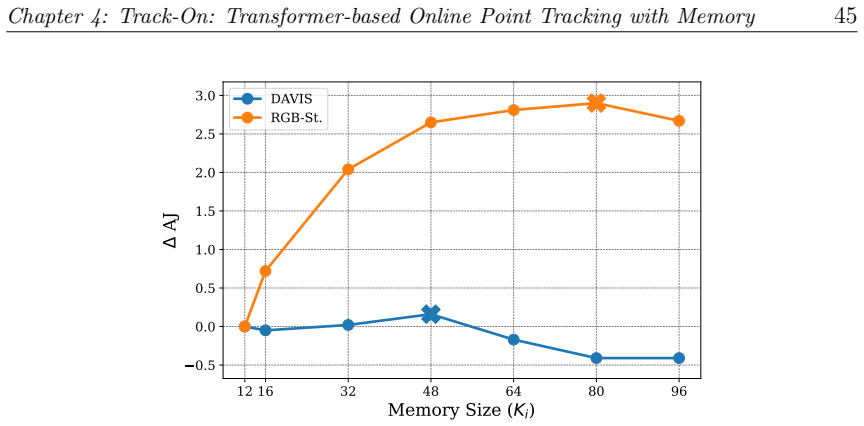
- [Section 4.1.3, 'Inference-Time Memory Extension'; Figure 4.8] Linearly interpolating temporal positional embeddings from a training memory size of K=12 to inference sizes up to Ki=96 is an unvalidated extrapolation. Figure 4.8 shows that AJ is non-monotonic in Ki and degrades beyond Ki=48 on DAVIS and beyond Ki=80 on RGB-Stacking, which is at least consistent with the interpolation not fully preserving the training-time semantics. Since this mechanism is used to justify the claim that the model generalizes to arbitrarily long videos, please restrict the claim to the tested range or provide an analysis of the interpolation, for example by training with several K values and comparing interpolated embeddings against embeddings trained at the target size.
minor comments (4)
- [Tables 4.1 and 4.2, footnote] The footnote sentence 'While online models process one frame at a time, enable frame-by-frame inference' is grammatically incomplete; it should read something like 'Online models process one frame at a time, enabling frame-by-frame inference.'
- [Section 4.2.2, RGB-Stacking paragraph] The text says the model 'outperforms offline competitors' on RGB-Stacking, which is contradicted by Table 4.1, where CoTracker3 with video input achieves a higher AJ (74.0) than Track-On (71.4); please rephrase to list the specific offline models that are outperformed.
- [Figure 4.8] The caption says memory sizes reported in Table 4.1 are marked with crosses, but the rendered figure does not show crosses; please either include the markers or clarify which points correspond to Table 4.1.
- [Section 4.1.3, Eq. (4.8)] The notation [qinit, qt] for the concatenated query is not defined; please state the concatenation axis and the resulting dimension so that the memory-write operation is unambiguous.
Circularity Check
No circularity: Track-On's central claims rest on external benchmark evaluation and ablations, not on a self-referential derivation or fitted-input prediction.
full rationale
The paper's central claim—that Track-On achieves state-of-the-art online point tracking without future access—is supported by external benchmark numbers on TAP-Vid, RoboTAP, Dynamic Replica, BADJA, and PointOdyssey. The model is trained on synthetic TAP-Vid Kubric ground truth and evaluated on held-out public benchmarks; no test labels are used to define the method or fit its parameters. The memory modules in Section 4.1.3 are architectural and engineering choices: spatial memory stores features around the model's own past predictions and context memory stores past query embeddings, but these are not defined in terms of the target predictions, and the reported gains come from ablations on external metrics. The paper's self-citations to the author's prior work (Chapter 3's FoMo analysis and the Track-On conference paper) are not load-bearing in a circular sense: Chapter 3 is an independent empirical study re-used as motivation, and Chapter 4 reports its own experiments. The assertion in Section 4.1.3 that query updates conditioned on all previous predictions 'prevents error propagation' is not proven by a failure-cascade analysis, but that is an empirical robustness gap or unsupported assumption, not circularity—the memory does not encode the target labels or a fitted version of the evaluation metric. The similarity ratio score (Eq. 4.11) compares the memory-updated query against ground-truth features, which is a diagnostic, not a training target. No equation reduces to its own input, and no fitted parameter is renamed as a prediction. The paper is therefore self-contained against external benchmarks, and no significant circularity is present.
Assumptions & free parameters
free parameters (6)
- Training memory size K =
12
- Uncertainty threshold delta_u =
8 pixels
- Visibility threshold delta_v =
not reported
- Total loss weight lambda =
not reported
- Top-k candidates in re-ranking =
not reported
- Encoder stride S =
4
assumptions (5)
- domain assumption TAP-Vid Kubric ground-truth trajectories and visibility labels are accurate and representative enough to train a general point tracker.
- domain assumption Cosine similarity between DINOv2 patch features is a meaningful correspondence signal across appearance change and domain shift.
- ad hoc to paper The model's own previous predictions can serve as correct locations for writing spatial memory.
- ad hoc to paper Linearly interpolating temporal positional embeddings from training size K=12 to inference sizes up to 96 preserves the semantics of the memory modules.
- domain assumption Queried-first evaluation on TAP-Vid, RoboTAP, Dynamic Replica, BADJA, and PointOdyssey measures the intended real-world online tracking capability.
Cite this review
Pith. "Pith review of Online Long-term Point Tracking in the Foundation Model Era." pith.science (2026). https://pith.science/paper/BITJJ7L3
@misc{pith2026250709217,
  author       = {Pith},
  title        = {Pith review of: Online Long-term Point Tracking in the Foundation Model Era},
  year         = {2026},
  howpublished = {\url{https://pith.science/paper/BITJJ7L3}},
  note         = {Machine review of arXiv:2507.09217}
}
read the original abstract
Point tracking aims to identify the same physical point across video frames and serves as a geometry-aware representation of motion. This representation supports a wide range of applications, from robotics to augmented reality, by enabling accurate modeling of dynamic environments. Most existing long-term tracking approaches operate in an offline setting, where future frames are available to refine predictions and recover from occlusions. However, real-world scenarios often demand online predictions: the model must operate causally, using only current and past frames. This constraint is critical in streaming video and embodied AI, where decisions must be made immediately based on past observations. Under such constraints, viewpoint invariance becomes essential. Visual foundation models, trained on diverse large-scale datasets, offer the potential for robust geometric representations. While they lack temporal reasoning on their own, they can be integrated into tracking pipelines to enrich spatial features. In this thesis, we address the problem of long-term point tracking in an online setting, where frames are processed sequentially without access to future information or sliding windows. We begin by evaluating the suitability of visual foundation models for this task and find that they can serve as useful initializations and be integrated into tracking pipelines. However, to enable long-term tracking in an online setting, a dedicated design is still required. In particular, maintaining coherence over time in this causal regime requires memory to propagate appearance and context across frames. To address this, we introduce Track-On, a transformer-based model that treats each tracked point as a query and processes video frames one at a time. Track-On sets a new state of the art across seven public benchmarks, demonstrating the feasibility of long-term tracking without future access.
Figures


Figures from the paper (14 more)



Reference graph
Works this paper leans on
-
[1]
[Amir et al., 2021] Amir, S., Gandelsman, Y., Bagon, S., and Dekel, T. (2021). Deep ViT features as dense visual descriptors. arXiv preprint arXiv:2112.05814 . [Aydemir et al., 2023a] Aydemir, G., Akan, A. K., and G¨ uney, F. (2023a). ADAPT: Efficient multi-agent trajectory prediction with adaptation. In Proc. of the IEEE International Conf. on Computer V...
arXiv 2021
-
[2]
Qiao, Y. (2022b). Vision transformer adapter for dense predictions. In Proc. of the International Conf. on Learning Representations (ICLR) . [Cheng and Schwing, 2022] Cheng, H. K. and Schwing, A. G. (2022). XMem: Long- term video object segmentation with an atkinson-shiffrin memory model. In Proc. of the European Conf. on Computer Vision (ECCV) . [Cho et ...
arXiv 2022
-
[3]
Gupta, A., Heyward, J., Rocco, I., Goroshin, R., Carreira, J., and Zisserman, A. (2024). BootsTAP: Bootstrapped training for tracking-any-point. Proc. of the Asian Conf. on Computer Vision (ACCV) . Bibliography 55 [Doersch et al., 2023] Doersch, C., Yang, Y., Vecerik, M., Gokay, D., Gupta, A.,
work page 2024
-
[4]
Aytar, Y., Carreira, J., and Zisserman, A. (2023). TAPIR: Tracking any point with per-frame initialization and temporal refinement. In Proc. of the IEEE In- ternational Conf. on Computer Vision (ICCV) . [Dosovitskiy et al., 2015] Dosovitskiy, A., Fischer, P., Ilg, E., Hausser, P., Hazirbas, C., Golkov, V., Smagt, P. v. d., Cremers, D., and Brox, T. (2015)...
work page 2023
-
[5]
Rubinstein, M., Sun, D., Guibas, L., Johnson, J., and Jampani, V. (2024). Probing the 3D awareness of visual foundation models. In Proc. IEEE Conf. on Computer Vision and Pattern Recognition (CVPR) . [Eun et al., 2020] Eun, H., Moon, J., Park, J., Jung, C., and Kim, C. (2020). Learn- ing to discriminate information for online action detection. In Proc. IE...
work page 2024
-
[6]
Tagliasacchi, A., and Yi, K. M. (2023). Unsupervised semantic correspondence using stable diffusion. In Advances in Neural Information Processing Systems (NeurIPS). [Horn and Schunck, 1981] Horn, B. K. and Schunck, B. G. (1981). Determining optical flow. In Artificial Intelligence (AI) . [Hu et al., 2022] Hu, E. J., Shen, Y., Wallis, P., Allen-Zhu, Z., Li...
work page 2023
-
[7]
Wang, L., and Chen, W. (2022). LoRA: Low-rank adaptation of large language models. In Proc. of the International Conf. on Learning Representations (ICLR) . [Jasinschi et al., 1998] Jasinschi, R. S., Veen, T. N., et al. (1998). Motion estimation methods for video compression—a review. Journal of the Franklin Institute . [Jin et al., 2025] Jin, L., Tucker, ...
arXiv 2022
-
[8]
Gustafson, L., Xiao, T., Whitehead, S., Berg, A. C., Lo, W.-Y., et al. (2023). Bibliography 57 Segment anything. In Proc. of the IEEE International Conf. on Computer Vision (ICCV). [Kondratyuk et al., 2021] Kondratyuk, D., Yuan, L., Li, Y., Zhang, L., Tan, M.,
work page 2023
Show all 22 references
-
[9]
Brown, M., and Gong, B. (2021). MoViNets: Mobile video networks for effi- cient video recognition. In Proc. IEEE Conf. on Computer Vision and Pattern Recognition (CVPR). [Lee et al., 2009] Lee, K.-Y., Chuang, Y.-Y., Chen, B.-Y., and Ouhyoung, M. (2009). Video stabilization usi...
2021
-
[10]
Zhang, L. (2024a). TAPTRv2: Attention-based position update improves tracking any point. In Advances in Neural Information Processing Systems (NeurIPS) . [Li et al., 2024b] Li, H., Zhang, H., Liu, S., Zeng, Z., Ren, T., Li, F., and Zhang, L. (2024b). TAPTR: Tracking any point ...
2024
-
[11]
Vedaldi, A. (2022). Deep spectral methods: A surprisingly strong baseline for unsupervised semantic segmentation and localization. In Proc. IEEE Conf. on Computer Vision and Pattern Recognition (CVPR) . [Neoral et al., 2024] Neoral, M., ˇSer` ych, J., and Matas, J. (2024). MFT...
2022
-
[12]
Huang, P.-Y., Xu, H., Sharma, V., Li, S.-W., Galuba, W., Rabbat, M., Assran, M., Ballas, N., Synnaeve, G., Misra, I., Jegou, H., Mairal, J., Labatut, P., Joulin, A., and Bojanowski, P. (2024). DINOv2: Learning robust visual features without supervision. Transactions on Machine...
2024
-
[13]
Agarwal, S., Sastry, G., Askell, A., Mishkin, P., Clark, J., et al. (2021). Learning transferable visual models from natural language supervision. In Proc. of the International Conf. on Machine learning (ICML) . [Ravi et al., 2025] Ravi, N., Gabeur, V., Hu, Y.-T., Hu, R., Ryal...
2021
-
[14]
V., Carion, N., Wu, C.-Y., Girshick, R., Doll´ ar, P., and Feichtenhofer, C
Khedr, H., R¨ adle, R., Rolland, C., Gustafson, L., Mintun, E., Pan, J., Alwala, K. V., Carion, N., Wu, C.-Y., Girshick, R., Doll´ ar, P., and Feichtenhofer, C. (2025). SAM 2: Segment anything in images and videos. In Proc. of the Interna- tional Conf. on Learning Representati...
2025
-
[15]
Ommer, B. (2022). High-resolution image synthesis with latent diffusion models. In Proc. IEEE Conf. on Computer Vision and Pattern Recognition (CVPR) . [Sand and Teller, 2008] Sand, P. and Teller, S. (2008). Particle video: Long-range motion estimation using point trajectories...
2022
-
[16]
Zhou, G., Hadsell, R., Agapito, L., and Scholz, J. (2023). RoboTAP: Tracking arbitrary points for few-shot visual imitation. In Proc. IEEE International Conf. on Robotics and Automation (ICRA) . [Wang et al., 2025] Wang, J., Chen, M., Karaev, N., Vedaldi, A., Rupprecht, C., an...
2023 arXiv
-
[17]
Sang, N. (2021). OadTR: Online action detection with transformers. In Proc. of the IEEE International Conf. on Computer Vision (ICCV) . [Wang et al., 2020] Wang, Z., Zheng, L., Liu, Y., Li, Y., and Wang, S. (2020). Towards real-time multi-object tracking. In Proc. of the Europ...
2021
-
[18]
Zhou, X. (2024). SpatialTracker: Tracking any 2D pixels in 3D space. In Proc. IEEE Conf. on Computer Vision and Pattern Recognition (CVPR) . [Xu et al., 2023] Xu, J., Liu, S., Vahdat, A., Byeon, W., Wang, X., and De Mello, S. (2023). Open-vocabulary panoptic segmentation with ...
2024 arXiv
-
[19]
Jin, X. (2024a). Flash-VStream: memory-based real-time understanding for long video streams. arXiv preprint arXiv:2406.08085 . [Zhang et al., 2024b] Zhang, J., Herrmann, C., Hur, J., Chen, E., Jampani, V., Sun, D., and Yang, M.-H. (2024b). Telling left from right: Identifying ...
2024 arXiv
-
[20]
Cole, F., Sun, D., and Yang, M.-H. (2025). Monst3r: A simple approach for Chapter 5: Conclusion 63 estimating geometry in the presence of motion. In Proc. of the International Conf. on Learning Representations (ICLR) . [Zhang et al., 2021b] Zhang, Z., Zhou, C., Ma, J., Lin, Z....
2025
-
[21]
Zhao, Z. (2021b). Learning to rehearse in long sequence memorization. In Proc. of the International Conf. on Machine learning (ICML) . [Zhao and Kr¨ ahenb¨ uhl, 2022] Zhao, Y. and Kr¨ ahenb¨ uhl, P. (2022). Real-time online video detection with temporal smoothing transformers....
2021
-
[22]
Nagrani, A., and Schmid, C. (2024). Streaming dense video captioning. In Proc. IEEE Conf. on Computer Vision and Pattern Recognition (CVPR) . [Zhu et al., 2021] Zhu, X., Su, W., Lu, L., Li, B., Wang, X., and Dai, J. (2021). Deformable DETR: Deformable transformers for end-to-e...
2024 arXiv
Reviewed August 6, 2026 · model on record in the stance chip above.
Discussion (0). Sign in to comment.