REVIEW 3 major objections 6 minor 77 references
Topological in-gap chiral edge states in superconducting Haldane model with spin-orbit coupling
T0 review · 3 major / 6 minor · reviewed 2026-08-06 · deepseek-v4-flash
Pith's one-line read Adding Rashba spin-orbit coupling pulls the Haldane model's chiral edge states inside the superconducting gap.
desk verdict A solid slab numerics study showing Rashba SOC pulls Haldane edge states into the s-wave gap with a gapless window, but the topological-superconductor label is asserted without a BdG invariant. read the letter →
The pith
A machine-rendered reading of the paper's core claim, the machinery that carries it, and where it could break.
The reading
What carries the argument
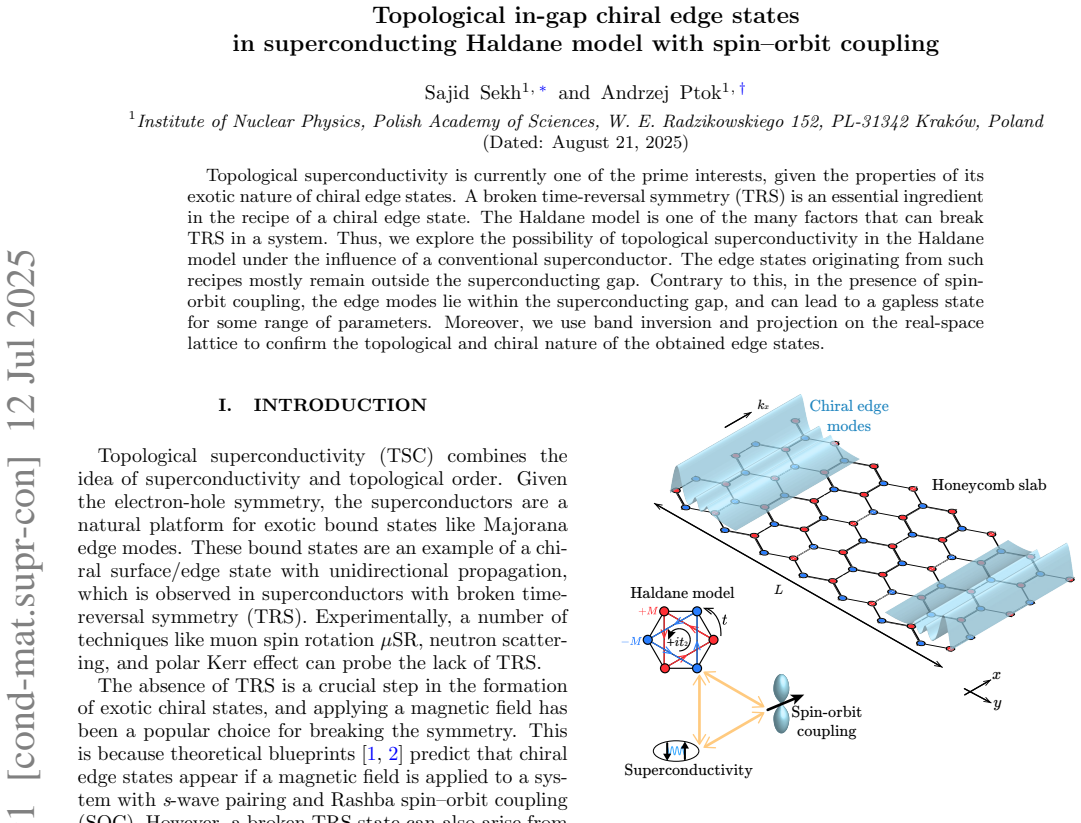
The central object is the Bogoliubov–de Gennes Hamiltonian of a zigzag honeycomb slab combining three terms: the Haldane complex next-nearest-neighbor hopping (with flux $\phi=\pi/2$ and staggered mass $M$), Rashba spin-orbit coupling of strength $\lambda_R$, and uniform on-site $s$-wave pairing at $\Delta/t=0.1$. The load-bearing mechanism is the valley-selective effect of Rashba coupling on the superconducting Haldane bands: without Rashba coupling the Haldane edge states remain outside the pairing gap, while Rashba coupling mixes spin sectors and pulls the $K'$-valley states into the gap, where they form pairs of chiral edge modes that cross at zero energy. The local Chern marker, a real-space projection of the Chern number, and the inverse participation ratio identify which states are localized chiral edge states.
What would settle it
A direct numerical check would be to compute the Chern number of the occupied Bogoliubov–de Gennes bands at, for example, $t_2/M=2$, $\lambda_R/t=0.5$, and $\Delta/t=0.1$; if the Chern number is zero while in-gap states are present, the gapless window is not a bulk topological superconducting phase.
Extended reading notes
Core claim
The central claim is that pairing the Haldane model with a uniform $s$-wave gap and Rashba spin-orbit coupling produces a topological superconducting state whose edge modes lie inside the superconducting gap. In the pristine Haldane model, topological edge states appear only for $|t_2/M|>1$ and cross at zero energy. In the superconducting Haldane model without spin-orbit coupling, those edge states are pushed outside the pairing gap: band inversion persists but no in-gap states appear, which the paper describes as a gapped topological edge mode in a trivial superconducting state. With Rashba coupling, states originating near the $K'$ valley enter the gap, form two pairs of chiral edge modes propagating along opposite edges, and touch at zero energy for an intermediate range of $\lambda_R$, producing a gapless superconducting spectrum. Band inversion, real-space projection of the edge states, and the inverse participation ratio are used to confirm the chiral and localized nature of the in-gap states.
Load-bearing premise
The calculations fix a uniform pairing amplitude $\Delta/t=0.1$ everywhere and never solve for it self-consistently, so the central results rest on the assumption that proximity-induced superconductivity survives uniformly once the Haldane flux and Rashba coupling are present.
Editorial extensions
If this is right
- Without spin-orbit coupling, pairing the Haldane Chern insulator with an $s$-wave gap keeps all edge states outside the superconducting gap, so the superconducting state is a gapped trivial state despite the nontrivial normal band structure.
- With Rashba coupling $\lambda_R \neq 0$ and Haldane parameters $|t_2/M|>1$, the slab hosts four chiral in-gap edge modes, localized as two pairs on opposite edges and connecting occupied states at one valley to unoccupied states at the other.
- Increasing $\lambda_R/t$ closes and reopens the in-gap gap, producing a finite gapless window; the zero-energy crossings remain protected over a range of $\lambda_R$.
- The topological transition at $t_2/M=\pm 1$ survives in the superconducting state with spin-orbit coupling, marked by the reappearance of gapless edge states, whereas in the superconducting state without spin-orbit coupling the gap never closes.
- Because the Haldane term breaks time-reversal symmetry internally, the chiral superconducting state is reached without a magnetic field, avoiding the usual competition between superconductivity and a Zeeman field.
Reading between the lines
- A natural next step would be to solve the Bogoliubov–de Gennes equations self-consistently for the pairing amplitude rather than keeping $\Delta/t=0.1$ fixed, to see whether the in-gap states survive when pairing is allowed to vary near the edges.
- Because the in-gap states are valley-selective, a junction between regions of opposite Haldane chirality could act as a switch for the propagation direction of the chiral modes, connecting these results to valleytronics in a superconducting setting.
- The paper does not compute a Chern number of the occupied Bogoliubov–de Gennes bands; computing one would independently confirm or refute the bulk topological interpretation of the gapless window.
Editorial analysis
A structured set of objections, weighed in public.
Referee Report
Summary. The paper studies a zigzag honeycomb slab of the Haldane model with on-site s-wave pairing and Rashba spin-orbit coupling. Using exact diagonalization of the Bogoliubov-de Gennes equations in a slab geometry, the authors find that, in the topological Haldane regime (|t2/M| > 1) and for finite Rashba coupling, four chiral edge modes appear inside the superconducting gap, with a gapless window in the spectrum for intermediate values of lambda_R. The states are characterized by sublattice projection, real-space position expectation, and inverse participation ratio, and the normal-state Haldane transition at |t2/M| = 1 is reproduced as a benchmark. The paper concludes that the Haldane model with superconductivity and SOC can realize a gapless topological superconducting state.
Significance. If the central claim holds, the proposed mechanism—using Haldane flux rather than a magnetic field to break time-reversal symmetry in a proximity-superconducting honeycomb system—provides a useful alternative route to chiral edge states, and the four-mode count and valley selectivity are concrete, falsifiable predictions. The numerical evidence is transparent: the in-gap edge states are directly visible in the plotted band structures, the IPR scaling with system size is an appropriate localization check, and the benchmark against the known Haldane phase boundary is a good sanity check. The manuscript is not circular: no parameters are fitted to the target result, and self-citations only support the formalism. The principal weakness is that no topological invariant is computed for the BdG Hamiltonian, so the 'topological superconductor' label currently rests on slab-spectrum evidence rather than on a verified bulk-boundary correspondence.
major comments (3)
- [Sec. III A and Sec. IV] The paper never computes a topological invariant of the BdG Hamiltonian. The local Chern marker in Sec. II C is evaluated with the projector (8) on occupied normal-state Haldane bands, not on negative-energy BdG eigenstates of Eq. (13). The Sec. IV statement that 'the bulk topology is related to the number of edge states through the bulk-boundary principle' is therefore not verified for the superconducting model. Please compute the Chern number (or a real-space Chern marker) of the occupied BdG bands in the gapped regions outside the gapless window and compare it with the observed number of chiral edge modes; this is the minimal evidence needed to justify calling the state a topological superconductor.
- [Eq. (11) and Sec. III C/IV] All phase diagrams (Figs. 5-8) use a fixed uniform pairing amplitude Delta/t = 0.1. For a model study this is an acceptable input, but the paper also presents the setup as an experimental proposal in Sec. IV. Please either perform a self-consistent BdG calculation that determines the local order parameter Delta_i in the presence of the Haldane flux and Rashba SOC, or discuss quantitatively why proximity-induced pairing can be expected to remain uniform and unsuppressed at the edges. Without this, the experimental claim is conditional on an unexamined assumption about the pairing state.
- [Sec. III C, Fig. 7] The crossings of the in-gap states are described as 'protected for a range of coupling parameters', but no protecting symmetry or invariant is identified. In the gapless window the bulk gap is closed, so the usual Chern classification does not apply. Please state the symmetry (e.g., particle-hole symmetry combined with a spatial symmetry or a valley quantum number) that protects the crossings, or classify the gapless phase with an appropriate invariant; otherwise the term 'protection' and the conclusion of a 'gapless topological superconducting state' in Sec. IV are not supported.
minor comments (6)
- [Fig. 5 caption] The caption contains the typo 'Halane' and should read 'Haldane'.
- [Sec. II C] The text contains typos: 'effet' should be 'effect' and 'quantzied' should be 'quantized'.
- [Sec. III C] The sentence 'the topological transition from trivial to non-trivial phase can be recognized through the opening/closing of the energy gap – thus, the in-gap state should exist in a finite system for realizing topological superconductivity' appears twice in slightly different forms, and the phrase 'is is visible' in Fig. 5 discussion contains a duplicated word.
- [Sec. III B] The wording 'gapped topological edge modes in a trivial superconducting state' is confusing: the normal state is topological, but the superconducting state is called trivial because there are no in-gap states. Please clarify what is meant by 'trivial' here.
- [Eq. (13)] The block-matrix form of the BdG equations is hard to read; please ensure the spin labels in H_ij_sigma and S_ij^sigma sigma' are typeset consistently and that the matrix entries match the accompanying text.
- [References] References [1] and [38] cite the same work (Sato, Takahashi, and Fujimoto, Phys. Rev. Lett. 103, 020401 (2009)); please merge or differentiate them.
Circularity Check
No significant circularity: the in-gap edge-state calculation is a direct BdG diagonalization of the stated model, with no parameter fitted to the target result.
full rationale
The paper's central claim is that the Haldane model with uniform s-wave pairing and Rashba spin-orbit coupling exhibits in-gap chiral edge states. The derivation is a direct tight-binding Bogoliubov-de Gennes calculation: Eq. (9) assembles H0, Hsoc, and Hsc; Eq. (13) is the BdG eigenproblem; Figs. 5-8 report finite-slab spectra, sublattice projections, real-space expectation values, and inverse participation ratios. No parameter appearing in the calculation (Delta/t = 0.1, lambda_R/t, t2/M) is fitted to the edge-state energies or to the gapless window; these are model inputs that are swept over ranges. The one benchmark against an independent analytic result is the normal-state Haldane transition at |t2/M| = 1, which is checked explicitly against the known condition in Sec. II C and Fig. 3(c); this is an external check, not an input. The self-citations (Refs. [47], [48], [50]) introduce standard SOC/BdG formalism and chirality-probing methods; none of them supplies the central result, and the central claim stands or falls on the exact diagonalization alone. The absence of a BdG Chern number and the use of a fixed, non-self-consistent pairing amplitude are scientific limitations that affect the strength of the topological classification and experimental realism, but they are not cases of a prediction reducing to its own inputs by construction. Therefore no circular step can be exhibited within the hard-rule standard, and the appropriate score is 0.
Assumptions & free parameters
free parameters (5)
- t2/M =
scanned across 0, ±1, ±1.5, ±2
- lambda_R/t =
scanned from 0 to 0.7
- Delta/t =
0.1
- mu/t =
0
- L =
20 unit cells in Figs. 5-8, with scaling up to larger sizes in Fig. 8(c)
assumptions (5)
- domain assumption The Haldane model with complex next-nearest-neighbor hopping at phase pi/2 breaks time-reversal symmetry and hosts Chern number +/-1 for |t2/M|>1.
- domain assumption A uniform, non-self-consistent s-wave pairing amplitude Delta is a valid description of the superconducting state.
- domain assumption Bulk-boundary correspondence holds for the BdG slab, so that localized in-gap chiral modes imply a nontrivial superconducting Chern number.
- domain assumption The nearest-neighbor out-of-plane Rashba term in Eq. (10) captures the relevant spin mixing for honeycomb proximity systems.
- standard math The intended complex NNN hopping phase in Eq. (3) is e^{i*phi} with phi=pi/2.
Cite this review
Pith. "Pith review of Topological in-gap chiral edge states in superconducting Haldane model with spin-orbit coupling." pith.science (2026). https://pith.science/paper/B4Q6UADQ
@misc{pith2026250709418,
  author       = {Pith},
  title        = {Pith review of: Topological in-gap chiral edge states in superconducting Haldane model with spin-orbit coupling},
  year         = {2026},
  howpublished = {\url{https://pith.science/paper/B4Q6UADQ}},
  note         = {Machine review of arXiv:2507.09418}
}
read the original abstract
Topological superconductivity is currently one of the prime interests, given the properties of its exotic nature of chiral edge states. A broken time-reversal symmetry (TRS) is an essential ingredient in the recipe of a chiral edge state. The Haldane model is one of the many factors that can break TRS in a system. Thus, we explore the possibility of topological superconductivity in the Haldane model under the influence of a conventional superconductor. The edge states originating from such recipes mostly remain outside the superconducting gap. Contrary to this, in the presence of spin-orbit coupling, the edge modes lie within the superconducting gap, and can lead to a gapless state for some range of parameters. Moreover, we use band inversion and projection on the real-space lattice to confirm the topological and chiral nature of the obtained edge states.
Figures


Figures from the paper (5 more)


Reference graph
Works this paper leans on
-
[1]
M. Sato, Y. Takahashi, and S. Fujimoto, Non-abelian topological order in s-wave superfluids of ultracold fermionic atoms, Phys. Rev. Lett. 103, 020401 (2009). 10
work page 2009
-
[2]
R. M. Lutchyn, J. D. Sau, and S. Das Sarma, Ma- jorana fermions and a topological phase transition in semiconductor-superconductor heterostructures, Phys. Rev. Lett. 105, 077001 (2010)
2010
-
[3]
K. E. Avers, W. J. Gannon, S. J. Kuhn, W. P. Halperin, J. A. Sauls, L. DeBeer-Schmitt, C. D. Dewhurst, J. Gav- ilano, G. Nagy, U. Gasser, and M. R. Eskildsen, Broken time-reversal symmetry in the topological superconduc- tor UPt3, Nat. Phys. 16, 531 (2020)
work page 2020
-
[4]
A. Pustogow, Y. Luo, A. Chronister, Y.-S. Su, D. A. Sokolov, F. Jerzembeck, A. P. Mackenzie, C. W. Hicks, N. Kikugawa, S. Raghu, E. D. Bauer, and S. E. Brown, Constraints on the superconducting order parameter in Sr2RuO4 from oxygen-17 nuclear magnetic resonance, Nature 574, 72 (2019)
work page 2019
-
[5]
K. Matsuura, M. Roppongi, M. Qiu, Q. Sheng, Y. Cai, K. Yamakawa, Z. Guguchia, R. P. Day, K. M. Kojima, A. Damascelli, Y. Sugimura, M. Saito, T. Takenaka, K. Ishihara, Y. Mizukami, K. Hashimoto, Y. Gu, S. Guo, L. Fu, Z. Zhang, F. Ning, G. Zhao, G. Dai, C. Jin, J. W. Beare, G. M. Luke, Y. J. Uemura, and T. Shibauchi, Two superconducting states with broken t...
work page 2023
-
[6]
Singh, M
D. Singh, M. S. Scheurer, A. D. Hillier, D. T. Adroja, and R. P. Singh, Time-reversal-symmetry breaking and unconventional pairing in the noncentrosymmetric super- conductor La7Rh3, Phys. Rev. B 102, 134511 (2020)
2020
-
[7]
Sigrist and K
M. Sigrist and K. Ueda, Phenomenological theory of un- conventional superconductivity, Rev. Mod. Phys.63, 239 (1991)
1991
-
[8]
H. A. Mook, Y. Sidis, B. Fauqu´ e, V. Bal´ edent, and P. Bourges, Observation of magnetic order in a super- conducting YBa 2Cu3O6.6 single crystal using polarized neutron scattering, Phys. Rev. B 78, 020506 (2008)
work page 2008
Show all 77 references
-
[9]
L. Yu, C. Wang, Y. Zhang, M. Sander, S. Ni, Z. Lu, S. Ma, Z. Wang, Z. Zhao, H. Chen, K. Jiang, Y. Zhang, H. Yang, F. Zhou, X. Dong, S. L. Johnson, M. J. Graf, J. Hu, H.-J. Gao, and Z. Zhao, Evidence of a hidden flux phase in the topological kagome metal CsV 3Sb5 (2021), arXiv:...
2021 arXiv
-
[10]
Fauqu´ e, Y
B. Fauqu´ e, Y. Sidis, V. Hinkov, S. Pailh` es, C. T. Lin, X. Chaud, and P. Bourges, Magnetic order in the pseudo- gap phase of high- TC superconductors, Phys. Rev. Lett. 96, 197001 (2006)
2006
-
[11]
Y. Li, V. Bal´ edent, G. Yu, N. Bariˇ si´ c, K. Hradil, R. A. Mole, Y. Sidis, P. Steffens, X. Zhao, P. Bourges, and M. Greven, Hidden magnetic excitation in the pseudo- gap phase of a high- Tc superconductor, Nature 468, 283 (2010)
2010
-
[12]
C. M. Varma, Non-fermi-liquid states and pairing insta- bility of a general model of copper oxide metals, Phys. Rev. B 55, 14554 (1997)
1997
-
[13]
G. M. Luke, Y. Fudamoto, K. M. Kojima, M. I. Larkin, J. Merrin, B. Nachumi, Y. J. Uemura, Y. Maeno, Z. Q. Mao, Y. Mori, H. Nakamura, and M. Sigrist, Time-reversal symmetry-breaking superconductivity in Sr2RuO4, Nature 394, 558 (1998)
1998
-
[14]
Kaminski, S
A. Kaminski, S. Rosenkranz, H. M. Fretwell, J. C. Cam- puzano, Z. Li, H. Raffy, W. G. Cullen, H. You, C. G. Olson, C. M. Varma, and H. H¨ ochst, Spontaneous break- ing of time-reversal symmetry in the pseudogap state of a high-Tc superconductor, Nature 416, 610 (2002)
2002
-
[15]
Mielke, D
C. Mielke, D. Das, J.-X. Yin, H. Liu, R. Gupta, Y.- X. Jiang, M. Medarde, X. Wu, H. C. Lei, J. Chang, P. Dai, Q. Si, H. Miao, R. Thomale, T. Neupert, Y. Shi, R. Khasanov, M. Z. Hasan, H. Luetkens, and Z. Guguchia, Time-reversal symmetry-breaking charge order in a kagome superc...
2022
-
[16]
H. Deng, G. Liu, Z. Guguchia, T. Yang, J. Liu, Z. Wang, Y. Xie, S. Shao, H. Ma, W. Li` ege, F. Bourdarot, X.- Y. Yan, H. Qin, C. Mielke, R. Khasanov, H. Luetkens, X. Wu, G. Chang, J. Liu, M. H. Christensen, A. Kreisel, B. M. Andersen, W. Huang, Y. Zhao, P. Bourges, Y. Yao, P. ...
2024
-
[17]
Shang, J
T. Shang, J. Z. Zhao, L.-H. Hu, D. J. Gawryluk, X. Y. Zhu, H. Zhang, J. Meng, Z. X. Zhen, B. C. Yu, Z. Zhou, Y. Xu, Q. F. Zhan, E. Pomjakushina, and T. Shi- roka, Fully gapped superconductivity and topological as- pects of the noncentrosymmetric superconductor TaReSi, Phys. Re...
2023
-
[18]
Mandal, A
M. Mandal, A. Kataria, P. K. Meena, R. K. Kush- waha, D. Singh, P. K. Biswas, R. Stewart, A. D. Hillier, and R. P. Singh, Time-reversal symmetry break- ing in Re-based kagome lattice superconductor (2024), arXiv:2409.10941
2024 arXiv
-
[19]
O. Can, T. Tummuru, R. P. Day, I. Elfimov, A. Damas- celli, and M. Franz, High-temperature topological super- conductivity in twisted double-layer copper oxides, Nat. Phys. 17, 519 (2021)
2021
-
[20]
S. D. Sarma, M. Freedman, and C. Nayak, Majorana zero modes and topological quantum computation, npj Quantum Inf. 1, 15001 (2015)
2015
-
[21]
Vijay, T
S. Vijay, T. H. Hsieh, and L. Fu, Majorana fermion sur- face code for universal quantum computation, Phys. Rev. X 5, 041038 (2015)
2015
-
[22]
Schneider, P
L. Schneider, P. Beck, T. Posske, D. Crawford, E. Mas- cot, S. Rachel, R. Wiesendanger, and J. Wiebe, Topolog- ical Shiba bands in artificial spin chains on superconduc- tors, Nat. Phys. 17, 943 (2021)
2021
-
[23]
D. Wang, L. Kong, P. Fan, H. Chen, S. Zhu, W. Liu, L. Cao, Y. Sun, S. Du, J. Schneeloch, R. Zhong, G. Gu, L. Fu, H. Ding, and H.-J. Gao, Evidence for Majorana bound states in an iron-based superconductor, Science 362, 333 (2018)
2018
-
[24]
Y.-T. Hsu, A. Vaezi, M. H. Fischer, and E.-A. Kim, Topo- logical superconductivity in monolayer transition metal dichalcogenides, Nat. Commun. 8, 14985 (2017)
2017
-
[25]
Mæland and A
K. Mæland and A. Sudbø, Topological superconductivity mediated by skyrmionic magnons, Phys. Rev. Lett. 130, 156002 (2023)
2023
-
[26]
P. A. Frigeri, D. F. Agterberg, A. Koga, and M. Sigrist, Superconductivity without inversion symmetry: MnSi versus CePt3Si, Phys. Rev. Lett. 92, 097001 (2004)
2004
-
[27]
Dimitrova and M
O. Dimitrova and M. V. Feigel’man, Theory of a two- dimensional superconductor with broken inversion sym- metry, Phys. Rev. B 76, 014522 (2007)
2007
-
[28]
M. H. Fischer, M. Sigrist, D. F. Agterberg, and Y. Yanase, Superconductivity and local inversion- symmetry breaking, Annu. Rev. Condens. Matter Phys. 14, 153 (2023)
2023
-
[29]
L. P. Gor’kov and E. I. Rashba, Superconducting 2d sys- tem with lifted spin degeneracy: Mixed singlet-triplet state, Phys. Rev. Lett. 87, 037004 (2001)
2001
-
[30]
Edel’shtein, Characteristics of the Cooper pairing in two-dimensional noncentrosymmetric electron systems, 11 Soviet Physics - JETP (English Translation) 68 (2025)
V. Edel’shtein, Characteristics of the Cooper pairing in two-dimensional noncentrosymmetric electron systems, 11 Soviet Physics - JETP (English Translation) 68 (2025)
2025
-
[31]
Barzykin and L
V. Barzykin and L. P. Gor’kov, Inhomogeneous stripe phase revisited for surface superconductivity, Phys. Rev. Lett. 89, 227002 (2002)
2002
-
[32]
D. F. Agterberg, Magnetoelectric effects, helical phases, and FFLO phases in superconductors without inversion symmetry (2011), arXiv:1106.0352 [cond-mat.supr-con]
2011 arXiv
-
[33]
H. Min, J. E. Hill, N. A. Sinitsyn, B. R. Sahu, L. Klein- man, and A. H. MacDonald, Intrinsic and Rashba spin- orbit interactions in graphene sheets, Phys. Rev. B 74, 165310 (2006)
2006
-
[34]
Z. Qiao, S. A. Yang, W. Feng, W.-K. Tse, J. Ding, Y. Yao, J. Wang, and Q. Niu, Quantum anomalous Hall effect in graphene from Rashba and exchange effects, Phys. Rev. B 82, 161414 (2010)
2010
-
[35]
Rainis, L
D. Rainis, L. Trifunovic, J. Klinovaja, and D. Loss, To- wards a realistic transport modeling in a superconduct- ing nanowire with Majorana fermions, Phys. Rev. B 87, 024515 (2013)
2013
-
[36]
Beenakker, Search for Majorana fermions in super- conductors, Annu
C. Beenakker, Search for Majorana fermions in super- conductors, Annu. Rev. Condens. Matter Phys. 4, 113 (2013)
2013
-
[37]
San-Jose, J
P. San-Jose, J. L. Lado, R. Aguado, F. Guinea, and J. Fern´ andez-Rossier, Majorana zero modes in graphene, Phys. Rev. X 5, 041042 (2015)
2015
-
[38]
M. Sato, Y. Takahashi, and S. Fujimoto, Non-abelian topological order in s-wave superfluids of ultracold fermionic atoms, Phys. Rev. Lett. 103, 020401 (2009)
2009
-
[39]
X.-L. Qi, T. L. Hughes, and S.-C. Zhang, Chiral topolog- ical superconductor from the quantum Hall state, Phys. Rev. B 82, 184516 (2010)
2010
-
[40]
F. D. M. Haldane, Model for a quantum Hall effect with- out landau levels: Condensed-matter realization of the ”parity anomaly”, Phys. Rev. Lett. 61, 2015 (1988)
1988
-
[41]
K. v. Klitzing, G. Dorda, and M. Pepper, New method for high-accuracy determination of the fine-structure con- stant based on quantized Hall resistance, Phys. Rev. Lett. 45, 494 (1980)
1980
-
[42]
Fu and C
L. Fu and C. L. Kane, Superconducting proximity effect and Majorana fermions at the surface of a topological insulator, Phys. Rev. Lett. 100, 096407 (2008)
2008
-
[43]
Fukui, K
T. Fukui, K. Shiozaki, T. Fujiwara, and S. Fujimoto, Bulk-edge correspondence for chern topological phases: A viewpoint from a generalized index theorem, J. Phys. Soc. Jpn. 81, 114602 (2012)
2012
-
[44]
R. S. K. Mong and V. Shivamoggi, Edge states and the bulk-boundary correspondence in Dirac Hamiltoni- ans, Phys. Rev. B 83, 125109 (2011)
2011
-
[45]
Bianco and R
R. Bianco and R. Resta, Mapping topological order in coordinate space, Phys. Rev. B 84, 241106 (2011)
2011
-
[46]
Ikegaya, Y
S. Ikegaya, Y. Asano, and D. Manske, Anomalous nonlo- cal conductance as a fingerprint of chiral Majorana edge states, Phys. Rev. Lett. 123, 207002 (2019)
2019
-
[47]
A. Ptok, D. J. Alspaugh, S. G lodzik, A. Kobia lka, A. M. Ole´ s, P. Simon, and P. Piekarz, Probing the chirality of one-dimensional Majorana edge states around a two- dimensional nanoflake in a superconductor, Phys. Rev. B 102, 245405 (2020)
2020
-
[48]
A. Ptok, S. G lodzik, and T. Doma´ nski, Yu-Shiba-Rusinov states of impurities in a triangular lattice of NbSe 2 with spin-orbit coupling, Phys. Rev. B 96, 184425 (2017)
2017
-
[49]
P. G. D. Gennes, Superconductivity of Metals and Alloys, Advanced Books Classics Series (Westview, 1999)
1999
-
[50]
A. Ptok, K. Rodr ´ ıguez, and K. J. Kapcia, Superconduct- ing monolayer deposited on substrate: Effects of the spin- orbit coupling induced by proximity effects, Phys. Rev. Mater. 2, 024801 (2018)
2018
-
[51]
A. Das, Y. Ronen, Y. Most, Y. Oreg, M. Heiblum, and H. Shtrikman, Zero-bias peaks and splitting in an Al– InAs nanowire topological superconductor as a signature of Majorana fermions, Nat. Phys. 8, 887 (2012)
2012
-
[52]
A. Y. Kitaev, Unpaired Majorana fermions in quantum wires, Phys.-Usp. 44, 131 (2001)
2001
-
[53]
V. S. Pribiag, A. J. A. Beukman, F. Qu, M. C. Cassidy, C. Charpentier, W. Wegscheider, and L. P. Kouwenhoven, Edge-mode superconductivity in a two- dimensional topological insulator, Nat. Nanotech. 10, 593 (2015)
2015
-
[54]
Kallin and J
C. Kallin and J. Berlinsky, Chiral superconductors, Rep. Prog. Phys. 79, 054502 (2016)
2016
-
[55]
Zhou and Z
S. Zhou and Z. Wang, Chern fermi pocket, topological pair density wave, and charge-4e and charge-6e super- conductivity in kagom´ e superconductors, Nat. Commun. 13, 7288 (2022)
2022
-
[56]
P. W. Anderson, Absence of diffusion in certain random lattices, Phys. Rev. 109, 1492 (1958)
1958
-
[57]
Kramer and A
B. Kramer and A. MacKinnon, Localization: theory and experiment, Rep. Prog. Phys. 56, 1469 (1993)
1993
-
[58]
Wegner, Inverse participation ratio in 2+ϵ dimensions, Z Physik B 36, 209 (1980)
F. Wegner, Inverse participation ratio in 2+ϵ dimensions, Z Physik B 36, 209 (1980)
1980
-
[59]
Dutreix, M
C. Dutreix, M. Guigou, D. Chevallier, and C. Bena, Ma- jorana fermions in honeycomb lattices, Eur. Phys. J. B 87, 296 (2014)
2014
-
[60]
Guguchia, C
Z. Guguchia, C. Mielke, D. Das, R. Gupta, J.-X. Yin, H. Liu, Q. Yin, M. H. Christensen, Z. Tu, C. Gong, N. Shumiya, M. S. Hossain, T. Gamsakhurdashvili, M. Elender, P. Dai, A. Amato, Y. Shi, H. C. Lei, R. M. Fernandes, M. Z. Hasan, H. Luetkens, and R. Khasanov, Tunable unconve...
2023
-
[61]
Hatsugai, Chern number and edge states in the integer quantum Hall effect, Phys
Y. Hatsugai, Chern number and edge states in the integer quantum Hall effect, Phys. Rev. Lett. 71, 3697 (1993)
1993
-
[62]
Hatsugai, Edge states in the integer quantum Hall effect and the Riemann surface of the Bloch function, Phys
Y. Hatsugai, Edge states in the integer quantum Hall effect and the Riemann surface of the Bloch function, Phys. Rev. B 48, 11851 (1993)
1993
-
[63]
Jotzu, M
G. Jotzu, M. Messer, R. Desbuquois, M. Lebrat, T. Uehlinger, D. Greif, and T. Esslinger, Experimental realization of the topological Haldane model with ultra- cold fermions, Nature 515, 237 (2014)
2014
-
[64]
Lanneb` ere and M
S. Lanneb` ere and M. G. Silveirinha, Photonic analogues of the Haldane and Kane–Mele models, Nanophotonics 8, 1387 (2019)
2019
-
[65]
Weeks, J
C. Weeks, J. Hu, J. Alicea, M. Franz, and R. Wu, En- gineering a robust quantum spin Hall state in graphene via adatom deposition, Phys. Rev. X 1, 021001 (2011)
2011
-
[66]
Kim and H.-Y
H.-S. Kim and H.-Y. Kee, Realizing Haldane model in Fe- based honeycomb ferromagnetic insulators, npj Quant. Mater. 2, 20 (2017)
2017
-
[67]
H. B. Heersche, P. Jarillo-Herrero, J. B. Oostinga, L. M. K. Vandersypen, and A. F. Morpurgo, Bipolar su- percurrent in graphene, Nature 446, 56 (2007)
2007
-
[68]
Lee and H.-J
G.-H. Lee and H.-J. Lee, Proximity coupling in superconductor-graphene heterostructures, Rep. Prog. Phys. 81, 056502 (2018)
2018
-
[69]
Moriya, N
R. Moriya, N. Yabuki, and T. Machida, Superconduct- ing proximity effect in a Nbse 2/graphene van der waals junction, Phys. Rev. B 101, 054503 (2020). 12
2020
-
[70]
J.-C. Liu, R. Pawlak, X. Wang, H. Chen, P. D’Astolfo, C. Drechsel, P. Zhou, R. H¨ aner, S. Decurtins, U. As- chauer, S.-X. Liu, W. Wulfhekel, and E. Meyer, Proximity-induced superconductivity in atomically pre- cise nanographene on Ag/Nb(110), ACS Materials Lett. 5, 1083 (2023)
2023
-
[71]
Gmitra and J
M. Gmitra and J. Fabian, Graphene on transition-metal dichalcogenides: A platform for proximity spin-orbit physics and optospintronics, Phys. Rev. B 92, 155403 (2015)
2015
-
[72]
Kezilebieke, V
S. Kezilebieke, V. Vaˇ no, M. N. Huda, M. Aapro, S. C. Ganguli, P. Liljeroth, and J. L. Lado, Moir´ e-enabled topological superconductivity, Nano Letters 22, 328 (2022)
2022
-
[73]
C.-H. Lin, J. D. Sau, and S. Das Sarma, Zero-bias con- ductance peak in Majorana wires made of semiconduc- tor/superconductor hybrid structures, Phys. Rev. B 86, 224511 (2012)
2012
-
[74]
Read and D
N. Read and D. Green, Paired states of fermions in two dimensions with breaking of parity and time-reversal symmetries and the fractional quantum Hall effect, Phys. Rev. B 61, 10267 (2000)
2000
-
[75]
Klocke, J
K. Klocke, J. E. Moore, J. Alicea, and G. B. Hal´ asz, Thermal probes of phonon-coupled kitaev spin liquids: From accurate extraction of quantized edge transport to anyon interferometry, Phys. Rev. X 12, 011034 (2022)
2022
-
[76]
Z. Wei, N. Batra, V. F. Mitrovi´ c, and D. E. Feldman, Thermal interferometry of anyons, Phys. Rev. B 107, 104406 (2023)
2023
-
[77]
Benjamin and R
C. Benjamin and R. Das, Probing Majorana bound states via thermoelectric transport, EPL 146, 16006 (2024)
2024
Reviewed August 6, 2026 · model on record in the stance chip above.
Discussion (0). Continue with ORCID to comment.