REVIEW 4 major objections 4 minor 2 cited by
AICrypto: Evaluating Cryptography Capabilities of Large Language Models
T0 review · 4 major / 4 minor · reviewed 2026-08-06 · deepseek-v4-flash
Pith's one-line read A 315-task benchmark finds that top language models match or surpass human experts on cryptography quizzes and proofs, but trail by 25–30 points on capture-the-flag exploits.
desk verdict A solid, much-needed crypto benchmark for LLMs, but the abstract overclaims CTF performance and the proof-grading validation needs a calibration check. read the letter →
The pith
A machine-rendered reading of the paper's core claim, the machinery that carries it, and where it could break.
The reading
What carries the argument
The object that carries the comparison is AICrypto itself: a curated, expert-reviewed evaluation of 135 multiple-choice questions, 150 capture-the-flag challenges, and 30 proof problems, with human expert baselines for all three parts. Its technical mechanisms are an agentic CTF harness that lets models run commands and scripts inside a sandbox over up to 100 turns and is scored by pass@3, and rubric-based automated proof grading in which two grader models each score an answer three times, with the six-score average correlating with human experts at Pearson 0.9025. The benchmark's design is what makes the central comparison, LLMs versus human experts across distinct cryptographic skills, measurable at all.
What would settle it
Search public web and code-hosted corpora for the exact statements and reference solutions of the 30 proof problems, and check whether models reproduce the problem wording verbatim; if a substantial fraction is found online or is echoed by models, the proof results are inflated rather than a measure of reasoning.
Extended reading notes
Core claim
The paper establishes a three-tier capability landscape for LLMs in cryptography. On AICrypto's multiple-choice component, the best model makes only three errors in 135 questions, surpassing the best human expert; on proof problems the top model scores 85.4% against a 94.0% human baseline; but on CTF challenges the best model solves only 56.0% of tasks against an 81.2% human rate. Manual failure analysis attributes the gap to inaccurate large-number arithmetic, excessive pattern matching over analysis, shallow mathematical comprehension, and proofs that look plausible but contain logical gaps. Because all tasks were expert-reviewed and human baselines were collected for every component, the paper treats these figures as the first systematic measure of LLM cryptographic proficiency rather than as isolated anecdotes.
Load-bearing premise
The load-bearing assumption is that the 30 proof problems, drawn from unpublished course materials, have not leaked into LLM training data; the paper runs contamination probes for the multiple-choice and CTF parts but not for the proofs, so if those problems reached the web, the near-human proof scores would be inflated.
Editorial extensions
If this is right
- For factual cryptography knowledge, top LLMs can already serve as reliable assistants, since they outperform the best human expert in this study on multiple-choice questions.
- For formal proof work, the best models produce usable routine proofs that approach, but do not reach, expert level, and the benchmark's automated rubric grading makes such evaluation scalable.
- For vulnerability exploitation of real cryptographic implementations, current LLMs are not yet dependable, with a 25–30 point gap on CTF challenges and especially weak performance on lattice-based problems.
- Reasoning-oriented models and higher reasoning effort consistently outperform general models, indicating that cryptographic capability scales with inference-time computation.
- The failure analysis identifies persistent weaknesses, including modular arithmetic errors, attack patterns applied without checking preconditions, and plausible-looking proofs with logical gaps, that future models must address.
Reading between the lines
- If the 30 proof problems ever reach public training corpora, the reported near-human proof performance would likely overstate genuine formal-reasoning ability; the paper's own examples of plausible-looking proofs with logical gaps point in that direction.
- The CTF gap may be partly an artifact of the 100-turn, single-agent scaffold, so evaluating the same models with stronger planning or multi-agent collaboration could narrow the 25-point gap without changing the underlying model weights.
- Because MCQ accuracy is near saturation, the next useful benchmark step is to shift weight toward novel protocol design, side-channel awareness, and problems requiring exact large-number arithmetic.
- The paper's contamination checks cover multiple-choice and CTF tasks but not proofs, so a public release of the proof set with independent contamination probes would be a natural validation of the benchmark's central comparison.
Editorial analysis
A structured set of objections, weighed in public.
Referee Report
Summary. The paper introduces AICrypto, a cryptography benchmark consisting of 135 multiple-choice questions, 150 capture-the-flag challenges, and 30 proof problems, all curated or authored by cryptography experts. The authors evaluate 17 LLMs using task-specific protocols—single-turn MCQs, an agentic framework for CTF, and best-of-three automated proof grading —and compare against human expert baselines. The central empirical finding is that top LLMs exceed human experts on MCQs (o3 at 97.8% vs. best human 94.1%), approach human performance on proof problems (gemini-2.5-pro 85.4% vs. human 94.0%), and substantially trail human experts on CTF challenges (gemini-2.5-pro 56.0% vs. human 81.2%). The paper also includes contamination analyses for MCQs and CTF, automated proof grading validated by correlation with human scores, and failure case analyses.
Significance. If the reported results hold, AICrypto would be a useful, multi-faceted resource for evaluating LLMs in cryptography, going beyond prior CTF-only benchmarks by adding conceptual and formal-reasoning components. The authors provide explicit expert effort, public code and dataset, human baselines, and a reproducible agent framework; they also ship a substantial contamination analysis for two of the three task types. The distinction between memorized cryptographic knowledge and end-to-end exploitation, as evidenced by the MCQ/CTF gap, is a valuable observation for the community. However, the proof-grading calibration and the contamination status of the proof problems are load-bearing for the paper's claim that LLMs 'approach human performance' on proofs, and the abstract/conclusion overstates the CTF results relative to the paper's own Figure 7.
major comments (4)
- [Abstract, §4.1, §7, Figure 7] The abstract claims that state-of-the-art models 'match or even surpass human experts in memorizing cryptographic concepts, exploiting common vulnerabilities, and routine proofs.' The CTF component does not support this. Figure 7 shows gemini-2.5-pro at 56.0% overall success rate versus human 81.2%, a 25-point gap, and even the best model on RSA (gemini-2.5-pro at 78.8%) trails the human baseline of 97.6%. The conclusion's phrase 'basic vulnerability exploitation' is similarly unsupported as stated. Please revise these claims to distinguish recognized textbook attacks (where LLMs do well) from realistic exploitation (where they clearly lag).
- [§3.4, Appendix G] The automated proof grader is validated only by Pearson (0.9025) and Spearman (0.8973) correlations on 306 samples. Correlation is invariant to additive shifts, so a systematic leniency bias would be invisible to this validation. The headline comparison is gemini-2.5-pro at 85.4% versus human 94.0%; an average grader bias of +8.6 percentage points would erase the gap. Given the paper's own §4.3 finding that LLM proofs 'appear correct at first glance but reveal critical flaws upon closer examination,' the grader has no demonstrated mechanism to avoid over-crediting such proofs. Please report the mean signed difference, standard deviation, and limits of agreement (e.g., Bland-Altman analysis), and ideally per-score-band calibration, between LLM and human scores.
- [§2.4, Appendix E] For MCQs (Table 4) and CTF challenges (Table 5) the paper provides contamination probes, but no analogous analysis is reported for the 30 proof problems. Section 2.4 asserts these problems were 'never publicly released online,' yet course materials routinely leak through student uploads, solution repositories, and course websites, and the problems are close enough to human performance that even a few leaked items could change the conclusion. Please run a retrieval-based or n-gram-based contamination probe for the proof problems, or provide explicit evidence that no public trace exists.
- [Appendix F.1 (Proof problems human baseline)] The human proof baseline is described as 'select the top five scores from each source' from real assignments/exams. This is not a like-for-like comparison with the LLM protocol, which uses three fresh attempts with a best-of-three score and an open-book, no-time-limit setting. Selecting the top historical scores may systematically inflate the human baseline, while not controlling for differences in problem exposure or grading conditions. Please describe the human baseline more precisely (number of distinct humans, grading rubric applied, whether the same 30 problems were used, and whether the comparison controls for attempt count) or re-measure the baseline under the LLM protocol.
minor comments (4)
- [Figure 6 and Appendix G] The notation 'ˆ indicates a parallel rule' is confusing; the same symbol is used as 'or' in the grader prompt. Please use a consistent label (e.g., 'parallel rule' or 'OR') in both places.
- [Appendix F.1 (CTF human baseline)] The human CTF baseline is computed on a subset of 100 of the 150 challenges; please state whether the subset is representative across the five categories and whether scoreboard top-10 ranking is available for all categories, since Figure 7 reports category-level human rates.
- [Figure 7] The model names in the heatmap x-axis are concatenated without separators (e.g., 'humangeminio3-high'), making the figure difficult to read. Please add spacing or line breaks.
- [Figure 9] The expression '442 mod 187' appears to be a typographical artifact (likely 44^2 mod 187). Please render the exponent in LaTeX for clarity.
Circularity Check
No significant circularity: AICrypto is an empirical benchmark whose reported results are grounded in objective answer keys, sandboxed flag recovery, and externally validated proof grading; the only self-citations appear in related work and are not load-bearing.
full rationale
AICrypto is an empirical benchmark, not a derivation, so the circularity patterns do not apply to its central claims. MCQ accuracy is computed by comparing model answers against curated answer keys; CTF success requires recovering the exact flag in a controlled execution environment; proof scores are produced by two external grader models (gpt-5.1 and gemini-3-pro-preview) using expert-authored rubrics and reference solutions, with the automated pipeline validated against 306 human-scored samples (Pearson 0.9025, Spearman 0.8973). The self-citations that appear in the manuscript (e.g., Wang et al. 2024 on jailbreaking and Cao et al. 2025 on test-case generation) appear only in related-work and benchmarking context and carry none of the load-bearing argument. The concerns raised about proof scoring (correlation without calibration, potential contamination of author-written proof problems, and LLM graders possibly tolerating superficially correct proofs) are threats to validity and measurement calibration, not circularity: none of the reported numbers is identical to a fitted input by construction, and no equation reduces the headline result to its own assumptions. Under the stated hard rules, a non-finding is the appropriate outcome.
Assumptions & free parameters
assumptions (3)
- domain assumption The 30 proof problems have not leaked into LLM training data.
- domain assumption The human expert baselines are representative of expert performance and comparable to LLM evaluation settings.
- domain assumption Automated grading by LLMs is a valid proxy for human expert grading of proofs.
Cite this review
Pith. "Pith review of AICrypto: Evaluating Cryptography Capabilities of Large Language Models." pith.science (2026). https://pith.science/paper/EP5H4BYN
@misc{pith2026250709580,
  author       = {Pith},
  title        = {Pith review of: AICrypto: Evaluating Cryptography Capabilities of Large Language Models},
  year         = {2026},
  howpublished = {\url{https://pith.science/paper/EP5H4BYN}},
  note         = {Machine review of arXiv:2507.09580}
}
read the original abstract
We build \textbf{AICrypto}, a comprehensive benchmark designed to evaluate the cryptography capabilities of large language models (LLMs). The benchmark comprises 135 multiple-choice questions, 150 capture-the-flag challenges, and 30 proof problems, covering a broad range of skills from knowledge memorization to vulnerability exploitation and formal reasoning. All tasks are carefully reviewed or constructed by cryptography experts to improve correctness and rigor. For each proof problem, we provide detailed scoring rubrics and reference solutions that enable automated grading, achieving high correlation with human expert evaluations. We introduce strong human expert performance baselines for comparison across all task types. Our evaluation of 17 leading LLMs reveals that state-of-the-art models match or even surpass human experts in memorizing cryptographic concepts, exploiting common vulnerabilities, and routine proofs. However, our analysis reveals that they still lack a deep understanding of abstract mathematical concepts and struggle with tasks that require multi-step reasoning and dynamic analysis. We hope this work could provide insights for future research on LLMs in cryptographic applications. Our code and dataset are available at https://github.com/wangyu-ovo/aicrypto-agent.
Figures


Figures from the paper (24 more)




Forward citations
Cited by 2 Pith papers
-
Free-MAD: Consensus-Free Multi-Agent Debate
Free-MAD picks the winning answer by scoring the full trajectory of agents' answers across debate rounds, beating majority voting with fewer rounds.
-
Improving LLM Agents with Reinforcement Learning on Cryptographic CTF Challenges
A tool-augmented 8B LLM fine-tuned with GRPO on a new procedurally generated crypto CTF dataset reaches 0.88 Pass@8 on unseen easy tasks, up from 0.10 in the body's tables.
Reference graph
Works this paper leans on
-
[1]
Choose anyr∈ {0,1} n−1 (e. g.r= 0 n−1). QueryTonx 0 = (r,0)andx 1 = (r,1), obtainingy 0, y1
-
[2]
WhenT=H n k we haveG n(x0) =G n(x1), hencey 0 =y 1 always and Pr[DH n k = 1] = 1
Output1ify 0 =y 1, otherwise output0. WhenT=H n k we haveG n(x0) =G n(x1), hencey 0 =y 1 always and Pr[DH n k = 1] = 1. WhenTis a truly random functionR:{0,1} n → {0,1}2n,y 0, y1 i.i.d. ← {0,1}2n, soPr[y 0 =y 1] = 2−2n. Therefore Pr[DR = 1] = 2−2n. The distinguishing advantage is1−2 −2n, overwhelming inn; thusHisnota pseudorandom function family. Fis a PR...
-
[3]
USENIX Association. ISBN 978-1-939133-44-1. URLhttps://www.usenix.org/conference/ usenixsecurity24/presentation/deng. Gerault, D., Hambitzer, A., Ronen, E., and Shamir, A. How to securely implement cryptography in deep neural net- works.Cryptology ePrint Archive, 2025. Google. Gemini 2.5 pro, 2025a. URL https:// deepmind.google/models/gemini/pro/. Google....
arXiv 2025
-
[4]
URL https://openreview.net/forum? id=chfJJYC3iL. Jimenez, C. E., Yang, J., Wettig, A., Yao, S., Pei, K., Press, O., and Narasimhan, K. Swe-bench: Can language mod- els resolve real-world github issues?arXiv preprint arXiv:2310.06770, 2023. Knott, B., Venkataraman, S., Hannun, A., Sengupta, S., Ibrahim, M., and van der Maaten, L. Crypten: Secure multi-part...
-
[5]
**No additional text** after ”### Action Content:”
-
[6]
**Check file sizes** before viewing large files
-
[7]
**Focus on CTF−specific vulnerabilities** and common attack patterns
-
[8]
**Write scripts before executing** − If you need to run a program, first write the script to a file and then run it; avoid direct`python −c`execution
Show all 52 references
-
[9]
**Store obtained flag** − After solving the challenge, save the flag to`<write path>/flag.txt`; verification is only valid if this file exists
-
[10]
Figure 21.System prompt for CTF challenges
**Mandatory structure** − Your reply must contain **exactly** the three sections`### Reasoning`,`### Action`, and`### Action Content`in this order. Figure 21.System prompt for CTF challenges. Example Prompt for Static CTF Challenges **CRYPTOGRAPHY CTF CHALLENGE** **Static Cryp...
-
[11]
Make gn always put its output inside a tiny, easy–to–recognise subset Tn ⊆ {0,1}n, but keep inversion hard by hiding (through an ordinary OWF) sufficient information about the first half of the input
-
[12]
Analyze this cryptography question and provide your reasoning and answer. It is a multiple-choice question with one correct answer
Let f n behave like a standard OWF everywhereexcepton Tn, where it collapses the value to a constant. Because Tn is exponentially small, a uniform input to f n lands there only with negligible probability, so f n remains one–way; however, since the image ofg n isalwaysinT n, t...
-
[13]
Read the question and all provided options carefully
-
[14]
Apply systematic reasoning and cryptographic knowledge to determine the correct answer(s)
-
[15]
Break down the problem, evaluate each option systematically, explain why incorrect options are wrong, and justify why the correct option(s) are right
Structure your response in the following format: ### Reasoning [Provide a clear step-by-step analysis of the question. Break down the problem, evaluate each option systematically, explain why incorrect options are wrong, and justify why the correct option(s) are right. Show an...
-
[16]
No extra words before or after
**command** − Write exactly one shell command on a single line. No extra words before or after
-
[17]
Start at the first character, end at the last
**create file xxx** − Write only the full contents of the file. Start at the first character, end at the last. Do **not** wrap it in code fences, backticks, or add any commentary
-
[18]
**verification** − Leave the Action Content section completely blank
-
[19]
If you add commentary, multiple commands, or any markdown formatting, your answer will be rejected
**give up** − Leave the Action Content section completely blank. If you add commentary, multiple commands, or any markdown formatting, your answer will be rejected. ## Critical Rules
-
[20]
**One action per response** − No multiple actions
-
[21]
**Mathematical analysis first** − Always reason before computing
-
[22]
**Use provided paths** − Never change working directories
-
[23]
**Exhaust smart approaches** − Only give up after trying all reasonable methods
-
[30]
Discover an algorithmic or implementation weakness
-
[31]
Exploit it to obtain the secret flag
-
[32]
Write the flag to`flag.txt`in the write directory and request verification. **File Access**: − Read only:`./public/` − Write to:`./` ## Helper Available:`helper.py` 37 AICrypto: Evaluating Cryptography Capabilities of Large Language Models **Critical:** Use`helper.py`to load a...
-
[34]
Save the obtained flag to`./flag.txt`before verification
The flag format is UDCTF{***}. Save the obtained flag to`./flag.txt`before verification
-
[36]
Figure 22.Example prompt for static CTF challenges
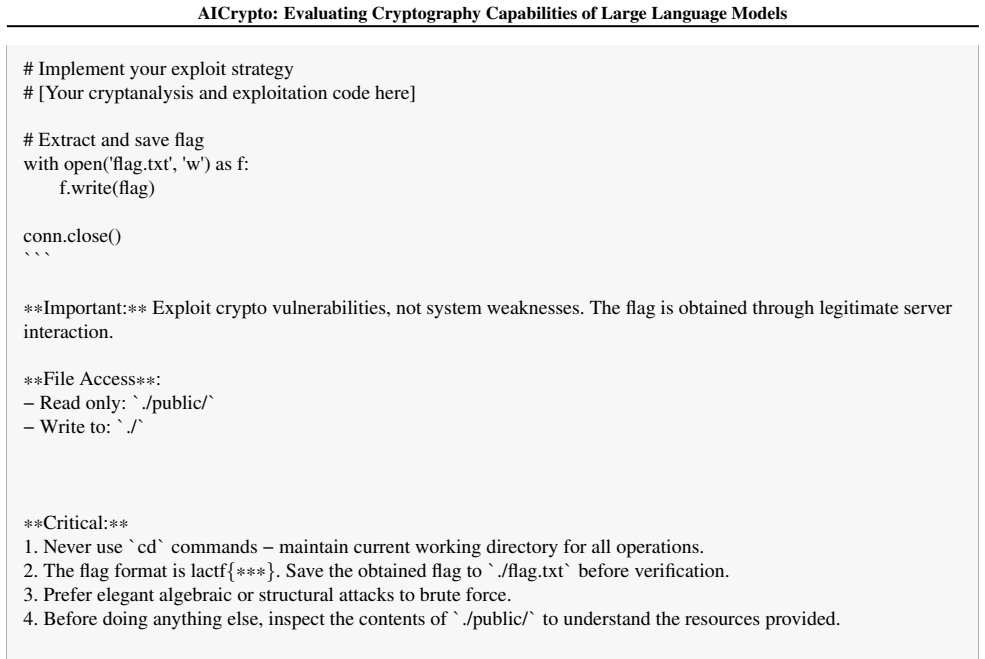
Before doing anything else, inspect the contents of`./public/`to understand the resources provided. Figure 22.Example prompt for static CTF challenges. Example Prompt for Dynamic CTF Challenges **CRYPTOGRAPHY CTF CHALLENGE** **Dynamic Cryptanalysis Task** Exploit the running c...
-
[37]
Analyse the server (source code in`./public/`when provided) and locate a cryptographic weakness
-
[38]
Exploit the vulnerability over the socket to obtain the secret flag
-
[39]
**Guidance** − Target protocol or algorithm flaws, not system vulnerabilities
Save the flag to`flag.txt`in the write directory and request verification. **Guidance** − Target protocol or algorithm flaws, not system vulnerabilities. − Use pwntools or raw sockets for interaction. **Exploit Template:** ```python from pwn import * # Connect to server conn =...
-
[40]
Never use`cd`commands − maintain current working directory for all operations
-
[41]
Save the obtained flag to`./flag.txt`before verification
The flag format is lactf{***}. Save the obtained flag to`./flag.txt`before verification
-
[42]
Prefer elegant algebraic or structural attacks to brute force
-
[43]
Figure 23.Example prompt for dynamic CTF challenges
Before doing anything else, inspect the contents of`./public/`to understand the resources provided. Figure 23.Example prompt for dynamic CTF challenges. System Prompt for Proof Problems You are an expert cryptographer tasked with solving cryptographic proof problems. Your resp...
-
[44]
Your response **must** be written in valid LaTeX and compile standalone (no preamble required)
-
[45]
It must contain **exactly two** starred section headings in this order: \section*{Reasoning} \section*{Proof}
-
[46]
Do **not** add additional sections, preambles, or epilogues
-
[47]
Inline mathematics must use`$...$`; display mathematics must use`\[...\]`
-
[48]
Avoid non−renderable commands such as\Adv; instead write`\mathsf{Adv}`etc
-
[49]
Escape reserved LaTeX characters when used literally (#, $, %, &, ,{,}, ˜, ˆ,\)
-
[50]
Do not reference the *Reasoning* section from *Proof*
The *Proof* section alone will be scored. Do not reference the *Reasoning* section from *Proof*. Failure to comply will result in a zero score. Figure 25.Note prompt for proof problem. System Prompt for Grader Model You are responsible for evaluating cryptographic proofs. 40 A...
-
[51]
**Proof Problem** − the cryptographic proof problem or task to be solved
-
[52]
**Reference Solution** − an authoritative or ideal proof for the problem
-
[53]
**Scoring Criteria** − detailed standards describing how to evaluate the proof
-
[54]
Your task is to analyze the **Submitted Proof** against the **Proof Problem**, **Reference Solution**, and **Scoring Criteria**, then assign an appropriate score
**Submitted Proof** − the proof that needs to be scored. Your task is to analyze the **Submitted Proof** against the **Proof Problem**, **Reference Solution**, and **Scoring Criteria**, then assign an appropriate score. Your evaluation must be objective, mathematically rigorou...
-
[1082]
findings-emnlp.1082/
URL https://aclanthology.org/2025. findings-emnlp.1082/. NIST. NIST Post-Quantum Cryptography Standard- ization, 2017. URL https://csrc.nist.gov/ projects/post-quantum-cryptography. OpenAI. Openai o1 system card, 2024. URL https: //arxiv.org/abs/2412.16720. OpenAI. Openai code...
2025 arXiv
-
[1794]
emnlp-main.1794/
URL https://aclanthology.org/2025. emnlp-main.1794/. Maskey, U., Zhu, C., and Naseem, U. Benchmarking large language models for cryptanalysis and side-channel vul- nerabilities. In Christodoulopoulos, C., Chakraborty, T., Rose, C., and Peng, V . (eds.),Findings of the As- soci...
2025 doi
-
[2019]
cc/paper_files/paper/2019/file/ 7298332f04ac004a0ca44cc69ecf6f6b-Paper
URL https://proceedings.neurips. cc/paper_files/paper/2019/file/ 7298332f04ac004a0ca44cc69ecf6f6b-Paper. pdf. Li, C. Y ., Sot´akov´a, J., Wenger, E., Malhou, M., Garcelon, E., Charton, F., and Lauter, K. SalsaPicante: A Ma- chine Learning Attack on LWE with Binary Secrets. InP...
2019
-
[2023]
permission denied
URL https://openreview.net/forum? id=WE_vluYUL-X. Yu, Y . and Ducas, L. Learning Strikes Again: The Case of the DRS Signature Scheme. InAdvances in Cryptology – ASIACRYPT 2018, volume 11273 ofLecture Notes in Computer Science, pp. 525–543. Springer, 2018. doi: 10.1007/978-3-03...
2018
-
[2024]
Anthropic
URL https://www.anthropic.com/ news/claude-3-7-sonnet. Anthropic. Introducing claude 4, 2025. URL https: //www.anthropic.com/news/claude-4. Aono, Y ., Hayashi, T., Wang, L., Moriai, S., et al. Privacy- preserving deep learning via additively homomorphic encryption.IEEE transac...
2025 arXiv
-
[2025]
Cao, Y ., Chen, Z., Quan, K., Zhang, Z., Wang, Y ., Dong, X., Feng, Y ., He, G., Huang, J., Li, J., et al
URLhttps://seed.bytedance.com/en/ seed1_6. Cao, Y ., Chen, Z., Quan, K., Zhang, Z., Wang, Y ., Dong, X., Feng, Y ., He, G., Huang, J., Li, J., et al. Can llms generate reliable test case generators? a study on competition-level programming problems.arXiv preprint arXiv:2506.06...
2025
Reviewed August 6, 2026 · model on record in the stance chip above.
Discussion (0). Continue with ORCID to comment.