Exploiting emergent symmetries in disorder-averaged quantum dynamics
Pith reviewed 2026-05-19 03:59 UTC · model grok-4.3
The pith
Disorder averaging restores permutation invariance in the effective dynamics of random all-to-all Ising models, allowing polynomial scaling of the symmetric subspace for simulating large spin systems.
A machine-rendered reading of the paper's core claim, the machinery that carries it, and where it could break.
Core claim
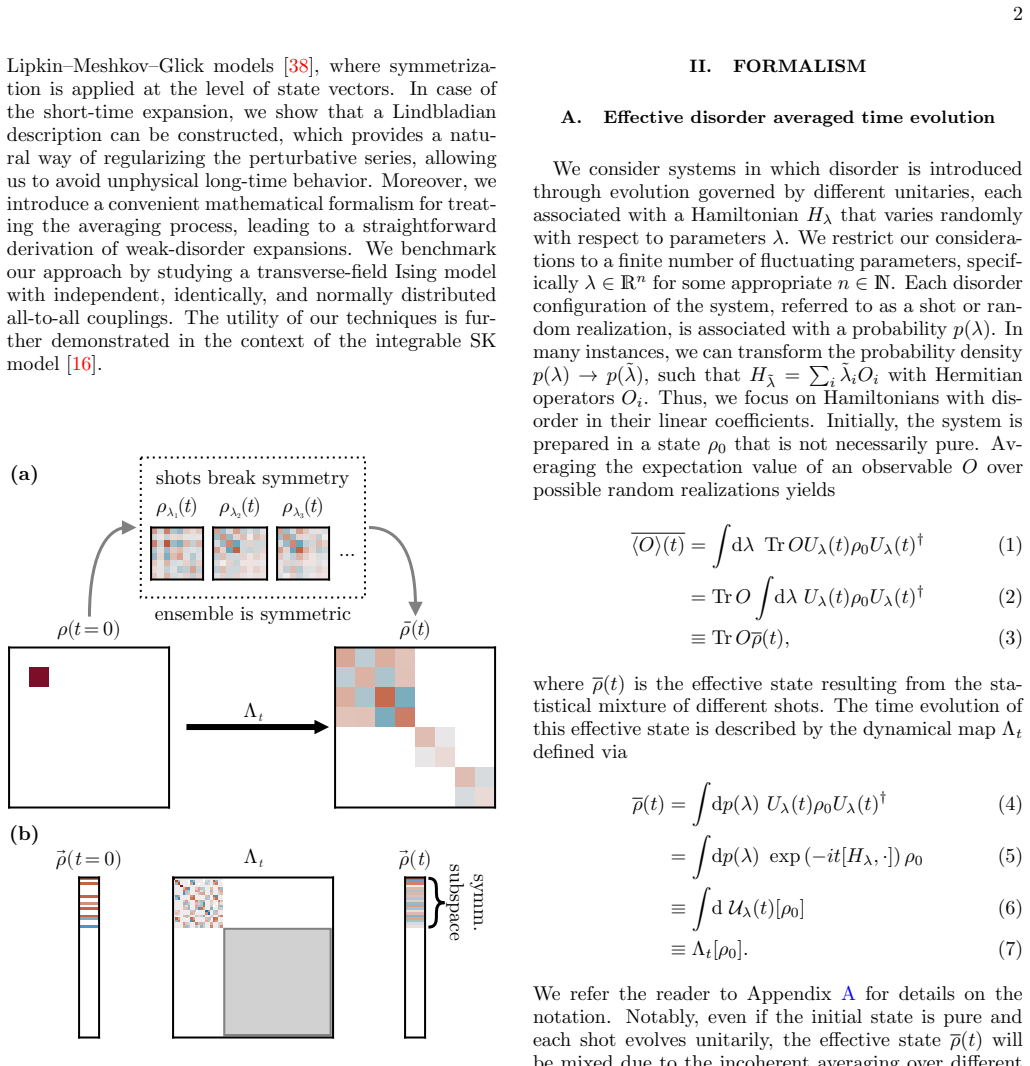
After disorder averaging, quantities linear in the time-evolved state can be computed using an effective dynamical map that restores symmetry at the superoperator level. For the Ising model with random all-to-all interactions in a transverse field, this symmetry is permutation invariance, so the size of the symmetric subspace scales polynomially in the number of spins.
What carries the argument
The effective dynamical map obtained by averaging the time-evolution operator directly, which restores symmetry for linear observables at the superoperator level.
If this is right
- Large spin systems can be simulated efficiently using the reduced symmetric subspace.
- Short-time and weak-disorder expansions allow efficient construction of the symmetric sectors.
- The method applies to computing expectation values in disordered quantum dynamics.
- The benchmark on the all-to-all Ising model demonstrates practical feasibility for larger N.
Where Pith is reading between the lines
- Similar emergent symmetries might appear in other disordered systems with all-to-all couplings after averaging.
- This approach could extend to higher-order observables by considering different averaging procedures.
- Testing on systems with different interaction ranges could reveal the generality of the permutation invariance restoration.
Load-bearing premise
That the quantities of interest are linear in the time-evolved state so that averaging commutes with the expectation value and can be applied to the evolution operator.
What would settle it
A numerical comparison showing that the disorder-averaged expectation values deviate from those computed in the symmetric subspace of the effective map for the Ising model.
Figures


read the original abstract
Symmetries are a key tool in understanding quantum systems, and, among many other things, can be exploited to increase the efficiency of numerical simulations of quantum dynamics. Disordered systems usually feature reduced symmetries and additionally require averaging over many realizations, making their numerical study computationally demanding. However, when studying quantities linear in the time-evolved state, i.e. expectation values of observables, one can apply the averaging procedure to the time evolution operator, resulting in an effective dynamical map, which restores symmetry at the level of superoperators. In this work, we develop schemes for efficiently constructing symmetric sectors of the disorder-averaged dynamical map using short-time and weak-disorder expansions. To benchmark the method, we apply it to an Ising model with random all-to-all interactions in the presence of a transverse field. After disorder averaging, this system becomes effectively permutation-invariant, and thus the size of the symmetric subspace scales polynomially in the number of spins allowing for the simulation of large systems.
Editorial analysis
A structured set of objections, weighed in public.
Referee Report
Summary. The manuscript introduces a technique for exploiting emergent symmetries in the disorder-averaged dynamics of quantum systems. By applying the averaging procedure directly to the time-evolution operator for linear observables, an effective dynamical map is constructed that restores symmetry. In the benchmark application to a transverse-field Ising model with random all-to-all couplings, the disorder-averaged system becomes permutation-invariant, confining the dynamics to a symmetric subspace of dimension scaling linearly with the number of spins, thus enabling efficient simulations of large systems using short-time and weak-disorder expansions.
Significance. This work provides a novel approach to mitigating the computational challenges associated with disorder averaging and large Hilbert spaces in quantum dynamics simulations. By leveraging the symmetry of the disorder distribution, it achieves polynomial scaling in system size for the effective description. This could have broad implications for the study of disordered quantum many-body systems, particularly if the expansions prove accurate for relevant parameter regimes. The internal consistency of the symmetry argument is a strong point.
minor comments (1)
- [Abstract] The abstract states that the method is benchmarked on the Ising model but lacks any mention of specific results, system sizes, or validation against exact methods, which would help readers assess the practical performance of the short-time and weak-disorder expansions.
Simulated Author's Rebuttal
We thank the referee for the positive assessment of our work and the recommendation for minor revision. The referee's summary accurately reflects the core idea of restoring permutation symmetry via disorder averaging of the time-evolution operator for linear observables, and we appreciate the recognition of the polynomial scaling achieved in the benchmark transverse-field Ising model.
Circularity Check
No significant circularity; derivation is self-contained
full rationale
The central derivation proceeds by averaging the unitary time-evolution operator directly over a permutation-symmetric disorder distribution, yielding an effective superoperator channel that inherits exact S_n invariance by construction of the measure. The polynomial dimension of the totally symmetric subspace then follows from standard representation theory (Dicke states, dimension n+1), independent of any fitted parameters or target observables. Short-time and weak-disorder expansions are applied to this already-symmetric channel; no step reduces the claimed symmetry or scaling back to the final simulation result by definition. No self-citations are invoked as load-bearing uniqueness theorems, and the argument remains falsifiable against direct sampling of realizations.
Axiom & Free-Parameter Ledger
axioms (1)
- domain assumption Expectation values of observables are linear functionals of the time-evolved density operator
Reference graph
Works this paper leans on
-
[1]
Example: Solving the SK Model First, we consider an integrable model for illustra- tion purposes, which is also solvable by other means than the differential one. A well-known example is the SK model, an Ising model with independently Gaus- sian distributed all-to-all couplings Hλ =P i<j λijZiZj, λij ∈ N (Jij, σ2 ij) ∀i, j. The Hamiltonian is a sum of com...
-
[2]
If all µij = µ and σ2 ij = σ2 such that the ensemble is permutation invariant, then Λ t and Lt are com- posed of only the permutation invariant operatorsP i<j[ZiZj, · ] and P i<j[ZiZj, · ]2. In this way, the symmetry of the ensemble directly manifests it- self in the structure of the effective time evolution
-
[3]
Noise in the coupling parameters λij leads to two- body decoherence terms
-
[4]
Gaussian noise always leads to time-dependent, lin- early increasing decoherence rates
-
[5]
To benchmark our new tool, we add a constant transverse field to the SK model
Weak-Disorder Expansion Application of the operator D to U(t) becomes non- trivial as soon as non-commuting operators are involved. To benchmark our new tool, we add a constant transverse field to the SK model. Splitting D into its coherent and incoherent part, i.e. splitting off the complex phase of the characteristic function, yields Λt = exp 1 2 ∇T µ ·...
-
[6]
R. H. Dicke, Coherence in spontaneous radiation pro- cesses, Phys. Rev. 93, 99 (1954)
work page 1954
-
[7]
K. Hepp and E. H. Lieb, Equilibrium statistical mechan- ics of matter interacting with the quantized radiation field, Phys. Rev. A 8, 2517 (1973)
work page 1973
-
[8]
J. Ma, X. Wang, C. P. Sun, and F. Nori, Quantum spin squeezing, Physics Reports 509, 89 (2011)
work page 2011
-
[9]
S. Dusuel and J. Vidal, Finite-size scaling exponents of the lipkin-meshkov-glick model, Phys. Rev. Lett. 93, 237204 (2004)
work page 2004
-
[10]
J. I. Latorre, R. Or´ us, E. Rico, and J. Vidal, Entangle- ment entropy in the lipkin-meshkov-glick model, Phys. Rev. A 71, 064101 (2005)
work page 2005
- [11]
-
[12]
J. A. Muniz, D. Barberena, R. J. Lewis-Swan, D. J. Young, J. R. K. Cline, A. M. Rey, and J. K. Thompson, Exploring dynamical phase transitions with cold atoms in an optical cavity, Nature 580, 602 (2020)
work page 2020
-
[13]
R. Chinnarasu, C. Poole, L. Phuttitarn, A. Noori, T. M. Graham, S. N. Coppersmith, A. B. Balantekin, and M. Saffman, Variational simulation of the lipkin- meshkov-glick model on a neutral atom quantum com- puter, PRX Quantum 6, 020350 (2025)
work page 2025
-
[14]
P. W. Anderson, Absence of diffusion in certain random lattices, Phys. Rev. 109, 1492 (1958)
work page 1958
-
[15]
D. A. Abanin, E. Altman, I. Bloch, and M. Serbyn, Col- loquium: Many-body localization, thermalization, and entanglement, Rev. Mod. Phys. 91, 021001 (2019)
work page 2019
-
[16]
S. F. Edwards and P. W. Anderson, Theory of spin glasses, Journal of Physics F: Metal Physics 5, 965 (1975)
work page 1975
-
[17]
Y. Imry and S.-k. Ma, Random-field instability of the ordered state of continuous symmetry, Phys. Rev. Lett. 35, 1399 (1975)
work page 1975
-
[18]
S. Sachdev and J. Ye, Gapless spin-fluid ground state in a random quantum heisenberg magnet, Phys. Rev. Lett. 70, 3339 (1993)
work page 1993
-
[19]
A. Kitaev, A simple model of quantum holography (part 1), Kavli Institute for Theoretical Physics Program: Entanglement in Strongly-Correlated Quantum Matter (Apr 6 - Jul 2, 2015) (2015)
work page 2015
-
[20]
J. Maldacena and D. Stanford, Remarks on the sachdev- ye-kitaev model, Phys. Rev. D 94, 106002 (2016)
work page 2016
-
[21]
D. Sherrington and S. Kirkpatrick, Solvable Model of a Spin-Glass, Phys. Rev. Lett. 35, 1792 (1975)
work page 1975
- [22]
-
[23]
R. S. K. Mong, J. H. Bardarson, and J. E. Moore, Quan- tum transport and two-parameter scaling at the surface of a weak topological insulator, Phys. Rev. Lett. 108, 076804 (2012)
work page 2012
-
[24]
I. C. Fulga, B. van Heck, J. M. Edge, and A. R. Akhmerov, Statistical topological insulators, Phys. Rev. B 89, 155424 (2014)
work page 2014
-
[25]
C. de Groot, A. Turzillo, and N. Schuch, Symmetry Pro- tected Topological Order in Open Quantum Systems, Quantum 6, 856 (2022)
work page 2022
- [26]
- [27]
-
[28]
J. Y. Lee, Y.-Z. You, and C. Xu, Symmetry protected topological phases under decoherence, Quantum 9, 1607 (2025)
work page 2025
-
[29]
A. Antinucci, G. Galati, G. Rizi, and M. Serone, Sym- metries and topological operators, on average (2023), arXiv:2305.08911
-
[30]
C. M. Kropf, C. Gneiting, and A. Buchleitner, Effective Dynamics of Disordered Quantum Systems, Phys. Rev. X 6, 031023 (2016)
work page 2016
-
[31]
Gneiting, Disorder-dressed quantum evolution, Phys
C. Gneiting, Disorder-dressed quantum evolution, Phys. Rev. B 101, 214203 (2020)
work page 2020
-
[32]
C. Gneiting, F. R. Anger, and A. Buchleitner, Incoherent ensemble dynamics in disordered systems, Phys. Rev. A 93, 032139 (2016)
work page 2016
-
[33]
C. Gneiting and F. Nori, Quantum evolution in disor- dered transport, Phys. Rev. A 96, 022135 (2017)
work page 2017
-
[34]
C. Gneiting, D. Leykam, and F. Nori, Disorder-Robust Entanglement Transport, Phys. Rev. Lett. 122, 066601 (2019)
work page 2019
- [35]
-
[36]
B. Paredes, F. Verstraete, and J. I. Cirac, Exploiting Quantum Parallelism to Simulate Quantum Random Many-Body Systems, Phys. Rev. Lett.95, 140501 (2005)
work page 2005
-
[37]
C. M. Kropf, V. N. Shatokhin, and A. Buchleitner, Open system model for quantum dynamical maps with classical noise and corresponding master equations, Open Systems & Information Dynamics 24, 1740012 (2017)
work page 2017
-
[38]
A. W. Sandvik, A. Avella, and F. Mancini, Computa- tional studies of quantum spin systems, in AIP Confer- ence Proceedings (AIP, 2010)
work page 2010
- [39]
-
[40]
S. Sarkar and J. S. Satchell, Optical bistability with small numbers of atoms, EPL 3, 797 (1987)
work page 1987
-
[41]
Hartmann, Generalized Dicke states, Quantum Inf
S. Hartmann, Generalized Dicke states, Quantum Inf. Comput. 16, 1333 (2016)
work page 2016
-
[42]
M. Xu, D. A. Tieri, and M. J. Holland, Simulating open quantum systems by applying SU(4) to quantum master equations, Phys. Rev. A 87, 062101 (2013)
work page 2013
-
[43]
H. J. Lipkin, N. Meshkov, and A. J. Glick, Validity of many-body approximation methods for a solvable model: (i). exact solutions and perturbation theory, Nuclear Physics 62, 188 (1965)
work page 1965
-
[44]
B. Yan, S. A. Moses, B. Gadway, J. P. Covey, K. R. A. Hazzard, A. M. Rey, D. S. Jin, and J. Ye, Observation of dipolar spin-exchange interactions with lattice-confined polar molecules, Nature 501, 521 (2013)
work page 2013
- [45]
-
[46]
A. Signoles, T. Franz, R. F. Alves, M. G¨ arttner, S. Whit- lock, G. Z¨ urn, and M. Weidem¨ uller, Glassy dynamics in a disordered Heisenberg quantum spin system, Phys. Rev. X 11, 011011 (2021)
work page 2021
-
[47]
J. Bezanson, A. Edelman, S. Karpinski, and V. B. Shah, Julia: A Fresh Approach to Numerical Computing, SIAM Review 59, 65 (2017)
work page 2017
-
[48]
G. Datseris, J. Isensee, S. Pech, and T. G´ al, DrWatson: The perfect sidekick for your scientific inquiries, Journal of Open Source Software 5, 2673 (2020)
work page 2020
-
[49]
Fons van der Plas, M. Dral, P. Berg, P. Γ εωργακ´ oπoυλoς, R. Huijzer, M. Boche´ nski, A. Mengali, C. Burns, B. Lungwitz, H. Priyashan, J. Ling, G. Wu, S. Kadowaki, E. Zhang, F. S. S. Schneider, I. Weaver, Xiu-zhe (Roger) Luo, J. Gerritsen, R. Novosel, Supanat, Z. Moon, L. M¨ uller, Timothy, V. Flore, Jeremiah, C. O’Mara, M. Hatherly, and kcin96, Fonsp/Pl...
work page 2024
-
[50]
C. Rackauckas and Q. Nie, Differentialequations.jl–a per- formant and feature-rich ecosystem for solving differen- tial equations in julia, Journal of Open Research Software 5, 15 (2017)
work page 2017
-
[51]
J. H. Verner, Numerically optimal Runge–Kutta pairs with interpolants, Numerical Algorithms 53, 383 (2010)
work page 2010
-
[52]
S. Danisch and J. Krumbiegel, Makie.jl: Flexible high- performance data visualization for Julia, Journal of Open Source Software 6, 3349 (2021)
work page 2021
discussion (0)
Sign in with ORCID, Apple, or X to comment. Anyone can read and Pith papers without signing in.