REVIEW 4 major objections 6 minor 57 references
Generate Aligned Anomaly: Region-Guided Few-Shot Anomaly Image-Mask Pair Synthesis for Industrial Inspection
T0 review · 4 major / 6 minor · reviewed 2026-08-06 · deepseek-v4-flash
Pith's one-line read A few defect examples can be expanded into aligned anomaly-mask pairs that train strong industrial inspectors.
desk verdict Useful synthesis framework with strong downstream numbers, but the inference procedure that puts anomalies onto normal images is never specified—send to peer review, not desk reject. read the letter →
The pith
A machine-rendered reading of the paper's core claim, the machinery that carries it, and where it could break.
The reading
What carries the argument
The load-bearing mechanism is Localized Concept Decomposition: a learnable placeholder token is split into a feature-focused embedding $e_f$ that captures texture and colour of the defect and a position-focused embedding $e_p$ obtained by encoding the anomaly mask, so the diffusion model sees both what and where. Around that core sit three supports: Adaptive Multi-Round Anomaly Clustering refines coarse labels into consistent subcategories; Region-Aware Mask Propagation uses the SAM segmentation model and the SegGPT prompt-based segmenter to transfer semantic region masks from a few normal samples to the whole normal set; and the ARS metric filters generated pairs by saliency-mask overlap. Together they produce the aligned masks that make the downstream gains possible.
What would settle it
Take the logical-anomaly categories in MVTec LOCO, such as pushpins or screw bags, generate anomaly pairs with GAA, and ask annotators to mark the true defective regions; if the generated masks' IoU with human annotations is close to the single-object categories, alignment holds, but if it falls sharply while generated images still look plausible, the region-propagation assumption is the point of failure.
Extended reading notes
Core claim
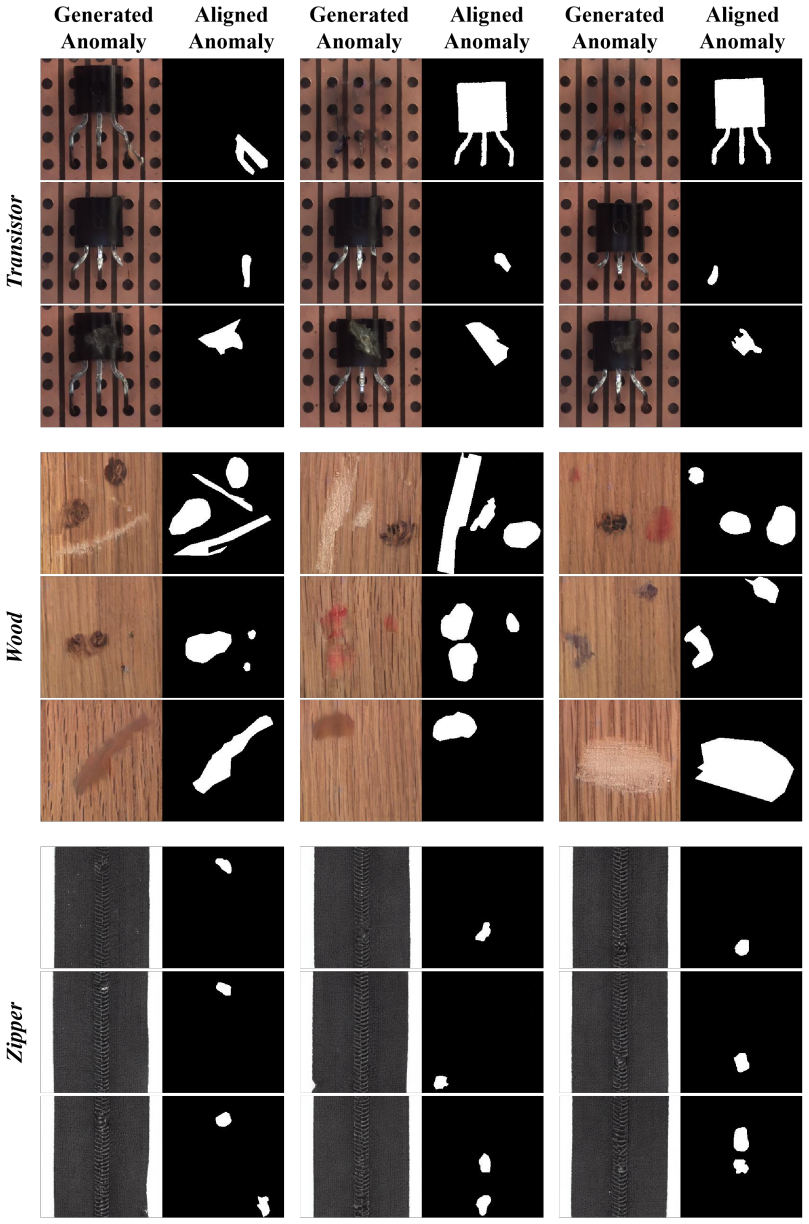
The central discovery is that anomaly generation becomes controllable when the anomaly concept is separated into a feature-focused embedding and a position-focused embedding, and when masks are generated from semantic regions of normal images. GAA clusters the coarse anomaly labels into purer subcategories, learns one feature embedding per subcategory, and encodes the synthetic mask with a shared position encoder; the two embeddings jointly guide the diffusion model. For logical anomalies such as a missing part, the semantic region mask itself becomes the anomaly mask, so the generated defect is aligned by construction. A low-quality sample filter based on Anomaly Region Score keeps only pairs whose saliency map overlaps the mask, and the paper shows that this pipeline yields better generation fidelity, diversity, and downstream localization and classification than previous synthesis methods.
Load-bearing premise
The load-bearing assumption is that the same semantic part of a product can be accurately segmented on every normal image from just a few examples; when that part segmentation fails on cluttered or many-object products, the anomaly masks inherit the error and the downstream localization and classification gains shrink.
Editorial extensions
If this is right
- A detector trained purely on synthetic image-mask pairs can match or beat specialist unsupervised and supervised detectors on real anomaly localization, so data synthesis becomes a viable route out of anomaly scarcity.
- Anomaly generation can be steered by part-level semantics: structural defects can be placed on random parts or edges, logical defects on the exact missing region, and combined defects as non-overlapping unions.
- Classification of anomalies improves when the generator distinguishes subcategories rather than treating one coarse label as a single concept, because the synthetic classes stay separable.
- Quality filtering by saliency-mask overlap matters: dropping low-ARS pairs improves downstream accuracy, so the value of a synthesis method depends on the whole pair, not just image realism.
Reading between the lines
- Beyond the paper: the method's ceiling on logical anomalies is set by its semantic region masks, so on multi-instance categories where part segmentation is unreliable, logical anomaly masks will inherit those errors and better instance-level segmentation should translate directly into better synthesized logical defects.
- Beyond the paper: the what/where embedding split is a transferable recipe for other part-local editing tasks beyond defect synthesis, such as medical image augmentation, by swapping the diffusion backbone and the region source.
- Beyond the paper: because GAA produces paired masks, the synthetic dataset could also be used to train open-set anomaly detectors that must localize unseen defect types, a setting the paper does not evaluate.
Editorial analysis
A structured set of objections, weighed in public.
Referee Report
Summary. The paper proposes GAA, a few-shot anomaly image-mask pair synthesis framework for industrial inspection. GAA learns anomaly concepts by decomposing a learnable text embedding into feature-focused and position-focused components, uses adaptive multi-round clustering to refine coarse anomaly categories, synthesizes anomaly masks via geometric enhancement, region-aware propagation from SAM/SegGPT, and type-adaptive placement, and filters low-quality synthetic pairs with a proposed ARS metric. The synthetic pairs are used to train a simple U-Net for localization and a ResNet-34 for classification. Experiments on MVTec AD and MVTec LOCO report state-of-the-art generation quality (IS/IC-LPIPS), localization (96.3% AUROC, 76.8% AP on MVTec average), and classification accuracy (84.7%), outperforming prior synthesis and detection baselines.
Significance. If the reported results hold, GAA would be a practically valuable contribution: it addresses a real bottleneck (anomaly data scarcity) by generating aligned image-mask pairs for downstream localization and classification, and it demonstrates consistent gains across two benchmarks and multiple metrics. The paper ships a substantial experimental effort, including comparisons to published baselines and ablations of the main modules. The ARS-based filtering idea is a useful practical addition. However, the core methodological contribution is not fully specified: the inference-time mechanism for injecting a normal image into the diffusion generation is never concretely defined, and at least one key equation is mathematically ambiguous. These issues must be resolved before the central claim is verifiable from the text.
major comments (4)
- [Section 3.4 (Inference Pipeline)] The inference procedure that converts a normal image I and a synthetic mask M_Align into a generated anomaly image is never concretely specified. Section 3.4 states only that the concatenated embedding e={e_f, e_p} is 'fed into the latent diffusion model', but it does not describe how the pixel content of I is injected into the generation process—e.g., whether the latent is initialized from the VAE encoding of I, whether noise is added only inside the mask region, whether DDIM inversion is used, or whether some latent blending is applied. This is load-bearing because the training loss in Eq. (3) supervises the denoising error only inside the ground-truth mask (the error is multiplied by M_a), so the model is never explicitly trained to preserve the unmasked background. Without a concrete algorithm, the central claim that GAA synthesizes anomalies 'on normal images I' is not reproducible from the text, and the localization/classification results in Tables 2–4 rest on an unspecified procedure.
- [Eq. (6)] Equation (6) is mathematically ambiguous: M_opt is described as a pseudo-mask (presumably binary), and the right-hand side multiplies M_opt by a scalar factor involving A_avg/A_M. If M_opt is binary, the result is either the same binary mask or a rescaled continuous map, but the equation as written would produce values that are not valid binary mask pixels, and the intended rescaling of a binary mask is not defined. The notation M_G^(x,y) = M_opt^(x,y) * (...) is dimensionally unclear when M_opt is discrete. This ambiguity affects the mask synthesis module that directly feeds M_Align into both the position encoder E and the downstream mask-based evaluation, so it needs clarification.
- [Section 4.2 and Tables 2-4] The paper reports no error bars, confidence intervals, or significance tests for any of the central quantitative claims. Given that the downstream gains in Table 2 and Table 3 are stated as single numbers (e.g., 96.3% vs. 94.1% AUROC and +18.6% accuracy), and given that the pipeline involves stochastic mask generation, clustering, and diffusion sampling, the reader cannot assess whether the reported advantages are stable. At minimum, the authors should report mean and standard deviation over multiple runs or seeds for the main comparisons, or justify why the differences are outside what seed variance could produce.
- [Section 3.3 (Region-Aware Mask Propagation)] For logical anomalies the paper directly uses the semantic region mask M_R as the anomaly mask M_Logic (e.g., 'missing nuts' becomes the nut region). This means that any error in the SegGPT-propagation step (which is prompted with only 3-5 SAM masks per category) directly becomes a misaligned anomaly mask. The paper does not quantify the accuracy of the propagated region masks on MVTec AD or LOCO, nor does it provide a failure analysis for complex multi-instance categories such as pushpins and screw bags, where the reported gains in Table 2 are smallest relative to baselines. A quantitative evaluation of mask-propagation accuracy, or at least a per-category discussion of propagation failures, would strengthen the claim of precise alignment.
minor comments (6)
- [Eq. (3) and surrounding text] The training loss in Eq. (3) multiplies the error by M_a, but the notation is inconsistent with the text: the equation shows a masked difference norm, while the text says 'the denoising error is computed only inside the mask'. Please clarify whether the mask is applied in latent space at the full latent resolution or after upsampling to pixel resolution, and define the multiplication operation explicitly.
- [Section 3.2, Eq. (2)] The clustering objective in Eq. (2) introduces weights w1 and w2 but their values are never specified anywhere in the paper or appendix. The dense-cluster threshold (N/(log(0.1N)+0.4)) should also be motivated more clearly, as it appears to be a heuristic.
- [Section 4.2, Table 3] The classification comparison re-evaluates AnoDiff (denoted AnoDiff^‡) on an officially released dataset, but the text does not explain why the original AnoDiff* numbers and the re-evaluated numbers differ substantially (e.g., 66.7 vs. 60.1 for capsule, 69.5 vs. 64.3 for zipper). Without a description of the re-evaluation protocol or the filtering step, the comparison basis is unclear.
- [Section 4.4, Table 5] The ablation table reports changes in IS, IC-LPIPS, ACC, and ARS when modules are removed, but the table labels '↓' values inconsistently (e.g., '– RAMS' shows IS 1.79 (↓0.03) but the full model is 1.89, which is a 0.10 decrease). Please verify all deltas and present absolute values consistently, since the current format may mislead readers.
- [Appendix B.3] In the evaluation metrics section, IC-LPIPS is defined at one point as 'between images within the same class' and at another as 'intra-class consistency'; the sign convention (higher is better for diversity) is stated, but the definition of 'intra-cluster' is not tied to the anomaly clusters from Eq. (2), which is confusing.
- [Throughout] The paper contains several typos and formatting issues, e.g., 'anomaly image-mask' vs 'image–mask pair' inconsistently, 'anomaly image–mask samples' in Section 4.1, and duplicated reference entries for DRAEM and U-Net. A careful proofread is needed.
Circularity Check
No significant circularity: GAA's central claims are benchmarked externally, and the only self-citation is a non-load-bearing taxonomy reference.
full rationale
GAA's derivation chain is not circular. The anomaly concept embeddings (e_f, e_p) are learned from a small set of real anomaly image-mask pairs via Eq. (3), but the paper's headline claims are verified against external benchmarks (MVTec AD, MVTec LOCO) and published baselines, not against the training inputs. The ARS filter (Eq. 7) is trained on normal images plus Gaussian noise and is used only to select generated pairs; it does not leak test labels or encode the evaluation metrics. The region-guided mask synthesis uses SAM/SegGPT region propagation; for logical anomalies the semantic region mask is directly used as the anomaly mask, but this is an explicit design choice, not a prediction derived from the learned model. The only self-citation is reference [18] (AnomalyXfusion, which shares author Yilin Lu) used alongside [3] for the anomaly-type taxonomy; this is not load-bearing because the taxonomy also comes from the MVTec dataset and the downstream comparisons are independent. One genuine weakness is that Section 3.4 does not specify how the normal image I is injected into the LDM at inference: Eq. (3) supervises only inside the mask, so background preservation is not guaranteed by the stated loss. This is an omitted algorithmic detail and a reproducibility risk, not a circular step, because the claimed results do not reduce to the training objective by construction.
Assumptions & free parameters
free parameters (7)
- w1, w2 (clustering criterion weights, Eq. 2) =
not reported
- alpha (scale-adaptive mask adjustment, Eq. 6) =
not reported
- Dense-cluster threshold constants (0.1, 0.4) =
0.1, 0.4
- Token counts for embeddings =
8 feature tokens, 4 position tokens
- ARS filter selection ratio =
keep top 500 of 1000
- Gaussian noise std for pseudo-anomalies =
0.015
- Geometric perturbation and placement offsets =
not reported
assumptions (6)
- domain assumption A pretrained latent diffusion model (e.g., Stable Diffusion) contains sufficient priors to generate realistic industrial anomaly textures when conditioned on learned embeddings.
- domain assumption Textual inversion on a frozen diffusion model can learn localized anomaly concepts from a few image-mask pairs.
- domain assumption SAM and SegGPT produce accurate semantic region masks for industrial product categories when prompted with 3-5 examples.
- domain assumption KMeans clustering on fused features yields semantically meaningful anomaly subcategories that improve the LDM conditioning.
- domain assumption A pixel-space anomaly mask can be used as a multiplicative mask in the latent-space denoising loss (Eq. 3).
- standard math Standard KMeans and the Calinski-Harabasz and Davies-Bouldin indices are appropriate for high-dimensional perceptual features.
Cite this review
Pith. "Pith review of Generate Aligned Anomaly: Region-Guided Few-Shot Anomaly Image-Mask Pair Synthesis for Industrial Inspection." pith.science (2026). https://pith.science/paper/2MKYTPJS
@misc{pith2026250709619,
  author       = {Pith},
  title        = {Pith review of: Generate Aligned Anomaly: Region-Guided Few-Shot Anomaly Image-Mask Pair Synthesis for Industrial Inspection},
  year         = {2026},
  howpublished = {\url{https://pith.science/paper/2MKYTPJS}},
  note         = {Machine review of arXiv:2507.09619}
}
read the original abstract
Anomaly inspection plays a vital role in industrial manufacturing, but the scarcity of anomaly samples significantly limits the effectiveness of existing methods in tasks such as localization and classification. While several anomaly synthesis approaches have been introduced for data augmentation, they often struggle with low realism, inaccurate mask alignment, and poor generalization. To overcome these limitations, we propose Generate Aligned Anomaly (GAA), a region-guided, few-shot anomaly image-mask pair generation framework. GAA leverages the strong priors of a pretrained latent diffusion model to generate realistic, diverse, and semantically aligned anomalies using only a small number of samples. The framework first employs Localized Concept Decomposition to jointly model the semantic features and spatial information of anomalies, enabling flexible control over the type and location of anomalies. It then utilizes Adaptive Multi-Round Anomaly Clustering to perform fine-grained semantic clustering of anomaly concepts, thereby enhancing the consistency of anomaly representations. Subsequently, a region-guided mask generation strategy ensures precise alignment between anomalies and their corresponding masks, while a low-quality sample filtering module is introduced to further improve the overall quality of the generated samples. Extensive experiments on the MVTec AD and LOCO datasets demonstrate that GAA achieves superior performance in both anomaly synthesis quality and downstream tasks such as localization and classification.
Figures


Figures from the paper (12 more)



Reference graph
Works this paper leans on
-
[1]
Rameen Abdal, Yipeng Qin, and Peter Wonka. 2019. Image2stylegan: How to embed images into the stylegan latent space?. In Proceedings of the IEEE/CVF international conference on computer vision . 4432–4441
work page 2019
-
[2]
Yuval Alaluf, Omer Tov, Ron Mokady, Rinon Gal, and Amit Bermano. 2022. Hyperstyle: Stylegan inversion with hypernetworks for real image editing. In Proceedings of the IEEE/CVF conference on computer Vision and pattern recognition . 18511–18521
work page 2022
-
[3]
Paul Bergmann, Kilian Batzner, Michael Fauser, David Sattlegger, and Carsten Steger. 2022. Beyond dents and scratches: Logical constraints in unsupervised anomaly detection and localization. International Journal of Computer Vision 130, 4 (2022), 947–969
work page 2022
-
[4]
Paul Bergmann, Michael Fauser, David Sattlegger, and Carsten Steger. 2019. MVTec AD–A comprehensive real-world dataset for unsupervised anomaly de- tection. In Proceedings of the IEEE/CVF conference on computer vision and pattern recognition. 9592–9600
work page 2019
-
[5]
Amit H Bermano, Rinon Gal, Yuval Alaluf, Ron Mokady, Yotam Nitzan, Omer Tov, Oren Patashnik, and Daniel Cohen-Or. 2022. State-of-the-Art in the Architecture, Methods and Applications of StyleGAN. In Computer Graphics Forum, Vol. 41. Wiley Online Library, 591–611
work page 2022
-
[6]
Tadeusz Caliński and Jerzy Harabasz. 1974. A dendrite method for cluster analysis. Communications in Statistics-theory and Methods 3, 1 (1974), 1–27
work page 1974
-
[7]
Arslan Chaudhry, Puneet K Dokania, Thalaiyasingam Ajanthan, and Philip HS Torr. 2018. Riemannian walk for incremental learning: Understanding forgetting and intransigence. In Proceedings of the European conference on computer vision (ECCV). 532–547
work page 2018
-
[8]
Niv Cohen and Yedid Hoshen. 2020. Sub-image anomaly detection with deep pyramid correspondences. arXiv preprint arXiv:2005.02357 (2020)
arXiv 2020
Show all 57 references
-
[9]
David L Davies and Donald W Bouldin. 1979. A cluster separation measure. IEEE transactions on pattern analysis and machine intelligence 2 (1979), 224–227
1979
-
[10]
Hanqiu Deng and Xingyu Li. 2022. Anomaly detection via reverse distillation from one-class embedding. In Proceedings of the IEEE/CVF conference on computer vision and pattern recognition . 9737–9746
2022
-
[11]
Prafulla Dhariwal and Alexander Nichol. 2021. Diffusion models beat gans on image synthesis. Advances in neural information processing systems 34 (2021), 8780–8794
2021
-
[12]
Choubo Ding, Guansong Pang, and Chunhua Shen. 2022. Catching both gray and black swans: Open-set supervised anomaly detection. In Proceedings of the IEEE/CVF conference on computer vision and pattern recognition . 7388–7398
2022
-
[13]
Alexey Dosovitskiy. 2020. An image is worth 16x16 words: Transformers for image recognition at scale. arXiv preprint arXiv:2010.11929 (2020)
2020 arXiv
-
[14]
Yuxuan Duan, Yan Hong, Li Niu, and Liqing Zhang. 2023. Few-shot defect image generation via defect-aware feature manipulation. In Proceedings of the AAAI Conference on Artificial Intelligence, Vol. 37. 571–578
2023
-
[15]
Rinon Gal, Yuval Alaluf, Yuval Atzmon, Or Patashnik, Amit H Bermano, Gal Chechik, and Daniel Cohen-Or. 2022. An image is worth one word: Personalizing text-to-image generation using textual inversion. arXiv preprint arXiv:2208.01618 (2022)
2022 arXiv
-
[16]
Kaiming He, Xiangyu Zhang, Shaoqing Ren, and Jian Sun. 2016. Deep residual learning for image recognition. In Proceedings of the IEEE conference on computer vision and pattern recognition . 770–778
2016
-
[17]
Jonathan Ho, Ajay Jain, and Pieter Abbeel. 2020. Denoising diffusion probabilistic models. Advances in neural information processing systems 33 (2020), 6840–6851
2020
-
[18]
Jie Hu, Yawen Huang, Yilin Lu, Guoyang Xie, Guannan Jiang, Yefeng Zheng, and Zhichao Lu. 2024. Anomalyxfusion: Multi-modal anomaly synthesis with diffusion. arXiv preprint arXiv:2404.19444 (2024)
2024 arXiv
-
[19]
Teng Hu, Jiangning Zhang, Ran Yi, Yuzhen Du, Xu Chen, Liang Liu, Yabiao Wang, and Chengjie Wang. 2024. Anomalydiffusion: Few-shot anomaly image gener- ation with diffusion model. In Proceedings of the AAAI Conference on Artificial Intelligence, Vol. 38. 8526–8534
2024
-
[20]
Jongheon Jeong, Yang Zou, Taewan Kim, Dongqing Zhang, Avinash Ravichan- dran, and Onkar Dabeer. 2023. Winclip: Zero-/few-shot anomaly classification and segmentation. In Proceedings of the IEEE/CVF Conference on Computer Vision and Pattern Recognition. 19606–19616
2023
-
[21]
Ying Jin, Jinlong Peng, Qingdong He, Teng Hu, Hao Chen, Jiafu Wu, Wenbing Zhu, Mingmin Chi, Jun Liu, Yabiao Wang, et al . 2024. DualAnoDiff: Dual- Interrelated Diffusion Model for Few-Shot Anomaly Image Generation. arXiv preprint arXiv:2408.13509 (2024)
2024 arXiv
-
[22]
Diederik P Kingma. 2013. Auto-encoding variational bayes. arXiv preprint arXiv:1312.6114 (2013)
2013 arXiv
-
[23]
Berg, Wan-Yen Lo, Piotr Dollar, and Ross Girshick
Alexander Kirillov, Eric Mintun, Nikhila Ravi, Hanzi Mao, Chloe Rolland, Laura Gustafson, Tete Xiao, Spencer Whitehead, Alexander C. Berg, Wan-Yen Lo, Piotr Dollar, and Ross Girshick. 2023. Segment Anything. InProceedings of the IEEE/CVF International Conference on Computer Vi...
2023
-
[24]
Chun-Liang Li, Kihyuk Sohn, Jinsung Yoon, and Tomas Pfister. 2021. Cutpaste: Self-supervised learning for anomaly detection and localization. In Proceedings of the IEEE/CVF conference on computer vision and pattern recognition . 9664–9674
2021
-
[25]
Xinyang Li, Zhangyu Lai, Linning Xu, Yansong Qu, Liujuan Cao, Shengchuan Zhang, Bo Dai, and Rongrong Ji. 2024. Director3d: Real-world camera trajectory and 3d scene generation from text. Advances in neural information processing systems 37 (2024), 75125–75151
2024
-
[26]
Xinyang Li, Chengjie Yi, Jiawei Lai, Mingbao Lin, Yansong Qu, Shengchuan Zhang, and Liujuan Cao. 2025. SynergyAmodal: Deocclude Anything with Text Control. arXiv preprint arXiv:2504.19506 (2025)
2025 arXiv
-
[27]
Zhikang Liu, Yiming Zhou, Yuansheng Xu, and Zilei Wang. 2023. Simplenet: A simple network for image anomaly detection and localization. In Proceedings of the IEEE/CVF Conference on Computer Vision and Pattern Recognition . 20402– 20411
2023
-
[28]
Fanbin Lu, Xufeng Yao, Chi-Wing Fu, and Jiaya Jia. 2023. Removing anom- alies as noises for industrial defect localization. In Proceedings of the IEEE/CVF International Conference on Computer Vision . 16166–16175
2023
-
[29]
Shuanlong Niu, Bin Li, Xinggang Wang, and Hui Lin. 2020. Defect image sample generation with GAN for improving defect recognition. IEEE Transactions on Automation Science and Engineering 17, 3 (2020), 1611–1622
2020
-
[30]
Timo Ojala, Matti Pietikainen, and Topi Maenpaa. 2002. Multiresolution gray- scale and rotation invariant texture classification with local binary patterns.IEEE Transactions on pattern analysis and machine intelligence 24, 7 (2002), 971–987
2002
-
[31]
Utkarsh Ojha, Yijun Li, Jingwan Lu, Alexei A Efros, Yong Jae Lee, Eli Shecht- man, and Richard Zhang. 2021. Few-shot image generation via cross-domain correspondence. In Proceedings of the IEEE/CVF conference on computer vision and pattern recognition. 10743–10752
2021
-
[32]
Guansong Pang, Choubo Ding, Chunhua Shen, and Anton van den Hengel. 2021. Explainable deep few-shot anomaly detection with deviation networks. arXiv preprint arXiv:2108.00462 (2021)
2021 arXiv
-
[33]
Yansong Qu, Dian Chen, Xinyang Li, Xiaofan Li, Shengchuan Zhang, Liujuan Cao, and Rongrong Ji. 2025. Drag Your Gaussian: Effective Drag-Based Editing with Score Distillation for 3D Gaussian Splatting. arXiv preprint arXiv:2501.18672 (2025)
2025 arXiv
-
[34]
Alec Radford, Jong Wook Kim, Chris Hallacy, Aditya Ramesh, Gabriel Goh, Sandhini Agarwal, Girish Sastry, Amanda Askell, Pamela Mishkin, Jack Clark, et al. 2021. Learning transferable visual models from natural language supervision. In International conference on machine learni...
2021
-
[35]
Nicolae-Cătălin Ristea, Neelu Madan, Radu Tudor Ionescu, Kamal Nasrollahi, Fahad Shahbaz Khan, Thomas B Moeslund, and Mubarak Shah. 2022. Self- supervised predictive convolutional attentive block for anomaly detection. In Proceedings of the IEEE/CVF conference on computer visi...
2022
-
[36]
Daniel Roich, Ron Mokady, Amit H Bermano, and Daniel Cohen-Or. 2022. Pivotal tuning for latent-based editing of real images. ACM Transactions on graphics (TOG) 42, 1 (2022), 1–13
2022
-
[37]
Robin Rombach, Andreas Blattmann, Dominik Lorenz, Patrick Esser, and Björn Ommer. 2022. High-resolution image synthesis with latent diffusion models. In Proceedings of the IEEE/CVF conference on computer vision and pattern recognition . 10684–10695
2022
-
[38]
Olaf Ronneberger, Philipp Fischer, and Thomas Brox. 2015. U-net: Convolu- tional networks for biomedical image segmentation. In Medical image computing and computer-assisted intervention–MICCAI 2015: 18th international conference, Munich, Germany, October 5-9, 2015, proceeding...
2015
-
[39]
Olaf Ronneberger, Philipp Fischer, and Thomas Brox. 2015. U-net: Convolutional networks for biomedical image segmentation. In International Conference on Medical Image Computing and Computer-Assisted Intervention. Springer, 234–241
2015
-
[40]
Karsten Roth, Latha Pemula, Joaquin Zepeda, Bernhard Schölkopf, Thomas Brox, and Peter Gehler. 2022. Towards total recall in industrial anomaly detection. In Proceedings of the IEEE/CVF conference on computer vision and pattern recognition . 14318–14328
2022
-
[41]
Marco Rudolph, Bastian Wandt, and Bodo Rosenhahn. 2021. Same same but differnet: Semi-supervised defect detection with normalizing flows. InProceedings of the IEEE/CVF winter conference on applications of computer vision . 1907–1916
2021
-
[42]
Chitwan Saharia, William Chan, Saurabh Saxena, Lala Li, Jay Whang, Emily L Denton, Kamyar Ghasemipour, Raphael Gontijo Lopes, Burcu Karagol Ayan, Tim Salimans, et al. 2022. Photorealistic text-to-image diffusion models with deep language understanding. Advances in neural infor...
2022
-
[43]
Tim Salimans, Ian Goodfellow, Wojciech Zaremba, Vicki Cheung, Alec Radford, and Xi Chen. 2016. Improved techniques for training gans. Advances in neural information processing systems 29 (2016)
2016
-
[44]
Janos Schanda. 2007. CIE colorimetry. Colorimetry: Understanding the CIE system 3 (2007), 25–78
2007
-
[45]
Jiaming Song, Chenlin Meng, and Stefano Ermon. 2020. Denoising diffusion implicit models. arXiv preprint arXiv:2010.02502 (2020)
2020 arXiv
-
[46]
Yang Song and Stefano Ermon. 2019. Generative modeling by estimating gradients of the data distribution. Advances in neural information processing systems 32 (2019)
2019
-
[47]
Omer Tov, Yuval Alaluf, Yotam Nitzan, Or Patashnik, and Daniel Cohen-Or. 2021. Designing an encoder for stylegan image manipulation. ACM Transactions on Graphics (TOG) 40, 4 (2021), 1–14
2021
-
[48]
Shashanka Venkataramanan, Kuan-Chuan Peng, Rajat Vikram Singh, and Abhijit Mahalanobis. 2020. Attention guided anomaly localization in images. InEuropean Conference on Computer Vision . Springer, 485–503
2020
-
[49]
Tengfei Wang, Yong Zhang, Yanbo Fan, Jue Wang, and Qifeng Chen. 2022. High- fidelity gan inversion for image attribute editing. In Proceedings of the IEEE/CVF conference on computer vision and pattern recognition . 11379–11388
2022
-
[50]
Xinlong Wang, Xiaosong Zhang, Yue Cao, Wen Wang, Chunhua Shen, and Tiejun Huang. 2023. SegGPT: Segmenting Everything In Context. arXiv preprint arXiv:2304.03284 (2023)
2023 arXiv
-
[51]
Weihao Xia, Yulun Zhang, Yujiu Yang, Jing-Hao Xue, Bolei Zhou, and Ming- Hsuan Yang. 2022. Gan inversion: A survey. IEEE transactions on pattern analysis and machine intelligence 45, 3 (2022), 3121–3138
2022
-
[52]
Pengfei Yue, Jianghang Lin, Shengchuan Zhang, Jie Hu, Yilin Lu, Hongwei Niu, Haixin Ding, Yan Zhang, GUANNAN JIANG, Liujuan Cao, et al. [n. d.]. Adaptive Selection based Referring Image Segmentation. In ACM Multimedia 2024
2024
-
[53]
Vitjan Zavrtanik, Matej Kristan, and Danijel Skocaj. 2021. DRAEM - A Discrimi- natively Trained Reconstruction Embedding for Surface Anomaly Detection. In Proceedings of the IEEE/CVF International Conference on Computer Vision (ICCV) . 8330–8339
2021
-
[54]
Vitjan Zavrtanik, Matej Kristan, and Danijel Skočaj. 2021. Draem-a discrimi- natively trained reconstruction embedding for surface anomaly detection. In Proceedings of the IEEE/CVF international conference on computer vision . 8330– 8339
2021
-
[55]
Gongjie Zhang, Kaiwen Cui, Tzu-Yi Hung, and Shijian Lu. 2021. Defect-GAN: High-fidelity defect synthesis for automated defect inspection. In Proceedings of the IEEE/CVF Winter Conference on Applications of Computer Vision . 2524–2534
2021
-
[56]
Hui Zhang, Zuxuan Wu, Zheng Wang, Zhineng Chen, and Yu-Gang Jiang. 2023. Prototypical residual networks for anomaly detection and localization. In Pro- ceedings of the IEEE/CVF Conference on Computer Vision and Pattern Recognition . 16281–16291
2023
-
[57]
cable" category, blue, green, and gray cables are grouped into distinct clusters. In the “bottle
Xinyi Zhang, Naiqi Li, Jiawei Li, Tao Dai, Yong Jiang, and Shu-Tao Xia. 2023. Unsupervised surface anomaly detection with diffusion probabilistic model. In Proceedings of the IEEE/CVF International Conference on Computer Vision . 6782– 6791. A Overview In this supplementary ma...
2023
Reviewed August 6, 2026 · model on record in the stance chip above.
Discussion (0). Sign in to comment.