REVIEW 2 major objections 5 minor 40 references
humancompatible.interconnect: Testing Properties of Repeated Uses of Interconnections of AI Systems
T0 review · 2 major / 5 minor · reviewed 2026-08-06 · deepseek-v4-flash
Pith's one-line read Repeated uses of interconnected AI systems can be certified for fairness and robustness by checking a single contraction-on-average condition, and the paper packages that check in a PyTorch toolkit called interconnect.
desk verdict A useful PyTorch toolkit for estimating contraction-on-average in closed-loop AI models, but the paper overstates the guarantees by calling a finite-sample heuristic an 'a priori' certificate. read the letter →
The pith
A machine-rendered reading of the paper's core claim, the machinery that carries it, and where it could break.
The reading
What carries the argument
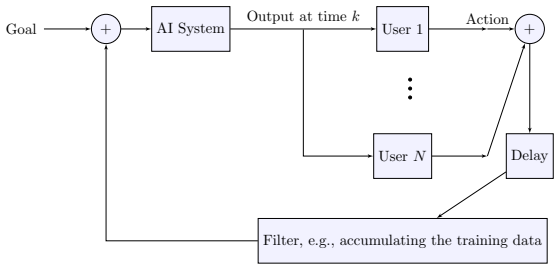
The central object is the stochastic difference inclusion x(k+1) in {F_m(x(k)): m in M}, with maps F_m sampled according to probabilities p_m, where each F_m describes one joint transition of agents, controller, filter, and delay. The load-bearing test is condition (12): the sum over m of p_m times the ratio of state separation after one transition to separation before the transition must be less than a constant C strictly below 1, for every pair of states. The toolkit's get_factor_from_list() function estimates this factor from a user-supplied list of reference signals and agent probabilities by simulation, and if the estimated C is below 1, ergodicity—and hence existence of the long-run averages behind equal impact—follows from the theory of iterated function systems.
What would settle it
Take a deliberately non-ergodic loop, such as two disconnected dynamics with alternating probabilities that violate condition (12), and run get_factor_from_list() on a coarse grid of reference signals; if it reports C below 1 even though the true supremum is at least 1, the finite-sample check has produced a false certificate. A reader could also search for two states x and xhat on the grid whose empirical ratio sum is at least 1 while the reported C is below 1, which would expose an inconsistency in the estimator.
Extended reading notes
Core claim
The paper's central claim is that a stochastic closed-loop model of AI systems with agents—where each agent's state evolves through finitely many maps chosen with probabilities conditioned on the AI system's output—can be tested for robustness and fairness by checking whether the stochastic difference inclusion satisfies contraction on average: the expected ratio of state separation after one transition to separation before the transition must be bounded by a constant C below 1 uniformly over all state pairs. If this holds, the Markov chain has a unique invariant measure and the long-run averages in Definition 2 exist; those averages are what equal-impact fairness is defined on. The paper contributes a PyTorch toolkit, interconnect, that lets a user assemble such loops as computational graphs and calls get_factor_from_list() to estimate C and kernel density estimates of output distributions, turning a regulator's a priori fairness requirement into a concrete numerical check.
Load-bearing premise
The certificate is only as good as the finite simulation grid: get_factor_from_list() estimates the maximum over all state pairs from a finite set of reference signals and agent probabilities, and the paper gives no bound on how far that estimate can fall below the true worst case.
Editorial extensions
If this is right
- If contraction on average holds for a specified loop, the Markov chain has a unique invariant measure, so the long-run averages in Definition 2 exist and are independent of initial conditions.
- Regulators can demand such a check before deployment: the loop's designer supplies the PyTorch graph and a reported C below 1 as an a priori guarantee of equal impact.
- The finite-state stochastic-pointer model covers discrete agent actions such as credit approved or denied, so non-Lipschitz classification maps do not block the ergodicity check.
- For cascaded interconnections such as two-sided markets, the user assembles the components and the same get_factor_from_list() call certifies the composite loop, not just its parts.
- The toolkit also estimates output-signal distributions by kernel density estimation, so the a priori guarantee is accompanied by a view of what the long-run behaviour looks like.
Reading between the lines
- Editorial extension: because condition (12) is sufficient for ergodicity but not necessary, a loop that fails the C below 1 test is not proven unfair; the tool is an a priori certifier for loops that pass, not a verdict on loops that fail.
- Editorial extension: the same contraction-on-average estimate could be used as a gradient signal, since the loop is a PyTorch graph; one could in principle differentiate through the simulated factor and tune controller or agent parameters toward smaller C, turning certification into design.
- Editorial extension: the guarantee concerns existence of long-run averages, not their rate of convergence, so two certified loops with the same C can still differ greatly in how many interactions regulators must observe before equal-impact averages are approached.
Editorial analysis
A structured set of objections, weighed in public.
Referee Report
Summary. The paper presents interconnect, an open-source PyTorch toolkit for modeling interconnections of AI systems and agents as closed-loop stochastic systems, and for testing properties of their repeated uses. The main theoretical premise is that fairness notions such as equal impact (Definition 2) require existence of long-run averages, which follows from ergodicity of the closed-loop system. The toolkit claims to provide a priori guarantees of robustness and fairness by checking a contraction-on-average condition (Eq. (12)) via the function get_factor_from_list(), which estimates the contraction factor C from finite simulations, and by approximating output distributions via kernel density estimation. The paper includes an example closed-loop system with ReLU controllers and two agent populations, together with code snippets and generated plots.
Significance. If the claimed a priori guarantees could be made rigorous, the toolkit would fill a useful gap: it connects stochastic control theory (iterated function systems, contraction-on-average) with practical verification of fairness and robustness in multi-agent AI systems, and it is implemented as an open-source PyTorch library with a non-trivial worked example. The theoretical foundations are drawn from published literature, and the paper is honest in Section 5 about scalability limitations. However, the central computational step—estimating C from finitely many simulations—currently produces only a heuristic indicator, not a formal certificate, and this undermines the paper's stated a priori-guarantee claim. The underlying theory is sound, and the gap is in principle addressable by either adding confidence intervals or PAC-style bounds, or by explicitly repositioning the toolkit as a heuristic screening tool. The paper is therefore of interest but requires substantial clarification or strengthening before its main claim can be accepted.
major comments (2)
- [Section 4, Eq. (12) and Figure 3] The central claim is that get_factor_from_list() provides a check of the contraction-on-average condition (12), which must hold for all state pairs x and xhat in X. The function, however, computes a stochastic approximation of C from a finite set of reference signals and agent probabilities (it=200, trials=500 in Figure 3), with no confidence interval, worst-case bound, or PAC certificate. An output C<1 therefore does not rule out the existence of an unsampled pair (x,xhat) for which the left-hand side of (12) exceeds C or exceeds 1. The paper's own Section 5 acknowledges that the error of the envisioned estimation methods 'has not been bounded a priori.' As written, the tool does not deliver the a priori guarantees promised in the abstract and in Section 4; it delivers a heuristic estimate of the contraction factor. This is a load-bearing gap between the universal condition and the implemented finite-sample check.
- [Section 4 and Definition 2] The paper asserts that satisfying the contraction-on-average condition guarantees the existence of the long-run averages in Definition 2 (equal impact), but the main text does not state the precise theorem or the additional regularity conditions (e.g., Lipschitz continuity, boundedness away from 0 and 1, strong connectivity, primitivity of the adjacency matrix) that are required for the theorem to apply. The connection is made only by citing prior work [9,36,37,30,38]. For a toolkit whose goal is to certify a priori guarantees, the user-facing claim should state these conditions explicitly so that a user can know whether the theorem applies to a given model. At minimum, the paper should state the theorem in a form directly applicable to Eq. (12) and Definition 3.
minor comments (5)
- [Section 4] Immediately after Eq. (12), the phrase 'if there there exists a constant' contains a duplicated word; it should read 'if there exists a constant'.
- [Section 3.2] The word 'hierachi-cally' in Section 3.2 appears to be a typo for 'hierarchically'.
- [References] References [10] and [30] cite the same Automatica paper, and references [11] and [37] cite the same Automatica paper; duplicate entries should be consolidated or cross-referenced to avoid confusion.
- [Figures 4 and 5] Figures 4 and 5 lack axis labels and captions explaining what is plotted; adding these would substantially improve reproducibility and interpretability.
- [Introduction] The introduction mentions 'some appropriate degree of statistical certainty' and PAC variants of the definitions, but the toolkit does not expose any way for a user to specify or verify such a certainty level; a brief note on how (or whether) this is supported would help align the text with the available functionality.
Circularity Check
No significant circularity: the toolkit's ergodicity guarantees are inherited from external iterated-function-system theorems, not redefined by construction.
full rationale
The derivation chain runs from Definition 2 (equal impact) to Definition 3 (robustness in the ergodic sense) to the contraction-on-average condition (12), which is a standard sufficient condition from iterated function systems, cited to Elton, Barnsley et al., Diaconis and Freedman, and Hairer et al., as well as to earlier work by the same group. These are external theorems with stated assumptions; the paper does not define equal impact in terms of the toolkit's get_factor_from_list() output, nor does it fit a parameter on a subset of data and then relabel that fit as a prediction. The get_factor_from_list() function in Figure 3 is presented as a stochastic approximation of C, and Section 5 explicitly concedes that for some scalable methods 'error has not been bounded a priori'; that is an acknowledged verification gap between a finite-sample estimate and the universal condition (12), not a circular definitional loop. The self-citations to [9,10,11,30,37,38] are load-bearing in the sense that they supply the theorems used, but these are prior peer-reviewed results invoked as evidence, not unverified claims manufactured within this paper. No step in the paper reduces to its own inputs by construction.
Assumptions & free parameters
free parameters (1)
- KDE bandwidth h =
not stated (manually set)
assumptions (4)
- standard math Contractivity on average (12) implies existence of a unique invariant measure for the closed-loop Markov chain.
- domain assumption Conditional stochastic independence of the agents' response probabilities given the AI output is a sufficient condition for fairness.
- domain assumption The graph G=(X,E) built from finite state transition maps is strongly connected and its adjacency matrix primitive, ensuring an attractive invariant measure.
- domain assumption The AI system observes only filtered aggregate actions, not individual agent states.
Cite this review
Pith. "Pith review of humancompatible.interconnect: Testing Properties of Repeated Uses of Interconnections of AI Systems." pith.science (2026). https://pith.science/paper/BFMEHEBD
@misc{pith2026250709626,
  author       = {Pith},
  title        = {Pith review of: humancompatible.interconnect: Testing Properties of Repeated Uses of Interconnections of AI Systems},
  year         = {2026},
  howpublished = {\url{https://pith.science/paper/BFMEHEBD}},
  note         = {Machine review of arXiv:2507.09626}
}
read the original abstract
Artificial intelligence (AI) systems often interact with multiple agents. The regulation of such AI systems often requires that {\em a priori\/} guarantees of fairness and robustness be satisfied. With stochastic models of agents' responses to the outputs of AI systems, such {\em a priori\/} guarantees require non-trivial reasoning about the corresponding stochastic systems. Here, we present an open-source PyTorch-based toolkit for the use of stochastic control techniques in modelling interconnections of AI systems and properties of their repeated uses. It models robustness and fairness desiderata in a closed-loop fashion, and provides {\em a priori\/} guarantees for these interconnections. The PyTorch-based toolkit removes much of the complexity associated with the provision of fairness guarantees for closed-loop models of multi-agent systems.
Figures


Figures from the paper (8 more)


Reference graph
Works this paper leans on
-
[1]
European Commission, “Regulation (EU) 2024/1689 of the European par- liament and of the Council of 13 June 2024 laying down harmonised rules on artificial intelligence and amending regulations (EC) no 300/2008, (EU) no 167/2013, (EU) no 168/2013, (EU) 2018/858, (EU) 2018/1139 and (EU) 2019/2144 and directives 2014/90/EU, (EU) 2016/797 and (EU) 2020/1828 (...
work page 2024
-
[2]
Closed-loop view of the regulation of ai: Equal impact across repeated interactions,
Q. Zhou, R. Ghosh, R. Shorten, and J. Mareček, “Closed-loop view of the regulation of ai: Equal impact across repeated interactions,” in2024 IEEE 40th International Conference on Data Engineering Workshops (ICDEW), pp. 176–181, 2024
work page 2024
-
[3]
H. 88th Congress (1963-1964), “To enforce the constitutional right to vote, to confer jurisdiction upon the district courts of the united states to provide injunctive relief against discrimination in public accommodations, to autho- rize the attorney general to institute suits to protect constitutional rights in public facilities and public education, to ...
work page 1963
-
[4]
Title vi legal manual (updated),
C. R. D. of U.S. Department of Justice, “Title vi legal manual (updated),” Federal Coordination and Compliance Section, 2021. Section VII- Proving Discrimination- Disparate Impact
work page 2021
-
[5]
M. Hairer, J. C. Mattingly, and M. Scheutzow, “Asymptotic coupling and a general form of harris’ theorem with applications to stochastic delay equations,” Probability theory and related fields, vol. 149, no. 1-2, pp. 223– 259, 2011
work page 2011
-
[6]
The complexity of Markov decision processes,
C. H. Papadimitriou and J. N. Tsitsiklis, “The complexity of Markov decision processes,” Mathematics of operations research, vol. 12, no. 3, pp. 441–450, 1987
work page 1987
-
[7]
PSPACE-completeness of modular supervisory control problems,
K. Rohloff and S. Lafortune, “PSPACE-completeness of modular supervisory control problems,”Discrete Event Dynamic Systems, vol. 15, pp. 145–167, 2005
work page 2005
-
[8]
On the undecidability of proba- bilistic planning and related stochastic optimization problems,
O. Madani, S. Hanks, and A. Condon, “On the undecidability of proba- bilistic planning and related stochastic optimization problems,”Artificial Intelligence, vol. 147, no. 1-2, pp. 5–34, 2003
work page 2003
Show all 40 references
-
[9]
On the ergodic control of ensembles,
A. R. Fioravanti, J. Marecek, R. N. Shorten, M. Souza, and F. Wirth, “On the ergodic control of ensembles,”Automatica, vol. 108, p. 108483, 2019
2019
-
[12]
Iterated piecewise-stationary ran- dom functions,
R. Ghosh, J. Marecek, and R. Shorten, “Iterated piecewise-stationary ran- dom functions,” arXiv preprint arXiv:1909.10093, 2019
1909 arXiv
-
[13]
K. H. J. Anuradha M. Annaswamy and G. J. Pappas, eds.,Control for Societal-scale Challenges: Road Map 2030. IEEE Control Systems Society,
-
[14]
2413, no
European Commission, “Directive (EU) 2023/2413 of the European Par- liament and of the council of 18 October 2023 amending directive (EU) 2018/2001, regulation (EU) 2018/1999 and directive 98/70/EC as regards the promotion of energy from renewable sources, and repealing counci...
2023
-
[15]
E. Commission, “Regulation (EU) 2024/1747 of the European Parliament and of the Council of 13 June 2024 amending regulations (EU) 2019/942 and (EU) 2019/943 as regards improving the Union’s electricity market design (text with EEA relevance),”Official Journal, L series, vol. 1...
2024
-
[16]
Optimal transport for fairness: Archival data repair using small research data sets,
A. Langbridge, A. Quinn, and R. Shorten, “Optimal transport for fairness: Archival data repair using small research data sets,” in2024 IEEE 40th International Conference on Data Engineering Workshops (ICDEW), 2024
2024
-
[17]
Obtaining fairness using optimal transport theory,
E. Del Barrio, G. Fabrice, P. Gordaliza, and J.-M. Loubes, “Obtaining fairness using optimal transport theory,” inInternational conference on machine learning, pp. 2357–2365, PMLR, 2019
2019
-
[18]
V. I. Bogachev,Weak convergence of measures. American Mathematical Society Providence, 2018
2018
-
[19]
Agenttorch: Agent-based modeling with automatic differentiation,
A. Chopra, J. Subramanian, B. Krishnamurthy, and R. Raskar, “Agenttorch: Agent-based modeling with automatic differentiation,” inSecond Agent Learning in Open-Endedness Workshop
-
[20]
Flame: A framework for learning in agent-based models,
A. Chopra, J. Subramanian, B. Krishnamurthy, and R. Raskar, “Flame: A framework for learning in agent-based models,” inProceedings of the 23rd International Conference on Autonomous Agents and Multiagent Systems, pp. 391–399, 2024
2024
-
[21]
Practices for governing agentic ai systems,
Y. Shavit, S. Agarwal, M. Brundage, S. Adler, C. O’Keefe, R. Campbell, T. Lee, P. Mishkin, T. Eloundou, A. Hickey,et al., “Practices for governing agentic ai systems,”Research Paper, OpenAI, December, 2023
2023
-
[22]
Automated design of agentic systems,
S. Hu, C. Lu, and J. Clune, “Automated design of agentic systems,”arXiv preprint arXiv:2408.08435, 2024
2024 arXiv
-
[23]
Bayesian calibration of differentiable agent-based models,
A. Quera-Bofarull, A. Chopra, A. Calinescu, M. Wooldridge, and J. Dyer, “Bayesian calibration of differentiable agent-based models,”arXiv preprint arXiv:2305.15340, 2023
2023 arXiv
-
[24]
An ergodic theorem for iterated maps,
J. H. Elton, “An ergodic theorem for iterated maps,”Ergodic Theory and Dynamical Systems, vol. 7, no. 04, pp. 481–488, 1987
1987
-
[25]
Recurrent iterated function systems,
M. F. Barnsley, J. H. Elton, and D. P. Hardin, “Recurrent iterated function systems,” Constructive approximation, vol. 5, no. 1, pp. 3–31, 1989
1989
-
[26]
Iterated random functions,
P. Diaconis and D. Freedman, “Iterated random functions,”SIAM Review, vol. 41, no. 1, pp. 45–76, 1999
1999
-
[27]
Random ordinary differential equations,
J. Strand, “Random ordinary differential equations,”Journal of Differential Equations, vol. 7, no. 3, pp. 538–553, 1970
1970
-
[28]
Ergodic theorem for contractive Markov systems,
I. Werner, “Ergodic theorem for contractive Markov systems,”Nonlinearity, vol. 17, no. 6, pp. 2303–2313, 2004. 14
2004
-
[29]
Contractive Markov systems,
I. Werner, “Contractive Markov systems,”Journal of the London Mathe- matical Society, vol. 71, no. 1, pp. 236–258, 2005
2005
-
[30]
Predictability and fairness in load aggregation and operations of virtual power plants,
J. Mareček, M. Roubalik, R. Ghosh, R. N. Shorten, and F. R. Wirth, “Predictability and fairness in load aggregation and operations of virtual power plants,”Automatica, vol. 147, p. 110743, 2023
2023
-
[31]
On the scalability and memory efficiency of semidefinite programs for lipschitz constant estimation of neural networks,
Z.Wang, B.Hu, A.J.Havens, A.Araujo, Y.Zheng, Y.Chen, andS.Jha, “On the scalability and memory efficiency of semidefinite programs for lipschitz constant estimation of neural networks,” in The Twelfth International Conference on Learning Representations, 2024
2024
-
[32]
Evaluating the robustness of neural networks: An extreme value theory approach,
T.-W. Weng, H. Zhang, P.-Y. Chen, J. Yi, D. Su, Y. Gao, C.-J. Hsieh, and L. Daniel, “Evaluating the robustness of neural networks: An extreme value theory approach,” inInternational Conference on Learning Representations, 2018
2018
-
[33]
Gradient masking causes clever to overestimate adversarial perturbation size,
I. Goodfellow, “Gradient masking causes clever to overestimate adversarial perturbation size,” 2018
2018
-
[34]
On extensions of clever: A neural network robustness evaluation algorithm,
T.-W. Weng, H. Zhang, P.-Y. Chen, A. Lozano, C.-J. Hsieh, and L. Daniel, “On extensions of clever: A neural network robustness evaluation algorithm,” in 2018 IEEE Global Conference on Signal and Information Processing (GlobalSIP), pp. 1159–1163, IEEE, 2018
2018
-
[35]
Formal specification for deep neural networks,
S. A. Seshia, A. Desai, T. Dreossi, D. J. Fremont, S. Ghosh, E. Kim, S. Shivakumar, M. Vazquez-Chanlatte, and X. Yue, “Formal specification for deep neural networks,” inAutomated Technology for Verification and Analysis: 16th International Symposium, ATVA 2018, Los Angeles, CA...
2018
-
[36]
Pre- dictability and fairness in social sensing,
R. Ghosh, J. Mareček, W. M. Griggs, M. Souza, and R. N. Shorten, “Pre- dictability and fairness in social sensing,”IEEE Internet of Things Journal, 2021
2021
-
[37]
On the ergodic control of ensembles in the presence of non-linear filters,
V. Kungurtsev, J. Marecek, R. Ghosh, and R. Shorten, “On the ergodic control of ensembles in the presence of non-linear filters,” Automatica, vol. 152, p. 110946, 2023
2023
-
[38]
Stochastic model predictive control as an iterated function system,
V. Kungurtsev, J. Marecek, and R. Shorten, “Stochastic model predictive control as an iterated function system,”arXiv preprint arXiv:2112.08138, 2021
2021 arXiv
-
[39]
Metrics for ergodicity and design of ergodic dy- namics for multi-agent systems,
G. Mathew and I. Mezić, “Metrics for ergodicity and design of ergodic dy- namics for multi-agent systems,”Physica D: Nonlinear Phenomena, vol. 240, no. 4-5, pp. 432–442, 2011
2011
-
[40]
Iterated function systems: A comprehensive survey,
R. Ghosh and J. Marecek, “Iterated function systems: A comprehensive survey,” arXiv preprint arXiv:2211.14661, 2022. 15 Supplementary Material: Part A A PyTorch Implementation It is clear that a formal specification of the AI system and the environment
2022 arXiv
-
[42]
i n p u t 1
and their interactions is needed to verify the properties of the closed loop. Considering the complexity of many AI systems, it seems natural to use the specification of the AI system within a machine-learning library such as PyTorch and their computational graphs. We have imp...
-
[2023]
Sponsored by the IEEE Control Systems Society, International Federation of Automatic Control (IFAC), and National Science Foundation (NSF)
Based on the 2022 IEEE CSS Workshop on Control for Societal-Scale Challenges. Sponsored by the IEEE Control Systems Society, International Federation of Automatic Control (IFAC), and National Science Foundation (NSF)
2022
Reviewed August 6, 2026 · model on record in the stance chip above.
Discussion (0). Continue with ORCID to comment.