REVIEW 4 major objections 5 minor 71 references
SimStep: Chain-of-Abstractions for Incremental Specification and Debugging of AI-Generated Interactive Simulations
T0 review · 4 major / 5 minor · reviewed 2026-08-06 · deepseek-v4-flash
Pith's one-line read The paper claims that decomposing AI code generation into four graph checkpoints lets non-programmers author and debug interactive simulations without writing code.
desk verdict A well-documented system paper whose core 'targeted revision' mechanism is never tested for edit propagation; the qualitative evidence is real, but the control claim outruns the data. read the letter →
The pith
A machine-rendered reading of the paper's core claim, the machinery that carries it, and where it could break.
The reading
What carries the argument
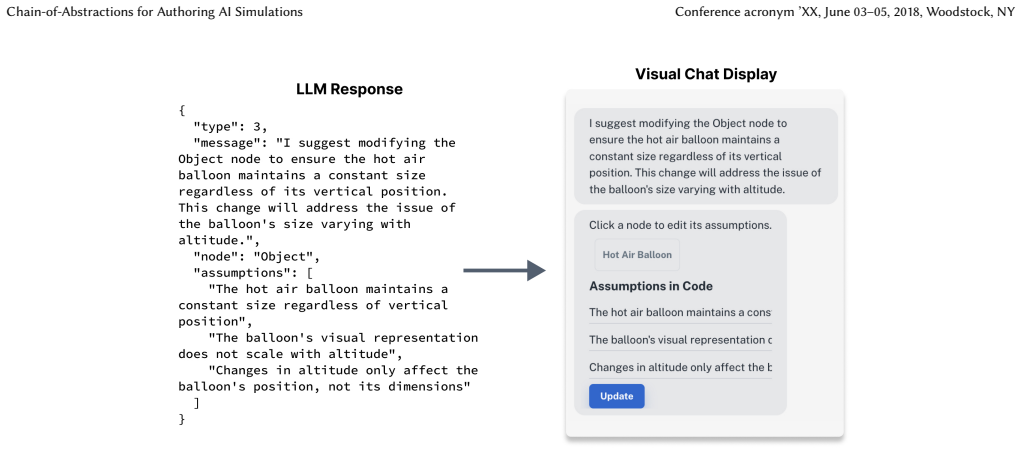
The chain-of-abstractions is a sequence of four node-link graphs (concepts, scenario, learning goals, and UI interaction) that externalize the user's intent at task boundaries. Each graph acts as a checkpoint for the operations Inspect, Refine, Validate, and Direct, and the underspecification resolution engine provides inverse correction by turning final code back into editable abstraction widgets.
What would settle it
Have a group of teachers use SimStep with several simulation specifications, plant known factual errors into the Scenario and Learning Goal graphs, and check whether users detect and fix those errors at the checkpoints; if detection is at chance level, the claim that checkpoints make assumptions visible collapses.
Extended reading notes
Core claim
The central claim is that the Chain-of-Abstractions framework turns prompt-to-code synthesis into a human-guided sequence of task-aligned representations. SimStep instantiates this with a Concept Graph, Scenario Graph, Learning Goal Graph, and UI Interaction Graph, each a node-link diagram the user can inspect and refine before code is generated. A complementary inverse process realizes code assumptions back into editable abstractions, so debugging happens at the level of intent rather than syntax. The paper presents educator evaluations and fidelity ratings as evidence that this restores authoring control and interpretability.
Load-bearing premise
The framework's usefulness rests on the four graph abstractions being accurate enough that editing them reveals errors rather than masking them; the paper's own fidelity ratings put the middle graphs at 6.65 and 7.08 out of 10.
Editorial extensions
If this is right
- Teachers can author and refine interactive simulations by editing graph nodes and links instead of HTML or JavaScript.
- Model assumptions that would otherwise surface only as bugs are exposed at abstraction checkpoints, allowing targeted correction before code is generated.
- Automated test-case generation and headless-browser verification can catch JavaScript, logic, and UI errors before a teacher sees them.
- The CoA structure applies beyond education, for example to data scientists moving from analysis goals to visual outputs or game designers from core mechanics to interaction feedback.
Reading between the lines
- An implication the paper leaves implicit is that the fidelity of the middle graphs (Scenario and Learning Goal) is the critical bottleneck; improving those two abstractions may matter more than any other system change.
- A controlled comparison against direct prompting, measuring objective simulation correctness rather than subjective usability, would isolate whether the checkpoints themselves add value.
- The framework's generalizability depends on finding task-aligned abstraction chains in each new domain, and the paper offers no recipe for discovering those chains automatically.
- A testable prediction that goes beyond the reported studies is that teachers given a graph with a planted factual error will detect and correct it at the checkpoint more often than they would by re-prompting.
Editorial analysis
A structured set of objections, weighed in public.
Referee Report
Summary. The paper proposes Chain-of-Abstractions (CoA), a framework for programming-by-prompting in which a natural-language prompt is decomposed into a sequence of editable graph abstractions (Concept Graph, Scenario Graph, Learning Goal Graph, User Interaction Graph) before code generation, plus an inverse correction process that surfaces model assumptions. The authors instantiate the framework in SimStep, an authoring environment for educators creating interactive simulations, and describe the system architecture, prompting details, and automated testing pipeline. They report a usability study with N=11 educators using PSSUQ, NASA-TLX, and Cognitive Dimensions of Notations, and a technical fidelity evaluation over 13 curated specifications. The central claim is that CoA gives non-programmers greater authoring control and interpretability than direct programming-by-prompting.
Significance. The paper has clear strengths: a fully implemented system, a detailed prompt-engineering appendix, an automated headless-browser testing workflow, and a user study using standard instruments. The design idea of task-aligned graph checkpoints is well motivated by distributed cognition and is a plausible direction for end-user programming. However, the evidence presented does not yet establish the headline claims of 'greater control' or of effective checkpoint-based debugging. The single-arm usability study and single-rater fidelity evaluation are suggestive but not conclusive, and the core edit-propagation mechanism is untested. If the authors add a propagation study and a baseline comparison, or substantially soften the claims, the contribution would be significant for AI-assisted content creation and end-user programming research. As written, the gap between the claims and the evidence is the main barrier.
major comments (4)
- [Section 6, Table 2] The fidelity evaluation uses a single learning-design student rating 13 specifications on one 1-10 question ('How closely does this abstraction adhere to the previous abstraction and user inputs?'). The Scenario Graph and Learning Goal Graph, which are the central checkpoints of the CoA pipeline, receive mean scores of 6.65 and 7.08 with standard deviations above 2. A single subjective rater, combined with a question that conflates adherence to the previous abstraction with fidelity to user intent, is too weak to support the claim that the middle abstractions reliably encode teacher intent. The scorer's own note about potential topic bias reinforces this. The paper should report multiple raters with inter-rater reliability and should separately assess agreement with the intended learning content, not only consistency with the previous abstraction.
- [Section 3.2 and Section 7.3] The core mechanism of 'targeted revision' is that user edits to an early abstraction change later abstractions and final code. Section 4.1 describes each abstraction as generated from the previous one via LLM prompting, and Section 3.2 describes direct manipulation widgets, but no experiment, trace, or case study demonstrates that an edit to a Concept Graph, Scenario Graph, or Learning Goal Graph propagates to downstream abstractions and the final simulation. Section 7.3 explicitly concedes that 'current LLMs ... often fail to maintain consistency across stages.' The anchor example in Section 3.1 (editing the Concept Graph to correct the buoyancy equation) is presented as a scenario, not as evidence. Without a propagation test, the central claim of authoring control through CoA checkpoints is unverified; the inverse correction path in Section 4.2 is similarly without empirical support.
- [Section 5 and Abstract] The abstract claims that CoA 'enables greater authoring control and interpretability,' but the user study is single-arm with N=11 and no comparison condition. PSSUQ 4.66, TLX 2.64, and CDN 4.61 are descriptive scores from one system; they cannot substantiate 'greater' control relative to direct prompt-to-code generation or to prior systems. The paper should either add a comparative condition (e.g., a within-subjects direct-prompting baseline) or revise the abstract and conclusions to claim perceived usability and interpretability without the comparative 'greater.'
- [Section 2.2] The formal monotonicity chain Ω(P) ⊃ Ω(B1) ⊃ Ω(B1') ⊃ ... ⊃ Ω(C) and the corresponding inequalities for U are asserted without proof and are questionable as stated. The sets Ω(X) are not constructively defined for heterogeneous representations such as a natural-language prompt, graph abstractions, and code, and user refinement may add nodes or links, which can expand rather than shrink the set of compatible implementations. The formalism should be presented as a design goal or empirically tested, not as a mathematical consequence of the framework.
minor comments (5)
- [Throughout] There are several typos and grammatical slips: 'promting' in Section 4.1.2, 'undespecification' in the opening of Section 4, 'cognatively' in Section 4.4, and 'the the notations' in Section 5.2.3. A copyedit pass is needed.
- [Section 5.2.2] The NASA-TLX score is reported as unweighted and the physical demand dimension was not assessed. This modification of the standard instrument should be stated explicitly in the method, with a discussion of how the resulting score compares to published TLX norms.
- [Table 2 and Section 4.1.4] The naming is inconsistent: Section 4.1.4 defines the 'User Interaction Graph,' while Table 2 and several later passages call it the 'UI Graph.' Please use one name consistently.
- [Figure 11] The comparison of CoA-generated simulations to direct prompt-to-code outputs is presented without criteria for selecting the examples or a systematic evaluation. If this figure is retained, the caption should describe how representative examples were chosen and what the comparison is intended to show.
- [Section 4.3.3] The statement that the LLM 'does a very reliable job' of fixing logical errors is not supported by reported data. Either add pass-rate metrics for the automated repair pipeline or soften this claim.
Circularity Check
No significant circularity: the CoA pipeline is a system design with independent user and technical evaluations; no fitted parameter or self-citation chain drives the central claim.
full rationale
SimStep is a system-design paper, not a fitted model or a first-principles derivation. The claimed chain from prompt P through Concept, Scenario, Learning Goal, and UI Interaction Graphs to code C is implemented by explicit LLM prompts (Appendix A) and evaluated with independent instruments: a user study with N=11 educators, PSSUQ, NASA-TLX, Cognitive Dimensions of Notations, and a separate 13-specification fidelity rating. No parameter is fit to an outcome and then renamed as a prediction; the forward transformations are generated by stated prompts, and the inverse correction process is implemented with widgets and LLM calls. Self-citations such as Spellburst [4] and Subramonyam et al. [52] appear only in related-work and motivation contexts; none provides a uniqueness theorem, forbids alternative representations, or carries the load of the central claim. Section 7.3 explicitly concedes that 'current LLMs are not inherently abstraction-aware and often fail to maintain consistency across stages,' which weighs against any suggestion that the framework's success is definitionally guaranteed. The closest concern is Section 6's fidelity metric, where the scorer is asked 'How closely does this abstraction adhere to the previous abstraction and user inputs?'; because each abstraction is generated from the previous one, this measures internal chain consistency rather than ground-truth intent, and the single-rater note in Table 2 acknowledges possible bias. That is a construct-validity limitation, not circularity by construction, and it does not constitute a circular step in the paper's derivation chain. The claim of 'greater authoring control' is also not supported by a baseline comparison, but that is an evaluation-design weakness rather than a circularity issue. Overall, the central contribution is a concrete system plus empirical evaluation, and no exhibitable reduction of a result to its own input is present.
Assumptions & free parameters
assumptions (4)
- domain assumption Distributed cognition provides an appropriate theoretical basis for treating graph abstractions as cognitive checkpoints.
- domain assumption The four abstractions (Concept, Scenario, Learning Goal, UI Interaction Graph) match teachers' natural task decomposition.
- domain assumption Each forward transformation reduces ambiguity and the set of compatible implementations (the Omega chain).
- domain assumption LLMs can generate and propagate edits across abstractions and code with sufficient reliability.
invented entities (5)
-
Concept Graph
-
Scenario Graph
-
Learning Goal Graph
-
User Interaction Graph
-
Code Assumptions Abstraction
Cite this review
Pith. "Pith review of SimStep: Chain-of-Abstractions for Incremental Specification and Debugging of AI-Generated Interactive Simulations." pith.science (2026). https://pith.science/paper/XNGHFLRJ
@misc{pith2026250709664,
  author       = {Pith},
  title        = {Pith review of: SimStep: Chain-of-Abstractions for Incremental Specification and Debugging of AI-Generated Interactive Simulations},
  year         = {2026},
  howpublished = {\url{https://pith.science/paper/XNGHFLRJ}},
  note         = {Machine review of arXiv:2507.09664}
}
read the original abstract
Programming-by-prompting with generative AI offers a new paradigm for end-user programming, shifting the focus from syntactic fluency to semantic intent. This shift holds particular promise for non-programmers such as educators, who can describe instructional goals in natural language to generate interactive learning content. Yet in bypassing direct code authoring, many of programming's core affordances - such as traceability, stepwise refinement, and behavioral testing - are lost. We propose the Chain-of-Abstractions (CoA) framework as a way to recover these affordances while preserving the expressive flexibility of natural language. CoA decomposes the synthesis process into a sequence of cognitively meaningful, task-aligned representations that function as checkpoints for specification, inspection, and refinement. We instantiate this approach in SimStep, an authoring environment for teachers that scaffolds simulation creation through four intermediate abstractions: Concept Graph, Scenario Graph, Learning Goal Graph, and UI Interaction Graph. To address ambiguities and misalignments, SimStep includes an inverse correction process that surfaces in-filled model assumptions and enables targeted revision without requiring users to manipulate code. Evaluations with educators show that CoA enables greater authoring control and interpretability in programming-by-prompting workflows.
Figures


Figures from the paper (8 more)



Reference graph
Works this paper leans on
-
[1]
Ernest Adams. 2014. Fundamentals of game design . Pearson Education
work page 2014
-
[2]
Garima Agrawal, Yuli Deng, Jongchan Park, Huan Liu, and Ying-Chih Chen. 2022. Building knowledge graphs from unstructured texts: Applications and impact analyses in cybersecurity education. Information 13, 11 (2022), 526
work page 2022
-
[3]
Abdulaziz Alaboudi and Thomas D Latoza. 2023. Hypothesizer: A Hypothesis- Based Debugger to Find and Test Debugging Hypotheses. In Proceedings of the 36th Annual ACM Symposium on User Interface Software and Technology . 1–14
work page 2023
-
[4]
Tyler Angert, Miroslav Suzara, Jenny Han, Christopher Pondoc, and Hariharan Subramonyam. 2023. Spellburst: A node-based interface for exploratory creative coding with natural language prompts. In Proceedings of the 36th Annual ACM Symposium on User Interface Software and Technology . 1–22
2023
-
[5]
Anthropic. 2023. Claude: Language Model by Anthropic. https://www.anthropic. com/
work page 2023
-
[6]
Iro Armeni, Zhi-Yang He, JunYoung Gwak, Amir Zamir, Martin Fischer, Jitendra Malik, and Silvio Savarese. 2019. 3D Scene Graph: A Structure for Unified Semantics, 3D Space, and Camera. 2019 IEEE/CVF International Conference on Computer Vision (ICCV) (2019), 5663–5672. https://api.semanticscholar.org/ CorpusID:203837042
work page 2019
-
[7]
Jacob Austin, Augustus Odena, Maxwell Nye, Maarten Bosma, Henryk Michalewski, David Dohan, Ellen Jiang, Carrie Cai, Michael Terry, Quoc Le, et al. 2021. Program synthesis with large language models. arXiv preprint arXiv:2108.07732 (2021)
arXiv 2021
-
[8]
Michael P Barnett and WM Ruhsam. 1968. A natural language programming system for text processing. IEEE transactions on engineering writing and speech 11, 2 (1968), 45–52
work page 1968
Show all 71 references
-
[9]
Michael Bostock and Jeffrey Heer. 2009. Protovis: A graphical toolkit for visu- alization. IEEE transactions on visualization and computer graphics 15, 6 (2009), 1121–1128. Chain-of-Abstractions for Authoring AI Simulations Conference acronym ’XX, June 03–05, 2018, Woodstock, NY
2009
-
[10]
Islem Bouzenia, Premkumar Devanbu, and Michael Pradel. 2024. Repairagent: An autonomous, llm-based agent for program repair. arXiv preprint arXiv:2403.17134 (2024)
2024 arXiv
-
[11]
Nick C Bradley, Thomas Fritz, and Reid Holmes. 2018. Context-aware conversa- tional developer assistants. In Proceedings of the 40th International Conference on Software Engineering. 993–1003
2018
-
[12]
Corey Brady, Brian Broll, Gordon Stein, Devin Jean, Shuchi Grover, Veronica Cateté, Tiffany Barnes, and Ákos Lédeczi. 2022. Block-based abstractions and expansive services to make advanced computing concepts accessible to novices. Journal of Computer Languages 73 (2022), 101156
2022
-
[13]
Salman Cheema and Joseph LaViola. 2012. PhysicsBook: a sketch-based interface for animating physics diagrams. In Proceedings of the 2012 ACM international conference on Intelligent User Interfaces . 51–60
2012
-
[14]
Penghe Chen, Yu Lu, Vincent W Zheng, Xiyang Chen, and Boda Yang. 2018. Knowedu: A system to construct knowledge graph for education. Ieee Access 6 (2018), 31553–31563
2018
-
[15]
Bhavya Chopra, Yasharth Bajpai, Param Biyani, Gustavo Soares, Arjun Radhakr- ishna, Chris Parnin, and Sumit Gulwani. 2024. Exploring Interaction Patterns for Debugging: Enhancing Conversational Capabilities of AI-assistants. arXiv preprint arXiv:2402.06229 (2024)
2024 arXiv
-
[16]
Paul Denny, Viraj Kumar, and Nasser Giacaman. 2023. Conversing with Copilot: Exploring Prompt Engineering for Solving CS1 Problems Using Natural Language. In Proceedings of the 54th ACM Technical Symposium on Computer Science Educa- tion V. 1(Toronto ON, Canada)(SIGCSE 2023). ...
2023
-
[17]
Shehzaad Dhuliawala, Mojtaba Komeili, Jing Xu, Roberta Raileanu, Xian Li, Asli Celikyilmaz, and Jason Weston. 2023. Chain-of-verification reduces hallucination in large language models. arXiv preprint arXiv:2309.11495 (2023)
2023 arXiv
-
[18]
Shihan Dou, Haoxiang Jia, Shenxi Wu, Huiyuan Zheng, Weikang Zhou, Muling Wu, Mingxu Chai, Jessica Fan, Caishuang Huang, Yunbo Tao, et al. 2024. What’s Wrong with Your Code Generated by Large Language Models? An Extensive Study. arXiv preprint arXiv:2407.06153 (2024)
2024
-
[19]
David Durman. 2024. joint.js. https://www.jointjs.com/
2024
-
[20]
Zhiyu Fan, Xiang Gao, Martin Mirchev, Abhik Roychoudhury, and Shin Hwei Tan. 2023. Automated repair of programs from large language models. In 2023 IEEE/ACM 45th International Conference on Software Engineering (ICSE) . IEEE, 1469–1481
2023
-
[21]
OpenJS Foundation. 2024. Node.js. https://nodejs.org/en/
2024
-
[22]
Silin Gao, Jane Dwivedi-Yu, Ping Yu, Xiaoqing Ellen Tan, Ramakanth Pasunuru, Olga Golovneva, Koustuv Sinha, Asli Celikyilmaz, Antoine Bosselut, and Tianlu Wang. 2024. Efficient tool use with chain-of-abstraction reasoning.arXiv preprint arXiv:2401.17464 (2024)
2024 arXiv
-
[23]
Google. 2024. Firebase. https://firebase.google.com/
2024
-
[24]
Thomas RG Green. 1989. Cognitive dimensions of notations.People and computers V (1989), 443–460
1989
-
[25]
SG Hart. 1988. Development of NASA-TLX (Task Load Index): Results of empirical and theoretical research. Human mental workload/Elsevier (1988)
1988
-
[26]
Jaylin Herskovitz, Andi Xu, Rahaf Alharbi, and Anhong Guo. 2024. ProgramAlly: Creating Custom Visual Access Programs via Multi-Modal End-User Program- ming. ArXiv abs/2408.10499 (2024). https://api.semanticscholar.org/CorpusID: 271909496
2024 arXiv
-
[27]
TJ Holowaychuk. 2024. Express.js. https://expressjs.com/
2024
-
[28]
Zichao Hu, Francesca Lucchetti, Claire Schlesinger, Yash Saxena, Anders Free- man, Sadanand Modak, Arjun Guha, and Joydeep Biswas. 2024. Deploying and evaluating llms to program service mobile robots. IEEE Robotics and Automation Letters 9, 3 (2024), 2853–2860
2024
-
[29]
Edwin Hutchins. 1995. Cognition in the Wild . MIT press
1995
-
[30]
Molina, Kristen Olson, Claire Kayacik, Aaron Dons- bach, Carrie J
Ellen Jiang, Edwin Toh, A. Molina, Kristen Olson, Claire Kayacik, Aaron Dons- bach, Carrie J. Cai, and Michael Terry. 2022. Discovering the Syntax and Strategies of Natural Language Programming with Generative Language Models. Proceed- ings of the 2022 CHI Conference on Human ...
2022
-
[31]
Ellen Jiang, Edwin Toh, Alejandra Molina, Kristen Olson, Claire Kayacik, Aaron Donsbach, Carrie J Cai, and Michael Terry. 2022. Discovering the syntax and strategies of natural language programming with generative language models. In Proceedings of the 2022 CHI Conference on H...
2022
-
[32]
Rubaiat Habib Kazi, Fanny Chevalier, Tovi Grossman, and George Fitzmaurice
-
[33]
Ko, Robin Abraham, Laura Beckwith, Alan F
Amy J. Ko, Robin Abraham, Laura Beckwith, Alan F. Blackwell, Margaret M. Burnett, Martin Erwig, Chris Scaffidi, Joseph Lawrance, Henry Lieberman, Brad A. Myers, M. Rosson, Gregg Rothermel, Mary Shaw, and Susan Wiedenbeck. 2011. The state of the art in end-user software enginee...
2011
-
[34]
Amy J Ko and Brad A Myers. 2004. Designing the whyline: a debugging inter- face for asking questions about program behavior. In Proceedings of the SIGCHI conference on Human factors in computing systems . 151–158
2004
-
[35]
Benjamin Lee, Arvind Satyanarayan, Maxime Cordeil, Arnaud Prouzeau, Bern- hard Jenny, and Tim Dwyer. 2023. Deimos: A grammar of dynamic embodied immersive visualisation morphs and transitions. In Proceedings of the 2023 CHI Conference on Human Factors in Computing Systems . 1–18
2023
-
[36]
Teemu Lehtinen, Charles Koutcheme, and Arto Hellas. 2024. Let’s Ask AI About Their Programs: Exploring ChatGPT’s Answers To Program Comprehension Questions. In Proceedings of the 46th International Conference on Software Engi- neering: Software Engineering Education and Traini...
2024
-
[37]
James R Lewis. 1992. Psychometric evaluation of the post-study system usability questionnaire: The PSSUQ. In Proceedings of the human factors society annual meeting, Vol. 36. Sage Publications Sage CA: Los Angeles, CA, 1259–1260
1992
-
[38]
What It Wants Me To Say
Michael Xieyang Liu, Advait Sarkar, Carina Negreanu, Benjamin G. Zorn, J. Williams, Neil Toronto, and Andrew D. Gordon. 2023. “What It Wants Me To Say”: Bridging the Abstraction Gap Between End-User Programmers and Code- Generating Large Language Models. Proceedings of the 202...
2023
-
[39]
Qing Lyu, Shreya Havaldar, Adam Stein, Li Zhang, Delip Rao, Eric Wong, Mar- ianna Apidianaki, and Chris Callison-Burch. 2023. Faithful chain-of-thought reasoning. In The 13th International Joint Conference on Natural Language Pro- cessing and the 3rd Conference of the Asia-Pac...
2023
-
[40]
John Maloney, Mitchel Resnick, Natalie Rusk, Brian Silverman, and Evelyn East- mond. 2010. The scratch programming language and environment. ACM Trans- actions on Computing Education (TOCE) 10, 4 (2010), 1–15
2010
-
[41]
Meta. 2024. React. https://react.dev/
2024
-
[42]
MUI. 2024. Material UI. https://mui.com/material-ui/
2024
-
[43]
Brad A Myers, Amy J Ko, and Margaret M Burnett. 2006. Invited research overview: end-user programming. In CHI’06 extended abstracts on Human factors in computing systems. 75–80
2006
-
[44]
Shep- herd
Nico Ritschel, Felipe Fronchetti, Reid Holmes, Ronald Garcia, and David C. Shep- herd. 2022. Can guided decomposition help end-users write larger block-based programs? a mobile robot experiment. Proceedings of the ACM on Program- ming Languages 6 (2022), 233 – 258. https://api...
2022
-
[45]
Karl Toby Rosenberg, Rubaiat Habib Kazi, Li-Yi Wei, Haijun Xia, and Ken Perlin
-
[46]
Steve Ruiz. 2021. tldraw: A tiny little drawing app. https://tldraw.com/
2021
-
[47]
Nazmus Saquib, Rubaiat Habib Kazi, Li-yi Wei, Gloria Mark, and Deb Roy. 2021. Constructing embodied algebra by sketching. In Proceedings of the 2021 CHI Conference on Human Factors in Computing Systems . 1–16
2021
-
[48]
Advait Sarkar, Andrew D Gordon, Carina Negreanu, Christian Poelitz, Sruti Srini- vasa Ragavan, and Ben Zorn. 2022. What is it like to program with artificial intelligence? arXiv preprint arXiv:2208.06213 (2022)
2022 arXiv
-
[49]
Ahmed Seffah, Jan Gulliksen, and Michel C Desmarais. 2005. Human-centered software engineering-integrating usability in the software development lifecycle . Vol. 8. Springer Science & Business Media
2005
-
[50]
David Canfield Smith, Allen Cypher, and Jim Spohrer. 1994. KidSim: Programming agents without a programming language. Commun. ACM 37, 7 (1994), 54–67
1994
-
[51]
Da Song, Zijie Zhou, Zhijie Wang, Yuheng Huang, Shengmai Chen, Bonan Kou, Lei Ma, and Tianyi Zhang. 2023. An empirical study of code generation errors made by large language models. In 7th Annual Symposium on Machine Program- ming
2023
-
[52]
Hari Subramonyam, Roy Pea, Christopher Pondoc, Maneesh Agrawala, and Colleen Seifert. 2024. Bridging the Gulf of Envisioning: Cognitive Challenges in Prompt Based Interactions with LLMs. In Proceedings of the CHI Conference on Human Factors in Computing Systems . 1–19
2024
-
[53]
Hariharan Subramonyam, Colleen Seifert, Priti Shah, and Eytan Adar. 2020. Texsketch: Active diagramming through pen-and-ink annotations. InProceedings of the 2020 CHI Conference on Human Factors in Computing Systems . 1–13
2020
-
[54]
Sangho Suh, Jian Zhao, and Edith Law. 2022. Codetoon: Story ideation, auto comic generation, and structure mapping for code-driven storytelling. In Proceedings of the 35th Annual ACM Symposium on User Interface Software and Technology . 1–16
2022
-
[55]
Ryo Suzuki, Rubaiat Habib Kazi, Li-Yi Wei, Stephen DiVerdi, Wilmot Li, and Daniel Leithinger. 2020. Realitysketch: Embedding responsive graphics and visualizations in AR through dynamic sketching. InProceedings of the 33rd Annual ACM Symposium on User Interface Software and Te...
2020
-
[56]
Knut Sveidqvist and Mermaid.js contributors. 2014. Mermaid: Generation of diagrams and flowcharts from text in a similar manner as markdown. https: //mermaid.js.org/
2014
-
[57]
Chee Wei Tan, Shangxin Guo, Man Fai Wong, and Ching Nam Hang. 2023. Copilot for Xcode: exploring AI-assisted programming by prompting cloud-based large language models. arXiv preprint arXiv:2307.14349 (2023)
2023 arXiv
-
[58]
Mei Tan and Hari Subramonyam. 2024. More than model documentation: uncov- ering teachers’ bespoke information needs for informed classroom integration of Conference acronym ’XX, June 03–05, 2018, Woodstock, NY Kaputa et al. ChatGPT. In Proceedings of the CHI Conference on Huma...
2024
-
[59]
Runchu Tian, Yining Ye, Yujia Qin, Xin Cong, Yankai Lin, Yinxu Pan, Yesai Wu, Haotian Hui, Weichuan Liu, Zhiyuan Liu, et al. 2024. Debugbench: Evaluating debugging capability of large language models. arXiv preprint arXiv:2401.04621 (2024)
2024 arXiv
-
[60]
Ektor Vrettakis, Christos Lougiakis, Akrivi Katifori, Vassilis Kourtis, Stamatis Christoforidis, Manos Karvounis, and Yannis Ioanidis. 2020. The story maker-an authoring tool for multimedia-rich interactive narratives. In Interactive Story- telling: 13th International Conferen...
2020
-
[61]
Jason Wei, Xuezhi Wang, Dale Schuurmans, Maarten Bosma, Fei Xia, Ed Chi, Quoc V Le, Denny Zhou, et al. 2022. Chain-of-thought prompting elicits reasoning in large language models. Advances in neural information processing systems 35 (2022), 24824–24837
2022
-
[62]
Sahraoui, and Bang Liu
Martin Weyssow, Houari A. Sahraoui, and Bang Liu. 2022. Better Modeling the Programming World with Code Concept Graphs-augmented Multi-modal Learning. 2022 IEEE/ACM 44th International Conference on Software Engi- neering: New Ideas and Emerging Results (ICSE-NIER) (2022), 21–2...
2022
-
[63]
Jules White, Quchen Fu, Sam Hays, Michael Sandborn, Carlos Olea, Henry Gilbert, Ashraf Elnashar, Jesse Spencer-Smith, and Douglas C Schmidt. 2023. A prompt pattern catalog to enhance prompt engineering with chatgpt. arXiv preprint arXiv:2302.11382 (2023)
2023 arXiv
-
[64]
Jules White, Sam Hays, Quchen Fu, Jesse Spencer-Smith, and Douglas C Schmidt
-
[65]
Kanit Wongsuphasawat, Dominik Moritz, Anushka Anand, Jock Mackinlay, Bill Howe, and Jeffrey Heer. 2015. Voyager: Exploratory analysis via faceted browsing of visualization recommendations.IEEE transactions on visualization and computer graphics 22, 1 (2015), 649–658
2015
-
[66]
Ziwei Xu, Sanjay Jain, and Mohan Kankanhalli. 2024. Hallucination is inevitable: An innate limitation of large language models. arXiv preprint arXiv:2401.11817 (2024)
2024 arXiv
-
[67]
In Generative ai for effective software development
Chatgpt prompt patterns for improving code quality, refactoring, require- ments elicitation, and software design. In Generative ai for effective software development. Springer, 71–108
-
[68]
p r e c o n n e c t
Yifeng Zhu, Jonathan Tremblay, Stan Birchfield, and Yuke Zhu. 2020. Hierarchical Planning for Long-Horizon Manipulation with Geometric and Symbolic Scene Graphs. 2021 IEEE International Conference on Robotics and Automation (ICRA) (2020), 6541–6548. https://api.semanticscholar...
2020
-
[70]
Xin Yin, Chao Ni, Tien N Nguyen, Shaohua Wang, and Xiaohu Yang. 2024. Rec- tifier: Code translation with corrector via llms. arXiv preprint arXiv:2407.07472 (2024)
2024 arXiv
-
[2014]
In Proceedings of the 27th annual ACM symposium on User interface software and technology
Kitty: sketching dynamic and interactive illustrations. In Proceedings of the 27th annual ACM symposium on User interface software and technology . 395–405
-
[2024]
arXiv preprint arXiv:2401.05631 (2024)
DrawTalking: Building Interactive Worlds by Sketching and Speaking. arXiv preprint arXiv:2401.05631 (2024)
2024 arXiv
Reviewed August 6, 2026 · model on record in the stance chip above.
Discussion (0). Sign in to comment.