REVIEW 3 major objections 5 minor 1 cited by
Using a Kerr interaction for GKP magic state preparation
T0 review · 3 major / 5 minor · reviewed 2026-08-06 · deepseek-v4-flash
Pith's one-line read The paper establishes that a Kerr interaction of duration π/(4K) realizes the logical square-root-Hadamard gate for finite-energy square GKP grid states, exactly when no errors occur, and that combining it with small-Big-small error…
desk verdict A genuinely new exact sqrt(H) gate for GKP via Kerr, but the robustness claims need a readout-error budget before they fully land. read the letter →
The pith
A machine-rendered reading of the paper's core claim, the machinery that carries it, and where it could break.
The reading
What carries the argument
The load-bearing object is the diagonal number-phase unitary $\hat{U}_K=e^{i\pi\hat n^2/8}$, the square of the generator of the GKP Hadamard gate $\hat F=e^{i\pi\hat n/2}$. It is generated by a quartic Kerr Hamiltonian $H=K\hat n^2/2$, so that after time $t_K=\pi/(4K)$ the oscillator has undergone a logical square-root Fourier transform on square GKP codes, whose Hadamard eigenstates live only on Fock numbers $4n$ and $4n+2$. What makes the construction cohere is the commutation $[\hat n^2,\hat E_\Delta]=0$: the Gaussian envelope of a finite-energy GKP state is untouched, so the gate is exact for the physically relevant states, not only for ideal infinite-energy combs. The same object also dictates the error behaviour through $\hat U_K\hat a=e^{i\pi/8}e^{-i\hat n\pi/4}\hat a\,\hat U_K$, meaning a photon lost before the gate is compounded into a large rotation, whereas a photon lost during the gate leaves the state outside the code space and therefore detectable by the SBS protocol.
What would settle it
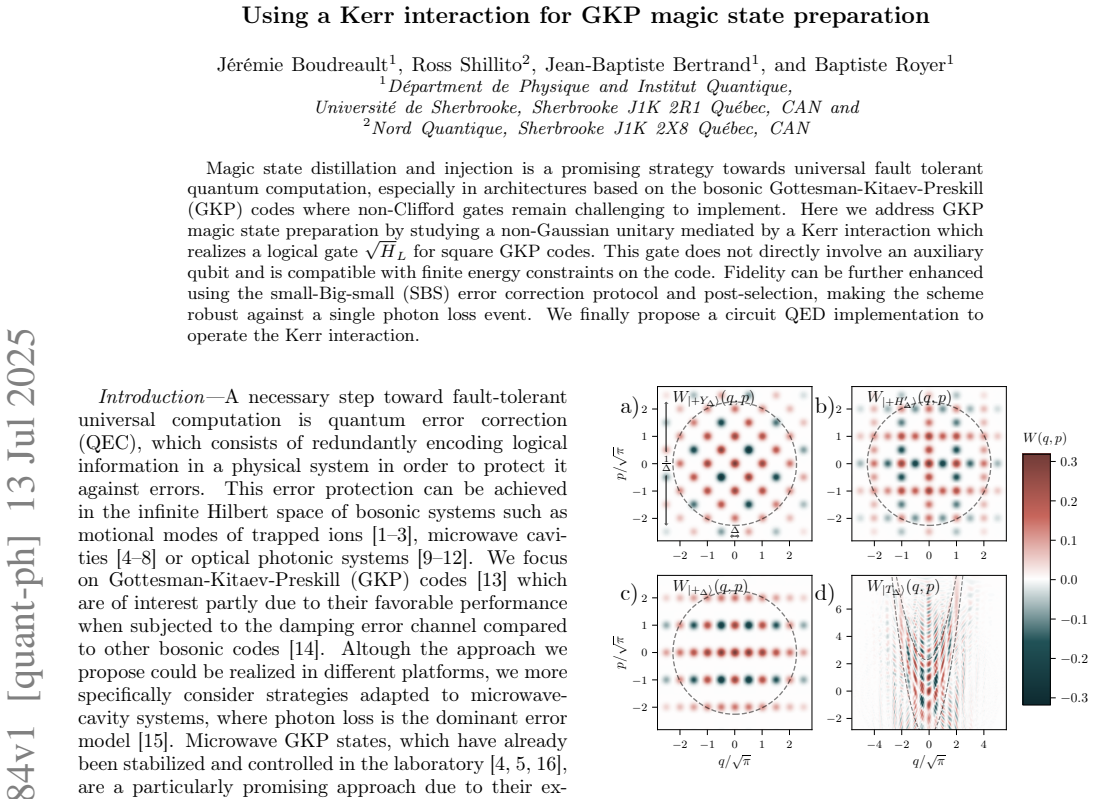
A direct experiment would prepare a finite-energy square GKP state $\lvert +Y_\Delta\rangle$, apply the Kerr drive for exactly $t_K=\pi/(4K)$, and perform Wigner tomography: if the output deviates from $\sqrt{H}_L\lvert +Y_\Delta\rangle$ beyond the expected loss and noise budget, or if the Gaussian envelope's width or position changes, the claimed exactness is falsified. A second, protocol-level test is to measure the post-selected infidelity as a function of $\gamma$: if it does not scale roughly as $\gamma^2$ when the false-positive readout probability $p(g|e)$ is varied, the robustness claim is falsified.
Extended reading notes
Core claim
The central claim is Eq. (6): for square GKP codes the unitary $\hat{U}_K=\exp(i\pi\hat{n}^2/8)$, generated by the Kerr Hamiltonian $H=K\hat{n}^2/2$ with $\hbar=1$, coincides with the logical gate $\sqrt{H}_L=\sqrt{\hat F}$ on the code space. The argument exploits the fact that the Hadamard eigenstates of square GKP codes have support only on Fock numbers $4n$ and $4n+2$; on those supports $\hat{U}_K$ produces exactly the phase pattern of a square-root Fourier transform. The finite-energy envelope $\hat E_\Delta=e^{-\Delta^2\hat n}$ commutes with $\hat n^2$, so the envelope is preserved and the gate is exact in the absence of errors—unlike the cubic-phase gate $T_L$, which distorts the envelope. The paper further shows that photon loss during the Kerr evolution is detectable but not correctable, so in an offline magic-state-preparation setting it applies SBS post-selection to reject single-loss events, recovering an error infidelity scaling close to $\sim\gamma^2$, and it estimates a realistic total fidelity $F_{\rm sbs}\approx0.996$ with about 81% success probability including measurement errors.
Load-bearing premise
The load-bearing premise is that the auxiliary-qubit readout used for post-selection can be made to almost never report 'success' when a photon-loss error has occurred (a false-positive probability $p(g|e)$ much smaller than the loss rate $\gamma$); the paper assumes a realistic $P(e|g)=10^{-3}$ and argues asymmetric thresholding can achieve this, but does not demonstrate it for the full protocol.
Editorial extensions
If this is right
- Magic states of H-type can be prepared from a GKP $\lvert +Y_\Delta\rangle$ state by a single oscillator-only drive, removing the auxiliary-qubit lifetime and leakage bottleneck that limits qubit-mediated gates.
- The protocol is compatible with finite-energy GKP states as prepared in the lab: no re-encoding or envelope-restoration step is needed after the gate.
- With SBS error correction and post-selection, the logical infidelity is suppressed approximately quadratically in the single-photon-loss parameter $\gamma$; two post-selection rounds already give $F_{\rm sbs}\approx 2.4\times10^{-4}$ at $\gamma=10^{-3}$.
- Including photon loss during initialization, gate, and error correction, plus measurement errors, the paper's parameter set ($\Delta=0.36$, $\gamma=10^{-2}$, $P(e|g)=10^{-3}$) yields $F_{\rm sbs}\approx0.996$ with success probability $\approx81\%$.
- A cavity-SNAIL implementation with $K/2\pi\approx-20\,$kHz gives a $6.3\,\mu$s gate time, and the associated cubic-Kerr term is mostly detectable by post-selection for $K/K_3\gtrsim10^3$.
Reading between the lines
- Extension: because any function of $\hat n$ commutes with the Gaussian envelope, the same Fock-space phase-engineering trick could yield other diagonal logical gates on square GKP codes, not only $\sqrt{H}_L$, by choosing integer-valued phase polynomials modulo the code's Fock support.
- Extension: the offline post-selection framing suggests a natural heralded-retry architecture: reject a failed preparation and rerun the Kerr gate, which could lower the magic-state cost per accepted state compared with distillation if the false-positive readout probability can be pushed well below $\gamma$.
- Extension: the paper's success metric could be refined by including finite-duration gate errors and Kerr nonlinearity calibration; a parameter sweep of SNAIL detuning versus gate time would identify an optimum for fixed cavity lifetime, something the paper leaves to future work.
- Extension: since the scheme works for any oscillator with a tunable self-Kerr, it transfers to trapped-ion motional modes and acoustic resonators, although the readout and post-selection steps would need platform-specific error models.
Editorial analysis
A structured set of objections, weighed in public.
Referee Report
Summary. This Letter proposes using the Kerr unitary U_K = exp(iπ n^2/8), generated by the quartic Hamiltonian H = K n^2/2, to implement the logical sqrt(H) gate on square GKP codes. Because U_K is diagonal in the Fock basis and the finite-energy GKP envelope E_Δ = exp(−Δ² n) is also diagonal, the envelope is preserved and the gate is claimed to be exact in the absence of errors, in contrast to cubic-phase gates. The authors then combine U_K with small-Big-small (SBS) error correction and post-selection to prepare GKP magic states robustly against photon loss, present simulations of infidelity versus loss parameter γ, discuss ancilla readout errors, and propose a SNAIL-based circuit QED implementation with K/2π ≈ −20 kHz and a gate time of 6.3 μs.
Significance. The central identity Eq. (6) is exact, clean, and parameter-free: U_K acts as sqrt(H)_L on the square-GKP code states because of their Fock-support structure, and it commutes with the finite-energy envelope. This gives a genuine qubit-independent route to a non-Clifford logical operation on GKP states, avoiding the envelope distortion that makes cubic-phase gates unsuitable. The combination with SBS post-selection is a natural way to turn single-photon-loss detection into quadratic infidelity suppression. These are real strengths. However, the practical robustness claims are presently weakened by an unresolved conflation of readout-error conditionals, by numerical simulations that lack convergence checks and error bars, and by an implementation section that does not clarify the relation between the n^2 Hamiltonian and the standard a†²a² Kerr term. These issues are local and fixable, so the underlying idea remains valuable.
major comments (3)
- [Main text (measurement-error paragraph after Fig. 2) and SM Sec. III.B] The robustness claim under measurement errors is not established because the two conditional probabilities of the ancilla readout are conflated. In a post-selection protocol that accepts only g outcomes, the fidelity-relevant quantity is p(g|e), the probability of reading g when the ancilla is in e. The main text correctly says that only false-positive results with probability p(g|e) affect the fidelity, but the realistic estimate F_sbs ≈ 0.996 with P(e|g) = 10^{-3} uses the opposite conditional, which only reduces the success probability and does not directly enter the post-selected infidelity. SM Sec. III.B then states that one can minimize P(e|g) at the cost of increasing P(g|e) and that the quality of the post-selection increases; this is backwards, because increasing P(g|e) admits more error-contaminated states and lowers quality. Furthermore, Figure S3's symbols are labeled P(e|g), yet they appear to change the infidelity; if both error directions are included in the model, the labeling is wrong, and if not, the plotted infidelity cannot depend on P(e|g) alone. To support the claimed quadratic suppression and the quoted realistic fidelity, the authors need to specify a budget or model for p(g|e) and show that it is small compared with γ.
- [Simulations and Fig. 2b] The numerical evidence for the central robustness claim lacks convergence checks and error bars. In Fig. 2b the Δ = 0.15 curve is stated to saturate at low γ, and the authors attribute this to numerical errors rather than physics. No truncation analysis (Fock-space cutoff, SBS-basis cutoff) or sampling statistics is reported, so the reader cannot tell whether the saturation is an artifact or a real effect. Since the paper's headline is the quadratic suppression of infidelity with γ, the quantitative support for that scaling should be backed by convergence data, at least for the curves used to claim the quadratic gain.
- [Circuit QED Implementation and SM Eq. (S14)] The implementation section leaves unspecified the relation between the n^2 Hamiltonian in Eq. (6) and the effective self-Kerr Hamiltonian H = (K/2)a†²a² = (K/2)(n² − n) in SM Eq. (S14). The difference is a linear term −(K/2)n, which at the quoted gate time t = π/(4K) contributes exp(∓iπ n/8), a nontrivial phase-space rotation on the square-GKP code. The paper does not state whether this term is cancelled by a rotating-frame choice or by an explicit frame-correction step, and the factor-of-two convention for K affects the gate time. Please clarify the rotating frame and the definition of K used in the SNAIL extraction.
minor comments (5)
- [Introduction] There is a typo: "Altough" should be "Although".
- [References] Reference [25] is malformed: "B. B. E. A. e. a. Ding, A.Z., Quantum control of an oscillator with a kerr-cat qubit" should be corrected to a proper author list and journal/year.
- [Fig. 2b caption] The caption says the x-axis values of γ differ between curves; please explain in the caption why the curves are horizontally offset or plot them on a common axis for direct comparison.
- [Simulations, paragraph after Fig. 2] The phrase "higher GKP size should outperform those with smaller size" is ambiguous; "larger GKP states (smaller Δ)" would be clearer.
- [SM Sec. III.B] Define P(e|g) and P(g|e) explicitly as conditional readout probabilities and state which one is the false-positive and which is the false-negative relative to the post-selection outcome, to avoid the present confusion.
Circularity Check
No significant circularity: the Kerr gate identity is a parameter-free algebraic derivation from GKP Fock-space support, and the SBS self-citations are contextual rather than load-bearing.
full rationale
The central claim, Eq. (6), defines sqrt(H)_L by the Kerr unitary U_K = exp(i pi n^2/8). This is derived directly from the square-GKP Hadamard gate H_L = F = exp(i pi n/2) and the known Fock-space support of the Hadamard eigenstates, |+H> on n = 4k and |-H> on n = 4k+2. On that support, exp(i pi n^2/8) evaluates to 1 and i respectively, exactly the phases of sqrt(H) on its eigenstates. This is an explicit algebraic derivation with no fitted parameters, no optimized constants, and no appeal to the paper's own prior results. The preservation of the finite-energy envelope follows from the commutation [n^2, E_Delta] = 0, which is a mathematical identity; the claim that the gate is exact in the absence of errors is therefore self-contained. The photon-loss simulations use standard Lindblad noise models and chosen physical parameters (Delta, gamma, N, K/K3), not parameters fitted to force the quoted fidelities. The SBS error-correction machinery is imported from prior work, including the authors' own refs. [26,27], but the SBS protocol is an established and externally demonstrated procedure (e.g., experimental demonstration in ref. [4]), and the paper's gate identity does not depend on those citations. I flag one non-circular limitation: the treatment of readout errors appears to swap the conditionals P(e|g) and P(g|e), both in the main text (which quotes P(e|g)=10^-3 after stating that only false positives p(g|e) affect fidelity) and in SM Sec. III.B (which says minimizing P(e|g) at the cost of increasing P(g|e) improves quality). That is a correctness risk for the practical robustness claim, not a circularity of the Kerr derivation, and it does not raise the circularity score. Overall, the derivation chain is independent of its inputs; the paper is not circular in any load-bearing sense.
Assumptions & free parameters
free parameters (7)
- GKP envelope size Delta =
0.15, 0.25, 0.36 (and 0.3 in SM)
- Self-Kerr strength K =
K/2pi ~ -20 kHz (gate time 6.3 us)
- SBS post-selection rounds N =
30
- Loss parameter gamma =
1.07e-2 for the reference implementation; swept from 1e-4 to 1e-1 in figures
- Readout error probability P(e|g) =
1e-3
- SNAIL circuit parameters =
EC/2pi=127 MHz, EJ/2pi=90 GHz, alpha=0.07, g/2pi=260 MHz, storage 8.1 GHz
- Cubic-Kerr ratio threshold K/K3 =
>1e3
assumptions (6)
- domain assumption GKP code structure, including Fock support of Hadamard eigenstates (n mod 4 = 0 for |+H>, n mod 4 = 2 for |-H>).
- domain assumption Finite-energy GKP states are E_Delta = exp(-Delta^2 n-hat) applied to ideal code words, and the SBS no-error subspace |(0,0), mu> approximates them.
- domain assumption Photon loss is the dominant error channel, modeled by the Lindblad dissipator D[sqrt(kappa) a-hat].
- domain assumption The SBS error-correction protocol with Kraus operators {K_jk} operates as modeled and its basis is a valid subsystem decomposition H_P = H_E tensor H_L.
- ad hoc to paper The auxiliary-qubit readout can achieve P(e|g)=1e-3 (and p(g|e) tunable via asymmetric thresholding).
- domain assumption The SNAIL-cavity system is described by the effective Hamiltonian (K/2) a-dagger^2 a^2 + (K3/6) a-dagger^3 a^3 after diagonalizing the lowest 10 eigenstates.
Cite this review
Pith. "Pith review of Using a Kerr interaction for GKP magic state preparation." pith.science (2026). https://pith.science/paper/YJTTVWPZ
@misc{pith2026250709684,
  author       = {Pith},
  title        = {Pith review of: Using a Kerr interaction for GKP magic state preparation},
  year         = {2026},
  howpublished = {\url{https://pith.science/paper/YJTTVWPZ}},
  note         = {Machine review of arXiv:2507.09684}
}
abstract
Magic state distillation and injection is a promising strategy towards universal fault tolerant quantum computation, especially in architectures based on the bosonic Gottesman-Kitaev-Preskill (GKP) codes where non-Clifford gates remain challenging to implement. Here we address GKP magic state preparation by studying a non-Gaussian unitary mediated by a Kerr interaction which realizes a logical gate $\sqrt{H}_L$ for square GKP codes. This gate does not directly involve an auxiliary qubit and is compatible with finite energy constraints on the code. Fidelity can be further enhanced using the small-Big-small (SBS) error correction protocol and post-selection, making the scheme robust against a single photon loss event. We finally propose a circuit QED implementation to operate the Kerr interaction.
Figures


Forward citations
Cited by 1 Pith paper
-
Enlarging the GKP stabilizer group for enhanced noise protection
The authors derive generators of the Gaussian stabilizer group of GKP codes and present a compiler that uses these symmetries to extend the lifetime of square-GKP qubits under bosonic loss, as shown by logical randomi...
Reference graph
Works this paper leans on
-
[1]
C. Flühmann, T. L. Nguyen, M. Marinelli, V. Negnevit- sky, K. Mehta, and J. P. Home, Encoding a qubit in a trapped-ion mechanical oscillator, Nature566, 513–517 (2019)
work page 2019
-
[2]
Saffman, T
M. Saffman, T. G. Walker, and K. Mølmer, Quantum information with rydberg atoms, Rev. Mod. Phys.82, 2313 (2010)
2010
-
[3]
B. de Neeve, T.-L. Nguyen, T. Behrle, and J. P. Home, Errorcorrectionofalogicalgridstatequbitbydissipative pumping, Nature Physics18, 296 (2022)
work page 2022
-
[4]
V. V. Sivak, A. Eickbusch, B. Royer, S. Singh, I. Tsiout- sios, S. Ganjam, A. Miano, B. L. Brock, A. Z. Ding, L. Frunzio, S. M. Girvin, R. J. Schoelkopf, and M. H. De- voret, Real-time quantum error correction beyond break- even, Nature616, 50–55 (2023)
2023
-
[5]
D. Lachance-Quirion, M.-A. Lemonde, J. O. Simoneau, L. St-Jean, P. Lemieux, S. Turcotte, W. Wright, A. Lacroix, J. Fréchette-Viens, R. Shillito, F. Hopf- mueller, M. Tremblay, N. E. Frattini, J. Camirand Le- myre,andP.St-Jean,Autonomousquantumerrorcorrec- tion of gottesman-kitaev-preskill states, Phys. Rev. Lett. 132, 150607 (2024)
work page 2024
-
[6]
A. L. Grimsmo and S. Puri, Quantum error correction with the gottesman-kitaev-preskill code, PRX Quantum 2, 020101 (2021)
2021
-
[7]
R. Lescanne, M. Villiers, T. Peronnin, A. Sarlette, M. Delbecq, B. Huard, T. Kontos, M. Mirrahimi, and Z. Leghtas, Exponential suppression of bit-flips in a qubit encoded in an oscillator, Nature Physics16, 509–513 (2020)
work page 2020
- [8]
Show all 41 references
-
[9]
M. V. Larsen, C. Chamberland, K. Noh, J. S. Neergaard- Nielsen, and U. L. Andersen, Fault-tolerant continuous- variable measurement-based quantum computation ar- chitecture, PRX Quantum2, 030325 (2021)
2021
-
[10]
J. E. Bourassa, R. N. Alexander, M. Vasmer, A. Patil, I. Tzitrin, T. Matsuura, D. Su, B. Q. Baragiola, S. Guha, G. Dauphinais, K. K. Sabapathy, N. C. Menicucci, and I. Dhand, Blueprint for a Scalable Photonic Fault- Tolerant Quantum Computer, Quantum5, 392 (2021)
2021
-
[11]
Tzitrin, T
I. Tzitrin, T. Matsuura, R. N. Alexander, G. Dauphi- nais, J. E. Bourassa, K. K. Sabapathy, N. C. Menicucci, and I. Dhand, Fault-tolerant quantum computation with static linear optics, PRX Quantum2, 040353 (2021)
2021
-
[12]
Hastrup and U
J. Hastrup and U. L. Andersen, All-optical cat-code quantum error correction, Phys. Rev. Res.4, 043065 (2022)
2022
-
[13]
Gottesman, A
D. Gottesman, A. Kitaev, and J. Preskill, Encod- ing a qubit in an oscillator, Physical Review A64, 10.1103/physreva.64.012310 (2001)
2001 doi
-
[14]
V. V. Albert, K. Noh, K. Duivenvoorden, D. J. Young, R. T. Brierley, P. Reinhold, C. Vuillot, L. Li, C. Shen, S. M. Girvin, B. M. Terhal, and L. Jiang, Performance and structure of single-mode bosonic codes, Physical Re- view A97, 10.1103/physreva.97.032346 (2018)
2018 doi
-
[15]
M. H. Michael, M. Silveri, R. T. Brierley, V. V. Albert, J. Salmilehto, L. Jiang, and S. M. Girvin, New class of quantumerror-correctingcodesforabosonicmode,Phys. Rev. X6, 031006 (2016)
2016
-
[16]
Campagne-Ibarcq, A
P. Campagne-Ibarcq, A. Eickbusch, S. Touzard, E. Zalys- Geller, N. E. Frattini, V. V. Sivak, P. Reinhold, S. Puri, S. Shankar, R. J. Schoelkopf, L. Frunzio, M. Mirrahimi, and M. H. Devoret, Quantum error correction of a qubit encoded in grid states of an oscillator, Nature584,...
2020
-
[17]
Eickbusch, V
A. Eickbusch, V. Sivak, A. Z. Ding, S. S. Elder, S. R. Jha, J. Venkatraman, B. Royer, S. Girvin, R. Schoelkopf, and M. Devoret, Fast universal control of an oscillator with weak dispersive coupling to a qubit (2021)
2021
-
[18]
Heeres, P
R. Heeres, P. Reinhold, N. Ofek, L. Frunzio, L. Jiang, M. Devoret, and R. Schoelkopf, Implementing a universal gate set on a logical qubit encoded in an oscillator (2016)
2016
-
[19]
Didier, J
N. Didier, J. Bourassa, and A. Blais, Fast quantum non- demolition readout by parametric modulation of longitu- dinal qubit-oscillator interaction, Physical Review Let- ters115, 10.1103/physrevlett.115.203601 (2015)
2015 doi
-
[20]
L. Hu, Y. Ma, W. Cai, X. Mu, Y. Xu, W. Wang, Y. Wu, H. Wang, Y. P. Song, C.-L. Zou, S. M. Girvin, L.-M. Duan, and L. Sun, Quantum error correction and univer- sal gate set operation on a binomial bosonic logical qubit, Nature Physics15, 503–508 (2019)
2019
-
[21]
Rosenblum, P
S. Rosenblum, P. Reinhold, M. Mirrahimi, L. Jiang, L. Frunzio, and R. J. Schoelkopf, Fault-tolerant detec- tion of a quantum error, Science361, 266 (2018)
2018
-
[22]
Singh, B
S. Singh, B. Royer, and S. M. Girvin, Towards non- abelian quantum signal processing: Efficient control of hybrid continuous- and discrete-variable architectures (2025), arXiv:2504.19992 [quant-ph]. 6
2025 arXiv
-
[23]
Hastrup, M
J. Hastrup, M. V. Larsen, J. S. Neergaard-Nielsen, N. C. Menicucci, and U. L. Andersen, Unsuitability of cubic phase gates for non-clifford operations on gottesman- kitaev-preskill states, Phys. Rev. A103, 032409 (2021)
2021
-
[24]
B. Q. Baragiola, G. Pantaleoni, R. N. Alexander, A. Karanjai, and N. C. Menicucci, All-gaussian universal- ity and fault tolerance with the gottesman-kitaev-preskill code, Physical Review Letters123, 10.1103/phys- revlett.123.200502 (2019)
2019 doi
-
[25]
B. B. E. A. e. a. Ding, A.Z., Quantum control of an oscillator with a kerr-cat qubit, Nat Commun 10.1038/s41586-020-2587-z (2025)
2025 doi
-
[26]
Royer, S
B. Royer, S. Singh, and S. M. Girvin, Stabilization of finite-energy gottesman-kitaev-preskill states, Phys. Rev. Lett.125, 260509 (2020)
2020
-
[27]
Hopfmueller, M
F. Hopfmueller, M. Tremblay, P. St-Jean, B. Royer, and M.-A. Lemonde, Bosonic pauli+: Efficient simulation of concatenated gottesman-kitaev-preskill codes, Quantum 8, 1539 (2024)
2024
-
[28]
(1) are not perfectly orthogonal
Notethat ˆP∆ isnotquiteaprojectorsincethecodewords defined by eq. (1) are not perfectly orthogonal
-
[29]
Bravyi and A
S. Bravyi and A. Kitaev, Universal quantum computa- tion with ideal clifford gates and noisy ancillas, Physical Review A71, 10.1103/physreva.71.022316 (2005)
2005 doi
-
[30]
Blais, A
A. Blais, A. L. Grimsmo, S. M. Girvin, and A. Wallraff, Circuit quantum electrodynamics, Rev. Mod. Phys.93, 025005 (2021)
2021
-
[31]
Z. Hua, Y. Xu, W. Wang, Y. Ma, J. Zhou, W. Cai, H. Ai, Y.-x. Liu, M. Li, C.-L. Zou, and L. Sun, Engineering the nonlinearity of bosonic modes with a multiloop squid, Phys. Rev. Appl.23, 054031 (2025)
2025
-
[32]
Zhang, W
W. Zhang, W. Huang, M. E. Gershenson, and M. T. Bell, Josephson metamaterial with a widely tunable positive or negative kerr constant, Phys. Rev. Appl.8, 051001 (2017)
2017
-
[33]
Y. Ye, K. Peng, M. Naghiloo, G. Cunningham, and K. P. O’Brien, Engineering purely nonlinear coupling between superconducting qubits using a quarton, Phys. Rev. Lett. 127, 050502 (2021)
2021
-
[34]
Y. Ye, J. B. Kline, A. Yen, G. Cunningham, M. Tan, A. Zang, M. Gingras, B. M. Niedzielski, H. Stickler, K. Serniak, M. E. Schwartz, and K. P. O’Brien, Near- ultrastrong nonlinear light-matter coupling in supercon- ducting circuits (2024), arXiv:2404.19199 [quant-ph]
2024 arXiv
-
[35]
Elliott, J
M. Elliott, J. Joo, and E. Ginossar, Designing kerr inter- actions using multiple superconducting qubit types in a single circuit, New Journal of Physics20, 023037 (2018)
2018
-
[36]
Scigliuzzo, L
M. Scigliuzzo, L. Peyruchat, R. M. Marabini, C. Becker, V. Jouanny, P. Delsing, and P. Scarlino, Quantum acous- tics with tunable nonlinearity in the superstrong coupling regime (2025), arXiv:2505.24865 [quant-ph]
2025
-
[37]
Miano, G
A. Miano, G. Liu, V. V. Sivak, N. E. Frattini, V. R. Joshi, W.Dai, L.Frunzio,andM.H.Devoret,Frequency- tunable kerr-free three-wave mixing with a gradiometric snail, Applied Physics Letters120, 10.1063/5.0083350 (2022)
2022 doi
-
[38]
Sivak, N
V. Sivak, N. Frattini, V. Joshi, A. Lingenfelter, S. Shankar, and M. Devoret, Kerr-free three-wave mixing in superconducting quantum circuits, Phys. Rev. Appl. 11, 054060 (2019)
2019
-
[39]
X. L. He, Y. Lu, D. Q. Bao, H. Xue, W. B. Jiang, Z. Wang, A. F. Roudsari, P. Delsing, J. S. Tsai, and Z. R. Lin, Fast generation of schrödinger cat states in a kerr-tunable superconducting resonator (2023), arXiv:2308.14676 [quant-ph]
2023 arXiv
-
[40]
Ranadive, M
A. Ranadive, M. Esposito, L. Planat, E. Bonet, C. Naud, O. Buisson, W. Guichard, and N. Roch, Kerr re- versal in josephson meta-material and traveling wave parametric amplification, Nature Communications13, 10.1038/s41467-022-29375-5 (2022)
2022 doi
-
[41]
Using a Kerr interaction for GKP magic state preparation
X. L. He, Y. Lu, D. Q. Bao, H. Xue, W. B. Jiang, Z. Wang, A. F. Roudsari, P. Delsing, J. S. Tsai, and Z. R. Lin, Fast generation of schrödinger cat states using a kerr-tunable superconducting resonator, Nature Com- munications14, 6358 (2023). Supplemental Material for “Using a...
2023
Reviewed August 6, 2026 · model on record in the stance chip above.
Discussion (0). Sign in to comment.