REVIEW 4 major objections 5 minor 69 references
Measuring the Impact of Rotation Equivariance on Aerial Object Detection
T0 review · 4 major / 5 minor · reviewed 2026-08-06 · deepseek-v4-flash
Pith's one-line read The paper demonstrates that strict rotation equivariance, preserved by a tuning layer before each downsampling step, improves aerial object detection enough that an 18.1M-parameter detector outperforms its approximate counterpart and…
desk verdict The paper's central claim—measuring strict vs. approximate rotation equivariance—does not hold up, because the tuning layer used to enforce strictness is itself an even-sized convolution that breaks rotation equivariance on the discrete grid. read the letter →
The pith
A machine-rendered reading of the paper's core claim, the machinery that carries it, and where it could break.
The reading
What carries the argument
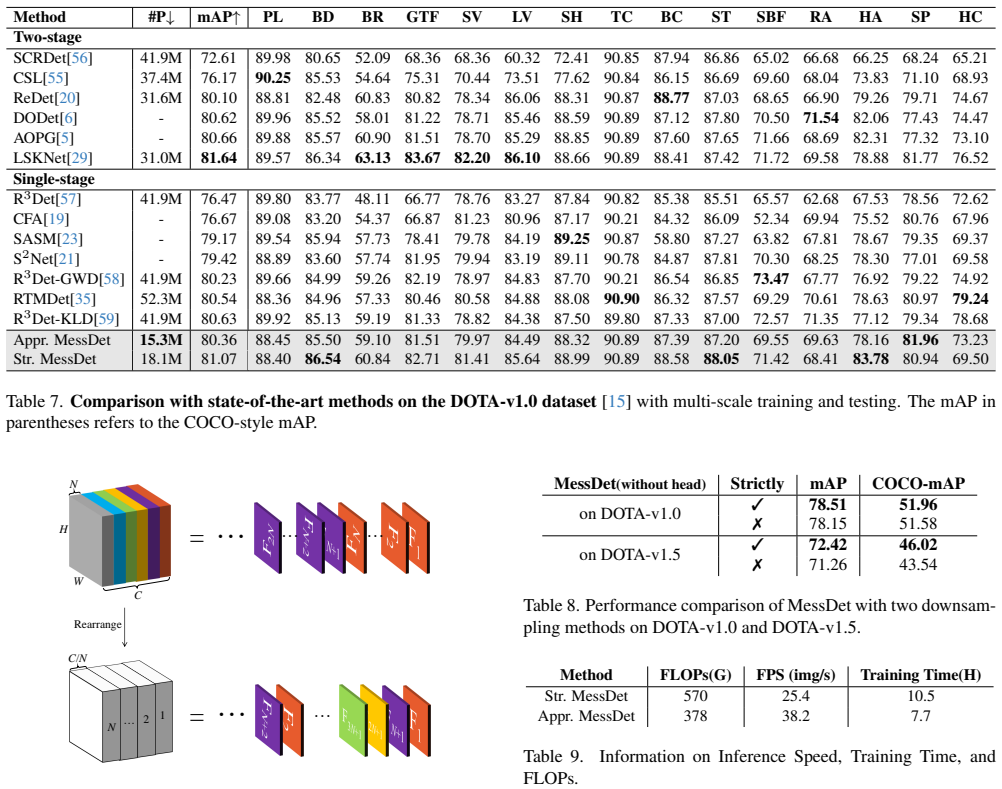
The load-bearing device is the tuning layer: a $4\times4$ kernel with stride 1 and padding 1 that maps an even $2n\times2n$ feature map to $(2n-1)\times(2n-1)$, so the following $3\times3$ stride-2 convolution always sees an odd-sized input and its sampling grid stays aligned under rotation. The paper relies on the parity condition $(i-k)\bmod s=0$ for equivariant downsampling, plus an explicit example showing that stride-2 sampling on even grids hits odd rows before rotation and even rows after a 90-degree rotation. Two supporting mechanisms are rotation-equivariant channel attention (RE-CA), which produces only $C/N$ per-orientation channel weights and repeats them $N$ times so weighting does not break the cyclic group structure, and the multi-branch head, which rearranges the $C$ channels into $N$ orientation groups and processes each group in its own branch before concatenation.
What would settle it
Train a strictly equivariant MessDet and an approximate counterpart matched for parameter count and FLOPs, for example by giving the approximate model equivalent extra channels or capacity, on DOTA-v1.0 and DOTA-v1.5; if strict equivariance is the active ingredient, the strict variant stays ahead, otherwise the gap should shrink or vanish. A complementary check would be to measure mAP after removing rotation data augmentation from training, since strict equivariance should absorb most of the loss.
Extended reading notes
Core claim
The central claim is that strict rotation equivariance, not just approximate equivariance learned from rotated training data, is measurably beneficial for oriented aerial object detection, and that this property can be kept without paying the usual cost in parameters. MessDet achieves this by inserting a tuning layer, a $4\times4$ stride-1 convolution, before every stride-2 downsampling layer, converting even-sized feature maps to odd sizes so that kernel sampling points align under rotation; by a rotation-equivariant channel attention that weights the orientation-group channels rather than breaking their structure; and by a multi-branch head that feeds features from each of $N$ orientations into separate branches, then concatenates the outputs, cutting head parameters. With $N=8$ orientation dimensions, the strictly equivariant MessDet outperforms its approximate twin on all three benchmarks and reaches the accuracy of much heavier detectors at roughly one third to one half of their parameter counts.
Load-bearing premise
The result that strict rotation equivariance helps aerial detection rests on comparing a strictly equivariant network with an approximate one that also differs in parameter count and FLOPs, so part of the mAP gap could come from the extra capacity of the tuning layers rather than from equivariance itself.
Editorial extensions
If this is right
- If the measured gains hold, aerial detectors can be made strictly rotation-equivariant without single-sided padding, avoiding the feature misalignment that padding introduces.
- A rotation-equivariant detector with 18.1M parameters can match or exceed the accuracy of detectors two to three times larger, so equivariance can substitute for parameter capacity in oriented detection.
- The rotation equivariance error of an approximately equivariant aerial detector falls during training, a behavior opposite to what is reported for classification, making equivariance error a useful training diagnostic.
- The grouped structure of rotation-equivariant features can be exploited architecturally, as the multi-branch head does, reducing parameters while improving accuracy.
Reading between the lines
- The strict and approximate variants differ not only in equivariance but in parameters (18.1M vs 15.3M) and FLOPs (570G vs 378G), because the tuning layers add capacity; a parameter-matched strict/approximate comparison would isolate how much of the mAP gap is equivariance rather than model size.
- If strict equivariance is the real source of the gain, it should also improve sample efficiency; training with fewer rotated augmentations or fine-tuning from less rotation-augmented data would be a direct test.
- The same tuning-layer trick and grouped multi-branch head could be carried to other equivariant symmetries, such as reflection or scale groups, in dense prediction tasks beyond aerial detection.
- Rotation equivariance error, reported only for backbone stages, could be logged per head branch and per orientation dimension to identify where approximate equivariance still leaks into the final detection output.
Editorial analysis
A structured set of objections, weighed in public.
Referee Report
Summary. The paper proposes MessDet, a rotation-equivariant single-stage detector for aerial imagery built on an E2CNN-style reimplementation of the RTMDet backbone and neck. The central contribution is a claimed causal measurement: comparing a strictly rotation-equivariant variant (Str. MessDet) against an approximately equivariant variant (Appr. MessDet) to quantify the impact of strict rotation equivariance. The strict variant introduces a so-called tuning layer, a k=4, s=1, p=1 RE-Conv placed before each 2x downsampling to convert even-sized feature maps to odd-sized ones. The paper also contributes a rotation-equivariant channel attention mechanism and a multi-branch head that exploits the grouped structure of rotation-equivariant features. Experiments on DOTA-v1.0, DOTA-v1.5, and DIOR-R report state-of-the-art or near-state-of-the-art mAP with 15.3M–18.1M parameters, and the supplementary reports FLOPs, FPS, and training time.
Significance. If the central claim is valid, the paper would provide a useful quantitative answer to an open question in aerial detection: whether strict, not merely approximate, rotation equivariance matters for detector accuracy. The engineering contributions are also valuable: the paper ships code, includes extensive comparisons, ablates the attention and head components, and demonstrates an unusually low parameter count. The main significance is tempered, however, by two unresolved issues: the strictness of the proposed tuning layer is not proven and is doubtful as written, and the strict-versus-approximate comparison is confounded by a 2.8M parameter and 192G FLOP difference.
major comments (4)
- [Sec. 4.1, Fig. 4b] The tuning layer that defines the 'strict' variant is a k=4, p=1, s=1 RE-Conv. On the standard integer lattice this layer has effective kernel offsets in {-1,0,1,2} in each spatial axis, and under a 90-degree rotation this support maps to {-2,-1,0,1} in one axis, which is not the same set. Therefore the convolution is not exactly equivariant under the grid rotation used in Eq. (1) and Fig. 2 unless an additional interpolation or symmetry convention is specified. The paper cites the condition (i-k) mod s = 0 from [16] only for the downsampling layer, not for the tuning layer itself. Since the tuning layer is the only architectural difference between Str. MessDet and Appr. MessDet, the manuscript does not currently establish that Str. MessDet is strictly rotation-equivariant. The authors should either prove exact equivariance of the full network including tuning layers, or measure the equivariance error of the complete Str. MessDet and show that it is exactly zero.
- [Sec. 5.3, Tables 1, 3, 6; Table 9] The central comparison is confounded by capacity. Str. MessDet uses 18.1M parameters and 570G FLOPs, while Appr. MessDet uses 15.3M parameters and 378G FLOPs, with the difference coming from the inserted tuning layers. The reported improvements of 0.67 mAP on DOTA-v1.0, 0.76 mAP on DOTA-v1.5, and 0.77 mAP on DIOR-R are attributed entirely to strict equivariance, but no parameter-matched or FLOP-matched baseline is provided. A control that adds the same number of non-equivariant convolutional parameters to Appr. MessDet, or one that removes layers from Str. MessDet to match capacity, is needed to separate the effect of equivariance from the effect of additional model capacity.
- [Sec. 5.2, Sec. 5.3] The magnitude of the central effect is small relative to typical training noise in aerial detection. The differences between Str. and Appr. MessDet are about 0.7 to 0.8 mAP on the three datasets, and the paper reports a single run for each configuration. No standard deviation, seed variation, or statistical significance test is reported. Given that the entire conclusion rests on this difference, the authors should report results over at least three seeds with mean and standard deviation, and ideally a paired comparison.
- [Sec. 5.4, Fig. 5] Figure 5 is presented as evidence that Str. MessDet has lower equivariance error, but the paper does not state whether the Str. curves are exactly zero or merely smaller than the Appr. curves. The y-axis resolution makes this ambiguous. The authors should report numerical values of the equivariance error for each stage of both variants and, crucially, isolate the contribution of the tuning layers by measuring the error with and without them. Without this, Figure 5 does not resolve the strictness question raised by the k=4 tuning layer.
minor comments (5)
- [Sec. 4.1] The choice of k=4 for the tuning layer is motivated only by output parity; the manuscript should explain why an odd-sized symmetric kernel with appropriate padding or cropping cannot serve the same purpose, since odd-sized kernels are the natural choice for exact discrete rotation equivariance.
- [Eq. (5)] The notation 1/(ijk) in the equivariance error definition is unclear; please define the index ranges and the normalization explicitly.
- [Sec. 5.2, Table 5] The number of convolutional modules in the multi-branch head is selected based on the best mAP in the ablation table; the paper should clarify whether this selection was made on the test set and discuss the potential for selection bias.
- [Sec. 9, Table 9] The FLOPs, FPS, and training-time differences between Str. and Appr. MessDet are useful, but the cost-benefit trade-off of strict equivariance should be discussed in the main text, especially since the parameter and FLOP increases are non-negligible.
- [Sec. 1, Fig. 1] The caption states that Str. MessDet 'eliminates such errors entirely,' which is stronger than anything demonstrated in the paper; please align the wording with the actual measurements.
Circularity Check
No circular derivation: the impact claim rests on held-out empirical comparisons, not on fitted inputs or self-citations.
full rationale
The paper's central claim is that strict rotation equivariance improves aerial detection, supported by mAP differences between Str. MessDet and Appr. MessDet on DOTA-v1.0, DOTA-v1.5, and DIOR-R. These numbers come from held-out test sets after standard training, so no test-set quantity is fitted or renamed as a prediction. The strict-versus-approximate distinction is an architectural control (presence or absence of the tuning layer before 2x downsampling), not a parameter fitted to the final mAP, and the equivariance error in Eq. (5) is defined independently of the detector loss and then measured. The paper's justification for strictness relies on an external condition (i-k) mod s = 0 attributed to [16], not on a self-citation chain, and the authors do not invoke their own prior work to forbid alternatives. The reviewer's concern that the k=4 tuning layer may not itself be rotation-equivariant on a discrete grid is a technical validity or correctness issue, not a circularity: the claim does not reduce by construction to its inputs, and the mAP advantage is not logically entailed by the architecture definition. The parameter/FLOPs difference between the two variants is an experimental confound, but confounding is not circular reasoning. Overall, no step in the derivation chain is equivalent to its own premise.
Assumptions & free parameters
free parameters (3)
- Number of orientation dimensions N =
8
- Tuning layer kernel size k =
4
- Multi-branch head number of conv modules =
3
assumptions (3)
- standard math For a stride-s downsampling layer, strict rotation equivariance is maintained iff (i - k) mod s = 0 for input size i and kernel size k (Edixhoven et al. [16]).
- domain assumption The E2CNN group-convolution machinery, including a newly introduced k=4 tuning layer and the RE-CA repeated-weight scheme, exactly implements C8-equivariant maps without breaking equivariance.
- domain assumption Random rotation augmentation during training does not eliminate the benefit of strict equivariance, so the observed mAP gap can be attributed to equivariance rather than augmentation.
Cite this review
Pith. "Pith review of Measuring the Impact of Rotation Equivariance on Aerial Object Detection." pith.science (2026). https://pith.science/paper/RH2AOOAD
@misc{pith2026250709896,
  author       = {Pith},
  title        = {Pith review of: Measuring the Impact of Rotation Equivariance on Aerial Object Detection},
  year         = {2026},
  howpublished = {\url{https://pith.science/paper/RH2AOOAD}},
  note         = {Machine review of arXiv:2507.09896}
}
read the original abstract
Due to the arbitrary orientation of objects in aerial images, rotation equivariance is a critical property for aerial object detectors. However, recent studies on rotation-equivariant aerial object detection remain scarce. Most detectors rely on data augmentation to enable models to learn approximately rotation-equivariant features. A few detectors have constructed rotation-equivariant networks, but due to the breaking of strict rotation equivariance by typical downsampling processes, these networks only achieve approximately rotation-equivariant backbones. Whether strict rotation equivariance is necessary for aerial image object detection remains an open question. In this paper, we implement a strictly rotation-equivariant backbone and neck network with a more advanced network structure and compare it with approximately rotation-equivariant networks to quantitatively measure the impact of rotation equivariance on the performance of aerial image detectors. Additionally, leveraging the inherently grouped nature of rotation-equivariant features, we propose a multi-branch head network that reduces the parameter count while improving detection accuracy. Based on the aforementioned improvements, this study proposes the Multi-branch head rotation-equivariant single-stage Detector (MessDet), which achieves state-of-the-art performance on the challenging aerial image datasets DOTA-v1.0, DOTA-v1.5 and DIOR-R with an exceptionally low parameter count.
Figures


Figures from the paper (5 more)


Reference graph
Works this paper leans on
-
[16]
Tom Edixhoven, Attila Lengyel, and Jan C. van Gemert. Us- ing and abusing equivariance. In ICCVW, pages 119–128,
-
[1]
Poly kernel inception network for remote sensing detection
Xinhao Cai, Qiuxia Lai, Yuwei Wang, Wenguan Wang, Zeren Sun, and Yazhou Yao. Poly kernel inception network for remote sensing detection. In CVPR, pages 27706–27716,
-
[2]
Hybrid task cascade for instance seg- mentation
Kai Chen, Jiangmiao Pang, Jiaqi Wang, Yu Xiong, Xiaox- iao Li, Shuyang Sun, Wansen Feng, Ziwei Liu, Jianping Shi, Wanli Ouyang, et al. Hybrid task cascade for instance seg- mentation. In CVPR, pages 4974–4983, 2019. 7
work page 2019
-
[3]
A survey on object detec- tion in optical remote sensing images
Gong Cheng and Junwei Han. A survey on object detec- tion in optical remote sensing images. ISPRS journal of pho- togrammetry and remote sensing, 117:11–28, 2016. 1
2016
-
[4]
Gong Cheng, Peicheng Zhou, and Junwei Han. Learning rotation-invariant convolutional neural networks for object detection in vhr optical remote sensing images. IEEE TGRS, 54(12):7405–7415, 2016. 2, 3
work page 2016
-
[5]
Anchor-free oriented proposal generator for object detection
Gong Cheng, Jiabao Wang, Ke Li, Xingxing Xie, Chunbo Lang, Yanqing Yao, and Junwei Han. Anchor-free oriented proposal generator for object detection. IEEE TGRS, 60:1– 11, 2022. 1, 2
work page 2022
-
[6]
Dual- aligned oriented detector
Gong Cheng, Yanqing Yao, Shengyang Li, Ke Li, Xingx- ing Xie, Jiabao Wang, Xiwen Yao, and Junwei Han. Dual- aligned oriented detector. IEEE TGRS , 60:1–11, 2022. 1, 2
work page 2022
-
[7]
Towards large-scale small object detection: Survey and benchmarks
Gong Cheng, Xiang Yuan, Xiwen Yao, Kebing Yan, Qinghua Zeng, Xingxing Xie, and Junwei Han. Towards large-scale small object detection: Survey and benchmarks. IEEE TPAMI, 45(11):13467–13488, 2023. 1
work page 2023
Show all 69 references
-
[8]
Group equivariant convolu- tional networks
Taco Cohen and Max Welling. Group equivariant convolu- tional networks. In ICML, pages 2990–2999, 2016. 2, 3, 4
2016
-
[9]
Steerable cnns
Taco Cohen and Max Welling. Steerable cnns. In ICLR,
-
[10]
Spherical cnns
Taco Cohen, Mario Geiger, Jonas K ¨ohler, and Max Welling. Spherical cnns. In ICLR, 2018. 3
2018
-
[11]
MMYOLO: OpenMMLab YOLO series toolbox and benchmark
MMYOLO Contributors. MMYOLO: OpenMMLab YOLO series toolbox and benchmark. https://github.com/ open-mmlab/mmyolo, 2022. 6, 2
2022
-
[12]
Ao2-detr: Arbitrary-oriented object detection trans- former
Linhui Dai, Hong Liu, Hao Tang, Zhiwei Wu, and Pinhao Song. Ao2-detr: Arbitrary-oriented object detection trans- former. IEEE TCSVT, 33(5):2342–2356, 2023. 1
2023
-
[13]
Imagenet: A large-scale hierarchical image database
Jia Deng, Wei Dong, Richard Socher, Li-Jia Li, Kai Li, and Li Fei-Fei. Imagenet: A large-scale hierarchical image database. In CVPR, pages 248–255, 2009. 6, 7
2009
-
[14]
Learning roi transformer for oriented object detection in aerial images
Jian Ding, Nan Xue, Yang Long, Gui-Song Xia, and Qikai Lu. Learning roi transformer for oriented object detection in aerial images. In CVPR, pages 2849–2858, 2019. 1, 3, 6, 7
2019
-
[15]
Object de- tection in aerial images: A large-scale benchmark and chal- lenges
Jian Ding, Nan Xue, Gui-Song Xia, Xiang Bai, Wen Yang, Michael Ying Yang, Serge Belongie, Jiebo Luo, Mihai Datcu, Marcello Pelillo, and Liangpei Zhang. Object de- tection in aerial images: A large-scale benchmark and chal- lenges. IEEE TPAMI, 44(11):7778–7796, 2022. 2, 5, 7
2022
-
[17]
Point- based estimator for arbitrary-oriented object detection in aerial images
Kun Fu, Zhonghan Chang, Yue Zhang, and Xian Sun. Point- based estimator for arbitrary-oriented object detection in aerial images. IEEE TGRS, 59(5):4370–4387, 2021. 6
2021
-
[18]
Rich feature hierarchies for accurate object detection and semantic segmentation
Ross Girshick, Jeff Donahue, Trevor Darrell, and Jitendra Malik. Rich feature hierarchies for accurate object detection and semantic segmentation. In CVPR, pages 580–587, 2014. 1
2014
-
[19]
Beyond bounding-box: Convex- hull feature adaptation for oriented and densely packed ob- ject detection
Zonghao Guo, Chang Liu, Xiaosong Zhang, Jianbin Jiao, Xi- angyang Ji, and Qixiang Ye. Beyond bounding-box: Convex- hull feature adaptation for oriented and densely packed ob- ject detection. In CVPR, pages 8792–8801, 2021. 1, 3, 2
2021
-
[20]
Redet: A rotation-equivariant detector for aerial object detection
Jiaming Han, Jian Ding, Nan Xue, and Gui-Song Xia. Redet: A rotation-equivariant detector for aerial object detection. In CVPR, pages 2786–2795, 2021. 2, 3, 6, 7
2021
-
[21]
Align deep features for oriented object detection
Jiaming Han, Jian Ding, Jie Li, and Gui-Song Xia. Align deep features for oriented object detection. IEEE TGRS, 60: 1–11, 2022. 1, 3, 6, 2
2022
-
[22]
Mask r-cnn
Kaiming He, Georgia Gkioxari, Piotr Dollar, and Ross Gir- shick. Mask r-cnn. In ICCV, pages 2961–2969, 2017. 3, 7
2017
-
[23]
Shape-adaptive selection and measurement for oriented object detection
Liping Hou, Ke Lu, Jian Xue, and Yuqiu Li. Shape-adaptive selection and measurement for oriented object detection. In AAAI, pages 923–932, 2022. 6, 2
2022
-
[24]
G- rep: Gaussian representation for arbitrary-oriented object de- tection
Liping Hou, Ke Lu, Xue Yang, Yuqiu Li, and Jian Xue. G- rep: Gaussian representation for arbitrary-oriented object de- tection. Remote Sensing, 15(3):757, 2023. 1, 6
2023
-
[25]
Squeeze-and-excitation net- works
Jie Hu, Li Shen, and Gang Sun. Squeeze-and-excitation net- works. In CVPR, pages 7132–7141, 2018. 2, 5
2018
-
[26]
Fred: Towards a full rotation-equivariance in aerial image object detection
Chanho Lee, Jinsu Son, Hyounguk Shon, Yunho Jeon, and Junmo Kim. Fred: Towards a full rotation-equivariance in aerial image object detection. In AAAI, pages 2883–2891,
-
[27]
Object detection in optical remote sensing images: A survey and a new benchmark
Ke Li, Gang Wan, Gong Cheng, Liqiu Meng, and Junwei Han. Object detection in optical remote sensing images: A survey and a new benchmark. ISPRS Journal of Photogram- metry and Remote Sensing , 159:296–307, 2020. 1, 2, 5, 7, 8
2020
-
[28]
Ori- ented reppoints for aerial object detection
Wentong Li, Yijie Chen, Kaixuan Hu, and Jianke Zhu. Ori- ented reppoints for aerial object detection. In CVPR, pages 1829–1838, 2022. 1, 3, 6, 7
2022
-
[29]
Large selective kernel network for remote sensing object detection
Yuxuan Li, Qibin Hou, Zhaohui Zheng, Ming-Ming Cheng, Jian Yang, and Xiang Li. Large selective kernel network for remote sensing object detection. In ICCV, pages 16794– 16805, 2023. 3, 6, 7, 2
2023
-
[30]
Feature pyramid networks for object detection
Tsung-Yi Lin, Piotr Dollar, Ross Girshick, Kaiming He, Bharath Hariharan, and Serge Belongie. Feature pyramid networks for object detection. In CVPR, pages 2117–2125,
-
[31]
Focal loss for dense object detection
Tsung-Yi Lin, Priya Goyal, Ross Girshick, Kaiming He, and Piotr Dollar. Focal loss for dense object detection. In ICCV, pages 2980–2988, 2017. 7
2017
-
[32]
Path aggregation network for instance segmentation
Shu Liu, Lu Qi, Haifang Qin, Jianping Shi, and Jiaya Jia. Path aggregation network for instance segmentation. In CVPR, pages 8759–8768, 2018. 4
2018
-
[33]
A high resolution optical satellite image dataset for ship recognition and some new baselines
Zikun Liu, Liu Yuan, Lubin Weng, and Yiping Yang. A high resolution optical satellite image dataset for ship recognition and some new baselines. In ICPRAM, pages 324–331, 2017. 1
2017
-
[34]
Decoupled weight decay regularization
Ilya Loshchilov and Frank Hutter. Decoupled weight decay regularization. arXiv preprint arXiv:1711.05101, 2017. 6, 2
2017 arXiv
-
[35]
Rtmdet: An empirical study of designing real-time object detectors
Chengqi Lyu, Wenwei Zhang, Haian Huang, Yue Zhou, Yudong Wang, Yanyi Liu, Shilong Zhang, and Kai Chen. Rtmdet: An empirical study of designing real-time object detectors. arXiv preprint arXiv:2212.07784, 2022. 2, 4, 5, 6, 7, 8
2022 arXiv
-
[36]
A data and compute efficient design for limited- resources deep learning
Mirgahney Mohamed, Gabriele Cesa, Taco Cohen, and Max Welling. A data and compute efficient design for limited- resources deep learning. arXiv preprint arXiv:2004.09691 ,
2004 arXiv
-
[37]
Dynamic refinement network for oriented and densely packed object detection
Xingjia Pan, Yuqiang Ren, Kekai Sheng, Weiming Dong, Haolei Yuan, Xiaowei Guo, Chongyang Ma, and Chang- sheng Xu. Dynamic refinement network for oriented and densely packed object detection. In CVPR, pages 11207– 11216, 2020. 1, 2, 6
2020
-
[38]
Adaptive rotated convolution for rotated object de- tection
Yifan Pu, Yiru Wang, Zhuofan Xia, Yizeng Han, Yulin Wang, Weihao Gan, Zidong Wang, Shiji Song, and Gao Huang. Adaptive rotated convolution for rotated object de- tection. In ICCV, pages 6589–6600, 2023. 3, 6
2023
-
[39]
You only look once: Unified, real-time object de- tection
Joseph Redmon, Santosh Divvala, Ross Girshick, and Ali Farhadi. You only look once: Unified, real-time object de- tection. In CVPR, pages 779–788, 2016. 1
2016
-
[40]
Faster r-cnn: Towards real-time object detection with region proposal networks
Shaoqing Ren, Kaiming He, Ross Girshick, and Jian Sun. Faster r-cnn: Towards real-time object detection with region proposal networks. IEEE TPAMI, 39(6):1137–1149, 2017. 7
2017
-
[41]
Attentive group equivariant convolutional networks
David Romero, Erik Bekkers, Jakub Tomczak, and Mark Hoogendoorn. Attentive group equivariant convolutional networks. In ICML, pages 8188–8199, 2020. 4
2020
-
[42]
Fair1m: A benchmark dataset for fine- grained object recognition in high-resolution remote sens- ing imagery
Xian Sun, Peijin Wang, Zhiyuan Yan, Feng Xu, Ruiping Wang, Wenhui Diao, Jin Chen, Jihao Li, Yingchao Feng, Tao Xu, et al. Fair1m: A benchmark dataset for fine- grained object recognition in high-resolution remote sens- ing imagery. ISPRS Journal of Photogrammetry and Remote Se...
2022
-
[43]
Cspnet: A new backbone that can enhance learning capability of cnn
Chien-Yao Wang, Hong-Yuan Mark Liao, Yueh-Hua Wu, Ping-Yang Chen, Jun-Wei Hsieh, and I-Hau Yeh. Cspnet: A new backbone that can enhance learning capability of cnn. In CVPRW, pages 390–391, 2020. 4
2020
-
[44]
Advancing plain vision transformer toward remote sensing foundation model
Di Wang, Qiming Zhang, Yufei Xu, Jing Zhang, Bo Du, Dacheng Tao, and Liangpei Zhang. Advancing plain vision transformer toward remote sensing foundation model. IEEE TGRS, 61:1–15, 2023. 1
2023
-
[45]
Learning center probability map for de- tecting objects in aerial images
Jinwang Wang, Wen Yang, Heng-Chao Li, Haijian Zhang, and Gui-Song Xia. Learning center probability map for de- tecting objects in aerial images. IEEE TGRS , 59(5):4307– 4323, 2021. 1, 3, 6
2021
-
[46]
General e(2)-equivariant steerable cnns
Maurice Weiler and Gabriele Cesa. General e(2)-equivariant steerable cnns. In NeurIPS, page 14334–14345, 2019. 2, 3, 4
2019
-
[47]
Hamprecht, and Martin Storath
Maurice Weiler, Fred A. Hamprecht, and Martin Storath. Learning steerable filters for rotation equivariant cnns. In CVPR, pages 849–858, 2018. 3
2018
-
[48]
Cbam: Convolutional block attention module
Sanghyun Woo, Jongchan Park, Joon-Young Lee, and In So Kweon. Cbam: Convolutional block attention module. In ECCV, pages 3–19, 2018. 2, 5
2018
-
[49]
Worrall, Stephan J
Daniel E. Worrall, Stephan J. Garbin, Daniyar Turmukham- betov, and Gabriel J. Brostow. Harmonic networks: Deep translation and rotation equivariance. In CVPR, pages 5028– 5037, 2017. 3
2017
-
[50]
Dota: A large-scale dataset for object detection in aerial images
Gui-Song Xia, Xiang Bai, Jian Ding, Zhen Zhu, Serge Be- longie, Jiebo Luo, Mihai Datcu, Marcello Pelillo, and Liang- pei Zhang. Dota: A large-scale dataset for object detection in aerial images. In CVPR, pages 3974–3983, 2018. 1, 5, 6
2018
-
[51]
Oriented r-cnn for object detection
Xingxing Xie, Gong Cheng, Jiabao Wang, Xiwen Yao, and Junwei Han. Oriented r-cnn for object detection. In ICCV, pages 3520–3529, 2021. 1, 3, 6, 2
2021
-
[52]
Dynamic coarse-to-fine learning for oriented tiny object detection
Chang Xu, Jian Ding, Jinwang Wang, Wen Yang, Huai Yu, Lei Yu, and Gui-Song Xia. Dynamic coarse-to-fine learning for oriented tiny object detection. In CVPR, pages 7318– 7328, 2023. 7
2023
-
[53]
Pp-yoloe: An evolved version of yolo
Shangliang Xu, Xinxin Wang, Wenyu Lv, Qinyao Chang, Cheng Cui, Kaipeng Deng, Guanzhong Wang, Qingqing Dang, Shengyu Wei, Yuning Du, et al. Pp-yoloe: An evolved version of yolo. arXiv preprint arXiv:2203.16250, 2022. 2, 5
2022 arXiv
-
[54]
Gliding vertex on the horizontal bounding box for multi-oriented object detec- tion
Yongchao Xu, Mingtao Fu, Qimeng Wang, Yukang Wang, Kai Chen, Gui-Song Xia, and Xiang Bai. Gliding vertex on the horizontal bounding box for multi-oriented object detec- tion. IEEE TPAMI, 43(4):1452–1459, 2021. 1, 3, 6
2021
-
[55]
Arbitrary-oriented object detec- tion with circular smooth label
Xue Yang and Junchi Yan. Arbitrary-oriented object detec- tion with circular smooth label. In ECCV, pages 677–694,
-
[56]
Scrdet: Towards more robust detection for small, cluttered and rotated objects
Xue Yang, Jirui Yang, Junchi Yan, Yue Zhang, Tengfei Zhang, Zhi Guo, Xian Sun, and Kun Fu. Scrdet: Towards more robust detection for small, cluttered and rotated objects. In ICCV, pages 8232–8241, 2019. 1, 3, 6, 2
2019
-
[57]
R3det: Refined single-stage detector with feature refinement for ro- tating object
Xue Yang, Junchi Yan, Ziming Feng, and Tao He. R3det: Refined single-stage detector with feature refinement for ro- tating object. In AAAI, pages 3163–3171, 2021. 1, 2, 6
2021
-
[58]
Rethinking rotated object detection with gaussian wasserstein distance loss
Xue Yang, Junchi Yan, Qi Ming, Wentao Wang, Xiaopeng Zhang, and Qi Tian. Rethinking rotated object detection with gaussian wasserstein distance loss. In ICML, pages 11830– 11841, 2021. 2, 3, 6
2021
-
[59]
Learning high-precision bounding box for rotated object detection via kullback- leibler divergence
Xue Yang, Xiaojiang Yang, Jirui Yang, Qi Ming, Wentao Wang, Qi Tian, and Junchi Yan. Learning high-precision bounding box for rotated object detection via kullback- leibler divergence. In NeurIPS, pages 18381–18394, 2021. 2, 3, 6
2021
-
[60]
Scrdet++: Detecting small, cluttered and rotated objects via instance-level feature denoising and rota- tion loss smoothing
Xue Yang, Junchi Yan, Wenlong Liao, Xiaokang Yang, Jin Tang, and Tao He. Scrdet++: Detecting small, cluttered and rotated objects via instance-level feature denoising and rota- tion loss smoothing. IEEE TPAMI, 45(2):2384–2399, 2023. 3
2023
-
[61]
The kfiou loss for rotated object detection
Xue Yang, Yue Zhou, Gefan Zhang, Jirui Yang, Wentao Wang, Junchi Yan, Xiaopeng Zhang, and Qi Tian. The kfiou loss for rotated object detection. In ICLR, 2023. 2
2023
-
[62]
Reppoints: Point set representation for object detection
Ze Yang, Shaohui Liu, Han Hu, Liwei Wang, and Stephen Lin. Reppoints: Point set representation for object detection. In ICCV, pages 9657–9666, 2019. 2
2019
-
[63]
Strip r-cnn: Large strip convolution for remote sensing object detection
Xinbin Yuan, ZhaoHui Zheng, Yuxuan Li, Xialei Liu, Li Liu, Xiang Li, Qibin Hou, and Ming-Ming Cheng. Strip r-cnn: Large strip convolution for remote sensing object detection. arXiv preprint arXiv:2501.03775, 2025. 3
2025 arXiv
-
[64]
Mmrotate: A rotated object detection benchmark using pytorch
Yue Zhou, Xue Yang, Gefan Zhang, Jiabao Wang, Yanyi Liu, Liping Hou, Xue Jiang, Xingzhao Liu, Junchi Yan, Chengqi Lyu, et al. Mmrotate: A rotated object detection benchmark using pytorch. In ACM MM, page 7331–7334, 2022. 6, 2
2022
-
[65]
Deep learning in remote sensing: A comprehensive review and list of resources
Xiao Xiang Zhu, Devis Tuia, Lichao Mou, Gui-Song Xia, Liangpei Zhang, Feng Xu, and Friedrich Fraundorfer. Deep learning in remote sensing: A comprehensive review and list of resources. IEEE Geoscience and Remote Sensing Maga- zine, 5(4):8–36, 2017. 1
2017
-
[66]
Object detection in 20 years: A survey
Zhengxia Zou, Keyan Chen, Zhenwei Shi, Yuhong Guo, and Jieping Ye. Object detection in 20 years: A survey. Proc. IEEE, 111(3):257–276, 2023. 1 Measuring the Impact of Rotation Equivariance on Aerial Object Detection Supplementary Material
2023
-
[67]
An Example Where Downsampling Breaks Rotation Equivariance In Section 3.2, we describe how conventional downsam- pling layers can break strict rotation equivariance. This occurs because the center sampling points of the convolu- tion kernels do not match before and after rotat...
-
[68]
The mathematical formulation of RE-CA is provided in Section 4.2, and its schematic diagram is shown in Fig
The Further Details of MessDet This paper introduces the rotation-equivariant channel at- tention (RE-CA), enabling rotation-equivariant networks to be implemented with more advanced network structures. The mathematical formulation of RE-CA is provided in Section 4.2, and its ...
-
[69]
Experiments Details and The Further Ex- periments Our model is implemented using the MMYOLO [11] and MMRotate [64] frameworks and trained for 36 epochs on DOTA-v1.0, DOTA-v1.5 and DIOR-R. During training, we followed most mainstream methods [1, 20, 29, 51] by em- MessDet(witho...
Reviewed August 6, 2026 · model on record in the stance chip above.
Discussion (0). Sign in to comment.