REVIEW 3 major objections 5 minor 86 references
Hypergraph-Based Models of Random Chemical Reaction Networks: Conservation Laws, Connectivity, and Percolation
T0 review · 3 major / 5 minor · reviewed 2026-08-06 · deepseek-v4-flash
Pith's one-line read In a random hypergraph model of chemistry, emergent cycles and forward reachability switch on at different critical probabilities, showing that reaction-network connectivity is not one graph-like property.
desk verdict A solid new null model for random CRNs with honest but unresolved order of the reachability transition; worth refereeing. read the letter →
The pith
A machine-rendered reading of the paper's core claim, the machinery that carries it, and where it could break.
The reading
What carries the argument
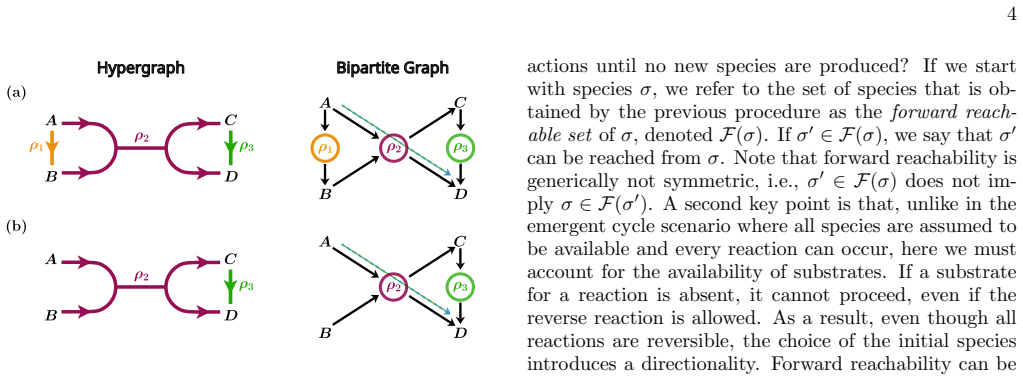
The engine of the paper is the random hypergraph model with composition-labeled species: a species is a vector $(n_1,\ldots,n_{N_A})$ of atom counts, and the universe of reactions consists of all dissociations $(n_1,\ldots,n_{N_A}) \leftrightarrow (m_1,\ldots,m_{N_A}) + (n_1-m_1,\ldots,n_{N_A}-m_{N_A})$, each included independently with probability $p = \gamma/|Z|_{\max}$ in the sparse scaling. Two structural identities carry the analysis: the rank-nullity bound $\langle|L|\rangle \geq \langle|Z|\rangle - \langle|R|\rangle$, capped by the number of atom types, which gives the universal crossover curve $\gamma^*(N_A)$ and predicts the nonmonotonic rise and fall of the number of conservation laws; and the root-species identity $|Z^r| = |L| + |\epsilon|_r$, which holds for every realization and identifies the independent roots with the conserved moieties. Emergent cycles are detected by computing $\dim(\ker(\nabla_X)) - \dim(\ker(\nabla))$, and forward reachable sets by iteratively closing a species set under all reactions whose substrates are present. The order parameters are the probability $P_\epsilon(\gamma)$ of an emergent cycle for a random chemostatted subset and the rescaled size $|f|(\gamma)$ of the largest forward reachable set.
What would settle it
Simulate the $N_A=1$ model at $Q = 10^4$ with many realizations and measure, on identical networks, the probability that a random chemostatted pair has an emergent cycle and the fraction of species whose forward-reachable set is extensive; if the two order parameters cross $1/2$ at the same $\gamma$ within statistical error, the claimed split at $3.62$ versus $2.92$ fails. Alternatively, computing $P_\epsilon(\gamma,Q)$ exactly for large $Q$ and finding that the variance peak broadens instead of sharpening would refute the discontinuity classification.
Extended reading notes
Core claim
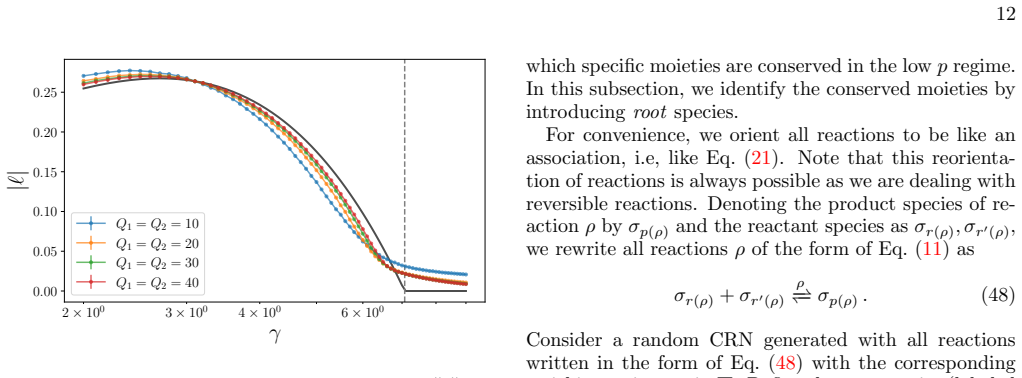
The paper claims that, in a composition-respecting random hypergraph ensemble, the two chemically meaningful connectivity notions are distinct and each has a sharp percolation transition. Concretely, for $N_A=1$ the probability that chemostatting two random species yields an emergent cycle jumps from zero to one at $\gamma_c = 3.62 \pm 0.02$, while the rescaled size of the largest forward-reachable set jumps at $\gamma_c = 2.92 \pm 0.01$; both are classified as discontinuous transitions on the basis of bimodal order-parameter histograms and sharpening variance peaks. For $N_A=2$ the emergent-cycle transition is instead continuous, with $\gamma_c = 6.74 \pm 0.01$ and critical exponents $a = 2.219 \pm 0.131$ and $b = 0.095 \pm 0.005$, while forward reachability again appears discontinuous. The coexistence of different thresholds is the paper's central assertion: connectivity in CRNs is not a single graph-like property, and the hypergraph structure together with atomic conservation laws is needed to see it.
Load-bearing premise
The model represents a chemical species solely by its molecular formula and therefore includes only composition-changing reactions, omitting structural isomerizations and bimolecular-to-bimolecular reactions; if molecular structure materially changes connectivity, the predicted thresholds hold for a composition-only model rather than for real chemistry.
Editorial extensions
If this is right
- Below $\gamma \approx 2.92$ for $N_A=1$, almost no species can synthesize another by forward cascades; above it, an extensive fraction of species becomes reachable from a single seed.
- Between $2.92$ and $3.62$, large closed CRNs can amplify a single species into many products, yet random chemostatted pairs typically cannot sustain a steady-state interconversion, so open and closed connectivity regimes are separated.
- Above $\gamma \approx 3.62$, nearly any chemostatted subset of species supports an emergent cycle, meaning random open CRNs become capable of steady-state transduction circuits.
- The average number of conservation laws rises then falls to the number of atom types, so the dominant structural motif changes from many isolated moieties at low $p$ to a maximally connected network at high $p$.
- Deficiency is typically zero below $\gamma^*$ and positive above it, implying that random CRNs are structurally incapable of complex dynamics at low $p$ and become capable of oscillations or multistability at high $p$.
Reading between the lines
- If the two thresholds remain split as $N_A$ grows, any graph projection of a CRN that conflates them will mis-locate the onset of synthetic capability; this suggests re-examining earlier S-graph-based percolation estimates as describing a different, possibly mixed, connectivity measure.
- The root-species construction gives a constructive way to read conservation laws off a random network; one could test it as a fast heuristic for detecting conserved moieties in large real metabolic networks without computing the stoichiometric nullspace.
- The continuous versus discontinuous distinction for emergent cycles between $N_A=1$ and $N_A=2$ is a candidate universality question; an extension would check whether $N_A=3$ recovers a continuous transition and how the exponents depend on $N_A$.
- The paper's composition-only universe is a controlled null model; adding a structural label per species, as the authors suggest for conformations, should shift the thresholds, and measuring that shift would quantify how much isomerization matters for network connectivity.
Editorial analysis
A structured set of objections, weighed in public.
Referee Report
Summary. The manuscript proposes an Erdős–Rényi-style random chemical reaction network model in which species are molecular formulas over NA atom types and reactions are the mass-balanced two-body associations/dissociations among them, each included independently with probability p = γ/|Z|max. The authors derive closed-form or semi-analytic results for the species degree distribution, the expected number of active species, and rank-nullity bounds on the number of conservation laws; they also introduce a root-species construction that identifies conserved moieties and connects root counts to conservation laws and emergent cycles. They then study two connectivity notions: emergent cycles under chemostatting (open-system steady-state synthesis) and forward reachability from a single species (closed-system synthesis). Numerical simulations are used to claim percolation-like transitions for both notions: the emergent-cycle transition is reported as discontinuous for NA = 1 (γc = 3.62 ± 0.02) and continuous for NA = 2 (γc = 6.74 ± 0.01), while the forward-reachability transition is reported as discontinuous for both, with γc = 2.92 ± 0.01 for NA = 1. The concluding claim is that the two connectivity notions have genuinely different thresholds.
Significance. If the connectivity claims are correct, this paper provides a valuable null model for chemical reaction networks, and it is one of the few random ensembles that enforces atomic conservation by construction. The analytical parts are genuine strengths: the degree distribution in Eq. (27), the expected species count in Eq. (28), and the rank-based conservation-law bounds in Eqs. (46)–(47) are closed-form predictions validated against simulation without fitting. The agreement of the theoretical γ* estimates with the measured thresholds to within 3–5% is a real predictive achievement. The root-species analysis in Sec. IV C 2 and Appendix G gives a constructive, non-perturbative picture of conserved moieties and leads to the exact relation |Zr| = |L| + |ε|r in Eq. (51). However, the reachability transition is load-bearing for the paper's central 'two distinct thresholds' claim, and the evidence for its first-order character is not internally consistent. The composition-only scope is explicitly acknowledged in Sec. VI and is a reasonable starting point, but it limits direct biochemical interpretation.
major comments (3)
- [Sec. IV D, Figs. 13–15, and Appendix H] The evidence for a discontinuous forward-reachability transition is not self-consistent, and the threshold estimate γc = 2.92 rests on an assumption that the paper's own scaling results contradict. The equal-weight histogram criterion (Fig. 14) presupposes two well-separated coexisting peaks that exchange weight at γ1/2(Q), with a linear extrapolation in 1/Q locating γc. But a first-order transition requires the derivative of the order parameter to grow linearly with system size, whereas Fig. 28a reports a power-law exponent of 0.35, and the susceptibility peak (Fig. 30a) grows as Q^0.52 rather than linearly in Q. The authors acknowledge this in Sec. V A and Sec. VI and explicitly compare with explosive percolation, where small-system bimodality is a finite-size artifact of a continuous transition. Moreover, because |f| is a maximum over all initial species, its histogram is an extreme-value statistic and can be bimodal even for continuous transitions, so the bimodal histograms in Fig. 13 are not independent evidence for first-order behavior. If the transition is continuous, the equal-weight point γ1/2(Q) need not converge to the asymptotic threshold, and the reported separation 2.92 vs 3.62 is not established. I request either a quantitative first-order analysis (for example, a demonstration that the peak-to-valley ratio of the histogram grows without bound with Q, or a scaling collapse of the two-peak structure with a linearly growing derivative) or, alternatively, a continuous-transition scaling analysis of ⟨|f|⟩ that would allow an unbiased estimate of γc. This is load-bearing because the abstract and Sec. VI emphasize the distinct critical probabilities.
- [Sec. IV C, Eq. (34), and Appendix F 2] The NA = 2 emergent-cycle transition is classified as continuous on the basis of the fitted finite-size scaling ansatz, but the fitted order-parameter exponent b = 0.095 ± 0.005 is very small, implying an extremely steep onset. The collapse score S = 1.56 and the derivative-peak exponent 0.419 ± 0.004 are internally consistent, but such a small b makes the numerical distinction from a weakly discontinuous transition delicate, and the authors do not test for an alternative discontinuous scenario. Since the paper's contrast between the discontinuous NA = 1 emergent-cycle transition and the continuous NA = 2 transition is a central narrative, a direct test of discontinuity (for example, examining the order-parameter distribution at γc for bimodality, or checking whether Pε develops a gap as Q → ∞) would materially strengthen the classification.
- [Sec. IV D and Sec. VI] The claim that the reachability transition is discontinuous for NA = 2 is supported only by histograms at a single small system size, Q1 = Q2 = 50, with no threshold estimate and no finite-size analysis (Fig. 16). Given that the NA = 1 reachability order is itself unresolved, the Sec. VI statement that 'the largest reachable set undergoes a discontinuous transition for both NA = 1 and NA = 2' is premature. At minimum, the NA = 2 statement should be downgraded to a preliminary observation, or supported by the same multi-Q histogram and scaling analysis used for NA = 1.
minor comments (5)
- [Eq. (5)] The right-hand side of the effective reaction should read ν^e_- · σ_y, not ν^e_+ · σ_y; as written, the effective reaction has the same vector on both sides.
- [Sec. III, condition below Eq. (11)] The condition 'min{m_a} > 0' excludes dissociations such as (1,2) → (1,0) + (0,2) listed in Appendix B; the intended condition is that both fragments are nonempty and the two sides are distinct, i.e., not all m_a = 0 and not m_a = n_a for all a.
- [Appendix G 3 e, Eq. (G21)] The decomposition of c appears to contain a typo: the third term should involve c_{σ_p(ρ)}, not a second copy of c_{σ_{r'}(ρ)}.
- [Sec. IV B, Eqs. (23)–(25)] The independence approximation leading to the Poisson-binomial number distribution is validated only through the mean μ(k) in Fig. 2a; the variance expression in Eq. (25) is not compared with simulation. Since this approximation is used again in the root analysis of Appendix D, a plot of the variance would help the reader assess its accuracy.
- [Appendix H, Figs. 28 and 30] The symbols γ*_r(Q) and γ*_s(Q) for the derivative and susceptibility peak locations are easily confused with the theoretical γ* of Sec. IV C 1; please rename them, for instance γ_r(Q) and γ_χ(Q).
Circularity Check
No significant circularity: simulation-derived thresholds and the rank-nullity bound are independent; self-citations are non-load-bearing background.
full rationale
The paper's central results are self-contained rather than circular. The random-CRN ensemble is defined directly in Sec. III by sampling stoichiometrically allowed reactions with probability p, and both connectivity thresholds are obtained from explicit simulations: the emergent-cycle threshold γc=3.62 for NA=1 is located by variance-peak extrapolation (Appendix F1), and the forward-reachability threshold γc=2.92 is obtained by equal-weight histogram extrapolation (Appendix H), each with reported bootstrap or grid uncertainties. The analytic estimates γ* in Eqs. (46) and (47) are derived from rank-nullity lower bounds on the average number of conservation laws and are compared with, not fitted to, the simulated γc; the paper explicitly notes the 3-5% discrepancy, confirming that they are genuine approximations rather than re-statements of the measured threshold. The fitted scaling exponents a and b for the NA=2 emergent-cycle collapse are a standard finite-size-scaling consistency check and do not feed back into the central threshold-separation claim. The self-citations, most notably Eq. (6) attributed to Refs. [33,34], concern established open-CRN identities used as background; they are not load-bearing because the paper proves its own root-species relation |Z^r|=|L|+|eps|_r in Appendix G3 and the numerical thresholds do not depend on the cited relation. The main caveat, that the forward-reachability transition is classified as first-order despite derivative and susceptibility peaks growing only as Q^0.35 and Q^0.52, is explicitly acknowledged by the authors in Secs. V-VI as possibly arising from strong finite-size effects or explosive-percolation-like continuous behavior. That is a correctness and finite-size concern about the asymptotic γc and transition order, not a circularity: the reported values are data estimates, not outputs forced by input assumptions. No derivation step reduces by construction to its own inputs.
Assumptions & free parameters
free parameters (3)
- a (scaling exponent) =
2.219 ± 0.131
- b (order parameter exponent) =
0.095 ± 0.005
- Gaussian filter width sigma =
4.0
assumptions (7)
- standard math Rank-nullity theorem applied to the stoichiometric matrix
- standard math Poisson approximation of the binomial distribution for degree statistics
- domain assumption Species are identified solely by atomic composition, ignoring molecular structure
- domain assumption All reactions are reversible and of the form A+B <-> C or 2A <-> B
- domain assumption Forward reachability assumes infinite amounts of initial species and no kinetics
- ad hoc to paper Independence approximation for the number distribution of species with degree k
- ad hoc to paper Finite-size scaling ansatz for the N_A=2 emergent-cycle transition
Cite this review
Pith. "Pith review of Hypergraph-Based Models of Random Chemical Reaction Networks: Conservation Laws, Connectivity, and Percolation." pith.science (2026). https://pith.science/paper/DAFH5MME
@misc{pith2026250709943,
  author       = {Pith},
  title        = {Pith review of: Hypergraph-Based Models of Random Chemical Reaction Networks: Conservation Laws, Connectivity, and Percolation},
  year         = {2026},
  howpublished = {\url{https://pith.science/paper/DAFH5MME}},
  note         = {Machine review of arXiv:2507.09943}
}
read the original abstract
Random graph models have been instrumental in characterizing complex networks, but chemical reaction networks (CRNs) are better represented as hypergraphs. Traditional models of random CRNs often reduce CRNs to bipartite graphs, representing species and reactions as distinct nodes, or simpler derived graphs, which can obscure the relationship between the statistical properties of these representations and the physical characteristics of the CRN. We introduce a straightforward model for generating random CRNs that preserves their hypergraph structure as well as atomic composition, enabling the direct study of chemically relevant features. Notably, our approach distinguishes two notions of connectivity that are equivalent in graphs but differ fundamentally in hypergraphs. These notions exhibit percolation-like phase transitions, which we analyze in detail. The first type of connectivity has relevance to steady-state synthesis and transduction, determining the effective reactions an open CRN can perform at steady state. The second type is suitable to identify which species can be produced from a given initial set of species in a closed CRN. Our findings highlight the importance of hypergraph-based modeling for uncovering the complex behaviors of CRNs.
Figures


Figures from the paper (20 more)




Reference graph
Works this paper leans on
-
[1]
author author C. M. \ Dobson ,\ 10.1038/nature03192 journal journal Nature \ volume 432 ,\ pages 824 ( year 2004 ) NoStop
-
[2]
author author J.-L. \ Reymond ,\ 10.1021/ar500432k journal journal Accounts of Chemical Research \ volume 48 ,\ pages 722 ( year 2015 ) NoStop
-
[3]
author author S. Stocker , author G. Cs a \' a nyi , author K. Reuter , \ and\ author J. T. \ Margraf ,\ 10.1038/s41467-020-19267-x journal journal Nat. Commun. \ volume 11 ,\ pages 1 ( year 2020 ) NoStop
-
[4]
author author P. M. \ Murray , author S. N. G. \ Tyler , \ and\ author J. D. \ Moseley ,\ 10.1021/op300275p journal journal Org. Process Res. Dev. \ volume 17 ,\ pages 40 ( year 2013 ) NoStop
-
[5]
author author B. A. \ Grzybowski , author K. J. M. \ Bishop , author B. Kowalczyk , \ and\ author C. E. \ Wilmer ,\ 10.1038/nchem.136 journal journal Nature Chemistry \ volume 1 ,\ pages 31 ( year 2009 ) NoStop
-
[6]
author author R. Albert \ and\ author A.-L. \ Barab \'a si ,\ 10.1103/RevModPhys.74.47 journal journal Reviews of Modern Physics \ volume 74 ,\ pages 47 ( year 2002 ) NoStop
-
[7]
author author M. E. J. \ Newman ,\ 10.1137/S003614450342480 journal journal SIAM Review \ volume 45 ,\ pages 167 ( year 2003 ) NoStop
-
[8]
Newman ,\ @noop title Networks ,\ edition second edition \ ed.\ ( publisher Oxford University Press ,\ address Oxford, New York ,\ year 2018 ) NoStop
author author M. Newman ,\ @noop title Networks ,\ edition second edition \ ed.\ ( publisher Oxford University Press ,\ address Oxford, New York ,\ year 2018 ) NoStop
2018
Show all 86 references
-
[9]
u ller--Groeling , \ and\ author H. A. \ Weidenm \
author author T. Guhr , author A. M \"u ller--Groeling , \ and\ author H. A. \ Weidenm \"u ller ,\ 10.1016/S0370-1573(97)00088-4 journal journal Physics Reports \ volume 299 ,\ pages 189 ( year 1998 ) NoStop
1998 doi
-
[10]
Jeong , author B
author author H. Jeong , author B. Tombor , author R. Albert , author Z. N. \ Oltvai , \ and\ author A.-L. \ Barab a \' a si ,\ 10.1038/35036627 journal journal Nature \ volume 407 ,\ pages 651 ( year 2000 ) NoStop
-
[11]
Tanaka ,\ 10.1103/PhysRevLett.94.168101 journal journal Physical Review Letters \ volume 94 ,\ pages 168101 ( year 2005 ) NoStop
author author R. Tanaka ,\ 10.1103/PhysRevLett.94.168101 journal journal Physical Review Letters \ volume 94 ,\ pages 168101 ( year 2005 ) NoStop
2005 doi
-
[12]
\ Palsson ,\ @noop title Systems Biology: Properties of Reconstructed Networks ,\ edition reprinted \ ed.\ ( publisher Cambridge Univ
author author B. . \ Palsson ,\ @noop title Systems Biology: Properties of Reconstructed Networks ,\ edition reprinted \ ed.\ ( publisher Cambridge Univ. Press ,\ address Cambridge ,\ year 2008 ) NoStop
2008
-
[13]
author author H. B. \ Smith , author H. Kim , \ and\ author S. I. \ Walker ,\ 10.1038/s41598-021-85903-1 journal journal Scientific Reports \ volume 11 ( year 2021 ),\ 10.1038/s41598-021-85903-1 NoStop
2021 doi
-
[14]
Klamt , author U.-U
author author S. Klamt , author U.-U. \ Haus , \ and\ author F. Theis ,\ 10.1371/journal.pcbi.1000385 journal journal PLoS Comput. Biol. \ volume 5 ,\ pages e1000385 ( year 2009 ) NoStop
2009 doi
-
[15]
Holme ,\ 10.1098/rsif.2008.0489 journal journal Journal of The Royal Society Interface \ volume 6 ( year 2009 ),\ 10.1098/rsif.2008.0489 NoStop
author author P. Holme ,\ 10.1098/rsif.2008.0489 journal journal Journal of The Royal Society Interface \ volume 6 ( year 2009 ),\ 10.1098/rsif.2008.0489 NoStop
2008
-
[16]
author author C. I. \ Sandefur , author M. Mincheva , \ and\ author S. Schnell ,\ 10.1039/C3MB70052F journal journal Molecular BioSystems \ volume 9 ( year 2013 ),\ 10.1039/C3MB70052F NoStop
2013 doi
-
[17]
Montañez , author M
author author R. Montañez , author M. A. \ Medina , author R. V. \ Solé , \ and\ author C. Rodríguez-Caso ,\ 10.1002/bies.200900145 journal journal BioEssays \ volume 32 ,\ pages 246 ( year 2010 ) NoStop
2010 doi
-
[18]
Fagerberg , author C
author author R. Fagerberg , author C. Flamm , author D. Merkle , author P. Peters , \ and\ author P. F. \ Stadler ,\ 10.1007/s11786-013-0160-y journal journal Math.Comput.Sci. \ volume 7 ,\ pages 275 ( year 2013 ) NoStop
2013 doi
-
[19]
Barthelemy ,\ 10.1103/PhysRevE.106.064310 journal journal Physical Review E \ volume 106 ,\ pages 064310 ( year 2022 ) NoStop
author author M. Barthelemy ,\ 10.1103/PhysRevE.106.064310 journal journal Physical Review E \ volume 106 ,\ pages 064310 ( year 2022 ) NoStop
2022 doi
-
[20]
Ghoshal , author V
author author G. Ghoshal , author V. Zlatić , author G. Caldarelli , \ and\ author M. E. J. \ Newman ,\ 10.1103/PhysRevE.79.066118 journal journal Physical Review E \ volume 79 ( year 2009 ),\ 10.1103/PhysRevE.79.066118 NoStop
2009 doi
-
[21]
Bianconi \ and\ author S
author author G. Bianconi \ and\ author S. N. \ Dorogovtsev ,\ 10.1103/PhysRevE.109.014306 journal journal Physical Review E \ volume 109 ,\ pages 014306 ( year 2024 ) NoStop
2024 doi
-
[22]
M \"u ller , author C
author author S. M \"u ller , author C. Flamm , \ and\ author P. F. \ Stadler ,\ 10.1186/s13321-022-00621-8 journal journal Journal of Cheminformatics \ volume 14 ,\ pages 1 ( year 2022 ) NoStop
2022 doi
-
[23]
author author D. F. \ Anderson \ and\ author T. D. \ Nguyen ,\ 10.1007/s10910-021-01278-8 journal journal Journal of Mathematical Chemistry \ volume 59 ,\ pages 2063 ( year 2021 ) NoStop
2021 doi
-
[24]
author author D. F. \ Anderson \ and\ author T. D. \ Nguyen ,\ 10.1017/jpr.2021.65 journal journal Journal of Applied Probability \ volume 59 ,\ pages 384 ( year 2022 ) NoStop
2021 doi
-
[25]
Bigan , author J.-M
author author E. Bigan , author J.-M. \ Steyaert , \ and\ author S. Douady ,\ @noop title Properties of random complex chemical reaction networks and their relevance to biological toy models , \ ( year 2013 ),\ http://arxiv.org/abs/1303.7439 arXiv:1303.7439 [q-bio.MN] NoStop
2013 arXiv
-
[26]
author author Z. G. \ Nicolaou , author S. B. \ Nicholson , author A. E. \ Motter , \ and\ author J. R. \ Green ,\ 10.1063/5.0142589 journal journal The Journal of Chemical Physics \ volume 158 ( year 2023 ),\ 10.1063/5.0142589 NoStop
2023 doi
-
[27]
Svehla ,\ @noop journal journal Pure and applied chemistry \ volume 65 ,\ pages 2291 ( year 1993 ) NoStop
author author G. Svehla ,\ @noop journal journal Pure and applied chemistry \ volume 65 ,\ pages 2291 ( year 1993 ) NoStop
1993
-
[28]
author author C. D. \ Meyer ,\ @noop title Matrix Analysis and Applied Linear Algebra \ ( publisher Society for Industrial and Applied Mathematics ,\ address Philadelphia ,\ year 2000 ) NoStop
2000
-
[29]
Rao \ and\ author M
author author R. Rao \ and\ author M. Esposito ,\ 10.1103/PhysRevX.6.041064 journal journal Phys. Rev. X \ volume 6 ,\ pages 041064 ( year 2016 ) NoStop
2016 doi
-
[30]
Avanzini , author G
author author F. Avanzini , author G. Falasco , \ and\ author M. Esposito ,\ 10.1088/1367-2630/abafea journal journal New J. Phys. \ volume 22 ,\ pages 093040 ( year 2020 ) NoStop
2020 doi
-
[31]
Rao \ and\ author M
author author R. Rao \ and\ author M. Esposito ,\ 10.1063/1.5042253 journal journal The Journal of Chemical Physics \ volume 149 ,\ pages 245101 ( year 2018 ) NoStop
2018 doi
-
[32]
Shimada , author P
author author M. Shimada , author P. Behrad , \ and\ author E. De Giuli ,\ 10.1103/PhysRevE.109.044105 journal journal Physical Review E \ volume 109 ,\ pages 044105 ( year 2024 ) NoStop
2024 doi
-
[33]
Polettini \ and\ author M
author author M. Polettini \ and\ author M. Esposito ,\ 10.1063/1.4886396 journal journal The Journal of Chemical Physics \ volume 141 ( year 2014 ),\ 10.1063/1.4886396 NoStop
2014 doi
-
[34]
Avanzini , author N
author author F. Avanzini , author N. Freitas , \ and\ author M. Esposito ,\ 10.1103/PhysRevX.13.021041 journal journal Phys. Rev. X \ volume 13 ,\ pages 021041 ( year 2023 ) NoStop
2023 doi
-
[35]
Dal Cengio , author V
author author S. Dal Cengio , author V. Lecomte , \ and\ author M. Polettini ,\ 10.1103/PhysRevX.13.021040 journal journal Physical Review X \ volume 13 ,\ pages 021040 ( year 2023 ) NoStop
2023 doi
-
[36]
Shinar \ and\ author M
author author G. Shinar \ and\ author M. Feinberg ,\ 10.1016/j.mbs.2012.08.002 journal journal Mathematical Biosciences \ volume 241 ( year 2013 ),\ 10.1016/j.mbs.2012.08.002 NoStop
2012 doi
-
[37]
Craciun \ and\ author M
author author G. Craciun \ and\ author M. Feinberg ,\ 10.1137/050634177 journal journal SIAM Journal on Applied Mathematics \ volume 66 ,\ pages 1321 ( year 2006 ) NoStop
2006 doi
-
[38]
Feinberg ,\ @noop title Foundations of Chemical Reaction Network theory \ ( publisher Springer ,\ year 2019 )\ p.\ pages 79–80 NoStop
author author M. Feinberg ,\ @noop title Foundations of Chemical Reaction Network theory \ ( publisher Springer ,\ year 2019 )\ p.\ pages 79–80 NoStop
2019
-
[39]
author author H.-M. \ Kaltenbach ,\ 10.1016/j.entcs.2020.06.005 journal journal Electronic Notes in Theoretical Computer Science \ series Proceedings of SASB 2018, the Ninth International Workshop on Static Analysis and Systems Biology , Freiburg , Germany - August 28th, 2018 ...
2020 doi
-
[40]
author author D. F. \ Anderson \ and\ author T. G. \ Kurtz ,\ 10.1007/978-3-319-16895-1 title Stochastic Analysis of Biochemical Systems \ ( publisher Springer International Publishing ,\ address Cham ,\ year 2015 ) NoStop
2015 doi
-
[41]
Polettini , author A
author author M. Polettini , author A. Wachtel , \ and\ author M. Esposito ,\ 10.1063/1.4935064 journal journal The Journal of Chemical Physics \ volume 143 ,\ pages 184103 ( year 2015 ) NoStop
2015 doi
-
[42]
author author S. G. \ Marehalli Srinivas , author M. Polettini , author M. Esposito , \ and\ author F. Avanzini ,\ 10.1063/5.0147283 journal journal The Journal of Chemical Physics \ volume 158 ,\ pages 204108 ( year 2023 ) NoStop
2023 doi
-
[43]
author author S. N. \ Dorogovtsev \ and\ author J. F. F. \ Mendes ,\ 10.1093/oso/9780199695119.001.0001 title The Nature of Complex Networks ,\ edition 1st \ ed.\ ( publisher Oxford University PressOxford ,\ year 2022 ) NoStop
2022
-
[44]
Tang \ and\ author F
author author W. Tang \ and\ author F. Tang ,\ 10.1214/22-STS852 journal journal Statistical Science \ volume 38 ( year 2023 ),\ 10.1214/22-STS852 NoStop
2023 doi
-
[45]
Stauffer \ and\ author A
author author D. Stauffer \ and\ author A. Aharony ,\ 10.1201/9781315274386 title Introduction To Percolation Theory : Second Edition ,\ edition 2nd \ ed.\ ( publisher Taylor & Francis ,\ address London ,\ year 2017 ) NoStop
2017 doi
-
[46]
Houdayer \ and\ author A
author author J. Houdayer \ and\ author A. Hartmann ,\ 10.1103/PhysRevB.70.014418 journal journal Physical Review B \ volume 70 ,\ pages 014418 ( year 2004 ) NoStop
2004 doi
- [47]
-
[48]
author author M. E. J. \ Newman , author S. H. \ Strogatz , \ and\ author D. J. \ Watts ,\ 10.1103/PhysRevE.64.026118 journal journal Physical Review E \ volume 64 ,\ pages 026118 ( year 2001 ) NoStop
2001 doi
-
[49]
author author S. N. \ Dorogovtsev , author J. F. F. \ Mendes , \ and\ author A. N. \ Samukhin ,\ 10.1103/PhysRevE.64.025101 journal journal Physical Review E \ volume 64 ,\ pages 025101 ( year 2001 ) NoStop
2001 doi
-
[50]
Binder , author K
author author K. Binder , author K. Vollmayr , author H.-P. \ Deutsch , author J. D. \ Reger , author M. Scheucher , \ and\ author D. P. \ Landau ,\ 10.1142/S0129183192000683 journal journal International Journal of Modern Physics C \ volume 03 ,\ pages 1025 ( year 1992 ) NoStop
-
[51]
author author M. V. \ Smoluchowski ,\ https://doi.org/10.1002/andp.19163532408 journal journal Annalen der Physik \ volume 353 ,\ pages 1103 ( year 1916 ) NoStop
1916 doi
-
[52]
Sharko , author D
author author A. Sharko , author D. Livitz , author S. De Piccoli , author K. J. M. \ Bishop , \ and\ author T. M. \ Hermans ,\ 10.1021/acs.chemrev.1c00958 journal journal Chemical Reviews \ volume 122 ,\ pages 11759 ( year 2022 ) NoStop
-
[53]
author author J. A. D. \ Wattis ,\ 10.1016/j.physd.2006.07.024 journal journal Physica D: Nonlinear Phenomena \ series Coagulation-fragmentation Processes ,\ volume 222 ,\ pages 1 ( year 2006 ) NoStop
2006 doi
-
[54]
author author W. J. \ Riehl , author P. L. \ Krapivsky , author S. Redner , \ and\ author D. Segr \`e ,\ 10.1371/journal.pcbi.1000725 journal journal PLoS Computational Biology \ volume 6 ,\ pages e1000725 ( year 2010 ) NoStop
2010 doi
-
[55]
Gagrani , author V
author author P. Gagrani , author V. Blanco , author E. Smith , \ and\ author D. Baum ,\ 10.1007/s10910-024-01576-x journal journal Journal of Mathematical Chemistry \ volume 62 ,\ pages 1012 ( year 2024 ) NoStop
2024 doi
-
[56]
author author S. A. \ Kauffman ,\ 10.1016/S0022-5193(86)80047-9 journal journal Journal of Theoretical Biology \ volume 119 ,\ pages 1 ( year 1986 ) NoStop
1986 doi
-
[57]
author author R. J. \ Bagley \ and\ author J. D. \ Farmer ,\ in\ @noop booktitle Artificial Life II ,\ editor edited by\ editor C. Langton , editor C. Taylor , editor J. Farmer , \ and\ editor S. Rasmussen \ ( publisher Addison-Wesley ,\ address Reading, Mass. ,\ year 1994 )\ ...
1994
-
[58]
Steel ,\ 10.1016/S0893-9659(99)00191-3 journal journal Applied Mathematics Letters \ volume 13 ,\ pages 91 ( year 2000 ) NoStop
author author M. Steel ,\ 10.1016/S0893-9659(99)00191-3 journal journal Applied Mathematics Letters \ volume 13 ,\ pages 91 ( year 2000 ) NoStop
2000 doi
-
[59]
Filisetti , author M
author author A. Filisetti , author M. Villani , author C. Damiani , author A. Graudenzi , author A. Roli , author W. Hordijk , \ and\ author R. Serra ,\ in\ 10.1007/978-3-319-12745-3_10 booktitle Advances in Artificial Life and Evolutionary Computation ,\ series and number Co...
-
[60]
Himeoka , author J
author author Y. Himeoka , author J. B. \ Kirkegaard , author N. Mitarai , \ and\ author S. Krishna ,\ 10.1038/s41598-024-73104-5 journal journal Scientific Reports \ volume 14 ,\ pages 22187 ( year 2024 ) NoStop
2024 doi
-
[61]
Garcia-Chung , author M
author author A. Garcia-Chung , author M. Berm \'u dez-Monta \ n a , author P. F. \ Stadler , author J. Jost , \ and\ author G. Restrepo ,\ 10.1007/s10910-024-01595-8 journal journal Journal of Mathematical Chemistry \ volume 62 ,\ pages 1357 ( year 2024 ) NoStop
-
[62]
Fischer , author A
author author J. Fischer , author A. Kleidon , \ and\ author P. Dittrich ,\ 10.1371/journal.pone.0117312 journal journal PLOS ONE \ volume 10 ,\ pages e0117312 ( year 2015 ) NoStop
2015 doi
-
[63]
Furusawa \ and\ author K
author author C. Furusawa \ and\ author K. Kaneko ,\ 10.1103/PhysRevLett.90.088102 journal journal Physical Review Letters \ volume 90 ,\ pages 088102 ( year 2003 ) NoStop
2003 doi
-
[64]
Kondo \ and\ author K
author author Y. Kondo \ and\ author K. Kaneko ,\ 10.1103/PhysRevE.84.011927 journal journal Physical Review E \ volume 84 ,\ pages 011927 ( year 2011 ) NoStop
2011 doi
-
[65]
Ara \'u jo , author P
author author N. Ara \'u jo , author P. Grassberger , author B. Kahng , author K. Schrenk , \ and\ author R. Ziff ,\ 10.1140/epjst/e2014-02266-y journal journal The European Physical Journal Special Topics \ volume 223 ,\ pages 2307 ( year 2014 ) NoStop
-
[66]
author author W. A. \ Warr ,\ 10.1002/wcms.36 journal journal WIREs Computational Molecular Science \ volume 1 ,\ pages 557 ( year 2011 ) NoStop
2011 doi
-
[67]
Wigh , author J
author author D. Wigh , author J. Goodman , \ and\ author A. Lapkin ,\ 10.1002/wcms.1603 journal journal Wiley Interdisciplinary Reviews: Computational Molecular Science \ volume 12 ( year 2022 ),\ 10.1002/wcms.1603 NoStop
2022 doi
-
[68]
Dittrich , author J
author author P. Dittrich , author J. Ziegler , \ and\ author W. Banzhaf ,\ 10.1162/106454601753238636 journal journal Artificial Life \ volume 7 ,\ pages 225 ( year 2001 ) NoStop
2001 doi
-
[69]
Benk \"o , author C
author author G. Benk \"o , author C. Flamm , \ and\ author P. F. \ Stadler ,\ 10.1021/ci0200570 journal journal Journal of Chemical Information and Computer Sciences \ volume 43 ,\ pages 1085 ( year 2003 a ) NoStop
2003 doi
-
[70]
Benk \"o , author C
author author G. Benk \"o , author C. Flamm , \ and\ author P. F. \ Stadler ,\ in\ 10.1007/978-3-540-39432-7_2 booktitle Advances in Artificial Life \ ( publisher Springer, Berlin, Heidelberg ,\ year 2003 )\ pp.\ pages 10--19 NoStop
2003 doi
-
[71]
author author J. L. \ Andersen , author C. Flamm , author D. Merkle , \ and\ author P. F. \ Stadler ,\ 10.1186/1759-2208-4-4 journal journal Journal of Systems Chemistry \ volume 4 ,\ pages 4 ( year 2013 ) NoStop
2013 doi
-
[72]
author author J. L. \ Andersen , author C. Flamm , author D. Merkle , \ and\ author P. F. \ Stadler ,\ in\ 10.1007/978-3-319-40530-8_5 booktitle Graph Transformation ,\ series and number Lecture Notes in Computer Science \ ( publisher Springer International Publishing ,\ year ...
-
[73]
Arya , author J
author author A. Arya , author J. Ray , author S. Sharma , author R. C. \ Simbron , author A. Lozano , author H. B. \ Smith , author J. L. \ Andersen , author H. Chen , author M. Meringer , \ and\ author H. J. \ Cleaves ,\ 10.1039/D2SC00256F journal journal Chemical Science \ ...
-
[74]
Zanghellini , author D
author author J. Zanghellini , author D. E. \ Ruckerbauer , author M. Hanscho , \ and\ author C. Jungreuthmayer ,\ 10.1002/biot.201200269 journal journal Biotechnology Journal \ volume 8 ,\ pages 1009 ( year 2013 ) NoStop
2013 doi
-
[75]
Schuster , author C
author author S. Schuster , author C. Hilgetag , author J. Woods , \ and\ author D. Fell ,\ 10.1007/s002850200143 journal journal Journal of Mathematical Biology \ volume 45 ,\ pages 153 ( year 2002 ) NoStop
2002 doi
-
[76]
author author R. M. \ May ,\ 10.1038/238413a0 journal journal Nature \ volume 238 ,\ pages 413 ( year 1972 ) NoStop
1972 doi
-
[77]
Cui , author R
author author W. Cui , author R. Marsland , \ and\ author P. Mehta ,\ 10.1103/PhysRevE.104.034416 journal journal Physical Review E \ volume 104 ,\ pages 034416 ( year 2021 ) NoStop
2021 doi
-
[78]
Aslyamov \ and\ author M
author author T. Aslyamov \ and\ author M. Esposito ,\ 10.1103/PhysRevLett.133.107103 journal journal Physical Review Letters \ volume 133 ,\ pages 107103 ( year 2024 ) NoStop
2024 doi
-
[79]
Varrette , author H
author author S. Varrette , author H. Cartiaux , author S. Peter , author E. Kieffer , author T. Valette , \ and\ author A. Olloh ,\ in\ @noop booktitle Proc. of the 6th ACM High Performance Computing and Cluster Technologies Conf. (HPCCT 2022) \ ( publisher Association for Co...
2022
-
[80]
Bollob \'a s ,\ @noop title Random Graphs ,\ edition 2nd \ ed.,\ series Cambridge Studies in Advanced Mathematics \ No
author author B. Bollob \'a s ,\ @noop title Random Graphs ,\ edition 2nd \ ed.,\ series Cambridge Studies in Advanced Mathematics \ No. number 73 \ ( publisher Cambridge University Press ,\ address Cambridge ; New York ,\ year 2001 ) NoStop
2001
-
[81]
Engel , author R
author author A. Engel , author R. Monasson , \ and\ author A. K. \ Hartmann ,\ 10.1007/s10955-004-2268-6 journal journal Journal of Statistical Physics \ volume 117 ,\ pages 387 ( year 2004 ) NoStop
2004 doi
-
[82]
Christensen , author R
author author K. Christensen , author R. Donangelo , author B. Koiller , \ and\ author K. Sneppen ,\ 10.1103/PhysRevLett.81.2380 journal journal Physical Review Letters \ volume 81 ,\ pages 2380 ( year 1998 ) NoStop
1998 doi
-
[83]
Abramowitz \ and\ editor I
editor M. Abramowitz \ and\ editor I. A. \ Stegun ,\ eds.,\ @noop title Handbook of Mathematical Functions : With Formulas , Graphs , and Mathematical Tables ,\ Dover Books on Mathematics \ ( publisher Dover Publishers ,\ address New York ,\ year 2012 ) NoStop
2012
-
[84]
author author T. A. \ Davis ,\ 10.1145/2049662.2049670 journal journal ACM Trans. Math. Softw. \ volume 38 ,\ pages 8:1 ( year 2011 ) NoStop
2011
-
[85]
https://pypi.org/project/sparseqr/ title sparseqr: Python wrapper for suitesparseqr , \ NoStop
-
[86]
author author C. G. \ West , author A. Garcia-Saez , \ and\ author T.-C. \ Wei ,\ 10.1103/PhysRevB.92.115103 journal journal Physical Review B \ volume 92 ,\ pages 115103 ( year 2015 ) NoStop
2015 doi
Reviewed August 6, 2026 · model on record in the stance chip above.
Discussion (0). Sign in to comment.