REVIEW 3 major objections 6 minor 72 references
Text-Driven Causal Representation Learning for Source-Free Domain Generalization
T0 review · 3 major / 6 minor · reviewed 2026-08-06 · deepseek-v4-flash
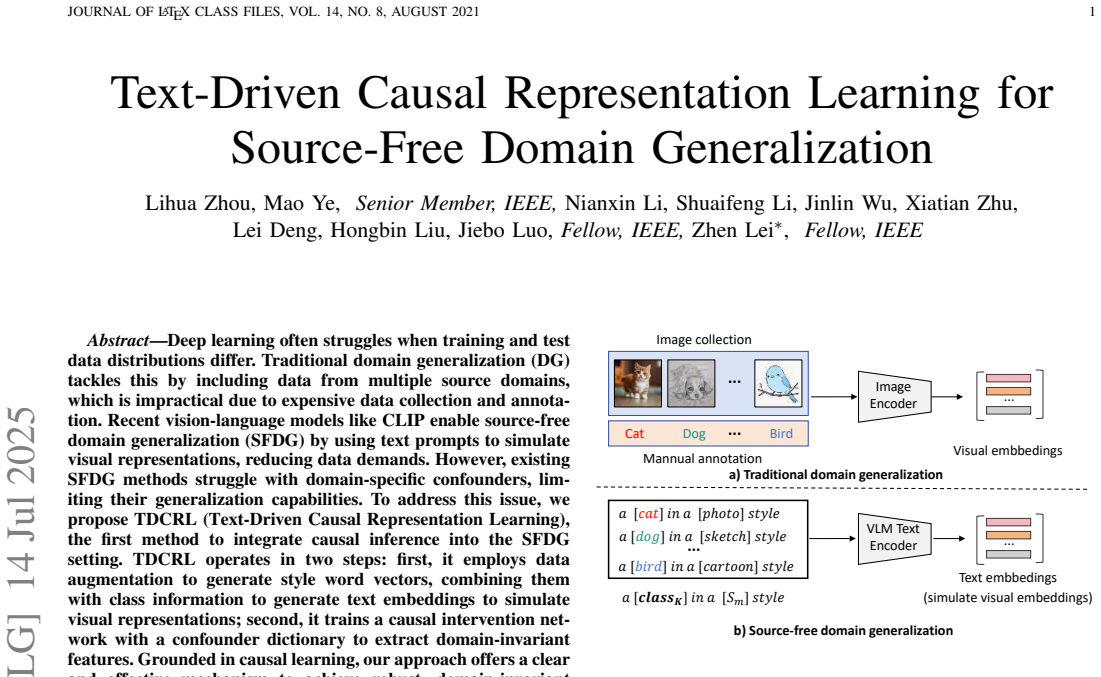
Pith's one-line read A causal do-operation on the style part of CLIP text embeddings removes domain confounders, letting a network trained with InfoNCE beat prior source-free domain generalization on four benchmarks.
desk verdict Useful SFDG method with consistent gains, but the causal theory does not match the implementation: the InfoNCE-trained network is style-specific, so the headline do-operation claim is overstated. read the letter →
The pith
A machine-rendered reading of the paper's core claim, the machinery that carries it, and where it could break.
The reading
What carries the argument
The load-bearing objects are the do-operation from causal inference, the confounder dictionary $Z = \{z_n\}$, and the intervention network $g(\cdot)$. The do-operation formalizes replacing the style component $f_{s_m}$ of a text embedding with a chosen style vector $z_n$, expressing the intervened label distribution as an expectation over $Z$. The confounder dictionary is a set of $N$ style embeddings produced from prompts like 'a object in a sketch style'; importantly, $N$ is finite in practice even though the derivation treats it as infinite. The intervention network $g(\cdot)$ is a small fully connected network that takes a text embedding and a style vector as inputs and outputs an intervened feature; it is trained so that $g(f_{cls}^{s_m}, z_n)$ matches the embedding of 'a [class] in a [domain] style' for the same class and style while being pushed away from other styles by the InfoNCE loss. Finally, the Normalized Weighted Geometric Mean approximation moves the expectation inside the softmax, so the classifier consumes the average intervened feature $\frac{1}{N}\sum_{n=1}^{N} g(f_{cls}^{s_m}, z_n)$. This combination is what carries the argument from the causal identity to a trainable classifier.
What would settle it
Compute the average cosine similarity (or mutual information) between the class-feature embeddings and the style-intervention vectors for all class-style pairs in the paper's prompt template; if the similarity is clearly above the level seen between unrelated CLIP embeddings, the independence assumption in Eq. (4) is violated. More directly, train the classifier on intervened features and compare its output distribution against CLIP's prediction from class-only prompts on the same test images; a systematic divergence between the two would show that the claimed identity is not what the network realizes.
Extended reading notes
Core claim
The central claim is that a causal intervention on the style component of a CLIP text embedding removes domain-specific confounding and recovers the distribution of labels given the class feature alone. Concretely, Eq. (7) states $P(Y|\mathrm{do}(f_{cls}^{s_m})) = P(Y|f_{cls})$, where $f_{cls}^{s_m}$ is a text embedding combining a class feature $f_{cls}$ with a style feature $f_{s_m}$. The derivation introduces a confounder dictionary $Z = \{z_n\}$ of $N$ style intervention vectors, replaces the style component with each $z_n$, and sums over the dictionary; the key step is the independence assumption $P(f_{cls}, z_n) = P(f_{cls})P(z_n)$. The paper implements this by training a neural network $g(\cdot)$ with an InfoNCE contrastive loss to map $f_{cls}^{s_m}$ to the intervened feature $g(f_{cls}^{s_m}, z_n)$, and then training a classifier on the expectation over all $z_n$. The same $g(\cdot)$ is applied to image features at test time, transferring the text-learned intervention across modalities.
Load-bearing premise
The derivation rests on the assumption that class identity and style are statistically independent in the text embedding, so that the joint probability factors as $P(f_{cls}, z_n) = P(f_{cls})P(z_n)$; if real embeddings correlate the two, the equality $P(Y|\mathrm{do}(f_{cls}^{s_m})) = P(Y|f_{cls})$ does not follow.
Editorial extensions
If this is right
- If the identity holds, classifiers trained on intervened text embeddings are effectively trained on pure class features, so style cannot act as a confounder on unseen test domains.
- The same intervention network transfers from text-trained features to image features at test time, which is what makes source-free generalization possible without any adaptation on the target domain.
- The reported gains are largest on smaller backbones, which suggests the causal intervention substitutes for the robustness that larger pre-trained models already provide.
- Style information is measurably removed after intervention: style-classification cross-entropy rises and average MMD distance between domain pairs falls on all four benchmarks.
- Ablations show the intervention contributes roughly 0.7 to 3.4 percentage points of accuracy across backbones, and accuracy improves with the number of confounders up to a point of diminishing returns.
Reading between the lines
- The independence assumption $P(f_{cls}, z_n) = P(f_{cls})P(z_n)$ is plausible for synthetic prompts, where class and style tokens are concatenated independently, but it is unlikely to hold exactly for real image features; a variant that models the dependence between class and style is a direct extension.
- The implemented model uses the softmax of an expected feature rather than the expected softmax, so it is worth measuring how much of the causal guarantee survives the Normalized Weighted Geometric Mean approximation on these benchmarks.
- Because the confounder dictionary is built from a fixed list of style words, the framework naturally extends to unseen styles by appending new style words and recomputing embeddings, without retraining the backbone.
- A direct test of the central identity would be to compare classifier predictions on intervened features against predictions made from class-only prompts on the same test images; a systematic divergence would indicate that the style intervention is not fully removing the confounder.
Editorial analysis
A structured set of objections, weighed in public.
Referee Report
Summary. TDCRL is a source-free domain generalization method built on CLIP text embeddings. The method first generates diverse style word vectors by mixup and random sampling from D predefined domain words, constructs M×K text prompts of the form "a [class_k] in a [style_m] style", and encodes them with CLIP's text encoder to simulate visual embeddings. It then trains a causal intervention network g(·) together with a confounder dictionary Z={z_n}_{n=1}^N using an InfoNCE loss, and trains a linear classifier on the average intervened feature (1/N)∑_n g(f,z_n). The paper gives a theoretical derivation (Eqs. 2–7) claiming that P(Y|do(f_cls_sm))=P(Y|f_cls), and reports state-of-the-art accuracy on PACS, VLCS, OfficeHome, and DomainNet with ResNet-50, ViT-B/16, and ViT-L/14 backbones, together with ablations on loss functions, confounder dictionary size, number of layers, and hyperparameters.
Significance. If the causal interpretation were sound, TDCRL would be a practical and efficient causal SFDG method with consistent gains over a broad set of baselines, including source-dependent methods. The empirical evaluation is substantial: three backbones, four benchmarks, comparisons with recent CLIP-based methods, component ablations, loss-function ablations, sensitivity analyses, t-SNE visualization, and cross-modal invariance metrics. However, the central theoretical claim is not established. The derivation assumes independence between class features and style interventions (Eq. 4) and treats a six-entry dictionary as an exhaustive style partition (Eq. 6), while the training objective in Eq. (11) explicitly rewards style-specific outputs. The empirical contribution is still potentially valuable as a text-driven feature-augmentation and regularization method, but the causal guarantee is currently unsupported.
major comments (3)
- [III-B1, Eqs. (4), (6), and (7)] The proof of the central claim P(Y|do(f_cls_sm))=P(Y|f_cls) rests on two unjustified steps. First, Eq. (4) asserts f_cls⊥z_n, the independence of the category feature and the style intervention vector; no argument or measurement is given for why this holds for real or even synthesized image features. Second, Eq. (6) requires that summing the joint P(Y,f_cls,z_n) over the N entries of Z yields the marginal P(Y,f_cls), which is only valid if the dictionary is an exhaustive partition of the style space. The paper selects N=6 words out of D=13 predefined domain words (Section IV), which is an arbitrary subset, not a partition of all possible styles. Consequently Eq. (7) does not follow from the preceding equations.
- [III-B2, Eqs. (10)-(12)] Even if Eqs. (2)-(7) were accepted, the trained network does not implement the object described by the theorem. Eq. (11) trains g(f_cls_sm,z_n) to match the embedding F[k,n,:] of "a [class_k] in a [domain_n] style" and to be dissimilar from F[k,j,:] for j≠n, so each intervened feature is explicitly style-specific. The classifier is then evaluated on (1/N)∑_n g(f_cls_sm,z_n), and nothing in the objective enforces that this average equals a class-only feature f_cls or that the label distribution is invariant to z_n, i.e., P(Y|f_cls,z_n)=P(Y|f_cls). The NWGM step in Eq. (10) only moves an expectation through a softmax and cannot repair this mismatch. The paper should either add an explicit invariance constraint that realizes the claimed intervention or reframe the method as a causal-inspired heuristic rather than a method with a proven equivalence.
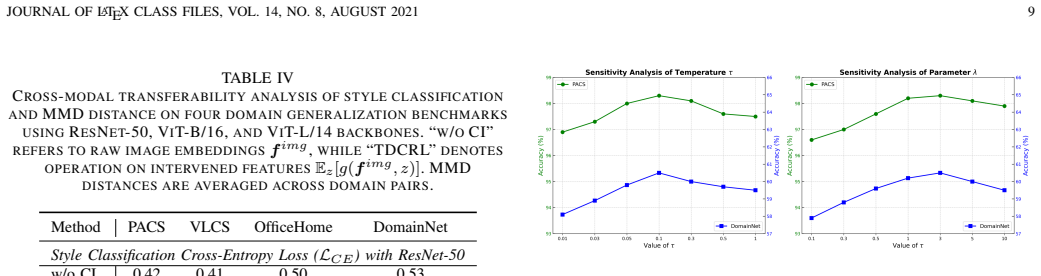
- [IV, Tables VIII and Fig. 4] Key hyperparameters, including the confounder dictionary size N=6, the number of layers in g(·), the temperature τ=0.1, and the balance weight λ=3.0, appear to be selected using accuracy on the same test benchmarks reported in Table I. Tables VII and VIII and Fig. 4 show the effect of these choices on PACS, VLCS, OfficeHome, and DomainNet. If the final configuration was chosen after inspecting performance on the test domains, the reported state-of-the-art numbers are optimistic and the margins over the best baselines are small (e.g., 0.1–0.6 points in many cells). A clearly described validation protocol, such as tuning on a held-out split of the source text embeddings or a separate validation set, is needed to support the empirical claim.
minor comments (6)
- [III-A, Eq. (1)] The Gaussian noise term ϵ in Eq. (1) is introduced in word-vector space, but its magnitude and scaling are not specified; please clarify whether it is normalized and whether it can violate the simplex constraint on the mixup weights.
- [III-B2, Eq. (8)] The notation "f_sm → z_n" (and "f_sm −→ z_n" in Eq. (8)) is undefined; use a standard do-notation or explicitly define the intervention operator before first use.
- [IV, Implementation details] There are several typos: "N = 6 style world" should be "N = 6 style words", "a object in a ... style" should be "an object ...", and "M = 80style word vectors" is missing a space. Figure 3 also says "Confunder Z" instead of "Confounder Z."
- [III-B2, Eq. (10)] The Normalized Weighted Geometric Mean approximation is cited to [59], which is an image-captioning paper; please cite the original source of the NWGM approximation or a standard reference for it.
- [IV-A, Table I] The text states that TDCRL achieves state-of-the-art results, but on DomainNet with ResNet-50 TDCRL obtains 49.8%, which is 0.3 points below SPG's 50.1%; the claim should be qualified to acknowledge this exception.
- [IV-B, Feature visualization] The t-SNE plot in Fig. 5 is descriptive and qualitative; consider supplementing it with a quantitative invariance metric computed on held-out target domains, such as domain classification accuracy or MMD with a separate validation split.
Circularity Check
No significant circularity: the causal equivalence is derived from explicitly stated independence and exhaustiveness assumptions, and the performance claims are evaluated against external benchmarks.
full rationale
The paper's central equivalence P(Y|do(f_cls_sm)) = P(Y|f_cls) (Eq. 7) is an algebraic consequence of two explicit assumptions: f_cls is independent of z_n (Eq. 4) and the style dictionary is exhaustive so the total-probability summation holds (Eq. 6). These assumptions are stated before the derivation and are not obtained from the conclusion, so the derivation is not circular in the definitional sense; whether the independence holds for real CLIP features is a validity/correctness risk, not a circularity. The implementation trains g(·) to map (f_cls_sm, z_n) to F[k,n,:] and averages over the N dictionary entries at prediction time, which is consistent with the expectation in Eq. (10); whether this truly removes confounders is an empirical question, and the paper evaluates it on external benchmarks (PACS, VLCS, OfficeHome, DomainNet) plus style-classification loss and MMD analyses. The acknowledged limitation that N is finite in practice ('we can only regard it as a finite number') weakens Eq. (6) but is an approximation rather than a fitted parameter renamed as a prediction. No load-bearing self-citations or imported uniqueness theorems appear; the citations to Pearl, IRM, and DPStyler are standard external references. The main concerns are therefore the unverified independence assumption and the finite-dictionary approximation, not circular reasoning.
Assumptions & free parameters
free parameters (5)
- Domain word list D=13 =
sketch, cartoon, photo, surrealism, minimalist, retro, pixel-art, collage, pointillism, stained-glass, illustration…
- Confounder dictionary size N =
6
- Temperature tau =
0.1
- Balance lambda =
3.0
- Number of layers in g =
3
assumptions (4)
- domain assumption CLIP text and image embeddings share a common space, so text can simulate visual representations.
- ad hoc to paper f_cls and z_n are independent (Eq. 4).
- domain assumption The do-operation formula (Eq. 2) correctly models causal intervention in this setting.
- standard math NWGM approximation is acceptable for softmax expectation.
Cite this review
Pith. "Pith review of Text-Driven Causal Representation Learning for Source-Free Domain Generalization." pith.science (2026). https://pith.science/paper/ZSEYJUEV
@misc{pith2026250709961,
  author       = {Pith},
  title        = {Pith review of: Text-Driven Causal Representation Learning for Source-Free Domain Generalization},
  year         = {2026},
  howpublished = {\url{https://pith.science/paper/ZSEYJUEV}},
  note         = {Machine review of arXiv:2507.09961}
}
read the original abstract
Deep learning often struggles when training and test data distributions differ. Traditional domain generalization (DG) tackles this by including data from multiple source domains, which is impractical due to expensive data collection and annotation. Recent vision-language models like CLIP enable source-free domain generalization (SFDG) by using text prompts to simulate visual representations, reducing data demands. However, existing SFDG methods struggle with domain-specific confounders, limiting their generalization capabilities. To address this issue, we propose TDCRL (\textbf{T}ext-\textbf{D}riven \textbf{C}ausal \textbf{R}epresentation \textbf{L}earning), the first method to integrate causal inference into the SFDG setting. TDCRL operates in two steps: first, it employs data augmentation to generate style word vectors, combining them with class information to generate text embeddings to simulate visual representations; second, it trains a causal intervention network with a confounder dictionary to extract domain-invariant features. Grounded in causal learning, our approach offers a clear and effective mechanism to achieve robust, domain-invariant features, ensuring robust generalization. Extensive experiments on PACS, VLCS, OfficeHome, and DomainNet show state-of-the-art performance, proving TDCRL effectiveness in SFDG.
Figures


Figures from the paper (2 more)

Reference graph
Works this paper leans on
-
[1]
Domain general- ization: A survey,
K. Zhou, Z. Liu, Y . Qiao, T. Xiang, and C. C. Loy, “Domain general- ization: A survey,” IEEE transactions on pattern analysis and machine intelligence, vol. 45, no. 4, pp. 4396–4415, 2022
work page 2022
-
[2]
Generalizing to unseen domains: A survey on domain generalization,
J. Wang, C. Lan, C. Liu, Y . Ouyang, T. Qin, W. Lu, Y . Chen, W. Zeng, and S. Y . Philip, “Generalizing to unseen domains: A survey on domain generalization,” IEEE transactions on knowledge and data engineering , vol. 35, no. 8, pp. 8052–8072, 2022
work page 2022
-
[3]
Multi-scale part-based feature representation for 3d domain generalization and adaptation,
X. Wei, X. Gu, and J. Sun, “Multi-scale part-based feature representation for 3d domain generalization and adaptation,” IEEE Transactions on Pattern Analysis and Machine Intelligence , 2024
work page 2024
-
[4]
Rotation-adaptive point cloud domain generalization via intricate orientation learning,
B. Liu, C. Zheng, X. Xu, C. Xu, H. Zhang, and S. He, “Rotation-adaptive point cloud domain generalization via intricate orientation learning,” IEEE Transactions on Pattern Analysis and Machine Intelligence , 2025
work page 2025
-
[5]
Incorporating pre-training data matters in unsupervised domain adaptation,
Y . Xu, A. Men, Y . Liu, X. Zhuang, and Q. Chen, “Incorporating pre-training data matters in unsupervised domain adaptation,” IEEE Transactions on Pattern Analysis and Machine Intelligence , 2025
work page 2025
-
[6]
Unified domain adaptive semantic segmentation,
Z. Zhang, G. Wu, J. Zhang, X. Zhu, D. Tao, and T. Chai, “Unified domain adaptive semantic segmentation,” IEEE transactions on pattern analysis and machine intelligence , 2025
work page 2025
-
[7]
Unraveling the mysteries of label noise in source-free domain adaptation: Theory and practice,
G. Xu, L. Yi, P. Xu, J. Li, R. Pu, C. Shui, C. Ling, A. I. McLeod, and B. Wang, “Unraveling the mysteries of label noise in source-free domain adaptation: Theory and practice,” IEEE Transactions on Pattern Analysis and Machine Intelligence , 2025
work page 2025
-
[8]
M. Arjovsky, L. Bottou, I. Gulrajani, and D. Lopez-Paz, “Invariant risk minimization,” arXiv preprint arXiv:1907.02893 , 2019
arXiv 1907
Show all 72 references
-
[9]
Domain generalization with mixstyle,
K. Zhou, Y . Yang, Y . Qiao, and T. Xiang, “Domain generalization with mixstyle,” in International Conference on Learning Representations
-
[10]
Learning transferable visual models from natural language supervision,
A. Radford, J. W. Kim, C. Hallacy, A. Ramesh, G. Goh, S. Agarwal, G. Sastry, A. Askell, P. Mishkin, J. Clark et al., “Learning transferable visual models from natural language supervision,” in International conference on machine learning . PMLR, 2021, pp. 8748–8763
2021
-
[11]
Scaling up visual and vision-language representation learning with noisy text supervision,
C. Jia, Y . Yang, Y . Xia, Y .-T. Chen, Z. Parekh, H. Pham, Q. Le, Y .-H. Sung, Z. Li, and T. Duerig, “Scaling up visual and vision-language representation learning with noisy text supervision,” in International conference on machine learning . PMLR, 2021, pp. 4904–4916
2021
-
[12]
Vision-language pre-training with triple contrastive learning,
J. Yang, J. Duan, S. Tran, Y . Xu, S. Chanda, L. Chen, B. Zeng, T. Chilimbi, and J. Huang, “Vision-language pre-training with triple contrastive learning,” in Proceedings of the IEEE/CVF Conference on Computer Vision and Pattern Recognition , 2022, pp. 15 671–15 680
2022
-
[13]
Modeling caption diversity in contrastive vision-language pretraining,
S. Lavoie, P. Kirichenko, M. Ibrahim, M. Assran, A. G. Wilson, A. Courville, and N. Ballas, “Modeling caption diversity in contrastive vision-language pretraining,” in Forty-first International Conference on Machine Learning
-
[14]
Vision-language models for vision tasks: A survey,
J. Zhang, J. Huang, S. Jin, and S. Lu, “Vision-language models for vision tasks: A survey,” IEEE Transactions on Pattern Analysis and Machine Intelligence, 2024
2024
-
[15]
Promptstyler: Prompt-driven style generation for source-free domain generalization,
J. Cho, G. Nam, S. Kim, H. Yang, and S. Kwak, “Promptstyler: Prompt-driven style generation for source-free domain generalization,” in Proceedings of the IEEE/CVF International Conference on Computer Vision, 2023, pp. 15 702–15 712
2023
-
[16]
Promptta: Prompt- driven text adapter for source-free domain generalization,
H. Zhang, S. Bai, W. Zhou, J. Fu, and B. Chen, “Promptta: Prompt- driven text adapter for source-free domain generalization,”arXiv preprint arXiv:2409.14163, 2024
2024 arXiv
-
[17]
Dpstyler: dynamic promptstyler for source-free domain generalization,
Y . Tang, Y . Wan, L. Qi, and X. Geng, “Dpstyler: dynamic promptstyler for source-free domain generalization,” IEEE Transactions on Multime- dia, 2025
2025
-
[18]
Batstyler: Advancing multi- category style generation for source-free domain generalization,
X. Xu, L. Qi, J. Zhou, and X. Geng, “Batstyler: Advancing multi- category style generation for source-free domain generalization,” IEEE Transactions on Circuits and Systems for Video Technology , 2025
2025
-
[19]
Models, reasoning and inference,
J. Pearl et al. , “Models, reasoning and inference,” Cambridge, UK: CambridgeUniversityPress, vol. 19, no. 2, p. 3, 2000
2000
-
[20]
Causality for machine learning,
B. Sch ¨olkopf, “Causality for machine learning,” in Probabilistic and causal inference: The works of Judea Pearl , 2022, pp. 765–804
2022
-
[21]
Causality inspired representation learning for domain generalization,
F. Lv, J. Liang, S. Li, B. Zang, C. H. Liu, Z. Wang, and D. Liu, “Causality inspired representation learning for domain generalization,” in Proceedings of the IEEE/CVF conference on computer vision and pattern recognition, 2022, pp. 8046–8056
2022
-
[22]
Causality-inspired single-source domain generalization for medical image segmentation,
C. Ouyang, C. Chen, S. Li, Z. Li, C. Qin, W. Bai, and D. Rueckert, “Causality-inspired single-source domain generalization for medical image segmentation,” IEEE Transactions on Medical Imaging , vol. 42, no. 4, pp. 1095–1106, 2022
2022
-
[23]
Domain generalization via invariant feature representation,
K. Muandet, D. Balduzzi, and B. Sch ¨olkopf, “Domain generalization via invariant feature representation,” in International conference on machine learning. PMLR, 2013, pp. 10–18
2013
-
[24]
Robust domain generalisation by enforcing distribution invariance,
S. Erfani, M. Baktashmotlagh, M. Moshtaghi, X. Nguyen, C. Leckie, J. Bailey, and R. Kotagiri, “Robust domain generalisation by enforcing distribution invariance,” in Proceedings of the Twenty-Fifth International Joint Conference on Artificial Intelligence (IJCAI-16) . AAAI Pre...
2016
-
[25]
Unified deep supervised domain adaptation and generalization,
S. Motiian, M. Piccirilli, D. A. Adjeroh, and G. Doretto, “Unified deep supervised domain adaptation and generalization,” in Proceedings of the IEEE international conference on computer vision , 2017, pp. 5715– 5725
2017
-
[26]
Generalizable feature learning in the presence of data bias and domain class imbalance with application to skin lesion classification,
C. Yoon, G. Hamarneh, and R. Garbi, “Generalizable feature learning in the presence of data bias and domain class imbalance with application to skin lesion classification,” in Medical Image Computing and Computer Assisted Intervention–MICCAI 2019: 22nd International Conference...
2019
-
[27]
Respecting domain relations: Hypothesis invariance for domain generalization,
Z. Wang, M. Loog, and J. Van Gemert, “Respecting domain relations: Hypothesis invariance for domain generalization,” in 2020 25th Inter- national Conference on Pattern Recognition (ICPR) . IEEE, 2021, pp. 9756–9763
2020
-
[28]
Domain generalization for medical imaging classification with linear-dependency regularization,
H. Li, Y . Wang, R. Wan, S. Wang, T.-Q. Li, and A. C. Kot, “Domain generalization for medical imaging classification with linear-dependency regularization,” in 34th Conference on Neural Information Processing Systems (NeurIPS 2020) , 2020
2020
-
[29]
Domain generalization with adversarial feature learning,
H. Li, S. J. Pan, S. Wang, and A. C. Kot, “Domain generalization with adversarial feature learning,” in Proceedings of the IEEE conference on computer vision and pattern recognition , 2018, pp. 5400–5409
2018
-
[30]
Deep domain generalization via conditional invariant adversarial networks,
Y . Li, X. Tian, M. Gong, Y . Liu, T. Liu, K. Zhang, and D. Tao, “Deep domain generalization via conditional invariant adversarial networks,” in Proceedings of the European conference on computer vision (ECCV) , 2018, pp. 624–639
2018
-
[31]
Multi-adversarial discriminative deep domain generalization for face presentation attack detection,
R. Shao, X. Lan, J. Li, and P. C. Yuen, “Multi-adversarial discriminative deep domain generalization for face presentation attack detection,” in Proceedings of the IEEE/CVF conference on computer vision and pattern recognition, 2019, pp. 10 023–10 031
2019
-
[32]
Correlation-aware adversarial domain adaptation and generalization,
M. M. Rahman, C. Fookes, M. Baktashmotlagh, and S. Sridharan, “Correlation-aware adversarial domain adaptation and generalization,” Pattern Recognition, vol. 100, p. 107124, 2020. JOURNAL OF LATEX CLASS FILES, VOL. 14, NO. 8, AUGUST 2021 12
2020
-
[33]
Learning to generalize: Meta-learning for domain generalization,
D. Li, Y . Yang, Y .-Z. Song, and T. Hospedales, “Learning to generalize: Meta-learning for domain generalization,” in Proceedings of the AAAI conference on artificial intelligence , vol. 32, no. 1, 2018
2018
-
[34]
Metareg: towards domain generalization using meta-regularization,
Y . Balaji, S. Sankaranarayanan, and R. Chellappa, “Metareg: towards domain generalization using meta-regularization,” in Proceedings of the 32nd International Conference on Neural Information Processing Systems, 2018, pp. 1006–1016
2018
-
[35]
Metanorm: Learning to nor- malize few-shot batches across domains,
Y . Du, X. Zhen, L. Shao, and C. G. Snoek, “Metanorm: Learning to nor- malize few-shot batches across domains,” in International Conference on Learning Representations , 2020
2020
-
[36]
Towards univer- sal representation learning for deep face recognition,
Y . Shi, X. Yu, K. Sohn, M. Chandraker, and A. K. Jain, “Towards univer- sal representation learning for deep face recognition,” in Proceedings of the IEEE/CVF conference on computer vision and pattern recognition , 2020, pp. 6817–6826
2020
-
[37]
Addressing model vulnerability to distribu- tional shifts over image transformation sets,
R. V olpi and V . Murino, “Addressing model vulnerability to distribu- tional shifts over image transformation sets,” in Proceedings of the IEEE/CVF International Conference on Computer Vision , 2019, pp. 7980–7989
2019
-
[38]
Generalizing to unseen domains via adversarial data augmentation,
R. V olpi, H. Namkoong, O. Sener, J. Duchi, V . Murino, and S. Savarese, “Generalizing to unseen domains via adversarial data augmentation,” in Proceedings of the 32nd International Conference on Neural Information Processing Systems, 2018, pp. 5339–5349
2018
-
[39]
Learning to learn single domain gen- eralization,
F. Qiao, L. Zhao, and X. Peng, “Learning to learn single domain gen- eralization,” in Proceedings of the IEEE/CVF conference on computer vision and pattern recognition , 2020, pp. 12 556–12 565
2020
-
[40]
Domain generalization by solving jigsaw puzzles,
F. M. Carlucci, A. D’Innocente, S. Bucci, B. Caputo, and T. Tommasi, “Domain generalization by solving jigsaw puzzles,” in Proceedings of the IEEE/CVF conference on computer vision and pattern recognition , 2019, pp. 2229–2238
2019
-
[41]
Self-supervised learning across domains,
S. Bucci, A. D’Innocente, Y . Liao, F. M. Carlucci, B. Caputo, and T. Tommasi, “Self-supervised learning across domains,” IEEE Trans- actions on Pattern Analysis and Machine Intelligence , vol. 44, no. 9, pp. 5516–5528, 2021
2021
-
[42]
Learning from extrin- sic and intrinsic supervisions for domain generalization,
S. Wang, L. Yu, C. Li, C.-W. Fu, and P.-A. Heng, “Learning from extrin- sic and intrinsic supervisions for domain generalization,” in European Conference on Computer Vision . Springer, 2020, pp. 159–176
2020
-
[43]
Filip: Fine-grained interactive language-image pre-training,
L. Yao, R. Huang, L. Hou, G. Lu, M. Niu, H. Xu, X. Liang, Z. Li, X. Jiang, and C. Xu, “Filip: Fine-grained interactive language-image pre-training,” in International Conference on Learning Representations
-
[44]
Pali: A jointly-scaled multilingual language-image model,
X. Chen, X. Wang, S. Changpinyo, A. Piergiovanni, P. Padlewski, D. Salz, S. Goodman, A. Grycner, B. Mustafa, L. Beyer et al. , “Pali: A jointly-scaled multilingual language-image model,” in The Eleventh International Conference on Learning Representations
-
[45]
Integrating neural-symbolic reasoning with variational causal inference network for explanatory visual ques- tion answering,
D. Xue, S. Qian, and C. Xu, “Integrating neural-symbolic reasoning with variational causal inference network for explanatory visual ques- tion answering,” IEEE Transactions on Pattern Analysis and Machine Intelligence, 2024
2024
-
[46]
A causal adjustment module for debiasing scene graph generation,
L. Liu, S. Sun, S. Zhi, F. Shi, Z. Liu, J. Heikkil ¨a, and Y . Liu, “A causal adjustment module for debiasing scene graph generation,” IEEE Transactions on Pattern Analysis and Machine Intelligence , 2025
2025
-
[47]
Intersecting the markov blankets of endogenous and exogenous variables for causal discovery,
Y . Dong and C. Gao, “Intersecting the markov blankets of endogenous and exogenous variables for causal discovery,” IEEE Transactions on Pattern Analysis and Machine Intelligence , 2025
2025
-
[48]
A causal perspective on dataset bias in machine learning for medical imaging,
C. Jones, D. C. Castro, F. De Sousa Ribeiro, O. Oktay, M. McCradden, and B. Glocker, “A causal perspective on dataset bias in machine learning for medical imaging,” Nature Machine Intelligence , vol. 6, no. 2, pp. 138–146, 2024
2024
-
[49]
Visual commonsense r- cnn,
T. Wang, J. Huang, H. Zhang, and Q. Sun, “Visual commonsense r- cnn,” in Proceedings of the IEEE/CVF conference on computer vision and pattern recognition , 2020, pp. 10 760–10 770
2020
-
[50]
Causal imitation learning with unobserved confounders,
J. Zhang, D. Kumor, and E. Bareinboim, “Causal imitation learning with unobserved confounders,” in Advances in neural information processing systems, 2020, pp. 12 263–12 274
2020
-
[51]
Woulda, coulda, shoulda: Counterfactually-guided policy search,
L. Buesing, T. Weber, Y . Zwols, N. Heess, S. Racaniere, A. Guez, and J.-B. Lespiau, “Woulda, coulda, shoulda: Counterfactually-guided policy search,” in International Conference on Learning Representations, 2018
2018
-
[52]
Causal inference in natural language processing: Estimation, prediction, interpretation and beyond,
A. Feder, K. A. Keith, E. Manzoor, R. Pryzant, D. Sridhar, Z. Wood- Doughty, J. Eisenstein, J. Grimmer, R. Reichart, M. E. Roberts et al. , “Causal inference in natural language processing: Estimation, prediction, interpretation and beyond,” Transactions of the Association for...
2022
-
[53]
Domain generalization using causal matching,
D. Mahajan, S. Tople, and A. Sharma, “Domain generalization using causal matching,” in International conference on machine learning . PMLR, 2021, pp. 7313–7324
2021
-
[54]
Domain generalization via contrastive causal learning,
Q. Miao, J. Yuan, and K. Kuang, “Domain generalization via contrastive causal learning,” arXiv preprint arXiv:2210.02655 , 2022
2022 arXiv
-
[55]
Invariant causal representation learning for out-of-distribution generalization,
C. Lu, Y . Wu, J. M. Hern ´andez-Lobato, and B. Sch ¨olkopf, “Invariant causal representation learning for out-of-distribution generalization,” in International Conference on Learning Representations , 2021
2021
-
[56]
Causal transportability for visual recognition,
C. Mao, K. Xia, J. Wang, H. Wang, J. Yang, E. Bareinboim, and C. V on- drick, “Causal transportability for visual recognition,” in Proceedings of the IEEE/CVF Conference on Computer Vision and Pattern Recognition, 2022, pp. 7521–7531
2022
-
[57]
Integrating markov blanket discovery into causal representation learning for domain generalization,
N. Yin, H. Wang, Y . Yu, T. Gao, A. Dhurandhar, and Q. Ji, “Integrating markov blanket discovery into causal representation learning for domain generalization,” in European Conference on Computer Vision. Springer, 2024, pp. 271–288
2024
-
[58]
Partial disentanglement for domain adaptation,
L. Kong, S. Xie, W. Yao, Y . Zheng, G. Chen, P. Stojanov, V . Akinwande, and K. Zhang, “Partial disentanglement for domain adaptation,” in International conference on machine learning . PMLR, 2022, pp. 11 455–11 472
2022
-
[59]
Show, attend and tell: neural image caption gen- eration with visual attention,
K. Xu, J. L. Ba, R. Kiros, K. Cho, A. Courville, R. Salakhutdinov, R. S. Zemel, and Y . Bengio, “Show, attend and tell: neural image caption gen- eration with visual attention,” in Proceedings of the 32nd International Conference on International Conference on Machine Learning...
2015
-
[60]
Deeper, broader and artier domain generalization,
D. Li, Y . Yang, Y .-Z. Song, and T. M. Hospedales, “Deeper, broader and artier domain generalization,” in Proceedings of the IEEE international conference on computer vision , 2017, pp. 5542–5550
2017
-
[61]
Unbiased metric learning: On the utilization of multiple datasets and web images for softening bias,
C. Fang, Y . Xu, and D. N. Rockmore, “Unbiased metric learning: On the utilization of multiple datasets and web images for softening bias,” in Proceedings of the IEEE international conference on computer vision , 2013, pp. 1657–1664
2013
-
[62]
Deep hashing network for unsupervised domain adaptation,
H. Venkateswara, J. Eusebio, S. Chakraborty, and S. Panchanathan, “Deep hashing network for unsupervised domain adaptation,” in Pro- ceedings of the IEEE conference on computer vision and pattern recognition, 2017, pp. 5018–5027
2017
-
[63]
Moment matching for multi-source domain adaptation,
X. Peng, Q. Bai, X. Xia, Z. Huang, K. Saenko, and B. Wang, “Moment matching for multi-source domain adaptation,” in Proceedings of the IEEE/CVF international conference on computer vision, 2019, pp. 1406– 1415
2019
-
[64]
Deep residual learning for image recognition,
K. He, X. Zhang, S. Ren, and J. Sun, “Deep residual learning for image recognition,” in Proceedings of the IEEE conference on computer vision and pattern recognition , 2016, pp. 770–778
2016
-
[65]
An image is worth 16x16 words: Transformers for image recognition at scale,
A. Dosovitskiy, L. Beyer, A. Kolesnikov, D. Weissenborn, X. Zhai, T. Unterthiner, M. Dehghani, M. Minderer, G. Heigold, S. Gelly et al., “An image is worth 16x16 words: Transformers for image recognition at scale,” in International Conference on Learning Representations
-
[66]
Attention is all you need,
A. Vaswani, N. Shazeer, N. Parmar, J. Uszkoreit, L. Jones, A. N. Gomez, Ł. Kaiser, and I. Polosukhin, “Attention is all you need,” in Proceedings of the 31st International Conference on Neural Information Processing Systems, 2017, pp. 6000–6010
2017
-
[67]
Sgdr: Stochastic gradient descent with warm restarts,
I. Loshchilov and F. Hutter, “Sgdr: Stochastic gradient descent with warm restarts,” arXiv preprint arXiv:1608.03983 , 2016
2016 arXiv
-
[68]
Optimal representations for covariate shift,
Y . Ruan, Y . Dubois, and C. J. Maddison, “Optimal representations for covariate shift,” in International Conference on Learning Representa- tions
-
[69]
Soft prompt generation for domain generalization,
S. Bai, Y . Zhang, W. Zhou, Z. Luan, and B. Chen, “Soft prompt generation for domain generalization,” in European Conference on Computer Vision. Springer, 2024, pp. 434–450
2024
-
[70]
Domain generalization by mutual-information regularization with pre-trained models,
J. Cha, K. Lee, S. Park, and S. Chun, “Domain generalization by mutual-information regularization with pre-trained models,” European Conference on Computer Vision (ECCV) , 2022
2022
-
[71]
Arcface: Additive angular margin loss for deep face recognition,
J. Deng, J. Guo, N. Xue, and S. Zafeiriou, “Arcface: Additive angular margin loss for deep face recognition,” in Proceedings of the IEEE/CVF conference on computer vision and pattern recognition, 2019, pp. 4690– 4699
2019
-
[72]
Visualizing data using t-sne,
L. van der Maaten and G. Hinton, “Visualizing data using t-sne,” Journal of Machine Learning Research , vol. 9, pp. 2579–2605, 2008
2008
Reviewed August 6, 2026 · model on record in the stance chip above.
Discussion (0). Continue with ORCID to comment.