REVIEW 4 major objections 5 minor 14 references
Sampling-Based Estimation of Jaccard Containment and Similarity
T0 review · 4 major / 5 minor · reviewed 2026-08-06 · deepseek-v4-flash
Pith's one-line read The paper claims that a binomial model for the overlap of two random samples yields a low-bias estimator of Jaccard containment with explicit error bounds and sample-size requirements.
desk verdict A useful estimator and a genuinely new exact likelihood, but the posterior MSE bounds and sample-size formulas are wrong as stated; the paper needs correction before the guarantees can be trusted. read the letter →
The pith
A machine-rendered reading of the paper's core claim, the machinery that carries it, and where it could break.
The reading
What carries the argument
The load-bearing object is the Cartesian product $A\times B$ with its $I$ diagonal matching pairs, and the assumption that the sampled subgrid $P\times Q$ sees each such pair independently with probability $I/(N_1N_2)$. This turns the observed overlap $x$ into a binomial count, which is tractable enough to derive an estimator, a Beta posterior, Chernoff-based validity conditions, and sample-complexity formulas. The exact likelihood derived by summing over a five-tuple decomposition is used only as ground truth because its nested sums are intractable for large sets.
What would settle it
Simulate two sets of known sizes and intersection, draw samples at a rate where $M_1M_2$ is not negligible relative to $N_1N_2$ (for example $\alpha_1=\alpha_2=0.2$), and compare the empirical distribution of $x$ with the binomial $P_b(x\mid I)$; if the observed mean or variance deviates from binomial predictions by more than the paper's posterior MSE bound, or if $\hat{I}_b$ shows bias exceeding the stated bound, the independence approximation fails in that regime.
Extended reading notes
Core claim
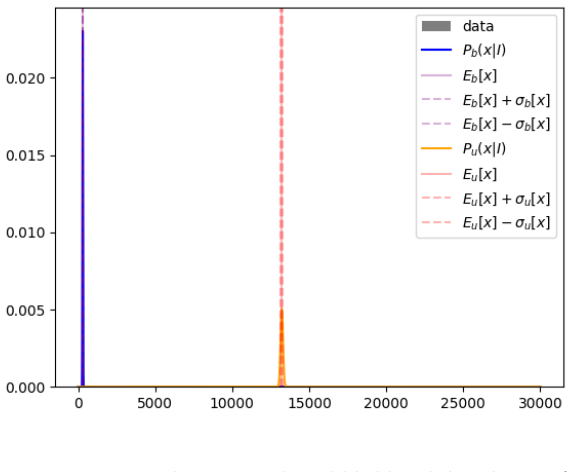
The central claim is that the likelihood for the observed number $x$ of matching elements in two uniform samples is, in the sparse regime, $P_b(x\mid I)=\binom{M_1M_2}{x}\left(\frac{I}{N_1N_2}\right)^x\left(1-\frac{I}{N_1N_2}\right)^{M_1M_2-x}$, where $M_1,M_2$ are the sample sizes and $N_1,N_2$ the set sizes. This leads to the estimator $\hat{I}_b = x\frac{N_1N_2}{M_1M_2}$ for the intersection size and $\hat{\phi}=x\frac{N_2}{M_1M_2}$ for the containment $\phi=I/N_1$. The paper reports that this binomial likelihood matches the exact sampling distribution closely in experiments, while a union-based likelihood from earlier work overestimates the overlap dramatically. Under a uniform prior on $I$, the posterior is Beta-like and yields the MSE bound $\mathrm{MSE} < x(N_1N_2)^2/(M_1M_2)^2$; enforcing estimator validity tightens this to $N_2/(M_1M_2)$, and combining the two conditions gives the sampling-rate requirement $\alpha_1\alpha_2 \ge \max\{1/(\delta^2 N_1),\, 2\ln(1/\epsilon)/((1-\phi)^2 N_1)\}$ for containment error below $\delta$ with confidence at least $1-\epsilon$.
Load-bearing premise
The estimator and all error bounds rest on treating the $M_1M_2$ sampled pairs as independent matching events with common probability $I/(N_1N_2)$, ignoring that the samples are drawn without replacement; the paper assumes the sparse regime $M_1M_2 \ll N_1N_2$ makes this dependence negligible.
Editorial extensions
If this is right
- With known $N_1,N_2$ and sparse sampling, containment can be estimated as $\hat{\phi}=x N_2/(M_1M_2)$, and the paper's bounds say this estimate has MSE below $xN_2^2/(M_1M_2)^2$, tightening to $N_2/(M_1M_2)$ when the estimator is valid.
- To guarantee containment RMSE below $\delta$ with probability at least $1-\epsilon$, sampling rates must satisfy $\alpha_1\alpha_2 \ge \max\{1/(\delta^2 N_1),\, 2\ln(1/\epsilon)/((1-\phi)^2 N_1)\}$; symmetric sampling needs $M_1\ge \sqrt{N_1}/\delta$.
- For Jaccard similarity, the fractional error of $\hat{J}$ scales as $O(1/\sqrt{x})$, so the required product of sample sizes grows like $1/(\delta^2 I)$ rather than $1/(\delta^2 N_1)$.
- Batched MinHash over sampled subsets yields a containment estimate whose RMSE is bounded by $\sqrt{2M N_2/(k M_1M_2)}$ (or $(N_2/M_2)\sqrt{(m_1+m_2)/(kM_1)}$ for unequal batches), and stratified batching restores the independence the binomial model assumes.
Reading between the lines
- If the binomial approximation holds, the same product-of-samples logic could extend to weighted or duplicate-rich collections, but the without-replacement correction would need to be quantified before trusting the bounds.
- The paper's sample-complexity formulas imply an allocation rule for asymmetric set sizes: when $N_2\gg N_1$, symmetric sampling forces $M_2$ to scale with $N_2/N_1$, so a practitioner should instead choose $M_2$ based on the desired observed overlap rather than a fixed fraction of $N_2$.
- The small negative bias noted in the batch MinHash experiments, left unexplained in the paper, may come from a second-order without-replacement effect or from the Jensen-type gap in converting sampled Jaccard estimates; a bias-correction study would be a direct test.
- Because the Jaccard fractional-error bound decreases as $1/\sqrt{x}$, a system could keep drawing samples until the observed overlap crosses the threshold $c=4/\delta^2$, which the paper's lower-tail bound directly addresses.
Signed reviews
Editorial analysis
A structured set of objections, weighed in public.
Referee Report
Summary. The paper studies estimation of Jaccard containment φ = |A∩B|/|A| and Jaccard similarity J = |A∩B|/|A∪B| from uniform random samples P ⊆ A and Q ⊆ B, assuming the set sizes N1, N2 and sample sizes M1, M2 are known. The author derives an exact combinatorial likelihood for the observed overlap x = |P∩Q|, proposes a binomial approximation Pb(x|I) based on treating the M1M2 pairs in P×Q as independent matches with probability I/(N1N2), and compares this approximation with a union-based likelihood from prior work. The paper then derives an estimator Îb = x N1N2/(M1M2), claims posterior MSE bounds and sample-size requirements under a uniform prior, extends the estimator to Jaccard similarity, and proposes batch-MinHash schemes for sampled data. The paper includes empirical validation on synthetic data and a GitHub repository with code.
Significance. If the central claims were sound, the paper would offer a practically relevant framework for containment and similarity estimation in settings where only samples of large sets are available and set sizes are known. The unconditional estimator Îb is unbiased, the exact likelihood derivation in Section 3.3 is a useful reference, and the empirical comparison against the union-based model is informative. The paper is clearly written and ships reproducible code. However, the posterior MSE analysis in Section 5 is directionally incorrect: the claimed inequality MSE < posterior variance is impossible for an estimator that is not the posterior mean, and the variance simplification is in the wrong direction in the sparse regime. Because Sections 6 and 7 build directly on these bounds, the advertised error guarantees and sample-size recommendations are not established.
major comments (4)
- [Section 5, 'Bounding Posterior MSE'] The displayed chain 'MSE_p(I)(Îb) < Var_B[I] < (N1N2)^2 · x(M1M2−x)/((M1M2)^2(M1M2+1))' is wrong in both inequalities. For any posterior, MSE equals posterior variance plus squared bias of the estimator relative to the posterior mean. Under the stated uniform prior and binomial likelihood, the approximate posterior mean of I is C(x+1)/(n+2) with C = N1N2 and n = M1M2, whereas Îb = Cx/n, giving a squared bias of C^2(n−2x)^2/(n^2(n+2)^2), which is positive unless n = 2x. Thus MSE is strictly greater than the posterior variance, not less. Additionally, the exact Beta variance with parameters (x+1, n−x+1) is (x+1)(n−x+1)/((n+2)^2(n+3)), which in the sparse small-x regime is larger than the paper's expression x(n−x)/(n^2(n+1)); for example at x = 1, n = 100 the exact variance is approximately 1.87×10^-4 while the paper's expression is approximately 9.80×10^-5. Hence the simplification is a lower bound, not an upper bound. The subsequent bound MSE_p(I)(Îb) < x(N1N2)^2/(M1M2)^2 and all sample-size conditions derived from it are therefore unsupported.
- [Section 6, 'Practicality in Real-World Regimes'] The numerical example is internally inconsistent. The paper states that for δ = 0.01 and N1 = 10^8 the accuracy condition requires α ≥ 1/(δ√N1) = 0.01, and the validity condition gives α ≥ 0.000403, so the binding constraint is α ≥ 0.01. The example then says 'we use α = 0.001' and reports M1 = 10^5, M2 = 5×10^5. This value of α is ten times smaller than the paper's own required minimum, so the example does not demonstrate feasibility under the stated conditions. The sample-size guidance in this section needs to be recomputed consistently after correcting the error bounds.
- [Section 7, 'Posterior Error Bounds'] The fractional-error bound for the Jaccard estimator depends on the Section 5 bound MSE_p(I)(Îb) < x(N1N2)^2/(M1M2)^2 and therefore inherits the failure of that bound. In addition, the propagation step writes 1 + I/(N1+N2−I) ≈ 1 + N1/N2, which requires I ≈ N1, i.e., containment near 1; this condition is not stated or justified. Consequently the claimed O(1/√x) fractional-error guarantee for J is not established for the general parameter range the paper targets.
- [Section 4, 'Experimental Setup' and 'Distributional Comparison'] The empirical validation of the binomial approximation against the exact distribution is performed at a single parameter configuration (N1 = 10^6, N2 = 2×10^6, I = 5×10^5, M1 = 3×10^4, M2 = 4×10^4). The paper does not report experiments that vary the sampling rate ratio M1M2/(N1N2) or approach the boundary of the sparse regime, even though the abstract and conclusion claim accuracy 'when sample sizes are small compared to the original sets.' Since the theoretical posterior-MSE support is flawed, this single-point validation is insufficient to substantiate the central claim of practical accuracy across the stated regime.
minor comments (5)
- [Section 3.1] The phrase 'a special subset of size I ⊆ F' is notational misuse: I is an integer, not a set. It should read 'a special subset S ⊆ F with |S| = I' or similar.
- [Section 5, 'Estimator Validity'] The displayed Chernoff-bound condition for α1α2 appears garbled due to the layout; the formula 'α1α2 ≥ ln(1/ε)/N1 · (2+φ)/(1−φ) / (1−φ)' should be rewritten unambiguously, and the numeric example (760/N1) should be checked against the corrected formula.
- [Section 7] The phrase 'with an arbitarily high confidence' contains a typo ('arbitarily' should be 'arbitrarily').
- [Section 8.4] The sentence 'Forturnately, it's easy to do' contains a typo ('Forturnately' should be 'Fortunately').
- [Section 9.2] The phrase 'emperical distribution' contains a typo ('emperical' should be 'empirical').
Circularity Check
No significant circularity: the binomial likelihood is an independent approximation validated against the exact sampling distribution, and no self-citation or fitted parameter is load-bearing.
full rationale
The paper's central derivation is self-contained. The binomial likelihood is obtained by an explicit independence ansatz over the Cartesian product of the two samples, not by defining it in terms of the quantity it is meant to predict. The estimator for the intersection size follows by moment matching from that likelihood, and it is not a fitted parameter renamed as a prediction. The paper validates the approximation against a separately derived exact combinatorial distribution, treating that exact distribution as ground truth, and against synthetic data generated by uniform sampling without replacement. The empirical check is therefore external to the binomial model rather than a reuse of its own output. The posterior analysis starts from the stated uniform prior and the Beta posterior, and the references cited for Beta variance and concentration inequalities are standard external results; no self-citation carries a load-bearing premise. The Section 5 claim that the posterior MSE of the estimator is bounded by the Beta variance would require the estimator to be the posterior mean, which is not established and appears mathematically incorrect; however, that is a correctness or proof gap, not a circularity, because the bound does not reduce to the model's inputs by construction. Consequently no circular step is exhibited.
Assumptions & free parameters
assumptions (6)
- domain assumption Samples P and Q are drawn uniformly at random without replacement from A and B, with set sizes N1 and N2 known.
- domain assumption The sparse sampling regime M1M2 << N1N2, x << I, and M_i - x << N_i - I holds.
- ad hoc to paper Each of the M1M2 pairs in P times Q is independently a matching pair with probability I/(N1N2).
- domain assumption Uniform prior p(I) = 1/N1 on [0, N1] for posterior inference.
- ad hoc to paper In the batch-MinHash scheme, the batch overlap counts xi,j are independent and follow Bin(xi,j | phi/N2, M^2).
- standard math MinHash estimate of Jaccard has RMSE sqrt(J(1-J)/k).
Cite this review
Pith. "Pith review of Sampling-Based Estimation of Jaccard Containment and Similarity." pith.science (2026). https://pith.science/paper/XX2HUSAA
@misc{pith2026250710019,
  author       = {Pith},
  title        = {Pith review of: Sampling-Based Estimation of Jaccard Containment and Similarity},
  year         = {2026},
  howpublished = {\url{https://pith.science/paper/XX2HUSAA}},
  note         = {Machine review of arXiv:2507.10019}
}
read the original abstract
This paper addresses the problem of estimating the containment and similarity between two sets using only random samples from each set, without relying on sketches of full sets. The study introduces a binomial model for predicting the overlap between samples, demonstrating that it is both accurate and practical when sample sizes are small compared to the original sets. The paper compares this model to previous approaches and shows that it provides better estimates under the considered conditions. It also analyzes the statistical properties of the estimator, including error bounds and sample size requirements needed to achieve a desired level of accuracy and confidence. The framework is extended to estimate set similarity, and the paper provides guidance for applying these methods in large scale data systems where only partial or sampled data is available.
Figures


Figures from the paper (4 more)


Reference graph
Works this paper leans on
-
[1]
K. Bai, C. Li, and Y. Li. Improved Consistent Weighted Sampling Revisited (I 2CWS). arXiv preprint arXiv:1706.01172, 2017
work page Pith review arXiv 2017
-
[2]
C. Ertl. SuperMinHash: A New Minwise Hashing Algorithm for Jaccard Similarity Estimation. arXiv preprint arXiv:1706.05698, 2017
work page Pith review arXiv 2017
-
[3]
K. Talwar and D. Panigrahy. Consistent Sampling with Replacement. Technical Report, 2006. Available at http://kunaltalwar.org/papers/wtdjacc.pdf
work page 2006
- [4]
-
[5]
A. Z. Broder, S. C. Glassman, M. S. Manasse, and G. Zweig. On the Resemblance and Containment of Documents. In Proc. of the 1997 IEEE SEQUOIA Workshop, 1997
work page 1997
-
[6]
A. Rajaraman and J. D. Ullman. Selectivity Estimation on Set Containment Search. In Mining of Massive Datasets, Springer. https://link.springer.com/article/10.1007/ s41019-019-00104-1
- [7]
-
[8]
Boucheron, G
S. Boucheron, G. Lugosi, and P. Massart. Concentration Inequalities: A Nonasymptotic Theory of Independence. Oxford University Press, 2013
2013
Show all 14 references
-
[9]
A. M. Mood, F. A. Graybill, and D. C. Boes. Introduction to the Theory of Statistics. McGraw- Hill, 3rd edition, 1974
1974
-
[10]
Casella and R
G. Casella and R. L. Berger. Statistical Inference. Duxbury Press, 2nd edition, 2001
2001
-
[11]
D. P. Dubhashi and A. Panconesi. Concentration of Measure for the Analysis of Randomized Algorithms. Cambridge University Press, 2009
2009
-
[12]
Avail- able at: https://asktom.oracle.com/ords/f?p=100:11:0::NO::P11_QUESTION_ID: 26043356526642
Oracle Corporation, Ask TOM: ORA HASH Function Performance , 2005. Avail- able at: https://asktom.oracle.com/ords/f?p=100:11:0::NO::P11_QUESTION_ID: 26043356526642. Accessed: July 20, 2025
2005
-
[13]
Avail- able at: https://docs.oracle.com/en/database/oracle/oracle-database/21/netag/ optimizing-performance.html
Oracle Corporation, Oracle Net Services Administrator’s Guide - Optimizing Per- formance (Example Using 100 Mbps Link) , Oracle Database 21c, 2021. Avail- able at: https://docs.oracle.com/en/database/oracle/oracle-database/21/netag/ optimizing-performance.html. Accessed: July 20, 2025
2021
-
[14]
Available at: https://makejavafaster.blogspot.com/2015/06/ jdbc-fetch-size-performance.html
Jacek Marchwicki, JDBC Fetch-Size Performance , Make Java Faster Blog, June 2015. Available at: https://makejavafaster.blogspot.com/2015/06/ jdbc-fetch-size-performance.html . Accessed: July 20, 2025. 29
2015
Reviewed August 6, 2026 · model on record in the stance chip above.
Discussion (0). Continue with ORCID to comment.