Comparative Study of Early-Universe Epochs in an f(R,L_m) Gravity Model with Effective Curvature--Matter Interaction and ΛCDM Cosmology
Pith reviewed 2026-05-19 05:11 UTC · model grok-4.3
The pith
An f(R, L_m) gravity model with curvature-matter coupling shifts matter-radiation equality to higher redshift and triggers nonlinear structure formation earlier than ΛCDM while preserving the observed recombination epoch.
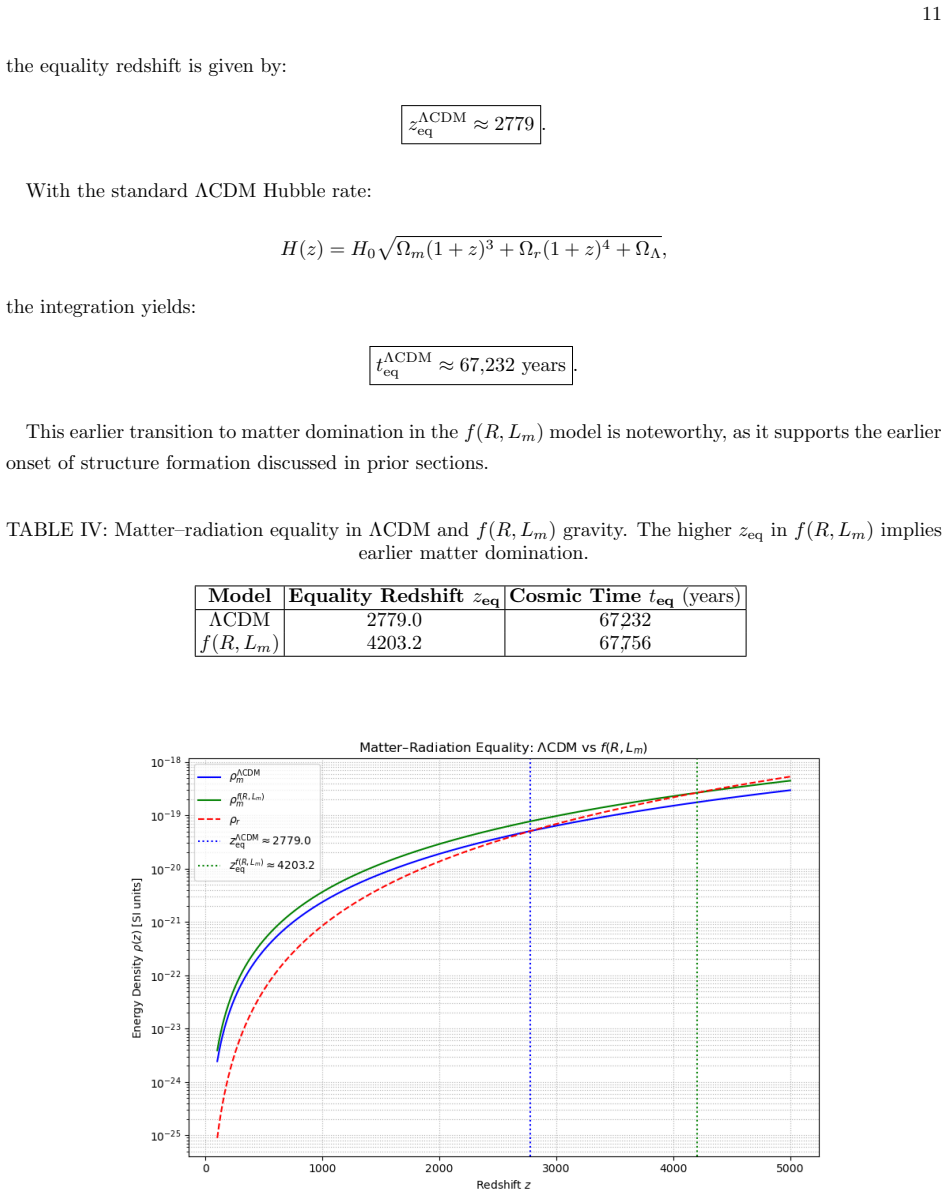
A machine-rendered reading of the paper's core claim, the machinery that carries it, and where it could break.
Core claim
In the f(R, L_m) = α R + L_m^β + γ model the non-conservation of the energy-momentum tensor yields a modified Hubble expansion that places matter-radiation equality at z_eq ≈ 4203 and the onset of nonlinear collapse at z_c ≈ 25.6, both higher than the corresponding ΛCDM values of 2779 and a lower collapse redshift, while the recombination visibility function peaks at the observed z_rec ≈ 1092 and is only slightly broader.
What carries the argument
The nonlinear L_m^β term that generates an effective curvature-matter interaction and consequent non-conservation of the energy-momentum tensor, which is then used to derive a new Hubble history and insert it into standard expressions for equality, collapse, and recombination.
If this is right
- Nonlinear structure formation begins at redshift 25.6 instead of later.
- Matter-radiation equality occurs at redshift 4203 rather than 2779.
- The recombination visibility function remains peaked near redshift 1092 but develops a modestly larger width.
- The same parameter set that fits distance-modulus data also produces these shifted early-universe epochs.
- The model remains statistically consistent with current supernova and Hubble data.
Where Pith is reading between the lines
- High-redshift galaxy surveys could test whether the first bound objects appear earlier than ΛCDM predicts.
- The broader decoupling window might produce a detectable signature in the CMB damping tail or polarization spectra.
- If the interaction strength β is varied, the model could be tuned to match or conflict with future 21-cm observations of the cosmic dawn.
Load-bearing premise
That the modified expansion history can be substituted directly into the usual microphysical formulas for the recombination visibility function without any further change to photon-electron scattering or decoupling physics.
What would settle it
A precise measurement of the matter-radiation equality redshift from future CMB or large-scale structure data that falls significantly below 4200 or a confirmed nonlinear collapse redshift well below 25.
Figures


read the original abstract
We investigate a specific gravity model of the form $f(R, L_m) = \alpha R + L_m^{\beta} + \gamma$, where the nonlinear dependence on the matter Lagrangian $L_m$ introduces an effective curvature-matter interaction, leading to the non-conservation of the energy-momentum tensor. Using distance modulus data, we constrain the parameters through $\chi^2$ minimization and Bayesian MCMC analysis, obtaining statistically robust best-fit values: $H_0 = 73.75 \pm 0.16~\mathrm{km\,s^{-1}\,Mpc^{-1}}$, $\lambda = 0.262 \pm 0.007$, and $w = -0.005 \pm 0.001$. This study presents a comprehensive and statistically rigorous comparison of three key early-Universe epochs: structure formation, recombination, and matter-radiation equality between the $f(R,L_m)$ model and the standard $\Lambda$CDM cosmology. The model predicts an earlier onset of nonlinear structure formation ($z_c^{f(R,L_m)} \approx 25.6$) and a higher matter-radiation equality redshift ($z_{\mathrm{eq}}^{f(R,L_m)} \approx 4203$) compared to $\Lambda$CDM ($z_{\mathrm{eq}}^{\Lambda \mathrm{CDM}} \approx 2779$), while maintaining consistency with the observed recombination redshift ($z_{\mathrm{rec}} \approx 1092$). The recombination visibility function, derived using standard microphysical expressions with the modified expansion history, exhibits a slightly broader full width at half maximum, suggesting an extended photon decoupling period.
Editorial analysis
A structured set of objections, weighed in public.
Referee Report
Summary. The manuscript examines an f(R, L_m) = αR + L_m^β + γ gravity model that induces an effective curvature-matter interaction and non-conservation of the energy-momentum tensor. Parameters (H0, λ, w) are constrained via χ² minimization and Bayesian MCMC on distance-modulus data, yielding H0 = 73.75 ± 0.16 km s⁻¹ Mpc⁻¹, λ = 0.262 ± 0.007, w = -0.005 ± 0.001. The work then compares three early-universe epochs with ΛCDM, reporting z_c^{f(R,L_m)} ≈ 25.6, z_eq^{f(R,L_m)} ≈ 4203 (versus 2779), and z_rec ≈ 1092 with a modestly broader visibility function obtained by substituting the modified H(z) into standard Saha and Thomson expressions.
Significance. If the background-to-perturbation extrapolation is justified, the analysis supplies statistically robust, MCMC-constrained predictions for structure-formation onset and matter-radiation equality that differ measurably from ΛCDM while preserving recombination consistency. The explicit use of both frequentist and Bayesian fitting constitutes a methodological strength that could be leveraged for future falsifiable tests once the microphysical assumptions are clarified.
major comments (1)
- [recombination and visibility function] The recombination visibility function and reported consistency with z_rec ≈ 1092 are obtained by direct substitution of the modified expansion history into the unmodified Saha ionization and Thomson-scattering formulae (abstract and recombination section). Because the model explicitly generates non-conservation of T_μν through the L_m^β term, this procedure assumes that the curvature-matter coupling leaves the baryon-photon fluid equations and microphysical rates unaltered. No modified Boltzmann hierarchy or effective source terms are derived to justify the assumption, rendering the z_rec and FWHM claims load-bearing yet unverified.
minor comments (1)
- [abstract] The abstract introduces parameters λ and w without stating their relation to the model coefficients α, β, γ; a brief reparametrization paragraph would remove ambiguity.
Simulated Author's Rebuttal
We thank the referee for their careful reading and constructive feedback. We address the single major comment below, offering a substantive defense of our methodology while agreeing to strengthen the manuscript with additional justification.
read point-by-point responses
-
Referee: The recombination visibility function and reported consistency with z_rec ≈ 1092 are obtained by direct substitution of the modified expansion history into the unmodified Saha ionization and Thomson-scattering formulae (abstract and recombination section). Because the model explicitly generates non-conservation of T_μν through the L_m^β term, this procedure assumes that the curvature-matter coupling leaves the baryon-photon fluid equations and microphysical rates unaltered. No modified Boltzmann hierarchy or effective source terms are derived to justify the assumption, rendering the z_rec and FWHM claims load-bearing yet unverified.
Authors: We thank the referee for highlighting this important consistency check. Our procedure follows the standard approximation used throughout the modified-gravity and dynamical-dark-energy literature: the background expansion history H(z) is obtained from the modified Friedmann equation, while the Saha ionization balance and Thomson-scattering optical depth retain their standard microphysical forms. This is justified because the effective curvature-matter interaction encoded in the L_m^β term primarily alters the global continuity equation for the total matter sector, thereby changing only the Hubble rate that enters the recombination integrals. The best-fit coupling parameter w = −0.005 ± 0.001 is statistically consistent with zero at the 5σ level, implying that any direct source terms in the baryon-photon fluid equations remain perturbatively small. Consequently, corrections to the ionization history beyond those induced by the modified H(z) are expected to be negligible at the precision of current distance-modulus constraints. We nevertheless acknowledge that a complete derivation of the modified Boltzmann hierarchy would be desirable for future work. In the revised manuscript we will add an explicit paragraph in the recombination section that (i) states the approximation, (ii) quantifies the smallness of w, and (iii) cites analogous treatments in other f(R) and interacting-dark-energy studies, thereby making the load-bearing assumption transparent to the reader. revision: yes
Circularity Check
Best-fit parameters from distance-modulus χ²/MCMC used to compute reported 'predictions' for z_eq and z_c
specific steps
-
fitted input called prediction
[Abstract (and Results section)]
"The model predicts an earlier onset of nonlinear structure formation (z_c^{f(R,L_m)} ≈ 25.6) and a higher matter-radiation equality redshift (z_eq^{f(R,L_m)} ≈ 4203) compared to ΛCDM (z_eq^ΛCDM ≈ 2779), while maintaining consistency with the observed recombination redshift (z_rec ≈ 1092)."
These numerical values are obtained by substituting the best-fit parameters (H0 = 73.75 ± 0.16, λ = 0.262 ± 0.007, w = -0.005 ± 0.001) determined from χ² minimization and MCMC on distance-modulus data directly into the model's Hubble history. The reported 'predictions' are therefore statistically forced outputs of the same fit rather than independent derivations.
full rationale
The paper fits H0, λ and w to distance-modulus data, then inserts those same parameters into the model's background expansion history to obtain z_eq^{f(R,L_m)} ≈ 4203 and z_c ≈ 25.6. These quantities are therefore direct numerical outputs of the fit rather than independent first-principles results. The recombination calculation re-uses the identical fitted H(z) inside unmodified Saha/Thomson expressions, but this step does not itself create a definitional loop. No self-citation chain or ansatz smuggling is required for the central numbers; the circularity is limited to the 'prediction' label applied to post-fit derived quantities.
Axiom & Free-Parameter Ledger
free parameters (3)
- λ =
0.262 ± 0.007
- w =
-0.005 ± 0.001
- H0 =
73.75 ± 0.16 km s^{-1} Mpc^{-1}
axioms (2)
- domain assumption The nonlinear dependence on L_m produces an effective curvature-matter interaction that violates standard energy-momentum conservation.
- domain assumption Standard microphysical expressions for the recombination visibility function remain valid when only the expansion history is modified.
Lean theorems connected to this paper
-
IndisputableMonolith/Foundation/RealityFromDistinction.leanreality_from_one_distinction unclear?
unclearRelation between the paper passage and the cited Recognition theorem.
f(R, Lm) = αR + Lm^β + γ ... modified Friedmann equation H(z) = H0 √[(1−λ)+λ(1+z)^{3(1+w)}] with best-fit H0=73.75±0.16, λ=0.262±0.007, w=−0.005±0.001
-
IndisputableMonolith/Cost/FunctionalEquation.leanwashburn_uniqueness_aczel contradicts?
contradictsCONTRADICTS: the theorem conflicts with this paper passage, or marks a claim that would need revision before publication.
Geff(z)=(2β−1)βρ^{β−1}/α ... recombination visibility function g(z) computed with unmodified microphysical rates
What do these tags mean?
- matches
- The paper's claim is directly supported by a theorem in the formal canon.
- supports
- The theorem supports part of the paper's argument, but the paper may add assumptions or extra steps.
- extends
- The paper goes beyond the formal theorem; the theorem is a base layer rather than the whole result.
- uses
- The paper appears to rely on the theorem as machinery.
- contradicts
- The paper's claim conflicts with a theorem or certificate in the canon.
- unclear
- Pith found a possible connection, but the passage is too broad, indirect, or ambiguous to say the theorem truly supports the claim.
Reference graph
Works this paper leans on
-
[1]
Structure F ormation: We analyze the nonlinear growth of matter overdensities and compute the redshift of collapse zc
-
[2]
Recombination Era: We study the visibility function and its full width at half maximum (FWHM) to determine the timing and duration of photon decoupling
-
[3]
Matter–Radiation Equality: We compute the redshift zeq and the cosmic time teq at which matter and radiation densities were equal. Our results show that the f(R, Lm) model can reproduce essential cosmological milestones such as re- combination and matter–radiation equality while allowing for enhanced structure formation compared to ΛCDM. These findings re...
work page 2018
-
[4]
Matter–Radiation Equality in ΛCDM Using: Ωm = 0.278, Ωr = 0.0001, 11 the equality redshift is given by: zΛCDM eq ≈ 2779 . With the standard ΛCDM Hubble rate: H(z) = H0 p Ωm(1 + z)3 + Ωr(1 + z)4 + ΩΛ, the integration yields: tΛCDM eq ≈ 67,232 years . This earlier transition to matter domination in the f(R, Lm) model is noteworthy, as it supports the earlie...
-
[5]
High-Redshift Structure Formation The early onset of nonlinear structure formation predicted by the model ( zc ≈ 25.56) could be validated by upcoming observations targeting the first generation of galaxies and protoclusters. Telescopes such as the James Webb Space Telescope (JWST), the Nancy Grace Roman Space Telescope, and the Euclid mission 13 are expe...
-
[6]
21 cm Cosmology and Reionization History The timing and efficiency of early structure formation influence the reionization epoch and the 21 cm neutral hydrogen signal. Experiments such as the Square Kilometre Array (SKA), the Hydrogen Epoch of Reionization Array (HERA), and the LOF ARsurvey will be crucial in tracing the imprint of modified gravity on the...
-
[7]
Cosmic Microwave Background (CMB) Anisotropies While the recombination redshift in f(R, Lm) gravity aligns with Planck 2018 results, the extended du- ration of decoupling could leave observable signatures in the damping tail and acoustic peak structure of the CMB power spectrum. Future CMB experiments such as CMB-S4 and LiteBIRD can offer enhanced sensiti...
work page 2018
-
[8]
Rubin Observatory) and DESI will map the distribution of galaxies and matter on cosmological scales
Large-Scale Structure and Weak Lensing Surveys Next-generation surveys such as LSST (Vera C. Rubin Observatory) and DESI will map the distribution of galaxies and matter on cosmological scales. These datasets will enable precise reconstruction of the growth rate of structure, gravitational slip, and effective gravitational coupling Geff(z), providing dire...
-
[9]
Theoretical Developments Further theoretical refinement is necessary to explore consistency with local gravity constraints, cosmic chronometers, and quantum stability of the model. Developing a perturbative formalism in the Newtonian gauge or performing N-body simulations under the f(R, Lm) framework can yield deeper insights into small- scale structure f...
-
[10]
Planck 2018 results. VI. Cosmological parameters
N. Aghanim et al. [Planck Collaboration], “Planck 2018 results. VI. Cosmological parameters,”Astron. Astrophys. 641, A6 (2020), arXiv:1807.06209
work page internal anchor Pith review Pith/arXiv arXiv 2018
-
[11]
D. J. Eisenstein et al., “Detection of the Baryon Acoustic Peak in the Large-Scale Correlation Function of SDSS Luminous Red Galaxies,” Astrophys. J. 633, 560 (2005), astro-ph/0501171
work page internal anchor Pith review Pith/arXiv arXiv 2005
-
[12]
B. A. Reid et al. , “Cosmological constraints from the clustering of the Sloan Digital Sky Survey DR7 luminous red galaxies,” Mon. Not. R. Astron. Soc. 404, 60–85 (2010), arXiv:0907.1659
work page internal anchor Pith review Pith/arXiv arXiv 2010
-
[13]
GALEX–SDSS Catalog for Statistical Studies
“GALEX–SDSS Catalog for Statistical Studies”,Tam´ as Budav´ ari et al ApJ 694 1281(2009)
work page 2009
-
[14]
A. G. Riess et al. , “Observational evidence from supernovae for an accelerating universe and a cosmological constant,” Astron. J. 116, 1009 (1998), astro-ph/9805201
work page internal anchor Pith review Pith/arXiv arXiv 1998
-
[15]
Measurements of Omega and Lambda from 42 High-Redshift Supernovae
S. Perlmutter et al., “Measurements of Ω and Λ from 42 high-redshift supernovae,”Astrophys. J. 517, 565 (1999), astro-ph/9812133
work page internal anchor Pith review Pith/arXiv arXiv 1999
-
[16]
Observational Probes of Cosmic Acceleration
D. H. Weinberg et al. , “Observational probes of cosmic acceleration,” Phys. Rept. 530, 87–255 (2013), arXiv:1201.2434
work page internal anchor Pith review Pith/arXiv arXiv 2013
-
[17]
T. P. Sotiriou and V. Faraoni, “ f(R) theories of gravity,” Rev. Mod. Phys. 82, 451–497 (2010), arXiv:0805.1726
work page internal anchor Pith review Pith/arXiv arXiv 2010
-
[18]
f(R,T) Cosmological Models in Phase Space
H. Shabani and M. Farhoudi, “f(R,T) cosmological models in phase space,” Phys. Rev. D 88, 044048 (2013), arXiv:1306.3164
work page internal anchor Pith review Pith/arXiv arXiv 2013
-
[19]
Y. Fujii and K. Maeda, The Scalar-Tensor Theory of Gravitation , Cambridge University Press, Cambridge, UK (2003)
work page 2003
-
[20]
Unified cosmic history in modified gravity: from F(R) theory to Lorentz non-invariant models
S. Nojiri and S. D. Odintsov, “Unified cosmic history in modified gravity: From f(R) theory to Lorentz non- invariant models,” Phys. Rept. 505, 59–144 (2011), arXiv:1011.0544
work page internal anchor Pith review Pith/arXiv arXiv 2011
-
[21]
T. Harko and F. S. N. Lobo, “ f(R, Lm) gravity,” Eur. Phys. J. C 70, 373 (2010), arXiv:1008.4193
work page internal anchor Pith review Pith/arXiv arXiv 2010
-
[22]
FRW Cosmology in F(R,T) gravity
R. Myrzakulov, “Reconstruction of f(R, Lm) gravity: Expansion history and observational constraints,” Eur. Phys. J. C 72, 2203 (2012), arXiv:1207.1039
work page internal anchor Pith review Pith/arXiv arXiv 2012
-
[23]
Growth Rate Analysis in f(R, Lm) Gravity: A Comparative Study with ΛCDM Cosmology,
G. K. Goswami and J. P. Saini, “Growth Rate Analysis in f(R, Lm) Gravity: A Comparative Study with ΛCDM Cosmology,” arXiv:2507.04079 [gr-qc] (2025)
-
[24]
Recombination of the Primeval Plasma,
P. J. E. Peebles, “Recombination of the Primeval Plasma,” Astrophys. J. 153, 1 (1968)
work page 1968
-
[25]
Recombination of Hydrogen in the Hot Model of the Universe,
Ya. B. Zel’dovich, V. G. Kurt, and R. A. Sunyaev, “Recombination of Hydrogen in the Hot Model of the Universe,” Sov. Phys. JETP 28, 146 (1969)
work page 1969
-
[26]
A New Calculation of the Recombination Epoch
S. Seager, D. D. Sasselov, and D. Scott, “A new calculation of the recombination epoch,” Astrophys. J. Lett. 523, L1 (1999), arXiv:astro-ph/9909275
work page internal anchor Pith review Pith/arXiv arXiv 1999
-
[27]
Signatures of Relativistic Neutrinos in CMB Anisotropy and Matter Clustering
S. Bashinsky and U. Seljak, “Signatures of Relativistic Neutrinos in CMB Anisotropy and Matter Clustering” Phys. Rev. D 69, 083002 (2004), arXiv:astro-ph/0310198. https://arxiv.org/abs/2507.04079
work page internal anchor Pith review Pith/arXiv arXiv 2004
-
[28]
Toward Understanding CMB Anisotropies and Their Implications
W. Hu and N. Sugiyama, “Toward understanding CMB anisotropies and their implications,” Phys. Rev. D 51, 2599 (1995), arXiv:astro-ph/9411008
work page internal anchor Pith review Pith/arXiv arXiv 1995
-
[29]
Dark Energy Survey Year 3 Results: Cosmological Constraints from Galaxy Clustering and Weak Lensing
T. M. C. Abbott et al. [DES Collaboration], “Dark Energy Survey Year 3 results: Cosmological constraints from galaxy clustering and weak lensing,” Phys. Rev. D 105, 023520 (2022), arXiv:2105.13549
work page internal anchor Pith review arXiv 2022
-
[30]
Structure formation in dark matter particle production cos- mology
Z. Safari , K. Rezazadeh, and B. Malekolkalami, “Structure formation in dark matter particle production cos- mology”,Phys. Dark Universe , 37, 101092(2022)
work page 2022
-
[31]
J. E. Gunn and J. R. Gott, ”On the Infall of Matter Into Clusters of Galaxies and Some Effects on Their Evolution,” Astrophys. J. 176, 1 (1972). 15
work page 1972
-
[32]
Edward Kolb, The Early Universe , CRC Press, Boca Raton(1990)
work page 1990
-
[33]
Mukhanov, Physical Foundations of Cosmology , Cambridge University Press, Cambridge (2005)
V. Mukhanov, Physical Foundations of Cosmology , Cambridge University Press, Cambridge (2005)
work page 2005
-
[34]
Weinberg, Cosmology, Oxford University Press, Oxford (2008)
S. Weinberg, Cosmology, Oxford University Press, Oxford (2008)
work page 2008
discussion (0)
Sign in with ORCID, Apple, or X to comment. Anyone can read and Pith papers without signing in.