REVIEW 4 major objections 6 minor 78 references
BlueGlass: A Framework for Composite AI Safety
T0 review · 4 major / 6 minor · reviewed 2026-08-06 · deepseek-v4-flash
Pith's one-line read Probes find a shared phase transition in vision-language detectors
desk verdict A coherent composite-safety toolkit with a useful VLM benchmark, but the phase-transition claim is not yet supported by the evidence. read the letter →
The pith
A machine-rendered reading of the paper's core claim, the machinery that carries it, and where it could break.
The reading
What carries the argument
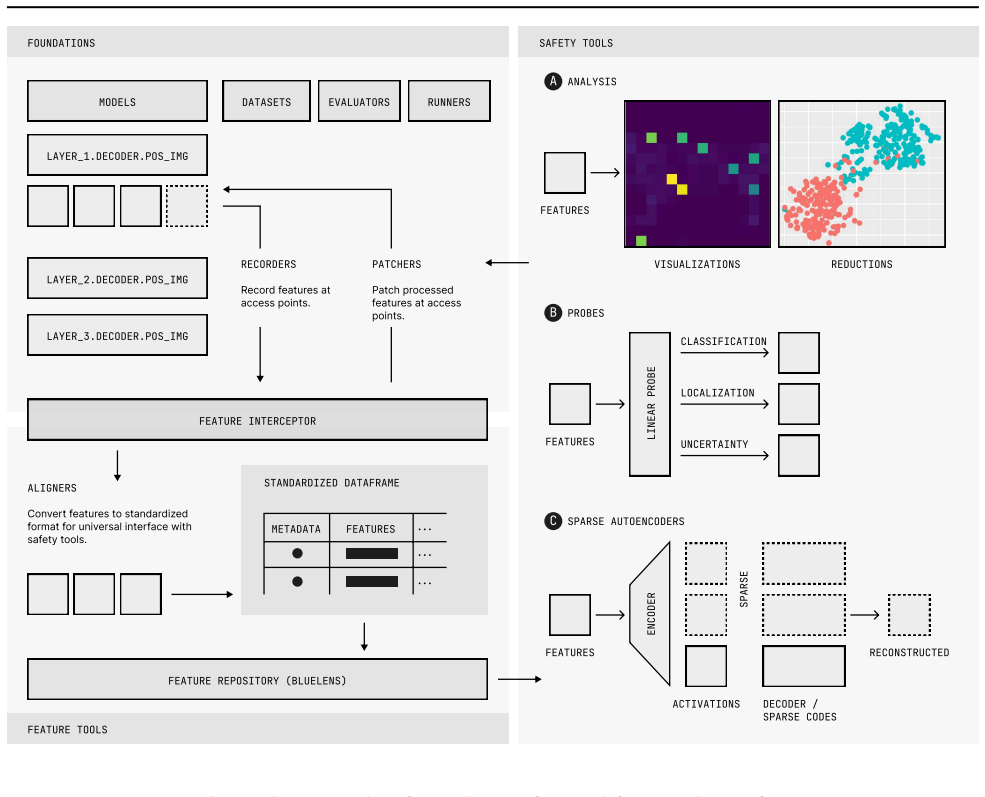
The approximation probe is the central instrument: a linear classifier or regressor trained on a layer's activations to match the target model's own final outputs, not ground-truth labels, with accuracy reported as AP at IoU 50. Its layer-by-layer trajectory is the evidence for the phase transition, which the paper formalizes as three phases—extraction, reorganization, refinement—and justifies with the information bottleneck principle and random hierarchy models. The supporting machinery is BlueGlass's feature-tool layer, whose interceptor, recorder, patcher, and aligner standardize activations from heterogeneous models into a shared schema, making the probes and the TopK sparse autoencoders composable.
What would settle it
Train approximation probes on randomized or shuffled final-output targets at every layer, or add a nonlinear probe head; if a similar dip-then-surge appears when the probe target carries no task structure, the dip is a probe artifact. Alternatively, compare probes trained on the same layer features with different optimization budgets: if increasing probe capacity or training time removes the dip at the transition layer, the dip reflects probe optimization difficulty rather than a reorganization of representation.
Extended reading notes
Core claim
The paper's central claim is that object-detection VLMs and vision-only detectors use the same internal strategy: after an extraction phase and before a refinement phase, both pass through a reorganization phase in which task-relevant information, as measured by approximation probes, drops and then surges. The transition is observed in decoder layers of Grounding DINO and DINO, across datasets, and for both classification and localization probes, so the paper proposes it as a shared hierarchical feature-learning mechanism rather than an artifact of one architecture. The emergent open-vocabulary ability of VLMs is then explained as language-aligned representations being folded into that shared hierarchy, which is what gives semantic flexibility without a separate detection mechanism. The framework contribution is BlueGlass itself, whose standardized feature repository lets probes, sparse autoencoders, and evaluators operate on the same captured activations.
Load-bearing premise
The whole phase-transition finding rests on the premise that layer-wise linear probes trained to match the model's own final outputs measure genuine information content in the features, rather than reflecting how hard each layer's features are to probe.
Editorial extensions
If this is right
- Safety analyses can target the transition layer: monitoring or patching around that reorganization point should be more informative than treating all decoder layers alike.
- The evaluation pipeline maps any open-ended VLM output to a fixed label set using text-embedding similarity, so new VLMs can be compared fairly on AP/AR without hand-written output parsing.
- The three-phase trajectory can serve as a diagnostic signature for whether a new model family is actually building hierarchical object representations.
- Because open-vocabulary ability is attributed to language-aligned features entering a shared visual hierarchy, improving geometric and localization priors should matter more for VLMs than scaling the language component alone.
- SAE concept attribution, as illustrated by the hand detector, can surface spurious correlations that distributional evaluation alone would miss.
Reading between the lines
- If the reorganization is genuine, interventions applied before the transition layer should be weaker and less task-specific than interventions at or after it; a direct layer-wise activation-patching experiment would test this.
- The hand-based spurious unit suggests a deployment monitor: track activation of that SAE unit on new data and flag predictions that co-occur with hand-like context but absent objects.
- The same approximation-probe recipe can be extended beyond object detection to other decoder-based multimodal tasks, which would show whether extraction–reorganization–refinement is universal.
- The standardized feature schema hints that safety tools trained on one model's features could migrate to another model, but the paper does not test cross-model transfer; that is a natural next experiment.
Editorial analysis
A structured set of objections, weighed in public.
Referee Report
Summary. The paper introduces BlueGlass, an open-source framework for composite AI safety that unifies model-interfacing, feature capture/storage, and safety-tool composition, and demonstrates it through three case studies on vision-language models (VLMs) for object detection: (1) distributional evaluation across six datasets comparing VLM and vision-only detectors; (2) a new "approximation probe" method that trains linear probes on intermediate decoder layers to predict model outputs, claimed to reveal a universal phase transition in layer dynamics shared by VLMs and vision-only detectors; and (3) sparse autoencoder (SAE) analysis on Grounding DINO that identifies interpretable concepts and a hand-based spurious correlation. The paper's central mechanistic claim is that the probe-accuracy dip-then-surge pattern indicates a three-phase (extract, reorganize, refine) hierarchical feature-learning strategy common to both model types, with VLM open-vocabulary ability arising from language-aligned features entering this shared hierarchy.
Significance. The BlueGlass framework itself is a useful infrastructure contribution: it addresses a real need for composable, architecture-agnostic safety tooling, and the paper names reproducible, open-source infrastructure as a deliverable. The distributional evaluation provides a broad, useful comparison of current VLMs on object detection, and the SAE discovery of a hand-based spurious correlation is a concrete, falsifiable finding with safety relevance. If the phase-transition claim in Section 4.2 were established, it would be a notable mechanistic result with implications for understanding VLM generalization. However, the current evidence does not support that claim at the level the paper presents it: the key curves are single-run, lack statistical controls, and the theoretical appendix does not bridge the gap from linear-probe accuracy to information-theoretic phase transitions. The manuscript's value is therefore uneven: the framework and evaluation contributions are solid, but the headline mechanistic finding needs substantial additional support.
major comments (4)
- [Section 4.2, Figure 3] The phase-transition claim is supported only by single-run linear-probe AP curves with no error bars, no multiple seeds, and no statistical testing. In Figure 3, the 'dip' is often a single layer out of six, and without variance estimates or significance tests the pattern cannot be distinguished from noise. The paper should report repeated probe training runs (or at least bootstrap confidence intervals) and a null control, such as probes trained on the same features with shuffled labels or on random projections, to demonstrate that the dip-and-surge is not an artifact of probe optimization.
- [Section 4.1, Equations (1)-(2)] The approximation-probe interpretation is undermined by an unresolved ambiguity and an unvalidated assumption. First, the text says the probes are trained to approximate the model's own final predictions, but Equations (1) and (2) use dataset labels y_class and y_bbox; the authors must clarify which target is used, because the two choices lead to very different interpretations of the curves. Second, the paper acknowledges the linear representation hypothesis but does not validate it: a dip in linear decodability at middle layers could reflect poor linear fit due to scale, conditioning, or non-linear encoding, rather than a genuine absence of task-relevant information. The authors should add nonlinear probe controls (e.g., a small MLP probe) and report probe training convergence per layer to show that the dip is not an optimization artifact.
- [Appendix E, Proposition E.1 and Theorem E.3] The theoretical support for the phase-transition claim does not bridge from mutual information to probe AP. Proposition E.1 simply asserts the existence of a critical layer and a reorganization dip, restating the empirical claim rather than proving it. Theorem E.3, as written, is not mathematically coherent: 'If f_l is linear for all l, then I(Z_l; X) = I(X; Y ) for all l' mixes input and target mutual information in a way that does not follow from linearity, and it does not imply any behavior of linear-probe average precision. Either provide a correct formal statement connecting layer-wise linear decodability to information reorganization, or explicitly present Appendix E as a heuristic analogy rather than a proof. As it stands, the appendix does not support the universality claim made in Section 4.3.
- [Section 4.3] The claim that the phase transition is 'universal' and 'irrespective of the dataset or architecture' is stronger than the evidence. Figure 3 shows only two model types (DINO-DETR and Grounding DINO) on a limited set of datasets, and the text itself notes that the classification-phase transition 'only arises for label sets with many classes.' The scope of the claim should be restricted to the models and datasets actually tested, or additional models and datasets should be added to support universality.
minor comments (6)
- [Table 1] The table reports single-run AP/AR values with no variance or repetition information; please state the number of runs and, if applicable, report standard deviations or note that each configuration was run once.
- [Section 3.1] The exclusion of LLaVA-NeXT, GPT-4o-mini, and PaliGemma-2 due to unparsable or incorrect outputs should be quantified (how many outputs were unparsable) and discussed as a limitation, since it may bias the comparison toward models with more structured output formats.
- [Appendix D, Table 2] The ablation table would benefit from a note on whether the COCO mini evaluation is representative of the full COCO results; the paper uses this mini set for ablations but the main table uses full-scale evaluation.
- [Section 5.2] The SAE concept discovery relies on manual interpretation of top-activating proposals; please report the SAE hyperparameters (expansion factor e, TopK k), the number of spurious units found relative to total units, and ideally a small inter-annotator agreement check to reduce subjectivity.
- [Throughout] There are several typographical and grammatical errors, including 'sate-of-the-art' (Abstract/Section 3.1), 'complimentary aspects' (Introduction), 'it's' in Section 2.2, 'The IB objective is can be denoted as' (Appendix E), and 'enables' subject-verb agreement issues; a thorough language edit is recommended.
- [Figure 3] The figure axes and subplot labels are difficult to parse; please clarify which subplot corresponds to which model and dataset, and add a legend that distinguishes classification vs. localization probes in all subplots.
Circularity Check
No circularity found: the probe/phase-transition analysis and evaluation benchmarks are empirical measurements over external data and model internals, and no load-bearing self-citation or fitted-input-as-prediction step appears in the derivation chain.
full rationale
The derivation chain contains no circular step that reduces a claimed prediction to a fitted input or to a self-citation. The three case studies are measurements over external data and model internals: Table 1 reports AP/AR from a fixed evaluation pipeline applied to public datasets; the pipeline hyperparameters and components were ablated on COCO mini (Table 2), but the reported AP values are model outputs transformed by the chosen encoder, not a re-expression of the selected hyperparameter, so any inflation concern is a benchmark-validity issue, not circularity. In Section 4, approximation probes are linear regressors independently trained at each decoder layer to predict the model's own final classification and box outputs (Eqs. 1-2); the per-layer accuracy curve is an empirical measurement, and the middle-layer dip is not forced by the training objective. The paper's phase-transition reading of that curve is an interpretation that could be wrong (e.g., if probe optimization succeeds unevenly across layers), but it is not equivalent by construction to the input data. The SAE analysis trains a reconstruction model on activations and labels units by top-activating examples from COCO; no fitted parameter is relabeled as a prediction. Finally, no load-bearing self-citation appears: citations to prior phase-transition work (Carroll, 2023; Olsson et al., 2022; Nakkiran et al., 2019) are contextual analogies, not the evidence for the observed trajectory. Appendix E's propositions are asserted rather than proved, and Theorem E.3 is formally questionable, but an unproved or invalid justification is a correctness gap, not a circular dependency. Therefore, the paper is self-contained against external benchmarks and its central mechanistic claim, while subject to robustness criticisms, is not circular.
Assumptions & free parameters
free parameters (6)
- MaxPred (VLM prediction limit) =
900 (selected from 10, 30, 100, 300, 900)
- MinConf (confidence threshold) =
0 (selected from 0, 0.001, 0.01, 0.1, 0.5)
- Negative class prompts =
included (e.g., 'an object', 'a thing')
- Part prompts =
included (e.g., 'parts of a car')
- Text encoder for label mapping =
CLIP
- SAE expansion factor and TopK k
assumptions (6)
- domain assumption Linear representation hypothesis: intermediate representations are increasingly linearly separable, so linear probes can measure task-relevant information.
- domain assumption The dip-and-surge shape of probe accuracy curves is evidence of a phase transition in representation reorganization, not a probe-training artifact.
- ad hoc to paper Information bottleneck and random hierarchy model propositions (E.1, E.2, Theorem E.3) are valid and imply phase transitions are fundamental.
- domain assumption The text-similarity pipeline maps open-ended VLM outputs to dataset labels faithfully.
- domain assumption Manual inspection of top-activating COCO proposals is a valid way to label SAE units as concepts.
- domain assumption The selected model in each VLM architectural class is representative of that class.
Cite this review
Pith. "Pith review of BlueGlass: A Framework for Composite AI Safety." pith.science (2026). https://pith.science/paper/QNZ6SAHK
@misc{pith2026250710106,
  author       = {Pith},
  title        = {Pith review of: BlueGlass: A Framework for Composite AI Safety},
  year         = {2026},
  howpublished = {\url{https://pith.science/paper/QNZ6SAHK}},
  note         = {Machine review of arXiv:2507.10106}
}
read the original abstract
As AI systems become increasingly capable and ubiquitous, ensuring the safety of these systems is critical. However, existing safety tools often target different aspects of model safety and cannot provide full assurance in isolation, highlighting a need for integrated and composite methodologies. This paper introduces BlueGlass, a framework designed to facilitate composite AI safety workflows by providing a unified infrastructure enabling the integration and composition of diverse safety tools that operate across model internals and outputs. Furthermore, to demonstrate the utility of this framework, we present three safety-oriented analyses on vision-language models for the task of object detection: (1) distributional evaluation, revealing performance trade-offs and potential failure modes across distributions; (2) probe-based analysis of layer dynamics highlighting shared hierarchical learning via phase transition; and (3) sparse autoencoders identifying interpretable concepts. More broadly, this work contributes foundational infrastructure and findings for building more robust and reliable AI systems.
Figures


Figures from the paper (3 more)


Reference graph
Works this paper leans on
-
[1]
write newline
" write newline "" before.all 'output.state := FUNCTION n.dashify 't := "" t empty not t #1 #1 substring "-" = t #1 #2 substring "--" = not "--" * t #2 global.max substring 't := t #1 #1 substring "-" = "-" * t #2 global.max substring 't := while if t #1 #1 substring * t #2 global.max substring 't := if while FUNCTION format.date year duplicate empty "emp...
-
[2]
Sanity Checks for Saliency Maps , 2020
Adebayo, J., Gilmer, J., Muelly, M., Goodfellow, I., Hardt, M., and Kim, B. Sanity Checks for Saliency Maps , 2020. URL https://arxiv.org/abs/1810.03292
arXiv 2020
-
[3]
Alain, G. and Bengio, Y. Understanding intermediate layers using linear classifier probes, 2018. URL https://arxiv.org/abs/1610.01644
arXiv 2018
- [4]
-
[5]
Apache Software Foundation . Apache parquet. https://parquet.apache.org/, 2013. Columnar storage format for Hadoop and big data processing
work page 2013
-
[6]
Apache arrow: A cross-language development platform for in-memory data
Apache Software Foundation . Apache arrow: A cross-language development platform for in-memory data. https://arrow.apache.org/, 2016. Versioned columnar memory format for flat and hierarchical data
work page 2016
-
[7]
Refusal in Language Models Is Mediated by a Single Direction , 2024
Arditi, A., Obeso, O., Syed, A., Paleka, D., Panickssery, N., Gurnee, W., and Nanda, N. Refusal in Language Models Is Mediated by a Single Direction , 2024. URL https://arxiv.org/abs/2406.11717
arXiv 2024
-
[8]
A Survey of Word Embeddings Evaluation Methods
Bakarov, A. A Survey of Word Embeddings Evaluation Methods , 2018. URL https://arxiv.org/abs/1801.09536
work page Pith review arXiv 2018
Show all 78 references
-
[9]
and Gavves, E
Bereska, L. and Gavves, E. Mechanistic interpretability for ai safety -- a review, 2024. URL https://arxiv.org/abs/2404.14082
2024 arXiv
-
[10]
Bloom, J., Tigges, C., Duong, A., and Chanin, D. SAELens . https://github.com/jbloomAus/SAELens, 2024
2024
-
[11]
Braun, M., Krebs, S., Flohr, F., and Gavrila, D. M. EuroCity Persons: A Novel Benchmark for Person Detection in Traffic Scenes . IEEE Transactions on Pattern Analysis and Machine Intelligence, 41 0 (8): 0 1844–1861, August 2019. ISSN 1939-3539. doi:10.1109/tpami.2019.2897684. ...
2019
-
[12]
E., Hume, T., Carter, S., Henighan, T., and Olah, C
Bricken, T., Templeton, A., Batson, J., Chen, B., Jermyn, A., Conerly, T., Turner, N., Anil, C., Denison, C., Askell, A., Lasenby, R., Wu, Y., Kravec, S., Schiefer, N., Maxwell, T., Joseph, N., Hatfield-Dodds, Z., Tamkin, A., Nguyen, K., McLean, B., Burke, J. E., Hume, T., Car...
2023
-
[13]
BatchTopK Sparse Autoencoders , 2024
Bussmann, B., Leask, P., and Nanda, N. BatchTopK Sparse Autoencoders , 2024. URL https://arxiv.org/abs/2412.06410
2024 arXiv
-
[14]
Learning Multi-Level Features with Matryoshka Sparse Autoencoders , 2025
Bussmann, B., Nabeshima, N., Karvonen, A., and Nanda, N. Learning Multi-Level Features with Matryoshka Sparse Autoencoders , 2025. URL https://arxiv.org/abs/2503.17547
2025 arXiv
-
[15]
M., Favero, A., and Wyart, M
Cagnetta, F., Petrini, L., Tomasini, U. M., Favero, A., and Wyart, M. How Deep Neural Networks Learn Compositional Data: The Random Hierarchy Model . Physical Review X, 14 0 (3), July 2024. ISSN 2160-3308. doi:10.1103/physrevx.14.031001. URL http://dx.doi.org/10.1103/PhysRevX....
2024 doi
-
[16]
On evaluating adversarial robustness, 2019
Carlini, N., Athalye, A., Papernot, N., Brendel, W., Rauber, J., Tsipras, D., Goodfellow, I., Madry, A., and Kurakin, A. On evaluating adversarial robustness, 2019. URL https://arxiv.org/abs/1902.06705
2019 arXiv
-
[17]
DLST 4: Phase Transitions in Neural Networks
Carroll, L. DLST 4: Phase Transitions in Neural Networks . https://www.lesswrong.com/s/czrXjvCLsqGepybHC/p/aKBAYN5LpaQMrPqMj, June 2023. LessWrong blog post
2023
-
[18]
C., and Lin, D
Chen, K., Wang, J., Pang, J., Cao, Y., Xiong, Y., Li, X., Sun, S., Feng, W., Liu, Z., Xu, J., Zhang, Z., Cheng, D., Zhu, C., Cheng, T., Zhao, Q., Li, B., Lu, X., Zhu, R., Wu, Y., Dai, J., Wang, J., Shi, J., Ouyang, W., Loy, C. C., and Lin, D. MMDetection: Open MMLab Detection ...
1906 arXiv
-
[19]
Generative Region-Language Pretraining for Open-Ended Object Detection
Chuang, L., Yi, J., Lizhen, Q., Zehuan, Y., and Jianfei, C. Generative Region-Language Pretraining for Open-Ended Object Detection . In Proceedings of IEEE Conference on Computer Vision and Pattern Recognition (CVPR), 2024
2024
-
[20]
Sparse Autoencoders Find Highly Interpretable Features in Language Models , 2023
Cunningham, H., Ewart, A., Riggs, L., Huben, R., and Sharkey, L. Sparse Autoencoders Find Highly Interpretable Features in Language Models , 2023. URL https://arxiv.org/abs/2309.08600
2023 arXiv
-
[21]
BERT: Pre-training of Deep Bidirectional Transformers for Language Understanding , 2019
Devlin, J., Chang, M.-W., Lee, K., and Toutanova, K. BERT: Pre-training of Deep Bidirectional Transformers for Language Understanding , 2019. URL https://arxiv.org/abs/1810.04805
2019 arXiv
-
[22]
An Image is Worth 16x16 Words: Transformers for Image Recognition at Scale , 2021
Dosovitskiy, A., Beyer, L., Kolesnikov, A., Weissenborn, D., Zhai, X., Unterthiner, T., Dehghani, M., Minderer, M., Heigold, G., Gelly, S., Uszkoreit, J., and Houlsby, N. An Image is Worth 16x16 Words: Transformers for Image Recognition at Scale , 2021. URL https://arxiv.org/a...
2021 arXiv
-
[23]
Transcoders Find Interpretable LLM Feature Circuits , 2024
Dunefsky, J., Chlenski, P., and Nanda, N. Transcoders Find Interpretable LLM Feature Circuits , 2024. URL https://arxiv.org/abs/2406.11944
2024 arXiv
-
[24]
Garçon , December 2021
Elhage, N., Nanda, N., Olsson, C., Henighan, T., Joseph, N., Mann, B., Askell, A., Bai, Y., Chen, A., Conerly, T., DasSarma, N., Drain, D., Ganguli, D., Hatfield-Dodds, Z., Hernandez, D., Jones, A., Kernion, J., Lovitt, L., Ndousse, K., Amodei, D., Brown, T., Clark, J., Kaplan...
2021
-
[25]
R., Todd, E., Brinkmann, J., Pal, K., Troitskii, D., Ripa, M., Belfki, A., Rager, C., Juang, C., Mueller, A., Marks, S., Sharma, A
Fiotto-Kaufman, J., Loftus, A. R., Todd, E., Brinkmann, J., Pal, K., Troitskii, D., Ripa, M., Belfki, A., Rager, C., Juang, C., Mueller, A., Marks, S., Sharma, A. S., Lucchetti, F., Prakash, N., Brodley, C., Guha, A., Bell, J., Wallace, B. C., and Bau, D. Nnsight and ndif: Dem...
2025 arXiv
-
[26]
D., Tillman, H., Goh, G., Troll, R., Radford, A., Sutskever, I., Leike, J., and Wu, J
Gao, L., la Tour, T. D., Tillman, H., Goh, G., Troll, R., Radford, A., Sutskever, I., Leike, J., and Wu, J. Scaling and evaluating sparse autoencoders , 2024. URL https://arxiv.org/abs/2406.04093
2024 arXiv
-
[27]
Detecting strategic deception using linear probes, 2025
Goldowsky-Dill, N., Chughtai, B., Heimersheim, S., and Hobbhahn, M. Detecting strategic deception using linear probes, 2025. URL https://arxiv.org/abs/2502.03407
2025 arXiv
-
[28]
and Hagn, K
Grau, O. and Hagn, K. VALERIE22 -- A photorealistic, richly metadata annotated dataset of urban environments , 2023. URL https://arxiv.org/abs/2308.09632
2023 arXiv
-
[29]
and Segerie, C.-R
Grey, M. and Segerie, C.-R. Safety by Measurement: A Systematic Literature Review of AI Safety Evaluation Methods , 2025. URL https://arxiv.org/abs/2505.05541
2025 arXiv
-
[30]
LVIS: A Dataset for Large Vocabulary Instance Segmentation , 2019
Gupta, A., Dollár, P., and Girshick, R. LVIS: A Dataset for Large Vocabulary Instance Segmentation , 2019. URL https://arxiv.org/abs/1908.03195
2019 arXiv
-
[31]
and Nanda, N
Heimersheim, S. and Nanda, N. How to use and interpret activation patching, 2024. URL https://arxiv.org/abs/2404.15255
2024 arXiv
-
[32]
FunnyBirds: A Synthetic Vision Dataset for a Part-Based Analysis of Explainable AI Methods , 2023
Hesse, R., Schaub-Meyer, S., and Roth, S. FunnyBirds: A Synthetic Vision Dataset for a Part-Based Analysis of Explainable AI Methods , 2023. URL https://arxiv.org/abs/2308.06248
2023 arXiv
-
[33]
A comprehensive survey on applications of transformers for deep learning tasks, 2023
Islam, S., Elmekki, H., Elsebai, A., Bentahar, J., Drawel, N., Rjoub, G., and Pedrycz, W. A comprehensive survey on applications of transformers for deep learning tasks, 2023. URL https://arxiv.org/abs/2306.07303
2023 arXiv
-
[34]
Ultralytics YOLO , January 2023
Jocher, G., Qiu, J., and Chaurasia, A. Ultralytics YOLO , January 2023. URL https://github.com/ultralytics/ultralytics
2023
-
[35]
Are sparse autoencoders useful? a case study in sparse probing, 2025
Kantamneni, S., Engels, J., Rajamanoharan, S., Tegmark, M., and Nanda, N. Are sparse autoencoders useful? a case study in sparse probing, 2025. URL https://arxiv.org/abs/2502.16681
2025 arXiv
-
[36]
The Open Images Dataset V4: Unified image classification, object detection, and visual relationship detection at scale
Kuznetsova, A., Rom, H., Alldrin, N., Uijlings, J., Krasin, I., Pont-Tuset, J., Kamali, S., Popov, S., Malloci, M., Kolesnikov, A., Duerig, T., and Ferrari, V. The Open Images Dataset V4: Unified image classification, object detection, and visual relationship detection at scal...
2020
-
[37]
NV-Embed: Improved Techniques for Training LLMs as Generalist Embedding Models , 2025
Lee, C., Roy, R., Xu, M., Raiman, J., Shoeybi, M., Catanzaro, B., and Ping, W. NV-Embed: Improved Techniques for Training LLMs as Generalist Embedding Models , 2025. URL https://arxiv.org/abs/2405.17428
2025 arXiv
-
[38]
A., Tartaglini, A
Lepori, M. A., Tartaglini, A. R., Vong, W. K., Serre, T., Lake, B. M., and Pavlick, E. Beyond the Doors of Perception: Vision Transformers Represent Relations Between Objects , 2024. URL https://arxiv.org/abs/2406.15955
2024 arXiv
-
[39]
Open World Object Detection: A Survey , 2024
Li, Y., Wang, Y., Wang, W., Lin, D., Li, B., and Yap, K.-H. Open World Object Detection: A Survey , 2024. URL https://arxiv.org/abs/2410.11301
2024 arXiv
-
[40]
L., and Dollár, P
Lin, T.-Y., Maire, M., Belongie, S., Bourdev, L., Girshick, R., Hays, J., Perona, P., Ramanan, D., Zitnick, C. L., and Dollár, P. Microsoft COCO: Common Objects in Context , 2015. URL https://arxiv.org/abs/1405.0312
2015 arXiv
-
[41]
Sparse Crosscoders for Cross-Layer Features and Model Diffing
Lindsey, J., Templeton, A., Marcus, J., Conerly, T., Batson, J., and Olah, C. Sparse Crosscoders for Cross-Layer Features and Model Diffing . Transformer Circuits Thread, 2024. URL https://transformer-circuits.pub/2024/crosscoders/index.html
2024
-
[42]
Liu, H., Li, C., Li, Y., Li, B., Zhang, Y., Shen, S., and Lee, Y. J. LLaVA-NeXT: Improved reasoning, OCR, and world knowledge , January 2024 a . URL https://llava-vl.github.io/blog/2024-01-30-llava-next/
2024
-
[43]
Grounding DINO: Marrying DINO with Grounded Pre-Training for Open-Set Object Detection , 2024 b
Liu, S., Zeng, Z., Ren, T., Li, F., Zhang, H., Yang, J., Jiang, Q., Li, C., Yang, J., Su, H., Zhu, J., and Zhang, L. Grounding DINO: Marrying DINO with Grounded Pre-Training for Open-Set Object Detection , 2024 b . URL https://arxiv.org/abs/2303.05499
2024 arXiv
-
[44]
Data Attribution: A Data-Centric Approach for Trustworthy AI Development
Ma, J. Data Attribution: A Data-Centric Approach for Trustworthy AI Development . Proceedings of the AAAI Conference on Artificial Intelligence, 39 0 (27): 0 28720--28720, Apr. 2025. doi:10.1609/aaai.v39i27.35114. URL https://ojs.aaai.org/index.php/AAAI/article/view/35114
2025 doi
-
[45]
A Survey on Vision-Language-Action Models for Embodied AI , 2025
Ma, Y., Song, Z., Zhuang, Y., Hao, J., and King, I. A Survey on Vision-Language-Action Models for Embodied AI , 2025. URL https://arxiv.org/abs/2405.14093
2025 arXiv
-
[46]
and Frey, B
Makhzani, A. and Frey, B. k-Sparse Autoencoders , 2014. URL https://arxiv.org/abs/1312.5663
2014 arXiv
-
[47]
J., Belinkov, Y., Bau, D., and Mueller, A
Marks, S., Rager, C., Michaud, E. J., Belinkov, Y., Bau, D., and Mueller, A. Sparse Feature Circuits: Discovering and Editing Interpretable Causal Graphs in Language Models , 2024. URL https://arxiv.org/abs/2403.19647
2024 arXiv
-
[48]
Deep Double Descent: Where Bigger Models and More Data Hurt , 2019
Nakkiran, P., Kaplun, G., Bansal, Y., Yang, T., Barak, B., and Sutskever, I. Deep Double Descent: Where Bigger Models and More Data Hurt , 2019. URL https://arxiv.org/abs/1912.02292
2019 arXiv
-
[49]
Interpretability will not reliably find deceptive ai
Nanda, N. Interpretability will not reliably find deceptive ai. https://www.lesswrong.com/posts/PwnadG4BFjaER3MGf, 2025
2025
-
[50]
and Bloom, J
Nanda, N. and Bloom, J. TransformerLens . https://github.com/TransformerLensOrg/TransformerLens, 2022
2022
-
[51]
Understanding Neural Networks via Feature Visualization: A survey , 2019
Nguyen, A., Yosinski, J., and Clune, J. Understanding Neural Networks via Feature Visualization: A survey , 2019. URL https://arxiv.org/abs/1904.08939
2019 arXiv
-
[52]
In-context Learning and Induction Heads
Olsson, C., Elhage, N., Nanda, N., Joseph, N., DasSarma, N., Henighan, T., Mann, B., Askell, A., Bai, Y., Chen, A., Conerly, T., Drain, D., Ganguli, D., Hatfield-Dodds, Z., Hernandez, D., Johnston, S., Jones, A., Kernion, J., Lovitt, L., Ndousse, K., Amodei, D., Brown, T., Cla...
2022
-
[53]
GPT-4o System Card , 2024
OpenAI. GPT-4o System Card , 2024. URL https://arxiv.org/abs/2410.21276
2024 arXiv
-
[54]
Patro, B. N. and Agneeswaran, V. S. Mamba-360: Survey of state space models as transformer alternative for long sequence modelling: Methods, applications, and challenges, 2024. URL https://arxiv.org/abs/2404.16112
2024 arXiv
-
[55]
Introducing Gemini 2.0: our new AI model for the agentic era , December 2024
Pichai, S., Hassabis, D., and Kavukcuoglu, K. Introducing Gemini 2.0: our new AI model for the agentic era , December 2024. URL https://blog.google/technology/google-deepmind/google-gemini-ai-update-december-2024/. Accessed: 2025-01-03
2024
-
[56]
On Evaluating the Durability of Safeguards for Open-Weight LLMs , 2024
Qi, X., Wei, B., Carlini, N., Huang, Y., Xie, T., He, L., Jagielski, M., Nasr, M., Mittal, P., and Henderson, P. On Evaluating the Durability of Safeguards for Open-Weight LLMs , 2024. URL https://arxiv.org/abs/2412.07097
2024 arXiv
-
[57]
Language Models are Unsupervised Multitask Learners , 2019
Radford, A., Wu, J., Child, R., Luan, D., Amodei, D., and Sutskever, I. Language Models are Unsupervised Multitask Learners , 2019. URL https://api.semanticscholar.org/CorpusID:160025533
2019
-
[58]
W., Hallacy, C., Ramesh, A., Goh, G., Agarwal, S., Sastry, G., Askell, A., Mishkin, P., Clark, J., Krueger, G., and Sutskever, I
Radford, A., Kim, J. W., Hallacy, C., Ramesh, A., Goh, G., Agarwal, S., Sastry, G., Askell, A., Mishkin, P., Clark, J., Krueger, G., and Sutskever, I. Learning Transferable Visual Models From Natural Language Supervision , 2021. URL https://arxiv.org/abs/2103.00020
2021 arXiv
-
[59]
Faster R-CNN: Towards Real-Time Object Detection with Region Proposal Networks , 2016
Ren, S., He, K., Girshick, R., and Sun, J. Faster R-CNN: Towards Real-Time Object Detection with Region Proposal Networks , 2016. URL https://arxiv.org/abs/1506.01497
2016 arXiv
-
[60]
A Phase Transition in Diffusion Models Reveals the Hierarchical Nature of Data , 2024
Sclocchi, A., Favero, A., and Wyart, M. A Phase Transition in Diffusion Models Reveals the Hierarchical Nature of Data , 2024. URL https://arxiv.org/abs/2402.16991
2024 arXiv
-
[61]
b1ade series of models , 2024
Shreyas Subramanian . b1ade series of models , 2024. URL https://huggingface.co/w601sxs/b1ade-embed
2024
-
[62]
The 'strong' feature hypothesis could be wrong
Smith, L. The 'strong' feature hypothesis could be wrong . AI Alignment Forum , 2024. URL https://www.alignmentforum.org/posts/tojtPCCRpKLSHBdpn/the-strong-feature-hypothesis-could-be-wrong
2024
-
[63]
Negative Results for SAEs On Downstream Tasks and Deprioritising SAE Research (GDM Mech Interp Team Progress Update \#2)
Smith, L., Rajamanoharan, S., Conmy, A., McDougall, C., Lieberum, T., Kramár, J., Shah, R., and Nanda, N. Negative Results for SAEs On Downstream Tasks and Deprioritising SAE Research (GDM Mech Interp Team Progress Update \#2) . https://www.lesswrong.com/posts/4uXCAJNuPKtKBsi2...
2025
-
[64]
Steiner, A., Pinto, A. S., Tschannen, M., Keysers, D., Wang, X., Bitton, Y., Gritsenko, A., Minderer, M., Sherbondy, A., Long, S., Qin, S., Ingle, R., Bugliarello, E., Kazemzadeh, S., Mesnard, T., Alabdulmohsin, I., Beyer, L., and Zhai, X. PaliGemma 2: A Family of Versatile VL...
2024 arXiv
-
[65]
Attribution Patching Outperforms Automated Circuit Discovery , 2023
Syed, A., Rager, C., and Conmy, A. Attribution Patching Outperforms Automated Circuit Discovery , 2023. URL https://arxiv.org/abs/2310.10348
2023 arXiv
-
[66]
R., Abeyruwan, S., Ainslie, J., Alayrac, J.-B., Arenas, M
Team, G. R., Abeyruwan, S., Ainslie, J., Alayrac, J.-B., Arenas, M. G., Armstrong, T., Balakrishna, A., Baruch, R., Bauza, M., Blokzijl, M., Bohez, S., Bousmalis, K., Brohan, A., Buschmann, T., Byravan, A., Cabi, S., Caluwaerts, K., Casarini, F., Chang, O., Chen, J. E., Chen, ...
2025 arXiv
-
[67]
L., McDougall, C., MacDiarmid, M., Freeman, C
Templeton, A., Conerly, T., Marcus, J., Lindsey, J., Bricken, T., Chen, B., Pearce, A., Citro, C., Ameisen, E., Jones, A., Cunningham, H., Turner, N. L., McDougall, C., MacDiarmid, M., Freeman, C. D., Sumers, T. R., Rees, E., Batson, J., Jermyn, A., Carter, S., Olah, C., and H...
2024
-
[68]
and Zaslavsky, N
Tishby, N. and Zaslavsky, N. Deep Learning and the Information Bottleneck Principle , 2015. URL https://arxiv.org/abs/1503.02406
2015 arXiv
-
[69]
L., Gugger, S., Drame, M., Lhoest, Q., and Rush, A
Wolf, T., Debut, L., Sanh, V., Chaumond, J., Delangue, C., Moi, A., Cistac, P., Rault, T., Louf, R., Funtowicz, M., Davison, J., Shleifer, S., von Platen, P., Ma, C., Jernite, Y., Plu, J., Xu, C., Scao, T. L., Gugger, S., Drame, M., Lhoest, Q., and Rush, A. M. HuggingFace's Tr...
2020 arXiv
-
[70]
Detectron2
Wu, Y., Kirillov, A., Massa, F., Lo, W.-Y., and Girshick, R. Detectron2 . https://github.com/facebookresearch/detectron2, 2019
2019
-
[71]
Florence-2: Advancing a Unified Representation for a Variety of Vision Tasks
Xiao, B., Wu, H., Xu, W., Dai, X., Hu, H., Lu, Y., Zeng, M., Liu, C., and Yuan, L. Florence-2: Advancing a Unified Representation for a Variety of Vision Tasks . In Proceedings of the IEEE/CVF Conference on Computer Vision and Pattern Recognition (CVPR), pp.\ 4818--4829, June 2024
2024
-
[72]
Diffusion models: A comprehensive survey of methods and applications, 2024
Yang, L., Zhang, Z., Song, Y., Hong, S., Xu, R., Zhao, Y., Zhang, W., Cui, B., and Yang, M.-H. Diffusion models: A comprehensive survey of methods and applications, 2024. URL https://arxiv.org/abs/2209.00796
2024
-
[73]
BDD100K: A Diverse Driving Dataset for Heterogeneous Multitask Learning , 2020
Yu, F., Chen, H., Wang, X., Xian, W., Chen, Y., Liu, F., Madhavan, V., and Darrell, T. BDD100K: A Diverse Driving Dataset for Heterogeneous Multitask Learning , 2020. URL https://arxiv.org/abs/1805.04687
2020 arXiv
-
[74]
M., and Shum, H.-Y
Zhang, H., Li, F., Liu, S., Zhang, L., Su, H., Zhu, J., Ni, L. M., and Shum, H.-Y. DINO: DETR with Improved DeNoising Anchor Boxes for End-to-End Object Detection , 2022. URL https://arxiv.org/abs/2203.03605
2022 arXiv
-
[75]
Vision-Language Models for Vision Tasks: A Survey , 2024
Zhang, J., Huang, J., Jin, S., and Lu, S. Vision-Language Models for Vision Tasks: A Survey , 2024. URL https://arxiv.org/abs/2304.00685
2024 arXiv
-
[76]
L., Zimmer, W., Cao, H., and Knoll, A
Zhou, X., Liu, M., Yurtsever, E., Zagar, B. L., Zimmer, W., Cao, H., and Knoll, A. C. Vision Language Models in Autonomous Driving: A Survey and Outlook , 2024. URL https://arxiv.org/abs/2310.14414
2024 arXiv
-
[77]
Object Detection in 20 Years: A Survey
Zou, Z., Chen, K., Shi, Z., Guo, Y., and Ye, J. Object Detection in 20 Years: A Survey . Proceedings of the IEEE, 111 0 (3): 0 257--276, 2023. doi:10.1109/JPROC.2023.3238524
2023
-
[78]
and Ilievski, E
Žunkovič, B. and Ilievski, E. Grokking phase transitions in learning local rules with gradient descent , 2022. URL https://arxiv.org/abs/2210.15435
2022 arXiv
Reviewed August 6, 2026 · model on record in the stance chip above.
Discussion (0). Sign in to comment.