REVIEW 3 major objections 6 minor 99 references
Epicyclic oscillations and accretion disk around a special Buchdahl-inspired spacetime
T0 review · 3 major / 6 minor · reviewed 2026-08-06 · deepseek-v4-flash
Pith's one-line read The paper shows that a static Buchdahl-inspired vacuum metric fits the 3:2 QPO pairs of two microquasars and predicts a monotonic brightening of their accretion disks as $\tilde{k}$ grows.
desk verdict Competent application of standard QPO/disk machinery to a newer metric, undermined by a union-versus-intersection slip in the headline parameter range that revision should fix. read the letter →
The pith
A machine-rendered reading of the paper's core claim, the machinery that carries it, and where it could break.
The reading
What carries the argument
The load-bearing object is the special Buchdahl-inspired metric (2), with $f(x)=1-2/((1+\tilde{k})x)$, whose ISCO is located numerically through the effective-potential conditions $\partial_r V_{\rm eff}=0$ and $\partial_{rr}V_{\rm eff}=0$. The epicyclic frequencies $\nu_r$ and $\nu_\theta$ from Eqs. (15)-(16) are combined in the forced-resonance model $\nu_U=\nu_\theta+\nu_r$, $\nu_L=\nu_\theta$, and matching these expressions to the two microquasars' measured peaks and mass error bands fixes the allowed $\tilde{k}$ interval. The disk analysis uses the geometrically thin, optically thick accretion disk model with inner edge at the ISCO, the flux integral of Eq. (23), and backward-in-time geodesic ray tracing with a power-law source profile to produce redshifted images and intensities.
What would settle it
Measure the spin of XTE J1550-564 independently through broad iron-line or continuum-fitting analysis, then compare the resulting ISCO radius with the value metric (2) predicts at the QPO-fitted $\tilde{k}$ and published mass; agreement within combined uncertainties would support the claim, while a statistically significant mismatch would exclude the static Buchdahl description.
Extended reading notes
Core claim
The paper's central claim is that the special Buchdahl-inspired metric (2), carrying one higher-derivative parameter $\tilde{k}$, reproduces the observed 3:2 upper-lower HF QPO ratios of XTE J1550-564 and GRO J1655-40 under a forced-resonance model while predicting a definite monotonic response of ISCO radius, disk radiation, and image morphology. For XTE J1550-564 the model curves intersect the mass error band for $0.03 \leq \tilde{k} \leq 0.13$; for GRO J1655-40 the same procedure gives $0.13 \leq \tilde{k} \leq 0.19$, beyond the upper limit obtained from M87* shadow modeling. The authors therefore conclude $0.03<\tilde{k}<0.19$ and emphasize that rotation is dropped because no analytic rotating version of the metric is available. Positive $\tilde{k}$ decreases $r_{\rm ISCO}$ below $6M$, increases $L_{\rm ISCO}$, lowers $E_{\rm ISCO}$, and raises the radiative efficiency.
Load-bearing premise
The paper assumes both microquasars can be modeled as non-rotating, spherically symmetric objects described by its central metric, and their actual spin is dropped from the fit; if they rotate appreciably, the ISCO, QPO frequencies, and disk emission all differ, and the inferred $\tilde{k}$ range would be biased.
Editorial extensions
If this is right
- Positive $\tilde{k}$ shrinks the ISCO below the Schwarzschild value, so the same accretion rate produces a disk whose inner edge is closer to the central object and whose ray-traced image has a smaller hollow region.
- The forced-resonance fit restricts the parameter to $0.03<\tilde{k}<0.19$ for the two microquasars, a range that future QPO observations with tighter mass and spin measurements can confirm or exclude.
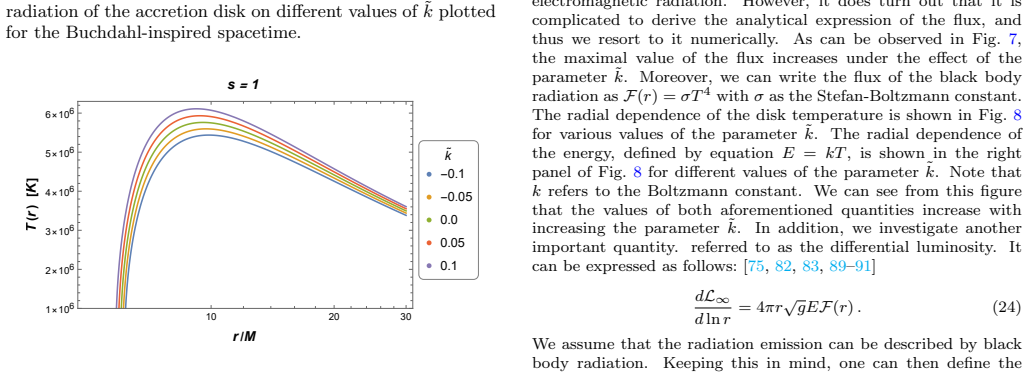
- Disk flux, temperature, differential luminosity, and radiative efficiency all increase with $\tilde{k}$, so a source at fixed mass and accretion rate would appear brighter in this spacetime than in Schwarzschild.
- The ray-traced images closely resemble Schwarzschild but with a significantly altered inner hollow region and a strongly concentrated intensity pattern, giving a concrete imaging signature for the metric.
Reading between the lines
- The static approximation likely biases the inferred $\tilde{k}$ band for real microquasars; if an analytic rotating Buchdahl-inspired metric becomes available, the best-fit interval may shift, so the quoted range should be read as the non-spinning geometry's prediction.
- Because both the QPO frequencies and the disk luminosity trace the ISCO, measuring continuum or iron-line flux together with QPO peaks in the same source could break degeneracies between $\tilde{k}$ and spin that separate fits cannot.
- The predicted size of the disk's inner hollow region is a direct target for next-generation high-resolution black hole imaging, since the brightness profile itself is not strongly altered.
- The paper's $\tilde{k}$ range could be checked against independent probes of the same metric, such as stellar orbits around the Galactic center, without waiting for a rotating solution.
Editorial analysis
A structured set of objections, weighed in public.
Referee Report
Summary. The paper analyzes test-particle geodesics, ISCO properties, epicyclic frequencies, HF QPO constraints, and thin accretion-disk radiation for the special Buchdahl-inspired metric (2). It reports that the Buchdahl parameter k~ shifts the ISCO inward for positive values, derives expressions for the radial and vertical epicyclic frequencies, fits the 3:2 HF QPOs of XTE J1550-564 and GRO J1655-40 to obtain an allowed range for k~, and computes disk flux, temperature, luminosity, and ray-traced images as functions of k~. The central quantitative claim is that the QPO data require 0.03<k~<0.19.
Significance. If the QPO constraint were valid, the paper would provide a new observational test of the Buchdahl-inspired spacetime using two well-known microquasars, complementing earlier constraints from S2-star and EHT shadow analyses. The paper also contains useful numerical results: the ISCO table (Table I), the monotonic dependence of ISCO radius and radiative efficiency on k~, and the ray-traced disk images are internally consistent and reproducible from the stated formalism. However, the headline QPO range is not supported by the reported numbers because the two source-specific intervals are combined as a union rather than a joint intersection; this undermines the main new observational claim. The disk and ray-tracing sections are standard applications and are not affected by this error.
major comments (3)
- [Sec. III, after Eq. (21), Figs. 5 and 6] The paper's concluding constraint 0.03<k~<0.19 is obtained by joining the interval 0.03≤k~≤0.13 from XTE J1550-564 and the interval 0.13≤k~≤0.19 from GRO J1655-40. Since k~ is a single parameter of the spacetime, the claim that metric (2) reproduces the 3:2 HF QPOs of both sources requires the intersection of the two allowed sets, which is only the endpoint k~=0.13 (or empty under strict inequalities). The union interval contains values for which at least one microquasar is not fitted, so the stated range does not follow from the figures. The authors should perform a joint fit or otherwise report the intersection and its uncertainty.
- [Sec. III, Figs. 5 and 6 and surrounding text] The QPO fitting procedure is purely graphical: the text states that intersections of the ν_U and ν_L curves with the mass-error band occur for certain k~ ranges, but it does not specify how the frequency uncertainties (e.g., ±3 Hz and ±5 Hz in Eq. (20)) are propagated, nor does it provide a goodness-of-fit or confidence level. A quantitative parameter estimation, even a simple chi-square or likelihood over k~ using both sources simultaneously, is needed to support the claimed constraint.
- [Sec. III, Eq. (17), and conclusion] The central inference assumes that XTE J1550-564 and GRO J1655-40 are static, spherically symmetric objects described by metric (2), and the authors explicitly drop the rotation parameter in Eq. (20). Given that both sources are known to have substantial spin, the inferred k~ range is potentially biased. The authors acknowledge this limitation in the text, but because the QPO constraint is the main novel result, the abstract and conclusions should state that the range is valid only under the static approximation, or the analysis should be extended to a rotating metric.
minor comments (6)
- [Sec. II, Eq. (17)] The relation 2r_g = (1+k~)r_s is taken from Ref. [18] without derivation; a brief explanation or an explicit reference to the mass definition would help readers understand how the Buchdahl parameter enters the observed mass.
- [Sec. IV, Eq. (24)] The symbol E is used for both the specific energy of a test particle (Eq. (9)) and the photon energy kT in Eq. (24); please use a distinct symbol for the photon energy to avoid confusion.
- [Fig. 4 caption] The caption reads 'for different values of the angular momentum and Buchdahl parameters' but the text says L and E are the specific angular momentum and energy; please clarify which parameters vary in each panel.
- [References] Reference [40] in the bibliography is formatted as ' [40] [40] G. Mustafa, ...', with a duplicated bracket; please correct the citation list.
- [Sec. IV, text before Eq. (24)] The phrase 'referred to as the differential luminosity' should read 'referred to as the differential luminosity' without the preceding comma; also, the sentence beginning 'We can see from this figure' appears to refer to the right panel of Fig. 8, which is not explicitly labeled.
- [Sec. III, Eqs. (18)–(19)] The paper sets c=G=M=1 earlier, but Eqs. (18) and (19) reintroduce c and G; please state explicitly that these equations are written in physical units or define the conversion.
Circularity Check
No significant circularity: the QPO and accretion-disk results are ordinary parameter-constraint calculations from an imported metric, not inputs disguised as outputs.
full rationale
The paper's central computations are self-contained applications of standard formulas to the special Buchdahl-inspired metric (2). The epicyclic frequencies (18)-(19) are obtained by substituting the metric into the general spherical-symmetric formulas (15)-(16); the QPO analysis then fits the free parameter k to external observational data for XTE J1550-564 (Eq. 20) and GRO J1655-40 using the forced-resonance model (21) from Ref. [72]. This is parameter estimation against external data, not a derivation that defines the observed frequencies in terms of k by construction. The accretion-disk section likewise computes ISCO parameters, flux, temperature, and luminosity from the metric and the Novikov-Thorne model, with no fitted output being relabeled as a prediction. The relation 2r_g = (1+k)r_s is imported from Ref. [18], which overlaps with some authors, but it is a published metric-parameter identification and does not by itself make the QPO constraint equivalent to its input; it merely sets the conversion between Schwarzschild radius and mass. The paper explicitly acknowledges limitations such as neglecting rotation and the moderate accuracy of the constraints, and the GRO J1655-40 fit is described as less satisfactory; these are correctness and modeling concerns, not circularity. The apparent union-of-intervals issue in the reported QPO constraint is a logical-consistency problem that could weaken the stated conclusion, but it is not a case of a derived quantity reducing to its own input by definition or self-citation. No circular step meeting the quoted-evidence standard was found.
Assumptions & free parameters
free parameters (3)
- Buchdahl parameter \tilde{k} =
0.03 < \tilde{k} < 0.19 (union); joint fit gives \tilde{k} ≈ 0.13
- radial intensity slope n
- photon index \Gamma
assumptions (5)
- domain assumption Metric (2) with rho(r) from (3) is an asymptotically flat vacuum solution of pure R^2 gravity.
- domain assumption The ADM mass M of the spacetime is related to the metric parameter r_s by 2r_g = (1+\tilde{k})r_s.
- domain assumption The observed HF QPOs arise from the forced-resonance model \nu_U=\nu_\theta+\nu_r and \nu_L=\nu_\theta.
- domain assumption The Novikov-Thorne thin accretion disk with inner edge at the ISCO applies to the Buchdahl-inspired spacetime for the full range of \tilde{k} considered.
- standard math Test-particle motion is confined to the equatorial plane θ=π/2 and oscillations are small perturbations about circular orbits.
Cite this review
Pith. "Pith review of Epicyclic oscillations and accretion disk around a special Buchdahl-inspired spacetime." pith.science (2026). https://pith.science/paper/IQ4PJQU2
@misc{pith2026250710198,
  author       = {Pith},
  title        = {Pith review of: Epicyclic oscillations and accretion disk around a special Buchdahl-inspired spacetime},
  year         = {2026},
  howpublished = {\url{https://pith.science/paper/IQ4PJQU2}},
  note         = {Machine review of arXiv:2507.10198}
}
abstract
In this paper, we consider the Buchdahl-inspired spacetime metric and investigate its aspects using the quasiperiodic oscillations and the accretion disk due to the accreting matter. First, we focus on analyzing the geodesics of particles around the Buchdahl-inspired spacetime, together with the conserved quantities such as specific energy and angular momentum for massive particles orbiting on the innermost stable circular orbits (ISCOs). We show that the effect of the Buchdahl parameter $\tilde{k}$ increases as the radii of the ISCO orbits decrease, resulting in shifting orbits toward the central object compared to the Schwarzschild black hole case. We also consider astrophysical epicyclic oscillations and derive their general expressions using implications of circular motion of massive particles around the Buchdahl-inspired spacetime. Further, we explore the astrophysical implications of observational higher-frequency QPOs of the selected galactic microquasars of X-ray binary systems to obtain the best-fit constraints on the Buchdahl-inspired spacetime parameters. Finally, we consider the accretion disk around the Buchdahl-inspired spacetime using implications of the ISCO parameters that define the accretion disk's inner edge. We explore radiation properties of the accretion disk and redshifted image and intensity of a lensed accretion disk around the Buchdahl-inspired spacetime.
Figures


Figures from the paper (7 more)



Reference graph
Works this paper leans on
-
[1]
B. P. Abbott et al. (LIGO Scientific, Virgo), Phys. Rev. Lett.116, 061102 (2016), arXiv:1602.03837 [gr-qc]
arXiv 2016
-
[2]
K. Akiyama et al. (Event Horizon Telescope), Astro- phys. J. Lett.875, L4 (2019), arXiv:1906.11241 [astro- ph.GA]. 9
arXiv 2019
-
[3]
The Event Horizon Telescope Collaboration, arXiv:2311.08680 (2023), arXiv:2311.08680 [astro- ph.HE]
arXiv 2023
- [4]
-
[5]
I. H. Stairs, Living Rev. Rel.6, 5 (2003), arXiv:astro- ph/0307536
arXiv 2003
- [6]
-
[7]
J. Lewandowski, Y. Ma, J. Yang, and C. Zhang, Phys. Rev. Lett.130, 101501 (2023), arXiv:2210.02253 [gr-qc]
arXiv 2023
-
[8]
Theory and phenomenology of a four dimensional string-corrected black hole
K. Jusufi and D. Stojkovic, Universe 8, 194 (2022), arXiv:2203.10957 [gr-qc]
work page Pith review arXiv 2022
Show all 99 references
-
[9]
F. M. Mele, J. M¨ unch, and S. Pateloudis, JCAP 02, 011 (2022), arXiv:2102.04788 [gr-qc]
2022 arXiv
- [10]
-
[11]
Pravda, A
V. Pravda, A. Pravdova, and G. Turner, (2024), arXiv:2406.05908 [gr-qc]
2024
-
[12]
H. A. Buchdahl, Il Nuovo Cimento 23, 141 (1962)
1962
-
[13]
H. K. Nguyen, Int. J. Mod. Phys. D32, 2342007 (2023), arXiv:2305.08163 [gr-qc]
2023 arXiv
-
[14]
H. K. Nguyen, Phys. Rev. D106, 104004 (2022), arXiv:2211.01769 [gr-qc]
2022 arXiv
-
[15]
H. K. Nguyen, Phys. Rev. D107, 104008 (2023), arXiv:2211.03542 [gr-qc]
2023 arXiv
-
[16]
H. K. Nguyen and M. Azreg-A ¨ ınou, Eur. Phys. J. C83, 626 (2023), arXiv:2305.04321 [gr-qc]
2023 arXiv
-
[18]
Azreg-A ¨ ınou and H
M. Azreg-A ¨ ınou and H. K. Nguyen, Phys. Scripta98, 125025 (2023), arXiv:2304.08456 [gr-qc]
2023 arXiv
-
[19]
Maryam, M
S. Maryam, M. Jamil, Azreg-A ¨ ınou, and Z. C. S. Chan, Annals of Physics473, 169911 (2025), arXiv:2412.20745 [gr-qc]
2025 arXiv
-
[20]
J.-M. Yan, T. Zhu, M. Azreg-A ¨ ınou, M. Jamil, and H. K. Nguyen, JCAP 2024, 071 (2024), arXiv:2405.10559 [gr-qc]
2024 arXiv
-
[21]
Kluzniak and M
W. Kluzniak and M. A. Abramowicz, Acta Phys. Pol. B 32, 3605 (2001)
2001
-
[22]
T¨ or¨ ok, M
G. T¨ or¨ ok, M. A. Abramowicz, W. Klu´ zniak, and Z. Stuchl ´ ık, Astron. Astrophys.436, 1 (2005)
2005
-
[23]
R. A. Remillard, J. E. McClintock, J. A. Orosz, and A. M. Levine, Astrophys. J.637, 1002 (2006), arXiv:astro- ph/0407025 [astro-ph]
2006
-
[24]
Stuchl ´ ık, A
Z. Stuchl ´ ık, A. Kotrlov´ a, and G. T¨ or¨ ok, Astron. Astro- phys.552, A10 (2013), arXiv:1305.3552 [astro-ph.HE]
2013 arXiv
-
[25]
Stella, M
L. Stella, M. Vietri, and S. M. Morsink, Astrophys. J. 524, L63 (1999), arXiv:astro-ph/9907346 [astro-ph]
1999 arXiv
-
[26]
Rezzolla, S
L. Rezzolla, S. Yoshida, T. J. Maccarone, and O. Zanotti, Mon. Not. R. Astron. Soc.344, L37 (2003), arXiv:astro-ph/0307487
2003 arXiv
-
[27]
T¨ or¨ ok, A
G. T¨ or¨ ok, A. Kotrlov´ a, E.ˇSr´ amkov´ a, and Z. Stuchl ´ ık, Astron. Astrophys.531, A59 (2011), arXiv:1103.2438 [astro-ph.HE]
2011 arXiv
-
[28]
Titarchuk and N
L. Titarchuk and N. Shaposhnikov, Astrophys. J.626, 298 (2005), arXiv:astro-ph/0503081
2005 arXiv
-
[29]
German´ a, Phys
C. German´ a, Phys. Rev. D98, 083025 (2018), arXiv:1810.12426 [astro-ph.HE]
2018 arXiv
-
[30]
Koloˇ s, Z
M. Koloˇ s, Z. Stuchl ´ ık, and A. Tursunov, Class. Quant. Grav.32, 165009 (2015), arXiv:1506.06799 [gr-qc]
2015 arXiv
-
[31]
Stuchlik, P
Z. Stuchlik, P. Slany, and G. Torok, Astron. Astrophys. 470, 401 (2007), arXiv:0704.1252 [astro-ph]
2007 arXiv
-
[33]
Jusufi, M
K. Jusufi, M. Azreg-A ¨ ınou, M. Jamil, S.-W. Wei, Q. Wu, and A. Wang, Phys. Rev. D103, 024013 (2021), arXiv:2008.08450 [gr-qc]
2021 arXiv
-
[34]
Shaymatov, J
S. Shaymatov, J. Vrba, D. Malafarina, B. Ahmedov, and Z. Stuchl ´ ık, Phys. Dark Universe30, 100648 (2020), arXiv:2005.12410 [gr-qc]
2020 arXiv
-
[35]
Shaymatov, M
S. Shaymatov, M. Jamil, K. Jusufi, and K. Bamba, Eur. Phys. J. C82, 636 (2022), arXiv:2205.00270 [gr-qc]
2022 arXiv
-
[36]
Ghasemi-Nodehi, M
M. Ghasemi-Nodehi, M. Azreg-A ¨ ınou, K. Jusufi, and M. Jamil, Phys. Rev. D102, 104032 (2020), arXiv:2011.02276 [gr-qc]
2020 arXiv
-
[37]
Rayimbaev, B
J. Rayimbaev, B. Majeed, M. Jamil, K. Jusufi, and A. Wang, Phys. Dark Universe35, 100930 (2022), arXiv:2202.11509 [gr-qc]
2022 arXiv
-
[38]
Shaymatov, B
S. Shaymatov, B. Ahmedov, M. De Laurentis, M. Jamil, Q. Wu, A. Wang, and M. Azreg-A ¨ ınou, Astrophys. J. 959, 6 (2023), arXiv:2307.10804 [gr-qc]
2023 arXiv
-
[39]
Shaymatov, K
S. Shaymatov, K. Jusufi, M. Alloqulov, and B. Ahmedov, Eur. Phys. J. Plus138, 997 (2023), arXiv:2303.06494 [gr-qc]
2023 arXiv
-
[40]
Mustafa, E
[40] G. Mustafa, E. Demir, F. Javed, S. Maurya, E. G¨ udekli, S. Murodov, and F. Atamurotov, Phys. Dark Universe46, 101708 (2024)
2024
-
[41]
Mitra, J
S. Mitra, J. Vrba, J. Rayimbaev, Z. Stuchl ´ ık, and B. Ahmedov, Physics of the Dark Universe46, 101561 (2024)
2024
-
[42]
Davlataliev, B
A. Davlataliev, B. Narzilloev, I. Hussain, A. Abdujab- barov, and B. Ahmedov, Physics of the Dark Universe 46, 101569 (2024)
2024
- [43]
-
[44]
Bambi, J
C. Bambi, J. Jiang, and J. F. Steiner, Class. Quantum Grav.33, 064001 (2016), arXiv:1511.07587 [gr-qc]
2016 arXiv
-
[45]
M. A. Abramowicz and P. C. Fragile, Living Rev. Rel- ativ.16, 1 (2013), arXiv:1104.5499 [astro-ph.HE]
2013 arXiv
-
[46]
R. P. Fender, T. M. Belloni, and E. Gallo, Mon. Not. R. Astron. Soc.355, 1105 (2004), arXiv:astro-ph/0409360 [astro-ph]
2004 arXiv
-
[47]
Auchettl, J
K. Auchettl, J. Guillochon, and E. Ramirez-Ruiz, As- trophys. J.838, 149 (2017), arXiv:1611.02291 [astro- ph.HE]
2017 arXiv
-
[48]
The IceCube Collaboration and et al., Science361, eaat1378 (2018), arXiv:1807.08816 [gr-qc]
2018 arXiv
-
[49]
Bambi,Black Holes: A Laboratory for Testing Strong Gravity(Springer, Singapore, 2017)
C. Bambi,Black Holes: A Laboratory for Testing Strong Gravity(Springer, Singapore, 2017)
2017
-
[50]
Chandrasekhar,The mathematical theory of black holes(Oxford University Press., New York, 1998)
S. Chandrasekhar,The mathematical theory of black holes(Oxford University Press., New York, 1998)
1998
-
[51]
H. K. Nguyen, Mod. Phys. Lett. A2450100(2023), arXiv:2305.12037v3 [gr-qc]
2023 arXiv
-
[52]
C. W. Misner, K. S. Thorne, and J. A. Wheeler, Grav- itation (W. H. Freeman, San Francisco, 1973)
1973
-
[53]
Bambi,Introduction to general relativity: a course for undergraduate students of physics(Springer, 2018)
C. Bambi,Introduction to general relativity: a course for undergraduate students of physics(Springer, 2018)
2018
-
[54]
Bambi, Universe10(2024)
C. Bambi, Universe10(2024)
2024
-
[55]
Narzilloev and B
B. Narzilloev and B. Ahmedov, Symmetry14(2022)
2022
-
[56]
S. L. Shapiro and S. A. Teukolsky,Black Holes, White Dwarfs, and Neutron Stars(John Wiley & Sons, New York, 1983)
1983
-
[57]
Shaymatov, P
S. Shaymatov, P. Sheoran, and S. Siwach, Phys. Rev. D 105, 104059 (2022), arXiv:2110.10610 [gr-qc]. 10
2022 arXiv
-
[58]
J. E. McClintock, R. Narayan, S. W. Davis, L. Gou, A. Kulkarni, J. A. Orosz, R. F. Penna, R. A. Remillard, and J. F. Steiner, Class. Quantum Grav.28, 114009 (2011), arXiv:1101.0811 [astro-ph.HE]
2011 arXiv
-
[59]
Barret, J.-F
D. Barret, J.-F. Olive, and M. C. Miller, Mon. Not. Roy. Astron. Soc.361, 855 (2005), arXiv:astro-ph/0505402 [astro-ph]
2005 arXiv
-
[60]
T. M. Belloni, A. Sanna, and M. M´ endez, Mon. Not. Roy. Astron. Soc.426, 1701 (2012), arXiv:1207.2311 [astro-ph.HE]
2012 arXiv
-
[61]
Kotrlov´ a, Z
A. Kotrlov´ a, Z. Stuchl ´ ık, and G. T¨ or¨ ok, Class. Quantum Grav.25, 225016 (2008), arXiv:0812.0720
2008 arXiv
-
[62]
T. E. Strohmayer, Astrophys. J. Lett.552, L49 (2001)
2001
-
[63]
Shafee, J
R. Shafee, J. E. McClintock, R. Narayan, S. W. Davis, L.-X. Li, and R. A. Remillard, Astrophys. J. Lett.636, L113 (2006), arXiv:astro-ph/0508302 [astro-ph]
2006 arXiv
-
[64]
Azreg-A ¨ ınou, Z
M. Azreg-A ¨ ınou, Z. Chen, B. Deng, M. Jamil, T. Zhu, Q. Wu, and Y.-K. Lim, Phys. Rev. D102, 044028 (2020), arXiv:2004.02602 [gr-qc]
2020 arXiv
-
[65]
A. N. Aliev and D. V. Galtsov, Gen. Relativ. Gravit. 13, 899 (1981)
1981
-
[66]
Azreg-A ¨ ınou, Int
M. Azreg-A ¨ ınou, Int. J. Mod. Phys. D28, 1950013 (2019)
2019
-
[67]
M. A. Abramowicz, V. Karas, W. Kluzniak, W. H. Lee, and P. Rebusco, Publ. Astron. Soc. Jap.55, 467 (2003), arXiv:astro-ph/0302183. [astro-ph]
2003 arXiv
-
[68]
Hor´ ak and V
J. Hor´ ak and V. Karas, Astron. Astrophys.451, 377 (2006), arXiv:astro-ph/0601053 [astro-ph]
2006 arXiv
-
[69]
Rebusco, Publ
P. Rebusco, Publ. Astron. Soc. Jap.56, 553 (2004), arXiv:astro-ph/0403341 [astro-ph]
2004 arXiv
-
[70]
Banerjee, JCAP 034 (2022), arXiv:2203.10890 [gr-qc]
I. Banerjee, JCAP 034 (2022), arXiv:2203.10890 [gr-qc]
2022 arXiv
-
[71]
Deligianni, B
E. Deligianni, B. Kleihaus, J. Kunz, P. Nedkova, and S. Yazadjiev, Phys. Rev. D104, 064043 (2021), arXiv:2107.01421 [gr-qc]
2021 arXiv
-
[72]
Stuchl ´ ık and M
Z. Stuchl ´ ık and M. Koloˇ s, A&A586, A130 (2016)
2016
-
[73]
Shahzadi, M
M. Shahzadi, M. Koloˇ s, R. Saleem, and Z. Stuchl ´ ık, Class. Quantum Grav.41, 075014 (2024), arXiv:2309.09712 [gr-qc]
2024 arXiv
-
[74]
T. Zhu, H. K. Nguyen, M. Azreg-A ¨ ınou, and M. Jamil, Eur. Phys. J. C84, 330 (2024), arXiv:2402.16922 [gr- qc]
2024 arXiv
-
[75]
I. D. Novikov and K. S. Thorne,Les Houches Summer School of Theoretical Physics: Black Holes,343(1973)
1973
-
[76]
Bondi, Monthly Notices of the Royal Astronomical Society112, 195 (1952)
H. Bondi, Monthly Notices of the Royal Astronomical Society112, 195 (1952)
1952
-
[77]
S. W. Davis, C. Done, and O. M. Blaes, The Astrophys- ical Journal647, 525-538 (2006)
2006
-
[78]
A. H. Bokhari, J. Rayimbaev, and B. Ahmedov, Phys. Rev. D102, 124078 (2020)
2020
-
[79]
Rayimbaev, S
J. Rayimbaev, S. Shaymatov, and M. Jamil, Eur. Phys. J. C81, 699 (2021), arXiv:2107.13436 [gr-qc]
2021 arXiv
-
[80]
D. N. Page and K. S. Thorne, Astrophys. J.191, 499 (1974)
1974
-
[81]
J. M. Bardeen, in Black Holes (Les Astres Occlus), edited by C. Dewitt and B. S. Dewitt (1973) pp. 215–239
1973
-
[82]
N. I. Shakura and R. A. Sunyaev, Astron. Astrophys. 24, 337 (1973)
1973
-
[83]
K. S. Thorne, Astrophys. J.191, 507 (1974)
1974
-
[84]
Boshkayev, R
K. Boshkayev, R. Giamb` o, T. Konysbayev, E. Kur- manov, O. Luongo, D. Malafarina, and H. Quevedo, (2021), arXiv:2110.15402 [astro-ph.HE]
2021 arXiv
-
[85]
Boshkayev, T
K. Boshkayev, T. Konysbayev, Y. Kurmanov, O. Lu- ongo, and D. Malafarina, The Astrophysical Journal 936, 96 (2022)
2022
-
[86]
Boshkayev, T
K. Boshkayev, T. Konysbayev, Y. Kurmanov, O. Lu- ongo, M. Muccino, A. Taukenova, and A. Urazalina, (2023), arXiv:2307.15003 [gr-qc]
2023 arXiv
-
[87]
Jumaniyozov, M
S. Jumaniyozov, M. Zahid, M. Alloqulov, I. Ibragimov, J. Rayimbaev, and S. Murodov, The European Physical Journal C85, 126 (2025)
2025
-
[88]
Alloqulov and S
M. Alloqulov and S. Shaymatov, The European Physical Journal Plus139, 731 (2024)
2024
-
[89]
Kurmanov, M
Y. Kurmanov, M. Muccino, K. Boshkayev, T. Konys- bayev, O. Luongo, H. Quevedo, and A. Urazalina, (2023), arXiv:2306.15050 [gr-qc]
2023 arXiv
-
[90]
Kurmanov, K
Y. Kurmanov, K. Boshkayev, T. Konysbayev, O. Lu- ongo, N. Saiyp, A. Urazalina, G. Ikhsan, and G. Suliyeva, (2024), arXiv:2404.15437 [gr-qc]
2024 arXiv
-
[91]
Kurmanov, K
Y. Kurmanov, K. Boshkayev, T. Konysbayev, M. Muc- cino, O. Luongo, A. Urazalina, A. Dalelkhankyzy, F. Belissarova, and M. Alimkulova, (2025), arXiv:2503.18028 [gr-qc]
2025 arXiv
-
[92]
Boshkayev, A
K. Boshkayev, A. Idrissov, O. Luongo, and D. Mala- farina, Mon. Not. Roy. Astron. Soc.496, 1115 (2020), arXiv:2006.01269 [astro-ph.HE]
2020 arXiv
-
[93]
Shaymatov, K
S. Shaymatov, K. Jusufi, M. Alloqulov, and B. Ahme- dov, The European Physical Journal Plus138, 997 (2023)
2023
-
[94]
Alloqulov, S
M. Alloqulov, S. Shaymatov, B. Ahmedov, and A. Jawad, Chinese Physics C48, 025101 (2024)
2024
-
[95]
Turimov, A
B. Turimov, A. Davlataliev, Y. Usmanov, S. Karshi- boev, and P. Tadjimuratov, Eur. Phys. J. C84, 1098 (2024)
2024
-
[96]
D’Agostino, R
R. D’Agostino, R. Giamb` o, and O. Luongo, Physical Review D107(2023)
2023
-
[97]
C. T. Cunningham and J. M. Bardeen, Astrophys. J. 183, 237 (1973)
1973
-
[98]
C. T. Cunningham, Astrophys. J.202, 788 (1975)
1975
-
[99]
Fanton, M
C. Fanton, M. Calvani, F. de Felice, and A. ˇCadeˇ z, Pub- lications of the Astronomical Society of Japan49, 159 (1997)
1997
-
[100]
B. Chen, R. Kantowski, X. Dai, E. Baron, and P. Mad- dumage, The Astrophysical Journal Supplement Series 218, 4 (2015)
2015
-
[101]
Chandrasekhar,Radiative Transfer,Dover Publica- tions (1960)
S. Chandrasekhar,Radiative Transfer,Dover Publica- tions (1960)
1960
Reviewed August 6, 2026 · model on record in the stance chip above.
Discussion (0). Sign in to comment.