REVIEW 4 major objections 4 minor 33 references
From Wardrobe to Canvas: Wardrobe Polyptych LoRA for Part-level Controllable Human Image Generation
T0 review · 4 major / 4 minor · reviewed 2026-08-06 · deepseek-v4-flash
Pith's one-line read The paper claims that a single LoRA-trained diffusion model can compose face, upper clothing, and lower clothing references into new full-body humans, transferring appearance to unseen identities without per-subject fine-tuning or extra…
desk verdict Plausible in-context LoRA extension for part-level human generation, but the identity metric may score the wardrobe copy rather than the generated canvas. read the letter →
The pith
A machine-rendered reading of the paper's core claim, the machinery that carries it, and where it could break.
The reading
What carries the argument
The central object is the wardrobe region: a fixed spatial region (here the left side of a 1024x1024 canvas) into which part-level subjects—face, upper clothing, lower clothing—are placed after segmentation, with non-subject areas masked out, and concatenated along the token dimension with the canvas. The LoRA-adapted DiT block self-attention is the mechanism that copies appearance from wardrobe tokens to canvas tokens; the newly introduced selective subject region loss, $L_{ssr}$, randomly drops each reference subject with probability $p_{drop}$ and applies the flow-matching loss only on the selected region (reconstruction loss otherwise), forcing the model to compose each part independently rather than copying everything. This loss and the wardrobe layout together carry the generalization claim.
What would settle it
Train WP-LoRA exactly as described, then evaluate it on a held-out set of, say, 100 unseen identities (rather than 12) with varied poses and lighting, and measure identity similarity on the generated face and clothing regions with the same DINO-based metric the paper uses. The central claim is refuted if identity similarity for unseen identities is no higher than for a control in which the wardrobe region is blanked out or filled with unrelated clothing, or if it drops sharply for part categories not present in training.
Extended reading notes
Core claim
On the paper's own terms, the central discovery is that a diffusion transformer can be taught, through LoRA weights alone and without an external image encoder, to use a spatially fixed wardrobe region as a reference board: the model learns to 'adapt to unseen individuals at test time: as long as the input part belongs to a known category, it accurately transfers its appearance into the final output' (Sec. 3). Training jointly on multiple identities with a reconstruction loss and the selective subject region loss yields identity-preserving part composition that the authors report outperforms single- and multi-subject personalization baselines and encoder-based part-level methods on their Persona-36 benchmark.
Load-bearing premise
The load-bearing premise is that the model can learn to copy a person's face and clothing details from a fixed reference strip into a new image well enough to work on people it never saw, using only about 100 training images and no extra encoder.
Editorial extensions
If this is right
- A single trained model can generate full-body images for identities never seen during training, with no per-subject fine-tuning at inference time.
- Parts from different people can be composed into one new identity in a single pass, supporting multi-individual combination without retraining.
- Inference adds no parameters or encoders beyond the trained LoRA weights, so the approach is compatible with real-time deployment.
- Training on about 100 images is enough to learn the part-level reference behavior, making the method practical in data-constrained settings.
- The selective subject region loss improves identity preservation in occluded or complex poses, such as when a foreground object covers part of the body.
Reading between the lines
- An implication the paper leaves implicit: because the wardrobe layout is fixed and categories are limited to face, upper, and lower clothing, the method may be learning a rigid three-slot template rather than a general part-reference skill; resizing, reordering, or adding a fourth slot (e.g., shoes) would test whether the mechanism transfers to other layouts.
- The attention-map evidence suggests the LoRA is learning to route body-part queries to matching wardrobe keys, which is exactly the behavior an external encoder would try to inject; if that interpretation is right, the same conditioning trick could plausibly be applied to other DiT-based generation tasks such as multi-object scene composition, though the paper does not test this.
- The generalization claim is only demonstrated on 12 unseen identities and three part categories; a natural extension would be to measure how identity fidelity degrades as the wardrobe category moves away from the training distribution, for instance with accessories or unusual garments.
Editorial analysis
A structured set of objections, weighed in public.
Referee Report
Summary. The paper proposes Wardrobe Polyptych LoRA (WP-LoRA), a method for part-level controllable human image generation. The approach places multiple part-level subject images (face, upper clothing, lower clothing) into a fixed 'wardrobe' region on the left half of a side-by-side input to a FLUX.1-Fill-dev inpainting model, and trains only LoRA layers to reconstruct the person in the right 'canvas' region. A selective subject region loss randomly drops individual subject regions during training to improve text-prompt adherence and prevent unwanted attribute transfer. The paper introduces a new dataset, Persona-36, and a benchmark with three composition settings, evaluating methods with CLIP prompt similarity and DINO-based identity similarity. The central claims are that a single model trained on about 100 images can compose part-level subjects and generalize to unseen identities without per-subject fine-tuning, and that it substantially outperforms prior personalization methods in fidelity and consistency.
Significance. If the claims hold, the method provides a lightweight and data-efficient alternative to per-subject fine-tuning and external image encoders for part-level human image composition, with potential applications in virtual try-on and creative content generation. The construction of the Persona-36 dataset and the selective subject region loss are useful empirical contributions. The paper also demonstrates an interesting use of spatial reference regions and attention transfer in a DiT backbone. However, the current evaluation contains significant confounds—most importantly a potentially circular identity-similarity metric and uncontrolled backbone differences—that prevent the quantitative superiority claim from being accepted as stated. The generalization claim is supported by only 12 unseen identities from a small, homogeneous dataset, so the evidence is currently thin.
major comments (4)
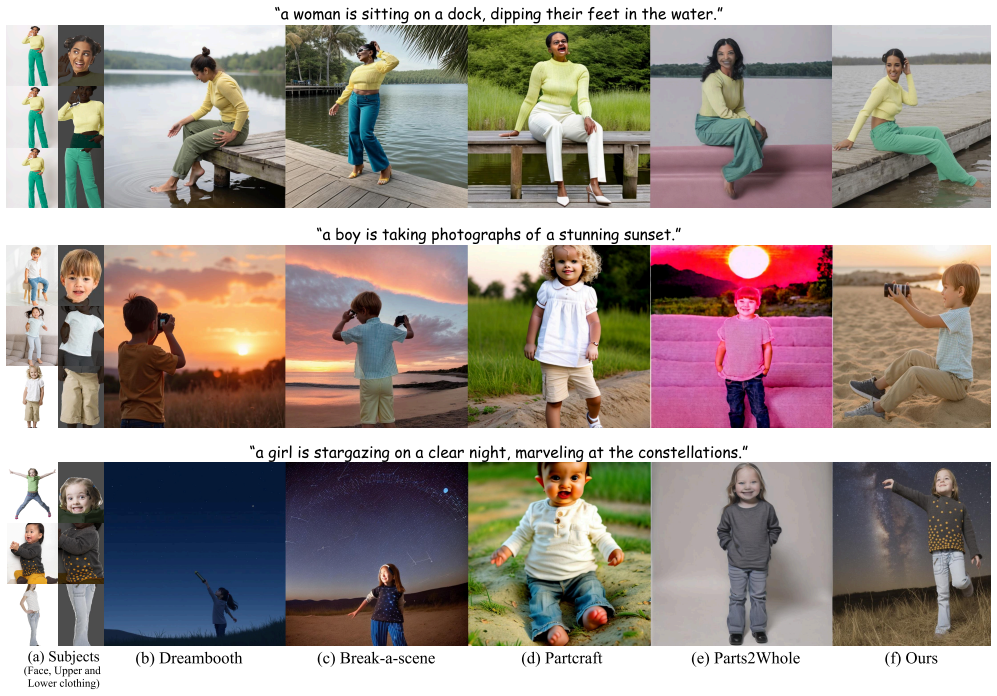
- [Section 4, Evaluation Metrics] The identity similarity metric is ambiguous and likely confounded by the wardrobe region. In WP-LoRA, the generated output is a side-by-side composition in which the left wardrobe region contains masked copies of the reference subjects (Fig. 2). The text explicitly restricts prompt similarity to 'the generated image in the canvas region' but gives no equivalent restriction for identity similarity, stating only that subject-specific cropped images are extracted from 'the generated output' with a human parsing model. If the parser crops can come from the wardrobe region, the DINO embedding will be compared against a near-identical copy of the same subject, inflating I.S. values in Table 1 and Fig. 7 regardless of whether the canvas accurately transfers identity. Because the central quantitative claim rests on this metric, the authors must specify the exact crop-coordinate protocol, release the crop masks, and recast the metric as canvas-only identity similarity. Without this, the numbers in Table 1 and Fig. 7 cannot be interpreted as evidence for the claimed fidelity.
- [Section 4, Baselines and Implementation Details] The comparison with PartCraft and Parts2Whole is not controlled. These baselines are evaluated on the RealVision 3.0 backbone, while WP-LoRA uses FLUX.1-Fill-dev, because of memory constraints (stated in the Implementation Details and Baselines subsections). Since the backbone is a dominant factor in image quality and identity preservation, the reported improvements may reflect backbone capability rather than the proposed method. The authors should either evaluate at least one strong baseline on the same FLUX backbone (e.g., via reduced resolution or a memory-efficient implementation), or provide a same-backbone ablation and explicitly discuss the residual difference. This issue is load-bearing for the claim of 'substantially outperforms existing personalization methods.'
- [Fig. 7 and Table 1] The quantitative results are reported as point estimates without error bars, standard deviations, or statistical significance tests. Figure 7 shows bar charts with no variance information, and Table 1 lists single average values for the training and test sets. Some reported differences are very small (e.g., prompt similarity 0.2868 vs. 0.2912 in Table 1), and without confidence intervals or paired tests across the 1,080 generated images, it is impossible to tell whether the differences are meaningful or within seed-to-seed noise. The authors should report per-seed variance, the number of samples per condition, and appropriate significance tests (e.g., paired bootstrap or Wilcoxon signed-rank) for the headline comparisons.
- [Section 3 and Section 4] The generalization claim—'the model learns to adapt to unseen individuals at test time: as long as the input part belongs to a known category, it accurately transfers its appearance into the final output' (Sec. 3)—is supported only by experiments on 12 unseen identities from Persona-36, a dataset of 36 Getty Images individuals with limited pose, background, and style diversity. This is a small and homogeneous sample for a strong generalization claim. The paper should either expand the unseen-identity evaluation to a more diverse set, or provide a systematic analysis of when transfer fails (e.g., per-identity breakdown, dependence on the number of training identities, and sensitivity to the hand-set hyperparameters pdrop and pssr). Without such evidence, the scope of the generalization claim is not established.
minor comments (4)
- [Section 3.2, Eq. (2)] The notation is ambiguous: the symbol m denotes both the number of part-level subjects and the mask (in Eqs. (2) and (3)), and the subscript t_j in {s_{t_j,j}} is not defined before use. Please use distinct symbols for the mask and the number of subjects, and clarify the prompt/subject indexing.
- [Section 4, Implementation Details] The paper states that 'in cases where the segmentation maps for individual subjects were inaccurate, we manually labeled them,' but it does not specify how many images were manually corrected or the exact manual labeling protocol, which affects reproducibility. Please report the number of manually corrected instances and the criteria used.
- [Section 4.1] There are minor typos and formatting issues, e.g., 'These issues are are also shown' in the second paragraph, and malformed spaces in the Fig. 1 caption ('a man is typing on a laptop' etc.). The manuscript should be proofread.
- [Section 4, Evaluation Metrics] The paper should specify exactly how the nine identity combinations are split between training and test identities, and whether 'set 1', 'set 2', and 'set 3' correspond to training or test combinations. Currently the text says the dataset is split 24/12 but does not state how the nine combinations are allocated.
Circularity Check
Identity-similarity metric can be satisfied by the wardrobe copy, so the headline fidelity numbers may reduce to copying the input rather than measuring canvas transfer.
-
other
[Section 4, Evaluation Metrics (with Section 3.2, Eq. 2)]
"Identity similarity evaluates how accurately compositional subjects are represented in the generated image, focusing on individual subject appearance rather than overall image similarity. To achieve this, we use a pre-trained human parsing model [19] to extract subject-specific cropped images from the generated output. We then compute the average similarity of the extracted subject embeddings using DINO [4], comparing them with their corresponding reference subjects."
The generated image is defined as a side-by-side composition: the reference subjects are placed in the wardrobe region and concatenated with the canvas (Eq. 2, Sec. 3.2), so the output contains near-exact copies of the input subjects. The identity-similarity metric extracts subject-specific crops from the full generated output and compares them with the corresponding reference subjects, without any stated restriction to the canvas region (unlike prompt similarity, which the paper explicitly restricts to the canvas region). If the parser selects the wardrobe copy, the DINO embedding is compared against a near-identical copy of itself, so I.S. is high by construction even when the canvas fails to transfer identity.
full rationale
The paper is largely an empirical training recipe with no uniqueness theorem, no load-bearing self-citation chain, and no fitted parameter renamed as a prediction. The hyperparameters pdrop and pssr are hand-set, and the unseen-identity generalization is tested on 12 held-out identities, so the core generalization claim has independent content. The single significant circularity concern is the identity-similarity metric: because the generated output contains the wardrobe region as an almost identical copy of the reference subjects, and the metric extracts crops from the full generated output without a canvas-only restriction, the reported I.S. values can reflect the presence of the input in the output rather than the model's ability to transfer appearance into the canvas. This reduces one of the paper's headline quantitative claims to a copy of its own input by construction. Since the qualitative results provide some independent evidence of transfer, the circularity is partial rather than total, and no self-citation or uniqueness-import issues are present. The score reflects the by-construction confound in the central fidelity metric, not a failure of the training procedure itself.
Assumptions & free parameters
free parameters (2)
- pdrop =
0.3
- pssr =
0.5
assumptions (3)
- domain assumption FLUX.1-Fill-dev provides a strong inpainting prior with DiT attention capable of spatial transfer.
- domain assumption SCHP and SAM2 produce sufficiently accurate segmentation masks for face, upper, and lower clothing.
- domain assumption CLIP similarity and DINO embedding similarity are valid proxies for prompt and identity fidelity respectively.
Cite this review
Pith. "Pith review of From Wardrobe to Canvas: Wardrobe Polyptych LoRA for Part-level Controllable Human Image Generation." pith.science (2026). https://pith.science/paper/2AN5HNTZ
@misc{pith2026250710217,
  author       = {Pith},
  title        = {Pith review of: From Wardrobe to Canvas: Wardrobe Polyptych LoRA for Part-level Controllable Human Image Generation},
  year         = {2026},
  howpublished = {\url{https://pith.science/paper/2AN5HNTZ}},
  note         = {Machine review of arXiv:2507.10217}
}
read the original abstract
Recent diffusion models achieve personalization by learning specific subjects, allowing learned attributes to be integrated into generated images. However, personalized human image generation remains challenging due to the need for precise and consistent attribute preservation (e.g., identity, clothing details). Existing subject-driven image generation methods often require either (1) inference-time fine-tuning with few images for each new subject or (2) large-scale dataset training for generalization. Both approaches are computationally expensive and impractical for real-time applications. To address these limitations, we present Wardrobe Polyptych LoRA, a novel part-level controllable model for personalized human image generation. By training only LoRA layers, our method removes the computational burden at inference while ensuring high-fidelity synthesis of unseen subjects. Our key idea is to condition the generation on the subject's wardrobe and leverage spatial references to reduce information loss, thereby improving fidelity and consistency. Additionally, we introduce a selective subject region loss, which encourages the model to disregard some of reference images during training. Our loss ensures that generated images better align with text prompts while maintaining subject integrity. Notably, our Wardrobe Polyptych LoRA requires no additional parameters at the inference stage and performs generation using a single model trained on a few training samples. We construct a new dataset and benchmark tailored for personalized human image generation. Extensive experiments show that our approach significantly outperforms existing techniques in fidelity and consistency, enabling realistic and identity-preserving full-body synthesis.
Figures


Figures from the paper (4 more)



Reference graph
Works this paper leans on
-
[1]
A neural space-time representation for text- 8 to-image personalization
Yuval Alaluf, Elad Richardson, Gal Metzer, and Daniel Cohen-Or. A neural space-time representation for text- 8 to-image personalization. ACM Transactions on Graphics (TOG), 42(6):1–10, 2023. 3
work page 2023
-
[2]
Flux.1-dev-controlnet-inpainting
Alimama-Creative. Flux.1-dev-controlnet-inpainting. https://huggingface.co/alimama-creative/ FLUX . 1 - dev - Controlnet - Inpainting - Beta,
-
[3]
Break-a-scene: Extracting multi- ple concepts from a single image
Omri Avrahami, Kfir Aberman, Ohad Fried, Daniel Cohen- Or, and Dani Lischinski. Break-a-scene: Extracting multi- ple concepts from a single image. In SIGGRAPH Asia 2023 Conference Papers, pages 1–12, 2023. 2, 3, 4
work page 2023
-
[4]
Emerg- ing properties in self-supervised vision transformers
Mathilde Caron, Hugo Touvron, Ishan Misra, Herv ´e J´egou, Julien Mairal, Piotr Bojanowski, and Armand Joulin. Emerg- ing properties in self-supervised vision transformers. In Pro- ceedings of the IEEE/CVF international conference on com- puter vision, pages 9650–9660, 2021. 6
2021
-
[5]
Scaling recti- fied flow transformers for high-resolution image synthesis
Patrick Esser, Sumith Kulal, Andreas Blattmann, Rahim Entezari, Jonas M ¨uller, Harry Saini, Yam Levi, Dominik Lorenz, Axel Sauer, Frederic Boesel, et al. Scaling recti- fied flow transformers for high-resolution image synthesis. In Forty-first international conference on machine learning,
-
[6]
Black forest labs. Flux.1-fill-dev. https : / / huggingface . co / black - forest - labs / FLUX . 1-Fill-dev, 2024. 2
work page 2024
-
[7]
An image is worth one word: Personalizing text-to- image generation using textual inversion
Rinon Gal, Yuval Alaluf, Yuval Atzmon, Or Patash- nik, Amit H Bermano, Gal Chechik, and Daniel Cohen- Or. An image is worth one word: Personalizing text-to- image generation using textual inversion. arXiv preprint arXiv:2208.01618, 2022. 2, 3, 4
arXiv 2022
-
[8]
Mix-of-show: Decentralized low- rank adaptation for multi-concept customization of diffusion models
Yuchao Gu, Xintao Wang, Jay Zhangjie Wu, Yujun Shi, Yun- peng Chen, Zihan Fan, Wuyou Xiao, Rui Zhao, Shuning Chang, Weijia Wu, et al. Mix-of-show: Decentralized low- rank adaptation for multi-concept customization of diffusion models. Advances in Neural Information Processing Sys- tems, 36:15890–15902, 2023. 3
2023
Show all 33 references
-
[9]
Viton: An image-based virtual try-on network
Xintong Han, Zuxuan Wu, Zhe Wu, Ruichi Yu, and Larry S Davis. Viton: An image-based virtual try-on network. In Proceedings of the IEEE conference on computer vision and pattern recognition, pages 7543–7552, 2018. 2
2018
-
[10]
Style aligned image generation via shared atten- tion
Amir Hertz, Andrey V oynov, Shlomi Fruchter, and Daniel Cohen-Or. Style aligned image generation via shared atten- tion. In Proceedings of the IEEE/CVF Conference on Com- puter Vision and Pattern Recognition , pages 4775–4785,
-
[11]
Lora: Low-rank adaptation of large language models
Edward J Hu, Yelong Shen, Phillip Wallis, Zeyuan Allen- Zhu, Yuanzhi Li, Shean Wang, Lu Wang, Weizhu Chen, et al. Lora: Low-rank adaptation of large language models. ICLR, 1(2):3, 2022. 4
2022
-
[12]
Animate anyone: Consistent and controllable image- to-video synthesis for character animation
Li Hu. Animate anyone: Consistent and controllable image- to-video synthesis for character animation. InProceedings of the IEEE/CVF Conference on Computer Vision and Pattern Recognition, pages 8153–8163, 2024. 3
2024
-
[13]
In-context lora for diffusion transformers
Lianghua Huang, Wei Wang, Zhi-Fan Wu, Yupeng Shi, Huanzhang Dou, Chen Liang, Yutong Feng, Yu Liu, and Jin- gren Zhou. In-context lora for diffusion transformers. arXiv preprint arXiv:2410.23775, 2024. 2, 7
2024 arXiv
-
[14]
From parts to whole: A unified reference framework for controllable human image generation
Zehuan Huang, Hongxing Fan, Lipeng Wang, and Lu Sheng. From parts to whole: A unified reference framework for controllable human image generation. arXiv preprint arXiv:2404.15267, 2024. 2, 3
2024 arXiv
-
[15]
Stableviton: Learning semantic correspon- dence with latent diffusion model for virtual try-on
Jeongho Kim, Guojung Gu, Minho Park, Sunghyun Park, and Jaegul Choo. Stableviton: Learning semantic correspon- dence with latent diffusion model for virtual try-on. In Pro- ceedings of the IEEE/CVF conference on computer vision and pattern recognition, pages 8176–8185, 2024. 2
2024
-
[16]
Omg: Occlusion-friendly personalized multi-concept generation in diffusion models
Zhe Kong, Yong Zhang, Tianyu Yang, Tao Wang, Kaihao Zhang, Bizhu Wu, Guanying Chen, Wei Liu, and Wenhan Luo. Omg: Occlusion-friendly personalized multi-concept generation in diffusion models. In European Conference on Computer Vision, pages 253–270. Springer, 2024. 3
2024
-
[17]
Multi-concept customization of text-to-image diffusion
Nupur Kumari, Bingliang Zhang, Richard Zhang, Eli Shechtman, and Jun-Yan Zhu. Multi-concept customization of text-to-image diffusion. In Proceedings of the IEEE/CVF conference on computer vision and pattern recognition , pages 1931–1941, 2023. 2, 3
1931
-
[18]
Blip-diffusion: Pre- trained subject representation for controllable text-to-image generation and editing
Dongxu Li, Junnan Li, and Steven Hoi. Blip-diffusion: Pre- trained subject representation for controllable text-to-image generation and editing. Advances in Neural Information Pro- cessing Systems, 36:30146–30166, 2023. 2, 3
2023
-
[19]
Self- correction for human parsing
Peike Li, Yunqiu Xu, Yunchao Wei, and Yi Yang. Self- correction for human parsing. IEEE Transactions on Pattern Analysis and Machine Intelligence, 44(6):3260–3271, 2020. 6
2020
-
[20]
Cosmicman: A text-to-image foun- dation model for humans
Shikai Li, Jianglin Fu, Kaiyuan Liu, Wentao Wang, Kwan- Yee Lin, and Wayne Wu. Cosmicman: A text-to-image foun- dation model for humans. In Proceedings of the IEEE/CVF Conference on Computer Vision and Pattern Recognition , pages 6955–6965, 2024. 2
2024
-
[21]
Flow matching for generative mod- eling
Yaron Lipman, Ricky TQ Chen, Heli Ben-Hamu, Maximil- ian Nickel, and Matt Le. Flow matching for generative mod- eling. arXiv preprint arXiv:2210.02747, 2022. 4
2022 arXiv
-
[22]
Sdedit: Guided image synthesis and editing with stochastic differential equa- tions
Chenlin Meng, Yutong He, Yang Song, Jiaming Song, Jia- jun Wu, Jun-Yan Zhu, and Stefano Ermon. Sdedit: Guided image synthesis and editing with stochastic differential equa- tions. arXiv preprint arXiv:2108.01073, 2021. 7
2021 arXiv
-
[23]
Partcraft: Crafting creative objects by parts
Kam Woh Ng, Xiatian Zhu, Yi-Zhe Song, and Tao Xiang. Partcraft: Crafting creative objects by parts. In European Conference on Computer Vision , pages 420–437. Springer,
-
[24]
Scalable diffusion models with transformers
William Peebles and Saining Xie. Scalable diffusion models with transformers. In Proceedings of the IEEE/CVF inter- national conference on computer vision , pages 4195–4205,
-
[25]
Learning transferable visual models from natural language supervi- sion
Alec Radford, Jong Wook Kim, Chris Hallacy, Aditya Ramesh, Gabriel Goh, Sandhini Agarwal, Girish Sastry, Amanda Askell, Pamela Mishkin, Jack Clark, et al. Learning transferable visual models from natural language supervi- sion. In International conference on machine learning, ...
2021
-
[26]
Sam 2: Segment anything in images and videos
Nikhila Ravi, Valentin Gabeur, Yuan-Ting Hu, Ronghang Hu, Chaitanya Ryali, Tengyu Ma, Haitham Khedr, Roman R¨adle, Chloe Rolland, Laura Gustafson, et al. Sam 2: Segment anything in images and videos. arXiv preprint arXiv:2408.00714, 2024. 6
2024 arXiv
-
[27]
High-resolution image 9 synthesis with latent diffusion models
Robin Rombach, Andreas Blattmann, Dominik Lorenz, Patrick Esser, and Bj ¨orn Ommer. High-resolution image 9 synthesis with latent diffusion models. In Proceedings of the IEEE/CVF conference on computer vision and pattern recognition, pages 10684–10695, 2022. 3
2022
-
[28]
Dreambooth: Fine tuning text-to-image diffusion models for subject-driven generation
Nataniel Ruiz, Yuanzhen Li, Varun Jampani, Yael Pritch, Michael Rubinstein, and Kfir Aberman. Dreambooth: Fine tuning text-to-image diffusion models for subject-driven generation. In Proceedings of the IEEE/CVF conference on computer vision and pattern recognition , pages 2250...
2023
-
[29]
Large-scale text-to-image model with inpainting is a zero-shot subject-driven image generator
Chaehun Shin, Jooyoung Choi, Heeseung Kim, and Sungroh Yoon. Large-scale text-to-image model with inpainting is a zero-shot subject-driven image generator. arXiv preprint arXiv:2411.15466, 2024. 2
2024 arXiv
-
[30]
p+: Extended textual conditioning in text-to- image generation
Andrey V oynov, Qinghao Chu, Daniel Cohen-Or, and Kfir Aberman. p+: Extended textual conditioning in text-to- image generation. arXiv preprint arXiv:2303.09522, 2023. 3
2023 arXiv
-
[31]
Magicanimate: Temporally consistent human im- age animation using diffusion model
Zhongcong Xu, Jianfeng Zhang, Jun Hao Liew, Hanshu Yan, Jia-Wei Liu, Chenxu Zhang, Jiashi Feng, and Mike Zheng Shou. Magicanimate: Temporally consistent human im- age animation using diffusion model. In Proceedings of the IEEE/CVF Conference on Computer Vision and Pattern Reco...
2024
-
[32]
Lora-composer: Leveraging low-rank adap- tation for multi-concept customization in training-free diffu- sion models
Yang Yang, Wen Wang, Liang Peng, Chaotian Song, Yao Chen, Hengjia Li, Xiaolong Yang, Qinglin Lu, Deng Cai, Boxi Wu, et al. Lora-composer: Leveraging low-rank adap- tation for multi-concept customization in training-free diffu- sion models. arXiv preprint arXiv:2403.11627, 2024. 3
2024 arXiv
-
[33]
Ip- adapter: Text compatible image prompt adapter for text-to- image diffusion models
Hu Ye, Jun Zhang, Sibo Liu, Xiao Han, and Wei Yang. Ip- adapter: Text compatible image prompt adapter for text-to- image diffusion models. arXiv preprint arXiv:2308.06721,
Reviewed August 6, 2026 · model on record in the stance chip above.
Discussion (0). Sign in to comment.