REVIEW 4 major objections 4 minor 35 references
Straighten Viscous Rectified Flow via Noise Optimization
T0 review · 4 major / 4 minor · reviewed 2026-08-06 · deepseek-v4-flash
Pith's one-line read The paper argues that reparameterizing the noise through an encoder, instead of reusing generated images as Reflow does, straightens rectified-flow trajectories enough for one-step and few-step generation.
desk verdict Interesting coupling-learning idea, but the headline FID gains rely on a sampler that conditions on dataset images, so the one-step unconditional claim does not hold. read the letter →
The pith
A machine-rendered reading of the paper's core claim, the machinery that carries it, and where it could break.
The reading
What carries the argument
The load-bearing object is the optimized coupling: a pair $(X_0, X_1)$ for which the learned velocity at every interpolated point is within a small epsilon of the reference velocity $X_1 - X_0$. It is produced by reparameterization, $X_0 = \epsilon \cdot \sigma^2 + \mu$ with $\mu, \sigma^2 = E_\phi(X_1)$, so randomly drawn standard-Gaussian noise is reshaped according to the image's encoded statistics. The second mechanism is the historical velocity term, $v_{\mathrm{history}} = \mathrm{stopgrad}(v_\theta(X_{t-\Delta t}, t-\Delta t, 0))$, appended to the velocity field's input so that the model can tell trajectories apart from their direction even when their states look alike. A KL term keeps the encoder's mean and variance near a standard Gaussian, and Theorem 3 asserts the flow with these optimized noises still preserves marginals, $\mathrm{Law}(Z_t) = \mathrm{Law}(X_t)$ for all $t$.
What would settle it
Run Algorithm 2 exactly as written but take the encoder input $X_1$ from a held-out split of the same domain rather than from the training set and recompute FID; if the score jumps from about 4.50 toward the plain one-step RF baseline of 379, the gain comes from conditioning on a dataset image rather than from straightened trajectories. A complementary check is to force the encoder output to standard-Gaussian statistics, $\mu=0$, $\sigma^2=1$, so that $X_0$ is pure noise, and compare the resulting FID.
Extended reading notes
Core claim
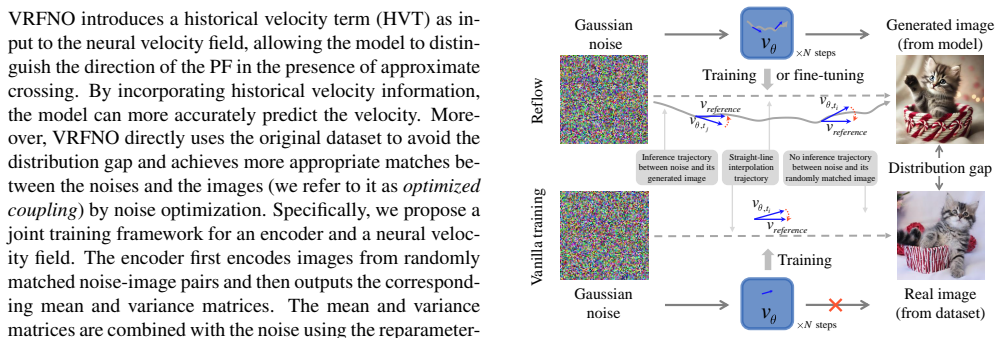
The central claim is that the obstacle to one-step rectified flow is not mainly the crossing of reference trajectories, which the paper argues is exponentially rare in high-dimensional space, but the model's difficulty in telling apart intermediate states whose statistical properties are very similar. The remedy is to make the noise–image coupling learnable: an encoder outputs per-image mean and variance, the noise is reparameterized as $X_0 = \epsilon \cdot \sigma^2 + \mu$, and the velocity field is trained to predict $X_1 - X_0$ along the interpolation while a historical velocity input carries directional information. The paper reports that this yields trajectories measurably closer to straight lines than those of 2-RF or CAF and a one-step FID of 4.50 on CIFAR-10, with better few-step FID than those baselines, all without distillation or adversarial training.
Load-bearing premise
The load-bearing premise is that it is legitimate to start generation from a noise computed by an encoder that has already seen a real image from the dataset; if that is not valid unconditional generation, the reported quality gains over baselines that draw pure random noise are based on an unfair comparison.
Editorial extensions
If this is right
- Training on real images directly removes the distribution gap that builds up when Reflow reuses model-generated images, so quality need not degrade after repeated rectification cycles.
- The paper's tables show one-step CIFAR-10 FID of 4.50, below 2-RF (11.97) and CAF (4.81) in the same comparisons.
- At ten Euler steps, VRFNO lowers CIFAR-10 FID to 3.36, under both 2-RF (3.83) and CAF (3.77).
- The ablation shows the historical-velocity input alone improves one-step FID from 379 to 332 even without noise optimization, and noise optimization alone brings it to 4.72, so both components contribute.
- Because the method does not use distillation or adversarial training, it can be applied to existing rectified-flow architectures by adding a small encoder and a historical-velocity input channel.
Reading between the lines
- Editorial inference: Algorithm 2 takes a dataset image $X_1$ as input and derives the starting noise from it, so the reported one-step results are conditional on an image the model has already seen; an unconditional-generation comparison would need the encoder input drawn from something other than the target data.
- Editorial inference: the same coupling construction suggests an image-to-image or editing recipe in which one image is fixed and only $\epsilon$ varies, since the encoder turns every source image into its own noise subspace.
- Editorial inference: Theorem 2 identifies velocity differences rather than state differences as the discriminative signal, so a natural extension is to feed an accumulated history of predicted velocities to the velocity field rather than only the immediately previous one.
- Editorial inference: if the marginal-preservation claim holds for the encoder-induced family, the method can be read as amortized noise optimization: optimized noises are produced in a single forward pass instead of iterative per-sample optimization, which could transfer to other flow-based generators.
Editorial analysis
A structured set of objections, weighed in public.
Referee Report
Summary. The paper proposes VRFNO, a joint training framework that combines an encoder with a neural velocity field to straighten rectified-flow trajectories. Two mechanisms are introduced: a historical velocity term (HVT) that is fed into the velocity field as auxiliary direction information, and a noise-optimization step in which an encoder reparameterizes Gaussian noise as X0 = ε·σ² + µ, where µ and σ² are outputs of the encoder applied to a real image X1. The authors claim that these optimized couplings avoid the distribution gap of Reflow and enable state-of-the-art one-step and few-step unconditional generation on CIFAR-10 and AFHQ. The paper also contains two theorems about trajectory crossing probability and velocity-versus-state discriminability, plus an ablation study and comparisons with rectified-flow baselines.
Significance. If the claims were valid, the work would offer a distillation-free alternative to Reflow with competitive one-step generation. The paper has useful empirical observations about Reflow and includes an ablation study, which is commendable. However, the central claim is not supported because the sampling protocol uses real dataset images as encoder input, so the reported FID/KID numbers measure an image-conditioned autoencoding procedure rather than unconditional generation. The comparison against unconditional baselines is therefore unfair, and Definition 1 is tautological. The theoretical results are either unproven or, in the case of Theorem 2, false as stated. These issues are load-bearing and cannot be fixed by local revision.
major comments (4)
- [Algorithm 2 / §3.2 Sampling] Algorithm 2 takes as input an "image in dataset X1" and computes X0 = ε·σ² + µ, with µ, σ² = Eφ(X1). The ODE therefore starts from noise that encodes a specific real image, and the output is a stochastic transform of that conditioning image rather than a sample drawn from π0 = N(0,I) and evolved to the data distribution. The text in §3.2 explicitly states "we integrate the dataset into the sampler." Consequently, the FID and KID numbers in Tables 1 and 2 compare this conditional autoencoding procedure against unconditional baselines such as 1-RF, 2-RF, and CAF, which sample from pure Gaussian noise. No experiment reports unconditional sampling from Gaussian noise alone, so the state-of-the-art generation claim is not demonstrated.
- [Definition 1 / Eq. (7)] Definition 1 defines an optimized coupling as a pair (X0,X1) satisfying ∥vθ(tX1+(1−t)X0)−(X1−X0)∥≤ε, which is exactly the regression objective minimized in Eq. (7). This makes the notion circular: the encoder is trained to produce pairs that satisfy the same objective that is used to declare success, so the encoder's effectiveness is tautological. Theorem 3, even if proven, concerns the training-time marginal Law(Zt)=Law(Xt) and does not justify the test-time marginal of X0; unless the encoder collapses to µ=0 and σ=1, the test-time X0 is not distributed as N(0,I).
- [Theorem 2] Theorem 2 as stated is false. Consider two trajectories with X0^(i)=(0,0), X1^(i)=(1,0) and X0^(j)=(0,1), X1^(j)=(1,1). The reference velocities are identical, so Δ(v_ref^(i), v_ref^(j))=0, while the state difference Δ(Xt^(i), Xt^(j))=1 for every t∈[0,1]. The claimed inequality therefore cannot hold in general, and the HVT cannot be justified by this theorem. Theorem 1 is also asserted without a proof or a precise definition of "crossing" (exact crossing at a point is a measure-zero event for continuous distributions, and the claimed rate O(e^{−c(n×n)}) is not derived).
- [Table 3] The ablation study in Table 3 conflates the effect of noise optimization with the change of sampling protocol. Config A (no HVT, no noise optimization) presumably evaluates ordinary unconditional sampling, while config C (noise optimization alone, FID 4.72 at NFE=1) uses the encoder-conditioned starting noise of Algorithm 2. The large gain from A to C is therefore not attributable to straighter trajectories or better training couplings, but at least in part to the fact that the sampler is provided with a real dataset image. This reinforces the concern that the headline improvements in Tables 1 and 2 are artifacts of the evaluation protocol rather than of unconditional generation quality.
minor comments (4)
- [§4.2 / Table 1] The text reports FID=4.53, KID=2.73, and IS=10.59 for one-step CIFAR-10, while Table 1 lists FID=4.50, KID=2.73, and IS=9.59 for the same configuration; please reconcile these numbers.
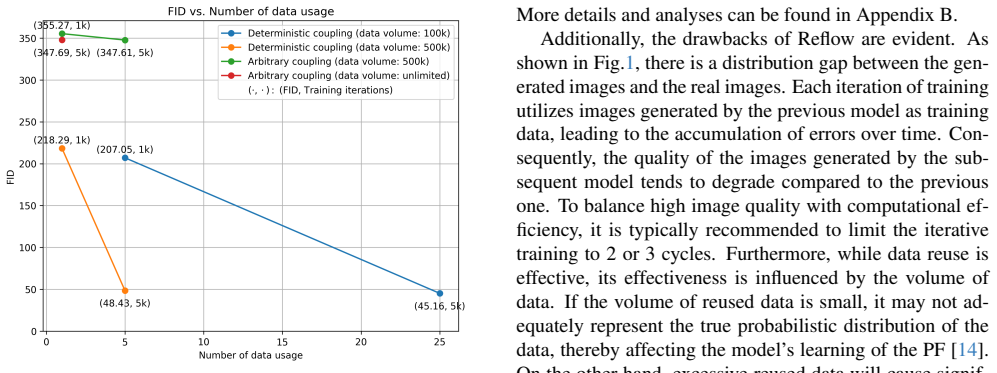
- [§2.2 / Figure 2] Figure 2 is referenced to support the claims about coupling type and data reuse, but the axes and experimental setting (number of iterations, dataset, metric) are not described in the caption; please make the figure self-contained.
- [Appendix references] Theorems 1–3 and implementation details are deferred to appendices A, B, C, and E, but the arXiv v1 submission does not include these appendices; please include them so the proofs and experimental details can be checked.
- [Theorem 2 notation] The definition ∆(·,·)=E[∥·−·∥²_F] in Theorem 2 does not specify the randomness over which the expectation is taken; please clarify whether it is over the data distribution, the time index, or the random coupling.
Circularity Check
Reported SOTA FID is measured with a sampler that conditions on a real dataset image; one-step 'generation' is a stochastic autoencoding of X1, so the central claim reduces by construction.
-
self definitional
[Section 3, Definition 1 (page 3)]
"(X0, X1) is called an optimized coupling if it satisfies the following condition: ∥vθ(tX1 + (1 − t)X0) − (X1 − X0)∥ ≤ ε, where ε > 0 is a small positive constant."
This definition of 'optimized coupling' is literally the velocity-consistency objective minimized in Eq. (7): VCL(θ, φ) = E[d(vref, vθ(Xt, t, vhistory))] with vref = X1 − X0. Hence the paper's claim that the encoder 'forms optimized couplings with real images' is true by construction once the joint loss is minimized; no independent criterion (optimal transport cost, straightness, or marginal preservation) is used to define optimality. The word 'optimized' names the training target rather than an independently derived property, so the proposed coupling mechanism is a definitional restatement of the loss.
-
fitted input called prediction
[Section 3.2, Algorithm 2 and 'Sampling' paragraph; Tables 1-2]
"Algorithm 2 Sampling of VRFNO. Input: image in dataset X1, sampling steps N, encoder Eφ, velocity field vθ. ... µ, σ2 = Eφ(X1); X0 = ε · σ2 + µ ... Additionally, we integrate the dataset into the sampler, meaning that the sampled noise is also reparameterized during the generation process."
At test time the ODE is initialized not from the learned base distribution π0 = N(0, I) but from X0 = εσ2 + µ, with (µ, σ2) = Eφ(X1), i.e., from a noise that already encodes the target image X1. The velocity field is trained so that vθ(tX1 + (1 − t)X0) ≈ X1 − X0; starting at this data-dependent X0 and integrating therefore reconstructs the conditioning image. FID/KID in Tables 1-2 are computed for VRFNO with this protocol, while baselines (1-RF, 2-RF, CAF) sample from pure Gaussian noise. The comparison turns 'one-step/few-step generation' into a stochastic autoencoding of dataset images, so the reported state-of-the-art result is forced by the evaluation protocol.
full rationale
The central derivation chain is not self-citation-driven: the paper does not rest its method on prior work by the same authors, and the HVT design, while using the model's own previous prediction as input, is a standard recurrence rather than a circular logical step. The circularity is instead in the evaluation and in the definition of the central object. Definition 1 defines 'optimized coupling' as exactly the inequality minimized by the joint loss, so the existence of optimized couplings is not an independent finding, it is the training objective by another name. More importantly, Algorithm 2's stated input is a real dataset image X1, and the initial ODE state X0 is computed from Eφ(X1). The reported FID/KID numbers therefore measure how well VRFNO reconstructs the conditioning image after one or few Euler steps, whereas the baselines (1-RF, 2-RF, CAF) start from standard Gaussian noise and perform genuine unconditional generation. No experiment reports the full VRFNO model sampling with X0 ~ N(0, I) independent of any dataset image; the closest configurations (A/B in Table 3) disable noise optimization. Consequently, the abstract's claim of 'state-of-the-art performance in both one-step and few-step generation tasks' is not supported as an unconditional generation result; it reduces, by the paper's own sampler, to a stochastic autoencoding of the input image. The KL regularization and Theorem 3 do not repair this, because the KL term only keeps µ and σ2 near prior values while still conditioning on X1, and Theorem 3 concerns marginal preservation of a process Z whose initial law is not the conditional law used in Algorithm 2.
Assumptions & free parameters
free parameters (3)
- alpha (KL loss weight)
- delta_t (time interval)
- perturbation scale
assumptions (4)
- ad hoc to paper Theorem 1: trajectory crossing probability is O(e^{-c(n×n)})
- ad hoc to paper Theorem 2: velocity differences exceed state differences along trajectories
- domain assumption Marginal preserving property of the viscous rectified flow (Theorem 3)
- domain assumption A Gaussian reparameterization (X0 = ϵ·σ² + µ) can realize optimized couplings
invented entities (3)
-
Historical velocity term (v_history)
-
Optimized coupling
-
Viscous rectified flow (VRF)
Cite this review
Pith. "Pith review of Straighten Viscous Rectified Flow via Noise Optimization." pith.science (2026). https://pith.science/paper/ZZCGNSX4
@misc{pith2026250710218,
  author       = {Pith},
  title        = {Pith review of: Straighten Viscous Rectified Flow via Noise Optimization},
  year         = {2026},
  howpublished = {\url{https://pith.science/paper/ZZCGNSX4}},
  note         = {Machine review of arXiv:2507.10218}
}
read the original abstract
The Reflow operation aims to straighten the inference trajectories of the rectified flow during training by constructing deterministic couplings between noises and images, thereby improving the quality of generated images in single-step or few-step generation. However, we identify critical limitations in Reflow, particularly its inability to rapidly generate high-quality images due to a distribution gap between images in its constructed deterministic couplings and real images. To address these shortcomings, we propose a novel alternative called Straighten Viscous Rectified Flow via Noise Optimization (VRFNO), which is a joint training framework integrating an encoder and a neural velocity field. VRFNO introduces two key innovations: (1) a historical velocity term that enhances trajectory distinction, enabling the model to more accurately predict the velocity of the current trajectory, and (2) the noise optimization through reparameterization to form optimized couplings with real images which are then utilized for training, effectively mitigating errors caused by Reflow's limitations. Comprehensive experiments on synthetic data and real datasets with varying resolutions show that VRFNO significantly mitigates the limitations of Reflow, achieving state-of-the-art performance in both one-step and few-step generation tasks.
Figures

Figures from the paper (2 more)

Reference graph
Works this paper leans on
-
[1]
Jonas Adler and Sebastian Lunz. Banach wasserstein gan. Advances in neural information processing systems , 31,
-
[2]
Fan Bao, Chongxuan Li, Jun Zhu, and Bo Zhang. Analytic- dpm: an analytic estimate of the optimal reverse vari- ance in diffusion probabilistic models. arXiv preprint arXiv:2201.06503, 2022. 8
arXiv 2022
-
[3]
Stargan v2: Diverse image synthesis for multiple domains
Yunjey Choi, Youngjung Uh, Jaejun Yoo, and Jung-Woo Ha. Stargan v2: Diverse image synthesis for multiple domains. In Proceedings of the IEEE/CVF conference on computer vi- sion and pattern recognition, pages 8188–8197, 2020. 6
work page 2020
-
[4]
Attack deterministic conditional image generative models for di- verse and controllable generation
Tianyi Chu, Wei Xing, Jiafu Chen, Zhizhong Wang, Jiakai Sun, Lei Zhao, Haibo Chen, and Huaizhong Lin. Attack deterministic conditional image generative models for di- verse and controllable generation. In Proceedings of the AAAI Conference on Artificial Intelligence , pages 1362– 1370, 2024. 1
work page 2024
-
[5]
Genie: Higher-order denoising diffusion solvers
Tim Dockhorn, Arash Vahdat, and Karsten Kreis. Genie: Higher-order denoising diffusion solvers. Advances in Neu- ral Information Processing Systems, 35:30150–30166, 2022. 8
work page 2022
-
[6]
Reno: Enhancing one-step text-to-image models through reward-based noise optimiza- tion
Luca Eyring, Shyamgopal Karthik, Karsten Roth, Alexey Dosovitskiy, and Zeynep Akata. Reno: Enhancing one-step text-to-image models through reward-based noise optimiza- tion. Advances in Neural Information Processing Systems , 37:125487–125519, 2025. 5
work page 2025
-
[7]
One step diffusion via shortcut models
Kevin Frans, Danijar Hafner, Sergey Levine, and Pieter Abbeel. One step diffusion via shortcut models. arXiv preprint arXiv:2410.12557, 2024. 6
arXiv 2024
-
[8]
beta-vae: Learning basic visual concepts with a constrained variational framework
Irina Higgins, Loic Matthey, Arka Pal, Christopher P Burgess, Xavier Glorot, Matthew M Botvinick, Shakir Mo- hamed, and Alexander Lerchner. beta-vae: Learning basic visual concepts with a constrained variational framework. ICLR (Poster), 3, 2017. 5, 7
work page 2017
Show all 35 references
-
[9]
Denoising dif- fusion probabilistic models
Jonathan Ho, Ajay Jain, and Pieter Abbeel. Denoising dif- fusion probabilistic models. Advances in neural information processing systems, 33:6840–6851, 2020. 1, 8
2020
-
[10]
Elucidating the design space of diffusion-based generative models
Tero Karras, Miika Aittala, Timo Aila, and Samuli Laine. Elucidating the design space of diffusion-based generative models. Advances in neural information processing systems, 35:26565–26577, 2022. 6
2022
-
[11]
Consistency trajectory mod- els: Learning probability flow ode trajectory of diffusion
Dongjun Kim, Chieh-Hsin Lai, Wei-Hsiang Liao, Naoki Mu- rata, Yuhta Takida, Toshimitsu Uesaka, Yutong He, Yuki Mitsufuji, and Stefano Ermon. Consistency trajectory mod- els: Learning probability flow ode trajectory of diffusion. arXiv preprint arXiv:2310.02279, 2023. 8
-
[12]
Learning multiple layers of features from tiny images
Alex Krizhevsky, Geoffrey Hinton, et al. Learning multiple layers of features from tiny images. 2009. 6
2009
-
[13]
Rectified flow: A marginal preserving approach to optimal transport
Qiang Liu. Rectified flow: A marginal preserving approach to optimal transport. arXiv preprint arXiv:2209.14577, 2022. 2
2022 arXiv
-
[14]
Flow straight and fast: Learning to generate and transfer data with rectified flow
Xingchao Liu, Chengyue Gong, and Qiang Liu. Flow straight and fast: Learning to generate and transfer data with rectified flow. arXiv preprint arXiv:2209.03003, 2023. 1, 3, 6, 8
2023 arXiv
-
[15]
Instaflow: One step is enough for high-quality diffusion- based text-to-image generation
Xingchao Liu, Xiwen Zhang, Jianzhu Ma, Jian Peng, et al. Instaflow: One step is enough for high-quality diffusion- based text-to-image generation. In The Twelfth International Conference on Learning Representations, 2024. 1, 8
2024
-
[16]
Dpm-solver: A fast ode solver for diffusion probabilistic model sampling in around 10 steps
Cheng Lu, Yuhao Zhou, Fan Bao, Jianfei Chen, Chongxuan Li, and Jun Zhu. Dpm-solver: A fast ode solver for diffusion probabilistic model sampling in around 10 steps. Advances in Neural Information Processing Systems , 35:5775–5787,
-
[17]
Dpm-solver++: Fast solver for guided sampling of diffusion probabilistic models
Cheng Lu, Yuhao Zhou, Fan Bao, Jianfei Chen, Chongx- uan Li, and Jun Zhu. Dpm-solver++: Fast solver for guided sampling of diffusion probabilistic models. arXiv preprint arXiv:2211.01095, 2022. 8
2022 arXiv
-
[18]
Knowledge distillation in iterative generative models for improved sampling speed
Eric Luhman and Troy Luhman. Knowledge distillation in iterative generative models for improved sampling speed. arXiv preprint arXiv:2101.02388, 2021. 6
2021 arXiv
-
[19]
Latent consistency models: Synthesizing high- resolution images with few-step inference
Simian Luo, Yiqin Tan, Longbo Huang, Jian Li, and Hang Zhao. Latent consistency models: Synthesizing high- resolution images with few-step inference. arXiv preprint arXiv:2310.04378, 2023. 8
2023 arXiv
-
[20]
Diff-instruct: A universal approach for transferring knowledge from pre-trained diffu- sion models
Weijian Luo, Tianyang Hu, Shifeng Zhang, Jiacheng Sun, Zhenguo Li, and Zhihua Zhang. Diff-instruct: A universal approach for transferring knowledge from pre-trained diffu- sion models. Advances in Neural Information Processing Systems, 36, 2024. 8
2024
-
[21]
Constant acceler- ation flow
Dogyun Park, Sojin Lee, Sihyeon Kim, Taehoon Lee, Youngjoon Hong, and Hyunwoo J Kim. Constant acceler- ation flow. arXiv preprint arXiv:2411.00322, 2024. 6
2024 arXiv
-
[22]
2-rectifications are enough for straight flows: A theoretical insight into wasserstein convergence
Saptarshi Roy, Vansh Bansal, Purnamrita Sarkar, and Alessandro Rinaldo. 2-rectifications are enough for straight flows: A theoretical insight into wasserstein convergence. arXiv e-prints, pages arXiv–2410, 2024. 1
2024
-
[23]
Palette: Image-to-image diffusion models
Chitwan Saharia, William Chan, Huiwen Chang, Chris Lee, Jonathan Ho, Tim Salimans, David Fleet, and Mohammad Norouzi. Palette: Image-to-image diffusion models. In ACM SIGGRAPH 2022 conference proceedings, pages 1–10,
2022
-
[24]
Progressive distillation for fast sampling of diffusion models
Tim Salimans and Jonathan Ho. Progressive distillation for fast sampling of diffusion models. arXiv preprint arXiv:2202.00512, 2022. 6, 8
2022 arXiv
-
[25]
Denoising diffusion implicit models
Jiaming Song, Chenlin Meng, and Stefano Ermon. Denoising diffusion implicit models. arXiv preprint arXiv:2010.02502, 2020. 1, 8
2010 arXiv
-
[26]
Improved techniques for training score-based generative models
Yang Song and Stefano Ermon. Improved techniques for training score-based generative models. Advances in neural information processing systems, 33:12438–12448, 2020. 7
2020
-
[27]
Score-based generative modeling through stochastic differential equa- tions
Yang Song, Jascha Sohl-Dickstein, Diederik P Kingma, Ab- hishek Kumar, Stefano Ermon, and Ben Poole. Score-based generative modeling through stochastic differential equa- tions. arXiv preprint arXiv:2011.13456, 2020. 6, 7
2011 arXiv
-
[28]
Consistency models
Yang Song, Prafulla Dhariwal, Mark Chen, and Ilya Sutskever. Consistency models. arXiv preprint arXiv:2303.01469, 2023. 6, 8
2023 arXiv
-
[29]
Traflow: Trajectory distillation on pre-trained rectified flow,
Zhangkai Wu, Xuhui Fan, Hongyu Wu, and Longbing Cao. Traflow: Trajectory distillation on pre-trained rectified flow,
-
[30]
Topic-vq-vae: Lever- aging latent codebooks for flexible topic-guided document generation
YoungJoon Yoo and Jongwon Choi. Topic-vq-vae: Lever- aging latent codebooks for flexible topic-guided document generation. In Proceedings of the AAAI Conference on Arti- ficial Intelligence, pages 19422–19430, 2024. 1
2024
-
[31]
Fast sampling of dif- fusion models with exponential integrator
Qinsheng Zhang and Yongxin Chen. Fast sampling of dif- fusion models with exponential integrator. arXiv preprint arXiv:2204.13902, 2022. 8
2022 arXiv
-
[32]
The unreasonable effectiveness of deep features as a perceptual metric
Richard Zhang, Phillip Isola, Alexei A Efros, Eli Shecht- man, and Oliver Wang. The unreasonable effectiveness of deep features as a perceptual metric. In Proceedings of the IEEE conference on computer vision and pattern recogni- tion, pages 586–595, 2018. 5
2018
-
[33]
Unipc: A unified predictor-corrector framework for fast sampling of diffusion models
Wenliang Zhao, Lujia Bai, Yongming Rao, Jie Zhou, and Jiwen Lu. Unipc: A unified predictor-corrector framework for fast sampling of diffusion models. Advances in Neural Information Processing Systems, 36, 2024. 8
2024
-
[34]
Dc- solver: Improving predictor-corrector diffusion sampler via dynamic compensation
Wenliang Zhao, Haolin Wang, Jie Zhou, and Jiwen Lu. Dc- solver: Improving predictor-corrector diffusion sampler via dynamic compensation. arXiv preprint arXiv:2409.03755 ,
-
[35]
Golden noise for diffusion models: A learning framework
Zikai Zhou, Shitong Shao, Lichen Bai, Zhiqiang Xu, Bo Han, and Zeke Xie. Golden noise for diffusion models: A learning framework. arXiv preprint arXiv:2411.09502 ,
Reviewed August 6, 2026 · model on record in the stance chip above.
Discussion (0). Sign in to comment.