REVIEW 5 major objections 6 minor 68 references
Synthesizing Near-Boundary OOD Samples for Out-of-Distribution Detection
T0 review · 5 major / 6 minor · reviewed 2026-08-06 · deepseek-v4-flash
Pith's one-line read This paper claims that near-boundary OOD samples can be synthesized by iterative diffusion inpainting guided by an energy-score gradient, and that fine-tuning CLIP on these samples yields average AUROC 97.01 and FPR95 14.27 on ImageNet…
desk verdict A practical, well-ablated synthetic-data pipeline for CLIP OOD detection whose benchmark gains may be partly driven by semantic overlap between the generated scenes and the test OOD sets. read the letter →
The pith
A machine-rendered reading of the paper's core claim, the machinery that carries it, and where it could break.
The reading
What carries the argument
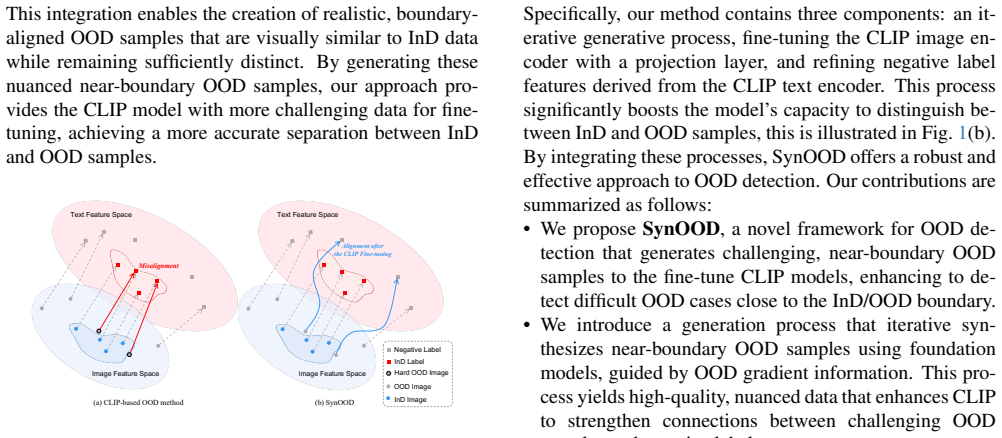
The mechanism that carries the argument is a closed loop between generation and detection. An MLLM supplies contextual prompts; a latent diffusion model performs iterative inpainting with strength below 1, so the scene's background is preserved while the subject is replaced. The key identity is the gradient update on the initial noise, $\epsilon := \epsilon - r \tilde{\nabla}_\epsilon L_O$, where $L_O$ is the energy score $L_O = m_\text{out} - \tau \log \sum_{i=1}^C e^{g_i(x_\text{syn})/\tau}$ computed on a frozen ResNet50 classifier, and a skip-gradient approximation makes the backpropagation tractable by dropping the Jacobian through the diffusion U-Net. This loop pushes generated images toward the detector's boundary rather than merely sampling random OOD-like images. On the fine-tuning side, the CLIP image encoder stays frozen while a projection layer is trained with a CLIP contrastive loss against negative labels, and then roughly half of the negative-label text features are tuned directly, which the paper argues prevents overfitting and keeps far-OOD sensitivity.
What would settle it
Take the generated synthetic set and measure its OOD score under the final fine-tuned CLIP detector. If the generated images' score distribution is not systematically closer to the InD/OOD threshold than ordinary ImageNet images, the claim that the energy-gradient loop manufactures near-boundary samples is false. A second check: replace the energy score with another OOD score, such as maximum softmax probability or nearest-neighbor distance; if the improvement disappears, boundary-adjacent generation rather than the specific energy loss is the wrong explanation.
Extended reading notes
Core claim
On its own terms, the paper's central claim is that iterative inpainting guided by an OOD-score gradient samples from the InD/OOD boundary, and that fine-tuning CLIP on those samples sharpens the boundary. Concretely, starting from an in-distribution image, the method lets an MLLM name contextual elements (for example, 'bamboo' for a panda image), then repeatedly denoises an inpainting diffusion model with a learnable noise vector updated by the gradient of an energy-based OOD loss from a ResNet50 classifier (Equations 7–10). The resulting synthetic images are visually similar to the originals but semantically outside the label space. Paired with the original images and a set of negative labels, they are used to train a projection layer on the frozen CLIP image encoder and to fine-tune about half of the negative-label text features. Across iNaturalist, SUN, Places, and Texture, the method reports average AUROC 97.01 and FPR95 14.27, improving on NegLabel, CSP, and AdaNeg, with under 2 ms added inference per image.
Load-bearing premise
The method assumes that images pushed to the energy-score boundary of a ResNet50 classifier are representative of the hard out-of-distribution cases the final CLIP detector will encounter, even though the boundary is computed on a different architecture and feature space and the test OOD datasets are unseen.
Editorial extensions
If this is right
- Synthetic near-boundary data can substitute for real OOD examples in fine-tuning CLIP, so detectors can be improved without waiting for or labeling natural OOD collections.
- The method adds under 1% parameters and under 2 ms inference time, so the improvement is compatible with deployment on top of existing CLIP-based detectors.
- The gains transfer across CLIP backbones (ResNet50, ViT-B/32, ViT-B/16), suggesting the fine-tuning recipe is architecture-agnostic.
- On the OpenOOD benchmark, the approach improves far-OOD detection to 96.21 AUROC and near-OOD to 77.55 AUROC while using only a 50k-image subset, showing the generation pipeline helps where real OOD training data is scarce.
- Fine-tuning about half of the negative label features, rather than all of them, preserves far-OOD performance while sharpening near-boundary discrimination; exceeding that budget degrades results.
Reading between the lines
- A testable extension is to drive the generation loop with a boundary defined directly in CLIP feature space instead of ResNet50 logits; if the proxy boundary is the active ingredient, CLIP-defined boundaries should match or beat the current results, and if not, the ResNet50 proxy may be supplying useful inductive bias.
- The same loop could be applied to other closed-set classifiers beyond CLIP, such as medical-image or defect-detection models, wherever near-boundary negatives are scarce; the paper does not test this.
- If the generated data are close enough to the true boundary, they could also serve as calibration or adversarial-training data, a use the paper leaves implicit.
- The sensitivity to the number of fine-tuned negative labels (peak at 50k synthetic images, decline at 75k) suggests the method's gains depend on a specific balance; reproducing the exact label-subset selection rule is needed before extrapolating.
Editorial analysis
A structured set of objections, weighed in public.
Referee Report
Summary. The paper proposes SynOOD, a method that generates synthetic near-boundary out-of-distribution (OOD) images for fine-tuning CLIP-based OOD detectors. An MLLM extracts contextual elements from ImageNet images by prompting for everything except the class subject; an iterative inpainting diffusion process replaces the subject with these context elements, guided by an energy-score loss computed with a ResNet50 classifier. The resulting synthetic OOD images, paired with negative labels, are used to fine-tune a projection layer on the CLIP image encoder and a subset of CLIP text-encoder negative-label features. On ImageNet-1k as in-distribution data, SynOOD reports state-of-the-art average AUROC 97.01 and FPR95 14.27 across iNaturalist, SUN, Places, and Texture, with a smaller-than-1% parameter increase and under 2 ms added inference time. The paper also reports results on the OpenOOD benchmark and across CLIP backbones (ResNet50, ViT-B/32, ViT-B/16), together with ablations of the generation strategy, the amount of synthetic data, and the training scheme.
Significance. If the central claim holds, SynOOD is a practically valuable contribution: it shows that foundation-model-based synthetic data can improve boundary-level OOD discrimination for CLIP, and the paper provides a public code release, ablations of design choices, and results across multiple architectures and evaluation protocols. The improvements over NegLabel on Places and Texture are large (AUROC +5.73 and +5.07 in Table 1), suggesting a real effect. However, the significance is moderated by the concern that the synthetic data may be semantically aligned with the scene/texture test distributions by construction, and by the absence of the directly competing DreamOOD baseline and of error bars. These issues do not invalidate the empirical findings but do affect the strength of the generality claim.
major comments (5)
- [Section 3.3, Eq. (3)] The synthetic OOD distribution appears to be semantically constructed to match the test OOD sets. The prompt p_in explicitly asks for 'what else is in the context besides the {class name}', and the iterative inpainting replaces the foreground subject with those contextual elements. For ImageNet, such context elements are typically scene components (sky, water, grass, buildings, textures), and the test sets SUN, Places365, and Texture are drawn from exactly these distributions. The largest gains in Table 1 are on Places (+5.73 AUROC over NegLabel) and Texture (+5.07), consistent with this confound. The paper provides no analysis of the overlap between the MLLM-extracted context terms and the test OOD class semantics, nor an experiment on a held-out OOD set that is not scene/texture-like (e.g., a non-natural-image dataset). Without such evidence, the contribution may be benchmark-specific data augmentation rather than general near-boundary OOD synthesis. I ask the authors to add a control experiment that evaluates on OOD sets with different semantic structure, and to quantify the semantic overlap between p_con and the test OOD datasets.
- [Section 3.3, Eqs. (7)-(10)] The near-boundary property is defined by an energy score on a ResNet50 classifier, while the final detector uses CLIP ViT-B/16. The paper does not show that samples pushed toward the ResNet50 energy boundary are also near the CLIP decision boundary, nor that the generated images are actually near any boundary under the final scoring function. The Skip Gradient approximation in Eq. (9) drops the Jacobian terms involving the diffusion denoising process, so the gradient signal is a coarse proxy; the paper claims rapid convergence of L_O but reports no distribution of final energy scores or any verification that the generated samples occupy the intended region. I request an analysis showing the energy scores of synthetic images under both ResNet50 and CLIP (or under the final OOD score used at test time), together with a comparison to real OOD samples, to support the claim that the generated data are genuinely near-boundary for the deployed detector.
- [Related Work and Table 1] DreamOOD [62] is cited as a method that learns a text-conditioned latent space to generate diverse OOD samples and is the closest generation-based baseline to SynOOD, yet it is absent from the main comparison in Table 1. Since the paper claims state-of-the-art performance, a direct comparison to DreamOOD on the same four OOD datasets is necessary, or the authors should state clearly why this baseline is excluded. Without this comparison, the superiority claim is not fully established for the generation-based family of methods.
- [Section 3.4] The construction of the fine-tuning dataset is under-specified. The paper states that each synthetic image is paired one-to-one with a negative label y^- in D_syn, but it does not specify how a given synthetic image is assigned to a particular negative label from Y^-, nor how the subset Y^*_ of 'associated' negative labels is formed. In addition, the selection of the InD subset D_in^* is based on a JPEG file-size-to-pixel-ratio heuristic, but no ablation compares this heuristic with random selection or with other complexity measures. These choices are load-bearing for the fine-tuning step and for the claim that the negative-label pairing drives the improvement, so they need to be described precisely and validated.
- [Table 1] All reported numbers are single-run point estimates without standard deviations or significance tests. Given that the generation process is stochastic (diffusion noise and iterative gradient updates) and the fine-tuning uses only 3-5 epochs, run-to-run variance could be non-negligible; several of the claimed improvements over AdaNeg, for example, are on the order of 1-2 FPR95 points. Please report mean and standard deviation over at least three random seeds for the main experiments, or explain why variance is negligible.
minor comments (6)
- [Eq. (2)] The denominator in Eq. (2) appears to be missing a plus sign: it should read sim(x, Y) + sim(x, Y^-) rather than sim(x,Y) sim(x,Y^-).
- [Section 3.5, Eqs. (13)-(14)] In Eq. (13) the synthetic image feature is defined as I_syn_i, but Eq. (14) uses I_i in the numerator; please make the notation consistent.
- [Table 1 and Section 4.3] There are typos in the headers: 'iNatrualist' should be 'iNaturalist' in Table 1, and 'Anaylsis' should be 'Analysis' in Section 4.3.
- [Figure 2] The label 'Label y_i\'' in Figure 2 is ambiguous; it should be clarified whether this is an InD label or a negative label.
- [Section 4.1] The paper states that SynOOD adds 'less than 1% additional parameters', but the number of learnable negative-label features in T_neg^* and the projection layer size are not given; please report the exact parameter counts.
- [Conclusion] The paper would benefit from a short limitations paragraph, in particular discussing the dependence on the MLLM/diffusion model quality and the computational cost of the offline generation phase.
Circularity Check
No significant circularity: the headline results are measured on held-out OOD datasets, and the energy-score guidance is a proxy used only for data synthesis, not the evaluation metric.
full rationale
I walked the derivation chain from Eq. (3) through Eq. (14) and the evaluation tables. The synthetic OOD images are generated by MLLM-context inpainting with an energy-score gradient on a ResNet50 (Eqs. 7-10), but this OOD score is not reused by the final CLIP detector; the detector is evaluated on held-out iNaturalist, SUN, Places, Texture, and OpenOOD sets. No fitted constant is renamed as a prediction: m_out is a synthesis target, and the reported AUROC/FPR95 values are computed from the fine-tuned CLIP score on test data. The learnable negative labels are trained only on synthetic data and tested on unseen OOD images, which is standard supervised fine-tuning rather than circularity. The cited Skip Gradient operation [32] is an external technique adopted for computational efficiency and does not smuggle in the target result. The self-citations [19,20] are contextual related-work citations, not load-bearing premises. The observation that MLLM-extracted scene/texture context may overlap with the SUN/Places/Texture test distributions is a benchmark-validity or distribution-overlap concern, not a circular derivation, because the test images themselves are never used to generate or select the synthetic data. No specific step reduces, by construction or self-citation, to its own inputs; therefore no circularity is established.
Assumptions & free parameters
free parameters (4)
- Energy threshold m_out =
not reported
- Gradient scale r*rho =
10
- Number of synthetic samples m =
50k (main results)
- Number of fine-tuned negative labels M' =
about 5.5k of 11k
assumptions (4)
- domain assumption The energy score of a ResNet50 classifier is a valid proxy for the InD/OOD boundary.
- domain assumption The MLLM (LLaVA) reliably enumerates contextual elements whose substitution yields meaningful OOD prompts.
- ad hoc to paper The Skip Gradient approximation from Chen et al. [32] preserves enough gradient signal to guide diffusion noise toward the energy boundary.
- domain assumption WordNet-derived negative labels (from NegLabel [18]) cover the semantic space of possible OOD categories.
Cite this review
Pith. "Pith review of Synthesizing Near-Boundary OOD Samples for Out-of-Distribution Detection." pith.science (2026). https://pith.science/paper/F6XWELXK
@misc{pith2026250710225,
  author       = {Pith},
  title        = {Pith review of: Synthesizing Near-Boundary OOD Samples for Out-of-Distribution Detection},
  year         = {2026},
  howpublished = {\url{https://pith.science/paper/F6XWELXK}},
  note         = {Machine review of arXiv:2507.10225}
}
read the original abstract
Pre-trained vision-language models have exhibited remarkable abilities in detecting out-of-distribution (OOD) samples. However, some challenging OOD samples, which lie close to in-distribution (InD) data in image feature space, can still lead to misclassification. The emergence of foundation models like diffusion models and multimodal large language models (MLLMs) offers a potential solution to this issue. In this work, we propose SynOOD, a novel approach that harnesses foundation models to generate synthetic, challenging OOD data for fine-tuning CLIP models, thereby enhancing boundary-level discrimination between InD and OOD samples. Our method uses an iterative in-painting process guided by contextual prompts from MLLMs to produce nuanced, boundary-aligned OOD samples. These samples are refined through noise adjustments based on gradients from OOD scores like the energy score, effectively sampling from the InD/OOD boundary. With these carefully synthesized images, we fine-tune the CLIP image encoder and negative label features derived from the text encoder to strengthen connections between near-boundary OOD samples and a set of negative labels. Finally, SynOOD achieves state-of-the-art performance on the large-scale ImageNet benchmark, with minimal increases in parameters and runtime. Our approach significantly surpasses existing methods, and the code is available at https://github.com/Jarvisgivemeasuit/SynOOD.
Figures


Figures from the paper (1 more)

Reference graph
Works this paper leans on
-
[62]
H. Liu, C. Li, Q. Wu, and Y . J. Lee, “Visual instruction tuning,”Advances in neural information processing systems, vol. 36, 2024. 5
work page 2024
-
[1]
A baseline for detecting misclassified and out-of-distribution examples in neural net- works,
D. Hendrycks and K. Gimpel, “A baseline for detecting misclassified and out-of-distribution examples in neural net- works,”arXiv preprint arXiv:1610.02136, 2016. 1, 2, 5, 6
arXiv 2016
-
[2]
Enhancing the reliability of out-of-distribution image detection in neural networks,
S. Liang, Y . Li, and R. Srikant, “Enhancing the reliability of out-of-distribution image detection in neural networks,” arXiv preprint arXiv:1706.02690, 2017. 2, 6
arXiv 2017
-
[3]
Energy-based out-of- distribution detection,
W. Liu, X. Wang, J. Owens, and Y . Li, “Energy-based out-of- distribution detection,”Advances in neural information pro- cessing systems, vol. 33, pp. 21 464–21 475, 2020. 4, 5, 6
work page 2020
-
[4]
On the importance of gradi- ents for detecting distributional shifts in the wild,
R. Huang, A. Geng, and Y . Li, “On the importance of gradi- ents for detecting distributional shifts in the wild,”Advances in Neural Information Processing Systems, vol. 34, pp. 677– 689, 2021. 1, 2, 6
work page 2021
-
[5]
Vim: Out-of- distribution with virtual-logit matching,
H. Wang, Z. Li, L. Feng, and W. Zhang, “Vim: Out-of- distribution with virtual-logit matching,” inProceedings of the IEEE/CVF conference on computer vision and pattern recognition, 2022, pp. 4921–4930. 5, 6
work page 2022
-
[6]
Out-of-distribution de- tection with deep nearest neighbors,
Y . Sun, Y . Ming, X. Zhu, and Y . Li, “Out-of-distribution de- tection with deep nearest neighbors,” inInternational Con- ference on Machine Learning. PMLR, 2022, pp. 20 827– 20 840. 6
work page 2022
-
[7]
V os: Learning what you don’t know by virtual outlier synthesis,
X. Du, Z. Wang, M. Cai, and Y . Li, “V os: Learning what you don’t know by virtual outlier synthesis,”arXiv preprint arXiv:2202.01197, 2022. 6
arXiv 2022
Show all 68 references
-
[8]
Dice: Leveraging sparsification for out- of-distribution detection,
Y . Sun and Y . Li, “Dice: Leveraging sparsification for out- of-distribution detection,” inEuropean Conference on Com- puter Vision. Springer, 2022, pp. 691–708. 1, 6
2022
-
[9]
React: Out-of-distribution detec- tion with rectified activations,
Y . Sun, C. Guo, and Y . Li, “React: Out-of-distribution detec- tion with rectified activations,”Advances in Neural Informa- tion Processing Systems, vol. 34, pp. 144–157, 2021. 1, 2, 5, 6
2021
-
[10]
Zero-shot out-of-distribution detection based on the pre-trained model clip,
S. Esmaeilpour, B. Liu, E. Robertson, and L. Shu, “Zero-shot out-of-distribution detection based on the pre-trained model clip,” inProceedings of the AAAI conference on artificial in- telligence, vol. 36, no. 6, 2022, pp. 6568–6576. 5, 6
2022
-
[11]
Delving into out-of-distribution detection with vision-language repre- sentations,
Y . Ming, Z. Cai, J. Gu, Y . Sun, W. Li, and Y . Li, “Delving into out-of-distribution detection with vision-language repre- sentations,”Advances in neural information processing sys- tems, vol. 35, pp. 35 087–35 102, 2022. 1, 2, 6
2022
-
[12]
Learning to prompt for vision-language models,
K. Zhou, J. Yang, C. C. Loy, and Z. Liu, “Learning to prompt for vision-language models,”International Journal of Com- puter Vision, vol. 130, no. 9, pp. 2337–2348, 2022. 6
2022
-
[13]
Conditional prompt learning for vision-language models,
——, “Conditional prompt learning for vision-language models,” inProceedings of the IEEE/CVF conference on computer vision and pattern recognition, 2022, pp. 16 816– 16 825. 6
2022
-
[14]
Non-parametric outlier synthesis,
L. Tao, X. Du, X. Zhu, and Y . Li, “Non-parametric outlier synthesis,”arXiv preprint arXiv:2303.02966, 2023. 3, 6
2023 arXiv
-
[15]
Clipn for zero-shot ood detection: Teaching clip to say no,
H. Wang, Y . Li, H. Yao, and X. Li, “Clipn for zero-shot ood detection: Teaching clip to say no,” inProceedings of the IEEE/CVF International Conference on Computer Vision, 2023, pp. 1802–1812. 1, 2, 6
2023
-
[16]
Out-of-distribution detection with negative prompts,
J. Nie, Y . Zhang, Z. Fang, T. Liu, B. Han, and X. Tian, “Out-of-distribution detection with negative prompts,” in The Twelfth International Conference on Learning Represen- tations, 2024. 2, 6
2024
-
[17]
Locoop: Few-shot out-of-distribution detection via prompt learning,
A. Miyai, Q. Yu, G. Irie, and K. Aizawa, “Locoop: Few-shot out-of-distribution detection via prompt learning,”Advances in Neural Information Processing Systems, vol. 36, 2024. 1, 6
2024
-
[18]
Negative label guided ood detection with pretrained vision-language models,
X. Jiang, F. Liu, Z. Fang, H. Chen, T. Liu, F. Zheng, and B. Han, “Negative label guided ood detection with pretrained vision-language models,”arXiv preprint arXiv:2403.20078,
-
[19]
Hierarchical visual categories modeling: A joint representation learning and density estimation frame- work for out-of-distribution detection,
J. Li, X. Zhou, P. Guo, Y . Sun, Y . Huang, W. Ge, and W. Zhang, “Hierarchical visual categories modeling: A joint representation learning and density estimation frame- work for out-of-distribution detection,” inProceedings of the IEEE/CVF International Conference on Computer ...
2023
-
[20]
Tagood: A novel approach to out- of-distribution detection via vision-language representations and class center learning,
J. Li, X. Zhou, K. Jiang, L. Hong, P. Guo, Z. Chen, W. Ge, and W. Zhang, “Tagood: A novel approach to out- of-distribution detection via vision-language representations and class center learning,”arXiv preprint arXiv:2408.15566,
-
[21]
Wordnet: a lexical database for english,
G. A. Miller, “Wordnet: a lexical database for english,”Com- munications of the ACM, vol. 38, no. 11, pp. 39–41, 1995. 3
1995
-
[22]
Learning transferable visual models from natural language supervision,
A. Radford, J. W. Kim, C. Hallacy, A. Ramesh, G. Goh, S. Agarwal, G. Sastry, A. Askell, P. Mishkin, J. Clarket al., “Learning transferable visual models from natural language supervision,” inInternational conference on machine learn- ing. PMLR, 2021, pp. 8748–8763. 1
2021
-
[23]
Visual instruction tun- ing,
H. Liu, C. Li, Q. Wu, and Y . J. Lee, “Visual instruction tun- ing,” 2023. 1
2023
-
[24]
Qwen technical report,
J. Bai, S. Bai, Y . Chu, Z. Cui, K. Dang, X. Deng, Y . Fan, W. Ge, Y . Han, F. Huang, B. Hui, L. Ji, M. Li, J. Lin, R. Lin, D. Liu, G. Liu, C. Lu, K. Lu, J. Ma, R. Men, X. Ren, X. Ren, C. Tan, S. Tan, J. Tu, P. Wang, S. Wang, W. Wang, S. Wu, B. Xu, J. Xu, A. Yang, H. Yang, J. ...
2023 arXiv
-
[25]
Blip-2: Bootstrapping language-image pre-training with frozen image encoders and large language models,
J. Li, D. Li, S. Savarese, and S. Hoi, “Blip-2: Bootstrapping language-image pre-training with frozen image encoders and large language models,” inInternational conference on ma- chine learning. PMLR, 2023, pp. 19 730–19 742. 1
2023
-
[26]
Gpt-4 technical report,
OpenAI, “Gpt-4 technical report,” 2023, accessed: 2023-10-
2023
-
[27]
Available: https://cdn.openai.com/papers/gpt- 4.pdf 1
[Online]. Available: https://cdn.openai.com/papers/gpt- 4.pdf 1
-
[28]
High-resolution image synthesis with latent diffusion models,
R. Rombach, A. Blattmann, D. Lorenz, P. Esser, and B. Om- mer, “High-resolution image synthesis with latent diffusion models,” inProceedings of the IEEE/CVF conference on computer vision and pattern recognition, 2022, pp. 10 684– 10 695. 1, 5
2022
-
[29]
SDXL: Improving latent diffusion models for high-resolution im- age synthesis,
D. Podell, Z. English, K. Lacey, A. Blattmann, T. Dock- horn, J. M ¨uller, J. Penna, and R. Rombach, “SDXL: Improving latent diffusion models for high-resolution im- age synthesis,” inThe Twelfth International Conference on Learning Representations, 2024. [Online]. Available: ...
2024
-
[30]
Auto-encoding variational bayes,
D. P. Kingma, “Auto-encoding variational bayes,”arXiv preprint arXiv:1312.6114, 2013. 3
2013 arXiv
-
[31]
Deep residual learning for image recognition,
K. He, X. Zhang, S. Ren, and J. Sun, “Deep residual learning for image recognition,” inProceedings of the IEEE confer- ence on computer vision and pattern recognition, 2016, pp. 770–778. 4, 7
2016
-
[32]
U-net: Con- volutional networks for biomedical image segmenta- tion,
O. Ronneberger, P. Fischer, and T. Brox, “U-net: Con- volutional networks for biomedical image segmenta- tion,” inMedical image computing and computer-assisted intervention–MICCAI 2015: 18th international conference, Munich, Germany, October 5-9, 2015, proceedings, part III
2015
-
[33]
Springer, 2015, pp. 234–241. 3
2015
-
[34]
Content-based unrestricted adversarial at- tack,
Z. Chen, B. Li, S. Wu, K. Jiang, S. Ding, and W. Zhang, “Content-based unrestricted adversarial at- tack,” inAdvances in Neural Information Process- ing Systems, A. Oh, T. Naumann, A. Globerson, K. Saenko, M. Hardt, and S. Levine, Eds., vol. 36. Curran Associates, Inc., 2023, ...
2023
-
[35]
Mos: Towards scaling out-of- distribution detection for large semantic space,
R. Huang and Y . Li, “Mos: Towards scaling out-of- distribution detection for large semantic space,” inProceed- ings of the IEEE/CVF Conference on Computer Vision and Pattern Recognition, 2021, pp. 8710–8719. 5
2021
-
[36]
Imagenet large scale visual recognition challenge,
O. Russakovsky, J. Deng, H. Su, J. Krause, S. Satheesh, S. Ma, Z. Huang, A. Karpathy, A. Khosla, M. Bernstein et al., “Imagenet large scale visual recognition challenge,” International journal of computer vision, vol. 115, pp. 211– 252, 2015. 5
2015
-
[37]
The inat- uralist species classification and detection dataset,
G. Van Horn, O. Mac Aodha, Y . Song, Y . Cui, C. Sun, A. Shepard, H. Adam, P. Perona, and S. Belongie, “The inat- uralist species classification and detection dataset,” inPro- ceedings of the IEEE conference on computer vision and pat- tern recognition, 2018, pp. 8769–8778. 5
2018
-
[38]
Sun database: Large-scale scene recognition from abbey to zoo,
J. Xiao, J. Hays, K. A. Ehinger, A. Oliva, and A. Torralba, “Sun database: Large-scale scene recognition from abbey to zoo,” in2010 IEEE computer society conference on com- puter vision and pattern recognition. IEEE, 2010, pp. 3485–
2010
-
[39]
Places: A 10 million image database for scene recognition,
B. Zhou, A. Lapedriza, A. Khosla, A. Oliva, and A. Torralba, “Places: A 10 million image database for scene recognition,” IEEE transactions on pattern analysis and machine intelli- gence, vol. 40, no. 6, pp. 1452–1464, 2017. 5
2017
-
[40]
Describing textures in the wild,
M. Cimpoi, S. Maji, I. Kokkinos, S. Mohamed, and A. Vedaldi, “Describing textures in the wild,” inProceed- ings of the IEEE conference on computer vision and pattern recognition, 2014, pp. 3606–3613. 5
2014
-
[41]
Openood: Benchmarking generalized out-of-distribution detection,
J. Yang, P. Wang, D. Zou, Z. Zhou, K. Ding, W. Peng, H. Wang, G. Chen, B. Li, Y . Sunet al., “Openood: Benchmarking generalized out-of-distribution detection,” Advances in Neural Information Processing Systems, vol. 35, pp. 32 598–32 611, 2022. 5
2022
-
[42]
Openood v1. 5: Enhanced benchmark for out-of-distribution detection,
J. Zhang, J. Yang, P. Wang, H. Wang, Y . Lin, H. Zhang, Y . Sun, X. Du, K. Zhou, W. Zhanget al., “Openood v1. 5: Enhanced benchmark for out-of-distribution detection,” arXiv preprint arXiv:2306.09301, 2023. 5, 6
2023 arXiv
-
[43]
Open-set recognition: A good closed-set classifier is all you need,
S. Vaze, K. Han, A. Vedaldi, and A. Zisserman, “Open-set recognition: A good closed-set classifier is all you need,” inInternational Conference on Learning Representations,
-
[44]
In or out? fix- ing imagenet out-of-distribution detection evaluation,
J. Bitterwolf, M. Mueller, and M. Hein, “In or out? fix- ing imagenet out-of-distribution detection evaluation,”arXiv preprint arXiv:2306.00826, 2023. 5
2023 arXiv
-
[45]
Swin transformer: Hierarchical vision transformer using shifted windows,
Z. Liu, Y . Lin, Y . Cao, H. Hu, Y . Wei, Z. Zhang, S. Lin, and B. Guo, “Swin transformer: Hierarchical vision transformer using shifted windows,” inProceedings of the IEEE/CVF international conference on computer vision, 2021, pp. 10 012–10 022. 1
2021
-
[46]
An image is worth 16x16 words: Transformers for image recognition at scale,
A. Dosovitskiy, L. Beyer, A. Kolesnikov, D. Weissenborn, X. Zhai, T. Unterthiner, M. Dehghani, M. Minderer, G. Heigold, S. Gelly, J. Uszkoreit, and N. Houlsby, “An image is worth 16x16 words: Transformers for image recognition at scale,” 2021. [Online]. Available: https://arxi...
2021 arXiv
-
[47]
Densely connected convolutional networks,
G. Huang, Z. Liu, L. Van Der Maaten, and K. Q. Weinberger, “Densely connected convolutional networks,” inProceed- ings of the IEEE conference on computer vision and pattern recognition, 2017, pp. 4700–4708
2017
-
[48]
Aggre- gated residual transformations for deep neural networks,
S. Xie, R. Girshick, P. Doll ´ar, Z. Tu, and K. He, “Aggre- gated residual transformations for deep neural networks,” in Proceedings of the IEEE conference on computer vision and pattern recognition, 2017, pp. 1492–1500. 1
2017
-
[49]
Pytorch: An imperative style, high-performance deep learning library,
A. Paszke, S. Gross, F. Massa, A. Lerer, J. Bradbury, G. Chanan, T. Killeen, Z. Lin, N. Gimelshein, L. Antiga et al., “Pytorch: An imperative style, high-performance deep learning library,”Advances in neural information processing systems, vol. 32, 2019. 5
2019
-
[50]
Gen: Pushing the limits of softmax-based out-of-distribution detection,
X. Liu, Y . Lochman, and C. Zach, “Gen: Pushing the limits of softmax-based out-of-distribution detection,” inProceed- ings of the IEEE/CVF Conference on Computer Vision and Pattern Recognition, 2023, pp. 23 946–23 955. 6
2023
-
[51]
Augmix: A simple data process- ing method to improve robustness and uncertainty,
D. Hendrycks, N. Mu, E. D. Cubuk, B. Zoph, J. Gilmer, and B. Lakshminarayanan, “Augmix: A simple data process- ing method to improve robustness and uncertainty,”arXiv preprint arXiv:1912.02781, 2019. 6
1912 arXiv
-
[52]
A simple fix to mahalanobis dis- tance for improving near-ood detection,
J. Ren, S. Fort, J. Liu, A. G. Roy, S. Padhy, and B. Lakshminarayanan, “A simple fix to mahalanobis dis- tance for improving near-ood detection,”arXiv preprint arXiv:2106.09022, 2021. 6
2021 arXiv
-
[53]
Extremely simple activation shaping for out-of-distribution detection,
A. Djurisic, N. Bozanic, A. Ashok, and R. Liu, “Extremely simple activation shaping for out-of-distribution detection,” arXiv preprint arXiv:2209.09858, 2022. 6
2022 arXiv
-
[54]
Natural adversarial examples,
D. Hendrycks, K. Zhao, S. Basart, J. Steinhardt, and D. Song, “Natural adversarial examples,” inProceedings of the IEEE/CVF conference on computer vision and pattern recognition, 2021, pp. 15 262–15 271. 5
2021
-
[55]
A simple unified frame- work for detecting out-of-distribution samples and adversar- ial attacks,
K. Lee, K. Lee, H. Lee, and J. Shin, “A simple unified frame- work for detecting out-of-distribution samples and adversar- ial attacks,”Advances in neural information processing sys- tems, vol. 31, 2018. 2
2018
-
[56]
Contrastive training for improved out-of-distribution detection,
J. Winkens, R. Bunel, A. G. Roy, R. Stanforth, V . Natarajan, J. R. Ledsam, P. MacWilliams, P. Kohli, A. Karthikesalingam, S. Kohlet al., “Contrastive training for improved out-of-distribution detection,”arXiv preprint arXiv:2007.05566, 2020. 2
2007 arXiv
-
[57]
A boundary based out-of-distribution classifier for generalized zero-shot learn- ing,
X. Chen, X. Lan, F. Sun, and N. Zheng, “A boundary based out-of-distribution classifier for generalized zero-shot learn- ing,” inEuropean conference on computer vision. Springer, 2020, pp. 572–588. 2
2020
-
[58]
Out-of-distribution detection using union of 1-dimensional subspaces,
A. Zaeemzadeh, N. Bisagno, Z. Sambugaro, N. Conci, N. Rahnavard, and M. Shah, “Out-of-distribution detection using union of 1-dimensional subspaces,” inProceedings of the IEEE/CVF conference on Computer Vision and Pattern Recognition, 2021, pp. 9452–9461. 2
2021
-
[59]
Un- certainty estimation using a single deep deterministic neural network,
J. Van Amersfoort, L. Smith, Y . W. Teh, and Y . Gal, “Un- certainty estimation using a single deep deterministic neural network,” inInternational conference on machine learning. PMLR, 2020, pp. 9690–9700. 2
2020
-
[60]
Feature space singularity for out-of-distribution detection,
H. Huang, Z. Li, L. Wang, S. Chen, B. Dong, and X. Zhou, “Feature space singularity for out-of-distribution detection,” arXiv preprint arXiv:2011.14654, 2020. 2
2011 arXiv
-
[61]
Exploring the limits of out-of-distribution detection,
S. Fort, J. Ren, and B. Lakshminarayanan, “Exploring the limits of out-of-distribution detection,”Advances in Neural Information Processing Systems, vol. 34, pp. 7068–7081,
-
[63]
Lapt: Label-driven automated prompt tuning for ood detection with vision- language models,
Y . Zhang, W. Zhu, C. He, and L. Zhang, “Lapt: Label-driven automated prompt tuning for ood detection with vision- language models,” inEuropean Conference on Computer Vi- sion. Springer, 2024, pp. 271–288. 3
2024
-
[64]
Dream the impossi- ble: Outlier imagination with diffusion models,
X. Du, Y . Sun, J. Zhu, and Y . Li, “Dream the impossi- ble: Outlier imagination with diffusion models,”Advances in Neural Information Processing Systems, vol. 36, pp. 60 878– 60 901, 2023. 3
2023
-
[65]
Conjugated semantic pool im- proves ood detection with pre-trained vision-language mod- els,
M. Chen, J. Gao, and C. Xu, “Conjugated semantic pool im- proves ood detection with pre-trained vision-language mod- els,”Advances in Neural Information Processing Systems, vol. 37, pp. 82 560–82 593, 2024. 6
2024
-
[66]
Adaneg: Adaptive negative proxy guided OOD detection with vision-language models,
Y . Zhang and L. Zhang, “Adaneg: Adaptive negative proxy guided OOD detection with vision-language models,” in The Thirty-eighth Annual Conference on Neural Information Processing Systems, 2024. [Online]. Available: https: //openreview.net/forum?id=vS5NC7jtCI 6
2024
-
[67]
Is out- of-distribution detection learnable?
Z. Fang, Y . Li, J. Lu, J. Dong, B. Han, and F. Liu, “Is out- of-distribution detection learnable?”Advances in Neural In- formation Processing Systems, vol. 35, pp. 37 199–37 213,
-
[68]
Out-of-distribution detection learning with unreli- able out-of-distribution sources,
H. Zheng, Q. Wang, Z. Fang, X. Xia, F. Liu, T. Liu, and B. Han, “Out-of-distribution detection learning with unreli- able out-of-distribution sources,”Advances in neural infor- mation processing systems, vol. 36, pp. 72 110–72 123, 2023. 2
2023
Reviewed August 6, 2026 · model on record in the stance chip above.
Discussion (0). Sign in to comment.