REVIEW 6 major objections 5 minor 71 references
Fine-Grained Zero-Shot Object Detection
T0 review · 6 major / 5 minor · reviewed 2026-08-06 · deepseek-v4-flash
Pith's one-line read Fine-grained zero-shot object detection is proposed as a new task, with a 1,432-species bird benchmark and an MSHC detector that the paper reports as outperforming all previous zero-shot detection methods on it.
desk verdict A genuinely new task and a large dataset, but the evaluation protocol is ambiguous enough that the SOTA claims need a clear masking statement and a validation split before I'd trust them. read the letter →
The pith
A machine-rendered reading of the paper's core claim, the machinery that carries it, and where it could break.
The reading
What carries the argument
The load-bearing mechanism is the combination of three components in MSHC. The first is an attention-based visual-semantic similarity loss that trains text and image encoders to match words in a species description to sub-regions of an image. The second is a multi-level semantics-aware generative network (MSA-Generative Network) whose MSA blocks apply sentence-level and word-level channel scaling and shifting to synthesize fine-grained visual features for unseen classes. The third, and the one most responsible for the reported gain, is the multi-level semantics-aware hierarchical contrastive loss (MSA-hicl), which pulls a feature toward momentum-cache prototypes along its taxonomic path and pushes it away from other classes with weights equal to the semantic distance between nodes; the aggregation function is set to $\varphi(l)=l$ in the final model. The hierarchy-aware head mirroring the order/family/genus/species tree lets the detector make coarse-to-fine decisions while sharing a class-agnostic box regressor.
What would settle it
Two checks would settle the central claim: independent expert re-annotation of a random sample of FGZSD-Birds to measure label noise and unseen-species leakage into the seen training set, and an ablation that removes all text descriptions and captions; if MSHC's advantage persists without any semantic input, the reported zero-shot mechanism is not what carries the result.
Extended reading notes
Core claim
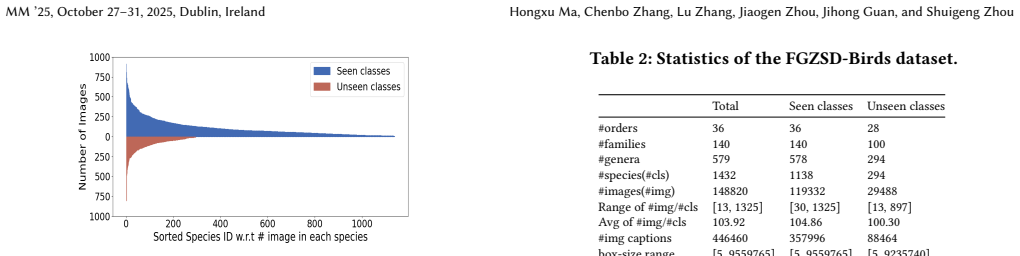
The central discovery, on the paper's own terms, is that zero-shot object detection can be pushed to species-level fine granularity and that the bottleneck is not only the model but also the absence of a benchmark combining detection boxes, hierarchical taxonomy, and rich text. FGZSD-Birds supplies that combination at 1,432 species, and MSHC exploits it by aligning visual sub-regions with individual words of the class description, generating fine-grained unseen-class features, and imposing a hierarchical contrastive loss whose negative-sample weights follow semantic distance in the taxonomy. The reported consequence is large: unseen-class mAP at IoU=0.5 rises from 4.11 for the previous state of the art to 11.4, with Recall@100 rising from 9.01 to 24.3, and in the generalized setting the harmonic mean of seen/unseen mAP rises from 5.814 to 17.504. The authors frame this as evidence that attention to local attributes plus hierarchy-aware feature geometry is what fine-grained zero-shot detection requires.
Load-bearing premise
The whole zero-shot comparison rests on the FGZSD-Birds annotations being accurate and leakage-free: every training image is correctly labeled at species level, every caption matches its image, and no image of an unseen species appears in the seen-class training set.
Editorial extensions
If this is right
- Existing zero-shot detectors, which rely mainly on global class-level features, are far from adequate for fine-grained unseen classes; MSHC's numbers suggest that word-level and hierarchy-aware features close much of that gap.
- The hierarchical contrastive loss is a recipe that can be applied to any taxonomy with text descriptions, so the method is not inherently bird-specific even though the benchmark is.
- Because FGZSD-Birds includes captions and class descriptions, the same dataset can support zero-shot classification, image captioning, and text-to-image generation, giving the community a shared testbed for several tasks.
- In the generalized setting (FG-GZSD), the method improves both seen and unseen performance, so the hierarchy-aware training does not sacrifice recognition of seen classes.
Reading between the lines
- A natural next experiment the paper does not run is testing MSHC on genera entirely absent from training; the current split guarantees each multi-species genus has an unseen species, so the model can lean on genus-level priors, and a fully held-out genus would be a stricter test.
- The abundance of text (captions plus Wikipedia descriptions) makes it possible to measure how much of the zero-shot gain is semantic rather than visual-similarity leakage; an ablation that removes captions or replaces descriptions with scrambled text would separate those causes.
- If the benchmark proves clean, it could serve as a diagnostic for whether other vision-language models genuinely distinguish similar species or merely match global appearance, since the dataset pairs many visually near-identical classes with distinct text.
- The word-level conditioning in the generative network suggests an untested extension to attributes: feeding explicit part-level attribute annotations (beak shape, feather color) as conditioning could improve detection on species with very similar global appearance.
Editorial analysis
A structured set of objections, weighed in public.
Referee Report
Summary. The paper introduces Fine-Grained Zero-Shot Object Detection (FG-ZSD), a task extending zero-shot detection to species-level categories with subtle visual differences. It presents FGZSD-Birds, a new dataset of 148,820 images across 1,432 bird species organized in a four-level taxonomy (order, family, genus, species) with bounding boxes, captions, and textual descriptions. The proposed MSHC method combines a Faster-RCNN detector with a hierarchical classification head, a multi-level semantics-aware generative network that synthesizes unseen-class visual features from text, and a hierarchical contrastive loss. Experiments on FGZSD-Birds report large improvements over existing ZSD methods, e.g., unseen mAP 11.4 vs 4.11 for M-RRFS at IoU=0.5.
Significance. The paper addresses a practical and under-explored problem, and the released dataset would be a valuable resource: it is an order of magnitude larger than existing fine-grained detection benchmarks and carries hierarchical labels and captions. The method is a reasonable synthesis of alignment, generation, and hierarchical contrastive learning, and the reported ablation shows each component contributes. However, the central SOTA claim cannot be accepted without resolving protocol concerns: the training-time use of unseen-class image-text pairs, pretraining on CUB without overlap analysis, test-set hyperparameter selection, and lack of quantitative dataset audit. If these are addressed, the contribution would be solid.
major comments (6)
- [§4.1, Eq. (5), Eq. (14)] The protocol is ambiguous about information leakage. Section 4.1 states that 'the training set contains only images of seen classes C_s' but also that 'during the training and testing phases, category descriptions and image-text pairs are provided for both seen and unseen classes.' Because L_avss in Eq. (5) is optimized on batches of image-text pairs and is part of the total training loss in Eq. (14), any unseen-class image-text pair used there exposes unseen visual content during training. In addition, the MSA-hicl loss in Eq. (11) sums over all c_j in C with C = C_s ∪ C_u, so unseen-class semantic vectors participate in training. The paper never states that unseen image-text pairs are excluded or that unseen nodes are masked. Please specify the exact protocol and, if unseen image-text pairs are used, rerun the experiments under a strictly inductive setting or justify the deviation from standard ZSD.
- [§5.1] The generative network is 'pretrained on CUB [43].' CUB is a bird dataset with 200 species, and some of those species are likely to be among the 294 unseen classes of FGZSD-Birds. If so, the generator has been trained on real images of unseen classes before the zero-shot evaluation, which constitutes a direct violation of the unseen-class assumption and could explain part of the large gap over baselines. The manuscript neither reports the class overlap nor excludes overlapping species. Please provide an overlap analysis and retrain without overlap, or justify that no unseen-class image was used at any training stage.
- [§4.4.1, Eq. (11)] The log-sum-exp stabilization is written incorrectly. As printed, F(l) = x_i·M_l^{c_i}/τ − log(Σ s·exp(z_j − b)) − b, which simplifies to log(Σ s·exp(z_j)) − 2b when b is the maximum; it does not implement the standard stable LSE (which would add b after the log) and can yield large negative values. Please correct the sign and verify the implemented loss.
- [§5.4.2–5.4.3, Tables 7–8] The aggregation function φ(l) and temperatures ξ, τ are selected by maximizing the mAP values reported on the test sets (FG-ZSD unseen and FG-GZSD), and no validation split is described. Selecting hyperparameters on the same test metrics used for the final comparison makes the reported numbers optimistic and partly reflects fit to the evaluation set. Please introduce a validation split or otherwise show that the chosen values were not selected using the test set.
- [§3.1, Table 2] For a new benchmark that supports the central claim, the manuscript provides no inter-annotator agreement, no label-noise estimate, and no independent audit. Section 3.1 describes a three-annotator consensus protocol, but no quantitative result is reported. If unseen-class birds appear in seen-class training images or if boxes/captions are incomplete, the zero-shot gap could be inflated or the benchmark could be misleading for downstream use. Please report annotation statistics and an independent quality audit.
- [§5.2, Table 3] The comparison against existing ZSD methods is not reproducible as written. No implementation details are given for how ZSIS, RRFS, SCR, SeeDs, TCB, SAUI, and M-RRFS are adapted to FGZSD-Birds, what hyperparameters or training budgets are used, or whether the numbers come from multiple runs; no error bars or standard deviations are reported. Without these, the claimed 15.29-point Recall@100 advantage could be influenced by unfavorable baseline settings or run-to-run variance. Please provide complete baseline specifications and repeated-run statistics.
minor comments (5)
- [§5.2] 'Improving Recall@100 by 15.29%' should be phrased as a 15.29 percentage-point increase (from 9.01 to 24.3), since the relative improvement is about 169%.
- [§4.3.2, Eq. (8)] r_f is used in the word-level affine weights but is not defined; Eq. (3) defines r_i for each word i, so the notation needs clarification.
- [§5.4.3] The text says 'increasing mAP ... as ξ grows', but Table 8 shows U=9.82 for ξ=10, lower than U=9.85 for ξ=5; please rephrase to describe the non-monotonic trend.
- [§4.4.2] 'Initialize these momentum caches using aligned semantic vectors in Eq. (5)' should refer to the encoder outputs trained by Eq. (5), since Eq. (5) is a loss function, not a set of vectors.
- [Table 1] The header contains a typo ('Image classificaiotn') and the FGZSD-Birds row uses exclamation marks inconsistently with the checkmarks elsewhere; please harmonize.
Circularity Check
Test-set hyperparameter selection makes the reported SOTA margin partly a fitted optimum; the core method and benchmark are otherwise not circular.
-
fitted input called prediction
[Section 5.4.3, Table 8 (final hyperparameters; Tables 3 and 4 report the same test-set metrics)]
"Tab. 8 indicates optimal results with τ = 0.5 and increasing mAP for both seen and unseen classes as ξ grows, with the best performance at ξ = 5."
The hyperparameters ξ and τ are selected by maximizing S/U/HM mAP, which are exactly the FG-GZSD test-set metrics reported in Table 4, and the FG-ZSD unseen-class mAP in Table 3 uses the same test split. No held-out validation split is described anywhere in the manuscript. The final headline claim, 'improving Recall@100 by 15.29% and mAP by 7.29% at IoU=0.5', is therefore evaluated on the same test set used to pick the hyperparameters. For the grid searched, the reported numbers are by construction the maximum of the metric with respect to those hyperparameters, so the claim that MSHC is SOTA is partly a fitted optimum rather than an independent prediction.
full rationale
The central derivation chain of MSHC is not circular in the usual sense: the visual-semantic alignment loss (Eq. 5), the generative network (Eqs. 7-9), and the hierarchical contrastive loss (Eqs. 10-13) are all defined from external semantic vectors and seen-class features, and the dataset FGZSD-Birds is an independently constructed input rather than an output of the method. The one concrete circularity is evaluative rather than derivational: Section 5.4.3 tunes ξ and τ directly on the S/U/HM mAP numbers that later become the paper's advertised performance (Tables 3 and 4). Because no validation split or masking procedure is reported, the reported SOTA margin is partly the result of fitting the evaluation set, which inflates the comparison against baselines whose hyperparameters were not tuned on this benchmark. I also note an unresolved protocol risk in Section 4.1: 'during the training and testing phases, category descriptions and image-text pairs are provided for both seen and unseen classes' appears to contradict the immediately preceding statement that the training set contains only seen-class images. If unseen-class image-text pairs enter Eq. (5)'s batch or Eq. (11)'s class set, the zero-shot claim would collapse; however, the paper never explicitly states those pairs are used in the losses, so I do not count this as a demonstrated circular step. The self-citation to prior hierarchical-contrastive work [55] is used as related work and is not load-bearing. Overall, the method retains independent content, so the score is moderate rather than severe.
Assumptions & free parameters
free parameters (5)
- temperature xi in Eq. (4) =
5
- temperature tau in Eq. (11) =
0.5
- aggregation function phi(l) =
phi(l)=l
- loss weights lambda1, lambda2, lambda3 =
0.1, 0.5, 0.01
- momentum coefficient m =
0.99
assumptions (4)
- domain assumption Wikipedia text descriptions and 3-sentence captions contain enough discriminative detail to separate visually similar bird species.
- domain assumption The genus-centered seen/unseen split makes unseen classes rely on attributes shared with seen classes.
- domain assumption Synthetic features and images of unseen classes produced by the MSA generative network are close enough to real unseen-class images to train a reliable detector.
- domain assumption The manual annotations (boxes, labels, captions) are complete and correct, and training images contain no unseen-class instances.
Cite this review
Pith. "Pith review of Fine-Grained Zero-Shot Object Detection." pith.science (2026). https://pith.science/paper/KNIWARA7
@misc{pith2026250710358,
  author       = {Pith},
  title        = {Pith review of: Fine-Grained Zero-Shot Object Detection},
  year         = {2026},
  howpublished = {\url{https://pith.science/paper/KNIWARA7}},
  note         = {Machine review of arXiv:2507.10358}
}
read the original abstract
Zero-shot object detection (ZSD) aims to leverage semantic descriptions to localize and recognize objects of both seen and unseen classes. Existing ZSD works are mainly coarse-grained object detection, where the classes are visually quite different, thus are relatively easy to distinguish. However, in real life we often have to face fine-grained object detection scenarios, where the classes are too similar to be easily distinguished. For example, detecting different kinds of birds, fishes, and flowers. In this paper, we propose and solve a new problem called Fine-Grained Zero-Shot Object Detection (FG-ZSD for short), which aims to detect objects of different classes with minute differences in details under the ZSD paradigm. We develop an effective method called MSHC for the FG-ZSD task, which is based on an improved two-stage detector and employs a multi-level semantics-aware embedding alignment loss, ensuring tight coupling between the visual and semantic spaces. Considering that existing ZSD datasets are not suitable for the new FG-ZSD task, we build the first FG-ZSD benchmark dataset FGZSD-Birds, which contains 148,820 images falling into 36 orders, 140 families, 579 genera and 1432 species. Extensive experiments on FGZSD-Birds show that our method outperforms existing ZSD models.
Figures


Figures from the paper (2 more)


Reference graph
Works this paper leans on
-
[43]
Catherine Wah, Steve Branson, Peter Welinder, Pietro Perona, and Serge Belongie
-
[1]
Ankan Bansal, Karan Sikka, Gaurav Sharma, Rama Chellappa, and Ajay Di- vakaran. 2018. Zero-shot object detection
work page 2018
-
[2]
Lukas Bossard, Matthieu Guillaumin, and Luc Van Gool. 2014. Food-101–mining discriminative components with random forests. Springer
work page 2014
- [3]
-
[4]
Shiming Chen, Guosen Xie, Yang Liu, Qinmu Peng, Baigui Sun, Hao Li, Xinge You, and Ling Shao. 2021. Hsva: Hierarchical semantic-visual adaptation for zero-shot learning. 34 (2021)
work page 2021
-
[5]
Adam Coates, Andrew Ng, and Honglak Lee. 2011. An analysis of single-layer networks in unsupervised feature learning
work page 2011
-
[6]
Berkan Demirel, Ramazan Gokberk Cinbis, and Nazli Ikizler-Cinbis. 2018. Zero- shot object detection by hybrid region embedding.arXiv preprint arXiv:1805.06157 (2018)
arXiv 2018
-
[7]
Abhimanyu Dubey, Otkrist Gupta, Ramesh Raskar, and Nikhil Naik. 2018. Maximum-entropy fine grained classification. 31 (2018)
work page 2018
Show all 71 references
-
[8]
Mark Everingham, Luc Van Gool, Christopher KI Williams, John Winn, and Andrew Zisserman. 2010. The pascal visual object classes (voc) challenge. 88 (2010)
2010
-
[9]
Qi Fan, Wei Zhuo, Chi-Keung Tang, and Yu-Wing Tai. 2020. Few-shot object detection with attention-RPN and multi-relation detector
2020
-
[10]
Ross Girshick. 2015. Fast r-cnn
2015
-
[11]
Dikshant Gupta, Aditya Anantharaman, Nehal Mamgain, Vineeth N Balasub- ramanian, CV Jawahar, et al. 2020. A multi-space approach to zero-shot object detection
2020
-
[12]
Guangxing Han, Jiawei Ma, Shiyuan Huang, Long Chen, and Shih-Fu Chang
-
[13]
Nasir Hayat, Munawar Hayat, Shafin Rahman, Salman Khan, Syed Waqas Zamir, and Fahad Shahbaz Khan. 2020. Synthesizing the unseen for zero-shot object detection
2020
-
[14]
Kaiming He, Xiangyu Zhang, Shaoqing Ren, and Jian Sun. 2016. Deep residual learning for image recognition
2016
-
[15]
Xiangteng He, Yuxin Peng, and Junjie Zhao. 2018. Fast fine-grained image classification via weakly supervised discriminative localization. 29, 5 (2018)
2018
-
[16]
Xiangteng He, Yuxin Peng, and Junjie Zhao. 2019. Which and how many regions to gaze: Focus discriminative regions for fine-grained visual categorization. 127 (2019)
2019
-
[17]
Peiliang Huang, Junwei Han, De Cheng, and Dingwen Zhang. 2022. Robust region feature synthesizer for zero-shot object detection
2022
-
[18]
Peiliang Huang, Dingwen Zhang, De Cheng, Longfei Han, Pengfei Zhu, and Junwei Han. 2024. M-RRFS: A Memory-Based Robust Region Feature Synthesizer for Zero-Shot Object Detection. (2024)
2024
-
[19]
Dat Huynh and Ehsan Elhamifar. 2020. Fine-grained generalized zero-shot learning via dense attribute-based attention
2020
-
[20]
Zhong Ji, Yanwei Fu, Jichang Guo, Yanwei Pang, Zhongfei Mark Zhang, et al. 2018. Stacked semantics-guided attention model for fine-grained zero-shot learning. 31 (2018)
2018
-
[21]
Ruixiang Jiang and Changwen Chen. 2025. Multimodal LLMs Can Reason about Aesthetics in Zero-Shot. arXiv preprint arXiv:2501.09012 (2025)
2025 arXiv
-
[22]
Jonathan Krause, Michael Stark, Jia Deng, and Li Fei-Fei. 2013. 3d object repre- sentations for fine-grained categorization. In Proceedings of the IEEE international conference on computer vision workshops
2013
-
[23]
Haoyu Li, Jilin Mei, Jiancong Zhou, and Yu Hu. 2023. Zero-shot object detection based on dynamic semantic vectors. IEEE
2023
-
[24]
Mingxiao Li, Fang Qu, Zhanpeng Chen, Na Su, Zhizhou Zhong, Ziyang Chen, Nan Du, and Xiaolong Li. 2025. From Visuals to Vocabulary: Establishing Equivalence Between Image and Text Token Through Autoregressive Pre-training in MLLMs. arXiv preprint arXiv:2502.09093 (2025)
2025 arXiv
-
[25]
Mingxiao Li, Na Su, Fang Qu, Zhizhou Zhong, Ziyang Chen, Yuan Li, Zhaopeng Tu, and Xiaolong Li. 2025. VISTA: Enhancing Vision-Text Alignment in MLLMs via Cross-Modal Mutual Information Maximization. arXiv preprint arXiv:2505.10917 (2025)
2025 arXiv
-
[26]
Tsung-Yi Lin, Michael Maire, Serge Belongie, James Hays, Pietro Perona, Deva Ramanan, Piotr Dollár, and C Lawrence Zitnick. 2014. Microsoft coco: Common objects in context. In Computer Vision–ECCV 2014: 13th European Conference, Zurich, Switzerland, September 6-12, 2014, Proce...
2014
-
[27]
Yanzuo Lu, Manlin Zhang, Andy J Ma, Xiaohua Xie, and Jianhuang Lai. 2024. Coarse-to-fine latent diffusion for pose-guided person image synthesis. In Pro- ceedings of the IEEE/CVF Conference on Computer Vision and Pattern Recognition . 6420–6429
2024
-
[28]
Hongxu Ma, Kai Tian, Tao Zhang, Xuefeng Zhang, Han Zhou, Chunjie Chen, Han Li, Jihong Guan, and Shuigeng Zhou. 2025. Generative Regression Based Watch Time Prediction for Short-Video Recommendation. arXiv:2412.20211 [cs.LG]
2025 arXiv
-
[29]
Subhransu Maji, Esa Rahtu, Juho Kannala, Matthew Blaschko, and Andrea Vedaldi
-
[30]
Qiaomei Mao, Chong Wang, Shenghao Yu, Ye Zheng, and Yuqi Li. 2020. Zero-shot object detection with attributes-based category similarity. IEEE Transactions on Circuits and Systems II: Express Briefs 67, 5 (2020)
2020
-
[31]
Yuxi Mi, Zhizhou Zhong, Yuge Huang, Qiuyang Yuan, Xuan Zhao, Jianqing Xu, Shouhong Ding, Shaoming Wang, Rizen Guo, and Shuigeng Zhou. 2025. Data Synthesis with Diverse Styles for Face Recognition via 3DMM-Guided Diffusion. In Proceedings of the Computer Vision and Pattern Reco...
2025
-
[32]
Maria-Elena Nilsback and Andrew Zisserman. 2008. Automated flower classifica- tion over a large number of classes. In 2008 Sixth Indian conference on computer vision, graphics & image processing . IEEE
2008
-
[33]
Shafin Rahman, Salman Khan, and Fatih Porikli. 2018. Zero-shot object detection: Learning to simultaneously recognize and localize novel concepts. Springer
2018
-
[34]
Shafin Rahman, Salman H Khan, and Fatih Porikli. 2020. Zero-shot object detec- tion: Joint recognition and localization of novel concepts. 128 (2020)
2020
-
[35]
Aditya Ramesh, Mikhail Pavlov, Gabriel Goh, Scott Gray, Chelsea Voss, Alec Radford, Mark Chen, and Ilya Sutskever. 2021. Zero-shot text-to-image generation. PMLR
2021
-
[36]
Scott Reed, Zeynep Akata, Xinchen Yan, Lajanugen Logeswaran, Bernt Schiele, and Honglak Lee. 2016. Generative adversarial text to image synthesis. PMLR
2016
-
[37]
Shaoqing Ren, Kaiming He, Ross Girshick, and Jian Sun. 2015. Faster r-cnn: Towards real-time object detection with region proposal networks. 28 (2015)
2015
-
[38]
Robin Rombach, Andreas Blattmann, Dominik Lorenz, Patrick Esser, and Björn Ommer. 2022. High-resolution image synthesis with latent diffusion models
2022
-
[39]
Olga Russakovsky, Jia Deng, Hao Su, Jonathan Krause, Sanjeev Satheesh, Sean Ma, Zhiheng Huang, Andrej Karpathy, Aditya Khosla, Michael Bernstein, et al
-
[40]
Sandipan Sarma, Sushil Kumar, and Arijit Sur. 2022. Resolving Semantic Confu- sions for Improved Zero-Shot Detection. arXiv preprint arXiv:2212.06097 (2022)
2022 arXiv
-
[41]
Guolei Sun, Hisham Cholakkal, Salman Khan, Fahad Khan, and Ling Shao. 2020. Fine-grained recognition: Accounting for subtle differences between similar classes, Vol. 34
2020
-
[42]
Ming Tao, Hao Tang, Fei Wu, Xiao-Yuan Jing, Bing-Kun Bao, and Changsheng Xu. 2022. Df-gan: A simple and effective baseline for text-to-image synthesis
2022
-
[44]
Jiahao Wang, Caixia Yan, Weizhan Zhang, Huan Liu, Hao Sun, and Qinghua Zheng. 2024. SAUI: Scale-Aware Unseen Imagineer for Zero-Shot Object Detec- tion, Vol. 38
2024
-
[45]
Zhihui Wang, Shijie Wang, Shuhui Yang, Haojie Li, Jianjun Li, and Zezhou Li
-
[46]
Tao Xu, Pengchuan Zhang, Qiuyuan Huang, Han Zhang, Zhe Gan, Xiaolei Huang, and Xiaodong He. 2018. Attngan: Fine-grained text to image generation with attentional generative adversarial networks
2018
-
[47]
Zunnan Xu, Jiaqi Huang, Ting Liu, Yong Liu, Haonan Han, Kehong Yuan, and Xiu Li. 2024. Enhancing fine-grained multi-modal alignment via adapters: a parameter-efficient training framework for referring image segmentation. In 2nd Workshop on Advancing Neural Network Training: Co...
2024
-
[48]
Zunnan Xu, Zhentao Yu, Zixiang Zhou, Jun Zhou, Xiaoyu Jin, Fa-Ting Hong, Xiaozhong Ji, Junwei Zhu, Chengfei Cai, Shiyu Tang, et al. 2025. Hunyuanportrait: Implicit condition control for enhanced portrait animation. In Proceedings of the Computer Vision and Pattern Recognition ...
2025
-
[49]
Caixia Yan, Xiaojun Chang, Minnan Luo, Huan Liu, Xiaoqin Zhang, and Qinghua Zheng. 2022. Semantics-guided contrastive network for zero-shot object detection. (2022)
2022
-
[50]
Caixia Yan, Qinghua Zheng, Xiaojun Chang, Minnan Luo, Chung-Hsing Yeh, and Alexander G Hauptman. 2020. Semantics-preserving graph propagation for zero-shot object detection. 29 (2020)
2020
-
[51]
Hang Yu, Yufei Xu, Jing Zhang, Wei Zhao, Ziyu Guan, and Dacheng Tao. 2021. Ap-10k: A benchmark for animal pose estimation in the wild. arXiv preprint arXiv:2108.12617 (2021)
2021 arXiv
-
[52]
Delong Zhang, Yi-Xing Peng, Xiao-Ming Wu, Ancong Wu, and Wei-Shi Zheng
-
[53]
Han Zhang, Tao Xu, Hongsheng Li, Shaoting Zhang, Xiaogang Wang, Xiaolei Huang, and Dimitris N Metaxas. 2017. Stackgan: Text to photo-realistic image synthesis with stacked generative adversarial networks
2017
-
[54]
Han Zhang, Tao Xu, Hongsheng Li, Shaoting Zhang, Xiaogang Wang, Xiaolei Huang, and Dimitris N Metaxas. 2018. Stackgan++: Realistic image synthesis with stacked generative adversarial networks. 41, 8 (2018)
2018
-
[55]
Lu Zhang, Yang Wang, Jiaogen Zhou, Chenbo Zhang, Yinglu Zhang, Jihong Guan, Yatao Bian, and Shuigeng Zhou. 2022. Hierarchical Few-Shot Object Detection: Problem, Benchmark and Method
2022
-
[56]
Xingxing Zhang, Shupeng Gui, Zhenfeng Zhu, Yao Zhao, and Ji Liu. 2019. Hier- archical prototype learning for zero-shot recognition. 22, 7 (2019). MM ’25, October 27–31, 2025, Dublin, Ireland Hongxu Ma, Chenbo Zhang, Lu Zhang, Jiaogen Zhou, Jihong Guan, and Shuigeng Zhou
2019
-
[57]
Yue Zhang, Zhizhou Zhong, Minhao Liu, Zhaokang Chen, Bin Wu, Yubin Zeng, Chao Zhan, Junxin Huang, Yingjie He, and Wenjiang Zhou. 2024. Musetalk: Real-time high quality lip synchronization with latent space inpainting. arXiv preprint arXiv:2410.10122 (2024)
2024 arXiv
-
[58]
Shizhen Zhao, Changxin Gao, Yuanjie Shao, Lerenhan Li, Changqian Yu, Zhong Ji, and Nong Sang. 2020. Gtnet: Generative transfer network for zero-shot object detection, Vol. 34
2020
-
[59]
Heliang Zheng, Jianlong Fu, Tao Mei, and Jiebo Luo. 2017. Learning multi- attention convolutional neural network for fine-grained image recognition
2017
-
[60]
Ye Zheng, Ruoran Huang, Chuanqi Han, Xi Huang, and Li Cui. 2020. Background learnable cascade for zero-shot object detection
2020
-
[61]
Ye Zheng, Jiahong Wu, Yongqiang Qin, Faen Zhang, and Li Cui. 2021. Zero-shot instance segmentation
2021
-
[62]
Pengfei Zhou, Weiqing Min, Yang Zhang, Jiajun Song, Ying Jin, and Shuqiang Jiang. 2023. SeeDS: Semantic Separable Diffusion Synthesizer for Zero-shot Food Detection. arXiv preprint arXiv:2310.04689 (2023)
2023 arXiv
-
[63]
Minfeng Zhu, Pingbo Pan, Wei Chen, and Yi Yang. 2019. Dm-gan: Dynamic memory generative adversarial networks for text-to-image synthesis
2019
-
[64]
Pengkai Zhu, Hanxiao Wang, and Venkatesh Saligrama. 2020. Don’t even look once: Synthesizing features for zero-shot detection
2020
-
[65]
Peiqin Zhuang, Yali Wang, and Yu Qiao. 2018. Wildfish: A large benchmark for fish recognition in the wild
2018
-
[2011]
The caltech-ucsd birds-200-2011 dataset. (2011)
2011
-
[2013]
arXiv preprint arXiv:1306.5151 (2013)
Fine-grained visual classification of aircraft. arXiv preprint arXiv:1306.5151 (2013)
2013 arXiv
-
[2015]
115 (2015)
Imagenet large scale visual recognition challenge. 115 (2015)
2015
-
[2020]
Weakly supervised fine-grained image classification via guassian mixture model oriented discriminative learning
-
[2022]
Few-shot object detection with fully cross-transformer
-
[2024]
InProceedings of the 32nd ACM International Conference on Multimedia
PixelFade: Privacy-preserving Person Re-identification with Noise-guided Progressive Replacement. InProceedings of the 32nd ACM International Conference on Multimedia. 6326–6334
Reviewed August 6, 2026 · model on record in the stance chip above.
Discussion (0). Sign in to comment.