REVIEW 3 major objections 4 minor 79 references
Modeling Atmospheric Alteration on Titan: Hydrodynamics and Shock-Induced Chemistry of Meteoroid Entry
T0 review · 3 major / 4 minor · reviewed 2026-08-06 · deepseek-v4-flash
Pith's one-line read Meteoroid entry into Titan's atmosphere drives shock chemistry that makes HCN so efficiently that about one hundred 1-km entries could supply the observed hydrogen cyanide, while also destroying water vapor and leaving nitrogen stable.
desk verdict Solid shock-chemistry framework, but the '100 events' HCN claim is undone by the paper's own photochemical loss timescale and rate-coefficient uncertainty. read the letter →
The pith
A machine-rendered reading of the paper's core claim, the machinery that carries it, and where it could break.
The reading
What carries the argument
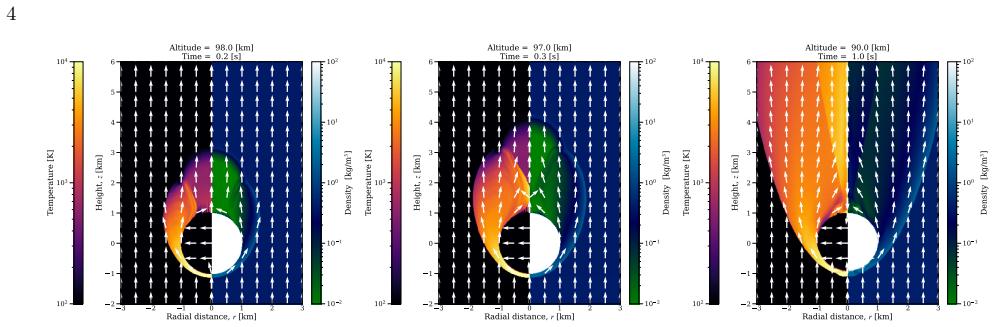
The load-bearing mechanism is chemical quenching in the post-shock expansion flow: the cooling timescale $\tau_{\mathrm{cool}}\sim R_{\mathrm{com}}/v_{\mathrm{ent}}$ is set purely by meteoroid size and entry velocity, and once expansion outruns the reaction timescales the gas composition freezes at non-equilibrium values. The method couples the Athena++ hydrodynamic solver, which produces the bow-shock flow and the secondary shock in the meteoroid's co-moving frame, with the Cantera kinetics package integrating the GRI-Mech 3.0 C/H/N/O network along test-particle streamlines. Three reactions carry most of the HCN production: $\mathrm{CH} + \mathrm{N}_2 \to \mathrm{HCN} + \mathrm{N}$ (49%), $\mathrm{H}_2\mathrm{CN} \to \mathrm{HCN} + \mathrm{H}$ (40%), and $\mathrm{CH}_3 + \mathrm{N} \to \mathrm{HCN} + \mathrm{H}_2$ (9.4%). The equilibrium-versus-non-equilibrium contrast is the analytical pivot: because expansion cooling beats the reactions except at the hottest instants, the final mixture is set by quench temperatures of roughly 500–1000 K rather than by thermodynamic equilibrium.
What would settle it
A shock-tube or laser-plasma measurement of $\mathrm{CH} + \mathrm{N}_2 \to \mathrm{HCN} + \mathrm{N}$ at 2000–3000 K would settle the main quantitative claim: the rate used in the paper is $8.0\times10^{-17}$ m$^3$ molecule$^{-1}$ s$^{-1}$ at 2447 K, while the experimental values it cites span $4.9\times10^{-14}$ to $2.8\times10^{-12}$ m$^3$ molecule$^{-1}$ s$^{-1}$, nearly two orders of magnitude, and the integrated HCN yield scales with this rate. A definitive measurement would confirm or rescale the inferred 'about 100 events' by the corresponding factor. A complementary atmospheric test is to measure HCN mixing ratios in Titan's 40–100 km altitude range: if entry chemistry is the dominant source there, the abundance should be reproducible from the meteoroid influx alone and should not follow the photochemical vertical profile.
Extended reading notes
Core claim
The paper's central claim is that the chemical aftermath of meteoroid entry must be modeled as a time-dependent, non-equilibrium process rather than as a sequence of equilibrium states. By tracking gas parcels along streamlines through the three-dimensional bow-shock flow and feeding each parcel's temperature–pressure history into a chemical kinetics solver, the authors find that products freeze at quench temperatures of roughly 500–1000 K, well below the 1000–3000 K range typically assumed for impact vapors. The result is a strong enhancement of HCN: the non-equilibrium molar fraction is about three orders of magnitude above the equilibrium prediction, and three reactions dominate the yield, led by $\mathrm{CH} + \mathrm{N}_2 \to \mathrm{HCN} + \mathrm{N}$ at nearly half. Applied to Titan, the integrated yields imply that on the order of 100 entry events of 1-km objects at 10 km/s could supply the present HCN abundance, that water vapor is reduced by about four orders of magnitude with oxygen converted into CO, and that $\mathrm{N}_2$ remains stable, a pattern the authors state is inconsistent with equilibrium-chemistry assumptions. The simulated production yields also agree with the molecule-per-joule values measured in laser-induced plasma experiments on $\mathrm{N}_2$–$\mathrm{CH}_4$ mixtures, and the simulations reveal a secondary shock behind the meteoroid, a feature absent from previous one-dimensional entry models, which reheats the gas but leaves already-quenched species such as HCN unaltered.
Load-bearing premise
The 'about 100 events' result depends on the rate coefficients that the GRI-Mech 3.0 network assigns to HCN formation, and the paper itself reports that the dominant reaction, $\mathrm{CH} + \mathrm{N}_2 \to \mathrm{HCN} + \mathrm{N}$, has measured rate coefficients spanning nearly two orders of magnitude at 2447 K, with no reliable data at all for the other two dominant reactions.
Editorial extensions
If this is right
- Meteoroid entry becomes a viable non-photochemical HCN source in Titan's lower atmosphere, below about 100 km, where the ultraviolet radiation that drives photochemistry is effectively absent.
- On the order of 100 entries of 1-km objects at 10 km/s could supply the present HCN reservoir, and because the early impact flux on Titan may have exceeded 1000 such events, entry chemistry plausibly shaped the organic content of the early atmosphere.
- The same shock processing gives a natural explanation for Titan's present low water abundance: a single entry reduces water vapor by about four orders of magnitude and channels the oxygen into CO.
- Because the HCN yield is nearly independent of the $\mathrm{N}_2$:$\mathrm{CH}_4$ ratio, the mechanism operates consistently across Titan's history even as the bulk atmospheric composition evolved.
- Aerodynamic entry chemistry can rival impact-vaporization chemistry as a driver of atmospheric change, especially on rocky-surfaced worlds where 10 km/s impacts vaporize little surface material.
Reading between the lines
- The same quenching mechanism should operate in any $\mathrm{N}_2$–$\mathrm{CH}_4$ atmosphere receiving a meteoroid influx, so the framework transfers to other reducing atmospheres such as an early Earth or a Pluto-like body, with yields set by the ratio of object radius to entry velocity.
- Because the HCN yield is tied directly to the rate of the dominant reaction, and the paper quotes experimental values for it spanning nearly two orders of magnitude, the 'about 100 events' figure is best read as an order-of-magnitude estimate; a better rate measurement would rescale the event count without overturning the qualitative non-equilibrium enhancement.
- The secondary shock's selectivity, perturbing $\mathrm{C}_2\mathrm{H}_6$ and $\mathrm{C}_2\mathrm{H}_4$ but not already-quenched HCN, suggests that relative abundances of shock products may record the entry-velocity and size distribution of the impacting population, a diagnostic future observations of Titan's lower atmosphere could exploit.
- If entry chemistry is the dominant sub-100 km HCN source, Titan's HCN mixing ratios below 100 km should be reproducible from the meteoroid influx alone and should not follow the photochemical vertical profile; sounding or in situ measurements could test this directly.
Editorial analysis
A structured set of objections, weighed in public.
Referee Report
Summary. The paper presents axisymmetric (labeled 3D) Athena++ hydrodynamic simulations of a 1-km, 10 km/s meteoroid entering Titan's atmosphere, combined with Cantera/GRI-Mech 3.0 chemical kinetics along test-particle trajectories. It reports bow-shock structure, a secondary shock behind the object, and chemical quenching controlled by adiabatic expansion cooling. The authors claim that non-equilibrium shock chemistry strongly enhances HCN production relative to equilibrium calculations, that a single event can remove water vapor efficiently while leaving N2 stable, that simulated yields agree with laser-plasma experiments, and that roughly 100 such entry events could account for the present HCN abundance on Titan, with emphasis on early Titan's history.
Significance. If the quantitative claims were supported, the paper would establish meteoroid entry as an important non-photochemical, abiotic source of prebiotic feedstock in Titan's lower atmosphere and would strengthen the case for time-dependent, non-equilibrium modeling over equilibrium approximations. The methodological core is credible and useful: the coupling of a shock-resolving hydrodynamic simulation to a kinetic network, the test-particle thermodynamic treatment, the iSALE-based check of the ideal-gas equation of state for the projectile, and the comparison with both Cassini abundances and Scattergood et al. (1989) laser experiments are all constructive steps. Credit is also due to the authors for explicitly discussing the uncertain rate coefficients in Section 4.1.4 and the azimuthal-resolution limitation in Section 2.1. However, the headline 'about 100 events' result is not currently supported: the present gas-phase inventory is not a cumulative reservoir in the presence of the photochemical loss timescale quoted by the authors themselves, and the dominant HCN formation rate coefficient carries an uncertainty far larger than the paper's own wording suggests.
major comments (3)
- [Sect. 4.1.3 and Table 1] The 'about 100 entry events' claim equates the integrated HCN production per event (1.5e11 mol, Table 1) with the present HCN column (1.4e13 mol) as though the atmosphere is a cumulative reservoir. The same section, however, states that the photochemical HCN timescale is only a few thousand years (Hébrard et al. 2012). With such a loss timescale, the present gas-phase abundance reflects the balance between recent production and loss, not the integral of all past production. A claim that ~100 ancient events supplied the present HCN inventory therefore requires either that those events occurred within the last few millennia, that HCN was stored in a condensed reservoir and later released, or that the loss timescale for the 100-km region is much longer than the quoted photochemical timescale. None of these options is specified. If the events are spread over 1e8 yr with the quoted 1000-yr loss timescale, the required rate is on the order of one event every ~10 yr, i.e., ~1e7 events, not 100. The Abstract and Section 5 repeat the 100-event claim without this caveat, so the paper's main quantitative conclusion is not currently supported.
- [Sect. 4.1.4 and Table 2] The paper states that the dominant HCN formation reaction, CH + N2 -> HCN + N (49% contribution), has experimental rate coefficients spanning nearly two orders of magnitude, but the actual numbers listed in Table 2 are 4.9e-14 to 280e-14 m3 molecule-1 s-1, while the adopted GRI-Mech value is 8.0e-17. Even if the intended comparison is only between the experimental extremes, the spread is a factor of roughly 60; relative to the adopted value, the discrepancy is orders of magnitude. No uncertainty propagation from Table 2 to the integrated yields in Table 1, to Figure 10, or to the inferred number of events is provided. Since the other two dominant reactions have no reliable high-temperature data, the quantitative HCN yield and the derived event count have an uncertainty that is large enough to change the central claim by an order of magnitude or more. The Conclusion should present the HCN yield and event count as a range, and Section 4.1.4 should reconcile the adopted rate with the cited experimental values or explain why the experimental values are not applicable at the shocked conditions.
- [Sect. 2.1 and Sect. 4.1.3] The derivation of the integrated yields in Table 1 is not described. Section 4.1.2 explains that Figure 10 uses cylindrical shells at three discrete radii (r0 = 1300, 1500, 1700 m), but the radial integration that produces the 'entire region heated' totals in Table 1 is not shown. The yield curve as a function of radius, the adopted outer cutoff, and the altitude extent over which the yields are integrated should be stated explicitly. Since the 100-event claim is a ratio of the Table 1 total to the observed column, the integration method is load-bearing for the headline result and needs to be reproducible from the text.
minor comments (4)
- [Title and Abstract; Sect. 2.1] The paper describes the simulations as three-dimensional, but Section 2.1 states that the azimuthal direction is resolved with only 2 cells and that axisymmetry is assumed. Please rephrase the title and abstract as 'axisymmetric' or 'quasi-3D' modeling, or justify the 2-cell azimuthal treatment as a full 3D calculation.
- [Sect. 4.1.2 and Fig. 10] The statement of 'good agreement' with Scattergood et al. (1989) is qualitative. The plotted yields differ among species by more than an order of magnitude, and no error bars or quantitative goodness-of-fit measure are provided. Please add a metric or a more precise statement of the agreement.
- [Sect. 2.2.2 and Eq. (8)] Equation (8) states tau_cool ~ Rcom/vent, but the text should define the reference temperature drop used to measure tau_cool and state whether the estimate is validated for all three cases in Figure 4 or only for the nearest streamline.
- [Sect. 4.1.3] The sentence citing Artemieva & Lunine (2005) says that a few billion years ago the number of entry events 'could have exceeded 1000.' Even setting aside the rate-uncertainty issue, 1000 events over several gigayears is far too low to maintain a steady-state HCN abundance with a few-thousand-year loss timescale, so this statement should be reconciled with the inventory calculation.
Circularity Check
No significant circularity: the HCN synthesis result is benchmarked against external Cassini abundances and Scattergood laser yields, with rates from the external GRI-Mech 3.0 network.
full rationale
The claimed derivation chain is self-contained: shock temperature and pressure histories come from independent Athena++ hydrodynamics, the kinetic network is the external GRI-Mech 3.0 mechanism evaluated in Cantera, and the Cassini abundances and Scattergood laser yields are external benchmarks applied after the chemistry is integrated. The '~100 events' number is a direct ratio of the Cassini HCN column (1.4e13 mol) to the simulated per-event yield (1.5e11 mol), with no parameter fitted to that target, so the headline claim is not forced by construction. The paper's own caveats about rate-coefficient scatter of nearly two orders for CH + N2 -> HCN + N and the absence of reference data for the other two dominant reactions are uncertainty statements, not circular steps. The skeptic's steady-state/loss-timescale objection to the '100 events' inference is a physical correctness concern, not a circularity: even if the inference is wrong, the yield calculation is not equivalent to its inputs. The only self-referential element is the citation of the authors' own impact-vapor model (Miyayama & Kobayashi 2024) in the Sect. 4.2 mass comparison; that is a non-load-bearing comparison for a separate mechanism and does not support the central HCN claim.
Assumptions & free parameters
free parameters (5)
- Meteoroid radius Rcom =
1 km
- Entry velocity vent =
10 km/s
- Initial atmospheric composition N2:CH4 =
9:1 with 7:3 variant
- Equilibrium/non-equilibrium switch temperature =
6000 K
- Azimuthal cell count =
2 cells
assumptions (5)
- domain assumption Ideal-gas hydrodynamics with gamma=1.4 describes both Titan's atmosphere and the solid meteoroid body.
- ad hoc to paper Azimuthal symmetry with 2 cells in phi captures the shock heating and streamline thermodynamics relevant to chemistry.
- ad hoc to paper GRI-Mech 3.0 is a valid kinetic network for the C/H/N/O system at post-shock temperatures up to 6000 K.
- domain assumption Gas cools purely by adiabatic expansion; heat conduction and radiation are negligible on the quenching timescale.
- domain assumption A single test-particle thermodynamic history represents the chemical evolution of an entire cylindrical shell.
Cite this review
Pith. "Pith review of Modeling Atmospheric Alteration on Titan: Hydrodynamics and Shock-Induced Chemistry of Meteoroid Entry." pith.science (2026). https://pith.science/paper/TWMEVV3M
@misc{pith2026250710369,
  author       = {Pith},
  title        = {Pith review of: Modeling Atmospheric Alteration on Titan: Hydrodynamics and Shock-Induced Chemistry of Meteoroid Entry},
  year         = {2026},
  howpublished = {\url{https://pith.science/paper/TWMEVV3M}},
  note         = {Machine review of arXiv:2507.10369}
}
read the original abstract
Meteoroid entry into planetary atmospheres generates bow shocks, resulting in high-temperature gas conditions that drive chemical reactions. In this paper, we perform three-dimensional hydrodynamic simulations of meteoroid entry using the Athena++ code, coupled with chemistry calculations via Cantera to model the non-equilibrium chemistry triggered by atmospheric entry. Our aerodynamical simulations reveal the formation of complex shock structures, including secondary shock waves, which influence the thermodynamic evolution of the gas medium. By tracking thermodynamic parameters along streamlines, we analyze the effects of shock heating and subsequent expansion cooling on chemical reaction pathways. Our results demonstrate that chemical quenching occurs when the cooling timescale surpasses reaction rates, leading to the formation of distinct chemical products that deviate from equilibrium predictions. We show that the efficiency of molecular synthesis depends on the object\textquotesingle s size and velocity, influencing the composition of the post-entry gas mixture. Applying our model to Titan, we demonstrate that organic matter can be synthesized in the present environment of Titan. Also, we find that nitrogen, the dominant atmospheric component, remains stable, while water vapor is efficiently removed, a result inconsistent with equilibrium chemistry assumptions. Moreover, we compare our simulation results with laser experiments and find good agreement in chemical yields. Finally, we also evaluate the impact on Titan\textquotesingle s atmosphere as a whole, showing that meteoroid entry events could have played a significant role in supplying molecules such as HCN during early Titan\textquotesingle s history.
Figures


Figures from the paper (11 more)


Reference graph
Works this paper leans on
-
[1]
, " * write output.state after.block = add.period write newline
ENTRY address archivePrefix author booktitle chapter doi edition editor eprint howpublished institution journal key month number organization pages publisher school series title misctitle type volume year version url label extra.label sort.label short.list INTEGERS output.state before.all mid.sentence after.sentence after.block FUNCTION init.state.consts ...
-
[2]
write newline
" write newline "" before.all 'output.state := FUNCTION format.url url empty "" new.block "" url * "" * if FUNCTION format.eprint eprint empty "" archivePrefix empty "" archivePrefix "arXiv" = new.block " " eprint * " " * new.block " " eprint * " " * if if if FUNCTION format.doi doi empty "" " " doi * " " * if FUNCTION format.pid doi empty eprint empty ur...
-
[3]
thebibliography [1] 20pt to REFERENCES 6pt =0pt \@twocolumntrue 12pt -12pt 10pt plus 3pt =0pt =0pt =1pt plus 1pt =0pt =0pt -12pt =13pt plus 1pt =20pt =13pt plus 1pt \@M =10000 =-1.0em =0pt =0pt 0pt =0pt =1.0em @enumiv\@empty 10000 10000 `\.\@m \@noitemerr \@latex@warning Empty `thebibliography' environment \@ifnextchar \@reference \@latexerr Missing key o...
work page 2017
-
[4]
1985, Lunar and Planetary Science Conference Proceedings, 90, C545
Abe , Y., & Matsui , T. 1985, Lunar and Planetary Science Conference Proceedings, 90, C545
work page 1985
-
[5]
1988, Journal of the Atmospheric Sciences, 45, 3081, 10.1175/1520-0469(1988)045<3081:EOAIGH>2.0.CO;2
---. 1988, Journal of the Atmospheric Sciences, 45, 3081, 10.1175/1520-0469(1988)045<3081:EOAIGH>2.0.CO;2
-
[6]
Amsden, A. A., Ruppel, H. M., & Hirt, C. W. 1980, SALE: a simplified ALE computer program for fluid flow at all speeds, 10.2172/5176006
-
[7]
Artemieva , N., & Lunine , J. I. 2005, , 175, 522, 10.1016/j.icarus.2004.12.005
-
[8]
Benlow , A., & Meadows , A. J. 1977, , 46, 293, 10.1007/BF00644376
Show all 79 references
-
[9]
L., & Walker , J
Chameides , W. L., & Walker , J. C. G. 1981, Origins of Life, 11, 291, 10.1007/BF00931483
1981 doi
-
[10]
1992, , 355, 125, 10.1038/355125a0
Chyba , C., & Sagan , C. 1992, , 355, 125, 10.1038/355125a0
1992 doi
-
[11]
F., Thomas , P
Chyba , C. F., Thomas , P. J., Brookshaw , L., & Sagan , C. 1990, Science, 249, 366, 10.1126/science.11538074
1990 doi
-
[12]
F., Thomas , P
Chyba , C. F., Thomas , P. J., & Zahnle , K. J. 1993, , 361, 40, 10.1038/361040a0
1993 doi
-
[13]
1998, , 336, L85
Coustenis , A., Salama , A., Lellouch , E., et al. 1998, , 336, L85
1998
-
[14]
E., Caldwell , J
Danielson , R. E., Caldwell , J. J., & Larach , D. R. 1973, , 20, 437, 10.1016/0019-1035(73)90016-X
1973 doi
-
[15]
G., Hartman , H., & Watkins , G
Fegley , Jr., B., Prinn , R. G., Hartman , H., & Watkins , G. H. 1986, , 319, 305, 10.1038/319305a0
1986 doi
- [16]
-
[17]
2005, , 435, 397, 10.1051/0004-6361:20042201
Foglizzo , T., Galletti , P., & Ruffert , M. 2005, , 435, 397, 10.1051/0004-6361:20042201
2005 doi
-
[18]
2005, , 438, 785, 10.1038/nature04314
Fulchignoni , M., Ferri , F., Angrilli , F., et al. 2005, , 438, 785, 10.1038/nature04314
2005 doi
-
[19]
2005, , 433, 842, 10.1038/nature03360
Genda , H., & Abe , Y. 2005, , 433, 842, 10.1038/nature03360
2005 doi
-
[20]
V., Ivanov , B
Gerasimov , M. V., Ivanov , B. A., Yakovlev , O. I., & Dikov , Y. P. 1998, Earth Moon and Planets, 80, 209, 10.1023/A:1006322032494
1998 doi
-
[21]
G., Moffat , H
Goodwin , D. G., Moffat , H. K., Schoegl , I., Speth , R. L., & Weber , B. W. 2023, Cantera: An Object-oriented Software Toolkit for Chemical Kinetics, Thermodynamics, and Transport Processes , 3.0.0, Zenodo, 10.5281/zenodo.8137090
2023 doi
-
[22]
L., Abe , Y., & Sugita , S
Hashimoto , G. L., Abe , Y., & Sugita , S. 2007, Journal of Geophysical Research (Planets), 112, E05010, 10.1029/2006JE002844
2007 doi
-
[23]
C., Bergeat , A., & Hickson , K
H \'e brard , E., Dobrijevic , M., Loison , J. C., Bergeat , A., & Hickson , K. M. 2012, , 541, A21, 10.1051/0004-6361/201218837
2012 doi
-
[24]
H \"o rst , S. M. 2017, Journal of Geophysical Research (Planets), 122, 432, 10.1002/2016JE005240
2017 doi
-
[25]
2011, , 741, L10, 10.1088/2041-8205/741/1/L10
Ishimaru , R., Sekine , Y., Matsui , T., & Mousis , O. 2011, , 741, L10, 10.1088/2041-8205/741/1/L10
2011 doi
-
[26]
2010, , 210, 411, 10.1016/j.icarus.2010.06.016
Ishimaru , R., Senshu , H., Sugita , S., & Matsui , T. 2010, , 210, 411, 10.1016/j.icarus.2010.06.016
2010 doi
-
[27]
P., Rae , A
Itcovitz , J. P., Rae , A. S. P., Citron , R. I., et al. 2022, PSJ, 3, 115, 10.3847/PSJ/ac67a9
2022 doi
-
[28]
1997, International Journal of Impact Engineering, 20, 411, https://doi.org/10.1016/S0734-743X(97)87511-2
Ivanov, B., Deniem, D., & Neukum, G. 1997, International Journal of Impact Engineering, 20, 411, https://doi.org/10.1016/S0734-743X(97)87511-2
1997 doi
-
[29]
D., & Lewis , J
Jones , T. D., & Lewis , J. S. 1987, , 72, 381, 10.1016/0019-1035(87)90181-3
1987 doi
-
[30]
2023, , 945, 39, 10.3847/1538-4357/acb7ea
Kitajima , K., & Inutsuka , S.-i. 2023, , 945, 39, 10.3847/1538-4357/acb7ea
2023 doi
-
[31]
Krasnopolsky , V. A. 2009, , 201, 226, 10.1016/j.icarus.2008.12.038
2009 doi
-
[32]
2023, , 957, 67, 10.3847/1538-4357/acfe0a
Kurosaki , K., Hori , Y., Ogihara , M., & Kunitomo , M. 2023, , 957, 67, 10.3847/1538-4357/acfe0a
2023 doi
-
[33]
2013, Origins of Life and Evolution of the Biosphere, 43, 221, 10.1007/s11084-013-9339-0
Kurosawa , K., Sugita , S., Ishibashi , K., et al. 2013, Origins of Life and Evolution of the Biosphere, 43, 221, 10.1007/s11084-013-9339-0
2013 doi
-
[34]
2015, , 257, 290, 10.1016/j.icarus.2015.05.007
Kuwahara , H., & Sugita , S. 2015, , 257, 290, 10.1016/j.icarus.2015.05.007
2015 doi
-
[35]
D., & Lifshitz , E
Landau , L. D., & Lifshitz , E. M. 1959, in Fluid mechanics (Oxford: Pergamon Press)
1959
-
[36]
A., & Ahrens , T
Lange , M. A., & Ahrens , T. J. 1982, , 51, 96, 10.1016/0019-1035(82)90031-8
1982 doi
-
[37]
C., H \'e brard , E., Dobrijevic , M., et al
Loison , J. C., H \'e brard , E., Dobrijevic , M., et al. 2015, , 247, 218, 10.1016/j.icarus.2014.09.039
2015 doi
-
[38]
E., Zahnle , K., Marley , M
Lupu , R. E., Zahnle , K., Marley , M. S., et al. 2014, , 784, 27, 10.1088/0004-637X/784/1/27
2014 doi
-
[39]
P., Scattergood , T
McKay , C. P., Scattergood , T. W., Pollack , J. B., Borucki , W. J., & van Ghyseghem , H. T. 1988, , 332, 520, 10.1038/332520a0
1988 doi
-
[40]
Melosh , H. J. 1981, in Multi-ring basins: Formation and Evolution, ed. R. B. Merill & P. H. Schultz , 29--35
1981
-
[41]
Melosh , H. J. 2007, M&PS, 42, 2079, 10.1111/j.1945-5100.2007.tb01009.x
2007
-
[42]
1997, Int
Miller , J., & Walch , S. 1997, Int. J. Chem. Kinet., 29, 253
1997
-
[43]
E., Foustoukos , D
Miller , K. E., Foustoukos , D. I., Cody , G. D., & Alexander , C. M. O. 2025, , 390, 38, 10.1016/j.gca.2024.12.026
2025 doi
-
[44]
2024, , 688, A103, 10.1051/0004-6361/202450177
Miyayama , R., & Kobayashi , H. 2024, , 688, A103, 10.1051/0004-6361/202450177
2024 doi
-
[45]
M., et al
Moreno , R., Lellouch , E., Lara , L. M., et al. 2012, , 221, 753, 10.1016/j.icarus.2012.09.006
2012 doi
-
[46]
M., Gerasimov , M
Mukhin , L. M., Gerasimov , M. V., & Safonova , E. N. 1989, , 340, 46, 10.1038/340046a0
1989 doi
-
[47]
B., Atreya , S
Niemann , H. B., Atreya , S. K., Bauer , S. J., et al. 2005, , 438, 779, 10.1038/nature04122
2005 doi
-
[48]
R., & Melosh , H
Passey , Q. R., & Melosh , H. J. 1980, , 42, 211, 10.1016/0019-1035(80)90072-X
1980 doi
-
[49]
Pearce , B. K. D., Molaverdikhani , K., Pudritz , R. E., Henning , T., & H \'e brard , E. 2020, , 901, 110, 10.3847/1538-4357/abae5c
2020 doi
-
[50]
Pearce , B. K. D., H \"o rst , S. M., Cline , C. J., et al. 2024, , 5, 68, 10.3847/PSJ/ad283e
2024 doi
-
[51]
J., & Bildsten , L
Prust , L. J., & Bildsten , L. 2024, , 527, 2869, 10.1093/mnras/stad3405
2024 doi
-
[52]
1996, Chem
Rodgers , A., & Smith , G. 1996, Chem. Phys. Lett., 253, 313
1996
-
[53]
W., McKay , C
Scattergood , T. W., McKay , C. P., Borucki , W. J., et al. 1989, , 81, 413, 10.1016/0019-1035(89)90061-4
1989 doi
-
[54]
2007, , 186, 462, 10.1016/j.icarus.2006.09.002
Schaefer , L., & Fegley , B. 2007, , 186, 462, 10.1016/j.icarus.2006.09.002
2007 doi
-
[55]
2010, , 208, 438, 10.1016/j.icarus.2010.01.026
---. 2010, , 208, 438, 10.1016/j.icarus.2010.01.026
2010 doi
-
[56]
E., Sari , R., & Yalinewich , A
Schlichting , H. E., Sari , R., & Yalinewich , A. 2015, , 247, 81, 10.1016/j.icarus.2014.09.053
2015 doi
-
[57]
2011, Nature Geoscience, 4, 359, 10.1038/ngeo1147
Sekine , Y., Genda , H., Sugita , S., Kadono , T., & Matsui , T. 2011, Nature Geoscience, 4, 359, 10.1038/ngeo1147
2011 doi
-
[58]
2009, , 44, 1095, 10.1111/j.1945-5100.2009.tb01209.x
Shuvalov , V. 2009, , 44, 1095, 10.1111/j.1945-5100.2009.tb01209.x
2009
-
[59]
u hrt , E., de Niem , D., & W \
Shuvalov , V., K \"u hrt , E., de Niem , D., & W \"u nnemann , K. 2014, , 98, 120, 10.1016/j.pss.2013.08.018
2014 doi
-
[60]
2017, , 147, 38, 10.1016/j.pss.2017.05.011
Shuvalov , V., Svetsov , V., Popova , O., & Glazachev , D. 2017, , 147, 38, 10.1016/j.pss.2017.05.011
2017 doi
-
[61]
V., & Artemieva , N
Shuvalov , V. V., & Artemieva , N. A. 2002, , 50, 181, 10.1016/S0032-0633(01)00079-4
2002 doi
-
[62]
A., Boslough , M., Hocking , W
Silber , E. A., Boslough , M., Hocking , W. K., Gritsevich , M., & Whitaker , R. W. 2018, Advances in Space Research, 62, 489, 10.1016/j.asr.2018.05.010
2018 doi
-
[63]
A., Hocking , W
Silber , E. A., Hocking , W. K., Niculescu , M. L., Gritsevich , M., & Silber , R. E. 2017, , 469, 1869, 10.1093/mnras/stx923
2017 doi
-
[64]
M., Tomida , K., White , C
Stone , J. M., Tomida , K., White , C. J., & Felker , K. G. 2020, , 249, 4, 10.3847/1538-4365/ab929b
2020 doi
-
[65]
Strobel , D. F. 2010, , 208, 878, 10.1016/j.icarus.2010.03.003
2010 doi
-
[66]
Svetsov , V. V. 2007, Solar System Research, 41, 28, 10.1134/S0038094607010030
2007 doi
-
[67]
2016, , 589, A10, 10.1051/0004-6361/201527629
Thun , D., Kuiper , R., Schmidt , F., & Kley , W. 2016, , 589, A10, 10.1051/0004-6361/201527629
2016 doi
-
[68]
Tillotson , J. H. 1962, Metallic Equations of State For Hypervelocity Impact , General Atomic Report GA-3216. 1962. Technical Report
1962
-
[69]
2007, , 188, 120, 10.1016/j.icarus.2006.10.031
Vinatier , S., B \'e zard , B., Fouchet , T., et al. 2007, , 188, 120, 10.1016/j.icarus.2006.10.031
2007 doi
-
[70]
A., et al
Vinatier , S., B \'e zard , B., Nixon , C. A., et al. 2010, , 205, 559, 10.1016/j.icarus.2009.08.013
2010 doi
-
[71]
V., Klippenstein , S
Vuitton , V., Yelle , R. V., Klippenstein , S. J., H \"o rst , S. M., & Lavvas , P. 2019, , 324, 120, 10.1016/j.icarus.2018.06.013
2019 doi
-
[72]
2016, , 829, 79, 10.3847/0004-637X/829/2/79
Willacy , K., Allen , M., & Yung , Y. 2016, , 829, 79, 10.3847/0004-637X/829/2/79
2016 doi
-
[73]
S., & Melosh , H
W \"u nnemann , K., Collins , G. S., & Melosh , H. J. 2006, , 180, 514, 10.1016/j.icarus.2005.10.013
2006 doi
-
[74]
C., Kral , Q., & Sinclair , C
Wyatt , M. C., Kral , Q., & Sinclair , C. A. 2020, , 491, 782, 10.1093/mnras/stz3052
2020 doi
-
[75]
F., & Pollack , J
Zahnle , K., Kasting , J. F., & Pollack , J. B. 1990, , 84, 502, 10.1016/0019-1035(90)90050-J
1990 doi
-
[76]
B., Grinspoon , D., & Dones , L
Zahnle , K., Pollack , J. B., Grinspoon , D., & Dones , L. 1992, , 95, 1, 10.1016/0019-1035(92)90187-C
1992 doi
-
[77]
2003, , 163, 263, 10.1016/S0019-1035(03)00048-4
Zahnle , K., Schenk , P., Levison , H., & Dones , L. 2003, , 163, 263, 10.1016/S0019-1035(03)00048-4
2003 doi
-
[78]
J., Lupu , R., Catling , D
Zahnle , K. J., Lupu , R., Catling , D. C., & Wogan , N. 2020, , 1, 11, 10.3847/PSJ/ab7e2c
2020 doi
-
[79]
B., & Raizer , Y
Zel'dovich , Y. B., & Raizer , Y. P. 1967, Physics of shock waves and high-temperature hydrodynamic phenomena
1967
Reviewed August 6, 2026 · model on record in the stance chip above.
Discussion (0). Sign in to comment.