REVIEW 4 major objections 6 minor 69 references
4D-Animal: Freely Reconstructing Animatable 3D Animals from Videos
T0 review · 4 major / 6 minor · reviewed 2026-08-06 · deepseek-v4-flash
Pith's one-line read 4D-Animal reconstructs animatable 3D animals from monocular videos without sparse keypoint annotations, using dense 2D cues and hierarchical alignment to fit SMAL models, and reports state-of-the-art shape and texture quality on the COP3D…
desk verdict Useful keypoint-free 4D animal reconstruction, but the headline margin over Avatars is unverified and the paper overclaims on model-free baselines. read the letter →
The pith
A machine-rendered reading of the paper's core claim, the machinery that carries it, and where it could break.
The reading
What carries the argument
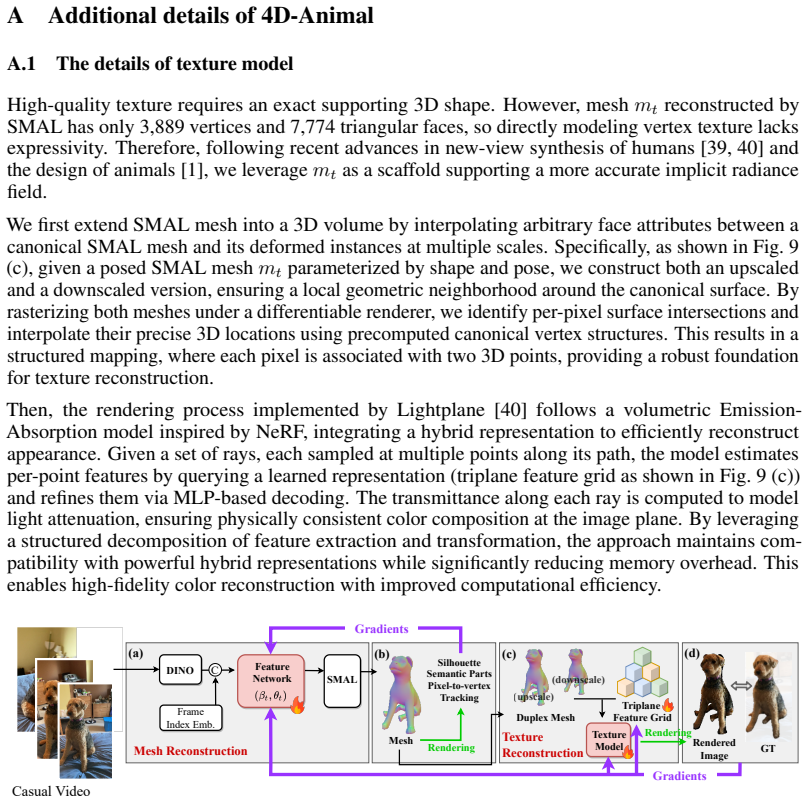
The central machinery is the hierarchical alignment loss combined with a dense feature network. The SMAL parametric model (a skinned quadruped template with shape and pose parameters) is fitted per frame by a learnable network that takes DINO-ViT features and a frame-index embedding and outputs SMAL parameters. A multi-stage training schedule first stabilizes global pose with weak object and temporal weights, then enables vertex offsets and fine alignment while decreasing part and pixel weights and increasing temporal weight. The four geometric losses—silhouette Chamfer distance, part-based point-to-vertex distance, CSE-derived pixel-to-vertex distance, and BootsTAP trajectory re-projection distance—each target a different granularity of alignment, and their calibrated combination is what substitutes for keypoint supervision.
What would settle it
Run 4D-Animal on a set of dog videos where the PartGLEE masks or CSE correspondences are known to be incorrect, for example fast-motion sequences with motion blur or occluded body parts, and measure IoU and LPIPS; if a keypoint-supervised baseline such as BITE or Avatars outperforms 4D-Animal on these subsets, the claim that keypoint-free fitting is universally superior would be falsified. A simpler test is to corrupt the CSE-to-SMAL mapping (e.g., by random vertex shuffles) and observe whether the reported COP3D gains vanish.
Extended reading notes
Core claim
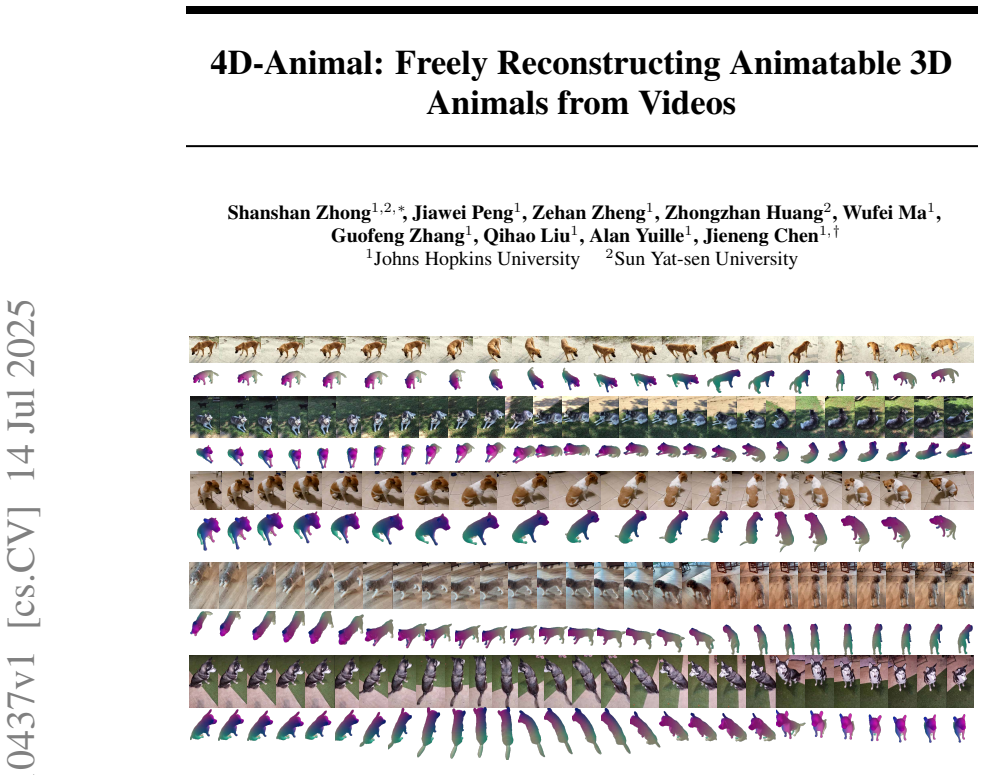
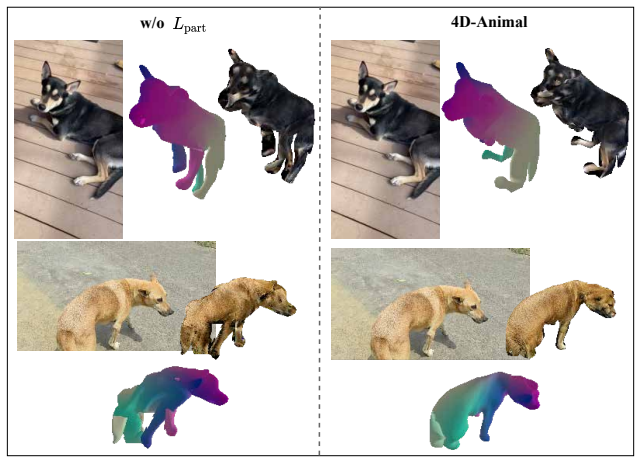
The central claim is that a keypoint-free, optimization-based fitting framework can achieve state-of-the-art animatable 3D animal reconstruction from monocular videos. The method, 4D-Animal, maps DINO-ViT image features to SMAL parameters through a lightweight dense feature network, then aligns the resulting mesh to the video using a hierarchical set of geometric losses: object-level silhouette matching with SAM masks, part-level alignment with semantic masks (head, body, feet, tail) from PartGLEE, pixel-to-vertex supervision from CSE correspondences transferred to the SMAL mesh via Zoom-Out, and temporal consistency from BootsTAP point tracks. On 50 dog videos from COP3D, 4D-Animal reports IoU 0.84, IoUw5 0.71, PSNR 21.28, and LPIPS 0.061, outperforming keypoint-dependent baselines BARC, BITE, and Avatars, and the model-free RAC; it also achieves lower depth error on TracksTo4D and roughly 3x faster convergence than Avatars. The paper further shows that removing the object-level loss drastically degrades performance (IoU drops to 0.51), while removing part, pixel, or temporal losses each causes measurable degradation, supporting the claim that the combination of hierarchical cues is what makes keypoint-free fitting work.
Load-bearing premise
The method assumes that the pretrained 2D models—especially the CSE-to-SMAL zoom-out mapping and PartGLEE part masks—produce accurate enough cues on the target dog videos; if these cues are unreliable, the hierarchical alignment loses its guidance and reconstruction quality drops.
Editorial extensions
If this is right
- If keypoint annotations are truly unnecessary, animal reconstruction pipelines can scale to arbitrary casual videos without manual labeling.
- The reported speedup in convergence suggests that dense feature initialization can make optimization-based fitting practical for larger video collections.
- The generated animatable 3D assets can be used to fine-tune large image-to-3D generative models, reducing the synthetic-to-real domain gap for unseen animal images.
- The method's generality beyond dogs is suggested by preliminary cat reconstructions using a dog-specific template, indicating potential extension to other quadrupeds.
- Better depth accuracy than Avatars on RGB-D dog videos implies that keypoint-free fitting can capture geometry at least as reliably as keypoint-supervised approaches.
Reading between the lines
- The approach implicitly shifts the annotation burden from sparse keypoints to the choice and quality of pretrained 2D models; as those models improve, keypoint-free reconstruction should improve without changing the pipeline.
- A testable extension would be to replace the SMAL template with a species-specific or learned template and measure whether the hierarchical cues alone can drive fitting for non-canine quadrupeds, a regime the paper only samples with cats.
- The failure cases point to a concrete boundary: when part masks, correspondences, or tracks are unreliable—fast motion, occlusion, atypical ears—the method loses its competitive edge, suggesting that robustness gains will come from making the 2D cues themselves more reliable rather than from the fitting objective.
- The claimed benefit to image-to-3D generation could be quantified more directly by measuring downstream model performance before and after fine-tuning on 4D-Animal assets across multiple generator architectures and unseen animal categories.
Editorial analysis
A structured set of objections, weighed in public.
Referee Report
Summary. The paper proposes 4D-Animal, an optimization-based method for reconstructing animatable 3D dog models from monocular videos without sparse keypoint annotations. It regresses SMAL parameters from DINO-ViT features through a shallow feature network and supervises the fit with a hierarchical set of cues: SAM silhouettes, PartGLEE part masks, CSE pixel-to-vertex correspondences mapped to SMAL via Zoom-Out, BootsTAP trajectories, and a perceptual LPIPS texture loss. The method is evaluated on 50 COP3D dog videos with a contiguous train/test frame split, reporting IoU 0.84, IoUw5 0.71, PSNR 21.28, and LPIPS 0.061, with comparisons to model-based (BARC, BITE, Avatars) and model-free (RAC) baselines; depth metrics on TracksTo4D and qualitative results are also included. The central claim is that keypoint-free fitting can outperform prior keypoint-based and model-free approaches.
Significance. If the reported results are validated, this is a useful contribution: it removes the need for manually annotated sparse keypoints, integrates dense but weak 2D cues in a principled hierarchical manner, and releases code. The held-out-frame evaluation split and the anchoring of losses to external pretrained models make the protocol substantially less prone to circularity than many fitting papers. The method also demonstrates potential downstream value for image-to-3D generation. However, the evaluation as presented has load-bearing gaps: the Avatars baseline is a re-run whose published numbers are withheld, no uncertainty estimates are provided, and the paper's own table contradicts the abstract claim of outperforming model-free baselines on PSNR.
major comments (4)
- [§4.2, Table 1, and Abstract] The abstract and Section 4.2 claim that 4D-Animal 'outperforms both model-based and model-free baselines' and achieves 'the best overall reconstruction.' Table 1, however, shows RAC (model-free) with PSNR 21.86 vs. 4D-Animal's 21.28, so the unqualified 'best overall' claim is internally contradicted by the paper's own reported metric. Please either state the aggregation criterion explicitly (e.g., wins on 4 of 5 metrics, with IoU/LPIPS as priorities), or temper the claim. The PSNR trade-off should be discussed, since it may reflect differences in texture-model capacity rather than geometry quality.
- [Appendix B.4 and Table 1] The Avatars* results in Table 1 come from a re-run that, by the authors' own admission, is 'slightly lower than those reported in the original paper.' The original published Avatars numbers are never reported, while the BARC, BITE, and RAC rows are copied from the Avatars paper. This mixes a possibly degraded re-run with published numbers for the other baselines, so the headline margins (IoU 0.84 vs. 0.81, PSNR 21.28 vs. 19.91) cannot be verified as reflecting a genuine improvement over Avatars. Please provide a table with both the original published values and the re-run values, and justify why the re-run is the appropriate basis for comparison rather than the original numbers.
- [§4.2 and §5 (RQ1, RQ2)] All quantitative results are point estimates over 50 videos with no standard deviations, confidence intervals, or significance tests. The margins over Avatars are small (e.g., IoU 0.84 vs. 0.81, PSNR 21.28 vs. 19.91), and even the shortfall to RAC on PSNR (0.58) could be within run-to-run or video-level variability. Please report per-video statistics with bootstrap confidence intervals or paired significance tests for the main metrics, and state the number of random seeds used.
- [§3.2 and Table 3] The dense feature network is a stated core contribution (abstract and Section 1), but its contribution is never ablated. Table 3 ablates only the hierarchical losses; there is no comparison against, for example, directly optimizing SMAL parameters per frame with the same losses and no feature network. The efficiency claim in Figure 6/12 (up to 3x speedup) is measured against Avatars rather than against an internal ablation, so the reader cannot attribute the improvements to the feature network specifically. Please add an ablation that removes or replaces the feature network to isolate its effect on accuracy and convergence speed.
minor comments (6)
- [§5 (Analysis)] There are two research questions labeled 'RQ4' in Section 5: one on downstream 3D generation and one on failure cases. The second should be renumbered to RQ5.
- [§3.3, §3.4, and Appendix cross-references] Several appendix cross-references do not match the actual appendix labels: 'Appendix 1.3' should be 'Appendix A.3,' 'Appendix 1.1' should be 'Appendix A.1,' and 'Appendix 2' / 'Appendix 2.1' should be 'Appendix B' / 'Appendix B.1.' Please correct them.
- [Table 4] The table's column structure is difficult to parse: under the three condition labels 'Initialization Org EPnP EPnP-RANSAC' there are seven numeric columns with checkmark rows that are not clearly aligned with the described configurations. Please restructure the table so each configuration has a single column, and state clearly what 'Org' means.
- [Figure 6 and Figure 12] The axis labels 'RNSP' and 'SPIPL' appear to be typos for 'PSNR' and 'LPIPS.' Please correct them in both figures.
- [Appendix B.7] The sentence 'As we have mentioned in Sec. 6 (main text)' is inaccurate because the downstream-task RQ4 appears in Section 5, not Section 6. Please correct the cross-reference.
- [Table 5] It is not stated whether the Avatars rows in Table 5 correspond to the same re-run as in Table 1. Please add a footnote so the reader can track which numbers are re-run results and which are from the original publication.
Circularity Check
No load-bearing circularity: the fitting objective is anchored to external pretrained 2D cues and evaluated on held-out frames; the Avatars re-run and PSNR table discrepancy are verification concerns, not circular derivation.
full rationale
Walking the derivation chain: Sec. 3.3 defines the objective as L = Lgeo + λtex Ltex + R, where Lgeo is a sum of four losses (Lobj, Lpart, Lpix, Ltime), each supervised by pretrained external models (SAM, PartGLEE, CSE+Zoom-Out, BootsTAP). None of these loss terms is defined in terms of the SMAL parameters being optimized in a way that makes the fitted value equal to the supervision: Lobj is a Chamfer distance between projected vertices and SAM masks, Lpart and Lpix are reprojection errors to PartGLEE/CSE outputs, and Ltime is a tracking reprojection error. The dense feature network f: It -> (βt, θt) is trained per video under these losses, and evaluation uses interleaved 15-train/5-test frame blocks (Sec. 4.1), so test-frame metrics are not fit quantities. The only self-citation with author overlap is Animal3D [15], used to evaluate the BARC keypoint detector's unreliability in Sec. 1; this motivates the method but is not load-bearing for the reconstruction results. Appendix B.4's admission that the Avatars re-run is 'slightly lower than those reported in the original paper' is an evaluation/verification caveat: it affects whether the headline comparisons are confirmed, but it is not a case of a prediction reducing to its inputs by construction. Likewise, Table 1's RAC PSNR (21.86) exceeding 4D-Animal (21.28) contradicts the abstract's unqualified 'outperforms both model-based and model-free baselines,' but this is an internal-consistency error, not circularity. Overall, no equation, fitted parameter, or cited result is equivalent to the paper's own outputs, so the circularity score is minimal.
Assumptions & free parameters
free parameters (4)
- lambda_obj, lambda_part, lambda_pix, lambda_time, lambda_tex =
scheduled values, e.g., obj: 1, 100, 500, 800 at milestones 300, 1000, 6000
- Ns (part sample count) =
200
- Nt (tracking point count) =
500 per key frame, 4 key frames
- confidence thresholds for part and CSE cues =
0.3 and 0.5
assumptions (3)
- domain assumption SMAL (dog-specific D-SMAL) parametrization plus vertex offsets is expressive enough to represent the target dogs' shape and pose.
- domain assumption Pretrained 2D models (SAM, PartGLEE, CSE, BootsTAP) produce reliable and consistent cues on unseen videos.
- domain assumption The Zoom-Out functional mapping between the CSE template and SMAL mesh preserves semantic correspondence.
Cite this review
Pith. "Pith review of 4D-Animal: Freely Reconstructing Animatable 3D Animals from Videos." pith.science (2026). https://pith.science/paper/TUCH26AX
@misc{pith2026250710437,
  author       = {Pith},
  title        = {Pith review of: 4D-Animal: Freely Reconstructing Animatable 3D Animals from Videos},
  year         = {2026},
  howpublished = {\url{https://pith.science/paper/TUCH26AX}},
  note         = {Machine review of arXiv:2507.10437}
}
read the original abstract
Existing methods for reconstructing animatable 3D animals from videos typically rely on sparse semantic keypoints to fit parametric models. However, obtaining such keypoints is labor-intensive, and keypoint detectors trained on limited animal data are often unreliable. To address this, we propose 4D-Animal, a novel framework that reconstructs animatable 3D animals from videos without requiring sparse keypoint annotations. Our approach introduces a dense feature network that maps 2D representations to SMAL parameters, enhancing both the efficiency and stability of the fitting process. Furthermore, we develop a hierarchical alignment strategy that integrates silhouette, part-level, pixel-level, and temporal cues from pre-trained 2D visual models to produce accurate and temporally coherent reconstructions across frames. Extensive experiments demonstrate that 4D-Animal outperforms both model-based and model-free baselines. Moreover, the high-quality 3D assets generated by our method can benefit other 3D tasks, underscoring its potential for large-scale applications. The code is released at https://github.com/zhongshsh/4D-Animal.
Figures


Figures from the paper (20 more)






Reference graph
Works this paper leans on
-
[1]
Animal avatars: Reconstructing animatable 3d animals from casual videos
Remy Sabathier, Niloy J Mitra, and David Novotny. Animal avatars: Reconstructing animatable 3d animals from casual videos. In European Conference on Computer Vision, pages 270–287. Springer, 2024
work page 2024
-
[2]
Fast encoder-based 3d from casual videos via point track processing
Yoni Kasten, Wuyue Lu, and Haggai Maron. Fast encoder-based 3d from casual videos via point track processing. arXiv preprint arXiv:2404.07097, 2024
arXiv 2024
-
[3]
Neural parametric gaussians for monocular non-rigid object reconstruction
Devikalyan Das, Christopher Wewer, Raza Yunus, Eddy Ilg, and Jan Eric Lenssen. Neural parametric gaussians for monocular non-rigid object reconstruction. In Proceedings of the IEEE/CVF Conference on Computer Vision and Pattern Recognition, pages 10715–10725, 2024
work page 2024
-
[4]
Reconstructing animatable categories from videos
Gengshan Yang, Chaoyang Wang, N Dinesh Reddy, and Deva Ramanan. Reconstructing animatable categories from videos. In Proceedings of the IEEE/CVF Conference on Computer Vision and Pattern Recognition, pages 16995–17005, 2023
work page 2023
-
[5]
Banmo: Building animatable 3d neural models from many casual videos
Gengshan Yang, Minh V o, Natalia Neverova, Deva Ramanan, Andrea Vedaldi, and Hanbyul Joo. Banmo: Building animatable 3d neural models from many casual videos. In CVPR, 2022
work page 2022
-
[6]
Learning the 3d fauna of the web
Zizhang Li, Dor Litvak, Ruining Li, Yunzhi Zhang, Tomas Jakab, Christian Rupprecht, Shangzhe Wu, Andrea Vedaldi, and Jiajun Wu. Learning the 3d fauna of the web. In CVPR, 2024
work page 2024
-
[7]
Ppr: Physically plausible reconstruction from monocular videos
Gengshan Yang, Shuo Yang, John Z Zhang, Zachary Manchester, and Deva Ramanan. Ppr: Physically plausible reconstruction from monocular videos. InProceedings of the IEEE/CVF International Conference on Computer Vision, pages 3914–3924, 2023
work page 2023
-
[8]
Smpl: A skinned multi-person linear model
Matthew Loper, Naureen Mahmood, Javier Romero, Gerard Pons-Moll, and Michael J Black. Smpl: A skinned multi-person linear model. In Seminal Graphics Papers: Pushing the Boundaries, V olume 2, pages 851–866. 2023
2023
Show all 69 references
-
[9]
Ghum & ghuml: Generative 3d human shape and articulated pose models
Hongyi Xu, Eduard Gabriel Bazavan, Andrei Zanfir, William T Freeman, Rahul Sukthankar, and Cristian Sminchisescu. Ghum & ghuml: Generative 3d human shape and articulated pose models. In Proceedings of the IEEE/CVF Conference on Computer Vision and Pattern Recognition , pages 6...
2020
-
[10]
Accelerating 3d deep learning with pytorch3d
Nikhila Ravi, Jeremy Reizenstein, David Novotny, Taylor Gordon, Wan-Yen Lo, Justin Johnson, and Georgia Gkioxari. Accelerating 3d deep learning with pytorch3d. arXiv preprint arXiv:2007.08501, 2020
2007 arXiv
-
[11]
Soft rasterizer: A differentiable renderer for image- based 3d reasoning
Shichen Liu, Tianye Li, Weikai Chen, and Hao Li. Soft rasterizer: A differentiable renderer for image- based 3d reasoning. In Proceedings of the IEEE/CVF international conference on computer vision , pages 7708–7717, 2019
2019
-
[12]
Bite: Beyond priors for improved three-d dog pose estimation
Nadine Rüegg, Shashank Tripathi, Konrad Schindler, Michael J Black, and Silvia Zuffi. Bite: Beyond priors for improved three-d dog pose estimation. InProceedings of the IEEE/CVF Conference on Computer Vision and Pattern Recognition, pages 8867–8876, 2023
2023
-
[13]
Barc: Learning to regress 3d dog shape from images by exploiting breed information
Nadine Rueegg, Silvia Zuffi, Konrad Schindler, and Michael J Black. Barc: Learning to regress 3d dog shape from images by exploiting breed information. In Proceedings of the IEEE/CVF Conference on Computer Vision and Pattern Recognition, pages 3876–3884, 2022
2022
-
[14]
3d menagerie: Modeling the 3d shape and pose of animals
Silvia Zuffi, Angjoo Kanazawa, David W Jacobs, and Michael J Black. 3d menagerie: Modeling the 3d shape and pose of animals. In Proceedings of the IEEE conference on computer vision and pattern recognition, pages 6365–6373, 2017
2017
-
[15]
Animal3d: A comprehensive dataset of 3d animal pose and shape
Jiacong Xu, Yi Zhang, Jiawei Peng, Wufei Ma, Artur Jesslen, Pengliang Ji, Qixin Hu, Jiehua Zhang, Qihao Liu, Jiahao Wang, et al. Animal3d: A comprehensive dataset of 3d animal pose and shape. arXiv preprint arXiv:2308.11737, 2023. 10
2023 arXiv
-
[16]
Partglee: A foundation model for recognizing and parsing any objects
Junyi Li, Junfeng Wu, Weizhi Zhao, Song Bai, and Xiang Bai. Partglee: A foundation model for recognizing and parsing any objects. In European Conference on Computer Vision, pages 475–494. Springer, 2024
2024
-
[17]
Sam 2: Segment anything in images and videos
Nikhila Ravi, Valentin Gabeur, Yuan-Ting Hu, Ronghang Hu, Chaitanya Ryali, Tengyu Ma, Haitham Khedr, Roman Rädle, Chloe Rolland, Laura Gustafson, et al. Sam 2: Segment anything in images and videos. arXiv preprint arXiv:2408.00714, 2024
2024 arXiv
-
[18]
Continuous surface embeddings
Natalia Neverova, David Novotny, Vasil Khalidov, Marc Szafraniec, Patrick Labatut, and Andrea Vedaldi. Continuous surface embeddings. 2020
2020
-
[19]
Bootstap: Bootstrapped training for tracking-any-point
Carl Doersch, Pauline Luc, Yi Yang, Dilara Gokay, Skanda Koppula, Ankush Gupta, Joseph Heyward, Ignacio Rocco, Ross Goroshin, João Carreira, et al. Bootstap: Bootstrapped training for tracking-any-point. In Proceedings of the Asian Conference on Computer Vision , pages 3257–3274, 2024
2024
-
[20]
Humans in 4D: Reconstructing and tracking humans with transformers
Shubham Goel, Georgios Pavlakos, Jathushan Rajasegaran, Angjoo Kanazawa*, and Jitendra Malik*. Humans in 4D: Reconstructing and tracking humans with transformers. In International Conference on Computer Vision (ICCV), 2023
2023
-
[21]
Efros, and Jitendra Malik
Angjoo Kanazawa, Shubham Tulsiani, Alexei A. Efros, and Jitendra Malik. Learning category-specific mesh reconstruction from image collections. In ECCV, 2018
2018
-
[22]
Lasr: Learning articulated shape reconstruction from a monocular video
Gengshan Yang, Deqing Sun, Varun Jampani, Daniel Vlasic, Forrester Cole, Huiwen Chang, Deva Ramanan, William T Freeman, and Ce Liu. Lasr: Learning articulated shape reconstruction from a monocular video. In CVPR, 2021
2021
-
[23]
Viser: Video-specific surface embeddings for articulated 3d shape reconstruction
Gengshan Yang, Deqing Sun, Varun Jampani, Daniel Vlasic, Forrester Cole, Ce Liu, and Deva Ramanan. Viser: Video-specific surface embeddings for articulated 3d shape reconstruction. Advances in Neural Information Processing Systems, 34:19326–19338, 2021
2021
-
[24]
Lassie: Learning articulated shape from sparse image ensemble via 3d part discovery
Chun-Han Yao, Wei-Chih Hung, Yuanzhen Li, Michael Rubinstein, Ming-Hsuan Yang, and Varun Jampani. Lassie: Learning articulated shape from sparse image ensemble via 3d part discovery. In NeurIPS, 2022
2022
-
[25]
Hi-lassie: High-fidelity articulated shape and skeleton discovery from sparse image ensemble
Chun-Han Yao, Wei-Chih Hung, Yuanzhen Li, Michael Rubinstein, Ming-Hsuan Yang, and Varun Jampani. Hi-lassie: High-fidelity articulated shape and skeleton discovery from sparse image ensemble. In CVPR, 2023
2023
-
[26]
Emerging properties in self-supervised vision transformers
Mathilde Caron, Hugo Touvron, Ishan Misra, Hervé Jégou, Julien Mairal, Piotr Bojanowski, and Armand Joulin. Emerging properties in self-supervised vision transformers. In Proceedings of the International Conference on Computer Vision (ICCV), 2021
2021
-
[27]
Dove: Learning deformable 3d objects by watching videos
Shangzhe Wu, Tomas Jakab, Christian Rupprecht, and Andrea Vedaldi. Dove: Learning deformable 3d objects by watching videos. International Journal of Computer Vision, 131(10):2623–2634, 2023
2023
-
[28]
MagicPony: Learning articulated 3d animals in the wild
Shangzhe Wu, Ruining Li, Tomas Jakab, Christian Rupprecht, and Andrea Vedaldi. MagicPony: Learning articulated 3d animals in the wild. In CVPR, 2023
2023
-
[29]
Dynamic gaussians mesh: Consistent mesh reconstruction from monocular videos, 2024
Isabella Liu, Hao Su, and Xiaolong Wang. Dynamic gaussians mesh: Consistent mesh reconstruction from monocular videos, 2024
2024
-
[30]
3d gaussian splatting for real-time radiance field rendering
Bernhard Kerbl, Georgios Kopanas, Thomas Leimkühler, and George Drettakis. 3d gaussian splatting for real-time radiance field rendering. ACM Transactions on Graphics, 42(4), July 2023
2023
-
[31]
Birds of a feather: Capturing avian shape models from images
Yufu Wang, Nikos Kolotouros, Kostas Daniilidis, and Marc Badger. Birds of a feather: Capturing avian shape models from images. In Computer Vision and Pattern Recognition (CVPR), 2021
2021
-
[32]
in the wild
Silvia Zuffi, Angjoo Kanazawa, Tanya Berger-Wolf, and Michael J. Black. Three-d safari: Learning to estimate zebra pose, shape, and texture from images "in the wild". In International Conference on Computer Vision, October 2019
2019
-
[33]
Who left the dogs out?: 3D animal reconstruction with expectation maximization in the loop
Benjamin Biggs, Oliver Boyne, James Charles, Andrew Fitzgibbon, and Roberto Cipolla. Who left the dogs out?: 3D animal reconstruction with expectation maximization in the loop. In ECCV, 2020
2020
-
[34]
Coarse-to-fine animal pose and shape estimation
Chen Li and Gim Hee Lee. Coarse-to-fine animal pose and shape estimation. Advances in Neural Information Processing Systems, 34:11757–11768, 2021
2021
-
[35]
Rgbd-dog: Predicting canine pose from rgbd sensors
Sinead Kearney, Wenbin Li, Martin Parsons, Kwang In Kim, and Darren Cosker. Rgbd-dog: Predicting canine pose from rgbd sensors. In IEEE/CVF Conference on Computer Vision and Pattern Recognition (CVPR), June 2020. 11
2020
-
[36]
Creatures great and SMAL: Recovering the shape and motion of animals from video
Benjamin Biggs, Thomas Roddick, Andrew Fitzgibbon, and Roberto Cipolla. Creatures great and SMAL: Recovering the shape and motion of animals from video. In ACCV, 2018
2018
-
[37]
Silvia Zuffi, Ylva Mellbin, Ci Li, Markus Hoeschle, Hedvig Kjellström, Senya Polikovsky, Elin Hernlund, and Michael J. Black. V AREN: Very accurate and realistic equine network. InIEEE/CVF Conference on Computer Vision and Pattern Recognition (CVPR), June 2024
2024
-
[38]
Emerging properties in self-supervised vision transformers
Mathilde Caron, Hugo Touvron, Ishan Misra, Hervé Jégou, Julien Mairal, Piotr Bojanowski, and Armand Joulin. Emerging properties in self-supervised vision transformers. In Proceedings of the IEEE/CVF international conference on computer vision , pages 9650–9660, 2021
2021
-
[39]
Efficient geometry-aware 3d generative adversarial networks
Eric R Chan, Connor Z Lin, Matthew A Chan, Koki Nagano, Boxiao Pan, Shalini De Mello, Orazio Gallo, Leonidas J Guibas, Jonathan Tremblay, Sameh Khamis, et al. Efficient geometry-aware 3d generative adversarial networks. In Proceedings of the IEEE/CVF conference on computer vis...
2022
-
[40]
Lightplane: Highly-scalable components for neural 3d fields
Ang Cao, Justin Johnson, Andrea Vedaldi, and David Novotny. Lightplane: Highly-scalable components for neural 3d fields. arXiv preprint arXiv:2404.19760, 2024
2024 arXiv
-
[41]
Creatures great and smal: Recovering the shape and motion of animals from video
Benjamin Biggs, Thomas Roddick, Andrew Fitzgibbon, and Roberto Cipolla. Creatures great and smal: Recovering the shape and motion of animals from video. In Computer Vision–ACCV 2018: 14th Asian Conference on Computer Vision, Perth, Australia, December 2–6, 2018, Revised Select...
2018
-
[42]
Zoomout: Spectral upsampling for efficient shape correspondence
Simone Melzi, Jing Ren, Emanuele Rodola, Abhishek Sharma, Peter Wonka, and Maks Ovsjanikov. Zoomout: Spectral upsampling for efficient shape correspondence. arXiv preprint arXiv:1904.07865 , 2019
1904 arXiv
-
[43]
The unreasonable effectiveness of deep features as a perceptual metric
Richard Zhang, Phillip Isola, Alexei A Efros, Eli Shechtman, and Oliver Wang. The unreasonable effectiveness of deep features as a perceptual metric. In Proceedings of the IEEE conference on computer vision and pattern recognition, pages 586–595, 2018
2018
-
[44]
As-rigid-as-possible shape manipulation
Takeo Igarashi, Tomer Moscovich, and John F Hughes. As-rigid-as-possible shape manipulation. ACM transactions on Graphics (TOG), 24(3):1134–1141, 2005
2005
-
[45]
Laplacian surface editing
Olga Sorkine, Daniel Cohen-Or, Yaron Lipman, Marc Alexa, Christian Rössl, and H-P Seidel. Laplacian surface editing. In Proceedings of the 2004 Eurographics/ACM SIGGRAPH symposium on Geometry processing, pages 175–184, 2004
2004
-
[46]
Laplacian mesh optimization
Andrew Nealen, Takeo Igarashi, Olga Sorkine, and Marc Alexa. Laplacian mesh optimization. In Proceedings of the 4th international conference on Computer graphics and interactive techniques in Australasia and Southeast Asia, pages 381–389, 2006
2006
-
[47]
Implicit fairing of irregular meshes using diffusion and curvature flow
Mathieu Desbrun, Mark Meyer, Peter Schröder, and Alan H Barr. Implicit fairing of irregular meshes using diffusion and curvature flow. In Proceedings of the 26th annual conference on Computer graphics and interactive techniques, pages 317–324, 1999
1999
-
[48]
Vggsfm: Visual geometry grounded deep structure from motion
Jianyuan Wang, Nikita Karaev, Christian Rupprecht, and David Novotny. Vggsfm: Visual geometry grounded deep structure from motion. In Proceedings of the IEEE/CVF conference on computer vision and pattern recognition, pages 21686–21697, 2024
2024
-
[49]
Flowmap: High-quality camera poses, intrinsics, and depth via gradient descent
Cameron Smith, David Charatan, Ayush Tewari, and Vincent Sitzmann. Flowmap: High-quality camera poses, intrinsics, and depth via gradient descent. arXiv preprint arXiv:2404.15259, 2024
2024 arXiv
-
[50]
Ep n p: An accurate o (n) solution to the p n p problem
Vincent Lepetit, Francesc Moreno-Noguer, and Pascal Fua. Ep n p: An accurate o (n) solution to the p n p problem. International journal of computer vision , 81:155–166, 2009
2009
-
[51]
Common pets in 3d: Dynamic new-view synthesis of real-life deformable categories
Samarth Sinha, Roman Shapovalov, Jeremy Reizenstein, Ignacio Rocco, Natalia Neverova, Andrea Vedaldi, and David Novotny. Common pets in 3d: Dynamic new-view synthesis of real-life deformable categories. In Proceedings of the IEEE/CVF Conference on Computer Vision and Pattern R...
2023
-
[52]
Lgm: Large multi-view gaussian model for high-resolution 3d content creation
Jiaxiang Tang, Zhaoxi Chen, Xiaokang Chen, Tengfei Wang, Gang Zeng, and Ziwei Liu. Lgm: Large multi-view gaussian model for high-resolution 3d content creation. In European Conference on Computer Vision, pages 1–18. Springer, 2024
2024
-
[53]
Mvdream: Multi-view diffusion for 3d generation
Yichun Shi, Peng Wang, Jianglong Ye, Mai Long, Kejie Li, and Xiao Yang. Mvdream: Multi-view diffusion for 3d generation. arXiv preprint arXiv:2308.16512, 2023. 12
2023 arXiv
-
[54]
Consistent video depth estimation
Xuan Luo, Jia-Bin Huang, Richard Szeliski, Kevin Matzen, and Johannes Kopf. Consistent video depth estimation. ACM Transactions on Graphics (ToG), 39(4):71–1, 2020
2020
-
[55]
Objaverse: A universe of annotated 3d objects
Matt Deitke, Dustin Schwenk, Jordi Salvador, Luca Weihs, Oscar Michel, Eli VanderBilt, Ludwig Schmidt, Kiana Ehsani, Aniruddha Kembhavi, and Ali Farhadi. Objaverse: A universe of annotated 3d objects. In Proceedings of the IEEE/CVF conference on computer vision and pattern rec...
2023
-
[56]
Shic: Shape-image correspondences with no keypoint supervision
Aleksandar Shtedritski, Christian Rupprecht, and Andrea Vedaldi. Shic: Shape-image correspondences with no keypoint supervision. In European Conference on Computer Vision , pages 129–145. Springer, 2024
2024
-
[57]
Unsupervised learning of category- level 3d pose from object-centric videos
Leonhard Sommer, Artur Jesslen, Eddy Ilg, and Adam Kortylewski. Unsupervised learning of category- level 3d pose from object-centric videos. In Proceedings of the IEEE/CVF Conference on Computer Vision and Pattern Recognition, pages 22787–22796, 2024
2024
-
[58]
4dpv: 4d pet from videos by coarse-to-fine non-rigid radiance fields
Sergio M de Paco and Antonio Agudo. 4dpv: 4d pet from videos by coarse-to-fine non-rigid radiance fields. In Proceedings of the Asian Conference on Computer Vision , pages 2596–2612, 2024
2024
-
[59]
Lepard: Learning explicit part discovery for 3d articulated shape reconstruction
Di Liu, Anastasis Stathopoulos, Qilong Zhangli, Yunhe Gao, and Dimitris Metaxas. Lepard: Learning explicit part discovery for 3d articulated shape reconstruction. Advances in Neural Information Processing Systems, 36:54187–54198, 2023
2023
-
[60]
Self-supervised single-view 3d reconstruction via semantic consistency
Xueting Li, Sifei Liu, Kihwan Kim, Shalini De Mello, Varun Jampani, Ming-Hsuan Yang, and Jan Kautz. Self-supervised single-view 3d reconstruction via semantic consistency. In Computer Vision–ECCV 2020: 16th European Conference, Glasgow, UK, August 23–28, 2020, Proceedings, Par...
2020
-
[61]
Saor: Single-view articulated object reconstruction
Mehmet Aygun and Oisin Mac Aodha. Saor: Single-view articulated object reconstruction. In Proceedings of the IEEE/CVF Conference on Computer Vision and Pattern Recognition , pages 10382–10391, 2024
2024
-
[62]
Mosca: Dynamic gaussian fusion from casual videos via 4d motion scaffolds
Jiahui Lei, Yijia Weng, Adam Harley, Leonidas Guibas, and Kostas Daniilidis. Mosca: Dynamic gaussian fusion from casual videos via 4d motion scaffolds. arXiv preprint arXiv:2405.17421, 2024
2024 arXiv
-
[63]
Shape of motion: 4d reconstruction from a single video
Qianqian Wang, Vickie Ye, Hang Gao, Jake Austin, Zhengqi Li, and Angjoo Kanazawa. Shape of motion: 4d reconstruction from a single video. arXiv preprint arXiv:2407.13764, 2024
2024
-
[64]
Sf3d: Stable fast 3d mesh re- construction with uv-unwrapping and illumination disentanglement
Mark Boss, Zixuan Huang, Aaryaman Vasishta, and Varun Jampani. Sf3d: Stable fast 3d mesh re- construction with uv-unwrapping and illumination disentanglement. arXiv preprint arXiv:2408.00653, 2024
2024 arXiv
-
[65]
Triplane meets gaussian splatting: Fast and generalizable single-view 3d reconstruction with transformers
Zi-Xin Zou, Zhipeng Yu, Yuan-Chen Guo, Yangguang Li, Ding Liang, Yan-Pei Cao, and Song-Hai Zhang. Triplane meets gaussian splatting: Fast and generalizable single-view 3d reconstruction with transformers. In Proceedings of the IEEE/CVF conference on computer vision and pattern...
2024
-
[66]
Crm: Single image to 3d textured mesh with convolutional reconstruction model
Zhengyi Wang, Yikai Wang, Yifei Chen, Chendong Xiang, Shuo Chen, Dajiang Yu, Chongxuan Li, Hang Su, and Jun Zhu. Crm: Single image to 3d textured mesh with convolutional reconstruction model. In European Conference on Computer Vision, pages 57–74. Springer, 2024
2024
-
[67]
3dtopia-xl: High-quality 3d pbr asset generation via primitive diffusion
Zhaoxi Chen, Jiaxiang Tang, Yuhao Dong, Ziang Cao, Fangzhou Hong, Yushi Lan, Tengfei Wang, Haozhe Xie, Tong Wu, Shunsuke Saito, et al. 3dtopia-xl: High-quality 3d pbr asset generation via primitive diffusion. arXiv preprint arXiv:2409.12957, 8, 2024
2024 arXiv
-
[68]
Instantmesh: Efficient 3d mesh generation from a single image with sparse-view large reconstruction models
Jiale Xu, Weihao Cheng, Yiming Gao, Xintao Wang, Shenghua Gao, and Ying Shan. Instantmesh: Efficient 3d mesh generation from a single image with sparse-view large reconstruction models. arXiv preprint arXiv:2404.07191, 2024
2024 arXiv
-
[69]
C" stands for concatena- tion. “Frame Index Emb
Jianfeng Xiang, Zelong Lv, Sicheng Xu, Yu Deng, Ruicheng Wang, Bowen Zhang, Dong Chen, Xin Tong, and Jiaolong Yang. Structured 3d latents for scalable and versatile 3d generation. arXiv preprint arXiv:2412.01506, 2024. 13 A Additional details of 4D-Animal A.1 The details of te...
2024 arXiv
Reviewed August 6, 2026 · model on record in the stance chip above.
Discussion (0). Sign in to comment.