REVIEW 3 major objections 6 minor 36 references
FinTeam: A Multi-Agent Collaborative Intelligence System for Comprehensive Financial Scenarios
T0 review · 3 major / 6 minor · reviewed 2026-08-06 · deepseek-v4-flash
Pith's one-line read FinTeam claims a four-agent pipeline makes a 7-billion-parameter model beat larger rivals on Chinese financial reports.
desk verdict A useful four-role financial agent assembly with solid per-agent benchmark gains, but the headline 'combining agents' claim lacks a single-model ablation and the evaluation reporting needs tightening. read the letter →
The pith
A machine-rendered reading of the paper's core claim, the machinery that carries it, and where it could break.
The reading
What carries the argument
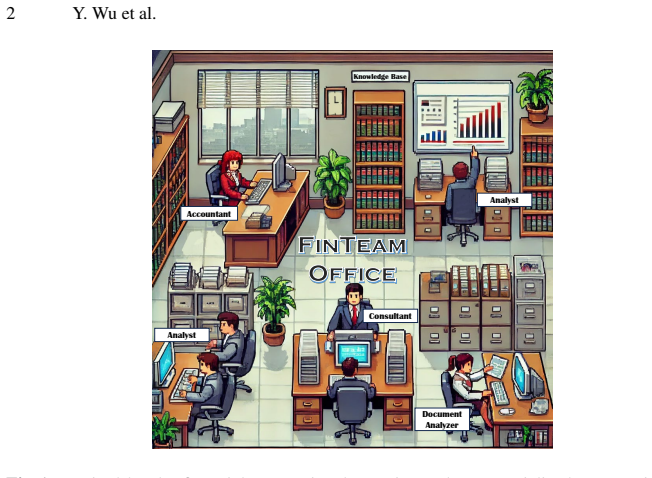
The load-bearing mechanism is a division of labor among four LLM agents, each fine-tuned with LoRA on part of a 241k-sample constructed dataset and then composed into scenario workflows. The document analyzer handles intent recognition, entity extraction, sentiment analysis, and related NLP tasks; the analyst performs retrieval-augmented generation over knowledge bases using the m3e-base embedding model and a Chain-of-Retrieval prompting method; the accountant emits Toolformer-style tool commands so numeric work is done by an expression calculator, equation solver, counter, or probability table instead of by the LLM; and the consultant generates final answers from Chinese financial knowledge data. These agents are arranged into three pipelines: macroeconomic analysis, industry analysis, and company analysis, where the document analyzer extracts, the analyst retrieves and analyzes, the accountant computes when needed, and the consultant compiles the final answer.
What would settle it
Train one Qwen2.5-7B-Chat model on the full 241k agent training set without role separation and evaluate it on the same 150 investor questions with the same human and GPT-4o evaluations; if its acceptance rate is statistically indistinguishable from 62.00%, then the multi-agent collaboration is not the source of FinTeam's reported advantage.
Extended reading notes
Core claim
The paper's central claim is that combining agents, not simply scaling the model, is what improves generation quality for real financial questions. FinTeam reaches an overall GPT-4o score of 4.86 out of 5 on a 150-query test set drawn from real investor inquiries, and its output is chosen as best in 93 of 150 human evaluations, a 62.00% acceptance rate, compared with 19.33% for Xuanyuan-13B and 5.33% for GPT-4o. Individually, the document analyzer improves average FinCUGE performance by 7.43 points over Qwen2.5-7B-Instruct, the consultant improves FinEval accuracy by 2.06 points, and the accountant improves formula-and-result accuracy by 0.09. The paper reports significance tests showing improvements in thoroughness, professionalism, and overall score are statistically significant. The intended conclusion is that FinTeam provides professional, thorough answers to questions that single financial LLMs cannot handle comprehensively.
Load-bearing premise
The claim that combining agents causes the gains rests on the untested premise that a single Qwen2.5-7B-Chat model fine-tuned on the same 241,000 training samples would not reach the same 62.00% acceptance rate on the same 150 questions.
Editorial extensions
If this is right
- FinTeam's 62.00% human acceptance rate implies that a 7-billion-parameter team can produce reports that human readers prefer over much larger or closed models on at least Chinese financial queries.
- The per-agent benchmark improvements imply that the 241k-sample training dataset is a reusable asset for building individual financial agents for text understanding, knowledge questions, and calculation.
- The accountant's tool-augmented design means financial computation can be offloaded from the language model to deterministic tools, a pattern that transfers to any domain where arithmetic accuracy matters.
- The three scenario workflows provide a concrete template for applying multi-agent collaboration to macroeconomic, industry, and company-level analysis outside the original training distribution.
Reading between the lines
- Inference: the paper does not isolate whether the gains come from the multi-agent architecture or simply from the extra 241k fine-tuning samples, because no single Qwen2.5-7B-Chat model trained on all samples is evaluated on the same 150 questions.
- Inference: the evaluation is entirely in Chinese and drawn from one domestic investment forum, so the 62.00% acceptance rate should not be extrapolated to English-language or global financial settings without new tests.
- Inference: the human preference test asks readers to choose the best of five anonymized answers, so structural qualities such as length and organization may contribute to the win; a fact-checking pass would be needed to separate style from correctness.
Editorial analysis
A structured set of objections, weighed in public.
Referee Report
Summary. The paper presents FinTeam, a Chinese financial multi-agent system with four role-specialized LLM agents (document analyzer, analyst, accountant, and consultant), each trained by LoRA on Qwen2.5-7B-Chat using 241k constructed samples. The system is evaluated on 150 real investor queries from an online forum across macro, industry, and company analysis scenarios; GPT-4o is used as both a baseline and an automated judge, with a supplementary human preference study. The headline results are a 62.00% human acceptance rate and an overall GPT-4o score of 4.86/5, plus agent-level improvements on FinCUGE, FinEval, and a small financial calculation benchmark. The paper attributes these gains to multi-agent collaboration.
Significance. If the central claim were fully supported, this would be a valuable empirical contribution: it would show that a modest open-weight model, through role decomposition, domain-specific fine-tuning, and tool use, can produce Chinese financial reports that human evaluators prefer over GPT-4o and a 13B financial model. Strengths include the use of real investor queries, an external human adjudication step, evaluation on established benchmarks (FinCUGE, FinEval) for the individual agents, and a publicly stated project link. However, the headline causal claim that the gains come from collaboration is not yet established: no single-model ablation trained on the full dataset is reported, and the evaluation design has a partial judge/baseline circularity. The system-level result is plausible and worth reporting, but the paper needs additional experiments and more careful statistical reporting before the claim as stated can be accepted.
major comments (3)
- The causal claim encoded in 'by combining agents, the financial reports ... achieved a 62.00% acceptance rate' is not supported by the reported comparisons. In Table 3, every baseline is an untuned general-purpose or financial LLM; none is a Qwen2.5-7B-Chat model trained on the full 241k agent training set described in Table 2. The evaluation therefore conflates three independent variables: the curated fine-tuning data, the RAG and tool augmentation, and the multi-agent workflow. Since the consultant agent (63k samples) synthesizes the final report, a single Qwen2.5-7B-Chat model fine-tuned on all 241k samples might match or exceed the 62% acceptance rate. Please add that monolithic ablation, evaluated on the same 150 queries, and report per-variable ablations (e.g., data-only, data+tools, and the full multi-agent workflow). Without this, the paper supports a system-level positive result but not the collaboration-specific interpretation stated in the abstract and Section 4.3.
- The evaluation has a partial circularity that is only partially mitigated by the human study. GPT-4o serves both as a baseline model and as the automated judge, while a substantial fraction of the training data was generated by ChatGPT (Sections 3.1 and 3.2); this can inflate FinTeam scores due to stylistic and lexical overlap with GPT-4o's preferences. The human adjudication provides independent grounding, but Table 5 reports only the raw counts (93/150) with no confidence interval, no number of annotators, and no inter-annotator agreement measure. Please report these quantities and, ideally, a blind pairwise comparison protocol rather than a single 'best answer' choice among five outputs. This is necessary to strengthen the real-world preference claim beyond a point estimate.
- The statistical reporting is incomplete and the textual summary is selective. Table 4 shows that Clarity is significantly worse for FinTeam than the baseline (t = -5.195, p < 0.0001) and Accuracy is not significant (p = 0.8005), yet the text states that 'the improvements in thoroughness, professionalism, and overall score are highly significant' without discussing the negative Clarity result. No multiple-comparison correction is applied across the five dimensions, and the overall-score p-value (0.0138) is marginal, not 'well below' typical thresholds after correction. Please report all pairwise tests (or a single multivariate test), apply a correction for the five dimensions, and rewrite the summary so that the dimension-specific trade-offs are stated accurately.
minor comments (6)
- The text in Section 4.3 says FinTeam improves the overall score by 0.13, but the Table 3 caption and the paper's own calculations imply 0.08 (4.86 vs. 4.83 for GPT-4o, or 4.86 vs. 4.78 for Qwen2.5-7B-Chat). Please reconcile these numbers.
- The sentence 'our financial agent collaboration system outperform GPT-3.5-turbo and Xuanyuan-13B across all dimensions' mentions GPT-3.5-turbo, but GPT-3.5-turbo does not appear in Table 3 or anywhere else in the experiments; either add it to the table or remove the mention.
- The paper describes the FinCUGE improvement as '7.43%' and the FinEval improvement as '2.06%', but the tables report absolute percentage-point differences (47.20 vs. 39.77 and 68.48 vs. 66.42). Please use 'points' or 'percentage points' consistently.
- The appendix text refers to 'Figure 9' when it means 'Table 9'; please fix the cross-reference.
- There are several language errors: 'perfessional' should be 'professional' in Section 4.1, and the abstract's 'financial reports generate from FinTeam' should be 'generated by FinTeam'.
- The project link in the abstract and Section 1 points to the DISC-FinLLM repository rather than a FinTeam-specific repository; please clarify whether FinTeam code, data, and model weights are actually released and provide a dedicated link if so.
Circularity Check
No significant circularity: FinTeam's headline results are measured human preferences and external benchmarks, not outputs reducible to fitted inputs or self-citations.
full rationale
FinTeam is an empirical system paper rather than a derivation. The headline 62.00% acceptance rate is a measured human preference count (93 of 150) against several independent baselines, not a quantity fitted from or defined by the comparison; it does not reduce by construction to the inputs. The GPT-4o scores are corroborated by the human evaluation, and the FinCUGE and FinEval results are external benchmarks with stated metrics (e.g., 7.43-point FinCUGE average gain and 2.06-point FinEval gain), so those claims are not self-referential. The multi-agent motivation cites prior work but does not invoke a load-bearing self-citation chain or uniqueness theorem; the system is trained with LoRA on Qwen2.5-7B-Chat rather than on the authors' previous models. The absence of a monolithic-model ablation trained on the full 241k agent dataset, and the overlap of GPT-4o as both baseline and judge, are experimental attribution/validity concerns about whether the gain is caused by collaboration; they are not cases where the paper's claimed result is equivalent to its inputs by definition. Under the hard rule requiring a quotable reduction (Eq. X = Eq. Y by construction, or a fitted parameter renamed as a prediction), no circular step can be exhibited, so the appropriate finding is no significant circularity.
Assumptions & free parameters
assumptions (3)
- domain assumption ChatGPT-generated and self-instruct training data is correct and diverse enough to impart financial expertise.
- domain assumption Human acceptance by finance undergraduates on 150 curated NGA queries is a valid proxy for comprehensive financial report quality.
- domain assumption The fixed three scenarios (macro, industry, company) represent the claimed 'comprehensive financial scenarios'.
Cite this review
Pith. "Pith review of FinTeam: A Multi-Agent Collaborative Intelligence System for Comprehensive Financial Scenarios." pith.science (2026). https://pith.science/paper/OA24EFOJ
@misc{pith2026250710448,
  author       = {Pith},
  title        = {Pith review of: FinTeam: A Multi-Agent Collaborative Intelligence System for Comprehensive Financial Scenarios},
  year         = {2026},
  howpublished = {\url{https://pith.science/paper/OA24EFOJ}},
  note         = {Machine review of arXiv:2507.10448}
}
read the original abstract
Financial report generation tasks range from macro- to micro-economics analysis, also requiring extensive data analysis. Existing LLM models are usually fine-tuned on simple QA tasks and cannot comprehensively analyze real financial scenarios. Given the complexity, financial companies often distribute tasks among departments. Inspired by this, we propose FinTeam, a financial multi-agent collaborative system, with a workflow with four LLM agents: document analyzer, analyst, accountant, and consultant. We train these agents with specific financial expertise using constructed datasets. We evaluate FinTeam on comprehensive financial tasks constructed from real online investment forums, including macroeconomic, industry, and company analysis. The human evaluation shows that by combining agents, the financial reports generate from FinTeam achieved a 62.00% acceptance rate, outperforming baseline models like GPT-4o and Xuanyuan. Additionally, FinTeam's agents demonstrate a 7.43% average improvement on FinCUGE and a 2.06% accuracy boost on FinEval. Project is available at https://github.com/FudanDISC/DISC-FinLLM/.
Figures


Reference graph
Works this paper leans on
-
[1]
Bao, Z., Chen, W., Xiao, S., Ren, K., Wu, J., Zhong, C., Peng, J., Huang, X., Wei, Z.: Disc-medllm: Bridging general large language models and real-world medical consultation (2023)
work page 2023
-
[2]
Biendata: ccksnec2022 (2022), https://www.biendata.xyz/competition/ccks-nec-2022
work page 2022
-
[3]
arXiv preprint arXiv:2310.15205 (2023)
Chen, W., Wang, Q., Long, Z., Zhang, X., Lu, Z., Li, B., Wang, S., Xu, J., Bai, X., Huang, X., et al.: Disc-finllm: A chinese financial large language model based on multiple experts fine-tuning. arXiv preprint arXiv:2310.15205 (2023)
arXiv 2023
-
[4]
arXiv preprint arXiv:2402.09742 (2024)
Fan, Z., Tang, J., Chen, W., Wang, S., Wei, Z., Xi, J., Huang, F., Zhou, J.: Ai hospital: Benchmarking large language models in a multi-agent medical interaction simulator. arXiv preprint arXiv:2402.09742 (2024)
arXiv 2024
-
[5]
In: Proceedings of the 2021 Conference on Empirical Methods in Natural Language Processing
Gerz, D., Su, P.H., Kusztos, R., Mondal, A., Lis, M., Singhal, E., Mrkši ´c, N., Wen, T.H., Vuli´c, I.: Multilingual and cross-lingual intent detection from spoken data. In: Proceedings of the 2021 Conference on Empirical Methods in Natural Language Processing. pp. 7468–7475 (2021)
work page 2021
-
[6]
Golkar, S., Pettee, M., Eickenberg, M., Bietti, A., Cranmer, M., Krawezik, G., Lanusse, F., Mc- Cabe, M., Ohana, R., Parker, L., Blancard, B.R.S., Tesileanu, T., Cho, K., Ho, S.: xval: A con- tinuous number encoding for large language models (2023), https://arxiv.org/abs/2310.02989
arXiv 2023
-
[7]
Hong, S., Zhuge, M., Chen, J., Zheng, X., Cheng, Y ., Zhang, C., Wang, J., Wang, Z., Yau, S.K.S., Lin, Z., Zhou, L., Ran, C., Xiao, L., Wu, C., Schmidhuber, J.: Metagpt: Meta program- ming for a multi-agent collaborative framework (2023), https://arxiv.org/abs/2308.00352
arXiv 2023
- [8]
Show all 36 references
-
[9]
arXiv preprint arXiv:2303.14742 (2023)
Ji, Y ., Deng, Y ., Gong, Y ., Peng, Y ., Niu, Q., Zhang, L., Ma, B., Li, X.: Exploring the impact of instruction data scaling on large language models: An empirical study on real-world use cases. arXiv preprint arXiv:2303.14742 (2023)
2023 arXiv
-
[10]
Advances in Neural Information Processing Systems 37, 79410–79452 (2024)
Kim, Y ., Park, C., Jeong, H., Chan, Y .S., Xu, X., McDuff, D., Lee, H., Ghassemi, M., Breazeal, C., Park, H.W.: Mdagents: An adaptive collaboration of llms for medical decision-making. Advances in Neural Information Processing Systems 37, 79410–79452 (2024)
2024
-
[11]
arXiv e-prints arXiv:2309.03736 (Sep 2023)
Li, Y ., Yu, Y ., Li, H., Chen, Z., Khashanah, K.: TradingGPT: Multi-Agent System with Layered Memory and Distinct Characters for Enhanced Financial Trading Performance. arXiv e-prints arXiv:2309.03736 (Sep 2023). https://doi.org/10.48550/arXiv.2309.03736
-
[12]
arXiv e-prints arXiv:2302.09432 (Feb 2023)
Lu, D., Wu, H., Liang, J., Xu, Y ., He, Q., Geng, Y ., Han, M., Xin, Y ., Xiao, Y .: BBT-Fin: Comprehensive Construction of Chinese Financial Domain Pre-trained Lan- guage Model, Corpus and Benchmark. arXiv e-prints arXiv:2302.09432 (Feb 2023). https://doi.org/10.48550/arXiv.2...
-
[13]
In: Companion proceedings of the the web conference 2018
Maia, M., Handschuh, S., Freitas, A., Davis, B., McDermott, R., Zarrouk, M., Balahur, A.: Www’18 open challenge: financial opinion mining and question answering. In: Companion proceedings of the the web conference 2018. pp. 1941–1942 (2018)
2018
-
[14]
Journal of the Association for Information Science and Technology 65(4), 782–796 (2014)
Malo, P., Sinha, A., Korhonen, P., Wallenius, J., Takala, P.: Good debt or bad debt: Detecting semantic orientations in economic texts. Journal of the Association for Information Science and Technology 65(4), 782–796 (2014)
2014
-
[15]
https://openai.com/blog/chatgpt (2023)
OpenAI: Chatgpt. https://openai.com/blog/chatgpt (2023)
2023
-
[16]
In: China Conference on Knowledge Graph and Semantic Computing
Ren, J., Wang, S., Song, R., Wu, Y ., Gao, Y ., An, B., Cheng, Z., Xu, G.: Iree: A fine- grained dataset for chinese event extraction in investment research. In: China Conference on Knowledge Graph and Semantic Computing. pp. 205–210. Springer (2022)
2022
-
[17]
Pearson Prentice Hall, Upper Saddle River, NJ, 11th edn
Robbins, S.P., Coulter, M.: Management. Pearson Prentice Hall, Upper Saddle River, NJ, 11th edn. (2012)
2012
-
[18]
Schick, T., Dwivedi-Yu, J., Dessi, R., Raileanu, R., Lomeli, M., Zettlemoyer, L., Cancedda, N., Scialom, T.: Toolformer: Language models can teach themselves to use tools (2023)
2023
-
[19]
Tianchi: ccks2022event (2022), https://tianchi.aliyun.com/dataset/dataDetail?dataId=136800
2022
-
[20]
arXiv e-prints arXiv:2302.13971 (Feb 2023)
Touvron, H., Lavril, T., Izacard, G., Martinet, X., Lachaux, M.A., Lacroix, T., Rozière, B., Goyal, N., Hambro, E., Azhar, F., Rodriguez, A., Joulin, A., Grave, E., Lample, G.: LLaMA: Open and Efficient Foundation Language Models. arXiv e-prints arXiv:2302.13971 (Feb 2023). ht...
-
[21]
arXiv e-prints arXiv:2306.10209 (Jun 2023)
Wang, G., Qin, H., Ade Jacobs, S., Holmes, C., Rajbhandari, S., Ruwase, O., Yan, F., Yang, L., He, Y .: ZeRO++: Extremely Efficient Collective Communication for Giant Model Training. arXiv e-prints arXiv:2306.10209 (Jun 2023). https://doi.org/10.48550/arXiv.2306.10209
-
[22]
Wang, Y ., Kordi, Y ., Mishra, S., Liu, A., Smith, N.A., Khashabi, D., Hajishirzi, H.: Self- instruct: Aligning language model with self generated instructions (2022)
2022
-
[23]
Wang, Z., Li, Y ., Wu, J., Soon, J., Zhang, X.: Finvis-gpt: A multimodal large language model for financial chart analysis (2023), https://arxiv.org/abs/2308.01430
2023 arXiv
-
[24]
Wang Yuxin, Sun Qingxuan, H.s.: M3e: Moka massive mixed embedding model (2023)
2023
-
[25]
Wu, Q., Bansal, G., Zhang, J., Wu, Y ., Li, B., Zhu, E., Jiang, L., Zhang, X., Zhang, S., Liu, J., Awadallah, A.H., White, R.W., Burger, D., Wang, C.: Autogen: Enabling next-gen llm applications via multi-agent conversation (2023), https://arxiv.org/abs/2308.08155
2023 arXiv
-
[26]
arXiv preprint arXiv:2303.17564 (2023)
Wu, S., Irsoy, O., Lu, S., Dabravolski, V ., Dredze, M., Gehrmann, S., Kambadur, P., Rosen- berg, D., Mann, G.: Bloomberggpt: A large language model for finance. arXiv preprint arXiv:2303.17564 (2023)
2023 arXiv
-
[27]
arXiv preprint arXiv:2306.05443 (2023)
Xie, Q., Han, W., Zhang, X., Lai, Y ., Peng, M., Lopez-Lira, A., Huang, J.: Pixiu: A large language model, instruction data and evaluation benchmark for finance. arXiv preprint arXiv:2306.05443 (2023)
2023 arXiv
-
[28]
arXiv preprint arXiv:2304.01196 (2023) FinTeam: Multi-Agent Financial Intelligence System 13
Xu, C., Guo, D., Duan, N., McAuley, J.: Baize: An open-source chat model with parameter- efficient tuning on self-chat data. arXiv preprint arXiv:2304.01196 (2023) FinTeam: Multi-Agent Financial Intelligence System 13
2023 arXiv
-
[29]
Yang, Y ., Tang, Y ., Tam, K.Y .: Investlm: A large language model for investment using financial domain instruction tuning (2023), https://arxiv.org/abs/2309.13064
2023 arXiv
-
[30]
Yu, Y ., Li, H., Chen, Z., Jiang, Y ., Li, Y ., Zhang, D., Liu, R., Suchow, J.W., Khashanah, K.: Finmem: A performance-enhanced llm trading agent with layered memory and character design (2023), https://arxiv.org/abs/2311.13743
2023 arXiv
-
[31]
In: Findings of the Association for Computational Linguistics: NAACL 2025
Yue, S., Huang, T., Jia, Z., Wang, S., Liu, S., Song, Y ., Huang, X.J., Wei, Z.: Multi-agent sim- ulator drives language models for legal intensive interaction. In: Findings of the Association for Computational Linguistics: NAACL 2025. pp. 6537–6570 (2025)
2025
-
[32]
In: International Conference on Database Systems for Advanced Applications
Yue, S., Liu, S., Zhou, Y ., Shen, C., Wang, S., Xiao, Y ., Li, B., Song, Y ., Shen, X., Chen, W., et al.: Lawllm: Intelligent legal system with legal reasoning and verifiable retrieval. In: International Conference on Database Systems for Advanced Applications. pp. 304–321. S...
2024
-
[33]
In: Proceedings of the AAAI Conference on Artificial Intelligence
Yue, S., Wang, S., Chen, W., Huang, X., Wei, Z.: Synergistic multi-agent framework with trajectory learning for knowledge-intensive tasks. In: Proceedings of the AAAI Conference on Artificial Intelligence. vol. 39, pp. 25796–25804 (2025)
2025
-
[34]
arXiv preprint arXiv:2308.09975 (2023)
Zhang, L., Cai, W., Liu, Z., Yang, Z., Dai, W., Liao, Y ., Qin, Q., Li, Y ., Liu, X., Liu, Z., et al.: Fineval: A chinese financial domain knowledge evaluation benchmark for large language models. arXiv preprint arXiv:2308.09975 (2023)
2023 arXiv
-
[35]
Zhang, W., Zhao, L., Xia, H., Sun, S., Sun, J., Qin, M., Li, X., Zhao, Y ., Zhao, Y ., Cai, X., Zheng, L., Wang, X., An, B.: A multimodal foundation agent for financial trading: Tool- augmented, diversified, and generalist (2024), https://arxiv.org/abs/2402.18485
2024 arXiv
-
[36]
Zhang, X., Yang, Q., Xu, D.: Xuanyuan 2.0: A large chinese financial chat model with hundreds of billions parameters. arXiv preprint arXiv:2305.12002 (2023) 7 Appendix 7.1 Information of NLP datasets To train thedocument analyzer in NLP tasks, we use various datasets, includin...
2023 arXiv
Reviewed August 6, 2026 · model on record in the stance chip above.
Discussion (0). Sign in to comment.