REVIEW 3 major objections 5 minor 49 references
Strain and Correlation Modulated Magnetic Anisotropy and Dzyaloshinskii--Moriya Interaction in 2D H-FeTe$_2$
T0 review · 3 major / 5 minor · reviewed 2026-08-06 · deepseek-v4-flash
Pith's one-line read A pristine monolayer of H-FeTe2 naturally hosts a Dzyaloshinskii–Moriya interaction and magnetic anisotropy, and both can be tuned by biaxial strain and electron correlation.
desk verdict Solid DFT+U study of DMI and MAE in pristine H-FeTe2, but the easy-axis crossover is sensitive to the Hubbard U choice and the 'robust' claim needs nuance. read the letter →
The pith
A machine-rendered reading of the paper's core claim, the machinery that carries it, and where it could break.
The reading
What carries the argument
The central machinery is a plane-wave DFT+U calculation with spin-orbit coupling, where the effective Hubbard U = 3.20 eV is fixed by linear-response theory and then scanned from 2 to 4 eV. Exchange couplings J1, J2, and J3 are extracted by mapping total energies of ferromagnetic, Néel, stripy, and zigzag spin configurations onto a Heisenberg Hamiltonian via the broken-symmetry approach. The DMI vector is obtained from the energy difference between clockwise and anticlockwise spin spirals in a 4x1 supercell, and the magnetic anisotropy is read from the energy difference between in-plane and out-of-plane magnetization, with the microscopic origin analyzed through second-order perturbation theory on Te 5p orbital hybridization. These pieces together connect strain-driven changes in bond angles and orbital occupations to the computed magnetic parameters.
What would settle it
Measure the easy axis and spiral handedness of an exfoliated monolayer H-FeTe2 as a function of applied biaxial strain; if the in-plane to out-of-plane crossover near 2% tensile strain or the strain-driven DMI sign reversal is absent, the central claim fails. Alternatively, a calculation using a method beyond DFT+U, or a U value outside 2–4 eV, that keeps the easy axis fixed across the strain range would contradict the prediction.
Extended reading notes
Core claim
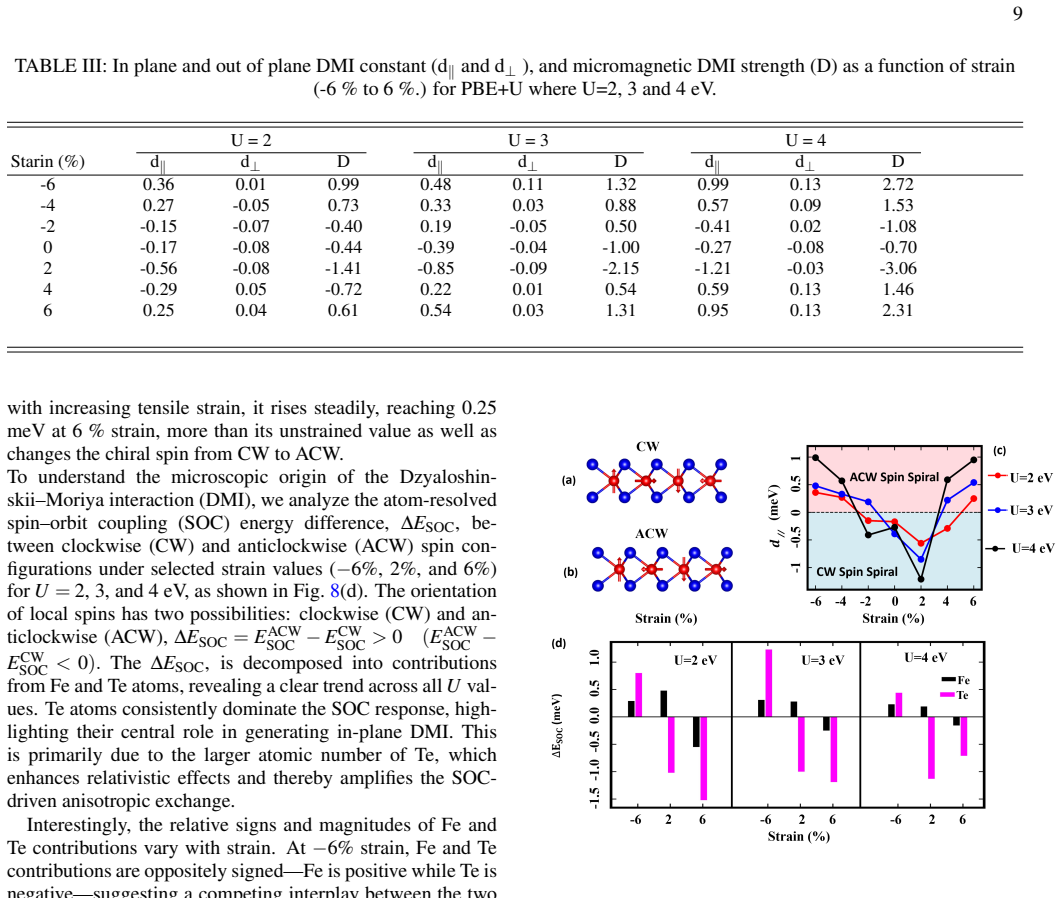
The discovery is that a pristine monolayer of H-FeTe2 can host a substantial DMI and magnetic anisotropy by itself: the H-phase structure lacks inversion symmetry both in-plane and out-of-plane, and the heavy Te atoms provide strong spin-orbit coupling, so Moriya-type antisymmetric exchange is allowed without any chemical or interfacial symmetry breaking. Using DFT+U with spin-orbit coupling, with U obtained self-consistently at 3.20 eV by linear response, the authors find that the ferromagnetic ground state persists across the strain range and that both the magnetic easy axis and the DMI are strongly tunable. At zero strain and U=2 eV the easy axis is in-plane with Ku = -6.54 meV, and it switches to out-of-plane as tensile strain and U increase, reaching 5.30 meV at 6% strain and U=4 eV. The in-plane DMI component d∥ is finite even without strain, reverses sign with strain, switching the preferred spin spiral between clockwise and anticlockwise, and the micromagnetic D reaches -3.06 meV at 2% strain and U=4 eV, while the out-of-plane component stays negligible. Te atoms dominate both the MAE and the DMI through their 5p orbital hybridization, as shown by atom-resolved and orbital-resolved analyses.
Load-bearing premise
The tunability story stands on the assumption that the true effective Coulomb interaction for Fe 3d electrons lies inside the scanned 2–4 eV range, with the linear-response value 3.20 eV as the representative point, because at zero strain the anisotropy changes sign within this window and the DMI also changes with U.
Editorial extensions
If this is right
- At zero strain, monolayer H-FeTe2 already carries a finite in-plane DMI and several meV of magnetic anisotropy, so pristine monolayers can be DMI-active without heterostructure engineering.
- Tensile strain beyond about 2% switches the easy axis from in-plane to out-of-plane, with Ku reaching 5.30 meV at 6% strain and U=4 eV, a regime favorable for perpendicular magnetic anisotropy.
- The in-plane DMI changes sign with strain, flipping the preferred spin spiral between anticlockwise and clockwise, and the micromagnetic D reaches 3.06 meV in magnitude, a range relevant for chiral texture engineering.
- Because Te atoms dominate both effects through 5p orbital hybridization and spin-orbit coupling, the anisotropy and DMI are controlled by the tellurium sublattice, not by the Fe moments alone.
Reading between the lines
- If Te-driven spin-orbit coupling is the mechanism, analogous strain-tunable DMI and easy-axis switching should appear in other pristine 2H-phase telluride monolayers, with the effect weakening as tellurium is replaced by selenium or sulfur.
- The sign reversals of d∥ with strain suggest that a spatially patterned strain field on a single monolayer could create lateral regions of opposite DMI chirality, enabling DMI landscapes without interfaces, a testable extension the paper does not pursue.
- The strong sensitivity of the easy axis to U implies that predictive accuracy hinges on the correlation treatment; comparing against a method that handles Fe 3d correlations beyond a static Hubbard U would be a sharp test of the crossover.
- The reported micromagnetic D values sit in a range where chiral skyrmions could be stabilized if D overcomes the dipolar energy, so whether strained H-FeTe2 actually hosts skyrmions is an experimental question left open by the paper.
Editorial analysis
A structured set of objections, weighed in public.
Referee Report
Summary. The manuscript reports DFT+U calculations of monolayer H-phase FeTe2 under biaxial strain (-6% to +6%) and on-site Coulomb interaction U (2-4 eV). It computes Heisenberg exchange couplings J1-J3, single-ion anisotropy Ku, and Dzyaloshinskii-Moriya interaction components d_parallel and d_perp from total-energy differences with spin-orbit coupling, then maps d_parallel to a micromagnetic D coefficient. The central claims are that pristine H-FeTe2 hosts intrinsic, nonzero DMI and sizable magnetic anisotropy because of broken inversion symmetry and Te spin-orbit coupling; that tensile strain together with increased U drives a crossover from in-plane to out-of-plane easy axis; and that strain changes the sign and magnitude of the in-plane DMI, with large in-plane DMI under combined strain and correlation. A Hubbard U = 3.20 eV is obtained by linear response, but the main parameter sweep is performed at U = 2, 3, and 4 eV.
Significance. If the claims hold, the paper identifies a chemically pristine monolayer with intrinsic DMI and tunable anisotropy, avoiding the usual doping, Janus, or heterostructure routes, and could therefore be useful for chiral spin textures and spintronic applications. The work benefits from direct energy-difference evaluation of MAE and DMI without fitting to target observables, a linear-response estimate of U, phonon checks of dynamical stability, and a fairly complete strain-U parameter map. The atom-resolved and orbital-resolved analyses connecting MAE sign changes to Te pz-orbital hybridization are a helpful mechanistic step. The main limitation is that the headline easy-axis and chirality-switching conclusions are sensitive to the chosen U within the scanned range, so the quantitative predictions are conditional on the correlation model rather than parameter-free.
major comments (3)
- [III D, Table II] The zero-strain easy axis is not robust across the scanned correlation range: Table II lists Ku = -6.54 meV at U = 2 eV, -4.80 meV at U = 3 eV, and +2.68 meV at U = 4 eV. The self-consistently estimated U is 3.20 eV (Section III A), which lies in the window where Ku changes sign, but no results are reported at exactly U = 3.20 eV. Because the abstract's 'robust' magnetic anisotropy and the IPMA-to-OPMA crossover are central claims, the authors should compute and tabulate Ku (and the crossover strain) at U = 3.20 eV and report the local slope dKu/dU near this value; otherwise the zero-strain easy-axis assignment is a parameter choice rather than a prediction.
- [IV, Table III] The chirality-switching conclusion for the DMI is also U-sensitive at fixed strain: at -2% strain, d_parallel = -0.15 meV for U = 2 eV, +0.19 meV for U = 3 eV, and -0.41 meV for U = 4 eV, so the CW/ACW preference changes twice within the scanned range. The finite in-plane DMI at zero strain is robust across U, but the strain-driven sign-change sequence is not demonstrated to be stable. The same DMI calculations should be repeated at U = 3.20 eV, or the authors should show that the sign-change sequence is stable under small variations of U.
- [II] No numerical convergence tests are reported for the energy differences that drive the conclusions. The MAE values in Table II and the DMI values in Table III are of order 0.1-5 meV, and several sign changes (e.g., Ku at zero strain, d_parallel at -2% strain) depend on sub-meV energy differences. The manuscript should include convergence checks with respect to k-point mesh, plane-wave cutoff, and supercell size for representative (strain, U) points to rule out numerical noise as the source of these sign changes.
minor comments (5)
- [III A] The text in Section III A refers to Table II for lattice constants and magnetic moments, but these quantities are listed in Table I; please correct the cross-reference.
- [III D] The orbital-PDOS discussion in Section III D cites 'Fig. 2(b)' and 'Fig. 2(c)' when describing Te pz shifts; these should refer to the corresponding panels of Fig. S2 in the Supplementary Material.
- [III B, IV] There are several typographical errors and inconsistencies, including 'Strurcture' in the Section III B heading, 'Starin (%)' in Table III, and the non-uniform rendering of 'N'eel'; these should be corrected before publication.
- [IV, Eq. (12)] The conversion from atomistic d_parallel to micromagnetic D in Eq. (12) should specify the units of a, t, and the resulting D; as written, the table values are labeled only 'meV', which is ambiguous for an energy-density coefficient.
- [References] The reference list contains duplicates (e.g., Refs. 2 and 32 are the same Shen et al. paper, and Refs. 32 and 33 are the same Liang et al. paper) and a formatting artifact in Ref. 21; these should be cleaned up.
Circularity Check
No significant circularity: Ku and d_parallel are computed as direct DFT total-energy differences, and the Hubbard U is obtained independently via linear response.
full rationale
The central predicted quantities—MAE (Ku) and DMI (d_parallel)—are not fitted inputs: Ku = E[100] - E[001] (Section III D) and d = (ECW - EACW)/m (Section IV) are direct total-energy differences from DFT+U calculations with constrained spin orientations. The Heisenberg exchanges J1-J3 are fitted to four collinear configurations, but they are intermediate parameters and the paper's MAE/DMI conclusions do not reduce to those fitted values. The Hubbard parameter U=3.20 eV is computed independently from linear-response theory (Eq. 1), and the subsequent scan U=2-4 eV is a parameter window, not a target-derived fit. The zero-strain easy-axis sign does flip within this window (Table II: Ku=-6.54 meV at U=2 to +2.68 meV at U=4), which is a sensitivity/correctness concern about the robustness of the anisotropy claim, not a circularity: the computed values are not constructed to equal the claimed outcome. Citations [6,40] for the H-phase structure and prior U=2 eV usage are by other groups, so no load-bearing self-citation chain exists. The derivation is self-contained against its DFT inputs.
Assumptions & free parameters
free parameters (1)
- Hubbard U =
2, 3, and 4 eV, plus computed linear-response value 3.20 eV
assumptions (3)
- domain assumption The local-moment Heisenberg Hamiltonian with exchange up to third neighbors, single-ion anisotropy, and DMI (Eq. 2) describes the magnetism of FeTe2 accurately.
- domain assumption PBE+U with U in the 2-4 eV range captures the Fe 3d correlation adequately for comparing magnetic energies.
- domain assumption The H-phase FeTe2 monolayer is dynamically stable for the full -6% to +6% strain range.
Cite this review
Pith. "Pith review of Strain and Correlation Modulated Magnetic Anisotropy and Dzyaloshinskii--Moriya Interaction in 2D H-FeTe$_2$." pith.science (2026). https://pith.science/paper/Q3HBJFRJ
@misc{pith2026250710477,
  author       = {Pith},
  title        = {Pith review of: Strain and Correlation Modulated Magnetic Anisotropy and Dzyaloshinskii--Moriya Interaction in 2D H-FeTe$_2$},
  year         = {2026},
  howpublished = {\url{https://pith.science/paper/Q3HBJFRJ}},
  note         = {Machine review of arXiv:2507.10477}
}
abstract
In the ongoing research on two-dimensional (2D) ferromagnetic materials with strong intrinsic Dzyaloshinskii--Moriya interaction (DMI), most efforts have focused on doping, Janus engineering, or heterostructure formation to break inversion symmetry and enhance spin--orbit coupling (SOC). Here, we demonstrate that a pristine 2D material, monolayer H-FeTe$_2$, can naturally host robust DMI and magnetic anisotropy due to its intrinsic broken inversion symmetry and the strong SOC of Te atoms. We explore the effect of biaxial strain and electron correlation on H-FeTe$_2$ using first-principles DFT+$U$ calculations. We systematically investigate the Heisenberg exchange interaction, magnetic anisotropy, and DMI in the space spanned by strain and correlation. Our results reveal a distinct, non-monotonic strain dependence of both magnetic anisotropy energy (MAE) and DMI, including a strain-tunable crossover between in-plane and out-of-plane magnetic easy axes. A remarkable enhancement of the in-plane DMI is observed under the combined influence of strain and strong correlations, which is unusual for pristine 2D materials and suggests a favorable regime for spintronic applications.Notably, even in the absence of strain, H-FeTe$_2$ exhibits finite DMI and considerable anisotropy, which is rare for a pure 2D material. Through these findings, we present H-FeTe$_2$ as a unique pristine 2D system with robust and tunable spin interactions for exploring fundamental spin--orbit-driven magnetic phenomena.
Figures


Figures from the paper (4 more)


Reference graph
Works this paper leans on
-
[1]
author M. Heide , author G. Bihlmayer , and author S. Bl\"ugel , journal Phys. Rev. B volume 78 , pages 140403 ( year 2008 ), ://link.aps.org/doi/10.1103/PhysRevB.78.140403
-
[3]
author C. Gong , author L. Li , author Z. Li , author H. Ji , author A. Stern , author Y. Xia , author T. Cao , author W. Bao , author C. Wang , author Y. Wang , et al. , journal Nature volume 546 , pages 265 ( year 2017 ), ://doi.org/10.1038/nature22060
-
[4]
author K. S. Burch , author D. Mandrus , and author J.-G. Park , journal Nature volume 563 , pages 47 ( year 2018 )
work page 2018
-
[5]
author M. Aras , author i. m. c. K l c c , and author S. Ciraci , journal Phys. Rev. B volume 95 , pages 075434 ( year 2017 ), ://link.aps.org/doi/10.1103/PhysRevB.95.075434
-
[6]
author X. Sui , author T. Hu , author J. Wang , author B.-L. Gu , author W. Duan , and author M.-s. Miao , journal Phys. Rev. B volume 96 , pages 041410 ( year 2017 ), ://link.aps.org/doi/10.1103/PhysRevB.96.041410
-
[7]
author L. Powalla , author M. T. Birch , author K. Litzius , author S. Wintz , author S. Satheesh , author M. Weigand , author E. Goering , author G. Sch\"utz , and author M. Burghard , journal Phys. Rev. B volume 108 , pages 214417 ( year 2023 ), ://link.aps.org/doi/10.1103/PhysRevB.108.214417
-
[8]
author A. K. Geim and author I. V. Grigorieva , journal Nature volume 499 , pages 419 ( year 2013 ), ://doi.org/10.1038/nature12385
-
[9]
author S. Manzeli , author D. Ovchinnikov , author D. Pasquier , author O. V. Yazyev , and author A. Kis , journal Nature Reviews Materials volume 2 , pages 1 ( year 2017 ), ://doi.org/10.1038/natrevmats.2017.33
Show all 49 references
-
[10]
Moreau-Luchaire , author C
author C. Moreau-Luchaire , author C. Moutafis , author N. Reyren , author J. Sampaio , author C. Vaz , author N. Van Horne , author K. Bouzehouane , author K. Garcia , author C. Deranlot , author P. Warnicke , et al. , journal Nature nanotechnology volume 11 , pages 444 ( yea...
2016 doi
-
[11]
Fert , author N
author A. Fert , author N. Reyren , and author V. Cros , journal Nature Reviews Materials volume 2 , pages 1 ( year 2017 ), ://doi.org/10.1038/natrevmats.2017.31
2017 doi
-
[12]
Park , author L
author T.-E. Park , author L. Peng , author J. Liang , author A. Hallal , author F. S. Yasin , author X. Zhang , author K. M. Song , author S. J. Kim , author K. Kim , author M. Weigand , et al. , journal Phys. Rev. B volume 103 , pages 104410 ( year 2021 ), ://link.aps.org/do...
2021 doi
-
[13]
Dzyaloshinsky , journal Journal of physics and chemistry of solids volume 4 , pages 241 ( year 1958 ), ://dx.doi.org/10.1016/0022-3697(58)90076-3
author I. Dzyaloshinsky , journal Journal of physics and chemistry of solids volume 4 , pages 241 ( year 1958 ), ://dx.doi.org/10.1016/0022-3697(58)90076-3
1958 doi
-
[14]
Moriya , journal Phys
author T. Moriya , journal Phys. Rev. volume 120 , pages 91 ( year 1960 ), ://link.aps.org/doi/10.1103/PhysRev.120.91
1960 doi
-
[15]
Fert and author P
author A. Fert and author P. M. Levy , journal Phys. Rev. Lett. volume 44 , pages 1538 ( year 1980 ), ://link.aps.org/doi/10.1103/PhysRevLett.44.1538
1980 doi
-
[16]
Nagaosa and author Y
author N. Nagaosa and author Y. Tokura , journal Nature nanotechnology volume 8 , pages 899 ( year 2013 ), ://doi.org/10.1038/nnano.2013.243
2013 doi
-
[17]
author A. N. Bogdanov and author D. Yablonskii , journal Zh. Eksp. Teor. Fiz volume 95 , pages 178 ( year 1989 ), ://doi.org/10.1016/0304-8853(94)90046-9
1989 doi
-
[18]
Thiaville , author S
author A. Thiaville , author S. Rohart , author \'E . Ju \'e , author V. Cros , and author A. Fert , journal Europhysics Letters volume 100 , pages 57002 ( year 2012 ), ://doi.org/10.1209/0295-5075/100/57002
2012 doi
-
[19]
Sampaio , author V
author J. Sampaio , author V. Cros , author S. Rohart , author A. Thiaville , and author A. Fert , journal Nature nanotechnology volume 8 , pages 839 ( year 2013 ), ://doi.org/10.1038/nnano.2013.210
2013 doi
-
[20]
Back , author V
author C. Back , author V. Cros , author H. Ebert , author K. Everschor-Sitte , author A. Fert , author M. Garst , author T. Ma , author S. Mankovsky , author T. Monchesky , author M. Mostovoy , et al. , journal Journal of Physics D: Applied Physics volume 53 , pages 363001 ( ...
-
[21]
Yu , author N
author X. Yu , author N. Kanazawa , author Y. Onose , author K. Kimoto , author W. Zhang , author S. Ishiwata , author Y. Matsui , and author Y. Tokura , journal Nature materials volume 10 , pages 106 ( year 2011 ), ://doi.org/10.1038/nmat2916
2011 doi
-
[22]
Yu , author Y
author X. Yu , author Y. Onose , author N. Kanazawa , author J. H. Park , author J. Han , author Y. Matsui , author N. Nagaosa , and author Y. Tokura , journal Nature volume 465 , pages 901 ( year 2010 ), ://doi.org/10.1038/nature09124
2010 doi
-
[23]
Kim , author M
author D.-H. Kim , author M. Haruta , author H.-W. Ko , author G. Go , author H.-J. Park , author T. Nishimura , author D.-Y. Kim , author T. Okuno , author Y. Hirata , author Y. Futakawa , et al. , journal Nature materials volume 18 , pages 685 ( year 2019 ), ://doi.org/10.10...
2019 doi
-
[24]
Emori , author U
author S. Emori , author U. Bauer , author S.-M. Ahn , author E. Martinez , and author G. S. Beach , journal Nature materials volume 12 , pages 611 ( year 2013 ), ://doi.org/10.1038/nmat3675
2013 doi
-
[25]
Heinze , author K
author S. Heinze , author K. Von Bergmann , author M. Menzel , author J. Brede , author A. Kubetzka , author R. Wiesendanger , author G. Bihlmayer , and author S. Bl \"u gel , journal nature physics volume 7 , pages 713 ( year 2011 ), ://doi.org/10.1038/nphys2045
2011 doi
-
[26]
Li , author J.-Q
author B. Li , author J.-Q. Yan , author D. M. Pajerowski , author E. Gordon , author A.-M. Nedi c \' c , author Y. Sizyuk , author L. Ke , author P. P. Orth , author D. Vaknin , and author R. J. McQueeney , journal Phys. Rev. Lett. volume 124 , pages 167204 ( year 2020 ), ://...
2020 doi
-
[27]
Gao , author S
author Y. Gao , author S. Yan , author Q. Yin , author H. Huang , author Z. Li , author Z. Zhu , author J. Cai , author B. Shen , author H. Lei , author Y. Zhang , et al. , journal Phys. Rev. B volume 105 , pages 014426 ( year 2022 ), ://link.aps.org/doi/10.1103/PhysRevB.105.014426
2022 doi
-
[28]
Xu , author X
author C. Xu , author X. Li , author P. Chen , author Y. Zhang , author H. Xiang , and author L. Bellaiche , journal Advanced Materials volume 34 , pages 2107779 ( year 2022 )
2022
-
[29]
Huang , author G
author B. Huang , author G. Clark , author E. Navarro-Moratalla , author D. R. Klein , author R. Cheng , author K. L. Seyler , author D. Zhong , author E. Schmidgall , author M. A. McGuire , author D. H. Cobden , et al. , journal Nature volume 546 , pages 270 ( year 2017 ), :/...
2017 doi
-
[30]
Gong , author T
author W. Gong , author T. Tabata , author K. Takei , author M. Morihama , author T. Maeda , and author T. Wada , journal physica status solidi (c) volume 12 , pages 700 ( year 2015 )
2015
-
[32]
Shen , author C
author Z. Shen , author C. Song , author Y. Xue , author Z. Wu , author J. Wang , and author Z. Zhong , journal Phys. Rev. B volume 106 , pages 094403 ( year 2022 b ), ://link.aps.org/doi/10.1103/PhysRevB.106.094403
2022 doi
-
[33]
Liang , author W
author J. Liang , author W. Wang , author H. Du , author A. Hallal , author K. Garcia , author M. Chshiev , author A. Fert , and author H. Yang , journal Phys. Rev. B volume 101 , pages 184401 ( year 2020 b ), ://link.aps.org/doi/10.1103/PhysRevB.101.184401
2020 doi
-
[34]
Cui , author J
author Q. Cui , author J. Liang , author Z. Shao , author P. Cui , and author H. Yang , journal Phys. Rev. B volume 102 , pages 094425 ( year 2020 ), ://link.aps.org/doi/10.1103/PhysRevB.102.094425
2020 doi
-
[35]
Ataca , author H
author C. Ataca , author H. Şahin , and author S. Ciraci , journal The Journal of Physical Chemistry C volume 116 , pages 8983 ( year 2012 ), ://doi.org/10.1021/jp212558p
2012 doi
-
[36]
Kresse and author J
author G. Kresse and author J. Furthm \"u ller , journal Computational materials science volume 6 , pages 15 ( year 1996 a )
1996
-
[37]
Kresse and author J
author G. Kresse and author J. Furthm \"u ller , journal Physical review B volume 54 , pages 11169 ( year 1996 b )
1996
-
[38]
Kresse and author D
author G. Kresse and author D. Joubert , journal Physical review b volume 59 , pages 1758 ( year 1999 )
1999
-
[39]
author J. P. Perdew , author K. Burke , and author M. Ernzerhof , journal Physical review letters volume 77 , pages 3865 ( year 1996 )
1996
-
[40]
Aras , author i
author M. Aras , author i. m. c. K l c c , and author S. Ciraci , journal Phys. Rev. B volume 101 , pages 054429 ( year 2020 ), ://link.aps.org/doi/10.1103/PhysRevB.101.054429
2020 doi
-
[41]
Togo and author I
author A. Togo and author I. Tanaka , journal Scripta Materialia volume 108 , pages 1 ( year 2015 ), ISSN issn 1359-6462 , ://www.sciencedirect.com/science/article/pii/S1359646215003127
2015
-
[42]
author H. J. Xiang , author E. J. Kan , author S.-H. Wei , author M.-H. Whangbo , and author X. G. Gong , journal Phys. Rev. B volume 84 , pages 224429 ( year 2011 ), ://link.aps.org/doi/10.1103/PhysRevB.84.224429
2011 doi
-
[43]
author V. I. Anisimov , author I. V. Solovyev , author M. A. Korotin , author M. T. Czy z \. z yk , and author G. A. Sawatzky , journal Phys. Rev. B volume 48 , pages 16929 ( year 1993 ), ://link.aps.org/doi/10.1103/PhysRevB.48.16929
1993 doi
-
[44]
Cococcioni and author S
author M. Cococcioni and author S. de Gironcoli , journal Phys. Rev. B volume 71 , pages 035105 ( year 2005 ), ://link.aps.org/doi/10.1103/PhysRevB.71.035105
2005 doi
-
[45]
Noodleman , journal The Journal of Chemical Physics volume 74 , pages 5737 ( year 1981 ), ://doi.org/10.1063/1.440939
author L. Noodleman , journal The Journal of Chemical Physics volume 74 , pages 5737 ( year 1981 ), ://doi.org/10.1063/1.440939
1981 doi
-
[46]
Wang , author R
author D.-s. Wang , author R. Wu , and author A. J. Freeman , journal Phys. Rev. B volume 47 , pages 14932 ( year 1993 ), ://link.aps.org/doi/10.1103/PhysRevB.47.14932
1993 doi
-
[47]
Hasan , author S
author S. Hasan , author S. San , author K. Baral , author N. Li , author P. Rulis , and author W.-Y. Ching , journal Materials volume 15 , pages 2843 ( year 2022 )
2022
-
[48]
author Y. Zhou , journal National Science Review volume 6 , pages 210 ( year 2018 ), ISSN issn 2095-5138 , https://academic.oup.com/nsr/article-pdf/6/2/210/38915382/nwy109.pdf , ://doi.org/10.1093/nsr/nwy109
2018 doi
-
[49]
Iwasaki , author M
author J. Iwasaki , author M. Mochizuki , and author N. Nagaosa , journal Nature nanotechnology volume 8 , pages 742 ( year 2013 ), ://doi.org/10.1038/nnano.2013.176
2013 doi
-
[50]
Fert , author V
author A. Fert , author V. Cros , and author J. Sampaio , journal Nature nanotechnology volume 8 , pages 152 ( year 2013 ), ://doi.org/10.1038/nnano.2013.29
2013 doi
-
[51]
Yang , author J
author H. Yang , author J. Liang , and author Q. Cui , journal Nature Reviews Physics volume 5 , pages 43 ( year 2023 ), ://doi.org/10.1038/s42254-022-00529-0
2023 doi
Reviewed August 6, 2026 · model on record in the stance chip above.
Discussion (0). Sign in to comment.