REVIEW 4 major objections 6 minor 52 references
Learning to Quantize and Precode in Massive MIMO Systems for Energy Reduction: a Graph Neural Network Approach
T0 review · 4 major / 6 minor · reviewed 2026-08-06 · deepseek-v4-flash
Pith's one-line read A graph neural network that learns to precode for coarse DACs can make 1-bit DACs match the sum rate of 3-bit MRT in single-user massive MIMO, cutting DAC power by 3-7x.
desk verdict Solid GNN-based quantized precoding with a convincing rate story, but the energy-saving headline rests on an optimistic single-point accelerator efficiency and needs sensitivity analysis before the crossover-bandwidth claims can be trusted. read the letter →
The pith
A machine-rendered reading of the paper's core claim, the machinery that carries it, and where it could break.
The reading
What carries the argument
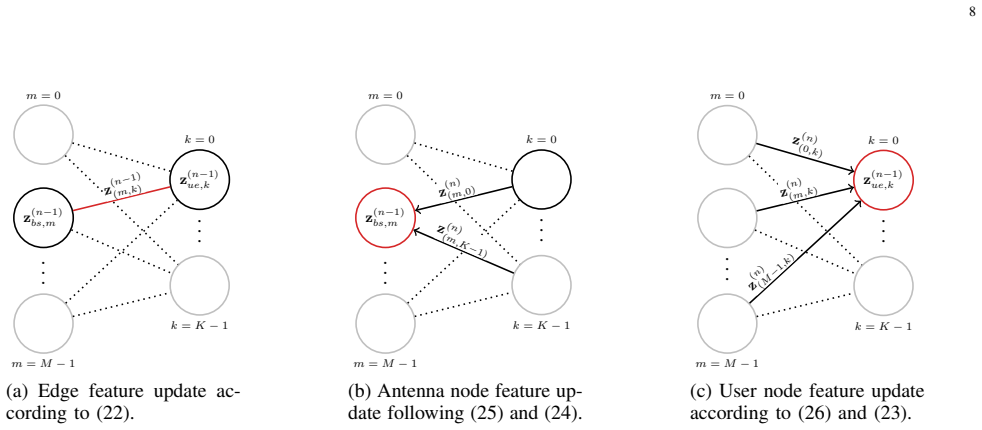
The load-bearing mechanism is a message-passing graph neural network whose graph has one node per antenna and one per user, with an edge $(m,k)$ carrying the complex channel coefficient. Each layer updates edge, antenna, and user features, and the final antenna features are probability vectors over the quantizer output levels, with the selected level chosen by argmax. Training uses the straight-through Gumbel-softmax estimator: the forward pass is discrete, the backward pass uses a relaxed soft gradient, and the loss is the negative achievable sum rate. The architecture imposes permutation equivariance over antennas and permutation invariance over users, which narrows the hypothesis space to functions consistent with the physical precoding problem.
What would settle it
Measure the actual end-to-end power draw of a base station using 1-bit and 3-bit DACs of the modeled current-steering architecture at the same rate target; if the measured DAC power ratio is below 4, the claimed 4-7x saving collapses.
Extended reading notes
Core claim
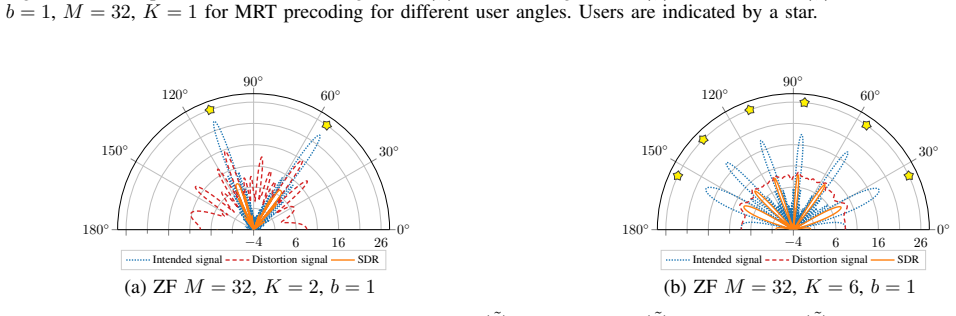
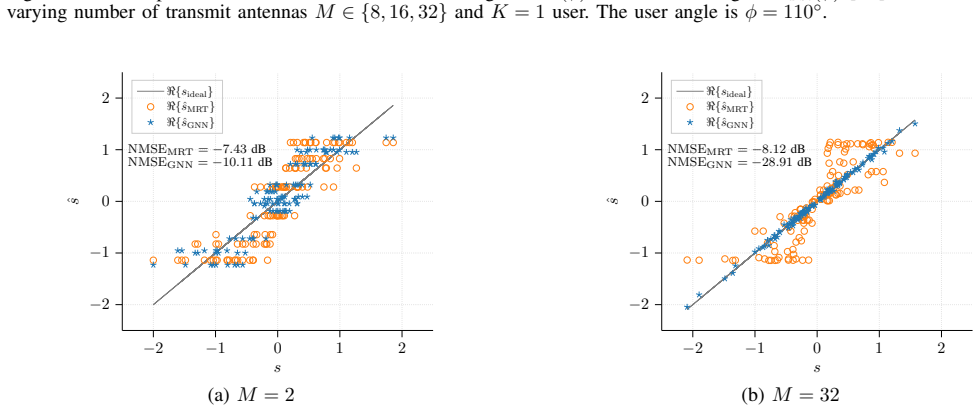
The central claim of the paper is that a graph neural network can directly map the channel matrix $H$ and intended symbol vector $s$ to a quantized precoded transmit vector $y_{NL}$, trained self-supervised by maximizing the achievable sum rate. To handle the non-differentiable DAC function, the network outputs probability vectors over quantizer levels, uses hard argmax selection in the forward pass, and uses a straight-through Gumbel-softmax estimator in the backward pass. The learned precoder outperforms MRT in the single-user case and ZF in the multi-user case at high SNR, with the largest gains at one bit. Radiation-pattern plots show the mechanism: the GNN pushes quantization distortion away from the user directions. In the headline comparison, 1-bit GNN precoding at $M=32$, $K=1$ matches or beats 3-bit MRT, yielding DAC power savings of 4-7x for baseband DACs and 3x for RF DACs; including GNN processing power, the baseband saving survives up to roughly 3.5 MHz bandwidth while RF DACs keep a 2.9x saving up to the accelerator's speed limit.
Load-bearing premise
The reported power savings assume a specific power model for current-steering digital-to-analog converters and a stated efficiency for the accelerator chip, neither of which is validated on hardware.
Editorial extensions
If this is right
- If the claims hold, a single-user base station with 32 antennas can use 1-bit DACs and still match the sum rate that MRT achieves with 3-bit DACs at high SNR.
- The same GNN trained for 2-4 users and 1 bit outperforms zero-forcing in the distortion-limited regime, with the gain shrinking as the number of users increases.
- With the reported DAC power model, replacing 3-bit by 1-bit DACs cuts baseband DAC power by a factor of 4-7 and RF-DAC power by a factor of 3, before counting the GNN's own power.
- When the GNN's processing power is included, the net baseband saving remains positive up to about 3.5 MHz of bandwidth; RF-DACs keep a 2.9x saving up to the 15.8 MHz accelerator speed limit.
- The method implies that quantization distortion can be spatially shaped: with enough antennas, the distortion is pushed into non-user directions rather than treated as unavoidable noise.
Reading between the lines
- One extension the authors leave implicit is to add spectral constraints, such as adjacent-channel leakage ratio limits, directly into the training loss; doing so would trade some in-band rate for standard compliance.
- Because the processing cost scales with symbol rate, a smaller or 8-bit-quantized version of the GNN would push the 3.5 MHz crossover bandwidth upward; the paper notes the model is trained in 32-bit while the cited accelerator uses 8-bit arithmetic, so the practical efficiency may be lower than assumed.
- The same distortion-shaping objective could be transferred to other nonlinear hardware impairments, such as power-amplifier distortion, generalizing the energy argument beyond DACs.
- A direct test of the mechanism would be to measure, on a 32-antenna prototype, whether the received constellation with 1-bit DACs and the learned precoder maintains the reported NMSE gap over MRT.
Editorial analysis
A structured set of objections, weighed in public.
Referee Report
Summary. The paper studies downlink massive MIMO with low-resolution DACs and proposes a graph neural network (GNN) that directly outputs a quantized precoded vector, trained in a self-supervised manner by maximizing the achievable sum rate. To handle the non-differentiability of the DAC quantization, the authors use a straight-through Gumbel-softmax estimator. The architecture is designed to be permutation equivariant with respect to antenna ordering and invariant with respect to user ordering. Simulations show that the GNN outperforms MRT and ZF in the few-user, few-bit regime; for example, in the single-user case with 1-bit DACs it matches the sum rate of MRT with 3-bit DACs at high SNR. The paper also gives a FLOP-count complexity analysis and an energy model that combines a current-steering DAC power model with a GNN accelerator efficiency figure, leading to claimed DAC power reductions by factors of 4-7 (baseband) and 3 (RF), with net power savings up to 3.5 MHz for baseband DACs and up to 15.8 MHz for RF DACs.
Significance. If the results hold, the paper offers a practically interesting way to reduce DAC resolution in massive MIMO systems in the distortion-limited few-user regime, and it does so with a well-motivated architecture: the permutation-equivariance argument for the GNN is convincing, and the self-supervised training procedure is clearly described. The FLOP analysis and the explicit crossover-bandwidth energy analysis are valuable and unusual in the literature; they make the energy trade-off concrete rather than merely qualitative. The main limitation is that the headline energy reductions rest on unvalidated hardware assumptions, and the rate comparisons are only against linear precoders, not against the cited non-linear 1-bit precoders. With added sensitivity analysis and stronger baselines, the contribution could be solid.
major comments (4)
- [Section VII-B (PGNN expression)] The GNN processing power is computed as P_GNN = (1/η)(B/(1+α_rol))(O_GNN^(add)+O_GNN^(mul)) with η = 646.6 TFLOPs/s/W taken as the peak efficiency of the accelerator in [48]. At the claimed 3.5 MHz crossover with N_h=8, d_h=32, the required throughput is about 8.8 TFLOPs/s, roughly 22% of that accelerator's 39.8 TFLOPs/s peak, so the computation uses a peak-efficiency figure at a low-utilization operating point where the efficiency is not established. A 2-3x decrease in effective η would move the baseband crossover below 1 MHz, so this assumption is load-bearing for the headline claim; please add an efficiency-versus-utilization model or a sensitivity analysis and adjust the crossover claims accordingly.
- [Section VII-B] The paper states that the accelerator from [48] operates on 8-bit floating point while the GNN is trained with 32-bit floating point, and that the influence of this reduced precision on performance 'should be further investigated.' Since P_GNN is based on the 8-bit accelerator, the rate results in Fig. 7 are not obtained with the same numerical precision as the power estimate; a quantized/precision-aware evaluation of the GNN, or at minimum a sensitivity analysis of the achievable rate to 8-bit weights and activations, is needed before the power-reduction factors can be presented as quantitative results.
- [Section VII-A, Eq. (39)] The DAC power model and its parameters (V_dd = 3 V, I_0 = 10 µA, C_p = 1 pF, from [4]) are used without hardware validation or sensitivity analysis, and the claimed 4-7 factor reduction for baseband DACs depends on bandwidth through f_s. Because the overall power-reduction claim is the central result, the authors should specify at which bandwidth each factor is obtained and provide a sensitivity analysis over the DAC parameters and over the RF-DAC sampling-rate assumption f_s = 4/3 f_c.
- [Section VI-B, Fig. 7] The rate comparisons are made only against MRT and ZF. Since the paper cites existing non-linear 1-bit precoders in [15] and [16] in Section I-B, the statement that the proposed method achieves a 'significant increase in achievable sum rate' is not established against the relevant state of the art. Please include at least one of these non-linear baselines in the comparison, or restrict the claim to gains over linear precoding.
minor comments (6)
- [Section VI-A] The sentence 'During training, the loss function in (13) is computed numerically' should refer to the loss in (14) or to the objective in (13), since (13) is the constrained optimization problem rather than the loss function.
- [Eq. (39)] The rendered expression for P_DAC is ambiguous; please format it as (1/2) V_dd I_0 (2^b - 1) + (b C_p f_s / 2) V_dd^2 so that the two terms are clear.
- [Fig. 10 caption] The caption contains a typo: 'transited symbol' should be 'transmitted symbol'.
- [Reference [5]] The URL in reference [5] contains a typo: 'https;//' should be 'https://'.
- [Figs. 12 and 13] The captions list four quantities but do not identify which line corresponds to which quantity; please add labels or a legend description in the captions.
- [Section VII-B] The discussion of the required accelerator speed is confusing because the text first says B = 1 MHz requires 12 TFLOPs/s and later says at B = 4 MHz the smaller GNN requires 8.82 TFLOPs/s; make explicit which architecture and which bandwidth each figure refers to.
Circularity Check
No material circularity: the GNN is trained on the same achievable-rate criterion used for evaluation, but that is a standard optimization/evaluation split, and the headline comparisons to MRT/ZF and the DAC-power model rely on external benchmarks and hardware references, not on the paper's own fitted parameters.
full rationale
The paper's central derivation is self-contained rather than circular. The GNN is trained by directly maximizing the achievable sum rate in Eq. (14), and the reported rates in Section VI are the same metric evaluated on an independent held-out test set; this is a legitimate training/evaluation procedure, not a fitted input renamed as a prediction. The key headline result, namely that 1-bit GNN precoding matches the rate of 3-bit MRT in the single-user case, comes from the external comparison in Fig. 7a between the learned precoder and classical MRT, and no parameter is fitted to produce that equivalence. The energy analysis in Section VII uses an external current-steering DAC model, Eq. (39), with parameters taken from reference [4], and an accelerator efficiency of 646.6 TFLOPs/s/W from reference [48]; neither quantity is derived from the paper's own results. The paper explicitly flags the unvalidated assumption that the accelerator's 8-bit arithmetic preserves the performance of the 32-bit trained GNN, and it acknowledges the 15.8 MHz processing-speed limit, but these are robustness/limitation caveats rather than circular reasoning. Self-citations to the authors' prior work appear in references [23], [24], [25], and [49], and they support architectural choices, GNN hypothesis-space reasoning, and fine-tuning context; however, they are not load-bearing for the central rate or energy claims, and [24] is cited alongside independent external works [28] and [29]. No equation is used as both input and output, no known result is merely renamed, and no uniqueness claim or ansatz is imported from the authors' own prior work to force the conclusion.
Assumptions & free parameters
free parameters (5)
- hidden dimension dh and number of hidden layers Nh =
dh=128, Nh=4; variants dh=256, Nh=8, dh=32
- Gumbel-softmax temperature tau =
tau=1
- training hyperparameters =
LR=5e-3, batch=128, epochs=20, Ns=125, 200k training channels
- DAC power model parameters =
Vdd=3 V, I0=10 uA, Cp=1 pF
- accelerator efficiency =
eta=646.6 TFLOPs/s/W
assumptions (5)
- domain assumption The transmitted symbols are i.i.d. CN(0,1), so the DAC input distribution is Gaussian and Max-Lloyd non-uniform quantization is near-optimal.
- standard math The worst-case Gaussian assumption for the joint distortion-and-noise yields a valid achievable sum-rate lower bound in Eq. (9).
- domain assumption The channel is perfectly known at the BS and follows the training distribution (Rayleigh fading in simulations).
- domain assumption The current-steering DAC power model in Eq. (39) with parameters from [4] applies to both baseband and RF DACs.
- domain assumption The selected NN accelerator reaches 646.6 TFLOPs/s/W at the required throughput and 8-bit inference preserves GNN performance.
Cite this review
Pith. "Pith review of Learning to Quantize and Precode in Massive MIMO Systems for Energy Reduction: a Graph Neural Network Approach." pith.science (2026). https://pith.science/paper/FHQB265Y
@misc{pith2026250710634,
  author       = {Pith},
  title        = {Pith review of: Learning to Quantize and Precode in Massive MIMO Systems for Energy Reduction: a Graph Neural Network Approach},
  year         = {2026},
  howpublished = {\url{https://pith.science/paper/FHQB265Y}},
  note         = {Machine review of arXiv:2507.10634}
}
read the original abstract
Massive MIMO systems are moving toward increased numbers of radio frequency chains, higher carrier frequencies and larger bandwidths. As such, digital-to-analog converters (DACs) are becoming a bottleneck in terms of hardware complexity and power consumption. In this work, non-linear precoding for coarsely quantized downlink massive MIMO is studied. Given the NP-hard nature of this problem, a graph neural network (GNN) is proposed that directly outputs the precoded quantized vector based on the channel matrix and the intended transmit symbols. The model is trained in a self-supervised manner, by directly maximizing the achievable rate. To overcome the non-differentiability of the objective function, introduced due to the non-differentiable DAC functions, a straight-through Gumbel-softmax estimation of the gradient is proposed. The proposed method achieves a significant increase in achievable sum rate under coarse quantization. For instance, in the single-user case, the proposed method can achieve the same sum rate as maximum ratio transmission (MRT) by using one-bit DAC's as compared to 3 bits for MRT. This reduces the DAC's power consumption by a factor 4-7 and 3 for baseband and RF DACs respectively. This, however, comes at the cost of increased digital signal processing power consumption. When accounting for this, the reduction in overall power consumption holds for a system bandwidth up to 3.5 MHz for baseband DACs, while the RF DACs can maintain a power reduction of 2.9 for higher bandwidths. Notably, indirect effects, which further reduce the power consumption, such as a reduced fronthaul consumption and reduction in other components, are not considered in this analysis.
Figures


Figures from the paper (8 more)





Reference graph
Works this paper leans on
-
[48]
A 40-nm 646.6tops/w sparsity-scaling dnn processor for on-device training,
Z.-S. Fu, Y .-C. Lee, A. Park, and C.-H. Yang, “A 40-nm 646.6tops/w sparsity-scaling dnn processor for on-device training,” in 2022 IEEE Symposium on VLSI Technology and Circuits (VLSI Technology and Circuits), 2022, pp. 40–41
work page 2022
-
[4]
Energy-constrained modulation optimization,
S. Cui, A. Goldsmith, and A. Bahai, “Energy-constrained modulation optimization,” IEEE Transactions on Wireless Communications , vol. 4, no. 5, pp. 2349–2360, 2005
work page 2005
-
[15]
Quantized Precoding for Massive MU-MIMO,
S. Jacobsson, G. Durisi, M. Coldrey, T. Goldstein, and C. Studer, “Quantized Precoding for Massive MU-MIMO,” IEEE Transactions on Communication, vol. 65, no. 11, pp. 4670–4684, Nov. 2017
work page 2017
-
[16]
Nonlinear 1-bit precoding for massive MU-MIMO with higher- order modulation,
——, “Nonlinear 1-bit precoding for massive MU-MIMO with higher- order modulation,” in 2016 50th Asilomar Conference on Signals, Systems and Computers , 2016, pp. 763–767
work page 2016
-
[1]
Massive mimo is a reality—what is next?: Five promising research directions for antenna arrays,
E. Bj ¨ornson, L. Sanguinetti, H. Wymeersch, J. Hoydis, and T. L. Marzetta, “Massive mimo is a reality—what is next?: Five promising research directions for antenna arrays,”Digital Signal Processing Special Issue on Source Localization in Massive MIMO, vol. 94, pp. 3–20, 2019
work page 2019
-
[2]
Massive MIMO for next generation wireless systems,
E. G. Larsson, O. Edfors, F. Tufvesson, and T. L. Marzetta, “Massive MIMO for next generation wireless systems,” IEEE Communications Magazine, vol. 52, no. 2, pp. 186–195, 2014
work page 2014
-
[3]
A. Shafie, N. Yang, C. Han, J. M. Jornet, M. Juntti, and T. K ¨urner, “Terahertz Communications for 6G and Beyond Wireless Networks: Challenges, Key Advancements, and Opportunities,” IEEE Network , vol. 37, no. 3, pp. 162–169, 2023
work page 2023
-
[5]
L. H. Crockett, D. Northcote, and R. W. Steward, Eds., Software defined radio with Zynq Ultrascale+ RFSoC , 1st ed. Strathclyde Academic Media, 2023. [Online]. Available: https;//www.RFSoCbook.com
work page 2023
Show all 52 references
-
[6]
SFDR-bandwidth limitations for high speed high resolution current steering CMOS D/A converters,
A. van den Bosch, M. Steyaert, and W. Sansen, “SFDR-bandwidth limitations for high speed high resolution current steering CMOS D/A converters,” in ICECS’99. Proceedings of ICECS ’99. 6th IEEE International Conference on Electronics, Circuits and Systems (Cat. No.99EX357), vol....
1999
-
[7]
Uplink Achievable Rate for Massive MIMO Systems With Low-Resolution ADC,
L. Fan, S. Jin, C.-K. Wen, and H. Zhang, “Uplink Achievable Rate for Massive MIMO Systems With Low-Resolution ADC,” IEEE Communi- cations Letters, vol. 19, no. 12, pp. 2186–2189, 2015
2015
-
[8]
Low power analog-to-digital conversion in millimeter wave systems: Impact of resolution and band- width on performance,
O. Orhan, E. Erkip, and S. Rangan, “Low power analog-to-digital conversion in millimeter wave systems: Impact of resolution and band- width on performance,” in 2015 Information Theory and Applications Workshop (ITA), 2015, pp. 191–198
2015
-
[9]
Spectral Efficiency of Mixed-ADC Massive MIMO,
H. Pirzadeh and A. L. Swindlehurst, “Spectral Efficiency of Mixed-ADC Massive MIMO,” IEEE Transactions on Signal Processing , vol. 66, no. 13, pp. 3599–3613, 2018
2018
-
[10]
Performance Analysis of Mixed-ADC Massive MIMO Systems Over Rician Fading Channels,
J. Zhang, L. Dai, Z. He, S. Jin, and X. Li, “Performance Analysis of Mixed-ADC Massive MIMO Systems Over Rician Fading Channels,” IEEE Journal on Selected Areas in Communications , vol. 35, no. 6, pp. 1327–1338, 2017
2017
-
[11]
An ADC-Aware Receiver Design for Multi-User MIMO Underlay System With Strong Cyclostationary Legacy Signal,
J. Chae and J. H. Cho, “An ADC-Aware Receiver Design for Multi-User MIMO Underlay System With Strong Cyclostationary Legacy Signal,” IEEE Access, vol. 11, pp. 119 788–119 801, 2023
2023
-
[12]
Spa- tial Characteristics of Distortion Radiated From Antenna Arrays With Transceiver Nonlinearities,
C. Mollen, U. Gustavsson, T. Eriksson, and E. G. Larsson, “Spa- tial Characteristics of Distortion Radiated From Antenna Arrays With Transceiver Nonlinearities,” IEEE Transactions on Wireless Communi- cations, vol. 17, no. 10, pp. 6663–6679, 2018
2018
-
[13]
On one-bit quantized ZF precoding for the multiuser massive MIMO downlink,
A. K. Saxena, I. Fijalkow, and A. L. Swindlehurst, “On one-bit quantized ZF precoding for the multiuser massive MIMO downlink,” in 2016 IEEE Sensor Array and Multichannel Signal Processing Workshop (SAM) , 2016, pp. 1–5
2016
-
[14]
MMSE precoder for massive MIMO using 1-bit quantization,
O. B. Usman, H. Jedda, A. Mezghani, and J. A. Nossek, “MMSE precoder for massive MIMO using 1-bit quantization,” in 2016 IEEE International Conference on Acoustics, Speech and Signal Processing (ICASSP), 2016, pp. 3381–3385
2016
-
[17]
Transmit processing with low resolution D/A-converters,
A. Mezghani, R. Ghiat, and J. A. Nossek, “Transmit processing with low resolution D/A-converters,” in 2009 16th IEEE International Conference on Electronics, Circuits and Systems - (ICECS 2009) , 2009, pp. 683– 686
2009
-
[18]
Energy Efficiency Maximization Precoding for Quantized Massive MIMO Systems,
J. Choi, J. Park, and N. Lee, “Energy Efficiency Maximization Precoding for Quantized Massive MIMO Systems,” IEEE Transactions on Wireless Communications, vol. 21, no. 9, pp. 6803–6817, 2022
2022
-
[19]
Hardware Distortion Correlation Has Negligible Impact on UL Massive MIMO Spectral Efficiency,
E. Bj ¨ornson, L. Sanguinetti, and J. Hoydis, “Hardware Distortion Correlation Has Negligible Impact on UL Massive MIMO Spectral Efficiency,” IEEE Transactions on Communication , vol. 67, no. 2, pp. 1085–1098, 2019
2019
-
[20]
Energy Efficiency of mmWave Massive MIMO Precoding With Low-Resolution DACs,
L. N. Ribeiro, S. Schwarz, M. Rupp, and A. L. F. de Almeida, “Energy Efficiency of mmWave Massive MIMO Precoding With Low-Resolution DACs,” IEEE Journal of Selected Topics in Signal Processing , vol. 12, no. 2, pp. 298–312, 2018
2018
-
[21]
Unsuper- vised Learning-Based Fast Beamforming Design for Downlink MIMO,
H. Huang, W. Xia, J. Xiong, J. Yang, G. Zheng, and X. Zhu, “Unsuper- vised Learning-Based Fast Beamforming Design for Downlink MIMO,” IEEE Access, vol. 7, pp. 7599–7605, 2019
2019
-
[22]
Model-Driven Beamform- ing Neural Networks,
W. Xia, G. Zheng, K.-K. Wong, and H. Zhu, “Model-Driven Beamform- ing Neural Networks,” IEEE Wireless Communications , vol. 27, no. 1, pp. 68–75, 2020
2020
-
[23]
Deep Unfolding for Fast Linear Massive MIMO Precoders under a PA Consumption Model,
T. Feys, X. Mestre, E. Peschiera, and F. Rottenberg, “Deep Unfolding for Fast Linear Massive MIMO Precoders under a PA Consumption Model,” in 2023 IEEE 97th Vehicular Technology Conference (VTC2023-Spring), 2023, pp. 1–5
2023
-
[24]
Toward Energy-Efficient Massive MIMO: Graph Neural Network Precoding for Mitigating Non- Linear PA Distortion,
T. Feys, L. Van der Perre, and F. Rottenberg, “Toward Energy-Efficient Massive MIMO: Graph Neural Network Precoding for Mitigating Non- Linear PA Distortion,”IEEE Transactions on Cognitive Communications and Networking, pp. 1–1, 2024
2024
-
[25]
Self-Supervised Learning of Linear Precoders under Non-Linear PA Distortion for Energy-Efficient Massive MIMO Systems,
T. Feys, X. Mestre, and F. Rottenberg, “Self-Supervised Learning of Linear Precoders under Non-Linear PA Distortion for Energy-Efficient Massive MIMO Systems,” in ICC 2023 - IEEE International Conference on Communications, 2023
2023
-
[26]
Relational inductive biases, deep learning, and graph networks,
P. W. Battaglia et al. , “Relational inductive biases, deep learning, and graph networks,” 2018. [Online]. Available: https://arxiv.org/abs/1806. 01261
2018
-
[27]
Goodfellow, Y
I. Goodfellow, Y . Bengio, and A. Courville, Deep Learning. MIT Press, 2016, http://www.deeplearningbook.org
2016
-
[28]
Understanding the performance of learn- ing precoding policies with graph and convolutional neural networks,
B. Zhao, J. Guo, and C. Yang, “Understanding the performance of learn- ing precoding policies with graph and convolutional neural networks,” IEEE Transactions on Communication , vol. 72, no. 9, pp. 5657–5673, 2024
2024
-
[29]
Learning Precoding Policy: CNN or GNN?
——, “Learning Precoding Policy: CNN or GNN?” in 2022 IEEE Wireless Communications and Networking Conference (WCNC) , 2022, pp. 1027–1032
2022
-
[30]
Neural-Network Optimized 1-bit Precoding for Massive MU-MIMO,
A. Balatsoukas-Stimming, O. Casta ˜neda, S. Jacobsson, G. Durisi, and C. Studer, “Neural-Network Optimized 1-bit Precoding for Massive MU-MIMO,” in 2019 IEEE 20th International Workshop on Signal Processing Advances in Wireless Communications (SPAWC) , 2019, pp. 1–5
2019
-
[31]
1-bit Massive MU-MIMO Precoding in VLSI,
O. Casta ˜neda, S. Jacobsson, G. Durisi, M. Coldrey, T. Goldstein, and C. Studer, “1-bit Massive MU-MIMO Precoding in VLSI,”IEEE Journal on Emerging and Selected Topics in Circuits and Systems , vol. 7, no. 4, pp. 508–522, 2017
2017
-
[32]
Deep Learning Based Interference Exploitation in 1-Bit Massive MIMO Precoding,
M. Hossienzadeh, H. Aghaeinia, and M. Kazemi, “Deep Learning Based Interference Exploitation in 1-Bit Massive MIMO Precoding,” IEEE Access, vol. 11, pp. 17 096–17 103, 2023
2023
-
[33]
Neural Combinatorial Optimization with Reinforcement Learning,
I. Bello, H. Pham, Q. V . Le, M. Norouzi, and S. Bengio, “Neural Combinatorial Optimization with Reinforcement Learning,” 2017. [Online]. Available: https://arxiv.org/abs/1611.09940
2017 arXiv
-
[34]
Neural Combinatorial Optimization: a New Player in the Field,
A. I. Garmendia, J. Ceberio, and A. Mendiburu, “Neural Combinatorial Optimization: a New Player in the Field,” 2022. [Online]. Available: https://arxiv.org/abs/2205.01356
2022 arXiv
-
[35]
Machine learning for combinato- rial optimization: A methodological tour d’horizon,
Y . Bengio, A. Lodi, and A. Prouvost, “Machine learning for combinato- rial optimization: A methodological tour d’horizon,” European Journal of Operational Research , vol. 290, no. 2, pp. 405–421, 2021
2021
-
[36]
Towards One- shot Neural Combinatorial Solvers: Theoretical and Empirical Notes on the Cardinality-Constrained Case,
R. Wang, L. Shen, Y . Chen, X. Yang, D. Tao, and J. Yan, “Towards One- shot Neural Combinatorial Solvers: Theoretical and Empirical Notes on the Cardinality-Constrained Case,” in The Eleventh International Conference on Learning Representations , 2023
2023
-
[37]
A Review of the Gumbel-max Trick and its Extensions for Discrete Stochasticity in Machine Learning,
I. A. M. Huijben, W. Kool, M. B. Paulus, and R. J. G. van Sloun, “A Review of the Gumbel-max Trick and its Extensions for Discrete Stochasticity in Machine Learning,” IEEE Transactions on Pattern Analysis and Machine Intelligence, vol. 45, no. 2, pp. 1353–1371, 2023
2023
-
[38]
Robust Predictive Quantization: Analysis and Design Via Convex Optimization,
A. K. Fletcher, S. Rangan, V . K. Goyal, and K. Ramchandran, “Robust Predictive Quantization: Analysis and Design Via Convex Optimization,” IEEE Journal of Selected Topics in Signal Processing , vol. 1, no. 4, pp. 618–632, 2007. 15
2007
-
[39]
The Bussgang Decomposition of Non- linear Systems: Basic Theory and MIMO Extensions [Lecture Notes],
O. T. Demir and E. Bjornson, “The Bussgang Decomposition of Non- linear Systems: Basic Theory and MIMO Extensions [Lecture Notes],” IEEE Signal Processing Magazine , vol. 38, no. 1, pp. 131–136, 2021
2021
-
[40]
Gersho and R
A. Gersho and R. Gray, Vector Quantization and Signal Compression , ser. The Springer International Series in Engineering and Computer Science. Springer US, 1991
1991
-
[41]
OFDM and Its Wireless Applications: A Survey,
T. Hwang, C. Yang, G. Wu, S. Li, and G. Ye Li, “OFDM and Its Wireless Applications: A Survey,” IEEE Transactions on Vehicular Technology , vol. 58, no. 4, pp. 1673–1694, 2009
2009
-
[42]
Quantizing for minimum distortion,
J. Max, “Quantizing for minimum distortion,” IRE Transactions on Information Theory, vol. 6, no. 1, pp. 7–12, 1960
1960
-
[43]
Adam: A Method for Stochastic Optimization,
D. P. Kingma and J. Ba, “Adam: A Method for Stochastic Optimization,”
-
[44]
Categorical Reparameterization with Gumbel-Softmax,
E. Jang, S. Gu, and B. Poole, “Categorical Reparameterization with Gumbel-Softmax,” 2017
2017
-
[45]
Multilayer feedforward networks are universal approximators,
K. Hornik, M. Stinchcombe, and H. White, “Multilayer feedforward networks are universal approximators,” Neural networks, vol. 2, no. 5, pp. 359–366, 1989
1989
-
[46]
Graph Representation Learning,
W. L. Hamilton, “Graph Representation Learning,” Synthesis Lectures on Artificial Intelligence and Machine Learning , vol. 14, no. 3, pp. 1–159
-
[47]
Neural network accelerator comparison
K. Guo, W. Li, Z. Zhu, S. Zeng, T. Xie, S. HA, Y . Xie, P. Debacker, M. Verhelst, and Y . Wang, “Neural network accelerator comparison.” [Online]. Available: https://nicsefc.ee.tsinghua.edu.cn/networkone.html
-
[49]
GNN-based Precoder Design and Fine- tuning for Cell-free Massive MIMO with Real-world CSI,
T. Miao, T. Feys, G. Callebaut, J. V . Mulders, E. Peschiera, M. A. Rahman, and F. Rottenberg, “GNN-based Precoder Design and Fine- tuning for Cell-free Massive MIMO with Real-world CSI,” 2025. [Online]. Available: https://arxiv.org/abs/2505.08788
2025 arXiv
-
[50]
A comprehensive survey of continual learning: Theory, method and application,
L. Wang, X. Zhang, H. Su, and J. Zhu, “A comprehensive survey of continual learning: Theory, method and application,” 2024. [Online]. Available: https://arxiv.org/abs/2302.00487
2024 arXiv
-
[51]
Overview of AI/ML related work in 3GPP
Juan Montojo. Overview of AI/ML related work in 3GPP. ETSI AI Conference 2025. [Online]. Avail- able: https://docbox.etsi.org/Workshop/2025/02 AICONFERENCE/ SESSION05/3GPPRAN MONTOJO JUAN QUALCOMM.pdf
2025
-
[2014]
Available: https://arxiv.org/abs/1412.6980
[Online]. Available: https://arxiv.org/abs/1412.6980
Reviewed August 6, 2026 · model on record in the stance chip above.
Discussion (0). Continue with ORCID to comment.