REVIEW 5 major objections 6 minor 1 cited by
Kernel Learning for Mean-Variance Trading Strategies
T0 review · 5 major / 6 minor · reviewed 2026-08-06 · deepseek-v4-flash
Pith's one-line read Kernel-parameterised trading positions yield a closed-form mean-variance optimum: one linear system in the PnL Gram matrix returns the optimal path-dependent strategy, and these strategies beat Markovian baselines when signals carry memory.
desk verdict Real contribution in the continuous theorem, but the finite-sample closed forms used in the experiments have the centering projection on the wrong side and a spurious 1/lambda, so the computed weights are not the stated optimum. read the letter →
The pith
A machine-rendered reading of the paper's core claim, the machinery that carries it, and where it could break.
The reading
What carries the argument
The load-bearing object is the PnL feature map $\Phi_X(\cdot) = \int_0^T K(\psi(X_{0,t}), \cdot)\, dX_t$, an element of the RKHS that encodes the whole asset trajectory such that the terminal PnL of any strategy $\phi$ is the inner product $\langle \phi, \Phi_X\rangle$. Because of this identity, the strategy's expected PnL and variance become inner products with $\mathbb{E}^P[\Phi_X]$ and the covariance operator $\mathbb{E}^P[\Phi_X \otimes \Phi_X] - \mathbb{E}^P[\Phi_X]\otimes \mathbb{E}^P[\Phi_X]$, and the optimisation reduces to a quadratic programme in Hilbert space. The induced kernel $K_\Phi(X,Y) = \langle \Phi_X, \Phi_Y\rangle$ and its Gram matrix then turn the solution into one linear system in $N$ training weights, while a spectral decomposition of that system (Theorem 3.2) yields a low-rank, numerically robust version of the weights $\alpha^*$.
What would settle it
Take a fixed kernel and a fixed training set, compute the closed-form weights $\alpha^*$, and then maximise the same regularised mean-variance objective directly over a much wider function class (for example a flexible neural-network parameterisation or a larger RKHS) using gradient methods; if the direct maximiser achieves a strictly higher objective out of sample, the reduction behind Theorem 3.1 fails. A cheaper check is to simulate near-duplicate trajectories for which the Gram matrix $K_\Phi(X,X)$ is nearly rank-deficient and test whether $\Omega$ remains coercive and invertible, since failure of that assumption removes the guarantee that $\alpha^*$ is optimal.
Extended reading notes
Core claim
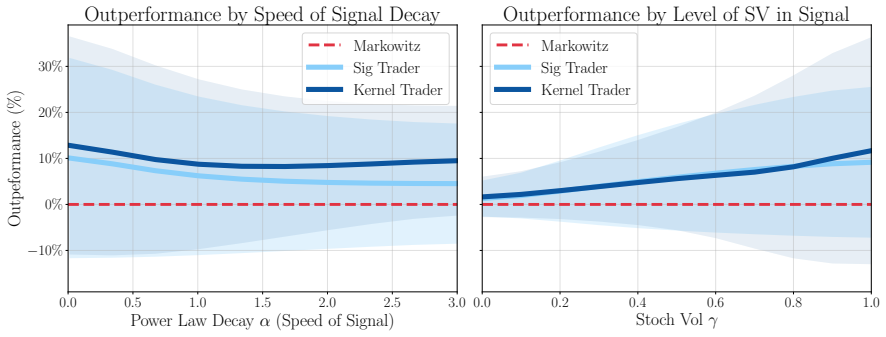
The paper's central claim is Theorem 3.1: for any kernel $K$ and feature embedding $\psi$ satisfying measurability of the induced kernel $K_\Phi$, a finite second moment $\mathbb{E}\|\Phi_X\|^2 < \infty$, and coercivity and invertibility of the operator $\Omega\colon \alpha \mapsto \mathbb{E}^P[\alpha(X)K_\Phi(X,\cdot)]$, the regularised mean-variance objective has an optimal kernel trading strategy of the form $\xi^*_t = \mathbb{E}^P[\alpha^*(Y)\Gamma(X_{0,t}, Y)]$, where $\alpha^*$ solves $(\lambda\mathrm{Id} + \eta \Xi^\Phi_P)(\alpha^*)(X) = 1$. With an empirical measure over $N$ co-location trajectories, this collapses to the closed-form weights $\alpha^* = \left(\lambda \mathrm{Id}_N + \frac{\eta}{N} K_\Phi(X,X)\left(\mathrm{Id}_N - \frac{1}{N}\mathbf{1}_N\mathbf{1}_N^\top\right)\right)^{-1}\mathbf{1}_N$, which retain the classical mean-variance structure of an inverse covariance multiplied by an expected return. The paper further shows that the Markowitz strategy, which is linear in the current drift, is suboptimal under a terminal-variance objective whenever the drift is stochastic, and demonstrates numerically that kernel and signature traders outperform Markovian baselines when either the asset dynamics or the predictive signals exhibit temporal dependence.
Load-bearing premise
The closed-form solution is the true optimum only if the best strategy in the full function space can be represented by weighted sums of the per-path PnL feature maps, a reduction the paper imports from earlier work and does not prove here; the proof also assumes, without verification, that the operator $\Omega$ is coercive and invertible on the data at hand.
Editorial extensions
If this is right
- Any choice of kernel — signature, randomised signature, RBF, or neural-network features — yields a closed-form optimal path-dependent strategy, making the framework a drop-in alternative to gradient-based learning for portfolio tasks.
- Because the closed form keeps the Markowitz shape of an inverse covariance multiplied by an expected return, the regularisation $\lambda$ and risk-aversion $\eta$ have transparent effects, and a target terminal variance can be achieved by numerically solving for $\eta$.
- When the signature kernel is used, the kernel trader coincides with the untruncated-signature limit, so it bounds the performance of truncated signature traders as the truncation order grows.
- The numerical results imply that linear Markovian strategies are suboptimal whenever the drift or predictive signals carry temporal structure, and that the gap widens with longer memory and longer trading horizons.
- The framework extends to any path-dependent kernel, including alignment kernels and convolutional kernels, so the closed-form solution is not tied to the signature construction.
Reading between the lines
- The expressiveness of the final strategy is bounded by the kernel: the optimality in Theorem 3.1 is optimality within what the chosen feature embedding can represent, so the kernel choice is the main modelling assumption rather than a technical detail.
- The closed-form weights have the shape of a shrinkage estimator of the optimal portfolio, with $\lambda$ interpolating between the raw covariance-based solution and a constant-weight portfolio; connecting this to classical covariance-shrinkage results would be a natural next step.
- A testable extension is to use the final-layer features of a trained neural network as the feature map $\psi$, which would let the closed form reproduce a deep-learning trading strategy and quantify the performance gap between the analytic and gradient-based routes.
- The dependence of outperformance on signal memory suggests the framework can serve as a diagnostic: fitting the kernel strategy and comparing it with Markowitz quantifies how much of a signal's alpha is genuinely non-Markovian.
Editorial analysis
A structured set of objections, weighed in public.
Referee Report
Summary. The paper develops a kernel-based framework for dynamic, path-dependent trading strategies under a mean-variance objective. Building on the rough-kernel hedging framework of Cirone and Salvi [CS25], the authors parameterize the inventory process as a function in an RKHS and derive an optimal strategy in terms of a 'PnL feature map' Φ_X and a weight function α* solving a linear operator equation. They provide closed-form and spectral formulas for α*, compare the approach with the signature-based trader of [FHW23], and report numerical results on synthetic and market data. The paper is clearly written and the broad idea is attractive, but several of the central algebraic formulas are not consistent with the stated theorem, and the numerical experiments rely on those formulas.
Significance. If the derivation is corrected, the paper would make a useful contribution: it extends kernel methods to mean-variance portfolio choice with path-dependent strategies, offers a unified treatment of signature and other kernels, and provides an explicit comparison of computational trade-offs with signature trading. The paper also ships a transparent algorithmic description (Algorithms 1 and 2), a careful discussion of hyperparameters, and a sensible experimental design in which the signal-to-noise ratio, memory, and heavy-tailedness of signals are controlled. However, the significance is currently conditional: the closed-form solution that drives all algorithms and numerical claims has concrete algebraic errors, and the main theorem relies on an unproved reduction imported from a preprint by the same research group. These issues are local and repairable, but they must be fixed before the results can be taken at face value.
major comments (5)
- [Section 3.1, Remark 3.2, Eqs. (3.4) and (3.6)] The finite-sample operator in Theorem 3.1 is (ΞΦ_P α)(X) = E_Y[α(Y)KΦ(Y,X)] − E_{Y,Z}[α(Y)KΦ(Y,Z)], which, for the empirical measure, is the matrix (1/N)(I − 11^T/N)KΦ(X,X), i.e. the centering projection acts on the left of the Gram matrix. Remark 3.2 and equations (3.4) and (3.6) instead use KΦ(X,X)(I − 11^T/N), with the projection on the right. These two matrices are not equal for a generic PSD kernel; they coincide only when KΦ has constant row sums, an assumption that is neither stated nor satisfied for generic signature or RBF kernels. Consequently (3.4) solves (λI + (η/N)KΦ(I−P))α = 1 rather than the equation in Theorem 3.1, and the weights computed in the numerical sections are not the claimed optimum.
- [Theorem 3.2 and Appendix B.2] The proof of Theorem 3.2 applies the rank-one update identity [λvv^T + A(I−vv^T)]^{−1}v = A^{−1}v/(λ v^T A^{−1}v), which is not valid for a general symmetric positive definite matrix A; it holds only when v is an eigenvector of A. For v = e_N and A = λI + (η/N)KΦ, there is no reason for the all-ones vector to be an eigenvector of the PnL Gram matrix. Therefore the closed form α* = √N A^{−1}e_N/(λ e_N^T A^{−1}e_N) and the spectral formula (3.8), which is exactly what Algorithm 1 evaluates, are not solutions of the stated system. This is a load-bearing error because the robust spectral implementation and the numerical experiments rely on it.
- [Corollary 3.1.1, Eq. (3.3), and Eq. (3.6)] Equation (3.3) inserts a factor 1/λ when passing from ϕ* = E_Y[α*(Y)Φ_Y] to the position ξ_t = ⟨ϕ*, K(ψ(X_{0,t}),·)e_m⟩. Theorem 3.1 contains no such factor: the regularization parameter enters only through the resolvent (λI + ηΞΦ_P)^{−1}. The spurious 1/λ propagates into Eq. (3.6), while Algorithm 2 and Eq. (6.1) do not contain it. The displayed formulas and the implementation are therefore mutually inconsistent; the correct position, up to the normalization of α*, is (1/N)Γ_P(ψ(X_{0,t}))α*, without the extra 1/λ.
- [Remark 3.3] The claimed cancellation '(ABA)^{−1}A = (AB)^{−1} for symmetric invertible A and B' is false in general; it would require A and B to commute. Moreover, the matrix I − (1/N)11^T is singular, so the displayed inverse of KΦ(I − (1/N)11^T)KΦ is not defined. The analogy with the classical mean-variance solution is therefore not established, and the statement that 'we obtained cancellations of the Gram matrix' is incorrect.
- [Appendix B.1, proof of Theorem 3.1] The proof of Theorem 3.1 delegates two load-bearing steps to [CS25]: the reduction that the maximizer over H_K lies in the closure of the span of the PnL feature maps, and the identity ι^T C_P ι = Ω∘(Id − 1⊗1)∘Ω. Neither of these results is stated precisely or proved in this paper, and the coercivity/invertibility assumption on Ω is not translated into checkable conditions on the kernel KΦ. Since the entire closed-form solution depends on this reduction, the paper should either provide a complete proof of the imported results or give a precise statement of the conditions under which they hold.
minor comments (6)
- [Algorithm 2] The online update in Algorithm 2 computes ξ_t = Γ_P(ψ(X_{0,t}))·α* without the normalization 1/N used in Eq. (3.6), while Eq. (3.6) additionally contains the spurious 1/λ discussed above; the normalization convention should be clarified and made consistent throughout.
- [Figure 3] The left panel label 'Outpeformance' is a typo for 'Outperformance'.
- [Figure 13] The axis labels in Figure 13 are garbled (for example '°4°2 0 2log(¥)' and 'p¢'); the figure should be regenerated with readable LaTeX math.
- [References] References [TCO25a] and [TCO25b] are the same paper listed twice; a single citation to Tóth, Dela Cruz, and Oberhauser should be used.
- [Appendix C.3] The sentence 'where as the conditional expectation includes no subscript' should read 'whereas the unconditional expectation includes no subscript'.
- [Section 4.2] The market-data experiments use a synthetic signal model, Eq. (4.2), with a fixed R² of 0.5%; the paper should state more prominently that the empirical outperformance claims are conditional on this model being representative of real predictive signals.
Circularity Check
Main theorem's representer reduction is imported from same-group preprint [CS25]; otherwise the derivation is self-contained and there is no fitting-to-data circularity.
-
uniqueness imported from authors
[Appendix B.1 (Proof of Theorem 3.1), after defining the map ι : L2P(X) → HΦ]
"From [CS25, Proposition 4] we see that any maximiser, which exists since ηCP + λId is self-adjoint, coercive and by moment assumptioncoercive, must lie in the closure of HP := ιL2P(X)."
Theorem 3.1 is the paper's central contribution: it asserts that the optimal strategy is ξ* = evK(ϕ*) with ϕ* = E[α*(X)ΦX] and α* solving (λId + ηΞΦ)(α*) = 1. The proof reduces the optimization over the full RKHS HΦ to the subspace HP = ιL2P(X) spanned by PnL feature maps by citing [CS25, Proposition 4]. This reduction is exactly what makes the closed-form weights α* = (λI + (η/N)KΦ(I−11^T/N))^{-1}1 in (3.4)/(3.6) represent the true optimum. The cited proposition comes from a preprint by the same research group (a co-author of this paper is also a co-author of [CS25]), is not proved in this paper, and is not machine-checked; under the review rules it therefore does not count as independent external support.
full rationale
I find no self-definitional or fitted-input-as-prediction circularity. The mean-variance specialization is derived with a new PnL feature map and benchmarked against external Markowitz and signature baselines; hyperparameters are selected by cross-validation and the reported performance is out of sample, so the numerical claims are not forced by construction. The only circularity-adjacent issue is the load-bearing import of [CS25, Proposition 4] (and, in the same proof, [CS25, Lemma 3]) to justify the reduction of the full RKHS optimization to the feature-map span. Since [CS25] is a same-group preprint that is not machine-checked or otherwise independently verified in this manuscript, that import does not qualify as independent support under the review rules; however, it is a transparently disclosed dependency rather than a hidden equation-level equivalence. If that reduction lemma is accepted, the rest of the derivation is self-contained. The skeptic's algebraic objections about the centering projection acting on the wrong side and the rank-one inverse identity concern correctness of the stated closed forms, not circularity, and are therefore not scored here.
Assumptions & free parameters
free parameters (4)
- Regularization lambda =
tuned via cross-validation; example grid 1e-9 to 1e-5 (Fig. 11)
- Path scaling gamma =
tuned via cross-validation; stable region roughly 1e-1 to 1e1 (Fig. 12)
- Eigenvalue truncation m =
example optimal range m in [50,500] (Fig. 14)
- Risk aversion eta =
user-specified; when a target variance Delta is required, eta is solved numerically and follows…
assumptions (5)
- standard math Representer theorem for regularized kernel optimization with p-loss (Theorem 2.2, [De+04])
- domain assumption Maximizer over H_K lies in the closure of the span of the PnL feature maps Phi_X ([CS25, Proposition 4])
- domain assumption Coercivity and invertibility of the operator Omega: alpha -> E[alpha(X)KPhi(X,.)] on L2_P(X)
- domain assumption Second moment condition E||Phi_X||^2 < infinity
- ad hoc to paper Synthetic signal model of Eq. (4.2) is representative of real predictive signals
Cite this review
Pith. "Pith review of Kernel Learning for Mean-Variance Trading Strategies." pith.science (2026). https://pith.science/paper/CXTW4RLV
@misc{pith2026250710701,
  author       = {Pith},
  title        = {Pith review of: Kernel Learning for Mean-Variance Trading Strategies},
  year         = {2026},
  howpublished = {\url{https://pith.science/paper/CXTW4RLV}},
  note         = {Machine review of arXiv:2507.10701}
}
read the original abstract
In this article, we develop a kernel-based framework for constructing dynamic, pathdependent trading strategies under a mean-variance optimisation criterion. Building on the theoretical results of (Muca Cirone and Salvi, 2025), we parameterise trading strategies as functions in a reproducing kernel Hilbert space (RKHS), enabling a flexible and non-Markovian approach to optimal portfolio problems. We compare this with the signature-based framework of (Futter, Horvath, Wiese, 2023) and demonstrate that both significantly outperform classical Markovian methods when the asset dynamics or predictive signals exhibit temporal dependencies for both synthetic and market-data examples. Using kernels in this context provides significant modelling flexibility, as the choice of feature embedding can range from randomised signatures to the final layers of neural network architectures. Crucially, our framework retains closed-form solutions and provides an alternative to gradient-based optimisation.
Figures


Figures from the paper (11 more)



Forward citations
Cited by 1 Pith paper
-
Path Portfolio Optimization: Defect, Lift, and the Price of Path Complexity
Excess growth rate is exactly the Marcus–forward lift gap of the price path's signature, and the practical gain of signature portfolios is a dimensional trade-off: the sample floor is set by unstructured estimation, n...
Reference graph
Works this paper leans on
-
[406]
QuadraticHedgingandMean-VariancePortfolioSelectionwith Random Parameters in an Incomplete Market
issn:1467-9965. doi: 10.1111/1467-9965.00100. url: https://onlinelibrary. wiley.com/doi/full/10.1111/1467-9965.00100%20https://onlinelibrary. wiley.com/doi/abs/10.1111/1467- 9965.00100%20https://onlinelibrary. wiley.com/doi/10.1111/1467-9965.00100. [Lim04] AndrewE.B.Lim.“QuadraticHedgingandMean-VariancePortfolioSelectionwith Random Parameters in an Incomp...
arXiv 2015
-
[2022]
Mean–Variance Portfolio Selection Under Volterra Heston Model
url: https://ssrn.com/abstract=4174589. [HW21] Bingyan Han and Hoi Ying Wong. “Mean–Variance Portfolio Selection Under Volterra Heston Model”. In:Applied Mathematics and Optimization 84.1 (Aug. 2021), pp. 683–710. issn: 14320606. doi: 10 . 1007 / S00245 - 020 - 09658 - 3 / FIGURES / 5. url: https : / / link . springer . com / article / 10 . 1007 / s00245 ...
work page 2021
-
[2340]
issn: 15406261. doi: 10.1111/jofi.12080. [Guy14] Julien Guyon. “Path-Dependent Volatility”. In: Risk (Sept. 2014). doi: 10.2139/ SSRN.2425048. url: https://papers.ssrn.com/abstract=2425048. [GL22] Julien Guyon and Jordan Lekeufack. “Volatility Is (Mostly) Path-Dependent”
-
[9965]
Optimal Portfolio Choice with Cross-Impact Propagators
doi: 10.1111/MAFI.12465 . url: https://onlinelibrary.wiley.com/ doi/full/10.1111/mafi.12465%20https://onlinelibrary.wiley.com/doi/ abs / 10 . 1111 / mafi . 12465 % 20https : / / onlinelibrary . wiley . com / doi / 10 . 1111/mafi.12465. [JNT24] Eduardo Abi Jaber, Eyal Neuman, and Sturmius Tuschmann. “Optimal Portfolio Choice with Cross-Impact Propagators”....
Reviewed August 6, 2026 · model on record in the stance chip above.
Discussion (0). Continue with ORCID to comment.