REVIEW 4 major objections 3 minor 48 references
Robust Multi-Manifold Clustering via Simplex Paths
T0 review · 4 major / 3 minor · reviewed 2026-08-06 · deepseek-v4-flash
Pith's one-line read Angle-based simplex path metric provably separates intersecting manifolds
desk verdict A genuinely new angle-based simplex path metric for multi-manifold clustering, with strong experiments and a plausible but incomplete theoretical guarantee. read the letter →
The pith
A machine-rendered reading of the paper's core claim, the machinery that carries it, and where it could break.
The reading
What carries the argument
The central object is the simplex graph G_S: nodes are valid d-simplices (d-dimensional triangles with d+1 vertices) built from annular nearest neighbors, and two simplices are connected when they share d vertices, with edge weight W_S = π - θ, where θ is the dihedral angle between them (or the two-sided variant min{π - θ, θ}). The metric LAPD between two simplices is the minimum over paths of the maximum edge weight along the path, i.e. the flattest route. The argument runs through a gap between the maximal within-manifold LAPD (wLAPD) and the minimal between-manifold LAPD (bLAPD), with a denoising step that discards simplices whose κ-th nearest neighbor LAPD is large, removing mixed simplices near intersections. The load-bearing estimate is Proposition B.4, a single-link volume bound: the set of points that can form an ε-angle link to a given straddle simplex has volume at most C e^d ε τ^(D-d).
What would settle it
Compute, for a fixed straddle simplex formed by points from two linear manifolds intersecting at angle Θ, the volume of points in a tube of radius τ around the second manifold that form an ε-angle link to it, and compare with the bound C e^d ε τ^(D-d) of Proposition B.4; if for small positive τ the measured volume exceeds the predicted constant times that expression, the noisy-case proof collapses. Alternatively, run the full pipeline on two linear manifolds with n large, e near (log n/n)^(1/d), and moderate noise, and check whether the empirical wLAPD-to-bLAPD gap fails at a rate consistent with O($n^{{-(d+1)}}$).
Extended reading notes
Core claim
The paper's central discovery is that the flattest-path geometry of a simplex graph, rather than any explicit tangent-plane or curvature estimate, is enough to solve multi-manifold clustering. For two linear manifolds intersecting at angle Θ, pure simplices (all vertices on one manifold) can always be joined by paths whose worst dihedral-angle dissimilarity is at most O(τ/e), while any path connecting different manifolds must pass through straddle simplices that make angle at least Θ/4 with both manifolds; a single-link volume estimate shows such straddling chains are unlikely, giving bLAPD ≥ (2C_5 n e^d)^(-1) and, after denoising, bLAPD ≥ Θ/4. Combining the two bounds yields wLAPD ≪ bLAPD with probability 1 - O($n^{{-(d+1)}}$) whenever e ≳ τ/Θ and e ≳ (log n/n)^(1/d). The paper states this as the first high-probability separation guarantee for an angle-based simplex path metric.
Load-bearing premise
The proof depends on a volume estimate, Proposition B.4, for how many points can form an epsilon-angle link to a straddle simplex near the intersection, and that estimate is proved rigorously only in the noiseless case; for positive noise τ the paper supplies only an informal argument in Appendix D, so the high-probability guarantee is not fully established in the noisy setting, and the main theorem also assumes connectivity of the denoised simplex graph and only two linear manifolds.
Editorial extensions
If this is right
- With n e^d ≳ log n and e above the noise-to-angle ratio, LAPD-based hierarchical clustering recovers the manifold components with failure probability decaying like a power of n.
- The denoising step makes the between-manifold distance scale like the intersection angle Θ, so even small noise that would otherwise fill the gap does not destroy separability.
- The number of manifolds can be estimated from the persistence of connected components across scales, removing a required input of many competing algorithms.
- The algorithm is quasi-linear in n and linear in ambient dimension D (with bounded intrinsic dimension), in contrast to at least quadratic costs for many baselines.
- Empirically the method handles curvature, noise, and small intersection angles better than the compared subspace and manifold clustering baselines on the tested synthetic and real datasets.
Reading between the lines
- A natural next step left implicit is a curvature-aware upper bound on e; the paper notes curvature forces smaller simplices but does not quantify it, so a testable extension is to verify the predicted τ/Θ versus (log n/n)^(1/d) scale for circles or spheres of varying radius.
- The two-sided weight improving real-data performance suggests a hybrid metric that mixes angle dissimilarity with point-density or path length could handle low-density intersections better than either alone; the paper itself suggests combining LAPD with a density-based distance.
- Because the theory treats only two linear manifolds, the hardest open case is multi-way and curved intersections; if the straddle-simplex mechanism extends there, the same machinery would give a general unsupervised segmentation tool for intersecting filamentary or surface data.
- A testable empirical prediction is that under nonuniform sampling with density bounded above and below, all constants should change but the separation should persist; one can check whether the gap wLAPD ≪ bLAPD remains for strongly nonuniform densities.
Editorial analysis
A structured set of objections, weighed in public.
Referee Report
Summary. The paper proposes a multi-manifold clustering method based on a graph of d-simplices whose edge weights are dihedral angles, and defines the largest angle path distance (LAPD) as an infinity shortest-path metric on this simplex graph. The authors derive a within-manifold upper bound (Theorem 4.1), a between-manifold lower bound in the raw and denoised settings (Theorems 4.4 and 4.5), and a combined gap theorem (Theorem 4.7) stating that, with high probability, wLAPD is much smaller than bLAPD. The proofs rely on a single-link volume estimate (Proposition B.4) for the volume of points that can form a low-angle link to a straddle simplex. The paper also gives implementation details, a quasi-linear complexity analysis, and extensive experiments on synthetic and real data, including comparisons with SSC, EKSS, LocPCA, PBC, and DCV.
Significance. If fully established, the LAPD separation theorem would be the first high-probability guarantee for an angle-based simplex path metric in multi-manifold clustering, addressing intersecting manifolds with noise. The geometric construction is natural and the noiseless single-link estimate in Lemma D.1 is a genuine technical contribution. The paper also provides a reproducible-style implementation, scalability analysis, and broad experiments, including on real data. However, the central high-probability claim is not fully proved in the noisy setting because Proposition B.4 is only proved for the noiseless case, and several supporting results are asserted or only proved in low dimensions. The contribution is potentially significant, but the main theorem currently outruns its proof.
major comments (4)
- [Appendix D, Proposition B.4] The single-link volume estimate is proved rigorously only for the noiseless case (Lemma D.1). The τ>0 case is handled by an informal paragraph that assumes τ≲ε and invokes continuity and a 'rough Taylor series' argument. This is load-bearing: Theorem 4.4 sets ε=(2C5 n e^d)^{-1}, and under the theorem's hypothesis n e^d ≳ log n this ε tends to 0 while τ may be fixed and only constrained by Assumption 3.2 (τ≤e/q). Thus the regime covered by the informal sketch does not include typical parameters satisfying the theorem hypotheses. Theorems 4.4, 4.5, and 4.7 therefore do not currently provide the stated high-probability bLAPD guarantees in the noisy setting. An independent, rigorous derivation of the noisy single-link volume bound is needed.
- [Appendix A, Proposition A.1 and Theorem 4.1] The proof of the wLAPD upper bound is complete only for d=1,2 and q=1. For d>2 the text states that the proof is 'straightforward but cumbersome' and is skipped, while the extension to q<1 is supported only by numerical optimization in Figure 9b. Since Theorem 4.1 is stated for general d and q and is used in Theorem 4.7, either a complete proof for all d and q must be supplied, or the theorem must be stated with the restriction under which it is proved.
- [Appendix B, Lemma B.3] The proof of Lemma B.3 asserts the triangle inequality ∠(Δ_i, M1) ≤ W^2_S(Δ_i,Δ_{i+1}) + ∠(Δ_{i+1}, M1) without justification. This inequality is the key step that converts a low-weight path into a long chain of straddle simplices, and it is not immediate because W^2_S is an angle between two simplices while ∠(·, M1) is an angle between a simplex and a manifold. A proof or a precise reference for this angle inequality is required for the bLAPD lower bound.
- [Theorem 4.7 and connectivity assumptions] The main gap theorem assumes that G_S and G_{S_dns} are connected (Theorem 4.1 and Theorem 4.7), and the proof of Theorem 4.7 says the denoising procedure will not impact wLAPD as long as the graph stays connected. No sampling condition is given that ensures connectivity with high probability. If the graph is disconnected, LAPD is infinite and the separation claim is vacuous. The connectivity requirement should either be proved under the stated sampling assumptions or explicitly incorporated into the theorem hypotheses.
minor comments (3)
- [Theorem 4.4 statement vs. proof] The statement of Theorem 4.4 defines C4 = (2C2/(q sin Θ))^{d+1}, but the proof in Appendix B uses C4 = (10C2/(q sin Θ))^{d+1}. These constants should be reconciled.
- [Theorem 4.5, denoising parameter κ] The parameter κ = Θ/(4 C5 n e^d) is used as a 'κ-th nearest neighbor' count, which must be an integer. The theorem should specify κ = ⌊Θ C5 n e^d / 4⌋ or otherwise clarify the rounding, since the proof relies on κ ≥ Θ/(8ε).
- [Appendix C, proof of Theorem 4.5] The sentence 'there exists a super straddle simplex that ϵ-links to s=Θ/(8ϵ) neighbors... That is, there exists a path of simplices such that Δ1→ϵ,str ...→ϵ,str Δs' is not immediate. The denoising criterion gives κ neighbors within LAPD η, and the argument should explicitly use a prefix of the realizing path to one of those neighbors to obtain a chain of the required length.
Circularity Check
No circular derivation: the LAPD separation theorem is proved from first principles; self-citations to prior work are used as computational tools, not as evidence for the gap bound.
full rationale
The central claim (Theorem 4.7) combines a deterministic wLAPD upper bound (Theorem 4.1, proved in Appendix A) with a probabilistic bLAPD lower bound (Theorems 4.4 and 4.5, proved in Appendices B and C), both derived from the paper's own assumptions and volume estimates. LAPD is defined in Definition 3.1 directly from the simplex graph weights, and the gap result is not an input to the metric's construction. The only author-overlapping citations are Little et al. (2017) for estimating d and tau and Little et al. (2020) for the multi-scale infinity-path-distance approximation; these are implementation tools and are not used to justify the separation theorem, so they are not load-bearing. The paper does contain genuine completeness gaps that a reviewer should weigh as correctness risk, not circularity: Proposition B.4 is proved rigorously only for tau=0 in Lemma D.1, and Appendix D explicitly gives only an informal 'rough Taylor series' argument for tau>0, with the claimed bound vol_D(A_tau) bounded by C e^d epsilon tau^{D-d} asserted rather than proven (the sketch additionally assumes tau less than about epsilon, which the theorem hypotheses do not guarantee). Appendix A's Proposition A.1 is proved only for d=1,2, with larger d supported by numerical optimization, and Lemma B.3's triangle-inequality step is asserted without proof. These gaps affect the completeness of the high-probability claim in the noisy setting but do not make any prediction equivalent to its inputs by construction. Accordingly, no circular step is identified and the circularity score is 1 due only to minor, non-load-bearing self-citation.
Assumptions & free parameters
free parameters (8)
- e (simplex edge scale) =
default sqrt(2)*tau
- q (edge distortion threshold) =
1 / (1.25 + 0.15*(d-2))
- r0 (volume distortion threshold) =
theoretical, not used in implementation
- B (annulus degree) =
25
- kappa (denoising neighbor count) =
10 log n default; theory uses Theta/(4 C5 n e^d)
- eta (denoising threshold) =
elbow point of sorted kappaNN LAPDs; theory uses (2 C5 n e^d)^(-1)
- k (number of scales) =
100
- d and tau estimates =
estimated via Little et al. 2017 if not provided
assumptions (8)
- domain assumption Assumption 2.1: manifold intersections are (d-1)-dimensional when nonempty.
- domain assumption Assumption 2.2: samples are i.i.d. from a uniform measure on the noisy tube T_tau(M), or from a density bounded away from 0 and infinity.
- domain assumption Assumption 3.1: a set of valid simplices exists with size constraints e <= edge length <= e/q and volume distortion bounds.
- domain assumption Assumption 3.2: noise level tau is small relative to simplex size, tau <= e/q.
- domain assumption Assumption 4.1: the manifold collection is exactly two linear manifolds intersecting at angle Theta.
- domain assumption Assumption 4.2: volume regularity of the tube near the intersection, vol_D(T_R) in [C1, C2] R tau^(D-d).
- domain assumption The denoised or full simplex graph G_S is connected.
- ad hoc to paper Proposition B.4 single-link volume estimate holds for tau > 0.
Cite this review
Pith. "Pith review of Robust Multi-Manifold Clustering via Simplex Paths." pith.science (2026). https://pith.science/paper/3FBBHBNW
@misc{pith2026250710710,
  author       = {Pith},
  title        = {Pith review of: Robust Multi-Manifold Clustering via Simplex Paths},
  year         = {2026},
  howpublished = {\url{https://pith.science/paper/3FBBHBNW}},
  note         = {Machine review of arXiv:2507.10710}
}
read the original abstract
This article introduces a novel, geometric approach for multi-manifold clustering (MMC), i.e. for clustering a collection of potentially intersecting, d-dimensional manifolds into the individual manifold components. We first compute a locality graph on d-simplices, using the dihedral angle in between adjacent simplices as the graph weights, and then compute infinity path distances in this simplex graph. This procedure gives a metric on simplices which we refer to as the largest angle path distance (LAPD). We analyze the properties of LAPD under random sampling, and prove that with an appropriate denoising procedure, this metric separates the manifold components with high probability. We validate the proposed methodology with extensive numerical experiments on both synthetic and real-world data sets. These experiments demonstrate that the method is robust to noise, curvature, and small intersection angle, and generally out-performs other MMC algorithms. In addition, we provide a highly scalable implementation of the proposed algorithm, which leverages approximation schemes for infinity path distance to achieve quasi-linear computational complexity.
Figures


Figures from the paper (6 more)


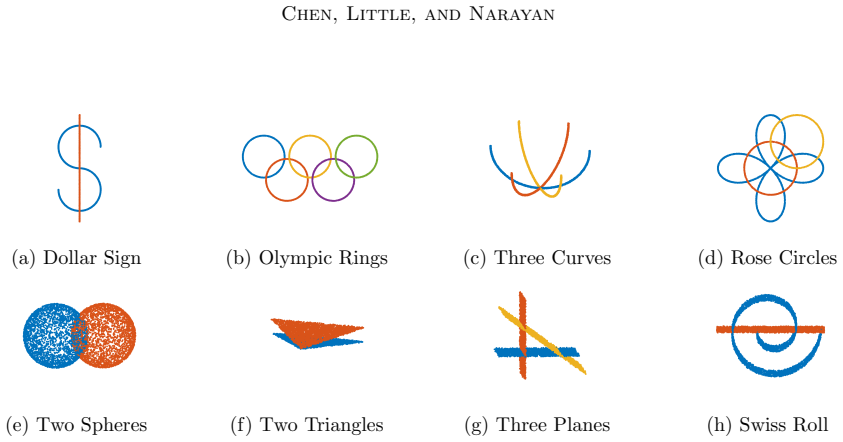


Reference graph
Works this paper leans on
-
[1]
Beyond linear subspace clustering: A comparative study of nonlinear manifold clustering algorithms
Maryam Abdolali and Nicolas Gillis. Beyond linear subspace clustering: A comparative study of nonlinear manifold clustering algorithms. Computer Science Review, 42: 0 100435, November 2021. ISSN 1574-0137. doi:10.1016/j.cosrev.2021.100435. URL https://www.sciencedirect.com/science/article/pii/S1574013721000757
arXiv 2021
-
[2]
Spectral Clustering Based on Local PCA
Ery Arias-Castro, Gilad Lerman, and Teng Zhang. Spectral Clustering Based on Local PCA . Journal of Machine Learning Research, 18 0 (9): 0 1--57, 2017. ISSN 1533-7928. URL http://jmlr.org/papers/v18/14-318.html
work page 2017
-
[3]
Multiple Manifold Clustering Using Curvature Constrained Path
Amir Babaeian, Alireza Bayestehtashk, and Mojtaba Bandarabadi. Multiple Manifold Clustering Using Curvature Constrained Path . PLOS ONE, 10 0 (9): 0 e0137986, September 2015. ISSN 1932-6203. doi:10.1371/journal.pone.0137986. URL https://journals.plos.org/plosone/article?id=10.1371/journal.pone.0137986. Publisher: Public Library of Science
-
[4]
Moderate deviation theorem for the Neyman-Pearson statistic in testing uniformity
R. Basri and D.W. Jacobs. Lambertian reflectance and linear subspaces. IEEE Transactions on Pattern Analysis and Machine Intelligence, 25 0 (2): 0 218--233, 2003. ISSN 0162-8828. doi:10.1109/TPAMI.2003.1177153
work page Pith review arXiv 2003
-
[5]
Laplacian eigenmaps for dimensionality reduction and data representation
Mikhail Belkin and Partha Niyogi. Laplacian eigenmaps for dimensionality reduction and data representation. Neural Computation, 15 0 (6): 0 1373--1396, 2003. doi:10.1162/089976603321780317
-
[6]
Hoss Belyadi, Alireza Haghighat, and Doug Yarranton. Machine Learning Guide for Oil and Gas Using Python - A Step-by-Step Breakdown with Data, Algorithms, Codes, and Applications. Elsevier, 2021. ISBN 9780323902321
work page 2021
-
[7]
P.S. Bradley and O.L. Mangasarian. k- Plane Clustering . Journal of Global Optimization, 16 0 (1): 0 23--32, January 2000. ISSN 1573-2916. doi:10.1023/A:1008324625522. URL https://doi.org/10.1023/A:1008324625522
-
[8]
A dendrite method for cluster analysis
Tadeusz Caliński and Harabasz JA. A dendrite method for cluster analysis. Communications in Statistics - Theory and Methods, 3: 0 1--27, 01 1974. doi:10.1080/03610927408827101
Show all 48 references
-
[9]
Camerini
Paolo M. Camerini. The min-max spanning tree problem and some extensions. Information Processing Letters, 7 0 (1): 0 10--14, 1978
1978
-
[10]
Largest angle path distance for multi-manifold clustering
Haoyu Chen, Anna Little, and Akil Narayan. Largest angle path distance for multi-manifold clustering. In 2023 International Conference on Sampling Theory and Applications (SampTA), pages 1--7, 2023. doi:10.1109/SampTA59647.2023.10301401
2023
-
[11]
Costeira and T
J.P. Costeira and T. Kanade. A Multibody Factorization Method for Independently Moving Objects . International Journal of Computer Vision, 29 0 (3): 0 159--179, 1998. ISSN 0920-5691. doi:10.1023/A:1008000628999
1998 doi
-
[12]
The mnist database of handwritten digit images for machine learning research
Li Deng. The mnist database of handwritten digit images for machine learning research. IEEE Signal Processing Magazine, 29 0 (6): 0 141--142, 2012
2012
-
[13]
Sparse Manifold Clustering and Embedding
Ehsan Elhamifar and René Vidal. Sparse Manifold Clustering and Embedding . In Advances in Neural Information Processing Systems , volume 24. Curran Associates, Inc., 2011. URL https://proceedings.neurips.cc/paper/2011/hash/fc490ca45c00b1249bbe3554a4fdf6fb-Abstract.html
2011
-
[14]
Sparse Subspace Clustering : Algorithm , Theory , and Applications
Ehsan Elhamifar and René Vidal. Sparse Subspace Clustering : Algorithm , Theory , and Applications . IEEE Transactions on Pattern Analysis and Machine Intelligence, 35 0 (11): 0 2765--2781, November 2013. ISSN 1939-3539. doi:10.1109/TPAMI.2013.57. Conference Name: IEEE Transac...
2013 doi
-
[15]
Algorithms for two bottleneck optimization problems
Harold N Gabow and Robert E Tarjan. Algorithms for two bottleneck optimization problems. Journal of Algorithms, 9 0 (3): 0 411--417, 1988
1988
-
[16]
Recommendations for validating hierarchical clustering in consumer sensory projects
Attila Gere. Recommendations for validating hierarchical clustering in consumer sensory projects. Current Research in Food Science, 6: 0 100522, 2023. ISSN 2665-9271. doi:https://doi.org/10.1016/j.crfs.2023.100522. URL https://www.sciencedirect.com/science/article/pii/S2665927...
2023
-
[17]
Robust multiple manifolds structure learning
Dian Gong, Xuemei Zhao, and Gérard Medioni. Robust multiple manifolds structure learning. In Proceedings of the 29th International Coference on International Conference on Machine Learning , ICML '12, pages 25--32, Madison, WI, USA, June 2012. Omnipress. ISBN 978-1-4503-1285-1
2012
-
[18]
Metrics and Models for Handwritten Character Recognition
Trevor Hastie and Patrice Simard. Metrics and Models for Handwritten Character Recognition . In Carlo Malaguerra, Stephan Morgenthaler, and Elvezio Ronchetti, editors, Conference on Statistical Science Honouring the Bicentennial of Stefano Franscini ’s Birth , Monte Verità , p...
1997 doi
-
[19]
Ho, Ming-Husang Yang, Jongwoo Lim, Kuang-Chih Lee, and D
J. Ho, Ming-Husang Yang, Jongwoo Lim, Kuang-Chih Lee, and D. Kriegman. Clustering appearances of objects under varying illumination conditions. In 2003 IEEE Computer Society Conference on Computer Vision and Pattern Recognition , 2003. Proceedings . , volume 1, pages I--I, Jun...
2003 arXiv
-
[20]
The maximum capacity route problem
TC Hu. The maximum capacity route problem. Operations Research, 9 0 (6): 0 898--900, 1961
1961
-
[21]
J. J. Hull . A database for handwritten text recognition research. IEEE Transactions on Pattern Analysis and Machine Intelligence, 16 0 (5): 0 550--554, 1994. doi:10.1109/34.291440
1994 doi
-
[22]
Zhang, Hongdong Li, Mathieu Salzmann, and Ian D
Pan Ji, T. Zhang, Hongdong Li, Mathieu Salzmann, and Ian D. Reid. Deep subspace clustering networks. In Neural Information Processing Systems, 2017. URL https://api.semanticscholar.org/CorpusID:3470712
2017
-
[23]
Learnable subspace clustering
Jun Li, Hongfu Liu, Zhiqiang Tao, Handong Zhao, and Yun Fu. Learnable subspace clustering. IEEE Transactions on Neural Networks and Learning Systems, 33 0 (3): 0 1119--1133, 2022 a . doi:10.1109/TNNLS.2020.3040379
2022
-
[24]
Zengyi Li, Yubei Chen, Yann LeCun, and Friedrich T. Sommer. Neural manifold clustering and embedding. ArXiv, abs/2201.10000, 2022 b . URL https://api.semanticscholar.org/CorpusID:246275780
2022 arXiv
-
[25]
Subspace clustering using ensembles of K-subspaces
John Lipor, David Hong, Yan Shuo Tan, and Laura Balzano. Subspace clustering using ensembles of K-subspaces . Information and Inference: A Journal of the IMA, 10 0 (1): 0 73--107, 11 2020. ISSN 2049-8772. doi:10.1093/imaiai/iaaa031. URL https://doi.org/10.1093/imaiai/iaaa031
2020 doi
-
[26]
Anna Little, Mauro Maggioni, and James M. Murphy. Path-based spectral clustering: guarantees, robustness to outliers, and fast algorithms. The Journal of Machine Learning Research, 21 0 (1): 0 6:184--6:249, 2020
2020
-
[27]
Little, Mauro Maggioni, and Lorenzo Rosasco
Anna V. Little, Mauro Maggioni, and Lorenzo Rosasco. Multiscale geometric methods for data sets i: Multiscale svd, noise and curvature. Applied and Computational Harmonic Analysis, 43 0 (3): 0 504--567, 2017. ISSN 1063-5203. doi:https://doi.org/10.1016/j.acha.2015.09.009. URL ...
2017 doi
-
[28]
G. Liu, Z. Lin, S. Yan, J. Sun, Y. Yu, and Y. Ma. Robust recovery of subspace structures by low-rank representation. IEEE Trans. on Pattern Analysis and Machine Intelligence, 35 0 (1): 0 171--184, 2012
2012
-
[29]
N2d: (not too) deep clustering via clustering the local manifold of an autoencoded embedding
Ryan McConville, Raúl Santos-Rodríguez, Robert J Piechocki, and Ian Craddock. N2d: (not too) deep clustering via clustering the local manifold of an autoencoded embedding. In 2020 25th International Conference on Pattern Recognition (ICPR), pages 5145--5152, 2021. doi:10.1109/...
2020
-
[30]
Columbia object image library (coil-20)
Sameer A Nene, Shree K Nayar, Hiroshi Murase, et al. Columbia object image library (coil-20). 1996
1996
-
[31]
Patel and René Vidal
Vishal M. Patel and René Vidal. Kernel sparse subspace clustering. In 2014 IEEE International Conference on Image Processing (ICIP), pages 2849--2853, 2014. doi:10.1109/ICIP.2014.7025576
2014
-
[32]
Deep subspace clustering
Xi Peng, Jiashi Feng, Joey Tianyi Zhou, Yingjie Lei, and Shuicheng Yan. Deep subspace clustering. IEEE Transactions on Neural Networks and Learning Systems, 31 0 (12): 0 5509--5521, 2020. doi:10.1109/TNNLS.2020.2968848
2020
-
[33]
Souvenir and R
R. Souvenir and R. Pless. Manifold clustering. In Tenth IEEE International Conference on Computer Vision ( ICCV '05) Volume 1 , volume 1, pages 648--653 Vol. 1, 2005. doi:10.1109/ICCV.2005.149
2005 doi
-
[34]
Tenenbaum, Vin de Silva, and John C
Joshua B. Tenenbaum, Vin de Silva, and John C. Langford. A global geometric framework for nonlinear dimensionality reduction. Science, 290 5500: 0 2319--23, 2000. URL https://api.semanticscholar.org/CorpusID:221338160
2000
-
[35]
Estimating the number of clusters in a data set via the gap statistic
Robert Tibshirani, Guenther Walther, and Trevor Hastie. Estimating the number of clusters in a data set via the gap statistic. Journal of the Royal Statistical Society Series B: Statistical Methodology, 63 0 (2): 0 411--423, 01 2002. ISSN 1369-7412. doi:10.1111/1467-9868.00293...
2002
-
[36]
Tipping and C.M
M.E. Tipping and C.M. Bishop. Mixtures of probabilistic principal component analyzers. Neural Computation, 11 0 (2): 0 443--482, 1999. ISSN 0899-7667. doi:10.1162/089976699300016728
1999 doi
-
[37]
Tomasi and T
C. Tomasi and T. Kanade. Shape and motion from image streams under orthography: a factorization method. International Journal of Computer Vision, 9 0 (2): 0 137--154, 1992. ISSN 0920-5691. doi:10.1007/BF00129684
1992 doi
-
[38]
Large sample spectral analysis of graph-based multi-manifold clustering, 2021
Nicolas Garcia Trillos, Pengfei He, and Chenghui Li. Large sample spectral analysis of graph-based multi-manifold clustering, 2021. URL http://arxiv.org/abs/2107.13610. arXiv:2107.13610 [cs, math, stat]
2021 arXiv
-
[39]
R. Vidal. Subspace clustering. IEEE Signal Processing Magazine, 28 0 (2): 0 52--68, 2011. ISSN 1053-5888. doi:10.1109/MSP.2010.939739
2011
-
[40]
Shankar Sastry
René Vidal, Yi Ma, and S. Shankar Sastry. Principal Component Analysis . In René Vidal, Yi Ma, and S.S. Sastry, editors, Generalized Principal Component Analysis , Interdisciplinary Applied Mathematics , pages 25--62. Springer, New York, NY, 2016. ISBN 978-0-387-87811-9. doi:1...
2016 doi
-
[41]
Multi-manifold modeling in non-euclidean spaces
Xu Wang, Konstantinos Slavakis, and Gilad Lerman. Multi-manifold modeling in non-euclidean spaces. In Guy Lebanon and S. V. N. Vishwanathan, editors, Proceedings of the Eighteenth International Conference on Artificial Intelligence and Statistics, volume 38 of Proceedings of M...
2015
-
[42]
Yang, Arvind Ganesh, S
John Wright, Allen Y. Yang, Arvind Ganesh, S. Shankar Sastry, and Yi Ma. Robust Face Recognition via Sparse Representation . IEEE Transactions on Pattern Analysis and Machine Intelligence, 31 0 (2): 0 210--227, February 2009. ISSN 1939-3539. doi:10.1109/TPAMI.2008.79. Conferen...
2009 doi
-
[43]
Generalized clustering and multi-manifold learning with geometric structure preservation
Lirong Wu, Zicheng Liu, Jun Xia, Zelin Zang, Siyuan Li, and Stan Z Li. Generalized clustering and multi-manifold learning with geometric structure preservation. In Proceedings of the IEEE/CVF Winter Conference on Applications of Computer Vision, pages 139--147, 2022 a
2022
-
[44]
Deep clustering and visualization for end-to-end high-dimensional data analysis
Lirong Wu, Lifan Yuan, Guojiang Zhao, Haitao Lin, and Stan Z Li. Deep clustering and visualization for end-to-end high-dimensional data analysis. IEEE Transactions on Neural Networks and Learning Systems, 2022 b
2022
-
[45]
Multi-manifold clustering: A graph-constrained deep nonparametric method
Xulun Ye and Jieyu Zhao. Multi-manifold clustering: A graph-constrained deep nonparametric method. 93: 0 215--227. ISSN 0031-3203. doi:10.1016/j.patcog.2019.04.029. URL https://www.sciencedirect.com/science/article/pii/S003132031930175X
2019 doi
-
[46]
A Survey of Sparse Representation : Algorithms and Applications
Zheng Zhang, Yong Xu, Jian Yang, Xuelong Li, and David Zhang. A Survey of Sparse Representation : Algorithms and Applications . IEEE Access, 3: 0 490--530, 2015. ISSN 2169-3536. doi:10.1109/ACCESS.2015.2430359. Conference Name: IEEE Access
2015
-
[47]
Deep adversarial subspace clustering
Pan Zhou, Yunqing Hou, and Jiashi Feng. Deep adversarial subspace clustering. In 2018 IEEE/CVF Conference on Computer Vision and Pattern Recognition, pages 1596--1604, 2018. doi:10.1109/CVPR.2018.00172
2018
-
[48]
Multi-view clustering via multi-manifold regularized non-negative matrix factorization
Linlin Zong, Xianchao Zhang, Long Zhao, Hong Yu, and Qianli Zhao. Multi-view clustering via multi-manifold regularized non-negative matrix factorization. 88: 0 74--89. ISSN 0893-6080. doi:10.1016/j.neunet.2017.02.003. URL https://www.sciencedirect.com/science/article/pii/S0893...
2017 doi
Reviewed August 6, 2026 · model on record in the stance chip above.
Discussion (0). Sign in to comment.