Optimal Debiased Inference on Privatized Data via Indirect Estimation and Parametric Bootstrap
Pith reviewed 2026-05-19 04:20 UTC · model grok-4.3
The pith
An adaptive indirect estimator achieves minimum asymptotic variance among consistent estimators for inference from privatized data.
A machine-rendered reading of the paper's core claim, the machinery that carries it, and where it could break.
Core claim
The adaptive indirect estimator, constructed through a simulation-based optimization that matches the observed privatized summary to its expected value under the privacy mechanism, is consistent for the true parameter and attains the minimum asymptotic variance among all well-behaved consistent estimators that depend only on the released statistic. Substituting this estimator into the parametric bootstrap yields bootstrap estimates, confidence intervals, and hypothesis tests that are consistent for the true quantities and possess the usual asymptotic validity properties.
What carries the argument
Simulation-based indirect inference that iteratively simulates the known privacy mechanism (including clamping) for candidate parameter values and selects the value whose simulated output best matches the observed privatized summary.
If this is right
- Parametric bootstrap confidence intervals attain the nominal coverage probability asymptotically.
- Hypothesis tests based on the bootstrap achieve the correct asymptotic type I error rate.
- The procedure remains valid for any privacy mechanism whose output distribution can be simulated given the parameter.
- The resulting estimator is asymptotically efficient within the class of consistent estimators that use only the released summary statistic.
Where Pith is reading between the lines
- Practitioners could apply the same simulation-matching idea to other distorting release mechanisms beyond differential privacy, such as synthetic data generators.
- The framework might be adapted to settings where only a black-box simulator of the mechanism is available rather than an explicit formula.
- Because the method separates estimation from the bootstrap step, it could be combined with existing private summary releases without requiring changes to the privacy protocol itself.
Load-bearing premise
The privacy mechanism must be fully known and accurately simulatable for every candidate parameter value.
What would settle it
In large-sample simulations with a known true parameter and privacy mechanism, the empirical coverage of the resulting confidence intervals deviates substantially from the nominal level, or another consistent estimator using the same summary achieves strictly smaller asymptotic variance.
Figures


read the original abstract
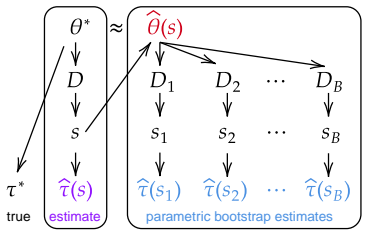
We design a debiased parametric bootstrap framework for statistical inference from differentially private data. Existing usage of the parametric bootstrap on privatized data ignored or avoided handling possible biases introduced by the privacy mechanism, such as by clamping, a technique employed by the majority of privacy mechanisms. Ignoring these biases leads to under-coverage of confidence intervals and miscalibrated type I errors of hypothesis tests, due to the inconsistency of parameter estimates based on the privatized data. We propose using the indirect inference method to estimate the parameter values consistently, and we use the improved estimator in parametric bootstrap for inference. To implement the indirect estimator, we present a novel simulation-based, adaptive approach along with the theory that establishes the consistency of the corresponding parametric bootstrap estimates, confidence intervals, and hypothesis tests. In particular, we prove that our adaptive indirect estimator achieves the minimum asymptotic variance among all ``well-behaved'' consistent estimators based on the released summary statistic. Our simulation studies show that our framework produces confidence intervals with well-calibrated coverage and performs hypothesis testing with the correct type I error, giving state-of-the-art performance for inference in several settings.
Editorial analysis
A structured set of objections, weighed in public.
Referee Report
Summary. The paper develops a debiased parametric bootstrap procedure for inference from differentially private data. It uses an adaptive simulation-based indirect estimator to obtain consistent parameter estimates that correct for biases induced by privacy mechanisms such as clamping, then feeds the estimator into a parametric bootstrap to produce confidence intervals and hypothesis tests. The authors prove consistency of the procedure and claim that the adaptive indirect estimator attains the minimum asymptotic variance among all well-behaved consistent estimators based on the released summary statistic; simulation studies are presented to illustrate coverage and type-I error control.
Significance. If the optimality result holds under the non-smooth clamping regime emphasized in the paper, the work would supply a practical and theoretically grounded method for valid inference on privatized data, improving upon existing parametric-bootstrap approaches that ignore mechanism-induced bias. The simulation evidence and the explicit handling of clamping constitute concrete strengths.
major comments (1)
- [Theory section / abstract optimality claim] Abstract and theory section: the claim that the adaptive indirect estimator achieves minimum asymptotic variance among well-behaved consistent estimators rests on regularity conditions (e.g., differentiability or Lipschitz continuity of the binding function). Clamping, repeatedly highlighted as the key source of bias, renders the binding function non-differentiable at the truncation points. The manuscript does not appear to verify explicitly that this non-smoothness preserves the efficiency bound or the validity of the adaptive simulation step; a concrete counter-example or additional regularity argument is needed to confirm that the efficiency guarantee extends to the clamped setting the paper positions as central.
minor comments (2)
- [Simulation studies] Simulation section: supply the precise data-exclusion rules, number of Monte Carlo replications, and method used to compute error bars so that readers can assess whether post-hoc choices affect the reported coverage and type-I error results.
- [Section 3] Notation: define the binding function and the adaptive simulation step more explicitly before the main theorems so that the consistency and optimality arguments are easier to follow.
Simulated Author's Rebuttal
We thank the referee for their careful reading of our manuscript and for the constructive feedback. We address the major comment point by point below.
read point-by-point responses
-
Referee: Abstract and theory section: the claim that the adaptive indirect estimator achieves minimum asymptotic variance among well-behaved consistent estimators rests on regularity conditions (e.g., differentiability or Lipschitz continuity of the binding function). Clamping, repeatedly highlighted as the key source of bias, renders the binding function non-differentiable at the truncation points. The manuscript does not appear to verify explicitly that this non-smoothness preserves the efficiency bound or the validity of the adaptive simulation step; a concrete counter-example or additional regularity argument is needed to confirm that the efficiency guarantee extends to the clamped setting the paper positions as central.
Authors: We appreciate the referee highlighting the potential issue with non-differentiability introduced by clamping. In our theoretical development, the optimality result is derived under the assumption that the binding function satisfies standard regularity conditions for indirect inference, including local differentiability. For the clamping mechanism, although the binding function is non-differentiable at the truncation points, these points have measure zero under the continuous distributions considered in our framework. Consequently, the asymptotic variance bound and the consistency of the adaptive estimator remain valid, as the contribution of these isolated points to the expectations and derivatives is negligible. The adaptive simulation step is justified by the uniform convergence of the simulated binding function, which holds even in the presence of non-smoothness as long as the function is continuous (which it is). To make this explicit, we will revise the manuscript by adding a remark or short appendix section that discusses the extension of the efficiency result to non-differentiable binding functions in this context, perhaps by appealing to results on asymptotic efficiency with non-smooth moments. We believe this will clarify the applicability to the clamped setting emphasized in the paper. revision: yes
Circularity Check
No significant circularity; derivation relies on independent indirect inference theory and simulation matching
full rationale
The paper derives consistency of the adaptive indirect estimator and its minimum asymptotic variance among well-behaved estimators via standard indirect inference arguments that target an external observed summary statistic through simulation of the known privacy mechanism. The parametric bootstrap step then uses the resulting consistent estimator for inference, preserving separation between the estimation target and the bootstrap distribution. No self-definitional reductions, fitted inputs renamed as predictions, or load-bearing self-citations appear in the claimed chain; the optimality result follows from the binding function and simulation matching under the paper's regularity conditions rather than by construction from the inputs themselves. The framework is self-contained against external benchmarks for indirect estimation.
Axiom & Free-Parameter Ledger
axioms (1)
- domain assumption The statistical model is parametric and the privacy mechanism (including clamping) is known and exactly simulatable.
Reference graph
Works this paper leans on
-
[1]
Ackerberg, D. A. (2009). A new use of importance sampling to reduce computational burden in simulation estimation. Quantitative Marketing and Economics, 7:343–376. 30 Alabi, D. and Vadhan, S. (2022). Hypothesis testing for differentially private linear regres- sion. Advances in Neural Information Processing Systems, 35:14196–14209. Awan, J. and Slavkovic,...
work page 2009
-
[2]
Awan, J. and Wang, Z. (2024). Simulation-based, finite-sample inference for privatized data. Journal of the American Statistical Association, pages 1–14. Beran, R. (1986). Simulated power functions. The Annals of Statistics, pages 151–173. Beran, R. (1997). Diagnosing bootstrap success. Annals of the Institute of Statistical Mathematics, 49:1–24. Bishop, ...
work page 2024
-
[3]
Chaudhuri, K., Monteleoni, C., and Sarwate, A. D. (2011). Differentially private empirical risk minimization. Journal of Machine Learning Research, 12(3). Covington, C., He, X., Honaker, J., and Kamath, G. (2021). Unbiased statistical estimation and valid confidence intervals under differential privacy. arXiv preprint arXiv:2110.14465. Davidson, R. and Ma...
-
[4]
Ju, N., Awan, J., Gong, R., and Rao, V. (2022). Data augmentation MCMC for Bayesian inference from privatized data. In Advances in Neural Information Processing Systems. 33 Kenny, C. T., Kuriwaki, S., McCartan, C., Rosenman, E. T., Simko, T., and Imai, K. (2021). The use of differential privacy for census data and its impact on redistricting: The case of ...
-
[5]
This indicates that Pθ1 inf θ∗∈Θ0 ˆτ(s) − τ(θ∗) ˆσ(s) > ˆξα(s) → 1 holds for all α ∈ (0, 1). Proof for Proposition 2.9. This proof mainly follows the proof by Ferrando et al. (2022, Theorem 1). For s ∼ Pθ∗, let √n(ˆτ(s) − τ(θ∗)) d − →V ∼ H(θ∗). As √n(ˆσ(s)) P − →σ(θ∗), by Slutsky’s theorem, we know that √n(ˆτ(s)−τ(θ∗))√n(ˆσ(s)) d − →V σ(θ∗) := T . We deno...
work page 2022
-
[6]
Lemma 6.2 (Lemma 3 by Ferrando et al
(for easier reference, we included it as Lemma 6.2 below), we have Pˆθ(s) ˆτ(sb)−τ(ˆθ(s)) ˆσ(sb) ≤ t s P − →FT (t) where sb ∼ Pˆθ(s). Lemma 6.2 (Lemma 3 by Ferrando et al. (2022)) . Suppose gn is a sequence of functions such that gn(hn) → 0 for any fixed sequence hn = O(1). Then gn(ˆhn) P − →0 for every random sequence ˆhn = OP (1). 6.2 Proofs for Section...
work page 2022
-
[7]
38 Proposition 6.3 (Consistency of M-estimator; Van der Vaart (2000))
in Proposition 6.3. 38 Proposition 6.3 (Consistency of M-estimator; Van der Vaart (2000)) . Let Mn be random functions and let M be a fixed function of θ such that for every ε > 0, supθ∈Θ |Mn(θ) − M(θ)| P − → 0 and supθ:∥θ−θ∗∥≥ε M(θ) < M (θ∗). Then any sequence of estimators ˆθn with Mn ˆθn ≥ Mn(θ∗) − op(1) converges in probability to θ∗. Note that a spec...
work page 2000
-
[8]
s θ∗ + hn√n − 1 R RX r=1 sr θ∗ + hn√n # = ((B∗)⊺ΩB∗)−1(B∗)⊺Ω + op(1) ( √n
Therefore, √n(ˆθIND − θ∗) = ((B∗)⊺ΩB∗)−1 (B∗)⊺Ω + op(1) √n " s − 1 R RX r=1 sr(θ∗) # . (4) From Lemma 6.4, we have √n(s − β∗) d − →(J ∗)−1v where v ∼ F ∗ ρ,u,DP, and similarly, √n(sr(θ∗) − β∗) d − →(J ∗)−1v where v ∼ F ∗ ρ,u,DP. Using s − 1 R RX r=1 sr(θ∗) = (s − β∗) − 1 R RX r=1 (sr(θ∗) − β∗), and the independence between s and sr, we have √n s − 1 R RX ...
work page 1991
-
[9]
((B∗)⊺ΩB∗)−1 (B∗)⊺Ω(J ∗)−1 v0 − 1 R RX r=1 vr !# ⪰ Var
We use Taylor expansion of mRn(ˆθ) at θ∗ to obtain mRn(ˆθ) = mRn(θ∗) + ∂mRn(˜θ) ∂θ (ˆθ − θ∗) where each entry of ˜θ is between the corresponding entries of θ∗ and ˆθ. As ˆθ is a consistent estimator of θ∗, we have ˆθ = θ∗ + op(1) and ˜θ = θ∗ + op(1). By (A9), we have ∂mRn(˜θ) ∂θ = B∗ + op(1) and Equation (9) becomes [2B∗ + op(1)]⊺ (Ω∗ + op(1)) h s − mRn(θ...
work page 1993
-
[10]
As ψ(s) is a consistent estimator to θ∗, we have ψ(s) = θ∗ + oP (1)
We adopt the idea by Jiang and Turnbull (2004, Proposition 1(iv)) to prove that ˆθADI has the smallest asymptotic variance among all consistent estimators ψ(s) of θ where ψ is continuously differentiable at β∗. As ψ(s) is a consistent estimator to θ∗, we have ψ(s) = θ∗ + oP (1). As ψ is continuous, we have ψ(s) = ψ(β∗) + oP (1). Therefore, ψ(β∗) = θ∗ for ...
work page 2004
-
[11]
In Figure 11, we further show the sampling distribution of our ADI estimator. The vertical line denotes the median of each distribution, and we can see that the medians match the true values and the distributions are symmetric in most cases, indicating that our method is robust across various clamping settings. In Remark 6.8, we explain how to compute the...
work page 2000
-
[12]
The DP mechanism has two parts, each resulting in a 2-dimensional output
6: Release T (X) + r · NK. The DP mechanism has two parts, each resulting in a 2-dimensional output. The first part is used to infer about the parameters a and b, which consists of noisy versions of the first two moments: (Pn i=1 zi,Pn i=1 z2 i ) + NK, where NK is from a K-norm mechanism discussed in the following paragraphs. The second part uses Algorith...
work page 2021
-
[13]
INPUT: X ∈ X n, ε > 0, a convex set Θ ⊂ Rm, a convex function r : Θ → R, a convex loss ˆL (θ; X) = 1 n Pn i=1 ℓ(θ; xi) defined on Θ such that ∇2ℓ(θ; x) is continuous in θ and x, ∆ > 0 such that sup x,x′∈X supθ∈Θ∥∇ℓ(θ; x) − ∇ℓ(θ; x′)∥∞ ≤ ∆, λ > 0 is an upper bound on the eigenvalues of ∇2ℓ(θ; x) for all θ ∈ Θ and x ∈ X , and q ∈ (0, 1). 1: Set γ = λ exp(ε(...
work page 2021
discussion (0)
Sign in with ORCID, Apple, or X to comment. Anyone can read and Pith papers without signing in.