REVIEW 3 major objections 7 minor 54 references
Detecting AI Assistance in Abstract Complex Tasks
T0 review · 3 major / 7 minor · reviewed 2026-08-06 · deepseek-v4-flash
Pith's one-line read By converting trial-by-trial search choices into images and a time series, off-the-shelf neural networks can tell whether a person received AI assistance on an abstract task, achieving over 86% accuracy without knowing how the AI works.
desk verdict A genuinely new preprocessing idea for detecting AI aid from task traces, but the evaluation leaks participant identity and tunes on the test set, so the headline 86.64% is likely optimistic. read the letter →
The pith
A machine-rendered reading of the paper's core claim, the machinery that carries it, and where it could break.
The reading
What carries the argument
The central machinery is a set of image formulations that translate raw search data into neural-network-friendly tensors, paired with a parallel CNN-RNN architecture. The basic formulation, sharpIM, puts height values only at visited nodes; smoothIM applies a wrapping 3×3 convolution. The multi-channel formulations bmcIM and cmcIM add binary visited layers and ternary/binary layers coding whether each move was exploration (Manhattan distance ≥3) or exploitation (distance ≤2), with cmcIM splitting exploration by dial direction. A supplemental LSTM consumes the explore/exploit sequence as a time series, and its output is concatenated with the CNN's output before a final MLP. The key idea is that exploring how humans trade off exploration and exploitation gives the model a signal that does not depend on any details of the AI's internal mechanism.
What would settle it
Train the same model with a participant-stratified split, keeping all four trials of each participant in either training or test, and compare accuracy to the reported 86.64%; if accuracy drops substantially, the original result overstates detection on unseen participants.
Extended reading notes
Core claim
The paper's central claim is that abstract-task behavior traces can be classified as human-only or AI-assisted by standard neural architectures after suitable preprocessing, without any built-in knowledge of the AI's algorithm. Using a dataset of 398 participants who each completed four dial-tuning searches (two solo, two with an AI teammate that used simulated annealing), the authors project each search into 24×24 images with channels that record visited locations, height values, and exploration/exploitation state. A modified ResNet-18 with a single residual block, combined with a supplemental LSTM trained on the explore/exploit time series, reaches 86.64% testing accuracy averaged over 100 random 80/20 splits on the combined dataset. The authors interpret this as evidence that human and AI search strategies leave distinguishable footprints in the temporal and spatial structure of choices.
Load-bearing premise
The evaluation assumes that a random 80/20 split of trials does not share the same participant across training and test, so the model might be learning person-specific habits rather than general features of AI assistance.
Editorial extensions
If this is right
- Detecting AI aid in abstract data is possible with common image-classification architectures, suggesting similar approaches could work for routing, protein folding, or other tasks where humans cannot easily read the data.
- Encoding exploration/exploitation state as extra image channels and as a time series consistently improves accuracy, indicating that temporal and spatial structure carry the discriminative information.
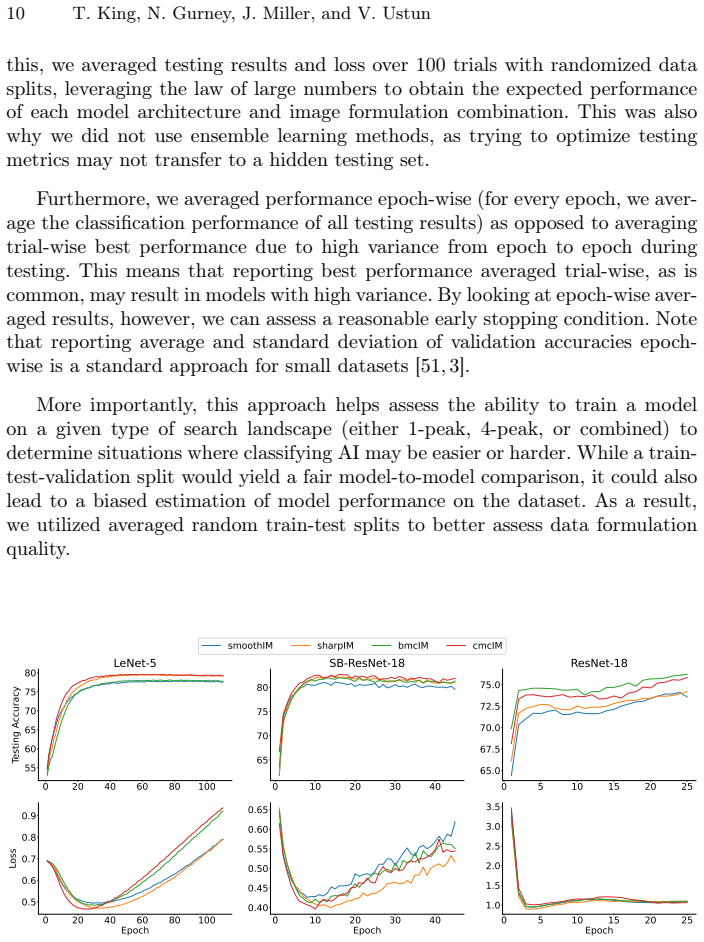
- Smaller, appropriately parameterized models (LeNet-5, SB-ResNet-18) outperform larger ResNet-18 on this small dataset, suggesting overparameterization hurts when data are limited.
- The method does not need to know how the AI assistant works, only how humans search, so it may transfer to new assistants that behave differently.
Reading between the lines
- A natural extension would be to test whether the model can detect AI assistance on a different set of task environments (different peaks, different reward structures) to see whether the learned explore/exploit signals generalize, which the paper does not directly test.
- If participant identity is leaked in the random split (as suspected), the reported accuracy may be optimistic for deployment with new users; a stratified split would reveal this.
- The explore/exploit encoding may also serve as a human-interpretable feature for other AI-assistance detection problems, such as medical diagnosis or autonomous driving, where sequential decisions are recorded.
Editorial analysis
A structured set of objections, weighed in public.
Referee Report
Summary. The paper addresses the problem of detecting whether a person received AI assistance while performing an abstract complex task (a two-dial search over procedurally generated landscapes). The authors convert each participant's trial into several 24×24 image encodings (sharp, smooth, basic multi-channel, and complex multi-channel) plus a supplemental time series encoding exploration/exploitation states, and they benchmark LeNet-5, ResNet-18, and a single-block ResNet-18 variant, optionally augmented with an LSTM. Using a dataset of 398 participants, each completing two solo and two AI-assisted trials, the best configuration (SB-ResNet-18 with LSTM on the cmcIM formulation) is reported to reach 86.64% test accuracy, averaged over 100 random 80/20 splits. The central claim is that AI assistance can be detected in abstract task data from behavior traces alone, without knowledge of the AI's internal algorithm.
Significance. If the reported accuracy were obtained under a clean evaluation protocol, the paper would provide a valuable demonstration that off-the-shelf deep networks can detect AI assistance in abstract, non-textual tasks, an understudied problem relative to LLM-text detection. The paper's strengths include the use of real human-subject data, a systematic comparison of several image encodings and architectures, and the explicit encoding of exploration/exploitation features that could transfer to other tasks. However, the headline result is not yet credible because the evaluation protocol allows participant identity to leak across train and test splits and because model selection is performed on the full dataset before the final evaluation. The paper's practical significance therefore depends on whether the authors can re-establish the result under participant-stratified, selection-free evaluation.
major comments (3)
- [Section 5 and Section 6.2] The evaluation uses a random 80/20 dataset split without any stated stratification by participant. With 398 participants each contributing four trials, a trial-level split places the same participant's trials in both the training and test sets. The model can then exploit person-specific behavioral signatures from the training trials to classify that participant's held-out trials, so the reported 86.64% accuracy (Section 6.2) does not measure detection for previously unseen individuals. The authors should replace this with a participant-stratified split or leave-one-participant-out cross-validation, and report accuracy separately for held-out participants.
- [Section 6.1] Hyperparameter selection is performed on the full dataset before the final 100 random 80/20 runs. Specifically, the grid search uses 10-fold cross-validation across each hyperparameter combination on the entire dataset, and only afterward are the chosen hyperparameters retested over 100 random splits. Because the final test trials are a subset of the data used for model selection, the reported test accuracy is an optimistic estimate that is not independent of the tuning process. A nested cross-validation or a strict three-way split (training, validation, and a test set not touched during any selection) is needed to support the central claim.
- [Table 2 and Table 3] The best-performing configuration is selected as the maximum over a grid of image formulations, architectures, and datasets (Table 2), and then only that configuration's tuned accuracy is reported in Table 3 without accounting for the selection process. This 'select the best then report its performance' protocol on the same data further inflates the apparent accuracy. The authors should report the full distribution of results across all combinations and present the final accuracy as a held-out evaluation of a pre-specified model, or apply an appropriate multiple-comparisons correction.
minor comments (7)
- [Section 4.1] The text refers to 'slip connections'; this should be 'skip connections'.
- [Section 4.1] The sentence 'The complete architecture can be seen in Figure 1' appears to be a cross-reference error; the architecture is depicted in Figure 2.
- [Section 6] The phrase 'unturned results' should be 'untuned results'.
- [Section 1] The introduction contains the phrase 'how humans perform tradeoffs between exploitation and exploitation'; this should read 'exploration and exploitation'.
- [Section 4.2] The normalization scheme applied 'across each channel' is not described; the authors should specify the exact normalization procedure so the preprocessing is reproducible.
- [Section 5] The description of reported accuracy is ambiguous: the text mentions both a 'best single trial' and a '100 trial average (which was averaged epoch-wise)', but it is not clear which quantity is reported in Tables 2 and 3.
- [General] No data or code availability statement is provided, which limits reproducibility of the reported experiments.
Circularity Check
No circular derivation: the classification result is an empirical benchmark, not a quantity defined by its own inputs.
full rationale
This is an empirical supervised-learning study, not a derivation. The target label (AI assistance vs. solo) comes from the experimental design of the prior data collection [14-16]; the features (height maps, visited nodes, explore/exploit encodings) are defined from behavioral movement and landscape geometry independently of that label. The central claim in Section 6.2 reports measured held-out accuracy of a trained classifier; nothing in the pipeline defines the label as the model output or fits a parameter that is then renamed a prediction. The citations to the authors' own prior work [14-16] supply the dataset and the AI assistant's simulated-annealing description, but they are not invoked as a proof or uniqueness theorem; the classification performance is computed from the data, and the data consists of externally collected behavioral trials. The exploration/exploitation encoding is borrowed from the original work's definitions, but using a feature definition from prior work is not circular. The evaluation does have a genuine methodological weakness: random 80/20 trial splits (Section 5) and 10-fold CV-based hyperparameter selection (Section 6.1) can leak participant identity, so the 86.64% figure may overstate generalization to unseen participants. That is a correctness and generalization concern, not circular reasoning. No step in the paper reduces to its own input by construction, and the self-citations are not load-bearing in the argument that the models detect AI assistance.
Assumptions & free parameters
free parameters (4)
- Tail exclusion threshold =
2.5% from each tail
- Exploration/exploitation Manhattan distance threshold =
<=2 exploit, >=3 explore
- Hyperparameters (learning rate, weight decay, LR scheduler, LSTM dropout) =
LR 1e-3 or 1e-4 depending on model; weight decay 0 or 5e-6; scheduler toggle; dropout 0-0.9
- Number of channels in image formulations =
1, 3, 5
assumptions (4)
- domain assumption The ground-truth labels (solo vs AI-assisted) are correct and the only difference between conditions is the presence of the AI helper.
- domain assumption Random trial-level 80/20 splits yield training and test sets that are statistically independent.
- domain assumption The AI assistant's simulated-annealing behavior is representative of AI assistance in general.
- domain assumption The preprocessed image channels (height, visited, explore/exploit) preserve the information needed for classification and do not introduce artifacts.
Cite this review
Pith. "Pith review of Detecting AI Assistance in Abstract Complex Tasks." pith.science (2026). https://pith.science/paper/ASBUSAKS
@misc{pith2026250710761,
  author       = {Pith},
  title        = {Pith review of: Detecting AI Assistance in Abstract Complex Tasks},
  year         = {2026},
  howpublished = {\url{https://pith.science/paper/ASBUSAKS}},
  note         = {Machine review of arXiv:2507.10761}
}
read the original abstract
Detecting assistance from artificial intelligence is increasingly important as they become ubiquitous across complex tasks such as text generation, medical diagnosis, and autonomous driving. Aid detection is challenging for humans, especially when looking at abstract task data. Artificial neural networks excel at classification thanks to their ability to quickly learn from and process large amounts of data -- assuming appropriate preprocessing. We posit detecting help from AI as a classification task for such models. Much of the research in this space examines the classification of complex but concrete data classes, such as images. Many AI assistance detection scenarios, however, result in data that is not machine learning-friendly. We demonstrate that common models can effectively classify such data when it is appropriately preprocessed. To do so, we construct four distinct neural network-friendly image formulations along with an additional time-series formulation that explicitly encodes the exploration/exploitation of users, which allows for generalizability to other abstract tasks. We benchmark the quality of each image formulation across three classical deep learning architectures, along with a parallel CNN-RNN architecture that leverages the additional time series to maximize testing performance, showcasing the importance of encoding temporal and spatial quantities for detecting AI aid in abstract tasks.
Figures


Reference graph
Works this paper leans on
-
[1]
Proceedings of the National Academy of Sciences116(32), 15849–15854 (2019)
Belkin, M., Hsu, D., Ma, S., Mandal, S.: Reconciling modern machine-learning practice and the classical bias–variance trade- off. Proceedings of the National Academy of Sciences116(32), 15849–15854 (2019). https://doi.org/10.1073/pnas.1903070116, https://www.pnas.org/doi/abs/10.1073/pnas.1903070116
-
[2]
Organization Science25(1), 93–108 (2014)
Billinger, S., Stieglitz, N., Schumacher, T.R.: Search on rugged landscapes: An experimental study. Organization Science25(1), 93–108 (2014)
work page 2014
-
[3]
Cai, T., Luo, S., Xu, K., He, D., Liu, T.Y., Wang, L.: Graphnorm: A principled approach to accelerating graph neural network training (2021)
work page 2021
-
[4]
Campbell,M.,HoaneJr,A.J.,Hsu,F.h.:Deepblue.Artificialintelligence134(1-2), 57–83 (2002)
work page 2002
-
[5]
Information & Communications Technology Law26(1), 32–45 (2017)
Collingwood, L.: Privacy implications and liability issues of autonomous vehicles. Information & Communications Technology Law26(1), 32–45 (2017)
work page 2017
-
[6]
Innovations in Education and Teaching In- ternational pp
Cotton, D.R., Cotton, P.A., Shipway, J.R.: Chatting and cheating: Ensuring aca- demic integrity in the era of chatgpt. Innovations in Education and Teaching In- ternational pp. 1–12 (2023)
work page 2023
-
[7]
Nature614(7947), 224–226 (2023)
van Dis, E.A., Bollen, J., Zuidema, W., van Rooij, R., Bockting, C.L.: Chatgpt: five priorities for research. Nature614(7947), 224–226 (2023)
work page 2023
-
[8]
Ezen-Can, A.: A comparison of lstm and bert for small corpus (2020) Detecting AI Assistance in Abstract Complex Tasks 15
work page 2020
Show all 54 references
-
[9]
Department of Distance Education, Open Education Faculty, Anadolu Unive (2023)
Firat, M.: How chat gpt can transform autodidactic experiences and open educa- tion. Department of Distance Education, Open Education Faculty, Anadolu Unive (2023)
2023
-
[10]
Minds and Machines30, 681–694 (2020)
Floridi, L., Chiriatti, M.: Gpt-3: Its nature, scope, limits, and consequences. Minds and Machines30, 681–694 (2020)
2020
-
[11]
batch normalization: an empirical study of their impact to deep learning
Garbin, C., Zhu, X., Marques, O.: Dropout vs. batch normalization: an empirical study of their impact to deep learning. Multimedia Tools and Applications79, 1–39 (05 2020). https://doi.org/10.1007/s11042-019-08453-9
2020 doi
-
[12]
George Philipp, Dawn Song, J.G.C.: Gradients explode - deep networks are shallow - resnet explained (2018), https://openreview.net/forum?id=HkpYwMZRb
2018
-
[13]
MIT Press (2016), http://www.deeplearningbook.org
Goodfellow, I., Bengio, Y., Courville, A.: Deep Learning. MIT Press (2016), http://www.deeplearningbook.org
2016
-
[14]
In: HCI International 2022–Late Breaking Posters: 24th International Con- ference on Human-Computer Interaction, HCII 2022, Virtual Event, June 26–July 1, 2022, Proceedings, Part I
Gurney, N., King, T., Miller, J.H.: An experimental method for studying complex choices. In: HCI International 2022–Late Breaking Posters: 24th International Con- ference on Human-Computer Interaction, HCII 2022, Virtual Event, June 26–July 1, 2022, Proceedings, Part I. pp. 39...
2022
-
[15]
PREPRINT (Version 1) available at Research Square (2023)
Gurney, N., Miller, J., Pynadath, D.: The role of heuristics and biases in complex choices. PREPRINT (Version 1) available at Research Square (2023). https://doi.org/10.21203/rs.3.rs-2472194/v1
2023 doi
-
[16]
Pro- ceedings of the AAAI Conference on Artificial Intelligence37(5), 5993–6001 (Jun 2023)
Gurney, N., Miller, J.H., Pynadath, D.V.: The role of heuris- tics and biases during complex choices with an ai teammate. Pro- ceedings of the AAAI Conference on Artificial Intelligence37(5), 5993–6001 (Jun 2023). https://doi.org/10.1609/aaai.v37i5.25741, https://ojs.aaai.org/...
2023 doi
-
[17]
Nature medicine25(1), 65–69 (2019)
Hannun, A.Y., Rajpurkar, P., Haghpanahi, M., Tison, G.H., Bourn, C., Turakhia, M.P., Ng, A.Y.: Cardiologist-level arrhythmia detection and classification in am- bulatory electrocardiograms using a deep neural network. Nature medicine25(1), 65–69 (2019)
2019
- [18]
-
[19]
Neural Computation 9(8), 1735–1780 (1997)
Hochreiter, S., Schmidhuber, J.: Long short-term memory. Neural Computation 9(8), 1735–1780 (1997). https://doi.org/10.1162/neco.1997.9.8.1735
1997 doi
-
[20]
Available at SSRN 4389233 (2023)
Katz, D.M., Bommarito, M.J., Gao, S., Arredondo, P.: Gpt-4 passes the bar exam. Available at SSRN 4389233 (2023)
2023
- [21]
-
[22]
CoRRabs/2005.11074(2020), https://arxiv.org/abs/2005.11074
Kyriakides, G., Margaritis, K.G.: An introduction to neural architec- ture search for convolutional networks. CoRRabs/2005.11074(2020), https://arxiv.org/abs/2005.11074
2020 arXiv
-
[23]
Proceedings of the IEEE86(11), 2278–2324 (1998)
Lecun, Y., Bottou, L., Bengio, Y., Haffner, P.: Gradient-based learning applied to document recognition. Proceedings of the IEEE86(11), 2278–2324 (1998). https://doi.org/10.1109/5.726791
1998 doi
-
[24]
Artificial Intelligence304, 103653 (2022)
Leonardos, S., Piliouras, G.: Exploration-exploitation in multi-agent learning: Catastrophe theory meets game theory. Artificial Intelligence304, 103653 (2022)
2022
-
[25]
Li, H., Xu, Z., Taylor, G., Studer, C., Goldstein, T.: Visualizing the loss landscape of neural nets (2018)
2018
-
[26]
Advances in Neural Information Processing Systems32(2019) 16 T
Li, Y., Wei, C., Ma, T.: Towards explaining the regularization effect of initial large learning rate in training neural networks. Advances in Neural Information Processing Systems32(2019) 16 T. King, N. Gurney, J. Miller, and V. Ustun
2019
-
[27]
arXiv preprint arXiv:2301.11305 (2023)
Mitchell, E., Lee, Y., Khazatsky, A., Manning, C.D., Finn, C.: Detectgpt: Zero- shot machine-generated text detection using probability curvature. arXiv preprint arXiv:2301.11305 (2023)
2023 arXiv
-
[28]
Murthy, R., Heinecke, S., Niebles, J.C., Liu, Z., Xue, L., Yao, W., Feng, Y., Chen, Z., Gokul, A., Arpit, D., Xu, R., Mui, P., Wang, H., Xiong, C., Savarese, S.: Rex: Rapid exploration and exploitation for ai agents (2024)
2024
-
[29]
CoRRabs/1912.02292 (2019), http://arxiv.org/abs/1912.02292
Nakkiran, P., Kaplun, G., Bansal, Y., Yang, T., Barak, B., Sutskever, I.: Deep double descent: Where bigger models and more data hurt. CoRRabs/1912.02292 (2019), http://arxiv.org/abs/1912.02292
2019 arXiv
-
[30]
agents” or “tools
Nishihata, C., Kobayashi, H., Yasuda, T.: Human-like “agents” or “tools”?: Exploring the implicature-of-quantity in hai. In: Proceed- ings of the 11th International Conference on Human-Agent Inter- action. p. 387–389. HAI ’23, Association for Computing Machinery, New York, NY,...
2023
-
[31]
arXiv preprint arXiv:2303.13375 (2023)
Nori, H., King, N., McKinney, S.M., Carignan, D., Horvitz, E.: Capabilities of gpt-4 on medical challenge problems. arXiv preprint arXiv:2303.13375 (2023)
2023 arXiv
-
[32]
Olah, C.: Understanding lstm networks (2015)
2015
-
[33]
Paszke, A., Gross, S., Massa, F., Lerer, A., Bradbury, J., Chanan, G., Killeen, T., Lin, Z., Gimelshein, N., Antiga, L., Desmaison, A., Köpf, A., Yang, E., DeVito, Z., Raison, M., Tejani, A., Chilamkurthy, S., Steiner, B., Fang, L., Bai, J., Chintala, S.: Pytorch: An imperativ...
2019
-
[34]
In: Proceedings of the 10th International Conference on Human- Agent Interaction
Patil, G., Bagala, P., Nalepka, P., Kallen, R.W., Richardson, M.J.: Eval- uating human-artificial agent decision congruence in a coordinated action task. In: Proceedings of the 10th International Conference on Human- Agent Interaction. p. 327–329. HAI ’22, Association for Comp...
2022
-
[35]
Humanities and Social Sciences Communications9(1) (Feb 2022)
Ponti, M., Seredko, A.: Human-machine-learning integration and task allocation in citizen science. Humanities and Social Sciences Communications9(1) (Feb 2022). https://doi.org/10.1057/s41599-022-01049-z, https://doi.org/10.1057/s41599-022- 01049-z
2022 doi
-
[36]
Neural Computation29(9), 2352–2449 (2017)
Rawat, W., Wang, Z.: Deep convolutional neural networks for image classifi- cation: A comprehensive review. Neural Computation29(9), 2352–2449 (2017). https://doi.org/10.1162/neco_a_00990
2017 doi
-
[37]
In: Proceedings of the 2022 Conference of the North American Chapter of the Association for Computational Linguistics: Human Language Technologies
Rodriguez,J.,Hay,T.,Gros,D.,Shamsi,Z.,Srinivasan,R.:Cross-domaindetection of gpt-2-generated technical text. In: Proceedings of the 2022 Conference of the North American Chapter of the Association for Computational Linguistics: Human Language Technologies. pp. 1213–1233 (2022)
2022
-
[38]
Nature588(7839), 604–609 (2020)
Schrittwieser, J., Antonoglou, I., Hubert, T., Simonyan, K., Sifre, L., Schmitt, S., Guez, A., Lockhart, E., Hassabis, D., Graepel, T., et al.: Mastering atari, go, chess and shogi by planning with a learned model. Nature588(7839), 604–609 (2020)
2020
-
[39]
Shamir, O.: Are resnets provably better than linear predictors? (2018)
2018
-
[40]
nature529(7587), 484–489 (2016)
Silver, D., Huang, A., Maddison, C.J., Guez, A., Sifre, L., Van Den Driessche, G., Schrittwieser, J., Antonoglou, I., Panneershelvam, V., Lanctot, M., et al.: Master- ing the game of go with deep neural networks and tree search. nature529(7587), 484–489 (2016)
2016
-
[41]
nature550(7676), 354–359 (2017) Detecting AI Assistance in Abstract Complex Tasks 17
Silver, D., Schrittwieser, J., Simonyan, K., Antonoglou, I., Huang, A., Guez, A., Hubert, T., Baker, L., Lai, M., Bolton, A., et al.: Mastering the game of go without human knowledge. nature550(7676), 354–359 (2017) Detecting AI Assistance in Abstract Complex Tasks 17
2017
-
[42]
Thorp, H.H.: Chatgpt is fun, but not an author (2023)
2023
-
[43]
Mind59(236), 433 (1950)
Turing, A.: Computing machinery and intelligence-am turing. Mind59(236), 433 (1950)
1950
-
[44]
arXiv preprint arXiv:2304.01002 (2023)
Uchendu, A., Lee, J., Shen, H., Le, T., Huang, T.H., Lee, D.: Understanding indi- vidual and team-based human factors in detecting deepfake texts. arXiv preprint arXiv:2304.01002 (2023)
2023 arXiv
-
[45]
Vaswani,A.,Shazeer,N.,Parmar,N.,Uszkoreit,J.,Jones,L.,Gomez,A.N.,Kaiser, L., Polosukhin, I.: Attention is all you need (2023)
2023
-
[46]
Nature575(7782), 350–354 (2019)
Vinyals, O., Babuschkin, I., Czarnecki, W.M., Mathieu, M., Dudzik, A., Chung, J., Choi, D.H., Powell, R., Ewalds, T., Georgiev, P., et al.: Grandmaster level in starcraft ii using multi-agent reinforcement learning. Nature575(7782), 350–354 (2019)
2019
-
[47]
arXiv preprint arXiv:2211.00241 (2022)
Wang, T.T., Gleave, A., Belrose, N., Tseng, T., Miller, J., Dennis, M.D., Duan, Y., Pogrebniak, V., Levine, S., Russell, S.: Adversarial policies beat professional-level go ais. arXiv preprint arXiv:2211.00241 (2022)
2022 arXiv
-
[48]
Communications of the ACM9(1), 36–45 (1966)
Weizenbaum, J.: Eliza—a computer program for the study of natural language communication between man and machine. Communications of the ACM9(1), 36–45 (1966)
1966
-
[49]
Westbrook, C.W.: The google made me do it: the complexity of criminal liability in the age of autonomous vehicles. Mich. St. L. Rev. p. 97 (2017)
2017
-
[50]
Current opinion in behavioral sciences38, 49–56 (2021)
Wilson, R.C., Bonawitz, E., Costa, V.D., Ebitz, R.B.: Balancing exploration and exploitation with information and randomization. Current opinion in behavioral sciences38, 49–56 (2021)
2021
-
[51]
Xu, K., Hu, W., Leskovec, J., Jegelka, S.: How powerful are graph neural networks? In: International Conference on Learning Representations (2019), https://openreview.net/forum?id=ryGs6iA5Km
2019
-
[52]
Cancers 11(12), 1901 (Nov 2019)
Yao, H., Zhang, X., Zhou, X., Liu, S.: Parallel structure deep neural network using cnn and rnn with an attention mecha- nism for breast cancer histology image classification. Cancers 11(12), 1901 (Nov 2019). https://doi.org/10.3390/cancers11121901, http://dx.doi.org/10.3390/c...
1901 doi
-
[53]
Yun, C., Sra, S., Jadbabaie, A.: Are deep resnets provably better than linear pre- dictors? CoRRabs/1907.03922(2019), http://arxiv.org/abs/1907.03922
2019 arXiv
-
[54]
Zhang, J., Karimireddy, S.P., Veit, A., Kim, S., Reddi, S.J., Kumar, S., Sra, S.: Why {adam} beats {sgd} for attention models (2020), https://openreview.net/forum?id=SJx37TEtDH
2020
Reviewed August 6, 2026 · model on record in the stance chip above.
Discussion (0). Sign in to comment.