REVIEW 5 major objections 5 minor 50 references
FPC-Net: Revisiting SuperPoint with Descriptor-Free Keypoint Detection via Feature Pyramids and Consistency-Based Implicit Matching
T0 review · 5 major / 5 minor · reviewed 2026-08-06 · deepseek-v4-flash
Pith's one-line read A new detector, FPC-Net, matches keypoints across views using only their positions, dropping descriptor computation, storage, and comparison.
desk verdict A credible lightweight keypoint detector undermined by overclaimed descriptor-free matching; coordinate-NN only works for small baselines, as the paper's own viewpoint results show. read the letter →
The pith
A machine-rendered reading of the paper's core claim, the machinery that carries it, and where it could break.
The reading
What carries the argument
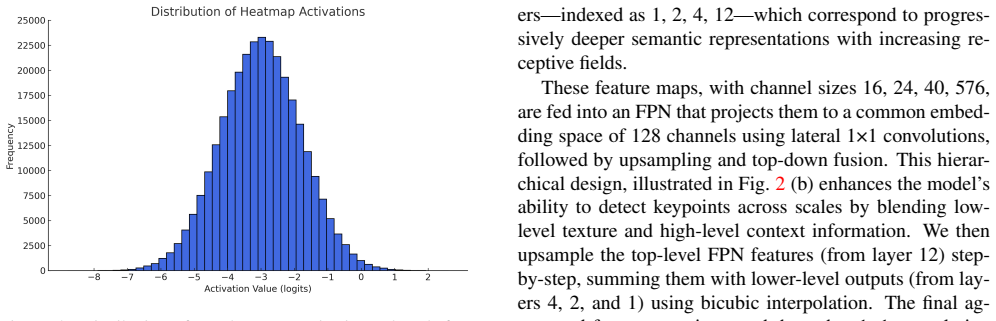
The central machinery is the descriptor-free heatmap produced by a MobileNetV3-Small backbone augmented with a Feature Pyramid Network. The heatmap is the only output: it encodes both where keypoints are and, through its consistency across warps, what corresponds to what. The training machinery is a two-stage distillation: stage one supervises the heatmap with SuperPoint pseudo-labels using focal loss; stage two adds a consistency loss (Huber regression or KL-divergence classification) that aligns the heatmap of a warped image with that of the original, where the alignment targets are Gaussian-smoothed masks derived from LightGlue correspondences. Matching at inference is nearest neighbor in image coordinates, so the identity of a keypoint is carried entirely by its spatial activation pattern.
What would settle it
Run FPC-Net on image pairs with large viewpoint change (for example the viewpoint sequences of HPatches) and compare homography accuracy at an 8-pixel error threshold against descriptor-based methods; if the accuracy gap is large (the paper reports 0.70 for FPC-Net versus 0.89 for SIFT and SuperPoint at that threshold), then the method has not replaced the role of descriptors in the regime where they matter most.
Extended reading notes
Core claim
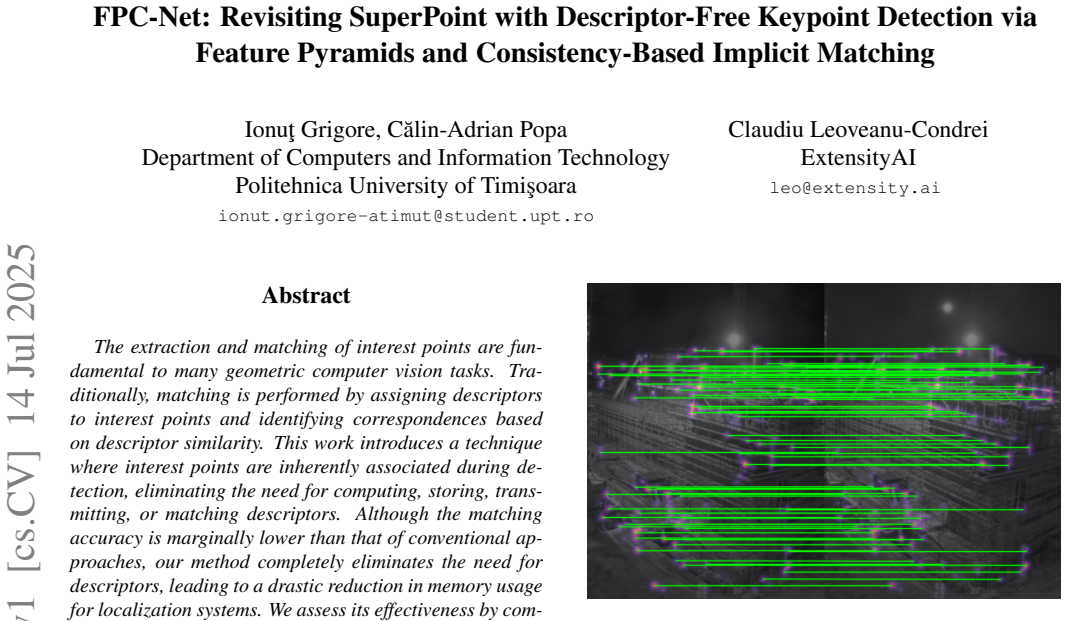
The central claim is that descriptors are not a necessary ingredient of a matching pipeline. FPC-Net learns a single-channel heatmap in which keypoints of the same physical location produce matching activation peaks across views; the training forces this consistency explicitly through a two-stage procedure. In the first stage the detector imitates SuperPoint's keypoint labels under a sigmoid focal loss; in the second stage it minimizes a consistency loss between the heatmap of an image and the heatmap of its homographic warp, using LightGlue-matched keypoints blurred into Gaussian target masks so that small spatial deviations are tolerated. At inference, keypoints are thresholded peaks of the heatmap and matched between frames purely by coordinate proximity, followed by RANSAC for homography or pose estimation. The paper reports that this descriptor-free scheme achieves repeatability on HPatches comparable to or higher than SuperPoint, FAST, Harris, and Shi, and homography estimation accuracy on par with SIFT and ORB at a small fraction of the runtime and zero descriptor storage.
Load-bearing premise
Matching by nearest neighbor in image coordinates is a sound replacement for descriptor matching; this only holds when the viewpoint change between the two images is small.
Editorial extensions
If this is right
- Localization systems can drop descriptor storage and transmission entirely; the paper's homography experiments use zero descriptor bytes per pair versus hundreds of megabytes for descriptor-based baselines.
- Keypoint matching reduces to a coordinate search followed by RANSAC, making the matching stage substantially faster than descriptor comparison and nearest-neighbor matching.
- The two-stage recipe (teacher keypoints first, consistency loss from a matcher second) can be applied to other lightweight backbones to make them descriptor-free.
- Pose estimation from a small number of keypoints (fewer than 30) is reported to remain accurate, suggesting the method is usable in low-texture or resource-constrained settings.
- The detector's heatmap output is a general representation that the authors suggest could be extended to other primitives such as lines or shapes.
Reading between the lines
- Editorial inference: The paper's matching rule is nearest neighbor in image coordinates, so the descriptor-free advantage is most credible when viewpoint change is small; the paper's own HPatches viewpoint numbers (0.70 at eps=8) trail SIFT and SuperPoint (0.89), suggesting the method as presented is best suited to sequential-frame settings like odometry rather than wide-baseline localization.
- Editorial inference: The consistency supervision is generated by LightGlue, a descriptor-based matcher; in effect the method distills descriptor-based correspondence knowledge into a descriptor-free representation rather than discovering correspondence from data alone, so the quality ceiling of the student is partly inherited from the teacher matcher.
- Editorial inference: A testable extension would be to replace the coordinate-nearest-neighbor greediness with a lightweight learned spatial verification layer, which could recover much of the viewpoint gap while still avoiding full descriptors.
Editorial analysis
A structured set of objections, weighed in public.
Referee Report
Summary. The paper proposes FPC-Net, a lightweight keypoint detector trained in two stages with SuperPoint pseudo-labels and LightGlue-derived consistency masks, using a MobileNetV3-Small backbone with an FPN and a single-channel heatmap output. At inference, keypoints are extracted by quantile thresholding and matched between image pairs by nearest-neighbor search in image coordinates, eliminating descriptors. Experiments report HPatches repeatability and homography estimation, plus KITTI/EuRoC pose comparisons, and the paper claims descriptor-free matching with accuracy comparable to or better than descriptor-based methods while drastically reducing memory usage.
Significance. If the central claims held, the proposal would offer a practical memory-computation trade-off for localization systems, and the lightweight architecture (8 ms per pair) plus code release would be useful contributions. The training design is reasonable and the paper is generally readable. However, the current evidence does not support the stated scope: the repeatability metric is non-standard, the homography table contradicts the text's accuracy claims, and the inference-time matching rule degenerates under viewpoint change, which is exactly the regime where descriptors matter most.
major comments (5)
- [§4.1, Eq. (5)] The repeatability definition in Eq. (5) compares raw keypoint coordinates p_m and q_n directly, with no application of the ground-truth homography that maps one image onto the other. The text says repeatability measures points that 'also appear in the corresponding warped image,' but the formula never applies the warp. Standard HPatches repeatability warps one keypoint set into the other image's frame before the nearest-neighbor comparison; without this, the metric measures coordinate stability rather than re-detection under viewpoint, which can inflate scores for any detector that fires at similar image locations. The evaluation must be recomputed with the homography applied.
- [§4.2, Table 2] The conclusion in §4.2 that 'FPC-Net achieves better accuracy and reliability' is directly contradicted by Table 2: on the full set at eps=8, FPC-Net scores 0.84 versus SuperPoint's 0.93 and SIFT's 0.89; on the viewpoint split at eps=8, FPC-Net scores 0.70 versus 0.89 for both SuperPoint and SIFT; at eps=3 on viewpoint, 0.60 versus 0.74. The paper should report these numbers accurately and temper or remove this claim.
- [§4.2, matching mechanism] Descriptor-free matching is implemented as nearest-neighbor search in image coordinates. This is a valid correspondence rule only when corresponding points project to nearly identical pixel locations, i.e., small baseline or a known pose prior. The paper's own viewpoint results in Table 2 quantify the failure of this assumption: on the HPatches viewpoint split, FPC-Net drops to 0.70 (eps=8) and 0.60 (eps=3), versus 0.89 and 0.74 for SIFT. The central claim of replacing descriptor matching is therefore only supported for small baselines; the paper must either introduce a viewpoint-tolerant matching rule or explicitly scope the claim to the small-baseline regime.
- [Table 2, Size column] The reported descriptor sizes are implausible and appear to contain a units error. For example, SIFT at 307.2 MB per pair would imply roughly 300,000 keypoints with 128-dimensional float descriptors, which is inconsistent with the evaluation setup (300 keypoints per image noted in §4.1). Similarly, SuperPoint at 614 MB per pair is not credible. The authors should specify exactly how these numbers were computed, including the number of keypoints used, and report sizes in consistent units; as written, the memory-reduction claim rests on an unreliable comparison.
- [§4.3 and pair-selection procedure] The pose-estimation evidence is too weak to support the paper's general claims. Only FPC-Net versus SIFT is compared, no error bars or repeated-run statistics are provided, and the KITTI/EuRoC pair construction uses KLT tracking with alpha=0.5 to enforce a minimum 50% overlap, which biases the evaluation toward small baselines. This is precisely the regime where coordinate nearest-neighbor matching can succeed. The authors should add aggregate pose-error tables, statistical variability, and at least one descriptor-based baseline under the same pair-selection protocol.
minor comments (5)
- [§3, Eq. (2)-(3)] The notation in the consistency losses is unclear: p and p' are described as predictions for original and warped images, and H and H^{-1} are used, but it is not explicitly stated which prediction is associated with which mask (m or m'), nor how the validity mask is applied in the equations.
- [§3, two-stage training] The paper experiments with both a regression (Huber) and a classification (KL) consistency loss, but no ablation or selection criterion is reported for choosing between them; the final method should state which variant is used and why.
- [Abstract and §5] The abstract's phrase 'matching accuracy is marginally lower' is not supported by the numbers in Table 2, where the gap at eps=8 on the full set is 0.09 (0.84 vs 0.93 for SuperPoint); the conclusion should quote the actual differences.
- [References] Reference [30] lists the year as '1912'; this should be corrected to the actual publication year of the PyTorch paper.
- [Fig. 3] The figure caption says 'number of matched keypoints' but the evaluation uses inlier correspondences after RANSAC; please clarify whether the x-axis is inliers, total matches, or something else.
Circularity Check
Descriptor-free 'implicit matching' is coordinate nearest-neighbor, the same operation as the repeatability metric; the core claim is a renaming, not a learned association.
-
renaming known result
[Section 4.2 (Homography Estimation Accuracy); cf. Eq. (4)-(5), Section 4.1; Abstract; Conclusions]
"This work introduces a technique where interest points are inherently associated during detection, eliminating the need for computing, storing, transmitting, or matching descriptors. ... We then perform descriptor-free matching by comparing the spatial proximity of detected points. Specifically, we match keypoints between image pairs based on nearest neighbor search in image coordinates."
The claimed 'inherent association during detection' is not realized by any learned cross-image mechanism: the matching rule in Sec. 4.2 is nearest-neighbor search in raw image coordinates, which is exactly the same coordinate-proximity operation used to define Repeatability in Eq. (4)-(5) (Match(p_m)=1 iff min_n ||p_m - q_n|| <= eps). Thus the headline 'descriptor-free implicit matching' is, by the paper's own equations, a restatement of coordinate repeatability under a different name: the matching result is the same quantity as the repeatability score.
full rationale
The paper's central numeric results are not circular in the fitted-input sense: the student detector is supervised by external SuperPoint pseudo-labels and LightGlue matches, and evaluation on HPatches/KITTI/EuRoC uses fixed benchmarks with external baselines. There are no self-citations, no author-imported uniqueness theorems, and no parameters fitted to the test set and then reported as predictions. The only identifiable circularity-adjacent step is the conceptual one: 'implicit matching' is implemented as nearest-neighbor search in image coordinates, which is identical to the raw-coordinate repeatability metric of Eq. (5). Hence the claim that matching is 'inherently associated during detection' is a renaming of repeatable co-location rather than a demonstrated learned correspondence. This does not invalidate the detector's independent external performance, but it does mean the descriptor-free matching claim should be read as small-baseline coordinate matching, especially since the paper's own Table 2 shows a large accuracy drop under viewpoint change (eps=8, v: 0.70 vs 0.89 for SIFT and SuperPoint).
Assumptions & free parameters
free parameters (4)
- consistency loss weight =
not reported
- Gaussian sigma for target masks =
not reported
- quantile threshold for keypoint extraction =
not reported
- keypoint count / NMS settings in homography and pose tests =
not reported
assumptions (4)
- domain assumption SuperPoint keypoints are reliable pseudo-ground-truth for keypoint detection.
- domain assumption LightGlue matches on MS-COCO provide correct correspondences for consistency supervision.
- domain assumption Homography warping and consistency training transfer to unseen viewpoint changes.
- standard math The HPatches repeatability protocol is applied with the homography warp implicit in Eq (4).
Cite this review
Pith. "Pith review of FPC-Net: Revisiting SuperPoint with Descriptor-Free Keypoint Detection via Feature Pyramids and Consistency-Based Implicit Matching." pith.science (2026). https://pith.science/paper/S6MG7KXR
@misc{pith2026250710770,
  author       = {Pith},
  title        = {Pith review of: FPC-Net: Revisiting SuperPoint with Descriptor-Free Keypoint Detection via Feature Pyramids and Consistency-Based Implicit Matching},
  year         = {2026},
  howpublished = {\url{https://pith.science/paper/S6MG7KXR}},
  note         = {Machine review of arXiv:2507.10770}
}
read the original abstract
The extraction and matching of interest points are fundamental to many geometric computer vision tasks. Traditionally, matching is performed by assigning descriptors to interest points and identifying correspondences based on descriptor similarity. This work introduces a technique where interest points are inherently associated during detection, eliminating the need for computing, storing, transmitting, or matching descriptors. Although the matching accuracy is marginally lower than that of conventional approaches, our method completely eliminates the need for descriptors, leading to a drastic reduction in memory usage for localization systems. We assess its effectiveness by comparing it against both classical handcrafted methods and modern learned approaches.
Figures


Figures from the paper (2 more)

Reference graph
Works this paper leans on
-
[1]
Hpatches: A benchmark and evaluation of handcrafted and learned local descriptors
Vassileios Balntas, Karel Lenc, Andrea Vedaldi, and Krys- tian Mikolajczyk. Hpatches: A benchmark and evaluation of handcrafted and learned local descriptors. In Proceedings of the IEEE conference on computer vision and pattern recog- nition, pages 5173–5182, 2017. 4
work page 2017
-
[2]
Surf: Speeded up robust features
Herbert Bay, Tinne Tuytelaars, and Luc Van Gool. Surf: Speeded up robust features. In Computer Vision–ECCV 2006: 9th European Conference on Computer Vision, Graz, Austria, May 7-13, 2006. Proceedings, Part I 9, pages 404–
work page 2006
-
[3]
The euroc micro aerial vehicle datasets
Michael Burri, Janosch Nikolic, Pascal Gohl, Thomas Schneider, Joern Rehder, Sammy Omari, Markus W Achte- lik, and Roland Siegwart. The euroc micro aerial vehicle datasets. The International Journal of Robotics Research , 35(10):1157–1163, 2016. 4
work page 2016
-
[4]
Albumentations: fast and flexible image augmenta- tions
Alexander Buslaev, Vladimir I Iglovikov, Eugene Khved- chenya, Alex Parinov, Mikhail Druzhinin, and Alexandr A Kalinin. Albumentations: fast and flexible image augmenta- tions. Information, 11(2):125, 2020. 7
work page 2020
-
[5]
Brief: Computing a local binary descriptor very fast
Michael Calonder, Vincent Lepetit, Mustafa Ozuysal, Tomasz Trzcinski, Christoph Strecha, and Pascal Fua. Brief: Computing a local binary descriptor very fast. IEEE transactions on pattern analysis and machine intelligence , 34(7):1281–1298, 2011. 2
work page 2011
-
[6]
Aspanformer: Detector-free image matching with adaptive span transformer
Hongkai Chen, Zixin Luo, Lei Zhou, Yurun Tian, Ming- min Zhen, Tian Fang, David Mckinnon, Yanghai Tsin, and Long Quan. Aspanformer: Detector-free image matching with adaptive span transformer. In European Conference on Computer Vision, pages 20–36. Springer, 2022. 2
work page 2022
-
[7]
Universal correspondence network
Christopher B Choy, JunYoung Gwak, Silvio Savarese, and Manmohan Chandraker. Universal correspondence network. Advances in neural information processing systems , 29,
-
[8]
Histograms of oriented gra- dients for human detection
Navneet Dalal and Bill Triggs. Histograms of oriented gra- dients for human detection. In 2005 IEEE computer soci- ety conference on computer vision and pattern recognition (CVPR’05), volume 1, pages 886–893. Ieee, 2005. 2
work page 2005
Show all 50 references
-
[9]
Superpoint: Self-supervised interest point detection and description
Daniel DeTone, Tomasz Malisiewicz, and Andrew Rabi- novich. Superpoint: Self-supervised interest point detection and description. In Proceedings of the IEEE conference on computer vision and pattern recognition workshops , pages 224–236, 2018. 1, 2, 3
2018
-
[10]
D2- net: A trainable cnn for joint description and detection of local features
Mihai Dusmanu, Ignacio Rocco, Tomas Pajdla, Marc Polle- feys, Josef Sivic, Akihiko Torii, and Torsten Sattler. D2- net: A trainable cnn for joint description and detection of local features. In Proceedings of the ieee/cvf conference on computer vision and pattern recognition, ...
-
[11]
Two-frame motion estimation based on polynomial expansion
Gunnar Farneb ¨ack. Two-frame motion estimation based on polynomial expansion. In Image Analysis: 13th Scandina- vian Conference, SCIA 2003 Halmstad, Sweden, June 29– July 2, 2003 Proceedings 13, pages 363–370. Springer, 2003. 2
2003
-
[12]
Hierarchical metric learning and matching for 2d and 3d geometric correspon- dences
Mohammed E Fathy, Quoc-Huy Tran, M Zeeshan Zia, Paul Vernaza, and Manmohan Chandraker. Hierarchical metric learning and matching for 2d and 3d geometric correspon- dences. In Proceedings of the european conference on com- puter vision (ECCV), pages 803–819, 2018. 2
2018
-
[13]
Random sample consensus: a paradigm for model fitting with applications to image analysis and automated cartography.Communications of the ACM, 24(6):381–395, 1981
Martin A Fischler and Robert C Bolles. Random sample consensus: a paradigm for model fitting with applications to image analysis and automated cartography.Communications of the ACM, 24(6):381–395, 1981. 6
1981
-
[14]
Complete solution classification for the perspective-three-point problem
Xiao-Shan Gao, Xiao-Rong Hou, Jianliang Tang, and Hang-Fei Cheng. Complete solution classification for the perspective-three-point problem. IEEE transactions on pattern analysis and machine intelligence , 25(8):930–943,
-
[15]
Vision meets robotics: The kitti dataset
Andreas Geiger, Philip Lenz, Christoph Stiller, and Raquel Urtasun. Vision meets robotics: The kitti dataset. The in- ternational journal of robotics research, 32(11):1231–1237,
-
[16]
A combined corner and edge detector
Chris Harris, Mike Stephens, et al. A combined corner and edge detector. In Alvey vision conference, volume 15, pages 10–5244. Citeseer, 1988. 2, 5
1988
-
[17]
Determining opti- cal flow
Berthold KP Horn and Brian G Schunck. Determining opti- cal flow. Artificial intelligence, 17(1-3):185–203, 1981. 2
1981
-
[18]
Searching for mo- bilenetv3
Andrew Howard, Mark Sandler, Grace Chu, Liang-Chieh Chen, Bo Chen, Mingxing Tan, Weijun Wang, Yukun Zhu, Ruoming Pang, Vijay Vasudevan, et al. Searching for mo- bilenetv3. In Proceedings of the IEEE/CVF international conference on computer vision, pages 1314–1324, 2019. 1, 3, 7
2019
-
[19]
Learning covariant feature detectors
Karel Lenc and Andrea Vedaldi. Learning covariant feature detectors. In Computer Vision–ECCV 2016 Workshops: Am- sterdam, The Netherlands, October 8-10 and 15-16, 2016, Proceedings, Part III 14, pages 100–117. Springer, 2016. 2
2016
-
[20]
Brisk: Binary robust invariant scalable keypoints
Stefan Leutenegger, Margarita Chli, and Roland Y Siegwart. Brisk: Binary robust invariant scalable keypoints. In 2011 International conference on computer vision , pages 2548–
2011
-
[21]
Dual- resolution correspondence networks
Xinghui Li, Kai Han, Shuda Li, and Victor Prisacariu. Dual- resolution correspondence networks. Advances in Neural In- formation Processing Systems, 33:17346–17357, 2020. 2
2020
-
[22]
Feature pyra- mid networks for object detection
Tsung-Yi Lin, Piotr Doll ´ar, Ross Girshick, Kaiming He, Bharath Hariharan, and Serge Belongie. Feature pyra- mid networks for object detection. In Proceedings of the IEEE conference on computer vision and pattern recogni- tion, pages 2117–2125, 2017. 1, 3, 7
2017
-
[23]
Focal loss for dense object detection
Tsung-Yi Lin, Priya Goyal, Ross Girshick, Kaiming He, and Piotr Doll´ar. Focal loss for dense object detection. In Pro- ceedings of the IEEE international conference on computer vision, pages 2980–2988, 2017. 3
2017
-
[24]
Lightglue: Local feature matching at light speed
Philipp Lindenberger, Paul-Edouard Sarlin, and Marc Polle- feys. Lightglue: Local feature matching at light speed. In Proceedings of the IEEE/CVF International Conference on Computer Vision, pages 17627–17638, 2023. 1, 2, 4
2023
-
[25]
Distinctive image features from scale- invariant keypoints
David G Lowe. Distinctive image features from scale- invariant keypoints. International journal of computer vi- sion, 60:91–110, 2004. 1, 2, 6
2004
-
[26]
Get out of my lab: Large-scale, real-time visual-inertial localization
Simon Lynen, Torsten Sattler, Michael Bosse, Joel A Hesch, Marc Pollefeys, and Roland Siegwart. Get out of my lab: Large-scale, real-time visual-inertial localization. In Robotics: Science and Systems, volume 1, 2015. 2
2015
-
[27]
Scale & affine invariant interest point detectors
Krystian Mikolajczyk and Cordelia Schmid. Scale & affine invariant interest point detectors. International journal of computer vision, 60:63–86, 2004. 2
2004
-
[28]
Visual odometry for ground vehicle applications
David Nist ´er, Oleg Naroditsky, and James Bergen. Visual odometry for ground vehicle applications. Journal of Field Robotics, 23(1):3–20, 2006. 1
2006
-
[29]
Lf-net: Learning local features from images
Yuki Ono, Eduard Trulls, Pascal Fua, and Kwang Moo Yi. Lf-net: Learning local features from images. Advances in neural information processing systems, 31, 2018. 2
2018
-
[30]
An imperative style, high-performance deep learning library
Adam Paszke, Sam Gross, Francisco Massa, Adam Lerer, JP Bradbury, Gregory Chanan, Trevor Killeen, Zeming Lin, Na- talia Gimelshein, Luca Antiga, et al. An imperative style, high-performance deep learning library. Adv. Neural Inf. Process. Syst, 32:8026, 1912. 7
1912
-
[31]
R2d2: Reliable and repeatable detec- tor and descriptor
Jerome Revaud, Cesar De Souza, Martin Humenberger, and Philippe Weinzaepfel. R2d2: Reliable and repeatable detec- tor and descriptor. Advances in neural information process- ing systems, 32, 2019. 1, 2
2019
-
[32]
Efficient neighbourhood consensus networks via submanifold sparse convolutions
Ignacio Rocco, Relja Arandjelovi ´c, and Josef Sivic. Efficient neighbourhood consensus networks via submanifold sparse convolutions. In Computer vision–ECCV 2020: 16th Euro- pean conference, Glasgow, UK, August 23–28, 2020, pro- ceedings, part IX 16, pages 605–621. Springer, 2020. 2
2020
-
[33]
Neighbourhood con- sensus networks
Ignacio Rocco, Mircea Cimpoi, Relja Arandjelovi ´c, Akihiko Torii, Tomas Pajdla, and Josef Sivic. Neighbourhood con- sensus networks. Advances in neural information processing systems, 31, 2018. 2
2018
-
[34]
Machine learning for high-speed corner detection
Edward Rosten and Tom Drummond. Machine learning for high-speed corner detection. In Computer Vision–ECCV 2006: 9th European Conference on Computer Vision, Graz, Austria, May 7-13, 2006. Proceedings, Part I 9, pages 430–
2006
-
[35]
Orb: An efficient alternative to sift or surf
Ethan Rublee, Vincent Rabaud, Kurt Konolige, and Gary Bradski. Orb: An efficient alternative to sift or surf. In 2011 International conference on computer vision , pages 2564–
2011
-
[36]
Superglue: Learning feature matching with graph neural networks
Paul-Edouard Sarlin, Daniel DeTone, Tomasz Malisiewicz, and Andrew Rabinovich. Superglue: Learning feature matching with graph neural networks. In Proceedings of the IEEE/CVF conference on computer vision and pattern recognition, pages 4938–4947, 2020. 2
2020
-
[37]
Benchmarking 6dof outdoor visual localization in changing conditions
Torsten Sattler, Will Maddern, Carl Toft, Akihiko Torii, Lars Hammarstrand, Erik Stenborg, Daniel Safari, Masatoshi Okutomi, Marc Pollefeys, Josef Sivic, et al. Benchmarking 6dof outdoor visual localization in changing conditions. In Proceedings of the IEEE conference on compu...
2018
-
[38]
Matching neural paths: transfer from recognition to corre- spondence search
Nikolay Savinov, Lubor Ladicky, and Marc Pollefeys. Matching neural paths: transfer from recognition to corre- spondence search. Advances in Neural Information Process- ing Systems, 30, 2017. 2
2017
-
[39]
Quad-networks: unsupervised learning to rank for interest point detection
Nikolay Savinov, Akihito Seki, Lubor Ladicky, Torsten Sat- tler, and Marc Pollefeys. Quad-networks: unsupervised learning to rank for interest point detection. In Proceed- ings of the IEEE conference on computer vision and pattern recognition, pages 1822–1830, 2017. 2
2017
-
[40]
Structure- from-motion revisited
Johannes L Schonberger and Jan-Michael Frahm. Structure- from-motion revisited. In Proceedings of the IEEE con- ference on computer vision and pattern recognition , pages 4104–4113, 2016. 1
2016
-
[41]
Semantic visual localization
Johannes L Sch ¨onberger, Marc Pollefeys, Andreas Geiger, and Torsten Sattler. Semantic visual localization. InProceed- ings of the IEEE conference on computer vision and pattern recognition, pages 6896–6906, 2018. 2
2018
-
[42]
Good features to track
Jianbo Shi et al. Good features to track. In 1994 Proceedings of IEEE conference on computer vision and pattern recogni- tion, pages 593–600. IEEE, 1994. 2, 5
1994
-
[43]
Loftr: Detector-free local feature matching with transformers
Jiaming Sun, Zehong Shen, Yuang Wang, Hujun Bao, and Xiaowei Zhou. Loftr: Detector-free local feature matching with transformers. In Proceedings of the IEEE/CVF con- ference on computer vision and pattern recognition , pages 8922–8931, 2021. 2
2021
-
[44]
Inloc: Indoor visual localization with dense matching and view synthesis
Hajime Taira, Masatoshi Okutomi, Torsten Sattler, Mircea Cimpoi, Marc Pollefeys, Josef Sivic, Tomas Pajdla, and Ak- ihiko Torii. Inloc: Indoor visual localization with dense matching and view synthesis. In Proceedings of the IEEE conference on computer vision and pattern recog...
2018
-
[45]
Visual data association in narrow-bandwidth net- works
Danilo Tardioli, Eduardo Montijano, and Alejandro R Mosteo. Visual data association in narrow-bandwidth net- works. In 2015 IEEE/RSJ International Conference on Intel- ligent Robots and Systems (IROS), pages 2572–2577. IEEE,
2015
-
[46]
Matchformer: Interleaving attention in transformers for feature matching
Qing Wang, Jiaming Zhang, Kailun Yang, Kunyu Peng, and Rainer Stiefelhagen. Matchformer: Interleaving attention in transformers for feature matching. In Proceedings of the Asian Conference on Computer Vision , pages 2746–2762,
-
[47]
Lift: Learned invariant feature transform
Kwang Moo Yi, Eduard Trulls, Vincent Lepetit, and Pascal Fua. Lift: Learned invariant feature transform. In Com- puter Vision–ECCV 2016: 14th European Conference, Am- sterdam, The Netherlands, October 11-14, 2016, Proceed- ings, Part VI 14, pages 467–483. Springer, 2016. 1, 2
2016
-
[48]
Learning to detect features in texture images
Linguang Zhang and Szymon Rusinkiewicz. Learning to detect features in texture images. In Proceedings of the IEEE conference on computer vision and pattern recogni- tion, pages 6325–6333, 2018. 2
2018
-
[49]
Evaluating local features for day-night matching
Hao Zhou, Torsten Sattler, and David W Jacobs. Evaluating local features for day-night matching. In Computer Vision– ECCV 2016 Workshops: Amsterdam, The Netherlands, Oc- tober 8-10 and 15-16, 2016, Proceedings, Part III 14, pages 724–736. Springer, 2016. 2
2016
-
[443]
Springer, 2006. 2, 5
2006
Reviewed August 6, 2026 · model on record in the stance chip above.
Discussion (0). Continue with ORCID to comment.