REVIEW 3 major objections 6 minor 32 references
Uncovering Causal Relation Shifts in Event Sequences under Out-of-Domain Interventions
T0 review · 3 major / 6 minor · reviewed 2026-08-06 · deepseek-v4-flash
Pith's one-line read This paper extends average treatment effect estimation to temporal event sequences under out-of-domain interventions and claims an inverse-probability-weighted estimator that is unbiased for the intervention-conditioned effect.
desk verdict The paper names a real gap in defining intervention-conditioned ATE for event sequences, but the central IPW estimator is biased as stated and the proof of unbiasedness does not hold. read the letter →
The pith
A machine-rendered reading of the paper's core claim, the machinery that carries it, and where it could break.
The reading
What carries the argument
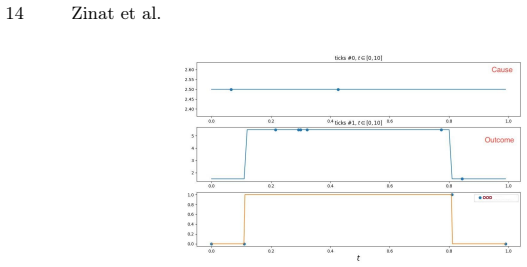
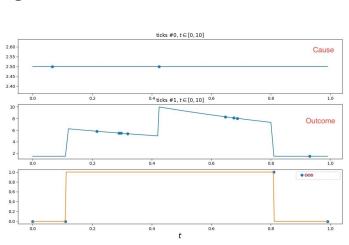
The central object is the intervention-conditioned average treatment effect $\tau(v^w_t)$, defined as the expected time-average difference between the counterfactual outcome intensity with cause present, $\lambda(1,v^w_t)(t)$, and with cause absent, $\lambda(0,v^w_t)(t)$, within a proximal time window. Carrying the argument is the propensity score $e^w_t(v)=P(c^w_t=1, v^w_t=v \mid x^w_t)$, which the paper estimates by a duration ratio of observed window states. The weight $\alpha^w_t(v)=\frac{\mathbf{1}\{c^w_t=1,v^w_t=v\}}{e^w_t(v)}-\frac{\mathbf{1}\{c^w_t=0,v^w_t=v\}}{1-e^w_t(v)}$ converts observed intensities into inverse-probability weighting, and Theorem 2 claims this adjustment cancels confounding. The neural component is a Transformer with event embeddings, trigonometric time encodings, and binary intervention encodings combined through weighted sums, followed by a CNN over basis-function weights that outputs the conditional intensity.
What would settle it
Simulate a point process with a known positive effect of cause $c$ on outcome $o$, let intervention $v$ toggle independently of $c$ so all four combinations $(c,v)\in\{0,1\}^2$ appear, and estimate $\hat{\tau}(v)$ with the paper's plug-in estimator; if the control-weight misspecification matters, the estimate's bias will fail to shrink to zero as the number of sequences grows, which would contradict Theorem 2's unbiasedness claim.
Extended reading notes
Core claim
On its own terms, the paper's central claim is that causal relation shifts induced by out-of-domain interventions are estimable from observed event sequences. It defines the intervention-conditioned average treatment effect as $\tau(v^w_t)$, comparing the conditional intensity of an outcome under cause present versus absent, within proximal windows where the out-of-domain intervention variable $v^w_t$ is fixed. The estimator reweights observed intensities by $\alpha^w_t(v)$, built from the propensity score $e^w_t(v)=P(c^w_t=1,v^w_t=v\mid x^w_t)$, and Theorem 2 asserts that under SUTVA, unconfoundedness, and overlap, $\mathbb{E}[\hat{\tau}(v)]=\tau(v)$ for both $v=0$ and $v=1$. The paper also introduces a hybrid Transformer-CNN point-process model that encodes intervention activity as part of the input and estimates the latent intensity $\lambda(t)$; experiments on simulated interventions and two real datasets, diabetes and predictive maintenance, compare favorably to a Granger-causality baseline.
Load-bearing premise
The load-bearing premise is that $1-e^w_t(v)$ correctly gives the probability of observing no cause with the same intervention, but because $e^w_t(v)$ is defined to include only the case where the cause is present, its complement also includes other combinations of cause and intervention, so the estimator's control weight is correct only if those other combinations do not occur.
Editorial extensions
If this is right
- Causal relation shifts under external interventions can be estimated from observational event logs without randomized assignment, provided the binary window model is adequate.
- The estimated $\tau(1)$ versus $\tau(0)$ comparison gives a quantitative signal for when an intervention creates, removes, or reverses a cause-outcome relationship.
- Predictive systems that fit the outcome intensity can absorb intervention information directly through the embedding, which the paper reports improves prediction error on maintenance logs and diabetes records.
- The framework offers a point-process analogue of the classical treatment-effect decomposition, with the intervention modeled as a second binary treatment rather than as effect modification.
Reading between the lines
- An unstated condition for Theorem 2 appears to be that the only possible joint states are $(c=1,v=v)$ and $(c=0,v=v)$; if other cause-intervention combinations occur, $1-e^w_t(v)$ is not the control-arm probability, and the control component of the IPW weight is mis-specified.
- Replacing the scalar propensity score with a joint propensity score over all four cells would preserve inverse-probability weighting when $c$ and $v$ toggle independently, and would be directly testable on the paper's simulated data.
- Because the estimator is a linear weighting of estimated intensities, the main practical bottleneck is accurate propensity-score estimation; the paper's duration-ratio estimator assumes covariates and windows are stable enough for that ratio to be a good probability.
- The reported real-data gains over a Granger-causality baseline are likely to reflect both the causal framing and the intervention-aware architecture; a controlled ablation that removes only the intervention embedding would separate the two sources.
Signed reviews
Editorial analysis
A structured set of objections, weighed in public.
Referee Report
Summary. The manuscript proposes a causal framework for temporal point processes in which an exogenous "out-of-domain" intervention v can shift the causal effect of a cause event c on an outcome event o. The authors define an intervention-conditioned average treatment effect τ(v), introduce a propensity-score-based inverse probability weighting (IPW) estimator, and prove unbiasedness in Theorem 2 under SUTVA, unconfoundedness, and overlap. They then design a Transformer-CNN model to estimate the conditional intensity function and validate the approach on simulated Hawkes processes and on predictive-maintenance and diabetes datasets. The central theoretical result is Theorem 2, which claims E[τ̂(v)] = τ(v) for v ∈ {0,1} using the weight α_t(v) = 1{c=1,v=v}/e_t(v) − 1{c=0,v=v}/(1−e_t(v)), where e_t(v) = P(c_t=1, v_t=v | x_t).
Significance. If Theorem 2 were correct, the paper would address a genuine gap: existing causal point-process work focuses on causal effects within a fixed domain and does not model how exogenous interventions modify cause–outcome relations. The paper also contributes a concrete neural architecture and extensive simulation experiments with injected ground-truth effects, which is a strength. The diabetes and predictive-maintenance applications are practically motivated and the authors are explicit about several limitations. However, the central unbiasedness claim is invalid as stated because the control-arm weight is misspecified, and the only real-world causal validation is qualitative. The framework is potentially salvageable with a corrected propensity score, but the current manuscript cannot be accepted without substantial theoretical and experimental revision.
major comments (3)
- [§3.4, Definition 2 and Eq. (2)] The control-arm weight is misspecified. Definition 2 defines e_t(v) = P(c_t=1, v_t=v | x_t), so 1 − e_t(v) = P(c_t=1, v_t=1−v | x_t) + P(c_t=0, v_t=1−v | x_t) + P(c_t=0, v_t=v | x_t). The indicator 1{c_t=0, v_t=v} is therefore weighted by the inverse probability of the complement of {c_t=1, v_t=v}, not by 1/P(c_t=0, v_t=v | x_t). Unless the first two terms vanish for all x_t, the control term contributes E[ P(c=0,v=v|x) / (1 − P(c=1,v=v|x)) · λ(0,v) ] instead of E[λ(0,v)], making the estimator biased. The overlap assumption in Assumption 3 cannot force the other cells to have zero probability; in fact the simulated data in Appendix B generate the out-of-domain intervention independently of the cause state (Algorithm 2), so the excluded combinations do occur. Theorem 2 is therefore false as stated.
- [Appendix A.2, proof of Theorem 2] The proof's key step is not a valid IPW identity. The manuscript asserts that conditioning on e_t(v) yields E[ 1{c=1,v=v}/e_t(v) · λ(1,v)(t) | e_t(v) ] = E[ λ(1,v)(t) | e_t(v) ], but inverse probability weighting requires conditioning on the full covariate vector x_t, and even then the treatment-arm identity does not transfer to the control arm because 1 − e_t(v) is not the probability of the observed control event. No subsequent step repairs the control denominator. A corrected estimator could define e_t(c,v) = P(c_t=c, v_t=v | x_t) and weight by 1{e_t=c, v_t=v}/e_t(c,v), which would restore unbiasedness under Assumptions 1–3, but the current proof and estimator must be rewritten.
- [§5.2, Table 4] The real-world causal validation is only qualitative. Table 4 reports no ATE estimates, confidence intervals, or effect sizes; it lists qualitative conclusions marked with a checkmark and cites medical literature. The text in Section 5.2 states that "ground truth ATEs for the diabetes dataset are unavailable" and that the method was "validated" against literature, but no numerical ATE values appear for either real-world dataset. This evidence does not support the claim that the estimator performs well outside simulation. The authors should report τ̂(1) and τ̂(0) with standard errors (or credible intervals) for the diabetes scenarios, and ideally a quantitative comparison against a meaningful baseline.
minor comments (6)
- [§4, optimization paragraph] The text says "raining is performed on batches" and should read "Training is performed on batches."
- [§5.2, Table 4] The column header contains the typo "symptopm"; it should be "symptom."
- [§1, contribution list] The second enumerated item uses "b)" while the other items use numbers 1, 3, 4; it should be numbered consistently.
- [Bibliography] References [3] and [7] have "null" as the DOI and publication field; these citations need to be completed.
- [Appendix A.1, proof of Theorem 1] The proof is a single sentence and does not formally use the definition of process independence or the exclusion of trivial direct causes; a complete proof is needed.
- [Eq. (3)] The propensity-score estimator should clarify how the indicator 1{x_t^w} is defined over sliding windows and how the ratio is computed when x_t changes continuously in time.
Circularity Check
No significant circularity: the central IPW derivation is self-contained but contains a control-arm denominator misspecification, which is a correctness flaw rather than a circular reduction.
full rationale
The main claimed derivation (Theorem 2) is not circular: it attempts a standard IPW/tower-property argument from Assumptions 1-3, and the estimator is not fitted to the outcome. The propensity score in Eq. (3) is estimated from event-duration ratios and the intensity model is trained on simulated data with injected ground-truth ATEs, so the empirical evaluation is externally anchored. The real problem with the derivation is algebraic, not circular: Definition 2 defines e_t(v)=P(c=1,v=v|x), yet Eq. (2) weights the control indicator {c=0,v=v} by 1/(1-e_t(v)), which is the inverse probability of the complement of {c=1,v=v}, not of {c=0,v=v}. Unless the other (c,v) combinations have zero probability, the control term is biased, and the proof's conditional-expectation step does not repair this. This invalidates Theorem 2 as stated, but invalidity is not circularity. The diabetes validation is also not circular in the derivation sense: it uses medical knowledge both to select variables and to confirm conclusions, which weakens its evidential value, but the ATE estimates are produced by the fitted model rather than being read off the literature. Theorem 1 is essentially a restatement of the direct-cause definition through the ATE definition, but it is presented as a sanity characterization and is not load-bearing for the estimator. Overall, no prediction reduces by construction to an input.
Assumptions & free parameters
free parameters (5)
- loss weight alpha (CE) =
5.0
- loss weight beta (reg) =
0.01
- causal window size w =
10
- number of basis functions B =
8
- basis bandwidths (dyadic spacing) =
not stated exactly
assumptions (6)
- domain assumption SUTVA (Assumption 1): no interference between time windows and a single version of each potential outcome.
- domain assumption Unconfoundedness (Assumption 2): potential outcomes independent of (c_w, v_w) given x_w.
- domain assumption Overlap (Assumption 3): propensity scores bounded away from 0 and 1.
- domain assumption Process independence and direct cause definition from graphical models of point processes.
- domain assumption Proximal history: only events within a recent window w influence the outcome.
- ad hoc to paper The neural-network-estimated CIF lambda(t) is an unbiased or consistent proxy for the true potential outcomes when plugged into the IPW estimator.
Cite this review
Pith. "Pith review of Uncovering Causal Relation Shifts in Event Sequences under Out-of-Domain Interventions." pith.science (2026). https://pith.science/paper/57MKWREG
@misc{pith2026250710809,
  author       = {Pith},
  title        = {Pith review of: Uncovering Causal Relation Shifts in Event Sequences under Out-of-Domain Interventions},
  year         = {2026},
  howpublished = {\url{https://pith.science/paper/57MKWREG}},
  note         = {Machine review of arXiv:2507.10809}
}
read the original abstract
Inferring causal relationships between event pairs in a temporal sequence is applicable in many domains such as healthcare, manufacturing, and transportation. Most existing work on causal inference primarily focuses on event types within the designated domain, without considering the impact of exogenous out-of-domain interventions. In real-world settings, these out-of-domain interventions can significantly alter causal dynamics. To address this gap, we propose a new causal framework to define average treatment effect (ATE), beyond independent and identically distributed (i.i.d.) data in classic Rubin's causal framework, to capture the causal relation shift between events of temporal process under out-of-domain intervention. We design an unbiased ATE estimator, and devise a Transformer-based neural network model to handle both long-range temporal dependencies and local patterns while integrating out-of-domain intervention information into process modeling. Extensive experiments on both simulated and real-world datasets demonstrate that our method outperforms baselines in ATE estimation and goodness-of-fit under out-of-domain-augmented point processes.
Figures

Figures from the paper (1 more)

Reference graph
Works this paper leans on
-
[9]
AdvancesinNeuralInformationProcessingSystems 34,17311–17324(2021)
Gao, T., Subramanian, D., Bhattacharjya, D., Shou, X., Mattei, N., Ben- nett, K.P.: Causal inference for event pairs in multivariate point processes. AdvancesinNeuralInformationProcessingSystems 34,17311–17324(2021)
work page 2021
-
[1]
https://github.com/Azure/ AI-PredictiveMaintenance (2018)
Azure: Ai predictive maintenance. https://github.com/Azure/ AI-PredictiveMaintenance (2018)
work page 2018
-
[2]
Bacry, E., Bompaire, M., Gaïffas, S., Poulsen, S.: Tick: a python library for statistical learning, with a particular emphasis on time-dependent mod- elling. arXiv preprint arXiv:1707.03003 (2017)
work page Pith review arXiv 2017
-
[3]
null (2018).https://doi.org/null
Bhattacharjya, D., Subramanian, D., Gao, T.: Proximal graphical event models. null (2018).https://doi.org/null
work page 2018
-
[4]
Campbell, M.D., Walker, M., Trenell, M.I., Luzio, S., Dunseath, G., Tuner, D., Bracken, R.M., Bain, S.C., Russell, M., Stevenson, E.J., et al.: Metabolic implications when employing heavy pre-and post-exercise rapid-acting in- sulin reductions to prevent hypoglycaemia in type 1 diabetes patients: a randomised clinical trial. PLoS One9(5), e97143 (2014)
work page 2014
-
[5]
Daley, D.J., Vere-Jones, D., et al.: An introduction to the theory of point processes: volume I: elementary theory and methods. Springer (2003)
work page 2003
-
[6]
Advances in Neural In- formation Processing Systems35, 16344–16359 (2022)
Dao, T., Fu, D., Ermon, S., Rudra, A., Ré, C.: Flashattention: Fast and memory-efficient exact attention with io-awareness. Advances in Neural In- formation Processing Systems35, 16344–16359 (2022)
work page 2022
-
[7]
null (2005).https://doi.org/null
Didelez, V.: Graphical models for marked point processes based on local independence. null (2005).https://doi.org/null
work page 2005
Show all 32 references
-
[8]
In: Proceedings of the 22nd ACM SIGKDD international conference on knowledge discovery and data mining
Du, N., Dai, H., Trivedi, R., Upadhyay, U., Gomez-Rodriguez, M., Song, L.: Recurrent marked temporal point processes: Embedding event history to vector. In: Proceedings of the 22nd ACM SIGKDD international conference on knowledge discovery and data mining. pp. 1555–1564 (2016)
2016
-
[10]
Journal of the Royal Statistical Society Series B: Statistical Methodology 33(3), 438–443 (1971)
Hawkes, A.G.: Point spectra of some mutually exciting point processes. Journal of the Royal Statistical Society Series B: Statistical Methodology 33(3), 438–443 (1971)
1971
-
[11]
Cambridge University Press (2015)
Imbens, G.W., Rubin, D.B.: Causal inference in statistics, social, and biomedical sciences. Cambridge University Press (2015)
2015
-
[12]
UCI Machine Learning Repository (1994), DOI: https://doi.org/10.24432/C5T59G
Kahn, M.: Diabetes. UCI Machine Learning Repository (1994), DOI: https://doi.org/10.24432/C5T59G
1994 doi
-
[13]
In: International conference on machine learning
Koh, P.W., Sagawa, S., Marklund, H., Xie, S.M., Zhang, M., Balsubramani, A.,Hu,W.,Yasunaga,M.,Phillips,R.L.,Gao,I.,etal.:Wilds:Abenchmark of in-the-wild distribution shifts. In: International conference on machine learning. pp. 5637–5664. PMLR (2021)
2021
-
[14]
In: Proceedings of the 29th Symposium on Operating Systems Principles
Kwon, W., Li, Z., Zhuang, S., Sheng, Y., Zheng, L., Yu, C.H., Gonzalez, J., Zhang, H., Stoica, I.: Efficient memory management for large language model serving with pagedattention. In: Proceedings of the 29th Symposium on Operating Systems Principles. pp. 611–626 (2023) Causal...
2023
-
[15]
British medical journal1(3406), 648 (1926)
Lawrence, R.: The effect of exercise on insulin action in diabetes. British medical journal1(3406), 648 (1926)
1926
-
[16]
JAMA internal medicine 174(5), 686–688 (2014)
Lee, S.J.: So much insulin, so much hypoglycemia. JAMA internal medicine 174(5), 686–688 (2014)
2014
-
[17]
arXiv preprint arXiv:2101.07600 (2021)
Marcinkevičs, R., Vogt, J.E.: Interpretable models for granger causality us- ing self-explaining neural networks. arXiv preprint arXiv:2101.07600 (2021)
2021 arXiv
-
[18]
Advances in neural information pro- cessing systems30 (2017)
Mei, H., Eisner, J.M.: The neural hawkes process: A neurally self- modulating multivariate point process. Advances in neural information pro- cessing systems30 (2017)
2017
-
[19]
In: International Conference on Machine Learning
Melnychuk, V., Frauen, D., Feuerriegel, S.: Causal transformer for esti- mating counterfactual outcomes. In: International Conference on Machine Learning. pp. 15293–15329. PMLR (2022)
2022
-
[20]
Machine Learning and Knowledge Extrac- tion 1(1), 19 (2019)
Nauta, M., Bucur, D., Seifert, C.: Causal discovery with attention-based convolutional neural networks. Machine Learning and Knowledge Extrac- tion 1(1), 19 (2019)
2019
-
[21]
AdvancesinNeuralInformationProcessingSystems 35,24810–24823(2022)
Noorbakhsh, K., Rodriguez, M.: Counterfactual temporal point processes. AdvancesinNeuralInformationProcessingSystems 35,24810–24823(2022)
2022
-
[22]
Advances in neural information processing systems30 (2017)
Schulam, P., Saria, S.: Reliable decision support using counterfactual mod- els. Advances in neural information processing systems30 (2017)
2017
-
[23]
Shchur, O., Türkmen, A.C., Januschowski, T., Günnemann, S.: Neural tem- poral point processes: A review (2021)
2021
-
[24]
Advances in neural information processing systems32 (2019)
Shi, C., Blei, D., Veitch, V.: Adapting neural networks for the estimation of treatment effects. Advances in neural information processing systems32 (2019)
2019
-
[25]
Advances in neural information processing systems30 (2017)
Vaswani, A., Shazeer, N., Parmar, N., Uszkoreit, J., Jones, L., Gomez, A.N., Kaiser, Ł., Polosukhin, I.: Attention is all you need. Advances in neural information processing systems30 (2017)
2017
-
[26]
JournaloftheAmericanMedicalInformaticsAssociation 25(10),1419–1428 (2018)
Xiao, C., Choi, E., Sun, J.: Opportunities and challenges in developing deep learning models using electronic health records data: a systematic review. JournaloftheAmericanMedicalInformaticsAssociation 25(10),1419–1428 (2018)
2018
-
[27]
In: Proceedings of the AAAI conference on artificial intelligence
Xiao, S., Yan, J., Yang, X., Zha, H., Chu, S.: Modeling the intensity function of point process via recurrent neural networks. In: Proceedings of the AAAI conference on artificial intelligence. vol. 31 (2017)
2017
-
[28]
Neural Computing and Applications pp
Zhang, L.n., Liu, J.w., Song, Z.y., Zuo, X.: Temporal attention augmented transformer hawkes process. Neural Computing and Applications pp. 1–15 (2022)
2022
-
[29]
In: Inter- national Conference on Machine Learning
Zhang, W., Panum, T., Jha, S., Chalasani, P., Page, D.: Cause: Learning granger causality from event sequences using attribution methods. In: Inter- national Conference on Machine Learning. pp. 11235–11245. PMLR (2020)
2020
-
[30]
IEEE/ACM Transactions on Audio, Speech, and Language Processing28, 1198–1209 (2020)
Zheng, Y., Chen, G., Huang, M.: Out-of-domain detection for natural lan- guage understanding in dialog systems. IEEE/ACM Transactions on Audio, Speech, and Language Processing28, 1198–1209 (2020)
2020
-
[31]
In: KDD 2023 International Workshop on Mining and Learning from Time Series (MileTS) (2023) 24 Zinat et al
Zhou, Y., Wang, Y., Song, H., Meharizghi, T., Jazaery, M.A., Xu, P., Colin- Magana, D., Abeyakoon, A.: Deep sequence modeling for event log-based predictive maintenance. In: KDD 2023 International Workshop on Mining and Learning from Time Series (MileTS) (2023) 24 Zinat et al
2023
-
[32]
In: International conference on machine learning
Zuo, S., Jiang, H., Li, Z., Zhao, T., Zha, H.: Transformer hawkes process. In: International conference on machine learning. pp. 11692–11702. PMLR (2020)
2020
Reviewed August 6, 2026 · model on record in the stance chip above.
Discussion (0). Continue with ORCID to comment.