REVIEW 3 major objections 6 minor 5 cited by
Diffuse gamma-ray and neutrino emission from the Milky Way and the local knee in the cosmic ray spectrum
T0 review · 3 major / 6 minor · reviewed 2026-08-06 · deepseek-v4-flash
Pith's one-line read Gamma-ray data reveal a local PeV cosmic-ray bubble around the Solar System.
desk verdict The universal-CR-spectrum excess above 100 TeV is robust and worth citing; the inferred bubble radii are illustrative, not measured. read the letter →
The pith
A machine-rendered reading of the paper's core claim, the machinery that carries it, and where it could break.
The reading
What carries the argument
The central object is the local cosmic-ray spectrum decomposed into three 'Peters cycles', rigidity-scaled source populations whose spectral shape is identical for all nuclear groups, with the third, highest-energy cycle accounting for the knee region seen by LHAASO. The argument works by computing diffuse gamma-ray and neutrino yields from these spectra through pion-production calculations and gamma-ray absorption corrections, comparing the results with Fermi-LAT and LHAASO diffuse measurements, and then re-fitting the third cycle as emission from a finite spherical bubble around the Solar System. The bubble radius is the parameter that reconciles the model with the observed deficit.
What would settle it
Measure the >100 TeV diffuse gamma-ray flux in a grid of longitude bins along the inner Galactic plane and compare it with the gas-column-weighted universal-cosmic-ray prediction. If any distant, gas-rich direction shows the full universal-prediction flux, the Solar System cannot be inside a small local bubble; if the flux drops below the prediction everywhere above about 100 TeV, the local-bubble interpretation is supported.
Extended reading notes
Core claim
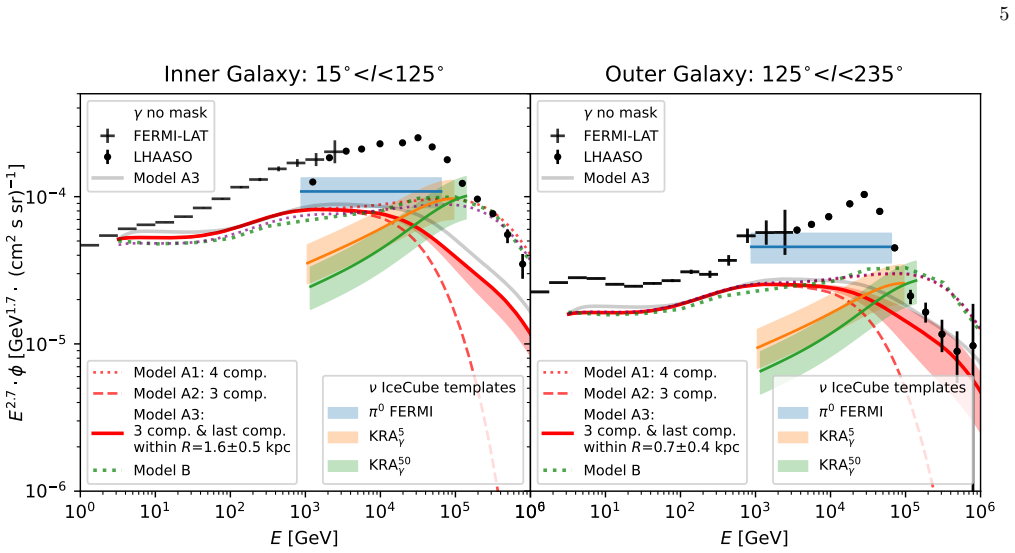
The paper establishes that the pion-decay component of diffuse gamma-ray emission computed from a cosmic-ray spectrum fitted to LHAASO's precise knee-region measurements exceeds the measured LHAASO diffuse flux in the inner Galaxy above about 30 TeV and in the outer Galaxy above about 100 TeV. Removing the highest-energy rigidity component of the fitted cosmic-ray spectrum from the emission calculation removes the excess, which the authors interpret as evidence that these particles occupy a limited volume around the Solar System rather than the whole Galactic disk. Attributing that highest-energy component to a local PeV cosmic-ray bubble and fitting its size to the LHAASO data gives an extension of 1.5 ± 0.3 kpc toward the inner Galaxy and 0.7 ± 0.3 kpc toward the outer Galaxy.
Load-bearing premise
The whole excess calculation leans on a model of how much hydrogen gas lies along each line of sight, and the uncertainties in that gas model are not propagated; if the gas is overestimated, the predicted glow is too bright and the inferred bubble could be an artifact.
Editorial extensions
If this is right
- If the local-bubble scenario is right, the cosmic-ray knee is not the same feature everywhere in the Galaxy; other regions have their own knee features set by recent local injections.
- LHAASO's deeper exposure should reveal strong variation of the >100 TeV diffuse gamma-ray flux from one line of sight to another, tracking where fresh PeV cosmic rays currently reside.
- Because gamma-rays and neutrinos share the same pion-production parentage, the same excess should appear as a suppression of the predicted high-energy neutrino flux from the same sky regions, testable with future neutrino telescopes.
- The fitted bubble sizes of 1.5 kpc inward and 0.7 kpc outward locate the Solar System asymmetrically inside this recent injection, pointing roughly toward the inner Galaxy and giving a target for identifying the source.
Reading between the lines
- Extension: the same decomposition could be applied to a longitude-resolved map of 100 TeV to 1 PeV gamma-ray emission, turning each high-energy spectral component that appears locally but not globally into a tracer of a recent cosmic-ray injection event.
- Extension: the local-bubble interpretation predicts a small arrival-direction anisotropy in local cosmic rays at and above the knee, roughly aligned with the inferred bubble direction, which current and future observatories could search for.
- Extension: the inner-Galaxy radius of 1.5 ± 0.3 kpc may be better interpreted as a lower bound if the injected particles have not had time to fill the whole bubble; combining the radius with a diffusion model could yield an age estimate for the recent injection event.
Editorial analysis
A structured set of objections, weighed in public.
Referee Report
Summary. The paper constructs two independent models of the Galactic cosmic-ray (CR) spectrum up to the knee (a three-Peters-cycle fit, Model A, and a DRAGON-2 diffusion-break fit, Model B), both calibrated to AMS-02, DAMPE, CALET, LHAASO, IceTop and Auger data. Assuming the local CR spectrum is universal throughout the Milky Way, the authors compute diffuse gamma-ray and neutrino emission from the inner (15°<l<125°) and outer (125°<l<235°) Galactic plane, normalizing the gamma-ray prediction to Fermi-LAT at 10 GeV with a 0.85 pion-decay fraction. Comparing to LHAASO diffuse gamma-ray data, they find the predicted pion-decay flux exceeds the measured diffuse flux above ~30 TeV (inner) and ~100 TeV (outer). They interpret this excess as evidence for a "local PeV CR bubble" and fit its radius, obtaining 1.5±0.3 kpc toward the inner Galaxy and 0.7±0.3 kpc toward the outer Galaxy; they also compare neutrino predictions to rescaled IceCube template fluxes.
Significance. If the claimed discrepancy is real, it challenges the standard assumption of a universal CR spectrum in the Galaxy and suggests that the knee is produced by a local, recent CR injection. The use of two independent CR models (Peters cycles and DRAGON-2) to predict the diffuse emission is a strength, and the consistency of the two predictions supports the robustness of the spectral-shape mismatch. The predicted gamma-ray and neutrino fluxes are falsifiable and the comparison to IceCube is a useful cross-check. However, the inference of bubble radii is not on the same footing as the discrepancy itself: it relies on a one-zone toy model with no spatial test.
major comments (3)
- [Section V, Fig. 3] The bubble-radii claim (R = 1.5 ± 0.3 kpc inner, 0.7 ± 0.3 kpc outer) is based only on the region-averaged spectra of the inner and outer Galaxy. The model predicts a characteristic longitude profile of >100 TeV emission that is localized around the Sun, but the paper does not compare this prediction with LHAASO's spatial data. A position-dependent CR spectrum (e.g., a radial gradient of the knee energy or of the escape rate) could produce the same two region-averaged spectra with different "bubble" sizes. Without a longitude-profile test, the quoted radii are not uniquely determined; they should be presented as illustrative, not as measured extensions.
- [Section V] The uncertainties on the bubble radii (0.3 kpc) are not derived from a statistical fit or from propagation of the input uncertainties (CR fit parameters, gas models, 10 GeV normalization, gamma-ray absorption). The text states only that the bubble radius was "adjusted" until the model "fits" the LHAASO data. Please specify the fitting procedure, the chi-square or likelihood used, and how the 0.3 kpc uncertainty was obtained; alternatively, state explicitly that these are systematic ranges from varying model assumptions.
- [Sections III and IV] The decomposition of the local CR spectrum into a steady-state component (Peters cycles 1 and 2) and a local knee component (Peters cycle 3) is an assumption of the toy model, not a result. The same LHAASO proton spectrum that defines the third cycle is then used as the spectrum inside the bubble, and the bubble radius is fit to the gamma-ray data. This leaves a degeneracy between the amplitude of the local component and its spatial extent. A minimal test would be to fix the bubble spectrum from an independent CR propagation model (e.g., a recent source injection) and fit only the geometry, or to include an alternative spatially varying CR model and compare fits.
minor comments (6)
- [Section III, Fig. 3 caption] The caption reads "155◦ < l <125◦", which appears to be a typo; it should be "15◦ < l <125◦" consistent with the text in Section III.
- [Section V] There is a typo "tot he" in the sentence "the CRs with the spectrum corresponding tot he 3rd Peters cycle"; it should be "to the".
- [Section III] The word "intergrals" in "line-of-sight intergrals" should be "integrals".
- [Section III] The 0.85 pion-decay fraction at 10 GeV and its quoted 10% uncertainty are not propagated to the predicted fluxes above 100 TeV; please add a systematic band or state explicitly that the excess is insensitive to this normalization.
- [Appendix A] The 10% upward shift of Auger energies is described, but its effect on the fitted CR spectra (and hence on the predicted gamma-ray flux) is not quantified; a short discussion would help.
- [Figures 3 and 4] The figure captions and legends are dense; consider adding a clear legend directly in the figure distinguishing the diffuse (masked) LHAASO data, total flux, Model A1/A2/A3, Model B, and IceCube templates.
Circularity Check
No significant circularity: the gamma-ray excess is a genuine model prediction checked against independent LHAASO data, and the bubble radii are admitted fits, not predictions.
full rationale
The derivation chain is non-circular. In Section II, Models A and B are fitted only to direct cosmic-ray measurements (AMS-02, DAMPE, CALET, LHAASO proton/all-particle spectra, IceTop, and Auger). In Section III, these fitted spectra are used to compute pion-decay gamma-ray and neutrino yields with the external AAfrag code and external gas models; the predicted gamma-ray spectra are then normalized at 10 GeV using Fermi-LAT diffuse modeling. Only in Section IV are the resulting predictions compared with LHAASO and Fermi-LAT gamma-ray data and IceCube neutrino estimates. No LHAASO gamma-ray measurement enters the CR fits or the yield calculation, so the reported excess above 30/100 TeV is a spectral-shape prediction rather than a restatement of an input. The local PeV bubble radii are not predictions: the paper states, 'We have adjusted the bubble radius in such a way that the sum of the steady-state diffuse emission ... fits LHAASO data,' making the radii explicitly fitted to the data they describe. The main self-citation, Ref. [32], is used for methodology ('Following the approach of Ref. [32]') and to note that the excess 'has already been noticed in Ref. [32]'; this is corroborative and non-load-bearing, since the present work independently repeats the derivation with new LHAASO proton data and Fermi-LAT/LHAASO gamma-ray data. Hence no circular step is exhibited; the central comparison is self-contained against external benchmarks, and the score is 0.
Assumptions & free parameters
free parameters (5)
- Bubble radius, inner Galaxy =
1.5 +/- 0.3 kpc
- Bubble radius, outer Galaxy =
0.7 +/- 0.3 kpc
- Model A third Peters cycle parameters (R30, R31, alpha3, alpha4, delta, N3 per element) =
R30=4.15e5 GV, R31=7.78e7 GV, alpha3=0.12, alpha4=3.79, delta=0.78; N3 values in Table I
- Model B upper diffusion break parameters (R45, R56, delta4, delta5, delta6, s45, s56) =
R45=1e5 GV, R56=4e6 GV, delta4=0.453, delta5=0.15, delta6=1.5, s45=0.022, s56=0.31
- Auger energy scale shift =
+10% on energy
assumptions (5)
- domain assumption The cosmic-ray spectrum measured locally is representative of the entire Milky Way (universal spectrum assumption) in the baseline models.
- domain assumption The atomic (HI) and molecular (H2) gas distributions from Ref. [47] accurately trace the target gas for pion production.
- domain assumption The pion-decay component constitutes 0.85 of the total Fermi-LAT diffuse flux at 10 GeV for |b| < 10 deg, and this fraction is a lower bound for |b| < 5 deg.
- domain assumption The gamma-ray absorption model for CMB, starlight, and infrared radiation fields from Refs. [52,53] is correct.
- ad hoc to paper The third Peters cycle in Model A represents a local, spatially limited PeV CR bubble that is not present elsewhere in the Galaxy.
invented entities (1)
-
Local PeV CR bubble
Cite this review
Pith. "Pith review of Diffuse gamma-ray and neutrino emission from the Milky Way and the local knee in the cosmic ray spectrum." pith.science (2026). https://pith.science/paper/V6GKQCVO
@misc{pith2026250710823,
  author       = {Pith},
  title        = {Pith review of: Diffuse gamma-ray and neutrino emission from the Milky Way and the local knee in the cosmic ray spectrum},
  year         = {2026},
  howpublished = {\url{https://pith.science/paper/V6GKQCVO}},
  note         = {Machine review of arXiv:2507.10823}
}
read the original abstract
The LHAASO observatory has recently measured details of the cosmic-ray (CR) spectrum in the knee region (1 -- 10 PeV) with unprecedented precision, including its average CR mass composition and the spectrum of the proton component. We use these precision measurements, combined with direct measurements of CRs by space-based detectors, to derive predictions for the spectrum of diffuse gamma-ray and neutrino emission from the interstellar medium under the assumption that the CR spectrum is universal throughout the Milky Way. We compare these predictions with the Fermi-LAT and LHAASO measurements of the diffuse gamma-ray flux from inner and outer Galactic Plane regions and with estimates of the neutrino flux based on the IceCube data for the same Galactic Plane regions. We notice that the model predictions exceed LHAASO gamma-ray measurements at energies above 100 TeV. This excess can be interpreted within a CR knee model assuming a "local PeV CR bubble''. Within this model, we infer the extension of the local PeV CR bubble of 1.5 +/- 0.3 kpc in the direction of the inner Galaxy and of 0.7+/-0.3 kpc toward the outer Galaxy.
Figures


Figures from the paper (2 more)

Forward citations
Cited by 5 Pith papers
-
Uncertainty in Hadronic Diffuse $\gamma$-Ray Emission from the Temporal Stochasticity of Cosmic-Ray Sources
Temporal stochasticity of cosmic-ray sources causes a normalization uncertainty in the local proton flux that propagates into a hadronic gamma-ray uncertainty of 30-100%, comparable to or exceeding experimental errors...
-
Too Heavy to Hide: Gamma-Ray Constraints on Annihilating Dark Matter beyond Unitarity
Gamma-ray upper limits from five high-energy observatories constrain the annihilation cross sections of composite dark matter in the mass range 10^5--10^12 GeV.
-
Implication of multiple source populations of Galactic cosmic rays from proton and helium spectra
The proton and helium spectra from 1 GeV to 10 PeV can be reproduced only by adding two local sources or a second background population on top of the standard cosmic-ray background.
-
Breaking Dark: Hunting Heavy Decaying Dark Matter with Tibet AS$_\gamma$ and LHAASO-KM2A
Tibet ASγ and LHAASO-KM2A diffuse gamma-ray data exclude decaying dark matter lifetimes below about 10^28 seconds for masses around 10^6-10^9 GeV, for many Standard Model final states.
-
Leptonic and hadronic models of high-energy nebula around V4641 Sgr
Protons produce the >100 TeV gamma-ray halo of V4641 Sgr while freshly accelerated electrons produce its X-rays, a mixed leptohadronic model that matches the observed spectrum and morphology.
Reference graph
Works this paper leans on
-
[32]
C. Evoli, D. Gaggero, A. Vittino, G. D. Bernardo, M. D. Mauro, A. Ligorini, P. Ullio, and D. Grasso, Jour- nal of Cosmology and Astroparticle Physics 2017, 015 (2017), URL https://dx.doi.org/10.1088/1475-7516/ 2017/02/015
-
[1]
V. S. Berezinskii, S. V. Bulanov, V. L. Ginzburg, V. A. Dogel, and V. S. Ptuskin, Astrophysics of cosmic rays. (1984)
work page 1984
-
[2]
We compare to data by CALET and LHAASO; while CALET differs from DAMPE at the highest en- ergy points, it was shown in Ref. [32] that the difference in the induced γ-ray and neutrino emissions are small. Also, the result of our fit is found to match IceTop data for protons and helium; on the other hand, the fit results in a higher intensity in the CNO gro...
work page 2008
-
[3]
M. Kachelriess and D. V. Semikoz, Prog. Part. Nucl. Phys. 109, 103710 (2019), 1904.08160
arXiv 2019
- [4]
- [5]
-
[6]
M. Aguilar, L. Ali Cavasonza, G. Ambrosi, L. Arruda, N. Attig, A. Bachlechner, F. Barao, A. Barrau, L. Barrin, A. Bartoloni, et al., Phys. Rev. Lett. 123, 181102 (2019)
work page 2019
- [7]
Show all 62 references
-
[9]
Q. An, R. Asfandiyarov, et al., Science Advances 5 (2019)
2019
-
[10]
Alemanno et al
F. Alemanno et al. (DAMPE), PoS ICRC2023, 003 (2024)
2024
-
[11]
Alemanno, Q
F. Alemanno, Q. An, et al., Phys. Rev. Lett. 126 (2021)
2021
-
[12]
Cao et al
Z. Cao et al. (LHAASO), Phys. Rev. Lett. 132, 131002 (2024), 2403.10010
2024
-
[13]
Cao et al
Z. Cao et al. (LHAASO) (2025), 2505.14447
2025
-
[14]
G. V. Kulikov and G. B. Khristiansen, JETP 8, 441 (1959)
1959
-
[15]
J. R. Hoerandel, Astropart. Phys. 21, 241 (2004), astro- ph/0402356
2004
-
[16]
Giacinti, M
G. Giacinti, M. Kachelriess, and D. V. Semikoz, JCAP 07, 051 (2018), 1710.08205
2018 arXiv
-
[17]
Ptuskin, V
V. Ptuskin, V. Zirakashvili, and E.-S. Seo, Astropys. J. 763, 47 (2013), 1212.0381
2013 arXiv
-
[18]
Kachelrieß, A
M. Kachelrieß, A. Neronov, and D. V. Semikoz, Phys. Rev. D 97, 063011 (2018), 1710.02321
2018 arXiv
-
[19]
Evoli, E
C. Evoli, E. Amato, P. Blasi, and R. Aloisio, Phys. Rev. D 104, 123029 (2021), 2111.01171
2021 arXiv
-
[20]
Ackermann, M
M. Ackermann, M. Ajello, W. B. Atwood, L. Baldini, J. Ballet, G. Barbiellini, D. Bastieri, K. Bechtol, R. Bel- lazzini, B. Berenji, et al., Astropys. J. 750, 3 (2012), 1202.4039
2012 arXiv
- [21]
- [22]
-
[23]
Amenomori et al
M. Amenomori et al. (Tibet ASgamma), Phys. Rev. Lett. 126, 141101 (2021), 2104.05181
2021 arXiv
-
[24]
Alfaro et al
R. Alfaro et al. (HA WC), Astrophys. J. 961, 104 (2024), 2310.09117
2024
-
[25]
Cao et al
Z. Cao et al. (LHAASO), Phys. Rev. Lett. 131, 151001 (2023), 2305.05372
2023
-
[26]
Abbasi, M
R. Abbasi, M. Ackermann, J. Adams, J. A. Aguilar, M. Ahlers, M. Ahrens, J. M. Alameddine, A. A. Alves, N. M. Amin, K. Andeen, et al., Science 380, 1338 (2023), ISSN 0036-8075, URL https://www.science.org/doi/ 10.1126/science.adc9818
2023 doi
- [27]
-
[28]
V. A. Allakhverdyan et al. (Baikal-GVD), Astrophys. J. 982, 73 (2025), 2411.05608
2025 arXiv
-
[29]
Peters, Nuovo Cim
B. Peters, Nuovo Cim. 22, 800 (1961)
1961
-
[30]
Zatsepin, N
G. Zatsepin, N. Gorunov, and L. Dedenko, lzv. Akad. Nauk USSR Ser. Fiz. 26, 685 (1962)
1962
-
[31]
Schwefer, P
G. Schwefer, P. Mertsch, and C. Wiebusch, The Astro- physical Journal 949, 16 (2023), URL https://dx.doi. org/10.3847/1538-4357/acc1e2
2023 doi
-
[33]
Prevotat, M
C. Prevotat, M. Kachelriess, S. Koldobskiy, A. Neronov, and D. Semikoz, Phys. Rev. D 110, 103035 (2024), 2407.11911
2024 arXiv
-
[34]
Abreu, M
P. Abreu, M. Aglietta, et al., The European Physi- cal Journal C 81 (2021), URL http://dx.doi.org/10. 1140/epjc/s10052-021-09700-w
2021
-
[35]
P. A. Abdul Halim et al., PoS ICRC2023, 016 (2023)
2023
-
[36]
M. J. Boschini, S. D. Torre, M. Gervasi, D. Grandi, G. J´ ohannesson, G. L. Vacca, N. Masi, I. V. Moskalenko, S. Pensotti, T. A. Porter, et al., The Astrophysi- cal Journal Supplement Series 250, 27 (2020), ISSN 00670049, 2006.01337, URL http://dx.doi.org/10. 3847/1538-4365/aba901
2020 arXiv
-
[37]
M. J. Boschini, S. D. Torre, M. Gervasi, D. Grandi, G. J´ ohannesson, G. La Vacca, N. Masi, I. V. Moskalenko, S. Pensotti, T. A. Porter, et al., The Astrophysical Journal 933, 147 (2022), ISSN 1538-4357, URL http: //dx.doi.org/10.3847/1538-4357/ac7443
2022 doi
-
[38]
M. J. Boschini, S. Della Torre, M. Gervasi, D. Grandi, G. J´ ohannesson, G. La Vacca, N. Masi, I. V. Moskalenko, S. Pensotti, T. A. Porter, et al., The Astrophysical Jour- nal 913, 5 (2021), ISSN 1538-4357, URL http://dx. doi.org/10.3847/1538-4357/abf11c
2021 doi
-
[39]
Adriani, Y
O. Adriani, Y. Akaike, K. Asano, Y. Asaoka, E. Berti, G. Bigongiari, W. R. Binns, M. Bongi, P. Brogi, A. Bruno, et al., Phys. Rev. Lett. 129, 101102 (2022), 2209.01302
2022 arXiv
-
[40]
Adriani, Y
O. Adriani, Y. Akaike, K. Asano, Y. Asaoka, E. Berti, G. Bigongiari, W. R. Binns, M. Bongi, P. Brogi, A. Bruno, et al., Phys. Rev. Lett. 130, 171002 (2023), 2304.14699
2023 arXiv
-
[41]
P. S. Marrocchesi, O. Adriani, Y. Akaike, Y. Asaoka, E. Berti, G. Bigongiari, M. Bongi, P. Brogi, A. Bruno, N. Cannady, et al., Physics of Atomic Nuclei 84, 985 (2021)
2021
-
[42]
Adriani, Y
O. Adriani, Y. Akaike, K. Asano, Y. Asaoka, E. Berti, G. Bigongiari, W. R. Binns, M. Bongi, P. Brogi, A. Bruno, et al., Phys. Rev. Lett. 126, 241101 (2021), 2106.08036
2021 arXiv
-
[43]
M. G. Aartsen, M. Ackermann, J. Adams, J. A. Aguilar, M. Ahlers, M. Ahrens, C. Alispach, K. Andeen, T. An- derson, I. Ansseau, et al., Physical Review D 100, 82002 (2019), 1906.04317
2019 arXiv
-
[44]
Aguilar, D
M. Aguilar, D. Aisa, B. Alpat, A. Alvino, G. Ambrosi, K. Andeen, L. Arruda, N. Attig, P. Azzarello, A. Bach- lechner, et al. (AMS Collaboration), Phys. Rev. Lett. 114, 171103 (2015), URL https://link.aps.org/doi/ 10.1103/PhysRevLett.114.171103
2015 doi
-
[45]
Aguilar, L
M. Aguilar, L. Ali Cavasonza, B. Alpat, G. Ambrosi, L. Arruda, N. Attig, S. Aupetit, P. Azzarello, A. Bach- lechner, F. Barao, et al. (AMS Collaboration), Phys. Rev. Lett. 119, 251101 (2017), URL https://link.aps.org/ doi/10.1103/PhysRevLett.119.251101
2017 doi
-
[46]
J. A. Morales-Soto, J. C. Arteaga-Vel´ azquez, Hawc, A. U. Abeysekara, A. Albert, R. Alfaro, C. Alvarez, J. d. D. ´Alvarez Romero, J. R. A. Camacho, J. C. Arteaga Ve- lazquez, et al., in 37th International Cosmic Ray Confer- ence (2022), p. 330, 2108.04748
2022 arXiv
-
[47]
M. G. Aartsen, M. Ackermann, et al., Physical Re- view D 100 (2019), URL http://dx.doi.org/10.1103/ PhysRevD.100.082002
2019
- [48]
- [49]
-
[50]
Kachelrieß, I
M. Kachelrieß, I. V. Moskalenko, and S. Ostapchenko, Computer Physics Communications 245, 106846 (2019), 1904.05129
2019 arXiv
-
[51]
Koldobskiy, M
S. Koldobskiy, M. Kachelrieß, A. Lskavyan, A. Neronov, S. Ostapchenko, and D. V. Semikoz, Phys. Rev. D 104, 123027 (2021), ISSN 2470-0029, 2110.00496, URL https://journals.aps.org/prd/abstract/10.1103/ PhysRevD.104.123027
2021 arXiv
-
[52]
K. M. Ferri` ere, Reviews of Modern Physics 73, 1031–1066 (2001), ISSN 1539-0756, URL http://dx. doi.org/10.1103/RevModPhys.73.1031
2001 doi
-
[53]
Celli, A
S. Celli, A. Palladino, and F. Vissani, The Euro- pean Physical Journal C 77 (2017), ISSN 1434- 6052, URL http://dx.doi.org/10.1140/epjc/ s10052-017-4635-x
2017 doi
-
[54]
Vernetto and P
S. Vernetto and P. Lipari, Phys. Rev. D 94, 063009 (2016), ISSN 2470-0010, URL https://link.aps.org/ doi/10.1103/PhysRevD.94.063009
2016 doi
-
[55]
Z. Cao, F. Aharonian, Axikegu, Y. X. Bai, Y. W. Bao, D. Bastieri, X. J. Bi, Y. J. Bi, W. Bian, A. V. Bukevich, et al., Physical Review Letters 134, 81002 (2025), ISSN 10797114, URL https://doi.org/10. 1103/PhysRevLett.134.081002
2025
- [56]
-
[57]
L. E. E. Castro, F. L. Villante, V. Vecchiotti, C. Evoli, and G. Pagliaroli (2025), 2506.06593
2025 arXiv
- [58]
-
[59]
A. D. Erlykin and A. W. Wolfendale, Astropart. Phys. 10, 69 (1999)
1999
-
[60]
Bouyahiaoui, M
M. Bouyahiaoui, M. Kachelriess, and D. V. Semikoz, JCAP 01, 046 (2019), 1812.03522
2019 arXiv
-
[61]
M. A. Gordon and W. B. Burton, Astropys. J. 208, 346 (1976)
1976
-
[62]
Bronfman, R
L. Bronfman, R. S. Cohen, H. Alvarez, J. May, and P. Thaddeus, Astrophysical Journal 324, 248 (1988)
1988
-
[63]
J. M. Cordes, J. M. Weisberg, D. A. Frail, S. R. Spangler, and M. Ryan, Nature (London) 354, 121 (1991)
1991
Reviewed August 6, 2026 · model on record in the stance chip above.
Discussion (0). Sign in to comment.