REVIEW 3 major objections 6 minor 102 references
The gamma-ray nebula around microquasar V4641 Sgr needs both protons and electrons: pion-decay from proton-gas collisions makes the >100 TeV emission, and electron synchrotron makes the X-rays.
Reviewed by Pith at T0; open to challenge. T0 means a machine referee read the full paper against a public rubric. the ladder, T0–T4 →
T0 review · deepseek-v4-flash
2026-08-03 16:24 UTC pith:A45GMWNH
load-bearing objection A transparent leptohadronic modeling paper worth refereeing; the HI-distance assumption is the weak joint, and the paper already knows it. the 3 major comments →
Leptonic and hadronic models of high-energy nebula around V4641 Sgr
The pith
A machine-rendered reading of the paper's core claim, the machinery that carries it, and where it could break.
Core claim
The paper's central claim is that no single emission component can explain the nebula. A purely leptonic model—continuous injection of electrons that up-scatter microwave background photons and radiate synchrotron—is energetically cheap (luminosity around 10^36 erg/s, well below the black hole's critical luminosity) but only reproduces the observed north-south asymmetry if the Galactic magnetic field bends on a roughly 200 pc scale or if particles sit in a finely tuned ballistic-to-diffusive transition. A purely hadronic model—a flash of protons diffusing along the magnetic field and producing gamma rays through proton-proton collisions with a nearby cold-gas overdensity—matches the morpholo
What carries the argument
The engine is proton-proton pion production against a cold-gas target. The authors identify an overdensity in the all-sky neutral-hydrogen map, in the velocity range 100–200 km/s (adopted 125 km/s), that is spatially aligned with the gamma-ray nebula and has an average density of roughly 0.1 cm^-3, rising to about 1 cm^-3 in the densest regions. Combined with anisotropic diffusion of high-energy protons along the Galactic magnetic field (longitudinal scale 55–110 pc inferred from flux profiles, with a parallel-to-perpendicular diffusion ratio near 13 and an energy-dependent diffusion coefficient roughly scaling as E^{1/3}), the gas distribution imprints the observed energy-dependent, asymmet
Load-bearing premise
The assumption that the neutral-hydrogen overdensity seen at 100–200 km/s lies at the source's roughly 6 kpc distance and serves as the target for proton-proton collisions; if that gas is foreground or background, the hadronic morphology explanation and the leptohadronic fits lose their anchor.
What would settle it
Measure the distance of the HI feature directly—for example, through HI absorption against background continuum sources along the same line of sight—and check whether it is at roughly 6 kpc; alternatively, accumulate neutrino exposure to confirm or exclude the predicted flux; or image the nebula's X-ray tips and see whether the predicted minimal synchrotron flux appears while the gamma rays persist.
If this is right
- The >100 TeV signal is hadronic, so V4641 Sgr is a PeV-scale proton accelerator contributing to the Galactic cosmic-ray budget through proton-proton collisions in its surrounding gas.
- The predicted neutrino flux from the hadronic component should be detectable by next-generation neutrino telescopes, offering an unambiguous test within roughly a decade.
- X-ray observations at the nebula's tips can discriminate the models: the leptonic component predicts a minimal synchrotron flux there that a hadron-dominated scenario would not produce.
- The nebula's angular size should grow with photon energy following a roughly E^{1/6} scaling from the assumed diffusion law; future imaging atmospheric telescope arrays can test this energy dependence of particle transport.
- If the extended X-ray emission is genuinely associated with the source, a purely hadronic interpretation is excluded—directly accelerated electrons must exist alongside the protons.
Where Pith is reading between the lines
- If the spatial coincidence between the gas overdensity and the gamma-ray brightness asymmetry is confirmed kinematically—say, by measuring an HI absorption distance—the hadronic interpretation would be on much firmer ground, and V4641 Sgr would become a clean laboratory for tracing PeV protons to their target gas.
- If that gas instead lies in the foreground or background, the hadronic morphology explanation collapses, and the leptonic ballistic-to-diffusive transition becomes the most plausible asymmetric scenario—still viable but less preferred energetically.
- The flash-plus-continuous-injection construction suggests a natural extension: monitoring future X-ray or radio outbursts of the binary should modulate the leptonic component on short timescales while leaving the hadronic component stable, a temporal signature not emphasized in the paper.
- The paper leaves open the possibility that the extended X-ray emission comes from an unrelated inner-Galaxy X-ray structure; if that is true, the purely hadronic model regains viability and the decisive tension becomes the enormous proton energy budget.
Editorial analysis
A structured set of objections, weighed in public.
Referee Report
Summary. The paper models the extended high-energy nebula around the microquasar V4641 Sgr using leptonic, hadronic, and leptohadronic scenarios, and attempts to reproduce the observed gamma-ray spectrum and morphology simultaneously. It argues that purely leptonic models are energetically efficient but morphologically contrived, that a purely hadronic model can explain the gamma-ray asymmetry via proton-proton interactions on an HI overdensity but requires ~10^50 erg in protons and cannot explain the XRISM extended X-ray emission, and that a combination of hadronic and leptonic components can reproduce both the spectral and morphological data. The paper also provides predictions for the X-ray flux at the nebula's tips and for neutrino fluxes, and emphasizes that the fits are not unique.
Significance. If the central conclusion holds, this would be an important step in understanding a potential PeV cosmic-ray accelerator: it would establish a hadronic origin for the >100 TeV emission and connect the gamma-ray morphology to a specific gas overdensity in the Galactic bar region. The paper is transparent about degeneracies and alternative interpretations, uses public survey data and standard transport/radiative tools, and provides falsifiable predictions (X-ray tip fluxes, neutrino fluxes) that can be tested with future instruments. The main significance, however, is conditional on two associations—the distance of the HI gas and the physical connection of the XRISM X-ray emission to the nebula—neither of which is currently confirmed. The modeling framework itself is standard and the parameter estimates are plausible, but the central morphological argument rests on an assumption that is explicitly recognized in the text as uncertain.
major comments (3)
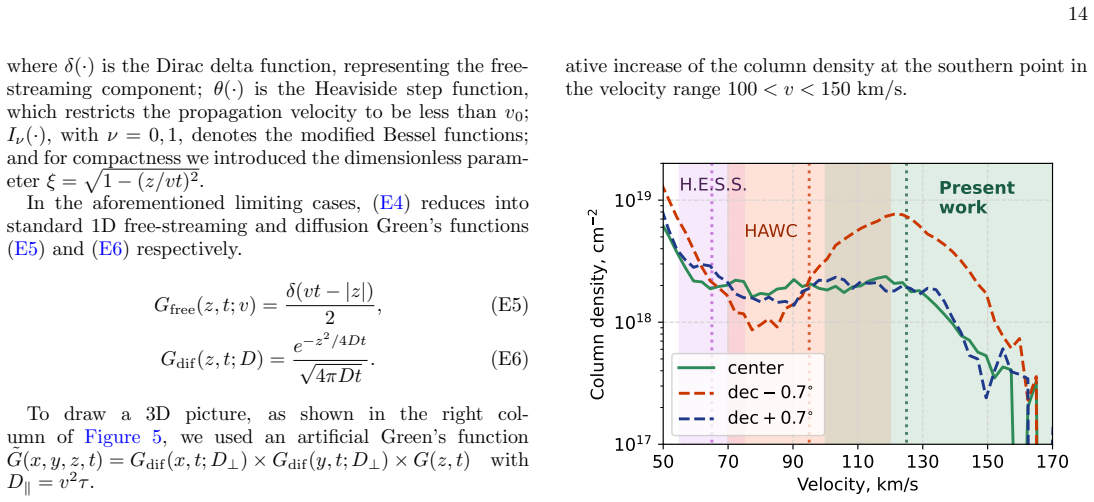
- [Sec. V A, Figs. 6–7, Appendix F] The hadronic and leptohadronic conclusions rest on the association of the HI4PI feature at v=125 km/s with a gas cloud at d≈6.1 kpc. The text correctly notes that the tangent-point distance-velocity relation is inapplicable in the bar region, and the 100–200 km/s interval is inferred from bar hydrodynamics and spatial coincidence. The sightline at l≈6.8°, b≈-4.8° passes through a long path in the bar region, so foreground or background gas at similar velocities is a real possibility. If this overdensity is not at the source distance, then the n_HI~0.1–1 cm^-3 used in Secs. V C–D and the corresponding E_prot~10^50(n0/n) erg values are not tied to V4641 Sgr, and the morphology match in Fig. 7 becomes a projection effect. This is the central load-bearing assumption of the paper. A 21-cm absorption measurement toward a background continuum source, or another independent kinematic/distance co
- [Sec. V B] The paper explicitly allows that the XRISM extended X-ray emission may be unrelated to the source, e.g., part of a larger inner-Galaxy structure. Yet the exclusion of the purely hadronic model and the requirement for a directly accelerated electron component follow from attributing the XRISM flux to the nebula. Since this is an admitted alternative, the statement that a purely hadronic model 'fails to reproduce the extended X-ray emission' is conditional: if the XRISM emission is unrelated, a purely hadronic model is not ruled out, and the central 'no single-component model works' conclusion is weakened. The authors should clearly carry this contingency through the abstract and conclusions, and, where possible, quantify the chance-coincidence probability (e.g., source counts of X-ray emitters within the XRISM region).
- [Sec. IV C, Sec. V A, Fig. 7] The morphological comparison is qualitative. For the leptonic explanations, R_curv, projection angle, and the ballistic-diffusion timescale τ are free inputs with no reported likelihood; for the hadronic maps, the high-energy proton distribution is assumed symmetric about the source and the predicted map is compared by eye with the observed TS maps. Thus the claim that the hadronic scenario 'can better explain' the gamma-ray morphology is not established by a quantitative criterion. A quantitative comparison—e.g., a 2D likelihood, a TS-map correlation, or at least residual profiles—would be needed to support the central morphological argument. Without it, the paper's key claim remains an interpretation rather than a constrained inference.
minor comments (6)
- [Fig. 3 and text in Sec. III] The figure axis label says 'Flux above 8 TeV' while the caption and the text use 'above 0.8 TeV'; please correct the inconsistency.
- [Sec. VI, first paragraph] 'A recent paper by XRISM reports the measurement of an extended gamma-ray emission around the binary' should read 'extended X-ray emission'.
- [Sec. II B] 'with the following features: a) its size...' contains a duplicated phrase 'with the with the following features'.
- [Appendix D, Eq. (D2)] In the flash solution, the prefactor is written as Q t; for the stated source q_flash = N0 δ(t)δ(r) it should be N0. Please correct the notation.
- [Appendix C, Fig. 15 caption and Fig. 12 legend] Typos: 'Luminocity' should be 'Luminosity'; 'quiscence' should be 'quiescence'.
- [Sec. V C–D] The model parameters for the leptohadronic models (Γ_p, E_cut,p, E_prot, L_e, B, t) are presented without uncertainties or a systematic exploration of the allowed region (beyond noting that the fit is not unique). Reporting at least rough ranges or a corner plot would help the reader assess how strongly the data prefer the quoted parameters.
Circularity Check
No significant circularity: the main neutrino and tip-X-ray predictions are forward calculations, and the hadronic gas-distance/morphology association is explicitly conditional.
full rationale
The paper's central model chain is not circular by construction. The diffusion scale is fitted to the H.E.S.S. 1D profile (Sec. III), but this fit is then used to build a 2D hadronic morphology map from the independent HI4PI gas map (Sec. V A), and the >100 TeV size is extrapolated via a Kolmogorov scaling rather than refit. The neutrino fluxes (Sec. V E) and the X-ray flux at the nebula tips (Sec. VI) are predictions computed from fitted models, not inputs to those fits. The leptohadronic decomposition is an interpretive fit, and the paper itself states the non-uniqueness ('the fit is not unique', Sec. V D) and the conditionality of the X-ray association ('It is in principle possible that X-ray flux does not correlate with high-energy emission', Sec. V B). The hadronic interpretation likewise rests on an explicitly stated assumption that the 125 km/s HI feature is at the source distance ('if the detected overdensity corresponds to the source location', Sec. V A), with the tangent-point caveat acknowledged; this is a correctness/robustness risk, not an identity reduction. Self-citations to [25] provide a published hadronic template and Fermi data reduction, but the present leptohadronic parameters are re-derived, and [25] is externally testable with IceCube/XRISM data; this is not load-bearing circularity. Overall, the claimed predictions are forward calculations with stated assumptions, so the circularity score is low.
Axiom & Free-Parameter Ledger
free parameters (11)
- Magnetic field strength B =
3 μG (continuous leptonic), 4 μG (leptohadronic)
- Electron injection index Γ_e =
1.9–2.0
- Electron cutoff energy E_cut,e =
6 PeV (leptonic), 1 PeV (leptohadronic)
- Diffusion scale sqrt(4 D∥ t) =
55 pc (flash), 110 pc (continuous)
- D∥/D⊥ anisotropy ratio =
13
- Nebula age t =
2 or 8 kyr (leptonic), 3 or 8 kyr (leptohadronic)
- Proton injection index Γ_p =
1.3 (leptohadronic), 1.8 (hadronic flash of [25])
- Proton cutoff E_cut,p =
5 PeV
- Total proton energy E_prot =
0.8–1.0e50 erg × (n0/n), n0=1 cm^-3
- Morphology free inputs (R_curv, projection angle, ballistic-diffusion τ) =
R_curv=200 pc; θ=45° in Fig. 5
- Electron luminosity L_e =
2e36 erg/s (leptohadronic continuous)
axioms (7)
- domain assumption Nebula major axis is a magnetic-field-aligned straight diffusion channel with anisotropy D∥/D⊥=13; projection along the line of sight is not known.
- ad hoc to paper HI4PI gas in the velocity range 100–200 km/s (reference 125 km/s) is located at V4641 Sgr's distance.
- domain assumption XRISM 2–10 keV extended emission is physically associated with the nebula.
- domain assumption Quasi-linear theory with Kolmogorov turbulence gives D∥ ∝ (E/B)^{1/3} η^{-2} with η≈1 inferred from minor width.
- domain assumption Axisymmetric interstellar radiation field of Popescu et al. [46] is valid at the source; CMB/dust/starlight densities are as modeled.
- domain assumption The particle release history is either a single flash or continuous injection at constant rate.
- standard math pp interactions and secondary products are described by the aafrag parameterization [59].
read the original abstract
A prominent, 200-pc-scale high-energy nebula surrounding the microquasar V4641 Sgr is the brightest known gamma-ray source in the Southern sky at $E > 100\,\mathrm{TeV}$. In this paper, we develop self-consistent leptonic, hadronic, and leptohadronic models that reproduce both the observed spectrum and morphology of the source. Purely leptonic models are energetically more favorable yet they require rather specific morphological assumptions. The gamma-ray morphology of the source can be better explained within a hadronic scenario based on the identification of cold gas structures spatially correlated with the observed gamma-ray emission. However, a purely hadronic model for the source emission requires a substantial energy reservoir in protons and fails to reproduce the extended x-ray emission recently detected by XRISM. We show that emission including a combination of leptonic and hadronic components can reproduce both the spectral and morphological properties of the source. We provide predictions for the x-ray and neutrino spectra of the nebula that can discriminate the hadronic and leptonic contributions to the overall source signal.
Figures


Reference graph
Works this paper leans on
-
[1]
M. Ackermannet al.(Fermi-LAT), Fermi-LAT Observations of the Diffuse Gamma-Ray Emission: Implications for Cos- mic Rays and the Interstellar Medium, Astrophys. J.750, 3 (2012), arXiv:1202.4039 [astro-ph.HE]
Pith/arXiv arXiv 2012
-
[2]
A. Neronov and D. Semikoz, Galactic diffuse gamma-ray emission at TeV energy, Astron. Astrophys.633, A94 (2020), arXiv:1907.06061 [astro-ph.HE]
Pith/arXiv arXiv 2020
-
[3]
Alfaroet al.(HA WC), Galactic Gamma-Ray Diffuse Emission at TeV Energies with HA WC Data, Astrophys
R. Alfaroet al.(HA WC), Galactic Gamma-Ray Diffuse Emission at TeV Energies with HA WC Data, Astrophys. J.961, 104 (2024), arXiv:2310.09117 [astro-ph.HE]
arXiv 2024
-
[4]
Z. Caoet al.(LHAASO), Measurement of Ultra-High- Energy Diffuse Gamma-Ray Emission of the Galactic Plane from 10 TeV to 1 PeV with LHAASO-KM2A, Phys. Rev. Lett.131, 151001 (2023), arXiv:2305.05372 [astro-ph.HE]
arXiv 2023
-
[5]
Z. Caoet al.(LHAASO), Measurement of Very-High-Energy Diffuse Gamma-Ray Emissions from the Galactic Plane with LHAASO-WCDA, Phys. Rev. Lett.134, 081002 (2025), arXiv:2411.16021 [astro-ph.HE]
arXiv 2025
-
[6]
S. Kaci, G. Giacinti, and D. Semikoz, On the Contribution of Unresolved Pulsars to the Ultra-high-energy Galactic Dif- fuse Gamma-Ray Emission, Astrophys. J.975, L6 (2024), arXiv:2407.20186 [astro-ph.HE]
Pith/arXiv arXiv 2024
-
[7]
Albertet al.(ANTARES), Hint for a TeV neutrino emis- sion from the Galactic Ridge with ANTARES, Phys
A. Albertet al.(ANTARES), Hint for a TeV neutrino emis- sion from the Galactic Ridge with ANTARES, Phys. Lett. B841, 137951 (2023), arXiv:2212.11876 [astro-ph.HE]
Pith/arXiv arXiv 2023
-
[8]
R. Abbasiet al.(IceCube), Observation of high-energy neu- trinos from the Galactic plane, Science380, adc9818 (2023), arXiv:2307.04427 [astro-ph.HE]
arXiv 2023
-
[9]
V. A. Allakhverdyanet al.(Baikal-GVD), Probing the Galactic Neutrino Flux at Neutrino Energies above 200 TeV with the Baikal Gigaton Volume Detector, Astrophys. J. 982, 73 (2025), arXiv:2411.05608 [astro-ph.HE]
Pith/arXiv arXiv 2025
-
[10]
Prevotatet al., Energy dependence of the knee in the cosmic-ray spectrum across the Milky Way, Phys
C. Prevotatet al., Energy dependence of the knee in the cosmic-ray spectrum across the Milky Way, Phys. Rev. D 110, 103035 (2024), arXiv:2407.11911 [astro-ph.HE]
Pith/arXiv arXiv 2024
-
[11]
L. E. E. Castroet al., LHAASO protons versus LHAASO diffuse gamma-rays: a consistency check, Mon. Not. Roy. Astron. Soc. L20, L26 (2025), arXiv:2506.06593 [astro- ph.HE]
Pith/arXiv arXiv 2025
-
[12]
C. Prevotatet al., Diffuse gamma-ray and neutrino emission from the Milky Way and the local knee in the cosmic ray spectrum, (2025), arXiv:2507.10823 [astro-ph.HE]
Pith/arXiv arXiv 2025
-
[13]
G. Giacinti and D. Semikoz, Model of Cosmic Ray Propagation in the Milky Way at the Knee, (2023), arXiv:2305.10251 [astro-ph.HE]
Pith/arXiv arXiv 2023
-
[14]
LHAASO Collaboration, Ultrahigh-energy gamma-ray emission associated with black hole-jet systems (2024), arXiv:2410.08988 [astro-ph.HE]
arXiv 2024
-
[15]
G. Giacinti, M. Kachelriess, and D. V. Semikoz, Reconciling cosmic ray diffusion with Galactic magnetic field models, JCAP07, 051, arXiv:1710.08205 [astro-ph.HE]
-
[16]
R. Jansson and G. R. Farrar, A New Model of the Galactic Magnetic Field, Astrophys. J.757, 14 (2012), arXiv:1204.3662 [astro-ph.GA]
Pith/arXiv arXiv 2012
-
[17]
M. Unger and G. R. Farrar, The Coherent Magnetic Field of the Milky Way, Astrophys. J.970, 95 (2024), arXiv:2311.12120 [astro-ph.GA]
Pith/arXiv arXiv 2024
-
[18]
A. Korochkin, D. Semikoz, and P. Tinyakov, The coherent magnetic field of the Milky Way halo, the Local Bubble, and the Fan region, Astron. Astrophys.693, A284 (2025), arXiv:2407.02148 [astro-ph.GA]
Pith/arXiv arXiv 2025
-
[19]
Alfaroet al.(HA WC Collaboration), Ultra-high-energy gamma-ray bubble around microquasar v4641 sgr, Nature 634, 557–560 (2024)
R. Alfaroet al.(HA WC Collaboration), Ultra-high-energy gamma-ray bubble around microquasar v4641 sgr, Nature 634, 557–560 (2024)
2024
-
[20]
A. Acharyya, F. Aharonian, H. Ashkar,et al.(H.E.S.S.), Constraining the nature of the most extreme Galactic par- ticle accelerator. H.E.S.S. observations of the microquasar V4641 Sgr (2025), arXiv:2511.10537 [astro-ph.HE]
arXiv 2025
-
[21]
Olivera-Nieto (H.E.S.S
L. Olivera-Nieto (H.E.S.S. Collaboration), H.E.S.S. detec- tion of very high energy emission surrounding the micro- quasar V4641 Sgr (2024)
2024
-
[22]
Suzukiet al., Detection of extended X-Ray emission around the PeVatron microquasar V4641 Sgr with XRISM, Astrophys
H. Suzukiet al., Detection of extended X-Ray emission around the PeVatron microquasar V4641 Sgr with XRISM, Astrophys. J. Lett.978, L20 (2025)
2025
-
[23]
Wan, J.-s
S.-Y. Wan, J.-s. Wang, and R.-Y. Liu, A leptonic interpreta- tion of the uhe gamma-ray emission from v4641 sgr (2025)
2025
-
[24]
Dmytriiev, F
A. Dmytriiev, F. Van der Merwe, and M. B¨ ottcher, Mod- eling particle acceleration and multi-wavelength emission of a PeVatron microquasar V4641 Sgr, inProceedings of High Energy Astrophysics in Southern Africa 2025 — PoS(HEASA2025), HEASA2025 (Sissa Medialab, 2025) p. 069
2025
-
[25]
Neronov, F
A. Neronov, F. Oikonomou, and D. Semikoz, Multimessen- ger signature of cosmic rays from the microquasar V4641 Sgr propagating along a Galactic magnetic field line, Phys. Rev. D111, 103025 (2025)
2025
- [26]
-
[27]
R. K. D. MacDonaldet al., The black hole binary v4641 sagitarii: Activity in quiescence and improved mass deter- minations, Astrophys. J.784, 2 (2014)
2014
-
[28]
R. M. Hjellminget al., Light curves and radio structure of the 1999 september transient event in V4641 sagittarii, Astrophys. J.544, 977 (2000)
1999
-
[29]
A. G. A. Brownet al.(Gaia Collaboration), Gaia data re- lease 2, Astron. Astrophys.616, A1 (2018)
2018
-
[30]
Vallenariet al.(Gaia Collaboration),Gaiadata release 3, Astron
A. Vallenariet al.(Gaia Collaboration),Gaiadata release 3, Astron. Astrophys.674(2023)
2023
-
[31]
Bland-Hawthorn and O
J. Bland-Hawthorn and O. Gerhard, The galaxy in con- text: Structural, kinematic, and integrated properties, An- nual Review of Astronomy and Astrophysics54, 529–596 (2016)
2016
-
[32]
Lindstrømet al., New clues on outburst mechanisms and improved spectroscopic elements of the black hole bi- nary V4641 Sagittarii, Mon
C. Lindstrømet al., New clues on outburst mechanisms and improved spectroscopic elements of the black hole bi- nary V4641 Sagittarii, Mon. Not. R. Astron. Soc.363, 882 (2005)
2005
-
[33]
Drimmel and D
R. Drimmel and D. N. Spergel, Three-dimensional structure of the milky way disk: The distribution of stars and dust beyond 0.35R ⊙, The Astrophysical Journal556, 181–202 (2001)
2001
-
[34]
Salvesen and S
G. Salvesen and S. Pokawanvit, Origin of spin–orbit mis- alignments: the microblazar V4641 sgr, Mon. Not. R. As- tron. Soc.495, 2179 (2020). 10
2020
-
[35]
Revnivtsev, M
M. Revnivtsev, M. Gilfanov, E. Churazov, and R. Sunyaev, Super-eddington outburst of V4641 Sgr, Astronomy & As- trophysics391, 1013–1022 (2002)
2002
-
[36]
Chatyet al., Optical and near-infrared observations of the microquasar V4641 sgr during the 1999 september outburst, Mon
S. Chatyet al., Optical and near-infrared observations of the microquasar V4641 sgr during the 1999 september outburst, Mon. Not. R. Astron. Soc.343, 169 (2003)
1999
-
[37]
T. Mu˜ noz-Darias, M. A. P. Torres, and M. R. Garcia, The low-luminosity accretion disc wind of the black hole tran- sient v4641 sagittarii, Monthly Notices of the Royal Astro- nomical Society479, 10.1093/mnras/sty1711 (2018)
-
[38]
A. U. Abeysekaraet al.(HA WC Collaboration), Observa- tion of the Crab nebula with the HA WC gamma-ray obser- vatory (2017)
2017
-
[39]
A. M. Price-Whelanet al.(The Astropy Collaboration), The astropy project: Sustaining and growing a community- oriented open-source project and the latest major release (v5.0) of the core package*, The Astrophysical Journal935, 167 (2022)
2022
-
[40]
Chuprikov and I
A. Chuprikov and I. Guirin, V4641 Sgr and KV UMa. Two black hole candidates, Memorie della Societa Astronomica Italiana82, 73 (2011)
2011
-
[41]
J. Mart ´ ı and P. L. Luque-Escamilla, Alignment of radio jets in the microquasar v4641 sagittarii with its high-energy structures (2025), arXiv:2511.19695 [astro-ph.HE]
arXiv 2025
-
[42]
Kachelrieß and D
M. Kachelrieß and D. Semikoz, Cosmic ray models, Progress in Particle and Nuclear Physics109, 103710 (2019)
2019
-
[43]
Giacinti, M
G. Giacinti, M. Kachelriess, and D. V. Semikoz, Reconciling cosmic ray diffusion with Galactic magnetic field models, J. Cosmol. Astropart. Phys.2018(07), 051
2018
-
[44]
Reichherzeret al., Turbulence-level dependence of cosmic ray parallel diffusion, Monthly Notices of the Royal Astro- nomical Society498, 5051–5064 (2020)
P. Reichherzeret al., Turbulence-level dependence of cosmic ray parallel diffusion, Monthly Notices of the Royal Astro- nomical Society498, 5051–5064 (2020)
2020
-
[45]
P. Mertsch, Test particle simulations of cosmic rays, Astro- physics and Space Science365, 10.1007/s10509-020-03832-3 (2020)
-
[46]
C. C. Popescuet al., A radiation transfer model for the milky way: I. radiation fields and application to high-energy astrophysics, Monthly Notices of the Royal Astronomical Society , 2539–2558 (2017)
2017
-
[47]
Z. Zhao, J. Li, and D. F. Torres, Upper limits on the gamma- ray emission from the microquasar v4641 sgr, The Astro- physical Journal984, 3 (2025)
2025
-
[48]
G. R. Blumenthal and R. J. Gould, Bremsstrahlung, syn- chrotron radiation, and compton scattering of high-energy electrons traversing dilute gases, Rev. Mod. Phys.42, 237 (1970)
1970
-
[49]
Fouka and S
M. Fouka and S. Ouichaoui, Analytical fits to the syn- chrotron functions, Research in Astronomy and Astro- physics13, 680–686 (2013)
2013
-
[50]
Foreman-Mackeyet al.,emcee: The MCMC hammer, Publications of the Astronomical Society of the Pacific125, 306–312 (2013)
D. Foreman-Mackeyet al.,emcee: The MCMC hammer, Publications of the Astronomical Society of the Pacific125, 306–312 (2013)
2013
-
[51]
R. C. Tautz and I. Lerche, Application of the three- dimensional telegraph equation to cosmic-ray transport, Res. Astron. Astrophys.16, 162 (2016)
2016
-
[52]
Misiriotiset al., The distribution of the ism in the milky way: A three-dimensional large-scale model, Astronomy & Astrophysics459, 113 (2006)
A. Misiriotiset al., The distribution of the ism in the milky way: A three-dimensional large-scale model, Astronomy & Astrophysics459, 113 (2006)
2006
-
[53]
Ferri` ere, W
K. Ferri` ere, W. Gillard, and P. Jean, Spatial distribution of interstellar gas in the innermost 3 kpc of our galaxy, As- tronomy & Astrophysics467, 611 (2007)
2007
-
[54]
Ben Bekhtiet al., HI4PI: a full-sky HI survey based on EBHIS and GASS, Astronomy & Astrophysics594, A116 (2016)
N. Ben Bekhtiet al., HI4PI: a full-sky HI survey based on EBHIS and GASS, Astronomy & Astrophysics594, A116 (2016)
2016
-
[55]
Chemin, F
L. Chemin, F. Renaud, and C. Soubiran, Incorrect rotation curve of the milky way, Astronomy & Astrophysics578, A14 (2015)
2015
-
[56]
Z. Li, J. Shen, O. Gerhard, and J. P. Clarke, Gas dynamics in the galaxy: Total mass distribution and the bar pattern speed, The Astrophysical Journal925, 71 (2022)
2022
-
[57]
Olivera-Nieto (H.E.S.S
L. Olivera-Nieto (H.E.S.S. Collaboration), Resolved gamma-ray emission around the microquasar V4641 Sgr (2025)
2025
-
[58]
P. Predehlet al., Detection of large-scale X-ray bub- bles in the Milky Way halo, Nature588, 227 (2020), arXiv:2012.05840 [astro-ph.GA]
Pith/arXiv arXiv 2020
-
[59]
Koldobskiyet al., Energy spectra of secondaries in proton-proton interactions, Phys
S. Koldobskiyet al., Energy spectra of secondaries in proton-proton interactions, Phys. Rev. D104, 123027 (2021)
2021
-
[60]
S. Aielloet al.(KM3NeT Collaboration), Astronomy poten- tial of km3net/arca, The European Physical Journal C84, 10.1140/epjc/s10052-024-13137-2 (2024)
-
[61]
Z. P. Ye, F. Hu, W. Tian, Q. C. Chang, Y. L. Chang, Z. S. Cheng,et al., A multi-cubic-kilometre neutrino telescope in the western pacific ocean (2022)
2022
-
[62]
Huang, Z
T.-Q. Huang, Z. Cao, M. Chen, J. Liu, Z. Wang, X. You, and Y. Qi, Proposal for the high energy neutrino telescope, in Proceedings of 38th International Cosmic Ray Conference — PoS(ICRC2023), ICRC2023 (Sissa Medialab, 2023) p. 1080
2023
- [63]
-
[64]
Winkleret al., The integral mission, Astronomy & As- trophysics411, L1 (2003)
C. Winkleret al., The integral mission, Astronomy & As- trophysics411, L1 (2003)
2003
-
[65]
M. S. Tashiroet al., Status of x-ray imaging and spec- troscopy mission (xrism), inSpace Telescopes and Instru- mentation 2020: Ultraviolet to Gamma Ray(SPIE, 2020)
2020
-
[66]
J.-L. Atteia, B. Cordier, and J. Wei, The svom mis- sion, International Journal of Modern Physics D31, 10.1142/s0218271822300087 (2021)
-
[67]
Zhanget al., Large array of imaging atmospheric cherenkov telescopes (LACT): status and future plans (2024) p
S. Zhanget al., Large array of imaging atmospheric cherenkov telescopes (LACT): status and future plans (2024) p. 808
2024
-
[68]
Z. Cao, D. Khangulyan, J. Liu, and R. Liu, Microquasar V4641 Sgr and Its Deep Investigation with LACT as a Super-PeVatron of Cosmic Rays, Research8, 0872 (2025). [69]Science with the Cherenkov Telescope Array(WORLD SCI- ENTIFIC, 2018)
2025
-
[70]
E. A. Barsukova, V. P. Goranskij, and P. Kroll, His- torical light curve of the black hole binary V4641 Sgr based on the moscow and sonneberg plate archives (2014), arXiv:1410.2055 [astro-ph.HE]
Pith/arXiv arXiv 2014
-
[71]
in ’t Zand, J
J. in ’t Zand, J. Heise, A. Bazzano, M. Cocchi, L. D. Ciolo, and J. M. Muller, SAX J1819.3-2525 (1999), iAU Circ., No. 7119
1999
-
[72]
Katoet al., Preoutburst activity of V4641 Sgr = SAX J1819.3-2525: Possible existence of 2.5-day period (1999)
T. Katoet al., Preoutburst activity of V4641 Sgr = SAX J1819.3-2525: Possible existence of 2.5-day period (1999)
1999
-
[73]
D. A. Smith, A. M. Levine, and E. H. Morgan, V4641 Sagit- tarii, IAU Circular (1999),https://cbat.eps.harvard. edu/iauc/07200/07253.html
1999
-
[74]
Stubbings, V4641 sgr — X-ray binary black hole star system, accessed: 2025-05-16
R. Stubbings, V4641 sgr — X-ray binary black hole star system, accessed: 2025-05-16
2025
-
[75]
Buxtonet al., (2003), the Astronomer’s Telegram, No
M. Buxtonet al., (2003), the Astronomer’s Telegram, No. 170
2003
-
[76]
Bailyn, D
C. Bailyn, D. Maitra, M. Buxton, L. Jeanty, and D. Gonza- lez, (2003), the Astronomer’s Telegram, No. 171
2003
-
[77]
M. P. Rupen, A. J. Mioduszewski, and V. Dhawan, (2003), the Astronomer’s Telegram, No. 172
2003
-
[78]
Swank, X-ray reappearance of v4641 sgr (2004), the As- tronomer’s Telegram, No
J. Swank, X-ray reappearance of v4641 sgr (2004), the As- tronomer’s Telegram, No. 295. 11
2004
-
[79]
M. P. Rupen, V. Dhawah, and A. J. Mioudzewski, (2004), the Astronomer’s Telegram, No. 296
2004
-
[80]
Bikmaevet al., (2004), the Astronomer’s Telegram, No
I. Bikmaevet al., (2004), the Astronomer’s Telegram, No. 309
2004
-
[81]
J. H. Swank, E. A. Smith, and C. B. Markwardt, V4641 sgr X-ray activity (2005), the Astronomer’s Telegram, No. 536
2005
discussion (0)
Sign in with ORCID, Apple, or X to comment. Anyone can read and Pith papers without signing in.