REVIEW 3 major objections 5 minor 26 references
Trexplorer Super: Topologically Correct Centerline Tree Tracking of Tubular Objects in CT Volumes
T0 review · 3 major / 5 minor · reviewed 2026-08-06 · deepseek-v4-flash
Pith's one-line read This paper argues that Trexplorer Super, a recurrent DETR-based tracker improved with trajectory-preserving training, focal cross-attention, and target augmentation, outperforms prior state-of-the-art centerline-tracking models on all…
desk verdict Valuable empirical gains and useful new benchmarks, undercut by a graph-level metric that is trivially zero for the proposed architecture. read the letter →
The pith
A machine-rendered reading of the paper's core claim, the machinery that carries it, and where it could break.
The reading
What carries the argument
The central object is the recurrent DETR-based tracker, in which object queries double as both branch-tracking state and attention inputs; each step predicts child nodes one voxel away and labels them end, intermediate, or bifurcation. Three mechanisms carry the argument: Super Trajectory Training chains a 54-step super trajectory as six 10-step sub-trajectories, reusing previous object-query outputs so tracking history survives patch boundaries; Focal Cross Attention restricts cross-attention to a $2 \times 16 \times 16 \times 16$ focal feature region while the encoder supplies long-range context; and Target Augmentation shifts bifurcation points by a Laplace-distributed offset proportional to node radius, with smoothing to preserve natural trajectories. Together these components turn the model from a per-patch tracker into a continuous root-to-leaf tracker and are what the ablation study credits for the reported gains.
What would settle it
Manually verify or independently re-extract the test-set centerlines for ATM'22 and Parse 2022, for example with expert correction or a second skeletonization algorithm, and rerun the three trained models against that corrected ground truth; if Trexplorer Super no longer achieves the best point-, branch-, and graph-level scores, the paper's central claim is refuted.
Extended reading notes
Core claim
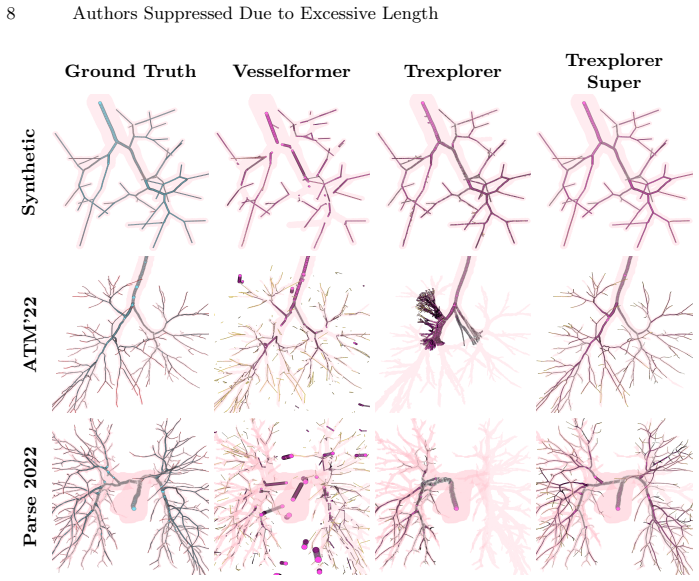
On its own terms, the paper establishes that the main obstacles to recurrent centerline-tree tracking, duplicate branch predictions and premature termination, are not inherent to the DETR-style formulation but follow from discarding the learned trajectory state when a new image patch is processed. Trexplorer Super keeps that state by chaining object-query outputs across six sub-trajectories (Super Trajectory Training), concentrates high-resolution cross-attention on a small focal region so queries can retain tracking history (Focal Cross Attention), and tolerates the fact that a bifurcation point is not a fixed location by shifting secondary branches along the primary branch with an offset scaled by radius (Target Augmentation). With these changes, the paper reports the best precision, recall, F1, radius error, branch F1, and Betti-0/Betti-1 errors among the compared models on every dataset, with the largest gains on real airway and pulmonary-artery data.
Load-bearing premise
The load-bearing assumption is that the automatically extracted centerline ground truths for the ATM'22 and Parse 2022 datasets are reliable enough to score against; if the VMTK plus Kimimaro pipeline systematically misses, adds, or misconnects branches, then every precision, recall, and F1 figure in the comparison is distorted, and the superiority claim may not reflect true tracking quality.
Editorial extensions
If this is right
- If the reported results hold, recurrent centerline tracking becomes competitive on real clinical CT data, not just synthetic vascular trees.
- Zero Betti-0 and Betti-1 errors on all test sets imply the predicted trees are single connected components without spurious cycles, so downstream analyses of airway and vessel geometry can trust the graph structure.
- The strong synthetic-versus-real gap the paper reports argues that new methods should be benchmarked on real tubular-tree datasets, and the released datasets make that possible.
- Eliminating duplicate branches removes the need for post-processing and speeds inference, making the approach more practical for large volumes.
- Because the hardest real dataset, Parse 2022, still yields noticeably lower scores, the paper points toward pretrained feature extractors and stronger sequence models as the next lever.
Reading between the lines
- The reported superiority over Vesselformer and Trexplorer is measured against ground truth that is itself machine-generated; a human-validated centerline set could shift the numbers, so an independent annotation study would be the natural next check.
- The radius-proportional augmentation and focal attention are not specific to airways or arteries; the same recipe may transfer to other branching tubular structures such as coronary arteries, biliary ducts, or plant root systems, though the paper does not test these.
- Since Betti numbers count components and cycles but not branch identity, the zero-error graph scores may understate the remaining difficulty that branch-level F1 reveals on the real datasets; future benchmarks could weight branch and tree-level metrics more heavily.
- The released synthetic dataset with collision avoidance could serve as a pre-training or debugging ground for other graph-extraction methods, not only recurrent trackers.
Editorial analysis
A structured set of objections, weighed in public.
Referee Report
Summary. The paper presents Trexplorer Super, an extension of the recurrent DETR-based centerline tracker Trexplorer, with three technical modifications: Super Trajectory Training, Focal Cross Attention, and Target Augmentation. The authors also introduce one synthetic (SVT-based) and two real (ATM'22, Parse 2022) centerline datasets, and compare Trexplorer Super with Vesselformer and Trexplorer using point-, branch-, and graph-level metrics. They report consistently higher precision, recall, F1, and branch F1 on all datasets, and zero Betti-number errors on all datasets.
Significance. If the reported results hold, the method is a substantial practical improvement in centerline tree tracking, and the new datasets plus the released code would be useful community resources. The evaluation is more careful than many medical imaging papers: five training runs per model with mean and standard deviation, a held-out test split, and per-component ablations. The point-level and branch-level F1 advantages over the two baselines are large and are the main evidence for the claimed ranking. However, the graph-level topological evidence is structurally vacuous, as detailed below, and the real-data ground truth is automatically extracted without validation. These issues affect the paper's headline claim of topological correctness and, to a lesser extent, the reliability of the real-data evaluation, but they do not by themselves overturn the substantial point- and branch-level improvements.
major comments (3)
- [Section 3.2, Table 3] Section 3.2, Table 3: The graph-level Betti metrics reported in Table 3 are architecturally guaranteed to be zero for Trexplorer and Trexplorer Super, so they carry no information about topological agreement with the ground truth. Section 2 describes tracking as breadth-first from a single root, with branches spawned only at bifurcation nodes and tracking stopping at end nodes; every nonempty output is therefore a rooted tree with Betti-0 = 1 and Betti-1 = 0. The ground-truth centerline trees are also single connected acyclic graphs. Consequently, the 0.000 errors in Table 3 are structural invariants of the model class, not measurements of correctness. A prediction consisting only of the root-to-leaf path of a single branch, omitting all side branches or containing wrong connections, would still receive zero Betti error. The paper's claim of 'topologically correct' tracking and the discussion in Section 3.4 that Trexplorer and Trexplorer Super 'ensure topological correctness' therefore rest on a metric that cannot detect missing branches, spurious branches, or incorrect connections. The point- and branch-level metrics are the only meaningful evidence for the ranking, and the graph-level claim needs to be either replaced with a structural metric (e.g., branch adjacency F1, tree edit distance, or correctness of bifurcation-to-end-node connectivity) or explicitly withdrawn.
- [Section 3.1] The ground-truth centerlines for the two real datasets (ATM'22 and Parse 2022) are automatically extracted from segmentation masks using VMTK root-point extraction followed by Kimimaro tracing, with no manual verification or comparison to an independent skeletonization. If the automatic extraction systematically misses small branches, introduces spurious branches, or makes incorrect connections, then every precision, recall, and F1 number reported in Tables 2 and 3 for these datasets is distorted in an unknown direction, and the claim that Trexplorer Super 'outperforms previous SOTA models on every dataset' may not reflect true tracking quality. The authors should validate the extracted centerlines against manual annotations on a subsample, or at least report quantitative agreement between VMTK+Kimimaro and an alternative method (e.g., another skeletonization or the original segmentation's voxel connectivity). They should also discuss the known failure modes of automatic skeletonization for thin peripheral branches. Given that the main evaluation claims rest on these datasets, this validation is load-bearing for the paper's central claim.
- [Section 3.5, Table 4] The ablation interpretation is not supported by the table. Row 2 (STT only) reports F1 = 0.0256, which is lower than the baseline in row 1 (F1 = 0.0317), and recall is essentially unchanged (0.0366 vs. 0.0359). Focal Cross Attention alone (row 3) gives F1 = 0.3301, while STT+FCA (row 4) gives F1 = 0.5391. The table therefore shows that the large gain comes from the combination of STT and FCA, not from STT alone, and the text's statement that 'Super Trajectory Training is the most crucial improvement' is not a fair reading of the reported numbers. In addition, row 2 has an enormous standard deviation for precision (0.3657 ± 0.5494) and the F1 value is inconsistent with the reported precision and recall if those are pooled values (the harmonic mean of 0.3657 and 0.0366 is about 0.066, not 0.0256). Please clarify how the metrics were averaged across runs and samples, report per-run values, and revise the interpretation of which component contributes the gain.
minor comments (5)
- [Section 3.1, Table 1] Please specify the train/val/test splitting procedure for each dataset, in particular whether the split is at the volume/patient level and whether any two scans from the same subject can appear in different splits. This is important for avoiding data leakage in the reported generalization results.
- [Introduction and Section 3.3] The paper says 'we establish a comprehensive baseline by evaluating prior SOTA models,' but only two baselines (Vesselformer and Trexplorer) are evaluated. Other cited methods such as DeepVesselNet, RelationFormer, or coronary-artery tracking methods are not compared. Please either broaden the comparison or temper the wording to 'two existing methods.'
- [Section 2] The inference loop would benefit from a precise algorithm box or pseudocode. The prose description of breadth-first tracking, stopping at end nodes, handling of concurrently tracked tokens, and duplicate suppression is not sufficient for exact reproduction, especially the mechanism by which 'object query outputs from previous patches are used' during inference.
- [Section 3.2] The 1.5-voxel matching radius for point-level metrics is defined, but the matching procedure is not fully described: it is stated that a ground-truth node is a false negative if it 'has not been matched to another prediction,' yet the order and tie-breaking of matches are not specified. Please clarify whether matching is greedy in a fixed sweep order or randomized, since this can affect the reported numbers.
- [References] Reference [4] is formatted incorrectly ('F., S.A., et al.'); the author list and citation keys should be corrected. Also, Section 3.3 mentions 'author-optimized hyperparameters' for Vesselformer without identifying who performed the optimization or what search procedure was used.
Circularity Check
The graph-level Betti-0/Betti-1 zero errors are structural invariants of any breadth-first tree output, making the 'topologically correct' claim vacuous; point- and branch-level comparisons are independent and non-circular.
-
self definitional
[Sec. 3.2 (Evaluation Metrics), Sec. 2 (Trexplorer Super Architecture), Sec. 3.4/Table 3 (Results)]
"To evaluate the overall graph structure, we use topological metrics, specifically the MAE of Betti-0 (connected components) and Betti-1 (cycles). ... The tracking process follows a sequential breadth-first approach such that in each step, we predict all the children nodes at the next level of the graph. ... Both Trexplorer and Trexplorer Super ensure topological correctness with zero Betti-0 and Betti-1 errors."
The reported Betti errors reduce to the algorithm's output class by construction. The tracker starts at a single root, spawns branches only at bifurcation nodes, and stops at end nodes, so every nonempty Trexplorer/Trexplorer Super output is a rooted tree with exactly one connected component (Betti-0=1) and no cycles (Betti-1=0). The ground-truth airway/vessel trees are likewise single acyclic graphs. Hence the MAE of Betti-0 and Betti-1 is identically zero for any nonempty prediction, regardless of missing branches, spurious branches, or incorrect connectivity. The 0.000 entries in Table 3 are therefore not empirical measurements of topological agreement; they are guaranteed by the breadth-first tree-construction definition.
full rationale
Apart from the vacuous Betti metric, the paper's evaluation is empirical and self-contained. Point-level and branch-level F1 scores are computed against held-out test data (Tables 2-3) and do not reduce to any fitted parameter; the ablations (Table 4) measure actual improvements from STT, FCA, and TA. The baseline Trexplorer is cited as prior work [10] and is used as a comparative baseline rather than as evidence for the new method's validity, so this self-citation is not load-bearing. The automatically extracted ground truth from VMTK/Kimimaro is a data-quality limitation, not a circularity. The single substantive circular/vacuous step is the graph-level Betti-0/Betti-1 result: because both the model outputs and the ground-truth trees are trees, zero error is guaranteed by architectural definition. This weakens the 'topologically correct' claim but does not undermine the point- and branch-level performance comparisons that form the quantitative core of the paper.
Assumptions & free parameters
free parameters (4)
- Number of object queries per bifurcation =
26
- Max concurrently tracked tokens =
196
- Super trajectory length =
54 (six sub-trajectories of 10)
- Laplace scale b for target augmentation =
proportional to bifurcation radius
assumptions (3)
- domain assumption Ground truth centerlines from segmentation masks via VMTK/Kimimaro are accurate enough for evaluation
- domain assumption The synthetic dataset generated with SVT with collision avoidance is a reasonable proxy for real vascular trees
- domain assumption The breadth-first tracking architecture enforces a tree structure, making the Betti-0 and Betti-1 metrics trivially zero
Cite this review
Pith. "Pith review of Trexplorer Super: Topologically Correct Centerline Tree Tracking of Tubular Objects in CT Volumes." pith.science (2026). https://pith.science/paper/MPNU22AB
@misc{pith2026250710881,
  author       = {Pith},
  title        = {Pith review of: Trexplorer Super: Topologically Correct Centerline Tree Tracking of Tubular Objects in CT Volumes},
  year         = {2026},
  howpublished = {\url{https://pith.science/paper/MPNU22AB}},
  note         = {Machine review of arXiv:2507.10881}
}
read the original abstract
Tubular tree structures, such as blood vessels and airways, are essential in human anatomy and accurately tracking them while preserving their topology is crucial for various downstream tasks. Trexplorer is a recurrent model designed for centerline tracking in 3D medical images but it struggles with predicting duplicate branches and terminating tracking prematurely. To address these issues, we present Trexplorer Super, an enhanced version that notably improves performance through novel advancements. However, evaluating centerline tracking models is challenging due to the lack of public datasets. To enable thorough evaluation, we develop three centerline datasets, one synthetic and two real, each with increasing difficulty. Using these datasets, we conduct a comprehensive evaluation of existing state-of-the-art (SOTA) models and compare them with our approach. Trexplorer Super outperforms previous SOTA models on every dataset. Our results also highlight that strong performance on synthetic data does not necessarily translate to real datasets. The code and datasets are available at https://github.com/RomStriker/Trexplorer-Super.
Figures

Reference graph
Works this paper leans on
-
[1]
In: European conference on computer vision
Carion, N., Massa, F., Synnaeve, G., Usunier, N., Kirillov, A., Zagoruyko, S.: End- to-end object detection with transformers. In: European conference on computer vision. pp. 213–229. Springer (2020)
2020
-
[2]
Journal of Cardiovascular Computed Tomography15(6), 470–476 (2021)
Choi, A.D., Marques, H., Kumar, V., Griffin, W.F., Rahban, H., Karlsberg, R.P., Zeman, R.K., Katz, R.J., Earls, J.P.: Ct evaluation by artificial intelligence for atherosclerosis, stenosis and vascular morphology(clarify): A multi-center, inter- national study. Journal of Cardiovascular Computed Tomography15(6), 470–476 (2021)
work page 2021
-
[3]
Community, S.D.: 3d slicer (2025),https://www.slicer.org/, accessed: 2025-02- 24
work page 2025
-
[4]
Journal of Computational Science 23, 59–69 (2018)
F., S.A., et al.: Vmtk: A toolkit for computational vascular modeling. Journal of Computational Science 23, 59–69 (2018). https://doi.org/10.1016/j.jocs. 2018.02.003, https://vmtk.org/, accessed: 2025-02-24
doi:10.1016/j.jocs 2018
-
[5]
In: 2011 12th International Conference on Computer-Aided Design and Computer Graphics
Huang, D., Tang, W., Ding, Y., Wan, T., Chen, Y.: An interactive 3d preoperative planning and training system for minimally invasive vascular surgery. In: 2011 12th International Conference on Computer-Aided Design and Computer Graphics. pp. 443–449. IEEE (2011)
work page 2011
-
[6]
Ameri- can Journal of Physiology-Renal Physiology314(5), F715–F725 (2018)
Khan, Z., Ngo, J.P., Le, B., Evans, R.G., Pearson, J.T., Gardiner, B.S., Smith, D.W.: Three-dimensional morphometric analysis of the renal vasculature. Ameri- can Journal of Physiology-Renal Physiology314(5), F715–F725 (2018)
work page 2018
-
[7]
Li,Z.,Xia,Q.,Hu,Z.,Wang,W.,Xu,L.,Zhang,S.:Adeepreinforcedtree-traversal agent for coronary artery centerline extraction. In: Medical Image Computing and Computer Assisted Intervention–MICCAI 2021: 24th International Confer- ence, Strasbourg, France, September 27–October 1, 2021, Proceedings, Part V 24. pp. 418–428. Springer (2021)
work page 2021
-
[8]
arXiv preprint arXiv:2304.03708 (2023)
Luo, G., Wang, K., Liu, J., Li, S., Liang, X., Li, X., Gan, S., Wang, W., Dong, S., Wang, W., et al.: Efficient automatic segmentation for multi-level pulmonary arteries: The parse challenge. arXiv preprint arXiv:2304.03708 (2023)
arXiv 2023
Show all 26 references
-
[9]
Computer methods in biomechanics and biomedical engineering 20(5), 471–482 (2017)
Miraucourt, O., Salmon, S., Szopos, M., Thiriet, M.: Blood flow in the cerebral venous system: modeling and simulation. Computer methods in biomechanics and biomedical engineering 20(5), 471–482 (2017)
2017
-
[10]
In: International Conference on Med- ical Image Computing and Computer-Assisted Intervention
Naeem, R., Hagerman, D., Svensson, L., Kahl, F.: Trexplorer: Recurrent detr for topologically correct tree centerline tracking. In: International Conference on Med- ical Image Computing and Computer-Assisted Intervention. pp. 744–754. Springer (2024)
2024
-
[11]
In: Medical Imaging with Deep Learning
Prabhakar, C., Shit, S., Paetzold, J.C., Ezhov, I., Koner, R., Li, H., Kofler, F.S., Menze,B.:Vesselformer:Towardscomplete3dvesselgraphgenerationfromimages. In: Medical Imaging with Deep Learning. pp. 320–331. PMLR (2024)
2024
-
[12]
In: International confer- ence on medical image computing and computer-assisted intervention
Qin, Y., Chen, M., Zheng, H., Gu, Y., Shen, M., Yang, J., Huang, X., Zhu, Y.M., Yang, G.Z.: Airwaynet: a voxel-connectivity aware approach for accurate 10 Authors Suppressed Due to Excessive Length airway segmentation using convolutional neural networks. In: International conf...
2019
-
[13]
arXiv preprint arXiv:2111.14330 (2021)
Roh, B., Shin, J., Shin, W., Kim, S.: Sparse detr: Efficient end-to-end object de- tection with learnable sparsity. arXiv preprint arXiv:2111.14330 (2021)
2021 arXiv
-
[14]
Sexton, Z.A.: Synthetic vascular toolkit (2023),https://github.com/zasexton/ Synthetic-Vascular-Toolkit, accessed: 2025-02-24
2023
-
[15]
ArXiv pp
Sexton, Z.A., Hudson, A.R., Herrmann, J.E., Shiwarski, D.J., Pham, J., Szafron, J.M., Wu, S.M., Skylar-Scott, M., Feinberg, A.W., Marsden, A.: Rapid model- guided design of organ-scale synthetic vasculature for biomanufacturing. ArXiv pp. arXiv–2308 (2023)
2023
-
[16]
In: European Conference on Computer Vision
Shit, S., Koner, R., Wittmann, B., Paetzold, J., Ezhov, I., Li, H., Pan, J., Shar- ifzadeh, S., Kaissis, G., Tresp, V., et al.: Relationformer: A unified framework for image-to-graph generation. In: European Conference on Computer Vision. pp. 422–439. Springer (2022)
2022
-
[17]
https://doi.org/10.5281/zenodo
Silversmith, W., Bae, J.A., Li, P.H., Wilson, A.: Kimimaro: Skeletonize densely labeled 3d image segmentations (2021). https://doi.org/10.5281/zenodo. 5539913, https://doi.org/10.5281/zenodo.5539913, accessed: 2021-09-29
2021 doi
-
[18]
Frontiers in Neuroscience 14, 1285 (2020)
Tetteh, G., Efremov, V., Forkert, N.D., Schneider, M., Kirschke, J., Weber, B., Zimmer, C., Piraud, M., Menze, B.H.: Deepvesselnet: Vessel segmentation, center- line prediction, and bifurcation detection in 3-d angiographic volumes. Frontiers in Neuroscience 14, 1285 (2020)
2020
-
[19]
Advances in neural information pro- cessing systems 30 (2017)
Vaswani,A.,Shazeer,N.,Parmar,N.,Uszkoreit,J.,Jones,L.,Gomez,A.N.,Kaiser, Ł., Polosukhin, I.: Attention is all you need. Advances in neural information pro- cessing systems 30 (2017)
2017
-
[20]
In: 2022 IEEE 19th international symposium on biomedical imaging (ISBI)
Yu, W., Zheng, H., Zhang, M., Zhang, H., Sun, J., Yang, J.: Break: Bronchi recon- struction by geodesic transformation and skeleton embedding. In: 2022 IEEE 19th international symposium on biomedical imaging (ISBI). pp. 1–5. IEEE (2022)
2022
-
[21]
Medical Image Analysis 90, 102957 (2023)
Zhang, M., Wu, Y., Zhang, H., Qin, Y., Zheng, H., Tang, W., Arnold, C., Pei, C., Yu, P., Nan, Y., et al.: Multi-site, multi-domain airway tree modeling. Medical Image Analysis 90, 102957 (2023)
2023
-
[22]
In: International conference on medical image computing and computer-assisted intervention
Zhang, M., Zhang, H., Yang, G.Z., Gu, Y.: Cfda: collaborative feature disentan- glement and augmentation for pulmonary airway tree modeling of covid-19 cts. In: International conference on medical image computing and computer-assisted intervention. pp. 506–516. Springer (2022)
2022
-
[23]
In: Medical Image Computing and Com- puter Assisted Intervention–MICCAI 2020: 23rd International Conference, Lima, Peru, October 4–8, 2020, Proceedings, Part VI 23
Zhang, Y., Luo, G., Wang, W., Wang, K.: Branch-aware double dqn for centerline extraction in coronary ct angiography. In: Medical Image Computing and Com- puter Assisted Intervention–MICCAI 2020: 23rd International Conference, Lima, Peru, October 4–8, 2020, Proceedings, Part V...
2020
-
[24]
Zheng, D., Dong, W., Hu, H., Chen, X., Wang, Y.: Less is more: Focus attention for efficient detr (2023)
2023
-
[25]
IEEE transactions on medical imaging 40(9), 2452–2462 (2021)
Zheng, H., Qin, Y., Gu, Y., Xie, F., Yang, J., Sun, J., Yang, G.Z.: Alleviating class- wise gradient imbalance for pulmonary airway segmentation. IEEE transactions on medical imaging 40(9), 2452–2462 (2021)
2021
-
[26]
arXiv preprint arXiv:2010.04159 (2020)
Zhu, X., Su, W., Lu, L., Li, B., Wang, X., Dai, J.: Deformable detr: Deformable transformers for end-to-end object detection. arXiv preprint arXiv:2010.04159 (2020)
2020 arXiv
Reviewed August 6, 2026 · model on record in the stance chip above.
Discussion (0). Sign in to comment.