REVIEW 4 major objections 5 minor 35 references
Mind the Gap: Bridging Occlusion in Gait Recognition via Residual Gap Correction
T0 review · 4 major / 5 minor · reviewed 2026-08-06 · deepseek-v4-flash
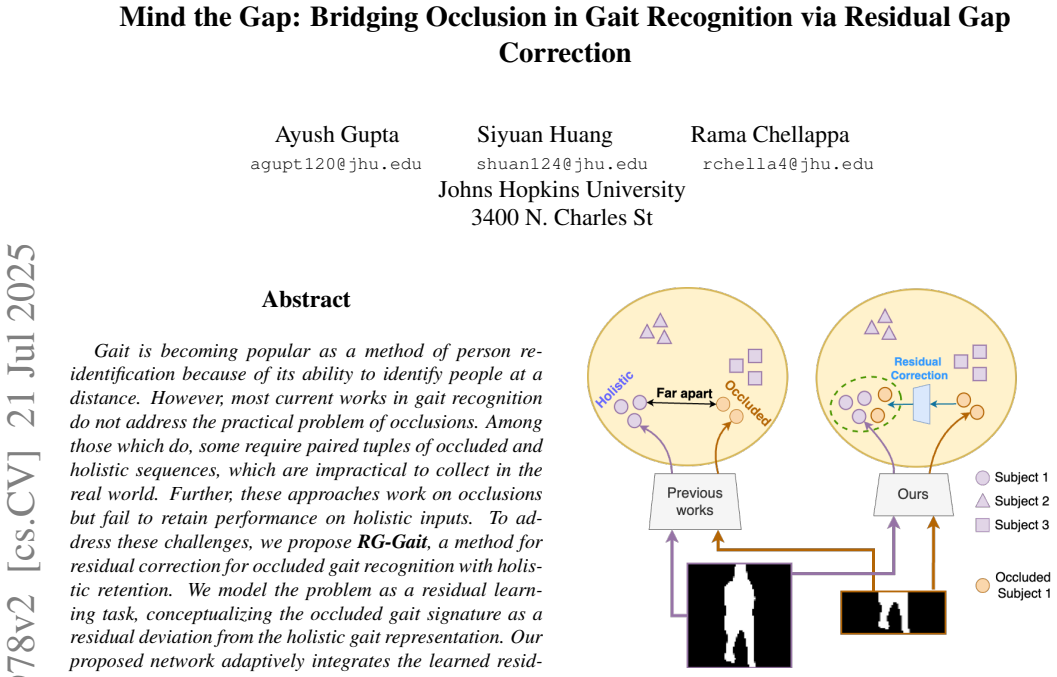
Pith's one-line read RG-Gait claims that occluded gait recognition can be improved by learning a residual correction against the holistic gait feature, adaptively added only under occlusion, without paired training data or loss of holistic accuracy.
desk verdict Strong occluded-gait results and a useful residual-correction idea, but Eq. 5 contradicts the paper's own definition of alpha; that load-bearing inconsistency has to be fixed before the numbers can be trusted. read the letter →
The pith
A machine-rendered reading of the paper's core claim, the machinery that carries it, and where it could break.
The reading
What carries the argument
The load-bearing mechanism is a residual correction feature R, produced by a Feature Restoration Network (FRN) from the silhouette sequence and an occlusion feature O, combined with the backbone's gait feature G as $f = G + \alpha R$. The scalar $\alpha$, output by an Occlusion Evaluation Module (OEM) trained to classify occlusion type and regress occlusion level, is meant to be close to 1 for complete silhouettes and to decrease with occlusion, so that the residual is applied when occlusion is present and stays near zero when the walk is fully visible. This adaptive feature integration is what the paper credits for both occluded accuracy and holistic retention.
What would settle it
Inspect the released code to see how the final feature is assembled. Feeding a clean sequence and a heavily occluded sequence, read the OEM score $\alpha$ and compare the norm of $\alpha R$ on both; the claimed mechanism requires this norm to be larger for the occluded input, while the literal equation predicts the opposite. Whether the code uses $f = G + \alpha R$ or $f = G + (1-\alpha)R$ decides the matter.
Extended reading notes
Core claim
The central claim is that a residual correction network, guided by an occlusion evaluation module, can restore discriminative identity cues missing from occluded silhouettes without degrading a backbone's performance on clean data. RG-Gait models the problem as residual learning: the Feature Restoration Network (FRN) receives the silhouette sequence and an occlusion feature vector O, and outputs a residual feature R; the final representation is $f = G + \alpha R$, where G is the backbone gait feature and $\alpha$ is a scalar occlusion quality score produced by the OEM. The OEM is trained to classify occlusion type and regress occlusion level, and the whole framework is trained in three stages so that the GSE stays holistic while the FRN learns only the correction. The paper argues that this adaptive integration is what lets the model improve occluded recognition while retaining holistic accuracy, and it demonstrates the effect across Gait3D, GREW, and BRIAR with different backbones.
Load-bearing premise
The method depends on the occlusion-quality score actually being used so that the residual grows as occlusion increases; as written, the formula $f = G + \alpha R$ with $\alpha$ close to 1 for clean silhouettes would add the residual most when there is no occlusion, so the real implementation must use a different weighting.
Editorial extensions
If this is right
- Occluded gait recognition can be improved without paired (occluded, complete) training tuples, removing a major data-collection bottleneck in real-world deployment.
- The residual correction is model-agnostic, so any gait recognition backbone can be upgraded for occlusion handling while retaining its holistic accuracy.
- The approach generalizes to occlusion types unseen in training, as shown by the generalizability and adaptability evaluations on middle and dynamic occlusions.
- Holistic performance is largely retained after occlusion training, unlike prior occlusion-specific methods that over-tune and drop on complete sequences.
- Because evaluation includes long-range and turbulent BRIAR data, the technique may extend to surveillance scenarios with heavy degradation.
Reading between the lines
- One testable extension is to check whether the final feature is actually computed as $f = G + \alpha R$ or as $f = G + (1-\alpha)R$; the paper's text alone does not decide this, and the choice determines whether the residual is gated by occlusion or by its absence.
- The same residual-correction idea could apply to other partial-observation recognition tasks, such as face recognition with masks or person re-identification with truncation, since those are also distribution shifts that a corrective additive term might bridge.
- Combining the learned residual with explicit generative reconstruction of occluded silhouettes might yield further gains, though the paper does not explore that direction.
- If holistic retention holds at the scales reported, the module could serve as a drop-in upgrade for existing surveillance pipelines without retraining their original holistic models.
Editorial analysis
A structured set of objections, weighed in public.
Referee Report
Summary. The paper presents RG-Gait, a model-agnostic module for occluded gait recognition. A Gait Signature Extractor (GSE) produces features G from silhouette sequences; an Occlusion Evaluation Module (OEM) outputs an occlusion feature O and a scalar α; a Feature Restoration Network (FRN) produces a residual R from the sequence and O; and the final feature is f = G + α·R. Training is carried out in three stages: OEM on synthetic occlusions, GSE on holistic data, then FRN with the OEM and GSE frozen. The method is evaluated on Gait3D, GREW, and BRIAR with GaitBase, DeepGaitV2, and SwinGait backbones, including ablations and generalizability/adaptability tests for new occlusion types. The central claims are that the residual is adaptively integrated mainly under occlusion and that holistic recognition accuracy is retained.
Significance. The proposed idea of treating the occluded representation as a residual deviation from a holistic representation is attractive and, if confirmed, would be practically useful because it avoids paired (occluded, complete) supervision and is backbone-agnostic. The paper releases code, evaluates on three datasets and three backbones, and includes component ablations and occlusion generalizability tests, which are strengths. The reported occluded Rank-1 gains over MimicGait are large. However, the adaptive weighting rule is described inconsistently in the text, and the central empirical claims lack error bars and are only partially documented for holistic retention, so the current manuscript cannot be accepted without substantive revision.
major comments (4)
- [§3.4, Eq. (5), §3.6, Supplementary §4] There is a load-bearing inconsistency in the definition of α and its use in the fusion rule. Section 3.4 states that α is 'close to 1 for complete silhouettes and decreases with occlusion,' but Eq. (5), f = G + α·R, then adds the residual at full strength for clean inputs and suppresses it for occluded inputs, which is the opposite of the adaptive behavior described in Section 3.6. The supplementary's OEM description says the regression head outputs approximately 0 for no occlusion and x for an occlusion magnitude of x, which would make Eq. (5) coherent but contradicts Section 3.4. Section 4.6's ablation discussion also treats α as 'a measure of the amount of occlusion present in the input.' As written, a reader cannot determine whether the implemented rule is f = G + α·R with α as an occlusion amount, f = G + (1−α)·R with α as a quality score, or something else. Since the occluded-performance gains in Table 1 and the holistic-retention claim in Fig. 5 both depend on this mechanism, the paper must resolve which definition and which fusion rule were actually used before the results can be interpreted.
- [Table 1, §4.8] The occluded evaluation uses randomly generated occlusions, so every evaluation run produces a different test set. Section 4.8 reports mean and standard deviation for only one configuration (Gait3D with GaitBase, 40.72 ± 1.14), while Table 1 and Table 4 report single-seed numbers without error bars. Because the evaluation data itself is random, the absence of variances for all configurations makes it difficult to assess the significance of the large reported margins, such as the 40.84 versus 22.72 Rank-1 difference on Gait3D. Please report mean ± standard deviation for all reported metrics, or justify why one configuration suffices.
- [Fig. 5, §4.5] Holistic performance retention is a central claim of the paper, but Fig. 5 presents it only for the GREW dataset and without numeric values or error bars. The text states that the method 'retains most of the holistic performance of the original backbone' but does not provide HPR numbers for Gait3D or BRIAR, nor a table quantifying the retention gap relative to the holistic upper bound. Please add quantitative HPR results for all datasets and backbones so that the holistic-retention claim can be verified.
- [§4.2, Table 1] It is not specified whether all compared methods are evaluated on identical randomly occluded test sequences (using the same seeds) or whether each method or run sees different occluded inputs. Because the occlusions are generated randomly, a fair comparison requires fixing the occluded test inputs across all methods or reporting paired-test statistics. Please state the evaluation protocol explicitly, including the random seed handling, in the main text.
minor comments (5)
- [Section 1 (Contributions)] The first contribution bullet says the method 'models holistic features as a residual deviation from occluded features,' while Section 3.5 says 'occluded features to be a residual deviation from the holistic features.' Please align the wording to avoid confusion about the direction of the residual.
- [Table 1 caption] The caption says values in parentheses denote the RP metric, but the BRIAR columns include TAR@0.01 FAR and its parenthetical value as well. Please clarify whether RP is applied to verification metrics and how it is computed there.
- [Figure 5] Figure 5 lacks axis labels and numerical values. Adding them would make the holistic retention comparison interpretable.
- [Supplementary Section 5] The GREW evaluation uses an adapted protocol based on 6,000 subjects with two sequences each, not the official GREW probe set. This is disclosed in the supplement, but it should also be stated in the main paper near Table 1 so readers do not mistake the results for official GREW evaluation.
- [Table 4] The generalizability and adaptability results in Table 4 are reported without error bars. Given the randomness of the occlusion generation, these results need the same treatment requested for Table 1.
Circularity Check
No significant circularity: central results are benchmark-driven; the α-polarity tension in Eq. 5 is a consistency issue, not a circular derivation.
full rationale
RG-Gait's derivation chain is self-contained as an empirical learning method: the GSE is any existing backbone, the OEM is trained on synthetic occlusion labels (Sec. 3.4, 3.7), the FRN outputs a residual R, and the final feature f = G + αR is trained with triplet and cross-entropy losses (Eqs. 5-6). No fitted parameter is later renamed as a prediction; the occluded Rank-1/RP results in Tables 1, 2 and 4 are direct benchmark evaluations against prior baselines, and Table 3 ablates each component. The only genuinely problematic passage is an internal consistency issue, not circularity: Sec. 3.4 defines α as 'close to 1 for complete silhouettes and decreases with occlusion,' while Sec. 3.6 claims clean inputs should rely primarily on direct gait features; under Eq. 5 that would add the residual at full strength on clean inputs unless R is trained to vanish there, which is not stated. This is a sign/reproducibility ambiguity, not a reduction of the claimed outcome to its inputs. The reuse of the authors' prior OEM/fusion components [8,9] is not load-bearing: those works are cited as baselines and building blocks, and the central gain is demonstrated by independent ablations and external benchmark numbers.
Assumptions & free parameters
free parameters (4)
- Loss weights lambda1, lambda2, lambda3 =
0.1, 1, 1
- Triplet margin =
0.2
- Frame count n =
30
- Synthetic occlusion magnitude =
up to 60% of subject
assumptions (4)
- domain assumption Silhouette extraction via Detectron2 yields accurate binary masks with subject centered; frames with no subject become empty black frames.
- domain assumption Synthetic top/bottom/middle/moving black occlusions on silhouettes are representative of real-world occlusions.
- domain assumption The triplet and cross-entropy losses on the final feature f induce a metric space where occluded and holistic features are comparable.
- ad hoc to paper The OEM regression head output maps monotonically to occlusion severity and alpha in [0,1] is a valid quality score.
invented entities (2)
-
Residual correction feature R
-
Occlusion quality score alpha
Cite this review
Pith. "Pith review of Mind the Gap: Bridging Occlusion in Gait Recognition via Residual Gap Correction." pith.science (2026). https://pith.science/paper/6ESSQMQ2
@misc{pith2026250710978,
  author       = {Pith},
  title        = {Pith review of: Mind the Gap: Bridging Occlusion in Gait Recognition via Residual Gap Correction},
  year         = {2026},
  howpublished = {\url{https://pith.science/paper/6ESSQMQ2}},
  note         = {Machine review of arXiv:2507.10978}
}
read the original abstract
Gait is becoming popular as a method of person re-identification because of its ability to identify people at a distance. However, most current works in gait recognition do not address the practical problem of occlusions. Among those which do, some require paired tuples of occluded and holistic sequences, which are impractical to collect in the real world. Further, these approaches work on occlusions but fail to retain performance on holistic inputs. To address these challenges, we propose RG-Gait, a method for residual correction for occluded gait recognition with holistic retention. We model the problem as a residual learning task, conceptualizing the occluded gait signature as a residual deviation from the holistic gait representation. Our proposed network adaptively integrates the learned residual, significantly improving performance on occluded gait sequences without compromising the holistic recognition accuracy. We evaluate our approach on the challenging Gait3D, GREW and BRIAR datasets and show that learning the residual can be an effective technique to tackle occluded gait recognition with holistic retention. We release our code publicly at https://github.com/Ayush-00/rg-gait.
Figures


Figures from the paper (4 more)


Reference graph
Works this paper leans on
-
[1]
C. Chheng and D. Wilson. Abnormal gait detection using wearable hall-effect sensors. Sensors, 21(4):1206, 2021. 2
work page 2021
-
[2]
D. Cornett, J. Brogan, N. Barber, D. Aykac, S. Baird, N. Burchfield, C. Dukes, A. Duncan, R. Ferrell, J. God- dard, G. Jager, M. Larson, B. Murphy, C. Johnson, I. Shelley, N. Srinivas, B. Stockwell, L. Thompson, M. Yohe, R. Zhang, S. Dolvin, H. J. Santos-Villalobos, and D. S. Bolme. Expand- ing accurate person recognition to new altitudes and ranges: The ...
work page 2023
-
[3]
C. Fan, S. Hou, Y . Huang, and S. Yu. Exploring deep models for practical gait recognition. arXiv preprint arXiv:2303.03301, 2023. 1, 2, 4, 6
arXiv 2023
-
[4]
C. Fan, J. Liang, C. Shen, S. Hou, Y . Huang, and S. Yu. Opengait: Revisiting gait recognition towards better practi- cality. In Proceedings of the IEEE/CVF Conference on Com- puter Vision and Pattern Recognition (CVPR), pages 9707– 9716, June 2023. 1, 2, 4, 6
work page 2023
-
[5]
Filipi Gonc ¸alves dos Santos, D
C. Filipi Gonc ¸alves dos Santos, D. d. S. Oliveira, L. A. Pas- sos, R. Gonc ¸alves Pires, D. Felipe Silva Santos, L. Pas- cotti Valem, T. P. Moreira, M. Cleison S. Santana, M. Roder, J. Paulo Papa, and D. Colombo. Gait recognition based on deep learning: A survey. ACM Comput. Surv. , 55(2), jan
-
[6]
Y . Guo, C. Peng, C. P. Lau, and R. Chellappa. Multi-modal human authentication using silhouettes, gait and rgb. In2023 IEEE 17th International Conference on Automatic Face and Gesture Recognition (FG), pages 1–7, 2023. 2
work page 2023
-
[7]
Y . Guo, A. Shah, J. Liu, A. Gupta, R. Chellappa, and C. Peng. Gaitcontour: Efficient gait recognition based on a contour-pose representation. In Proceedings of the Win- ter Conference on Applications of Computer Vision (WACV), pages 1051–1061, February 2025. 2
work page 2025
-
[8]
A. Gupta and R. Chellappa. You can run but not hide: Im- proving gait recognition with intrinsic occlusion type aware- ness. In Proceedings of the IEEE/CVF Winter Conference on Applications of Computer Vision (WACV), pages 5893–5902, January 2024. 1, 2, 3, 4, 5, 6, 7, 8
work page 2024
Show all 35 references
-
[9]
Gupta and R
A. Gupta and R. Chellappa. Mimicgait: A model agnostic approach for occluded gait recognition using correlational knowledge distillation. In Proceedings of the Winter Con- ference on Applications of Computer Vision (WACV), pages 4757–4766, February 2025. 1, 2, 4, 5, 6, 7, 8
2025
-
[10]
K. He, X. Zhang, S. Ren, and J. Sun. Deep residual learn- ing for image recognition. In Proceedings of the IEEE con- ference on computer vision and pattern recognition , pages 770–778, 2016. 2
2016
-
[11]
R. Kaur, K. Sridhar, S. Park, Y . Yang, S. Jha, A. Roy, O. Sokolsky, and I. Lee. Codit: Conformal out-of- distribution detection in time-series data for cyber-physical systems. In Proceedings of the ACM/IEEE 14th Interna- tional Conference on Cyber-Physical Systems (with CPS- ...
2023
-
[12]
Kirkpatrick, R
J. Kirkpatrick, R. Pascanu, N. Rabinowitz, J. Veness, G. Des- jardins, A. A. Rusu, K. Milan, J. Quan, T. Ramalho, A. Grabska-Barwinska, D. Hassabis, C. Clopath, D. Ku- maran, and R. Hadsell. Overcoming catastrophic forgetting in neural networks. Proceedings of the National Aca...
2017
-
[13]
S. Li, C. H. Liu, Q. Lin, Q. Wen, L. Su, G. Huang, and Z. Ding. Deep residual correction network for partial do- main adaptation. IEEE transactions on pattern analysis and machine intelligence, 43(7):2329–2344, 2020. 2
2020
-
[14]
B. Lin, S. Zhang, and X. Yu. Gait Recognition via Effec- tive Global-Local Feature Representation and Local Tempo- ral Aggregation. In 2021 IEEE/CVF International Confer- ence on Computer Vision (ICCV), pages 14628–14636, Mon- treal, QC, Canada, Oct. 2021. IEEE. 4
2021
-
[15]
M. Long, H. Zhu, J. Wang, and M. I. Jordan. Unsupervised domain adaptation with residual transfer networks.Advances in neural information processing systems, 29, 2016. 2
2016
-
[16]
V . D. Nguyen, P. Mantini, and S. K. Shah. Acml: Attention- based cross-modality learning for cloth-changing and oc- cluded person re-identification. In 2024 IEEE International Conference on Image Processing (ICIP), pages 2396–2402,
2024
-
[17]
V . D. Nguyen, P. Mantini, and S. K. Shah. Crossvit- reid: Cross-attention vision transformer for occluded cloth- changing person re-identification. In Proceedings of the Asian Conference on Computer Vision (ACCV), pages 3982– 3999, December 2024. 2
2024
-
[18]
V . D. Nguyen, P. Mantini, and S. K. Shah. Occluded cloth- changing person re-identification via occlusion-aware ap- pearance and shape reasoning. In 2024 IEEE International Conference on Advanced Video and Signal Based Surveil- lance (AVSS), pages 1–8, 2024. 2
2024
-
[19]
V . D. Nguyen, P. Mantini, and S. K. Shah. Occlusion- aware cross-attention fusion for video-based occluded cloth- changing person re-identification. In 2024 IEEE Interna- tional Joint Conference on Biometrics (IJCB) , pages 1–11,
2024
-
[20]
G. Park, K. M. Lee, and S. Koo. Uniqueness of gait kinemat- ics in a cohort study. Scientific Reports, 11(1):15248, 2021. 2
2021
-
[21]
Prasanth, M
H. Prasanth, M. Caban, U. Keller, G. Courtine, A. Ijspeert, H. Vallery, and J. von Zitzewitz. Wearable sensor-based real- time gait detection: A systematic review. Sensors, 21(8),
-
[22]
J. P. Singh, S. Jain, U. P. Singh, and S. Arora. Hybrid neu- ral network model for reconstruction of occluded regions in multi-gait scenario. Multimedia Tools and Applications , 81(7):9607–9629, 2022. 2
2022
-
[23]
C. Song, Y . Huang, W. Wang, and L. Wang. Casia-e: a large comprehensive dataset for gait recognition. IEEE transactions on pattern analysis and machine intelligence , 45(3):2801–2815, 2022. 2
2022
-
[24]
L. Sun, Y . Wu, Z. Fan, X. Ding, Y . Huang, and J. Paisley. A deep error correction network for compressed sensing mri. BMC Biomedical Engineering, 2:1–12, 2020. 3
2020
-
[25]
W. Tao, T. Liu, R. Zheng, and H. Feng. Gait analysis using wearable sensors. Sensors (Basel, Switzerland), 12:2255–83, 12 2012. 2
2012
-
[26]
Uddin, D
M. Uddin, D. Muramatsu, N. Takemura, M. Ahad, A. Rah- man, Y . Yagi, et al. Spatio-temporal silhouette sequence reconstruction for gait recognition against occlusion. IPSJ Transactions on Computer Vision and Applications, 11(1):1– 18, 2019. 2
2019
-
[27]
Z.-Y . Wang, J. Liu, J. Chen, and R. Chellappa. Vm-gait: Multi-modal 3d representation based on virtual marker for gait recognition. In Proceedings of the Winter Conference on Applications of Computer Vision (WACV) , pages 5326– 5335, February 2025. 2
2025
-
[28]
Y . Wu, A. Kirillov, F. Massa, W.-Y . Lo, and R. Gir- shick. Detectron2. https : / / github . com / facebookresearch/detectron2, 2019. 1
2019
-
[29]
C. Xu, Y . Makihara, X. Li, and Y . Yagi. Occlusion-Aware Human Mesh Model-Based Gait Recognition. IEEE Trans- actions on Information Forensics and Security , 18:1309– 1321, 2023. Conference Name: IEEE Transactions on In- formation Forensics and Security. 2
2023
-
[30]
C. Xu, S. Tsuji, Y . Makihara, X. Li, and Y . Yagi. Oc- cluded gait recognition via silhouette registration guided by automated occlusion degree estimation. In Proceedings of the IEEE/CVF International Conference on Computer Vision (ICCV) Workshops, pages 3199–3209, October 2023. 2
2023
-
[31]
Zhang, Y
W. Zhang, Y . Ling, Z. Chen, K. Ren, S. Chen, P. Huang, and Y . Tan. Wearable sensor-based quantitative gait analysis in parkinson’s disease patients with different motor subtypes. npj Digital Medicine, 7(1):169, 2024. 2
2024
-
[32]
Zhang, L
Z. Zhang, L. Tran, X. Yin, Y . Atoum, X. Liu, J. Wan, and N. Wang. Gait recognition via disentangled representation learning. In Proceedings of the IEEE/CVF conference on computer vision and pattern recognition, pages 4710–4719,
-
[33]
H. Zhao, R. Wang, D. Qi, J. Xie, J. Cao, and W.-H. Liao. Wearable gait monitoring for diagnosis of neurodegenerative diseases. Measurement, 202:111839, 2022. 2
2022
-
[34]
Zheng, X
J. Zheng, X. Liu, W. Liu, L. He, C. Yan, and T. Mei. Gait recognition in the wild with dense 3d representations and a benchmark. In IEEE Conference on Computer Vision and Pattern Recognition (CVPR), 2022. 2, 4, 5
2022
-
[35]
Z. Zhu, X. Guo, T. Yang, J. Huang, J. Deng, G. Huang, D. Du, J. Lu, and J. Zhou. Gait recognition in the wild: A benchmark. In Proceedings of the IEEE/CVF international conference on computer vision , pages 14789–14799, 2021. 2, 4, 5
2021
Reviewed August 6, 2026 · model on record in the stance chip above.
Discussion (0). Sign in to comment.