REVIEW 3 major objections 4 minor 1 cited by
The Rosetta Stone project. III. ALMA synthetic observations of fragmentation in high-mass star-forming clumps
T0 review · 3 major / 4 minor · reviewed 2026-08-06 · deepseek-v4-flash
Pith's one-line read Simulated ALMA observations of collapsing high-mass clumps show that magnetic field strength, not initial mass or turbulence, most strongly controls how many fragments an interferometer detects at ~7000 AU: strongly magnetized clumps…
desk verdict Solid, reusable pipeline paper whose headline magnetization claim rests mainly on one turbulent seed and should be softened before it is used to interpret SQUALO fragment counts. read the letter →
The pith
A machine-rendered reading of the paper's core claim, the machinery that carries it, and where it could break.
The reading
What carries the argument
The central object is an end-to-end post-processing chain that turns radiative magnetohydrodynamical simulations into realistic interferometric observations: the simulated density and temperature fields are run through radiative transfer to produce 1.3 mm intensity maps, then through an interferometric simulator tuned to the exact array configuration, elevation, weather, and cleaning settings of the reference ALMA survey, and finally through the same source-extraction and photometry pipeline used on the real data. The physical parameter carrying the argument is the normalized mass-to-flux ratio $\mu$, which orders the models from quasi-hydrodynamic to strongly magnetized states; the turbulence level, set by the Mach number at 7 or 10, has little effect on the recovered multiplicity. This machinery lets the comparison between theory and observation be one-to-one in resolution, noise, spatial filtering, and source-identification bias.
What would settle it
Measure magnetic field strengths toward a sample of SQUALO-like clumps spanning the observed 0 to 14 fragment range at ~7000 AU resolution, using dust polarization or Zeeman observations, and check whether clumps with few fragments are systematically those with low $\mu$ (strong fields) at $L/M > 20$; a null or inverted correlation between fragment count and field strength would falsify the paper's central inference.
Extended reading notes
Core claim
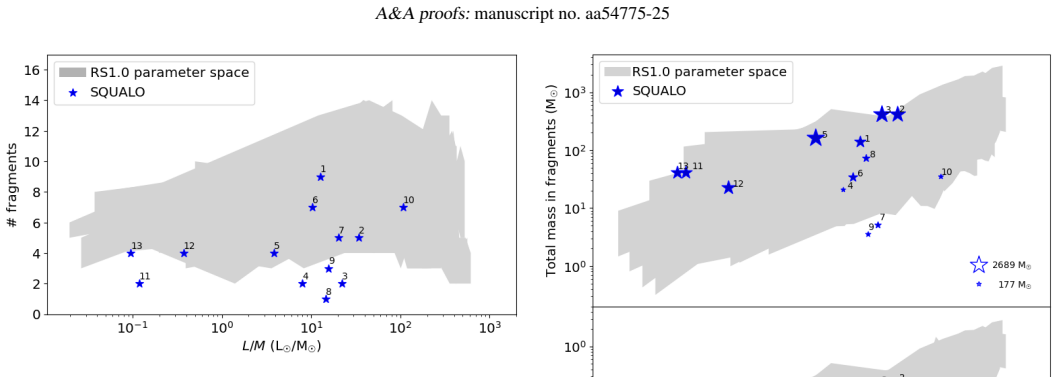
At a fixed linear resolution of ~7000 AU, the fragment multiplicity recovered from 1.3 mm dust continuum observations is governed mainly by the clump's magnetization, parameterized by the normalized mass-to-flux ratio $\mu$, with the quasi-hydrodynamic ($\mu=100$) realizations producing more fragments than the magnetized ($\mu=3$ and $\mu=10$) realizations once the clump evolves past $L/M\simeq 20\,L_\odot/M_\odot$. The paper argues that the SQUALO clumps, with 1 to 9 observed fragments, are therefore most likely magnetized, while clumps with more than about 11 fragments require sub-dominant magnetic fields. It also shows that ~75% of the detected fragments correspond to one or several sink particles, that the remaining ~25% are starless overdensities, projection artifacts, or transient structures, and that both fragments and sinks accrete mass throughout the collapse, favoring a hierarchical, clump-fed star-formation scenario over one in which fragments are isolated.
Load-bearing premise
The mapping from fragment counts to magnetization assumes that real high-mass clumps resemble the simulated isolated, uniform, 10 K spheres with a single uniform magnetic field and no outflows or HII regions; if real clumps are fed by filaments, have tangled fields, or are significantly heated by feedback, the fragment-count-to-magnetization link may not transfer.
Editorial extensions
If this is right
- If fragment counts at ~7000 AU are set mainly by magnetization, then ALMA surveys can use multiplicity as a first-pass magnetic-regime indicator before dedicated polarimetric or Zeeman measurements.
- The SQUALO clumps with 1 to 9 fragments are probably magnetized, while clumps showing more than about 11 fragments are likely to have sub-dominant magnetic fields.
- Fragment multiplicity cannot be equated with star multiplicity: about a quarter of detected fragments have no sink counterpart, and multiple sinks can lie inside a single ~7000 AU fragment, supporting hierarchical fragmentation.
- The fragment formation efficiency exceeding the sink formation efficiency at all stages implies continuous mass accretion from the parent clump, consistent with a clump-fed star-formation scenario.
- The absence of synthetic clumps with zero or one fragment suggests that such observed cases require either stronger magnetization than explored here or additional physics such as outflows, HII regions, or filamentary accretion.
Reading between the lines
- Editorial inference: a direct test of the paper's central claim would be to measure magnetic field strengths, via dust polarization or Zeeman observations, toward a sample of SQUALO-like clumps and check whether low-fragment clumps are systematically those with low $\mu$ at $L/M > 20$.
- Editorial inference: the same pipeline, adapted to a higher-resolution survey at ~2000 AU, should reveal more fragments overall, and the magnetization signal may shift or weaken as smaller-scale fragmentation is resolved.
- Editorial inference: the lack of outflows and HII regions likely means the simulations underestimate local temperatures in the most evolved stages, so real feedback could reduce the number and mass of detectable fragments and may explain the observed one- and two-fragment clumps not reproduced by the grid.
- Editorial inference: because real observers see only one projection, the spread across the three synthetic lines of sight gives a lower bound on how much of the magnetization-versus-multiplicity signal can be recovered in a single ALMA field.
Editorial analysis
A structured set of objections, weighed in public.
Referee Report
Summary. This paper presents the third installment of the Rosetta Stone project, an end-to-end framework that connects RMHD simulations of high-mass clump fragmentation to ALMA observations through synthetic observations. The authors run 24 radiative MHD simulations varying clump mass (500, 1000 Msun), turbulent Mach number (7, 10), normalized mass-to-flux ratio (3, 10, 100), and turbulent seed (1, 2), post-process the outputs with RADMC-3D and CASA to mimic the SQUALO survey's 1.3 mm observing strategy, and extract compact sources with the Hyper code. They then compare fragment multiplicities, masses, distances, and fragment formation efficiencies across 732 synthetic fields with the 13 SQUALO clumps. The central claims are that magnetic fields have the largest impact on fragment multiplicity at ~7000 AU, that low fragment counts preferentially indicate magnetized clumps, that ~75% of fragments are associated with sink particles, and that fragments continuously accrete from the parent clump, supporting a clump-fed scenario.
Significance. If the magnetization-fragment multiplicity relation is robust, the paper offers a direct observational diagnostic of the magnetic regime of parsec-scale clumps from ALMA continuum counts alone. The strengths of the work are the systematic and reproducible post-processing pipeline (RAMSES -> RADMC-3D -> CASA -> Hyper -> SQUALO comparison), the validation of fragment temperatures and masses against simulation truth in Sec. 3.2, and the quantitative fragment-sink association statistics in Table 3. The forward modeling is not circular: the synthetic observations are post-processed outputs compared with real data rather than fitted to them. The main scientific caveat is the evident seed-dependence of the headline magnetization result, which is documented by the authors themselves in Appendix D.
major comments (3)
- [Sec. 4.1, Fig. 5, Appendix D] The headline claim that magnetic fields have the largest impact on fragment multiplicity at ~7000 AU is not robust across turbulent seeds. The main analysis in Sec. 2.3 is restricted to Seed 2, while Seed 1 is reported only in Appendix D, which states that for S1 'the impact of the clump magnetization on the number of fragments is less clear, especially across the M500 realizations' and that 'stochasticity has larger impact on the fragmentation, and its effects seem to counteract the magnetic regulation.' With two seeds and no significance test, the separation between mu=100 and mu=3/10 seen in Fig. 5 for L/M > 20 could be a single-random-realization effect. Appendix E reinforces this concern by showing that seed variations can dominate fragmentation (e.g., M1000_mu10_M7_S4). Because the Abstract and Sec. 6 state the 'largest impact' claim unconditionally, and because Sec. 5.2.1 uses it to infer that SQUALO clumps with 1-9 fragments are magnetized, the central result needs a quantitative seed-level analysis (e.g., per-parameter distributions of S1 vs S2, or a permutation test) and a revised statement that is conditional on the seed dependence.
- [Sec. 2.3, Figs. 5-7] The statistical basis for the 'largest impact' comparison is not established because the 732 synthetic fields are not independent samples: they are three fixed orthogonal projections of the same time series for each of the 24 realizations, and adjacent time steps are strongly correlated. The shaded bands in Figs. 5-7 combine projection scatter with time-step correlations, so statements such as 'only a few maps are characterized by the presence of two fragments' and the relative ranking of mu values are not supported by a stated statistical test. I ask the authors to report the number of independent realization-time steps per parameter cell and to provide a proper test (e.g., bootstrap over realizations, or mixed-effects model) for the multiplicity differences they report.
- [Sec. 5.2.1, Appendix E] The inference that the SQUALO clumps (1-9 fragments) are preferentially magnetized is weakened by the acknowledged inability of the RS1.0 grid to reproduce the low-fragment tail. The text states that no synthetic field shows a single fragment and only a few show two, and Appendix E shows that the control models (Bonnor-Ebert, Mach 3, additional seeds) do not systematically populate this region either. The comparison in Fig. 9 thus rests on an incomplete empirical anchor on the low-multiplicity side. Please make the conditional nature of the magnetization inference explicit and quantify how much of the SQUALO sample actually falls inside the simulated parameter space, rather than in extrapolated regions.
minor comments (4)
- [Table 1, Eq. (1)] The symbol M is used both for the clump mass (M(Msun)) and for the Mach number (M), which is confusing; please use e.g. M_cl for mass and a script M or Mach for the Mach number.
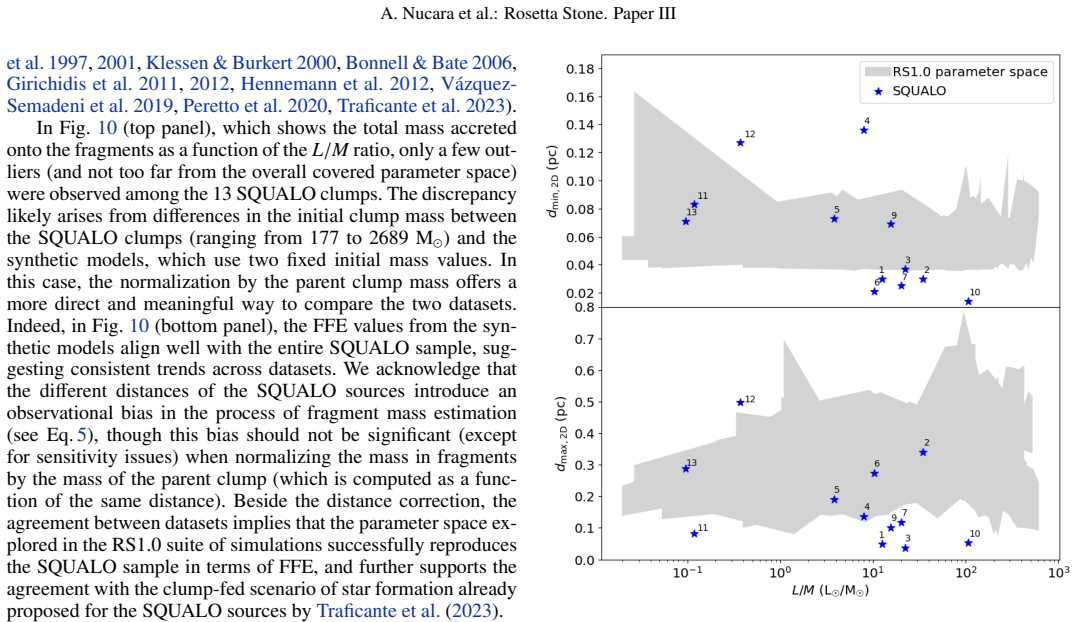
- [Sec. 3.2.2, Fig. 6, Sec. 5.2.2] The total fragment mass is reported to exceed the initial clump mass in the most evolved synthetic stages; although this is attributed to the temperature prescription, the same prescription underlies the total-mass and FFE comparisons with SQUALO in Fig. 10. Please add an explicit caveat in Sec. 5.2.2 that the FFE values at high L/M are affected by this known overestimate.
- [Appendix E, first paragraph] The phrase 'to test the effect of of two additional seeds' contains a duplicated 'of'.
- [Abstract] The sentence 'Among the initial conditions of the simulations, magnetic fields have the largest impact on the fragment multiplicity at these scales' is stated without the seed-dependence caveat documented in Appendix D; please qualify it in the abstract as well.
Circularity Check
No significant circularity: the fragment-multiplicity results are forward-model outputs benchmarked against external SQUALO data; only the internal SFE-to-L/M calibration (Paper II) is a minor self-citation.
full rationale
The paper's derivation chain is: RMHD simulations with clearly stated initial conditions (Sec. 2.1) -> RADMC-3D radiative transfer -> CASA post-processing mimicking the SQUALO observing strategy (Sec. 2.2) -> Hyper source extraction (Sec. 2.3) -> fragment counts and properties (Secs. 3-4) -> comparison with the external SQUALO sample (Sec. 5.2). The central claims - that within this grid the magnetic field has the largest impact on fragment multiplicity at ~7000 AU, and that low-multiplicity SQUALO clumps are likely magnetized - are not obtained by fitting any parameter to the SQUALO fragment counts. The grid is not tuned to reproduce SQUALO: the paper explicitly reports that the 1-2-fragment SQUALO sources are not reproduced (Sec. 5.2.1, App. E), and the control models also fail to systematically produce them. The only imported calibration is the SFE-to-L/M relation of Paper II, Eq. 4, which is used as the evolutionary coordinate. This is a self-citation with overlapping authors, and it is mildly load-bearing for the SQUALO overlay; however, the mu-dependent separation in Fig. 5 is a direct simulation output and would persist on an SFE axis, so the main inference does not reduce to the fit. The paper's own caveats (Appendix D: seed S1 makes the magnetization effect 'less clear' and stochasticity 'counteract[s] the magnetic regulation'; Sec. 5.2.3: isolated boxes without large-scale dynamics) are robustness limitations, not evidence of definitional circularity. Score 2 reflects one minor internal calibration/self-citation; no prediction in the paper is equivalent to its inputs by construction.
Assumptions & free parameters
free parameters (9)
- Initial clump mass M =
500, 1000 Msun
- Initial clump radius R =
0.383 pc
- Initial gas temperature =
10 K
- Turbulent Mach number =
7 and 10
- Normalized mass-to-flux ratio mu =
3, 10, 100
- Turbulent seed =
1, 2 (plus S3, S4 controls)
- Sink formation density threshold =
1e9 cm^-3
- Accretion luminosity factor f_acc =
0.1 reference, tested 0.01-1
- Paper II L/M-SFE calibration coefficients =
slope 1.20, intercept 3.28
assumptions (5)
- domain assumption Ideal MHD is sufficient for the collapse of ~0.4 pc high-mass clumps
- domain assumption An isolated, uniform-density spherical clump with no incoming large-scale flow is representative of SQUALO clumps
- domain assumption Accretion luminosity (without outflows or HII regions) is adequate feedback for the evolved stages studied
- domain assumption A single dust opacity at 1.3 mm with gas-to-dust ratio 100 applies to all fragments
- domain assumption One dust temperature per clump, assigned from L/M ranges in Table 2, is adequate for fragment mass estimates
Cite this review
Pith. "Pith review of The Rosetta Stone project. III. ALMA synthetic observations of fragmentation in high-mass star-forming clumps." pith.science (2026). https://pith.science/paper/SVDTFHEL
@misc{pith2026250711032,
  author       = {Pith},
  title        = {Pith review of: The Rosetta Stone project. III. ALMA synthetic observations of fragmentation in high-mass star-forming clumps},
  year         = {2026},
  howpublished = {\url{https://pith.science/paper/SVDTFHEL}},
  note         = {Machine review of arXiv:2507.11032}
}
read the original abstract
The physical mechanisms that regulate the collapse of high-mass parsec-scale clumps and allow them to form clusters of new stars represent a crucial aspect of star formation. To investigate these mechanisms, we developed the Rosetta Stone project: an end-to-end (simulations-observations) framework that is based on the systematic production of realistic synthetic observations of clump fragmentation and their comparison with real data. In this work, we compare ALMA 1.3mm continuum dust emission observations from the SQUALO survey with a new set of 24 radiative magnetohydrodynamical simulations of high-mass clump fragmentation, post-processed using the CASA software to mimic the observing strategy of SQUALO. The simulations were initialized combining typical values of clump mass (500,1000 solar masses) and radius (~0.4pc) with two levels of turbulence (Mach number of 7,10) and three levels of magnetization (mass-to-flux ratio of ~3,10,100). Following the clump evolution over time with two random seeds projected along three orthogonal directions, we produced a collection of 732 synthetic fields. The synthetic observations of clump fragmentation at ~7000AU revealed between 2 and 14 fragments per field. Among the initial conditions of the simulations, magnetic fields have the largest impact on the fragment multiplicity at these scales. In advanced stages of clump evolution, a lower number of fragments is preferentially associated with magnetized clumps. Fragments identified at ~7000AU correspond to individual or multiple sink particles in ~75% of the cases, suggesting that not all fragments are actively forming stars. Both sinks and fragments accrete mass throughout the whole clump evolution, favoring a scenario in which fragments are not isolated from the environment. Our study demonstrates the importance of synthetic observations in interpreting results from interferometric observations.
Figures


Figures from the paper (8 more)



Forward citations
Cited by 1 Pith paper
-
How Should We Understand the Core Mass Function? A memo of the CMF2IMF conference at ESO Garching
The high-mass slope of the core mass function depends strongly on the minimum fitting mass: completeness-based fits look top-heavy, while KS-selected tail fits move toward Salpeter, and the early-stage ASHES sample ap...
Reference graph
Works this paper leans on
-
[1]
A \ n ez-L \'o pez , N., Busquet , G., Koch , P. M., et al. 2020, http://dx.doi.org/10.1051/0004-6361/202039152 magenta , 644, A52 https://ui.adsabs.harvard.edu/abs/2020A&A...644A..52A
-
[2]
Avison , A., Fuller , G. A., Peretto , N., et al. 2021, http://dx.doi.org/10.1051/0004-6361/201936043 magenta , 645, A142 https://ui.adsabs.harvard.edu/abs/2021A&A...645A.142A
-
[3]
S., Mac Low , M
Ballesteros-Paredes , J., Klessen , R. S., Mac Low , M. M., & Vazquez-Semadeni , E. 2007, in Protostars and Planets V, ed. B. Reipurth , D. Jewitt , & K. Keil , 63 https://ui.adsabs.harvard.edu/abs/2007prpl.conf...63B
2007
-
[4]
Beuther , H., Gieser , C., Soler , J. D., et al. 2024, http://dx.doi.org/10.1051/0004-6361/202348117 magenta , 682, A81 https://ui.adsabs.harvard.edu/abs/2024A&A...682A..81B
-
[5]
Beuther , H., Gieser , C., Suri , S., et al. 2021, http://dx.doi.org/10.1051/0004-6361/202040106 magenta , 649, A113 https://ui.adsabs.harvard.edu/abs/2021A&A...649A.113B
-
[6]
Beuther , H., Mottram , J. C., Ahmadi , A., et al. 2018, http://dx.doi.org/10.1051/0004-6361/201833021 magenta , 617, A100 https://ui.adsabs.harvard.edu/abs/2018A&A...617A.100B
-
[7]
Bjorkman , J. E. & Wood , K. 2001, http://dx.doi.org/10.1086/321336 magenta , 554, 615 https://ui.adsabs.harvard.edu/abs/2001ApJ...554..615B
doi:10.1086/321336 2001
-
[8]
Bleuler , A. & Teyssier , R. 2014, http://dx.doi.org/10.1093/mnras/stu2005 magenta , 445, 4015 https://ui.adsabs.harvard.edu/abs/2014MNRAS.445.4015B
Show all 105 references
-
[9]
2024, http://dx.doi.org/10.1051/0004-6361/202348920 magenta , 688, A30 https://ui.adsabs.harvard.edu/abs/2024A&A...688A..30B
Bonanomi , F., Hacar , A., Socci , A., Petry , D., & Suri , S. 2024, http://dx.doi.org/10.1051/0004-6361/202348920 magenta , 688, A30 https://ui.adsabs.harvard.edu/abs/2024A&A...688A..30B
2024 doi
-
[10]
Bonnell , I. A. & Bate , M. R. 2006, http://dx.doi.org/10.1111/j.1365-2966.2006.10495.x magenta , 370, 488 https://ui.adsabs.harvard.edu/abs/2006MNRAS.370..488B
2006
-
[11]
A., Bate , M
Bonnell , I. A., Bate , M. R., Clarke , C. J., & Pringle , J. E. 1997, http://dx.doi.org/10.1093/mnras/285.1.201 magenta , 285, 201 https://ui.adsabs.harvard.edu/abs/1997MNRAS.285..201B
1997 doi
-
[12]
A., Bate , M
Bonnell , I. A., Bate , M. R., Clarke , C. J., & Pringle , J. E. 2001, http://dx.doi.org/10.1046/j.1365-8711.2001.04270.x magenta , 323, 785 https://ui.adsabs.harvard.edu/abs/2001MNRAS.323..785B
2001
-
[13]
2025, http://dx.doi.org/10.1051/0004-6361/202452706 magenta , 696, A151 https://ui.adsabs.harvard.edu/abs/2025A&A...696A.151C
Coletta , A., Molinari , S., Schisano , E., et al. 2025, http://dx.doi.org/10.1051/0004-6361/202452706 magenta , 696, A151 https://ui.adsabs.harvard.edu/abs/2025A&A...696A.151C
2025 doi
-
[14]
2024, http://dx.doi.org/10.1051/0004-6361/202348983 magenta , 686, A155 https://ui.adsabs.harvard.edu/abs/2024A&A...686A.155C
Colman , T., Brucy , N., Girichidis , P., et al. 2024, http://dx.doi.org/10.1051/0004-6361/202348983 magenta , 686, A155 https://ui.adsabs.harvard.edu/abs/2024A&A...686A.155C
2024 doi
-
[15]
2012, http://dx.doi.org/10.1051/0004-6361/201118706 magenta , 545, A98 https://ui.adsabs.harvard.edu/abs/2012A&A...545A..98C
Commer c on , B., Launhardt , R., Dullemond , C., & Henning , T. 2012, http://dx.doi.org/10.1051/0004-6361/201118706 magenta , 545, A98 https://ui.adsabs.harvard.edu/abs/2012A&A...545A..98C
2012 doi
-
[16]
F., Testi , L., et al
Curone , P., Izquierdo , A. F., Testi , L., et al. 2022, http://dx.doi.org/10.1051/0004-6361/202142748 magenta , 665, A25 https://ui.adsabs.harvard.edu/abs/2022A&A...665A..25C
2022 doi
-
[17]
2015, http://dx.doi.org/10.1093/mnrasl/slv105 magenta , 453, L73 https://ui.adsabs.harvard.edu/abs/2015MNRAS.453L..73D
Dipierro , G., Price , D., Laibe , G., et al. 2015, http://dx.doi.org/10.1093/mnrasl/slv105 magenta , 453, L73 https://ui.adsabs.harvard.edu/abs/2015MNRAS.453L..73D
2015 doi
-
[18]
M., Dobbs , C
Duarte-Cabral , A., Acreman , D. M., Dobbs , C. L., et al. 2015, http://dx.doi.org/10.1093/mnras/stu2586 magenta , 447, 2144 https://ui.adsabs.harvard.edu/abs/2015MNRAS.447.2144D
2015 doi
-
[19]
P., Juhasz , A., Pohl , A., et al
Dullemond , C. P., Juhasz , A., Pohl , A., et al. 2012, RADMC-3D: A multi-purpose radiative transfer tool , Astrophysics Source Code Library, record ascl:1202.015
2012
-
[20]
2021, http://dx.doi.org/10.1093/mnras/stab1038 magenta , 504, 2742 https://ui.adsabs.harvard.edu/abs/2021MNRAS.504.2742E
Elia , D., Merello , M., Molinari , S., et al. 2021, http://dx.doi.org/10.1093/mnras/stab1038 magenta , 504, 2742 https://ui.adsabs.harvard.edu/abs/2021MNRAS.504.2742E
2021 doi
-
[21]
& Klessen , R
Federrath , C. & Klessen , R. S. 2012, http://dx.doi.org/10.1088/0004-637X/761/2/156 magenta , 761, 156 https://ui.adsabs.harvard.edu/abs/2012ApJ...761..156F
2012 doi
-
[22]
2018, http://dx.doi.org/10.1051/0004-6361/201832672 magenta , 615, A94 https://ui.adsabs.harvard.edu/abs/2018A&A...615A..94F
Fontani , F., Commer c on , B., Giannetti , A., et al. 2018, http://dx.doi.org/10.1051/0004-6361/201832672 magenta , 615, A94 https://ui.adsabs.harvard.edu/abs/2018A&A...615A..94F
2018 doi
-
[23]
2006, http://dx.doi.org/10.1051/0004-6361:20065371 magenta , 457, 371 https://ui.adsabs.harvard.edu/abs/2006A&A...457..371F
Fromang , S., Hennebelle , P., & Teyssier , R. 2006, http://dx.doi.org/10.1051/0004-6361:20065371 magenta , 457, 371 https://ui.adsabs.harvard.edu/abs/2006A&A...457..371F
2006 doi
-
[25]
Girichidis , P., Federrath , C., Banerjee , R., & Klessen , R. S. 2012, http://dx.doi.org/10.1111/j.1365-2966.2011.20073.x magenta , 420, 613 https://ui.adsabs.harvard.edu/abs/2012MNRAS.420..613G
2012
-
[26]
Goodman , A. A. 2011, in Computational Star Formation, ed. J. Alves , B. G. Elmegreen , J. M. Girart , & V. Trimble , Vol. 270, 511--519 https://ui.adsabs.harvard.edu/abs/2011IAUS..270..511G
2011
-
[27]
J., Douglas , T
Harries , T. J., Douglas , T. A., & Ali , A. 2017, http://dx.doi.org/10.1093/mnras/stx1490 magenta , 471, 4111 https://ui.adsabs.harvard.edu/abs/2017MNRAS.471.4111H
2017 doi
-
[28]
J., Glover , S
Haworth , T. J., Glover , S. C. O., Koepferl , C. M., Bisbas , T. G., & Dale , J. E. 2018, http://dx.doi.org/10.1016/j.newar.2018.06.001 magenta , 82, 1 https://ui.adsabs.harvard.edu/abs/2018NewAR..82....1H
2018 doi
-
[29]
2011, http://dx.doi.org/10.1051/0004-6361/201016052 magenta , 528, A72 https://ui.adsabs.harvard.edu/abs/2011A&A...528A..72H
Hennebelle , P., Commer c on , B., Joos , M., et al. 2011, http://dx.doi.org/10.1051/0004-6361/201016052 magenta , 528, A72 https://ui.adsabs.harvard.edu/abs/2011A&A...528A..72H
2011 doi
-
[30]
& Falgarone , E
Hennebelle , P. & Falgarone , E. 2012, http://dx.doi.org/10.1007/s00159-012-0055-y magenta , 20, 55 https://ui.adsabs.harvard.edu/abs/2012A&ARv..20...55H
2012 doi
-
[31]
& Inutsuka , S.-i
Hennebelle , P. & Inutsuka , S.-i. 2019, http://dx.doi.org/10.3389/fspas.2019.00005 magenta Frontiers in Astronomy and Space Sciences , 6, 5 https://ui.adsabs.harvard.edu/abs/2019FrASS...6....5H
2019
-
[32]
2022, http://dx.doi.org/10.1051/0004-6361/202243803 magenta , 668, A147 https://ui.adsabs.harvard.edu/abs/2022A&A...668A.147H
Hennebelle , P., Lebreuilly , U., Colman , T., et al. 2022, http://dx.doi.org/10.1051/0004-6361/202243803 magenta , 668, A147 https://ui.adsabs.harvard.edu/abs/2022A&A...668A.147H
2022 doi
-
[33]
2012, http://dx.doi.org/10.1051/0004-6361/201219429 magenta , 543, L3 https://ui.adsabs.harvard.edu/abs/2012A&A...543L...3H
Hennemann , M., Motte , F., Schneider , N., et al. 2012, http://dx.doi.org/10.1051/0004-6361/201219429 magenta , 543, L3 https://ui.adsabs.harvard.edu/abs/2012A&A...543L...3H
2012 doi
-
[34]
2010, http://dx.doi.org/10.1051/0004-6361/201014635 magenta , 518, L95 https://ui.adsabs.harvard.edu/abs/2010A&A...518L..95H
Henning , T., Linz , H., Krause , O., et al. 2010, http://dx.doi.org/10.1051/0004-6361/201014635 magenta , 518, L95 https://ui.adsabs.harvard.edu/abs/2010A&A...518L..95H
2010 doi
-
[35]
Hildebrand , R. H. 1983, , 24, 267 https://ui.adsabs.harvard.edu/abs/1983QJRAS..24..267H
1983
-
[36]
M., Galv \'a n-Madrid , R., Fritz , J., et al
J \'a quez-Dom \' nguez , J. M., Galv \'a n-Madrid , R., Fritz , J., et al. 2023, http://dx.doi.org/10.3847/1538-4357/accae7 magenta , 950, 88 https://ui.adsabs.harvard.edu/abs/2023ApJ...950...88J
2023 doi
-
[37]
2019, http://dx.doi.org/10.1051/0004-6361/201935882 magenta , 629, A63 https://ui.adsabs.harvard.edu/abs/2019A&A...629A..63J
Juvela , M., Padoan , P., Ristorcelli , I., & Pelkonen , V.-M. 2019, http://dx.doi.org/10.1051/0004-6361/201935882 magenta , 629, A63 https://ui.adsabs.harvard.edu/abs/2019A&A...629A..63J
2019 doi
-
[38]
Klessen , R. S. & Burkert , A. 2000, http://dx.doi.org/10.1086/313371 magenta , 128, 287 https://ui.adsabs.harvard.edu/abs/2000ApJS..128..287K
2000 doi
-
[39]
Klessen , R. S. & Glover , S. C. O. 2016, http://dx.doi.org/10.1007/978-3-662-47890-5_2 magenta Saas-Fee Advanced Course , 43, 85 https://ui.adsabs.harvard.edu/abs/2016SAAS...43...85K
2016 doi
-
[40]
M., Robitaille , T
Koepferl , C. M., Robitaille , T. P., Dale , J. E., & Biscani , F. 2017, http://dx.doi.org/10.3847/1538-4365/233/1/1 magenta , 233, 1 https://ui.adsabs.harvard.edu/abs/2017ApJS..233....1K
2017 doi
-
[41]
R., Klein , R
Krumholz , M. R., Klein , R. I., & McKee , C. F. 2007 a , http://dx.doi.org/10.1086/519305 magenta , 665, 478 https://ui.adsabs.harvard.edu/abs/2007ApJ...665..478K
2007 doi
-
[42]
R., Klein , R
Krumholz , M. R., Klein , R. I., & McKee , C. F. 2007 b , http://dx.doi.org/10.1086/510664 magenta , 656, 959 https://ui.adsabs.harvard.edu/abs/2007ApJ...656..959K
2007 doi
-
[43]
Lada , C. J. & Lada , E. A. 2003, http://dx.doi.org/10.1146/annurev.astro.41.011802.094844 magenta , 41, 57 https://ui.adsabs.harvard.edu/abs/2003ARA&A..41...57L
2003 arXiv
-
[44]
2023, http://dx.doi.org/10.1093/mnras/stad047 magenta , 522, 3719 https://ui.adsabs.harvard.edu/abs/2023MNRAS.522.3719L
Liu , H.-L., Tej , A., Liu , T., et al. 2023, http://dx.doi.org/10.1093/mnras/stad047 magenta , 522, 3719 https://ui.adsabs.harvard.edu/abs/2023MNRAS.522.3719L
2023 doi
-
[45]
2024, http://dx.doi.org/10.1088/1674-4527/ad0d5c magenta Research in Astronomy and Astrophysics , 24, 025009 https://ui.adsabs.harvard.edu/abs/2024RAA....24b5009L
Liu , X., Liu , T., Zhu , L., et al. 2024, http://dx.doi.org/10.1088/1674-4527/ad0d5c magenta Research in Astronomy and Astrophysics , 24, 025009 https://ui.adsabs.harvard.edu/abs/2024RAA....24b5009L
2024 doi
-
[46]
2021, http://dx.doi.org/10.1051/0004-6361/202040053 magenta , 653, A157 https://ui.adsabs.harvard.edu/abs/2021A&A...653A.157L
Louvet , F., Hennebelle , P., Men'shchikov , A., et al. 2021, http://dx.doi.org/10.1051/0004-6361/202040053 magenta , 653, A157 https://ui.adsabs.harvard.edu/abs/2021A&A...653A.157L
2021 doi
-
[47]
Mairs , S., Johnstone , D., Offner , S. S. R., & Schnee , S. 2014, http://dx.doi.org/10.1088/0004-637X/783/1/60 magenta , 783, 60 https://ui.adsabs.harvard.edu/abs/2014ApJ...783...60M
2014 doi
-
[48]
C., Lunttila , T., & Padoan , P
Malinen , J., Juvela , M., Collins , D. C., Lunttila , T., & Padoan , P. 2011, http://dx.doi.org/10.1051/0004-6361/201015767 magenta , 530, A101 https://ui.adsabs.harvard.edu/abs/2011A&A...530A.101M
2011 doi
-
[49]
Maury , A., Hennebelle , P., & Girart , J. M. 2022, http://dx.doi.org/10.3389/fspas.2022.949223 magenta Frontiers in Astronomy and Space Sciences , 9, 949223 https://ui.adsabs.harvard.edu/abs/2022FrASS...9.9223M
2022
-
[50]
McKee , C. F. & Ostriker , E. C. 2007, http://dx.doi.org/10.1146/annurev.astro.45.051806.110602 magenta , 45, 565 https://ui.adsabs.harvard.edu/abs/2007ARA&A..45..565M
2007 arXiv
-
[51]
McKee , C. F. & Tan , J. C. 2003, http://dx.doi.org/10.1086/346149 magenta , 585, 850 https://ui.adsabs.harvard.edu/abs/2003ApJ...585..850M
2003 doi
-
[52]
P., Waters , B., Schiebel , D., Young , W., & Golap , K
McMullin , J. P., Waters , B., Schiebel , D., Young , W., & Golap , K. 2007, in Astronomical Society of the Pacific Conference Series, Vol. 376, Astronomical Data Analysis Software and Systems XVI, ed. R. A. Shaw , F. Hill , & D. J. Bell , 127 https://ui.adsabs.harvard.edu/abs...
2007
-
[53]
2021, http://dx.doi.org/10.1051/0004-6361/202038956 magenta , 646, A74 https://ui.adsabs.harvard.edu/abs/2021A&A...646A..74M
M \`e ge , P., Russeil , D., Zavagno , A., et al. 2021, http://dx.doi.org/10.1051/0004-6361/202038956 magenta , 646, A74 https://ui.adsabs.harvard.edu/abs/2021A&A...646A..74M
2021 doi
-
[54]
2016, http://dx.doi.org/10.3847/2041-8205/826/1/L8 magenta , 826, L8 https://ui.adsabs.harvard.edu/abs/2016ApJ...826L...8M
Molinari , S., Merello , M., Elia , D., et al. 2016, http://dx.doi.org/10.3847/2041-8205/826/1/L8 magenta , 826, L8 https://ui.adsabs.harvard.edu/abs/2016ApJ...826L...8M
2016 doi
-
[55]
2025, http://dx.doi.org/10.1051/0004-6361/202452702 magenta , 696, A149 https://ui.adsabs.harvard.edu/abs/2025A&A...696A.149M
Molinari , S., Schilke , P., Battersby , C., et al. 2025, http://dx.doi.org/10.1051/0004-6361/202452702 magenta , 696, A149 https://ui.adsabs.harvard.edu/abs/2025A&A...696A.149M
2025 doi
-
[56]
2010, http://dx.doi.org/10.1051/0004-6361/201014659 magenta , 518, L100 https://ui.adsabs.harvard.edu/abs/2010A&A...518L.100M
Molinari , S., Swinyard , B., Bally , J., et al. 2010, http://dx.doi.org/10.1051/0004-6361/201014659 magenta , 518, L100 https://ui.adsabs.harvard.edu/abs/2010A&A...518L.100M
2010 doi
-
[57]
2024, http://dx.doi.org/10.3847/1538-4357/ad32d0 magenta , 966, 171 https://ui.adsabs.harvard.edu/abs/2024ApJ...966..171M
Morii , K., Sanhueza , P., Zhang , Q., et al. 2024, http://dx.doi.org/10.3847/1538-4357/ad32d0 magenta , 966, 171 https://ui.adsabs.harvard.edu/abs/2024ApJ...966..171M
2024 doi
-
[58]
2022, http://dx.doi.org/10.1051/0004-6361/202141677 magenta , 662, A8 https://ui.adsabs.harvard.edu/abs/2022A&A...662A...8M
Motte , F., Bontemps , S., Csengeri , T., et al. 2022, http://dx.doi.org/10.1051/0004-6361/202141677 magenta , 662, A8 https://ui.adsabs.harvard.edu/abs/2022A&A...662A...8M
2022 doi
-
[59]
2025, http://dx.doi.org/10.1051/0004-6361/202451931 magenta , 694, A24 https://ui.adsabs.harvard.edu/abs/2025A&A...694A..24M
Motte , F., Pouteau , Y., Nony , T., et al. 2025, http://dx.doi.org/10.1051/0004-6361/202451931 magenta , 694, A24 https://ui.adsabs.harvard.edu/abs/2025A&A...694A..24M
2025 doi
-
[60]
Mouschovias , T. C. & Spitzer , Jr., L. 1976, http://dx.doi.org/10.1086/154835 magenta , 210, 326 https://ui.adsabs.harvard.edu/abs/1976ApJ...210..326M
1976 doi
-
[61]
Offner , S. S. R. & Arce , H. G. 2014, http://dx.doi.org/10.1088/0004-637X/784/1/61 magenta , 784, 61 https://ui.adsabs.harvard.edu/abs/2014ApJ...784...61O
2014 doi
-
[62]
2020, http://dx.doi.org/10.3847/1538-4357/abaa47 magenta , 900, 82 https://ui.adsabs.harvard.edu/abs/2020ApJ...900...82P
Padoan , P., Pan , L., Juvela , M., Haugb lle , T., & Nordlund , A . 2020, http://dx.doi.org/10.3847/1538-4357/abaa47 magenta , 900, 82 https://ui.adsabs.harvard.edu/abs/2020ApJ...900...82P
2020 doi
-
[63]
M., Juvela , M., Haugb lle , T., & Nordlund , A
Padoan , P., Pelkonen , V. M., Juvela , M., Haugb lle , T., & Nordlund , A . 2023, http://dx.doi.org/10.1093/mnras/stad1213 magenta , 522, 3548 https://ui.adsabs.harvard.edu/abs/2023MNRAS.522.3548P
2023 doi
-
[64]
2015, http://dx.doi.org/10.1093/mnras/stv1834 magenta , 453, 3785 https://ui.adsabs.harvard.edu/abs/2015MNRAS.453.3785P
Palau , A., Ballesteros-Paredes , J., V \'a zquez-Semadeni , E., et al. 2015, http://dx.doi.org/10.1093/mnras/stv1834 magenta , 453, 3785 https://ui.adsabs.harvard.edu/abs/2015MNRAS.453.3785P
2015 doi
-
[65]
M., et al
Palau , A., Zhang , Q., Girart , J. M., et al. 2021, http://dx.doi.org/10.3847/1538-4357/abee1e magenta , 912, 159 https://ui.adsabs.harvard.edu/abs/2021ApJ...912..159P
2021 doi
-
[66]
2023, in Astronomical Society of the Pacific Conference Series, Vol
Pattle , K., Fissel , L., Tahani , M., Liu , T., & Ntormousi , E. 2023, in Astronomical Society of the Pacific Conference Series, Vol. 534, Protostars and Planets VII, ed. S. Inutsuka , Y. Aikawa , T. Muto , K. Tomida , & M. Tamura , 193 https://ui.adsabs.harvard.edu/abs/2023A...
2023
-
[67]
A., Duarte-Cabral , A., et al
Peretto , N., Fuller , G. A., Duarte-Cabral , A., et al. 2013, http://dx.doi.org/10.1051/0004-6361/201321318 magenta , 555, A112 https://ui.adsabs.harvard.edu/abs/2013A&A...555A.112P
2013 doi
-
[68]
2020, http://dx.doi.org/10.1093/mnras/staa1656 magenta , 496, 3482 https://ui.adsabs.harvard.edu/abs/2020MNRAS.496.3482P
Peretto , N., Rigby , A., Andr \'e , P., et al. 2020, http://dx.doi.org/10.1093/mnras/staa1656 magenta , 496, 3482 https://ui.adsabs.harvard.edu/abs/2020MNRAS.496.3482P
2020 doi
-
[69]
S., & Mac Low , M.-M
Peters , T., Banerjee , R., Klessen , R. S., & Mac Low , M.-M. 2011, http://dx.doi.org/10.1088/0004-637X/729/1/72 magenta , 729, 72 https://ui.adsabs.harvard.edu/abs/2011ApJ...729...72P
2011 doi
-
[70]
C., et al
Pillai , T., Kauffmann , J., Tan , J. C., et al. 2015, http://dx.doi.org/10.1088/0004-637X/799/1/74 magenta , 799, 74 https://ui.adsabs.harvard.edu/abs/2015ApJ...799...74P
2015 doi
-
[71]
Pillai , T., Kauffmann , J., Wiesemeyer , H., & Menten , K. M. 2016, http://dx.doi.org/10.1051/0004-6361/201527803 magenta , 591, A19 https://ui.adsabs.harvard.edu/abs/2016A&A...591A..19P
2016 doi
-
[72]
2011, http://dx.doi.org/10.1051/0004-6361/201015899 magenta , 530, A118 https://ui.adsabs.harvard.edu/abs/2011A&A...530A.118P
Pillai , T., Kauffmann , J., Wyrowski , F., et al. 2011, http://dx.doi.org/10.1051/0004-6361/201015899 magenta , 530, A118 https://ui.adsabs.harvard.edu/abs/2011A&A...530A.118P
2011 doi
-
[73]
2022, http://dx.doi.org/10.1051/0004-6361/202142951 magenta , 664, A26 https://ui.adsabs.harvard.edu/abs/2022A&A...664A..26P
Pouteau , Y., Motte , F., Nony , T., et al. 2022, http://dx.doi.org/10.1051/0004-6361/202142951 magenta , 664, A26 https://ui.adsabs.harvard.edu/abs/2022A&A...664A..26P
2022 doi
-
[74]
W., & Henning , T
Preibisch , T., Ossenkopf , V., Yorke , H. W., & Henning , T. 1993, , 279, 577 https://ui.adsabs.harvard.edu/abs/1993A&A...279..577P
1993
-
[75]
2024, http://dx.doi.org/10.1051/0004-6361/202346413 magenta , 685, A67 https://ui.adsabs.harvard.edu/abs/2024A&A...685A..67R
Redaelli , E., Bovino , S., Lupi , A., et al. 2024, http://dx.doi.org/10.1051/0004-6361/202346413 magenta , 685, A67 https://ui.adsabs.harvard.edu/abs/2024A&A...685A..67R
2024 doi
-
[76]
2016, http://dx.doi.org/10.1051/0004-6361/201424930 magenta , 593, A87 https://ui.adsabs.harvard.edu/abs/2016A&A...593A..87R
Reissl , S., Wolf , S., & Brauer , R. 2016, http://dx.doi.org/10.1051/0004-6361/201424930 magenta , 593, A87 https://ui.adsabs.harvard.edu/abs/2016A&A...593A..87R
2016 doi
-
[77]
2018, POLARIS: POLArized RadIation Simulator , Astrophysics Source Code Library, record ascl:1807.001
Reissl , S., Wolf , S., & Brauer , R. 2018, POLARIS: POLArized RadIation Simulator , Astrophysics Source Code Library, record ascl:1807.001
2018
-
[78]
L., Offner , S
Rosen , A. L., Offner , S. S. R., Sadavoy , S. I., et al. 2020, http://dx.doi.org/10.1007/s11214-020-00688-5 magenta , 216, 62 https://ui.adsabs.harvard.edu/abs/2020SSRv..216...62R
2020 doi
-
[79]
Rygl , K. L. J., Wyrowski , F., Schuller , F., & Menten , K. M. 2010, http://dx.doi.org/10.1051/0004-6361/200913510 magenta , 515, A42 https://ui.adsabs.harvard.edu/abs/2010A&A...515A..42R
2010 doi
-
[80]
2019, http://dx.doi.org/10.3847/1538-4357/ab45e9 magenta , 886, 102 https://ui.adsabs.harvard.edu/abs/2019ApJ...886..102S
Sanhueza , P., Contreras , Y., Wu , B., et al. 2019, http://dx.doi.org/10.3847/1538-4357/ab45e9 magenta , 886, 102 https://ui.adsabs.harvard.edu/abs/2019ApJ...886..102S
2019 doi
-
[81]
J., Glover , S
Smith , R. J., Glover , S. C. O., Clark , P. C., Klessen , R. S., & Springel , V. 2014, http://dx.doi.org/10.1093/mnras/stu616 magenta , 441, 1628 https://ui.adsabs.harvard.edu/abs/2014MNRAS.441.1628S
2014 doi
-
[82]
C., Tre , R
Sormani , M. C., Tre , R. G., Ridley , M., et al. 2018, http://dx.doi.org/10.1093/mnras/stx3258 magenta , 475, 2383 https://ui.adsabs.harvard.edu/abs/2018MNRAS.475.2383S
2018 doi
-
[83]
E., Shirley , Y
Svoboda , B. E., Shirley , Y. L., Traficante , A., et al. 2019, http://dx.doi.org/10.3847/1538-4357/ab40ca magenta , 886, 36 https://ui.adsabs.harvard.edu/abs/2019ApJ...886...36S
2019 doi
-
[84]
P., Pohl , A., & Quanz , S
Szul \'a gyi , J., Dullemond , C. P., Pohl , A., & Quanz , S. P. 2019, http://dx.doi.org/10.1093/mnras/stz1326 magenta , 487, 1248 https://ui.adsabs.harvard.edu/abs/2019MNRAS.487.1248S
2019 doi
-
[85]
C., Beltr \'a n , M
Tan , J. C., Beltr \'a n , M. T., Caselli , P., et al. 2014, in Protostars and Planets VI, ed. H. Beuther , R. S. Klessen , C. P. Dullemond , & T. Henning , 149--172 https://ui.adsabs.harvard.edu/abs/2014prpl.conf..149T
2014
-
[86]
M., Peretto , N., et al
Tang , Y.-W., Koch , P. M., Peretto , N., et al. 2019, http://dx.doi.org/10.3847/1538-4357/ab1484 magenta , 878, 10 https://ui.adsabs.harvard.edu/abs/2019ApJ...878...10T
2019 doi
-
[87]
2002, http://dx.doi.org/10.1051/0004-6361:20011817 magenta , 385, 337 https://ui.adsabs.harvard.edu/abs/2002A&A...385..337T
Teyssier , R. 2002, http://dx.doi.org/10.1051/0004-6361:20011817 magenta , 385, 337 https://ui.adsabs.harvard.edu/abs/2002A&A...385..337T
2002 doi
-
[88]
A., Billot , N., et al
Traficante , A., Fuller , G. A., Billot , N., et al. 2017, http://dx.doi.org/10.1093/mnras/stx1375 magenta , 470, 3882 https://ui.adsabs.harvard.edu/abs/2017MNRAS.470.3882T
2017 doi
-
[89]
A., Pineda , J
Traficante , A., Fuller , G. A., Pineda , J. E., & Pezzuto , S. 2015, http://dx.doi.org/10.1051/0004-6361/201323254 magenta , 574, A119 https://ui.adsabs.harvard.edu/abs/2015A&A...574A.119T
2015 doi
-
[90]
M., Avison , A., et al
Traficante , A., Jones , B. M., Avison , A., et al. 2023, http://dx.doi.org/10.1093/mnras/stad272 magenta , 520, 2306 https://ui.adsabs.harvard.edu/abs/2023MNRAS.520.2306T
2023 doi
-
[91]
2024, http://dx.doi.org/10.1051/0004-6361/202348730 magenta , 684, A36 https://ui.adsabs.harvard.edu/abs/2024A&A...684A..36T
Tung , N.-D., Testi , L., Lebreuilly , U., et al. 2024, http://dx.doi.org/10.1051/0004-6361/202348730 magenta , 684, A36 https://ui.adsabs.harvard.edu/abs/2024A&A...684A..36T
2024 doi
-
[92]
S., Moore , T
Urquhart , J. S., Moore , T. J. T., Csengeri , T., et al. 2014, http://dx.doi.org/10.1093/mnras/stu1207 magenta , 443, 1555 https://ui.adsabs.harvard.edu/abs/2014MNRAS.443.1555U
2014 doi
-
[93]
C., & Gonz \'a lez-Samaniego , A
V \'a zquez-Semadeni , E., G \'o mez , G. C., & Gonz \'a lez-Samaniego , A. 2024 a , http://dx.doi.org/10.1093/mnras/stae1090 magenta , 530, 3445 https://ui.adsabs.harvard.edu/abs/2024MNRAS.530.3445V
2024 doi
-
[94]
C., & Zamora-Avil \'e s , M
V \'a zquez-Semadeni , E., Palau , A., Ballesteros-Paredes , J., G \'o mez , G. C., & Zamora-Avil \'e s , M. 2019, http://dx.doi.org/10.1093/mnras/stz2736 magenta , 490, 3061 https://ui.adsabs.harvard.edu/abs/2019MNRAS.490.3061V
2019 doi
- [95]
-
[96]
M., Clarke , S
Wang , J.-W., Koch , P. M., Clarke , S. D., et al. 2024, http://dx.doi.org/10.3847/1538-4357/ad165b magenta , 962, 136 https://ui.adsabs.harvard.edu/abs/2024ApJ...962..136W
2024 doi
-
[97]
2011, http://dx.doi.org/10.1088/0004-637X/735/1/64 magenta , 735, 64 https://ui.adsabs.harvard.edu/abs/2011ApJ...735...64W
Wang , K., Zhang , Q., Wu , Y., & Zhang , H. 2011, http://dx.doi.org/10.1088/0004-637X/735/1/64 magenta , 735, 64 https://ui.adsabs.harvard.edu/abs/2011ApJ...735...64W
2011 doi
-
[98]
2024, http://dx.doi.org/10.3847/1538-4365/acfee5 magenta , 270, 9 https://ui.adsabs.harvard.edu/abs/2024ApJS..270....9X
Xu , F., Wang , K., Liu , T., et al. 2024, http://dx.doi.org/10.3847/1538-4365/acfee5 magenta , 270, 9 https://ui.adsabs.harvard.edu/abs/2024ApJS..270....9X
2024 doi
-
[99]
2023, http://dx.doi.org/10.1093/mnras/stad012 magenta , 520, 3259 https://ui.adsabs.harvard.edu/abs/2023MNRAS.520.3259X
Xu , F.-W., Wang , K., Liu , T., et al. 2023, http://dx.doi.org/10.1093/mnras/stad012 magenta , 520, 3259 https://ui.adsabs.harvard.edu/abs/2023MNRAS.520.3259X
2023 doi
-
[100]
2023, http://dx.doi.org/10.3847/1538-4357/acdf42 magenta , 953, 40 https://ui.adsabs.harvard.edu/abs/2023ApJ...953...40Y
Yang , D., Liu , H.-L., Tej , A., et al. 2023, http://dx.doi.org/10.3847/1538-4357/acdf42 magenta , 953, 40 https://ui.adsabs.harvard.edu/abs/2023ApJ...953...40Y
2023 doi
-
[101]
2015, http://dx.doi.org/10.1088/0004-637X/804/2/141 magenta , 804, 141 https://ui.adsabs.harvard.edu/abs/2015ApJ...804..141Z
Zhang , Q., Wang , K., Lu , X., & Jim \'e nez-Serra , I. 2015, http://dx.doi.org/10.1088/0004-637X/804/2/141 magenta , 804, 141 https://ui.adsabs.harvard.edu/abs/2015ApJ...804..141Z
2015 doi
-
[102]
2009, http://dx.doi.org/10.1088/0004-637X/696/1/268 magenta , 696, 268 https://ui.adsabs.harvard.edu/abs/2009ApJ...696..268Z
Zhang , Q., Wang , Y., Pillai , T., & Rathborne , J. 2009, http://dx.doi.org/10.1088/0004-637X/696/1/268 magenta , 696, 268 https://ui.adsabs.harvard.edu/abs/2009ApJ...696..268Z
2009 doi
-
[103]
, " * write output.state after.block = add.period write newline
ENTRY address archiveprefix author booktitle chapter edition editor howpublished institution eprint journal key month note number organization pages publisher school series title type volume year label extra.label sort.label short.list INTEGERS output.state before.all mid.sent...
-
[104]
write newline
" write newline "" before.all 'output.state := FUNCTION n.dashify 't := "" t empty not t #1 #1 substring "-" = t #1 #2 substring "--" = not "--" * t #2 global.max substring 't := t #1 #1 substring "-" = "-" * t #2 global.max substring 't := while if t #1 #1 substring * t #2 gl...
-
[105]
, " * write output.state after.block = add.period write newline
ENTRY address archiveprefix author booktitle chapter edition editor howpublished institution eprint doi url journal key month note number organization pages publisher school series title type volume year adsurl label extra.label sort.label short.list INTEGERS output.state befo...
-
[106]
write newline
" write newline "" before.all 'output.state := FUNCTION n.dashify 't := "" t empty not t #1 #1 substring "-" = t #1 #2 substring "--" = not "--" * t #2 global.max substring 't := t #1 #1 substring "-" = "-" * t #2 global.max substring 't := while if t #1 #1 substring * t #2 gl...
Reviewed August 6, 2026 · model on record in the stance chip above.
Discussion (0). Continue with ORCID to comment.