REVIEW 4 major objections 6 minor 48 references
A Multi-View High-Resolution Foot-Ankle Complex Point Cloud Dataset During Gait for Occlusion-Robust 3D Completion
T0 review · 4 major / 6 minor · reviewed 2026-08-06 · deepseek-v4-flash
Pith's one-line read FootGait3D pairs partial foot scans with full ground truth.
desk verdict First dynamic foot-ankle point cloud dataset with paired partial-complete views; a useful resource that needs quantitative ground-truth completeness validation before its benchmark claims are bulletproof. read the letter →
The pith
A machine-rendered reading of the paper's core claim, the machinery that carries it, and where it could break.
The reading
What carries the argument
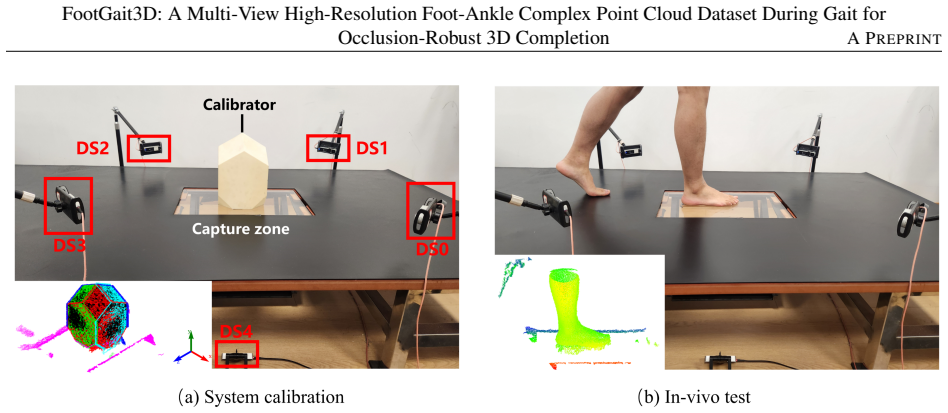
The organizing mechanism is the view-subset synthesis rule: every partial cloud is a genuine sensor-level subset of the same synchronized capture, so partial and complete clouds share the same global coordinate frame and time instance. The bottom camera (DS4) is always removed in every partial condition, guaranteeing that the plantar surface is missing just as it is on a non-transparent floor; then one, two, or all three of the remaining side views are dropped to create graded occlusion levels. This design converts the dataset into a controlled severity ladder for occlusion: 4-view, four 3-view combinations, and six 2-view combinations, all paired with the same full 5-view ground truth. The data acquisition itself is carried by the Point-cloud Foot Analysis (PFA) system, a five-camera rig whose sensor poses are fixed by coarse calibration with a physical object followed by point-to-plane ICP registration.
What would settle it
Take a subject's foot, obtain a high-resolution static 3D scan in a pose matching a FootGait3D frame, register the two surfaces, and compute per-region missing area; if the 5-view reconstruction shows consistent gaps under the arch or at heel-strike beyond the reported 2 mm RMSE, the ground truth is incomplete and completion rankings on FootGait3D would need re-evaluation.
Extended reading notes
Core claim
The paper's central claim is that FootGait3D supplies what prior real-world point cloud datasets lack: paired partial and complete surface geometry of a dynamic biological structure, captured during actual gait. The ground truth is the merged five-view reconstruction from sensors arranged around the capture zone plus one beneath a transparent plate; the partial inputs are created by dropping the bottom camera and then subsets of the side cameras, producing 4-view, 3-view, and 2-view conditions that simulate plantar occlusion and swing-foot occlusion. Benchmark experiments with eleven completion methods show that multi-modal methods that fuse real depth maps (notably SVDFormer and PointSea) keep stable performance across all view counts, while single-modal point-only methods vary unpredictably, with some (PointAttn) doing better on sparser inputs. The paper argues this pattern reflects real-world complexity and makes FootGait3D a more discriminating benchmark than synthetic ShapeNet-derived sets.
Load-bearing premise
The five-view merged reconstruction, checked only by visual inspection, is treated as complete ground-truth surface geometry for the foot and ankle; if systematic missing regions (for instance under the arch or at heel-strike) persist despite the bottom camera, the completion target itself is biased.
Editorial extensions
If this is right
- Completion models trained on synthetic CAD data can be retrained or fine-tuned on real dynamic foot geometry and evaluated against true paired ground truth rather than proxy metrics.
- The graded 4/3/2-view conditions make it possible to measure how each method's accuracy degrades with occlusion severity, separating models robust to missing plantar data from those that only need denser input.
- Multi-modal methods that consume the real five-view depth maps and camera extrinsics can be assessed for cross-modal fusion on authentic data, not rendered pseudo-views.
- Biomechanics studies gain a markerless source of dense surface geometry of the foot-ankle complex across stance phase, supporting multi-segment foot modeling and subject-specific simulation.
- The defined train/validation/test split (5881/841/1681 instances) gives a common protocol so future completion results on FootGait3D are directly comparable.
Reading between the lines
- Beyond the paper: the always-missing plantar surface makes FootGait3D a natural probe for whether completion models actually learn anatomical priors for the arch and heel, since those regions can never be observed in the input and must be hallucinated from side geometry.
- Beyond the paper: the same capture setup could be repurposed as a self-supervised pretraining source for foot shape completion, using the 5-view reconstructions as pseudo-labels and the view subsets as augmentation, before fine-tuning on sparser clinical capture rigs.
- Beyond the paper: one could test whether the reported F1 threshold (1e-3 of the bounding-box diagonal) rewards models that fill in the missing plantar region at all, or merely those that match the visible dorsal surface; a region-masked metric would settle this.
- Beyond the paper: a static high-resolution scan of each subject's foot in a matching pose would provide an external check on the ground truth; if systematic missing regions appear under the arch, model rankings on completion quality could change.
Editorial analysis
A structured set of objections, weighed in public.
Referee Report
Summary. FootGait3D is a dataset paper presenting a multi-view, high-resolution point cloud collection of the foot-ankle complex during the stance phase of gait. The data were acquired with a five-camera depth-sensing system (the previously reported PFA system): four horizontal cameras and one camera beneath a transparent walkway plate. The dataset contains 8,403 frames from 46 subjects; for each frame, a five-view merged point cloud serves as ground truth, and partial point clouds are generated from all combinations of four, three, and two horizontal cameras (with the bottom camera always omitted), yielding 100,836 point cloud frames in total. The authors benchmark eleven point cloud completion methods (PCN, PoinTr, AnchorFormer, SnowflakeNet, PointAttn, SVDFormer, PointSea, CSDN, EGIINet, XMFNet, MAENet) using Chamfer Distance and F1-score, and report that SnowflakeNet, PointAttn, SVDFormer, and PointSea perform best. The dataset is publicly available on HuggingFace.
Significance. The resource is potentially valuable: it is the first real-world dataset, to my knowledge, that provides paired partial and complete dense point clouds of the foot-ankle complex during dynamic gait, with graded occlusion levels. If the ground-truth completeness is validated, it would enable direct training and evaluation of completion models on realistic dynamic anatomical data, complementing static foot datasets (Foot3D, SynFoot) and synthetic completion benchmarks (PCN, ShapeNet). The public release and the systematic benchmarking against standard architectures are strengths, as is the use of a previously described capture system with known hardware characteristics. However, the paper's central assumption—that the five-view reconstruction is a complete and accurate surface—is not quantitatively established, and the evaluation protocol contains ambiguities that must be resolved before the benchmark numbers can be used.
major comments (4)
- [§3.3.3; §3.3.2; §5] The ground-truth completeness claim is not quantitatively demonstrated. Section 3.3.3 states that full-view clouds were visually inspected and that the system has 'surface reconstruction accuracy below 2 mm RMSE,' but no measurement protocol is given for this accuracy and it is not shown to apply to the dynamic foot captures in FootGait3D. Because partial clouds are generated by dropping camera subsets before merging (Section 3.3.2), any region invisible to the retained cameras and also absent from the five-view merge—for example, the plantar contact patch under weight bearing, the arch during mid-stance, or surfaces occluded by the contralateral swing foot before removal—is missing from both the input and the ground truth. The paper's own Section 5 acknowledges residual synchronization offsets that were manually filtered. If such systematic missing regions exist, the completion target is biased and model rankings could change. Please add quantitative completeness evaluation (e.g., comparison with independent high-resolution static scans, repeated-trial reconstruction consistency, or per-frame hole statistics) and specify how the 2 mm RMSE figure was obtained for the dynamic data.
- [§4.1; Tables 1–2] The F1-score threshold is inconsistently defined. Equation (2) and Section 4.1 specify τ = 0.001 (1e-3), while the captions of Tables 1 and 2 define F1 at '1‰ of the bounding-box diagonal.' These two definitions coincide only if the point clouds are normalized to a unit bounding box, but no such normalization is described. Without normalization, a threshold of 1 mm combined with CD-L1 values of 17–19 × 10^-3 (i.e., average distances in the 17–19 mm range if coordinates are in meters) is hard to reconcile with F1 values near 0.97. Please state explicitly whether and how the coordinates were normalized before metric computation, provide the exact threshold used, and recompute the affected numbers if needed.
- [§4.3; Tables 1–2] The evaluation protocol is under-specified in two respects that affect the benchmark conclusions. First, the text says all 16384-point predictions and ground-truth clouds were downsampled to 2048 points with FPS before metric computation, yet the tables also present parenthetical values for 16384 predicted points; the paper does not describe how the 16384-point ground truth is constructed from the original clouds (which contain roughly 78k–120k points) nor how the parenthetical and non-parenthetical numbers are related. Second, the train/validation/test split is described only as 'based on the instance count' (5881/841/1681); it is not stated whether the split is subject-independent. If frames from the same subject appear in both the training and test sets, the reported performance overestimates generalization to new individuals. Please specify the split construction and the exact metric computation pipeline, including which resolution each reported number corresponds to.
- [§3; Data Availability] The paper does not document the format and organization of the released dataset. It only states that the dataset is available on HuggingFace and that sensor calibration matrices are provided. For a dataset contribution, the paper should describe the file formats for the point clouds and depth maps, coordinate units and axis conventions, directory and naming structure, the exact train/validation/test split used in the benchmark, and the license under which the data are released. Please add a data card or an appendix with this information.
minor comments (6)
- [§3.2] The phrase 'All subjects all free from lower limb, foot, and ankle injuries' should be corrected to 'All subjects were free from lower limb, foot, and ankle injuries.'
- [Table 1] In the PointAttn row, the 2-view F1 value '0.997' is missing its closing parenthesis; the model name is written 'PointAttn' in the table but 'PointAttN' in the text.
- [§4.4] The claim that 'AnchorFormer's performance steadily degrades as the number of views decreases' is not supported by Table 1: the 4-view CD-L1 is 18.944 and the 3-view CD-L1 is 18.174, which is an improvement. Please reconcile the text with the table.
- [Supplementary B.1] The sentence claiming that 'PointAttn performs worst under the 4-view condition' contradicts Table 1, where PointAttn has the best (lowest) CD-L1 among single-modal methods at 4 views. This appears to be a typo and should be corrected.
- [Figure 6] The caption contains grammatical errors: 'showed' should be 'show' and 'This reflect' should be 'This reflects.'
- [§4.3] For the multi-modal methods other than SVDFormer, the paper does not specify how their architectures were adapted to the five-view depth maps and extrinsics. Please provide a brief description or refer to a code repository.
Circularity Check
No circularity: FootGait3D is an externally measured dataset, and the completion benchmark compares models against a 5-view reconstruction that is not derived from the models' own outputs or from a fitted parameter.
full rationale
This paper makes no first-principles derivation; its contribution is a captured dataset plus empirical baselines. The full-view ground truth is produced by registering and merging five depth-camera point clouds (Sec. 3.3.1), and the partial clouds are generated by selecting subsets of those cameras before merging (Sec. 3.3.2). The completion task (Sec. 4.1) is to predict the 5-view cloud from a reduced-view input; this is a standard paired-input/ground-truth benchmark, not a tautology. No fitted parameter is renamed as a prediction, and no quantity is defined in terms of the completion models' outputs. The only self-citation is to the authors' prior PFA system [Jiang et al., 2023], which legitimately supplies the hardware, calibration, and an inherited 2 mm RMSE accuracy figure; even if that accuracy is not re-measured on dynamic captures, citing prior infrastructure is not circular. The acknowledged limitations—visual-only completeness inspection (Sec. 3.3.3) and synchronization offsets manually filtered (Sec. 5)—are validity risks for the ground-truth target, but they do not make the derivation circular: the target is an external measurement whose completeness could in principle be checked independently. Therefore, no specific circular reduction can be exhibited, and the appropriate score is 0.
Assumptions & free parameters
assumptions (4)
- domain assumption The 5-view camera fusion provides a complete ground-truth surface of the foot-ankle complex.
- domain assumption Stance phase heel-strike and toe-off events are correctly detected by counting points in a virtual ground layer.
- domain assumption Partial clouds formed by omitting camera views, especially the bottom camera, represent realistic occlusion patterns.
- domain assumption Downsampling all outputs to 2048 points with FPS yields a fair comparison across models with different output resolutions.
Cite this review
Pith. "Pith review of A Multi-View High-Resolution Foot-Ankle Complex Point Cloud Dataset During Gait for Occlusion-Robust 3D Completion." pith.science (2026). https://pith.science/paper/5NFHMHMV
@misc{pith2026250711037,
  author       = {Pith},
  title        = {Pith review of: A Multi-View High-Resolution Foot-Ankle Complex Point Cloud Dataset During Gait for Occlusion-Robust 3D Completion},
  year         = {2026},
  howpublished = {\url{https://pith.science/paper/5NFHMHMV}},
  note         = {Machine review of arXiv:2507.11037}
}
read the original abstract
The kinematics analysis of foot-ankle complex during gait is essential for advancing biomechanical research and clinical assessment. Collecting accurate surface geometry data from the foot and ankle during dynamic gait conditions is inherently challenging due to swing foot occlusions and viewing limitations. Thus, this paper introduces FootGait3D, a novel multi-view dataset of high-resolution ankle-foot surface point clouds captured during natural gait. Different from existing gait datasets that typically target whole-body or lower-limb motion, FootGait3D focuses specifically on the detailed modeling of the ankle-foot region, offering a finer granularity of motion data. To address this, FootGait3D consists of 8,403 point cloud frames collected from 46 subjects using a custom five-camera depth sensing system. Each frame includes a complete 5-view reconstruction of the foot and ankle (serving as ground truth) along with partial point clouds obtained from only four, three, or two views. This structured variation enables rigorous evaluation of 3D point cloud completion methods under varying occlusion levels and viewpoints. Our dataset is designed for shape completion tasks, facilitating the benchmarking of state-of-the-art single-modal (e.g., PointTr, SnowflakeNet, Anchorformer) and multi-modal (e.g., SVDFormer, PointSea, CSDN) completion networks on the challenge of recovering the full foot geometry from occluded inputs. FootGait3D has significant potential to advance research in biomechanics and multi-segment foot modeling, offering a valuable testbed for clinical gait analysis, prosthetic design, and robotics applications requiring detailed 3D models of the foot during motion. The dataset is now available at https://huggingface.co/datasets/ljw285/FootGait3D.
Figures


Figures from the paper (7 more)


Reference graph
Works this paper leans on
-
[1]
The relationship between foot posture and lower limb kinematics during walking: A systematic review
Andrew K Buldt, George S Murley, Paul Butterworth, Pazit Levinger, Hylton B Menz, and Karl B Landorf. The relationship between foot posture and lower limb kinematics during walking: A systematic review. Gait & posture, 38 0 (3): 0 363--372, 2013
work page 2013
-
[2]
Abdul Aziz Hulleck, Dhanya Menoth Mohan, Nada Abdallah, Marwan El Rich, and Kinda Khalaf. Present and future of gait assessment in clinical practice: Towards the application of novel trends and technologies. Frontiers in medical technology, 4: 0 901331, 2022
work page 2022
-
[3]
Gait analysis methods in rehabilitation
Richard Baker. Gait analysis methods in rehabilitation. Journal of neuroengineering and rehabilitation, 3: 0 1--10, 2006
work page 2006
-
[4]
Humanoid robot lola: Design and walking control
Thomas Buschmann, Sebastian Lohmeier, and Heinz Ulbrich. Humanoid robot lola: Design and walking control. Journal of physiology-Paris, 103 0 (3-5): 0 141--148, 2009
work page 2009
-
[5]
Dimple Sethi, Sourabh Bharti, and Chandra Prakash. A comprehensive survey on gait analysis: History, parameters, approaches, pose estimation, and future work. Artificial Intelligence in Medicine, 129: 0 102314, 2022
work page 2022
-
[6]
Association between foot type and tibial stress injuries: a systematic review
Andrew Barnes, Jonathan Wheat, and Clare Milner. Association between foot type and tibial stress injuries: a systematic review. British journal of sports medicine, 42 0 (2): 0 93--98, 2008
work page 2008
-
[7]
MC Carson, ME Harrington, N Thompson, JJ O’connor, and TN Theologis. Kinematic analysis of a multi-segment foot model for research and clinical applications: a repeatability analysis. Journal of biomechanics, 34 0 (10): 0 1299--1307, 2001
work page 2001
-
[8]
Logan Wade, Laurie Needham, Polly McGuigan, and James Bilzon. Applications and limitations of current markerless motion capture methods for clinical gait biomechanics. PeerJ, 10: 0 e12995, 2022
work page 2022
Show all 48 references
-
[9]
Gait assessment using the microsoft xbox one kinect: Concurrent validity and inter-day reliability of spatiotemporal and kinematic variables
Benjamin F Mentiplay, Luke G Perraton, Kelly J Bower, Yong-Hao Pua, Rebekah McGaw, Sophie Heywood, and Ross A Clark. Gait assessment using the microsoft xbox one kinect: Concurrent validity and inter-day reliability of spatiotemporal and kinematic variables. Journal of biomech...
2015
-
[10]
Lidar-based gait analysis and activity recognition in a 4d surveillance system
Csaba Benedek, Bence G \'a lai, Bal \'a zs Nagy, and Zsolt Jank \'o . Lidar-based gait analysis and activity recognition in a 4d surveillance system. IEEE Transactions on Circuits and Systems for Video Technology, 28 0 (1): 0 101--113, 2016
2016
-
[11]
A novel dataset and deep learning-based approach for marker-less motion capture during gait
Saman Vafadar, Wafa Skalli, Aurore Bonnet-Lebrun, Marc Khalif \'e , Mathis Renaudin, Amine Hamza, and Laurent Gajny. A novel dataset and deep learning-based approach for marker-less motion capture during gait. Gait & Posture, 86: 0 70--76, 2021
2021
-
[12]
Unsupervised point cloud representation learning with deep neural networks: A survey
Aoran Xiao, Jiaxing Huang, Dayan Guan, Xiaoqin Zhang, Shijian Lu, and Ling Shao. Unsupervised point cloud representation learning with deep neural networks: A survey. IEEE Transactions on Pattern Analysis and Machine Intelligence, 45 0 (9): 0 11321--11339, 2023
2023
-
[13]
Point cloud matters: Rethinking the impact of different observation spaces on robot learning
Haoyi Zhu, Yating Wang, Di Huang, Weicai Ye, Wanli Ouyang, and Tong He. Point cloud matters: Rethinking the impact of different observation spaces on robot learning. Advances in Neural Information Processing Systems, 37: 0 77799--77830, 2024
2024
-
[14]
Deep learning for image and point cloud fusion in autonomous driving: A review
Yaodong Cui, Ren Chen, Wenbo Chu, Long Chen, Daxin Tian, Ying Li, and Dongpu Cao. Deep learning for image and point cloud fusion in autonomous driving: A review. IEEE Transactions on Intelligent Transportation Systems, 23 0 (2): 0 722--739, 2021
2021
-
[15]
Computer vision and machine learning for medical image analysis: recent advances, challenges, and way forward
Eyad Elyan, Pattaramon Vuttipittayamongkol, Pamela Johnston, Kyle Martin, Kyle McPherson, Carlos Francisco Moreno-Garc \' a, Chrisina Jayne, and Md Mostafa Kamal Sarker. Computer vision and machine learning for medical image analysis: recent advances, challenges, and way forwa...
2022
-
[16]
Quantifying skin motion artifact error of the hindfoot and forefoot marker clusters with the optical tracking of a multi-segment foot model using single-plane fluoroscopy
R Shultz, AE Kedgley, and TR Jenkyn. Quantifying skin motion artifact error of the hindfoot and forefoot marker clusters with the optical tracking of a multi-segment foot model using single-plane fluoroscopy. Gait & posture, 34 0 (1): 0 44--48, 2011
2011
-
[17]
Three-dimensional cameras and skeleton pose tracking for physical function assessment: A review of uses, validity, current developments and kinect alternatives
Ross A Clark, Benjamin F Mentiplay, Emma Hough, and Yong Hao Pua. Three-dimensional cameras and skeleton pose tracking for physical function assessment: A review of uses, validity, current developments and kinect alternatives. Gait & posture, 68: 0 193--200, 2019
2019
-
[18]
Dynamic 3d scanning as a markerless method to calculate multi-segment foot kinematics during stance phase: Methodology and first application
Inge Van den Herrewegen, Kris Cuppens, Mario Broeckx, Bettina Barisch-Fritz, Jos Vander Sloten, Alberto Leardini, and Louis Peeraer. Dynamic 3d scanning as a markerless method to calculate multi-segment foot kinematics during stance phase: Methodology and first application. Jo...
2014
-
[19]
Gait recognition in the wild with dense 3d representations and a benchmark
Jinkai Zheng, Xinchen Liu, Wu Liu, Lingxiao He, Chenggang Yan, and Tao Mei. Gait recognition in the wild with dense 3d representations and a benchmark. In Proceedings of the IEEE/CVF conference on computer vision and pattern recognition, pages 20228--20237, 2022
2022
-
[20]
Find: An unsupervised implicit 3d model of articulated human feet
Oliver Boyne, James Charles, and Roberto Cipolla. Find: An unsupervised implicit 3d model of articulated human feet. arXiv preprint arXiv:2210.12241, 2022
2022 arXiv
-
[21]
Found: Foot optimization with uncertain normals for surface deformation using synthetic data
Oliver Boyne, Gwangbin Bae, James Charles, and Roberto Cipolla. Found: Foot optimization with uncertain normals for surface deformation using synthetic data. In Proceedings of the IEEE/CVF Winter Conference on Applications of Computer Vision, pages 8097--8106, 2024
2024
-
[22]
Pcn: Point completion network
Wentao Yuan, Tejas Khot, David Held, Christoph Mertz, and Martial Hebert. Pcn: Point completion network. In 2018 international conference on 3D vision (3DV), pages 728--737. IEEE, 2018
2018
-
[23]
Pointr: Diverse point cloud completion with geometry-aware transformers
Xumin Yu, Yongming Rao, Ziyi Wang, Zuyan Liu, Jiwen Lu, and Jie Zhou. Pointr: Diverse point cloud completion with geometry-aware transformers. In Proceedings of the IEEE/CVF international conference on computer vision, pages 12498--12507, 2021
2021
-
[24]
Are we ready for autonomous driving? the kitti vision benchmark suite
Andreas Geiger, Philip Lenz, and Raquel Urtasun. Are we ready for autonomous driving? the kitti vision benchmark suite. In 2012 IEEE conference on computer vision and pattern recognition, pages 3354--3361. IEEE, 2012
2012
-
[25]
Robustness of object detectors in degrading weather conditions
Muhammad Jehanzeb Mirza, Cornelius Buerkle, Julio Jarquin, Michael Opitz, Fabian Oboril, Kay-Ulrich Scholl, and Horst Bischof. Robustness of object detectors in degrading weather conditions. In 2021 IEEE International Intelligent Transportation Systems Conference (ITSC), pages...
2021
-
[26]
Cv-hazop: Introducing test data validation for computer vision
Oliver Zendel, Markus Murschitz, Martin Humenberger, and Wolfgang Herzner. Cv-hazop: Introducing test data validation for computer vision. In Proceedings of the IEEE International Conference on Computer Vision, pages 2066--2074, 2015
2015
-
[27]
Shapenet: An information-rich 3d model repository
Angel X Chang, Thomas Funkhouser, Leonidas Guibas, Pat Hanrahan, Qixing Huang, Zimo Li, Silvio Savarese, Manolis Savva, Shuran Song, Hao Su, et al. Shapenet: An information-rich 3d model repository. arXiv preprint arXiv:1512.03012, 2015
2015 arXiv
-
[28]
Scannet: Richly-annotated 3d reconstructions of indoor scenes
Angela Dai, Angel X Chang, Manolis Savva, Maciej Halber, Thomas Funkhouser, and Matthias Nie ner. Scannet: Richly-annotated 3d reconstructions of indoor scenes. In Proceedings of the IEEE conference on computer vision and pattern recognition, pages 5828--5839, 2017
2017
-
[29]
Revisiting point cloud completion: Are we ready for the real-world? arXiv preprint arXiv:2411.17580, 2024
Stuti Pathak, Prashant Kumar, Dheeraj Baiju, Nicholus Mboga, Gunther Steenackers, and Rudi Penne. Revisiting point cloud completion: Are we ready for the real-world? arXiv preprint arXiv:2411.17580, 2024
2024 arXiv
-
[30]
A framework for evaluating the effect of view angle, clothing and carrying condition on gait recognition
Shiqi Yu, Daoliang Tan, and Tieniu Tan. A framework for evaluating the effect of view angle, clothing and carrying condition on gait recognition. In 18th international conference on pattern recognition (ICPR'06), volume 4, pages 441--444. IEEE, 2006
2006
-
[31]
Multi-view large population gait dataset and its performance evaluation for cross-view gait recognition
Noriko Takemura, Yasushi Makihara, Daigo Muramatsu, Tomio Echigo, and Yasushi Yagi. Multi-view large population gait dataset and its performance evaluation for cross-view gait recognition. IPSJ transactions on Computer Vision and Applications, 10: 0 1--14, 2018
2018
-
[32]
Comprehensive review of deep learning-based 3d point cloud completion processing and analysis
Ben Fei, Weidong Yang, Wen-Ming Chen, Zhijun Li, Yikang Li, Tao Ma, Xing Hu, and Lipeng Ma. Comprehensive review of deep learning-based 3d point cloud completion processing and analysis. IEEE Transactions on Intelligent Transportation Systems, 23 0 (12): 0 22862--22883, 2022
2022
-
[33]
Grnet: Gridding residual network for dense point cloud completion
Haozhe Xie, Hongxun Yao, Shangchen Zhou, Jiageng Mao, Shengping Zhang, and Wenxiu Sun. Grnet: Gridding residual network for dense point cloud completion. In European conference on computer vision, pages 365--381. Springer, 2020
2020
-
[34]
Progressive growth for point cloud completion by surface-projection optimization
Ben Fei, Rui Zhang, Weidong Yang, Zhijun Li, and Wen-Ming Chen. Progressive growth for point cloud completion by surface-projection optimization. IEEE Transactions on Intelligent Vehicles, 2024
2024
-
[35]
Anchorformer: Point cloud completion from discriminative nodes
Zhikai Chen, Fuchen Long, Zhaofan Qiu, Ting Yao, Wengang Zhou, Jiebo Luo, and Tao Mei. Anchorformer: Point cloud completion from discriminative nodes. In Proceedings of the IEEE/CVF conference on computer vision and pattern recognition, pages 13581--13590, 2023
2023
-
[36]
Point patches contrastive learning for enhanced point cloud completion
Ben Fei, Liwen Liu, Tianyue Luo, Weidong Yang, Lipeng Ma, Zhijun Li, and Wen-Ming Chen. Point patches contrastive learning for enhanced point cloud completion. IEEE Transactions on Multimedia, 2025 a
2025
-
[37]
Snowflakenet: Point cloud completion by snowflake point deconvolution with skip-transformer
Peng Xiang, Xin Wen, Yu-Shen Liu, Yan-Pei Cao, Pengfei Wan, Wen Zheng, and Zhizhong Han. Snowflakenet: Point cloud completion by snowflake point deconvolution with skip-transformer. In Proceedings of the IEEE/CVF international conference on computer vision, pages 5499--5509, 2021
2021
-
[38]
Multi-modality consistency for point cloud completion via differentiable rendering
Ben Fei, Yixuan Li, Weidong Yang, Wen-Ming Chen, and Zhijun Li. Multi-modality consistency for point cloud completion via differentiable rendering. IEEE Transactions on Artificial Intelligence, 2025 b
2025
-
[39]
Fast tool to evaluate 3d movements of the foot-ankle complex using multi-view depth sensors
Donggang Jiang, Jie-Wen Li, Xiang Geng, Xin Ma, and Wen-Ming Chen. Fast tool to evaluate 3d movements of the foot-ankle complex using multi-view depth sensors. Medicine in Novel Technology and Devices, 17: 0 100212, 2023
2023
-
[40]
Object modelling by registration of multiple range images
Yang Chen and G \'e rard Medioni. Object modelling by registration of multiple range images. Image and vision computing, 10 0 (3): 0 145--155, 1992
1992
-
[41]
Density-aware chamfer distance as a comprehensive metric for point cloud completion
Tong Wu, Liang Pan, Junzhe Zhang, Tai Wang, Ziwei Liu, and Dahua Lin. Density-aware chamfer distance as a comprehensive metric for point cloud completion. arXiv preprint arXiv:2111.12702, 2021
2021 arXiv
-
[42]
Pointattn: You only need attention for point cloud completion
Jun Wang, Ying Cui, Dongyan Guo, Junxia Li, Qingshan Liu, and Chunhua Shen. Pointattn: You only need attention for point cloud completion. In Proceedings of the AAAI Conference on artificial intelligence, volume 38, pages 5472--5480, 2024
2024
-
[43]
Svdformer: Complementing point cloud via self-view augmentation and self-structure dual-generator
Zhe Zhu, Honghua Chen, Xing He, Weiming Wang, Jing Qin, and Mingqiang Wei. Svdformer: Complementing point cloud via self-view augmentation and self-structure dual-generator. In Proceedings of the IEEE/CVF International Conference on Computer Vision, pages 14508--14518, 2023 a
2023
-
[44]
Pointsea: Point cloud completion via self-structure augmentation
Zhe Zhu, Honghua Chen, Xing He, and Mingqiang Wei. Pointsea: Point cloud completion via self-structure augmentation. International Journal of Computer Vision, pages 1--25, 2025
2025
-
[45]
Csdn: Cross-modal shape-transfer dual-refinement network for point cloud completion
Zhe Zhu, Liangliang Nan, Haoran Xie, Honghua Chen, Jun Wang, Mingqiang Wei, and Jing Qin. Csdn: Cross-modal shape-transfer dual-refinement network for point cloud completion. IEEE Transactions on Visualization and Computer Graphics, 2023 b
2023
-
[46]
Explicitly guided information interaction network for cross-modal point cloud completion
Hang Xu, Chen Long, Wenxiao Zhang, Yuan Liu, Zhen Cao, Zhen Dong, and Bisheng Yang. Explicitly guided information interaction network for cross-modal point cloud completion. In European Conference on Computer Vision, pages 414--432. Springer, 2024
2024
-
[47]
Cross-modal learning for image-guided point cloud shape completion
Emanuele Aiello, Diego Valsesia, and Enrico Magli. Cross-modal learning for image-guided point cloud shape completion. Advances in Neural Information Processing Systems, 35: 0 37349--37362, 2022
2022
-
[48]
Maenet: Boost image-guided point cloud completion more accurate and even
Moyun Liu, Ziheng Yang, Bing Chen, Youping Chen, Jingming Xie, Lei Yao, Lap-Pui Chau, Jiawei Du, and Joey Tianyi Zhou. Maenet: Boost image-guided point cloud completion more accurate and even. Information Fusion, page 103179, 2025
2025
Reviewed August 6, 2026 · model on record in the stance chip above.
Discussion (0). Sign in to comment.