REVIEW 3 major objections 5 minor 44 references
TRAN-D: 2D Gaussian Splatting-based Sparse-view Transparent Object Depth Reconstruction via Physics Simulation for Scene Update
T0 review · 3 major / 5 minor · reviewed 2026-08-06 · deepseek-v4-flash
Pith's one-line read The paper claims that segmenting transparent objects, training 2D Gaussians with an object-aware loss, and refreshing the scene by physics simulation give sparse-view depth with single-image updates.
desk verdict The efficiency story and the physics-simulation scene update are genuinely nice, but the headline accuracy numbers rest on an unstated asymmetric evaluation protocol (object-only rendering vs full-scene baselines) that needs to be fixed before the claims can be trusted. read the letter →
The pith
A machine-rendered reading of the paper's core claim, the machinery that carries it, and where it could break.
The reading
What carries the argument
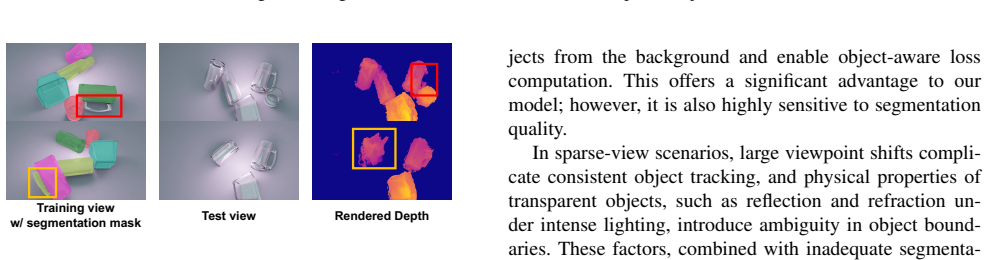
The load-bearing mechanism is a triplet of interacting components. First, a fine-tuned segmentation model with a category-specific text prompt produces instance-consistent masks across sparse views; masks are rendered colorized, and each Gaussian carries an object-index one-hot vector that is splatted, normalized with softmax, and trained with a dice loss. Second, the object-aware 3D loss takes the farthest 2D Gaussian means of each object as group centers, gathers their nearest neighbors, and minimizes the variance of both minimal center distances ($L_d$) and within-group distance sums ($L_S$) over three hierarchical $(n_g, n_n)$ configurations; this is what pulls Gaussians into fully obscured regions and prevents floaters with fewer Gaussians. Third, the scene-update module converts the Gaussian surface to a depth-rendered mesh and runs a short material-point-method simulation under gravity and floor collisions, then re-optimizes the moved Gaussians for a brief refinement from a single post-change image, omitting the object-aware loss.
What would settle it
Two concrete checks would settle the central claim. First, run the pipeline on transparent-object sequences where the segmentation is known to be wrong (strong reflections, intense lighting, or boundaries the fine-tuned model misses) and compare depth MAE against baselines: if error rises to baseline levels whenever masks are inaccurate, the claimed robustness is conditional on the segmentation. Second, at $t=1$, suppress the physics simulation and keep only the brief re-optimization from the single image: if the $\delta < 2.5\,\text{cm}$ accuracy stays near 48 percent, the scene-update benefit attributed to simulation should be re-attributed to the refinement step.
Extended reading notes
Core claim
The central claim, on the paper's own terms, is that transparent-object depth can be reconstructed more accurately from sparse views by making the Gaussian splatting object-aware rather than relying on foundation-model depth priors. TRAN-D renders not just RGB but also segmentation masks and object-index one-hot vectors through the same 2D Gaussian splatting pipeline, so optimization is forced to place Gaussians on the transparent object's surface. A hierarchical object-aware 3D loss samples the farthest Gaussians of each object as group centers, gathers nearest-neighbor groups, and penalizes the variance of center-to-center distances and of within-group density sums, generating gradients for Gaussians in regions occluded from every view. For scene changes, the object's Gaussians are turned into a depth-rendered mesh and fed to a material-point-method simulation; the simulation predicts the toppling or sliding of remaining objects after a removal, and a short re-optimization from one new image reconciles the moved Gaussians with observation. The reported consequence is a mean-absolute-error reduction of over 39 percent on the TRansPose sequences, a $\delta < 2.5\,\text{cm}$ accuracy of 48.46 percent at the updated state from one image against six-image baselines, training in under a minute, and a scene update of about 14 seconds.
Load-bearing premise
The load-bearing premise is that the fine-tuned segmentation masks are accurate and keep each transparent object's identity consistent across the sparse views; every later stage—object-aware loss, object removal, and single-image refinement—acts on those masks, and the paper's own failure analysis shows that wrong or incomplete masks break both the reconstruction and the physics update.
Editorial extensions
If this is right
- On the synthetic TRansPose sequences, the method reports a mean-absolute-error reduction of more than 39 percent against the Gaussian-splatting baselines and roughly doubles the $\delta < 2.5\,\text{cm}$ accuracy (69.11 percent vs 43.01 percent) at the initial state.
- After an object is removed, the scene update needs a single image rather than six: TRAN-D reports 48.46 percent $\delta < 2.5\,\text{cm}$ accuracy at $t=1$, over 1.5 times the best baseline that uses six images.
- The object-aware loss keeps the representation compact (about 33.5k Gaussians at $t=0$, about 16k at $t=1$), which is what makes training finish in under a minute and the update in about 14 seconds including the physics simulation.
- Accuracy stays nearly flat as the training view count moves from 3 to 12, so the method is usable without tuning the number of views to the scene.
Reading between the lines
- Because the fine-tuned segmentation is the pipeline's bottleneck, a natural extension the paper does not develop is self-supervised mask refinement that uses the rendered one-hot consistency as a signal, which would let the method correct its own wrong masks.
- The ablation shows the physics simulation's contribution at $t=1$ is small in average error (MAE 0.0891 without vs 0.0886 with), so most of the single-image accuracy appears to come from the re-optimization; the simulation's real role may be preventing shape collapse rather than lowering the mean, a distinction the paper does not make.
- Because the paper evaluates depth on object regions only while baselines render the full scene, the headline 39-percent improvement is not directly comparable to full-frame depth metrics; a reader transferring the method should re-benchmark on complete frames.
Editorial analysis
A structured set of objections, weighed in public.
Referee Report
Summary. This paper presents TRAN-D, a 2D Gaussian Splatting (2DGS)-based pipeline for sparse-view depth reconstruction of transparent objects. The method (i) fine-tunes Grounded SAM with category-specific prompts to obtain instance-consistent segmentation masks across views; (ii) augments standard 2DGS optimization with rendered segmentation-mask and object-index one-hot losses plus an object-aware 3D loss that regularizes the variance of inter-center distances and local densities among hierarchically grouped Gaussians, with the stated aim of covering obscured regions; and (iii) handles object removal by deleting the corresponding Gaussians, running a Taichi MPM physics simulation on a mesh extracted from the rendered depth to predict the remaining objects' motions, and re-optimizing the Gaussians using a single post-change image. Quantitative results are reported on synthetic sequences built from the TRansPose and ClearPose datasets (MAE, RMSE, and delta-threshold accuracies), together with efficiency comparisons, ablations on view counts and loss components, and qualitative real-world results. The abstract claims a >39% MAE reduction over baselines at t=0 and a single-image t=1 update achieving 48.46% delta<2.5cm accuracy, exceeding six-image baselines by a factor of 1.5.
Significance. Transparent-object depth estimation from sparse views is a practically important open problem for robotic manipulation, and the combination of segmentation-guided 2DGS optimization with a physics-based scene-update mechanism is a plausible and potentially useful direction; reusing object-specific Gaussians through an MPM simulation rather than rescanning the scene is the most distinctive contribution. Strengths of the manuscript include a clear component-wise ablation (Tables 4 and 5), an honest discussion of segmentation dependence and failure cases (Section 5 and Appendix E), reported training times that show a genuine efficiency advantage (54.1 s at t=0 and 13.8 s at t=1 in Table 3), and a public code link. However, the headline quantitative claims currently rest on an asymmetric evaluation protocol (object-only rendering for TRAN-D versus full-scene rendering for the baselines), and TRAN-D's RMSE is worse than the best baselines at TRansPose t=0 and at t=1 in both datasets; both issues must be resolved before the claimed improvements can be considered established.
major comments (3)
- [Sections 4.1 and 4.3, Tables 1-2] The quantitative comparison supporting the abstract's headline claims (>39% MAE reduction; >1.5x delta<2.5cm accuracy) rests on an asymmetric evaluation protocol. Section 4.3 states that 'Unlike other models that include the entire scene during rendering, TRAN-D renders only the objects,' while Section 4.1 defines the metric as rendered depth compared with ground-truth object depth, but the paper never states whether the baseline depth maps were masked to the object region before computing MAE, RMSE, and the delta thresholds. For transparent objects, the background is visible at object pixels, so an unmasked baseline render contributes large background-depth errors in exactly the object region where TRAN-D's object-only render does not. If the baselines were not masked, the reported advantages largely reflect this protocol difference rather than the method's geometric accuracy. Please (a) state exactly which pixels are included in each metric for each method, (b) re-evaluate all baselines with the same object-region mask used for TRAN-D, and (c) verify that the headline MAE and delta accuracy improvements survive that protocol.
- [Section 4.3, Tables 1-2] The claimed 'consistently demonstrated robust improvements' are not consistent across metrics. At TRansPose t=0, TRAN-D's RMSE (0.1069) is worse than 2DGS (0.0914) and TranSplat (0.0982); at t=1 in both datasets TRAN-D's RMSE is worse than the best baselines (TRansPose: 0.1971 vs 2DGS 0.1083 and TranSplat 0.1169; ClearPose: 0.1899 vs Feature Splatting 0.1266 and TranSplat 0.1560). A lower MAE together with a higher RMSE implies a small number of large-error outliers, which is exactly the failure mode that matters for manipulation, and Section 4.3 does not discuss RMSE at all. Moreover, at t=1 on TRansPose the MAE advantage over TranSplat is only about 1.7% (0.0864 vs 0.0879), so the 'over 1.5x' delta-threshold claim appears driven by metric selection. Please analyze where the large errors occur (for example, occluded regions or thin structures), report a robust statistic such as median error or outlier fractions, and temper the consistency claim if the outliers cannot be characterized.
- [Section 3.2.3, Table 5] The paper asserts that the object-aware loss 'places Gaussians on the true surface in fully obscured regions' (Section 3.2.3 and Figure 4), but Eqs. (3)-(7) only penalize the variance of nearest-center distances and the variance of local density sums; no term involves the actual surface in regions unobserved by all views, so the mechanism can at best promote a smooth, uniformly spaced point set that need not coincide with the true geometry. The ablation in Table 5 shows a real but modest benefit (t=0 MAE 0.0447 to 0.0419, RMSE 0.1136 to 0.1059; t=1 MAE 0.0932 to 0.0886), so this does not by itself undermine the headline result, but the 'true surface' claim needs direct evidence. Please evaluate depth error restricted to occluded or obscured object regions (for example, the parts of objects not visible in any training view) and compare against an alternative regularizer of comparable complexity, such as uniformly sampling the current point cloud, to demonstrate that the hierarchical farthest-point grouping is what matters.
minor comments (5)
- [Eq. (2)] In Eq. (2) the summation runs over index i, but the Gaussian kernel is written as G_j(u(x)); this should be G_i(u(x)) to match the other rendering equations.
- [Section 4.5.1, Table 4, and Appendix D] Table 4 shows that TRAN-D's t=0 MAE degrades slightly with more views (0.0405 at 3 views, 0.0419 at 6 views, 0.0448 at 12 views), and the t=1 row shows the same trend, yet Appendix D states that 'increasing the number of training views generally leads to better depth reconstruction.' Please reconcile the text with the table or explain why additional views mildly hurt performance.
- [Section 3.2.2] Applying a softmax to the alpha-composited one-hot features after blending is unusual because the composited vector is a convex combination of per-Gaussian vectors only if the accumulated opacities sum to one at each pixel; please justify this post-blending normalization or describe how it interacts with the alpha-blending weights.
- [Section 4.1, Tables 1-2] The tables report averages over 10 TRansPose and 9 ClearPose sequences without per-sequence variance or standard errors; given the protocol sensitivity identified above, please report per-sequence results or error bars so that the stability of the MAE advantage across sequences can be assessed.
- [Throughout] The baseline method name is spelled inconsistently as 'TranSplat' in most places, 'TransSplat' in Section 4.2, and 'Transplat' in the reference list; similarly the dataset is 'TRansPose' in the text and 'Transpose' in reference [16]. Please unify these names.
Circularity Check
No circularity: depth is produced by forward Gaussian rendering and MPM simulation; self-citations are only to datasets/baselines and are not load-bearing.
full rationale
TRAN-D's derivation chain is not circular. The object-aware 3D loss (Sec. 3.2.3, Eqs. 3-8) regularizes Gaussian placement using segmentation masks and nearest-neighbor distances; it does not ingest the ground-truth depth used for evaluation, and its weights are fixed hyperparameters rather than quantities fitted to the target. The physics-based scene update (Sec. 3.3) runs a forward MPM simulation seeded from a depth-rendered mesh and then refines the Gaussians with one RGB image; the material parameters in Appendix A were selected for simulation speed and visual behavior, not by minimizing the reported MAE/RMSE/delta metrics against ground-truth poses. The synthetic ground truth was generated independently with BlenderProc's physics engine, which is not the same as the Taichi MPM forward model, so the evaluation does not invert the method's own computation. The only self-citations are to the TRansPose dataset and the TranSplat baseline; these are external benchmarks and do not carry the load-bearing argument. The paper explicitly acknowledges in Sec. 5 and Appendix E that performance depends heavily on segmentation quality; that is an input-sensitivity limitation, not a definitional reduction of the depth output to the mask input. The object-only rendering protocol versus full-scene baselines noted in Sec. 4.3 is an evaluation-comparability concern, but it does not make the depth predictions equal to the method's inputs or fitted parameters.
Assumptions & free parameters
free parameters (3)
- MPM material parameters =
Young's modulus 5e4 Pa; Poisson's ratio 0.4
- Object-aware loss weights and grouping sizes =
aS=10000/3, ad=1/3, aone-hot=1.0, acolor=0.5, amask=0.5; (ng,nn) = (16,16), (32,16), (64,32)
- Segmentation category-specific text prompt =
786dvpteg
assumptions (4)
- domain assumption The fine-tuned Grounded SAM produces accurate, view-consistent instance segmentation masks for transparent objects across sparse views and real-world lighting.
- ad hoc to paper The object-aware variance loss places Gaussians on the true surface in fully obscured regions.
- domain assumption Material Point Method with hand-set elastic parameters and a static floor predicts the real chain-reaction movement of remaining objects.
- domain assumption 2D Gaussian disks provide a faithful surface representation of transparent objects despite unmodeled refraction and reflection.
Cite this review
Pith. "Pith review of TRAN-D: 2D Gaussian Splatting-based Sparse-view Transparent Object Depth Reconstruction via Physics Simulation for Scene Update." pith.science (2026). https://pith.science/paper/NK6FGJ4T
@misc{pith2026250711069,
  author       = {Pith},
  title        = {Pith review of: TRAN-D: 2D Gaussian Splatting-based Sparse-view Transparent Object Depth Reconstruction via Physics Simulation for Scene Update},
  year         = {2026},
  howpublished = {\url{https://pith.science/paper/NK6FGJ4T}},
  note         = {Machine review of arXiv:2507.11069}
}
read the original abstract
Understanding the 3D geometry of transparent objects from RGB images is challenging due to their inherent physical properties, such as reflection and refraction. To address these difficulties, especially in scenarios with sparse views and dynamic environments, we introduce TRAN-D, a novel 2D Gaussian Splatting-based depth reconstruction method for transparent objects. Our key insight lies in separating transparent objects from the background, enabling focused optimization of Gaussians corresponding to the object. We mitigate artifacts with an object-aware loss that places Gaussians in obscured regions, ensuring coverage of invisible surfaces while reducing overfitting. Furthermore, we incorporate a physics-based simulation that refines the reconstruction in just a few seconds, effectively handling object removal and chain-reaction movement of remaining objects without the need for rescanning. TRAN-D is evaluated on both synthetic and real-world sequences, and it consistently demonstrated robust improvements over existing GS-based state-of-the-art methods. In comparison with baselines, TRAN-D reduces the mean absolute error by over 39% for the synthetic TRansPose sequences. Furthermore, despite being updated using only one image, TRAN-D reaches a {\delta} < 2.5 cm accuracy of 48.46%, over 1.5 times that of baselines, which uses six images. Code and more results are available at https://jeongyun0609.github.io/TRAN-D/.
Figures


Figures from the paper (11 more)




Reference graph
Works this paper leans on
-
[1]
Clearpose: Large-scale trans- parent object dataset and benchmark
Xiaotong Chen, Huijie Zhang, Zeren Yu, Anthony Opipari, and Odest Chadwicke Jenkins. Clearpose: Large-scale trans- parent object dataset and benchmark. In European confer- ence on computer vision, pages 381–396. Springer, 2022. 5
work page 2022
-
[2]
Mvsplat: Efficient 3d gaussian splatting from sparse multi-view images
Yuedong Chen, Haofei Xu, Chuanxia Zheng, Bohan Zhuang, Marc Pollefeys, Andreas Geiger, Tat-Jen Cham, and Jianfei Cai. Mvsplat: Efficient 3d gaussian splatting from sparse multi-view images. In European conference on computer vision, pages 370–386. Springer, 2024. 2
work page 2024
-
[3]
Strobl, Matthias Humt, and Rudolph Triebel
Maximilian Denninger, Dominik Winkelbauer, Martin Sun- dermeyer, Wout Boerdijk, Markus Knauer, Klaus H. Strobl, Matthias Humt, and Rudolph Triebel. Blenderproc2: A pro- cedural pipeline for photorealistic rendering. Journal of Open Source Software, 8(82):4901, 2023. 5, 1
work page 2023
-
[4]
Bert: Pre-training of deep bidirectional trans- formers for language understanding
Jacob Devlin, Ming-Wei Chang, Kenton Lee, and Kristina Toutanova. Bert: Pre-training of deep bidirectional trans- formers for language understanding. In Proceedings of the 2019 conference of the North American chapter of the asso- ciation for computational linguistics: human language tech- nologies, volume 1 (long and short papers) , pages 4171– 4186, 2019. 1
work page 2019
-
[5]
Residual-nerf: Learning residual nerfs for transparent object manipulation
Bardienus P Duisterhof, Yuemin Mao, Si Heng Teng, and Jeffrey Ichnowski. Residual-nerf: Learning residual nerfs for transparent object manipulation. In Proceedings of the IEEE International conference on robotics and automation, 2024. 1, 3
work page 2024
-
[6]
Instantsplat: Unbounded sparse-view pose-free gaussian splatting in 40 seconds
Zhiwen Fan, Wenyan Cong, Kairun Wen, Kevin Wang, Jian Zhang, Xinghao Ding, Danfei Xu, Boris Ivanovic, Marco Pavone, Georgios Pavlakos, et al. Instantsplat: Unbounded sparse-view pose-free gaussian splatting in 40 seconds. arXiv preprint arXiv:2403.20309, 2(3):4, 2024. 1, 2, 3, 6
arXiv 2024
-
[7]
Sugar: Surface- aligned gaussian splatting for efficient 3d mesh reconstruc- tion and high-quality mesh rendering
Antoine Gu ´edon and Vincent Lepetit. Sugar: Surface- aligned gaussian splatting for efficient 3d mesh reconstruc- tion and high-quality mesh rendering. In Proceedings of the IEEE/CVF conference on computer vision and pattern recognition, pages 5354–5363, 2024. 2
2024
-
[8]
Difftaichi: Differentiable programming for physical simulation
Yuanming Hu, Luke Anderson, Tzu-Mao Li, Qi Sun, Nathan Carr, Jonathan Ragan-Kelley, and Fr´edo Durand. Difftaichi: Differentiable programming for physical simulation. Inter- national Conference on Learning Representations, 2020. 5
work page 2020
Show all 44 references
-
[9]
2d gaussian splatting for geometrically ac- curate radiance fields
Binbin Huang, Zehao Yu, Anpei Chen, Andreas Geiger, and Shenghua Gao. 2d gaussian splatting for geometrically ac- curate radiance fields. In ACM SIGGRAPH 2024 conference papers, pages 1–11, 2024. 2, 6
2024
-
[10]
Fatesgs: Fast and accurate sparse-view surface reconstruction using gaussian splatting with depth-feature consistency
Han Huang, Yulun Wu, Chao Deng, Ge Gao, Ming Gu, and Yu-Shen Liu. Fatesgs: Fast and accurate sparse-view surface reconstruction using gaussian splatting with depth-feature consistency. In Proceedings of the AAAI Conference on Ar- tificial Intelligence, 2025. 2
2025
-
[11]
Transparentgs: Fast inverse rendering of transpar- ent objects with gaussians
Letian Huang, Dongwei Ye, Jialin Dan, Chengzhi Tao, Hui- wen Liu, Kun Zhou, Bo Ren, Yuanqi Li, Yanwen Guo, and Jie Guo. Transparentgs: Fast inverse rendering of transpar- ent objects with gaussians. ACM Transactions on Graphics,
-
[12]
Dex-Nerf: Using a Neural Radiance Field to Grasp Transparent Objects
Jeffrey Ichnowski et al. Dex-Nerf: Using a Neural Radiance Field to Grasp Transparent Objects. In6th annual conference on robot learning, pages 526–536, 2022. 1, 2, 6
2022
-
[13]
A4t: Hierarchical affordance detection for transparent ob- jects depth reconstruction and manipulation
Jiaqi Jiang, Guanqun Cao, Thanh-Toan Do, and Shan Luo. A4t: Hierarchical affordance detection for transparent ob- jects depth reconstruction and manipulation. IEEE Robotics and Automation Letters, 7(4):9826–9833, 2022. 1
2022
-
[14]
3d gaussian splatting for real-time radiance field rendering
Bernhard Kerbl, Georgios Kopanas, Thomas Leimk ¨uhler, and George Drettakis. 3d gaussian splatting for real-time radiance field rendering. ACM Transactions on Graphics, 42 (4):139–1, 2023. 1, 5, 6
2023
-
[15]
Evo-nerf: Evolving nerf for sequential robot grasping of transparent objects
Justin Kerr, Letian Fu, Huang Huang, Yahav Avigal, Matthew Tancik, Jeffrey Ichnowski, Angjoo Kanazawa, and Ken Goldberg. Evo-nerf: Evolving nerf for sequential robot grasping of transparent objects. In 6th annual conference on robot learning, 2022. 1, 2
2022
-
[16]
Transpose: Large-scale multispectral dataset for transparent object
Jeongyun Kim, Myung-Hwan Jeon, Sangwoo Jung, Wooseong Yang, Minwoo Jung, Jaeho Shin, and Ayoung Kim. Transpose: Large-scale multispectral dataset for transparent object. The International Journal of Robotics Research, 43(6):731–738, 2024. 5, 1
2024
-
[17]
Transplat: Surface embedding-guided 3d gaussian splatting for transparent object manipulation
Jeongyun Kim, Jeongho Noh, DongGuw Lee, and Ayoung Kim. Transplat: Surface embedding-guided 3d gaussian splatting for transparent object manipulation. In Proceed- ings of the IEEE International conference on robotics and automation, 2025. 2, 3, 6
2025
-
[18]
Segment any- thing
Alexander Kirillov, Eric Mintun, Nikhila Ravi, Hanzi Mao, Chloe Rolland, Laura Gustafson, Tete Xiao, Spencer White- head, Alexander C Berg, Wan-Yen Lo, et al. Segment any- thing. In Proceedings of the IEEE/CVF international confer- ence on computer vision, pages 4015–4026, 2023. 6
2023
-
[19]
Nfl: Normal field learning for 6-dof grasping of trans- parent objects
Junho Lee, Sang Min Kim, Yonghyeon Lee, and Young Min Kim. Nfl: Normal field learning for 6-dof grasping of trans- parent objects. IEEE Robotics and Automation Letters, 9(1): 819–826, 2023. 2, 6
2023
-
[20]
Ground- ing image matching in 3d with mast3r, 2024
Vincent Leroy, Yohann Cabon, and Jerome Revaud. Ground- ing image matching in 3d with mast3r, 2024. 2
2024
-
[21]
Dngaussian: Optimizing sparse-view 3d gaussian radiance fields with global-local depth normaliza- tion
Jiahe Li, Jiawei Zhang, Xiao Bai, Jin Zheng, Xin Ning, Jun Zhou, and Lin Gu. Dngaussian: Optimizing sparse-view 3d gaussian radiance fields with global-local depth normaliza- tion. In Proceedings of the IEEE/CVF conference on com- puter vision and pattern recognition , pages 2...
-
[22]
Don’t hit me! glass detection in real-world scenes
Haiyang Mei, Xin Yang, Yang Wang, Yuanyuan Liu, Shengfeng He, Qiang Zhang, Xiaopeng Wei, and Ryn- son WH Lau. Don’t hit me! glass detection in real-world scenes. In Proceedings of the IEEE/CVF conference on computer vision and pattern recognition, pages 3687–3696,
-
[23]
Glass segmentation using intensity and spectral po- larization cues
Haiyang Mei, Bo Dong, Wen Dong, Jiaxi Yang, Seung-Hwan Baek, Felix Heide, Pieter Peers, Xiaopeng Wei, and Xin Yang. Glass segmentation using intensity and spectral po- larization cues. In Proceedings of the IEEE/CVF conference on computer vision and pattern recognition , pages...
2022
-
[24]
Nerf: Representing scenes as neural radiance fields for view syn- thesis
Ben Mildenhall, Pratul P Srinivasan, Matthew Tancik, Jonathan T Barron, Ravi Ramamoorthi, and Ren Ng. Nerf: Representing scenes as neural radiance fields for view syn- thesis. Communications of the ACM , 65(1):99–106, 2021. 1
2021
-
[25]
V-net: Fully convolutional neural networks for volumetric medical image segmentation
Fausto Milletari, Nassir Navab, and Seyed-Ahmad Ahmadi. V-net: Fully convolutional neural networks for volumetric medical image segmentation. In fourth international con- ference on 3D vision, pages 565–571. IEEE, 2016. 4
2016
-
[26]
Maxime Oquab, Timoth ´ee Darcet, Th´eo Moutakanni, Huy V . V o, Marc Szafraniec, Vasil Khalidov, Pierre Fernandez, Daniel HAZIZA, Francisco Massa, Alaaeldin El-Nouby, Mido Assran, Nicolas Ballas, Wojciech Galuba, Russell Howes, Po-Yao Huang, Shang-Wen Li, Ishan Misra, Michael ...
2024
-
[27]
Language-driven physics-based scene synthesis and editing via feature splatting
Ri-Zhao Qiu, Ge Yang, Weijia Zeng, and Xiaolong Wang. Language-driven physics-based scene synthesis and editing via feature splatting. In European conference on computer vision, 2024. 6
2024
-
[28]
Learning transferable visual models from natural language supervi- sion
Alec Radford, Jong Wook Kim, Chris Hallacy, Aditya Ramesh, Gabriel Goh, Sandhini Agarwal, Girish Sastry, Amanda Askell, Pamela Mishkin, Jack Clark, et al. Learning transferable visual models from natural language supervi- sion. In International conference on machine learning, ...
2021
-
[29]
Towards robust monocular depth estimation: Mixing datasets for zero-shot cross-dataset transfer
Ren ´e Ranftl, Katrin Lasinger, David Hafner, Konrad Schindler, and Vladlen Koltun. Towards robust monocular depth estimation: Mixing datasets for zero-shot cross-dataset transfer. IEEE transactions on pattern analysis and machine intelligence, 44(3):1623–1637, 2020. 2
2020
-
[30]
Grounded sam: Assembling open-world models for diverse visual tasks,
Tianhe Ren, Shilong Liu, Ailing Zeng, Jing Lin, Kun- chang Li, He Cao, Jiayu Chen, Xinyu Huang, Yukang Chen, Feng Yan, Zhaoyang Zeng, Hao Zhang, Feng Li, Jie Yang, Hongyang Li, Qing Jiang, and Lei Zhang. Grounded sam: Assembling open-world models for diverse visual tasks,
-
[31]
Object-centric 2d gaussian splatting: Background removal and occlusion- aware pruning for compact object models
Marcel Rogge and Didier Stricker. Object-centric 2d gaussian splatting: Background removal and occlusion- aware pruning for compact object models. arXiv preprint arXiv:2501.08174, 2025. 2, 4
2025 arXiv
-
[32]
Dreambooth: Fine tuning text-to-image diffusion models for subject-driven generation
Nataniel Ruiz, Yuanzhen Li, Varun Jampani, Yael Pritch, Michael Rubinstein, and Kfir Aberman. Dreambooth: Fine tuning text-to-image diffusion models for subject-driven generation. In Proceedings of the IEEE/CVF conference on computer vision and pattern recognition , pages 2250...
2023
-
[33]
Structure-from-motion revisited
Johannes Lutz Sch ¨onberger and Jan-Michael Frahm. Structure-from-motion revisited. In Proceedings of the IEEE/CVF conference on computer vision and pattern recognition, 2016. 3
2016
-
[34]
Hisplat: Hierarchical 3d gaus- sian splatting for generalizable sparse-view reconstruction
Shengji Tang, Weicai Ye, Peng Ye, Weihao Lin, Yang Zhou, Tao Chen, and Wanli Ouyang. Hisplat: Hierarchical 3d gaus- sian splatting for generalizable sparse-view reconstruction. arXiv preprint arXiv:2410.06245, 2024. 2
2024 arXiv
-
[35]
Mv- dust3r+: Single-stage scene reconstruction from sparse views in 2 seconds
Zhenggang Tang, Yuchen Fan, Dilin Wang, Hongyu Xu, Rakesh Ranjan, Alexander Schwing, and Zhicheng Yan. Mv- dust3r+: Single-stage scene reconstruction from sparse views in 2 seconds. In Proceedings of the IEEE/CVF conference on computer vision and pattern recognition, pages 5283–5293,
-
[36]
Said-nerf: Segmentation-aided nerf for depth completion of transparent objects
Avinash Ummadisingu, Jongkeum Choi, Koki Yamane, Shimpei Masuda, Naoki Fukaya, and Kuniyuki Takahashi. Said-nerf: Segmentation-aided nerf for depth completion of transparent objects. In 2024 IEEE/RSJ International con- ference on intelligent robots and systems, pages 7535–7542...
2024
-
[37]
Gaussurf: Geometry-guided 3d gaussian splatting for surface recon- struction
Jiepeng Wang, Yuan Liu, Peng Wang, Cheng Lin, Junhui Hou, Xin Li, Taku Komura, and Wenping Wang. Gaussurf: Geometry-guided 3d gaussian splatting for surface recon- struction. arXiv preprint arXiv:2411.19454, 2024. 2
2024 arXiv
-
[38]
Dust3r: Geometric 3d vi- sion made easy
Shuzhe Wang, Vincent Leroy, Yohann Cabon, Boris Chidlovskii, and Jerome Revaud. Dust3r: Geometric 3d vi- sion made easy. In Proceedings of the IEEE/CVF conference on computer vision and pattern recognition , pages 20697– 20709, 2024. 2
2024
-
[39]
latentsplat: Autoencoding varia- tional gaussians for fast generalizable 3d reconstruction
Christopher Wewer, Kevin Raj, Eddy Ilg, Bernt Schiele, and Jan Eric Lenssen. latentsplat: Autoencoding varia- tional gaussians for fast generalizable 3d reconstruction. In European conference on computer vision , pages 456–473. Springer, 2024. 2
2024
-
[40]
Segmenting transparent objects in the wild
Enze Xie, Wenjia Wang, Wenhai Wang, Mingyu Ding, Chun- hua Shen, and Ping Luo. Segmenting transparent objects in the wild. In European conference on computer vision, pages 696–711. Springer, 2020. 1
2020
-
[41]
Sparsegs: Real- time 360° sparse view synthesis using gaussian splatting
Haolin Xiong, Sairisheek Muttukuru, Rishi Upadhyay, Pradyumna Chari, and Achuta Kadambi. Sparsegs: Real- time 360° sparse view synthesis using gaussian splatting. Arxiv, 2023. 2
2023
-
[42]
Gaussianob- ject: High-quality 3d object reconstruction from four views with gaussian splatting
Chen Yang, Sikuang Li, Jiemin Fang, Ruofan Liang, Lingxi Xie, Xiaopeng Zhang, Wei Shen, and Qi Tian. Gaussianob- ject: High-quality 3d object reconstruction from four views with gaussian splatting. ACM Transactions on Graphics, 43 (6):1–13, 2024. 3
2024
-
[43]
Transplat: Generalizable 3d gaussian splatting from sparse multi-view images with transformers
Chuanrui Zhang, Yingshuang Zou, Zhuoling Li, Minmin Yi, and Haoqian Wang. Transplat: Generalizable 3d gaussian splatting from sparse multi-view images with transformers. In Proceedings of the AAAI Conference on Artificial Intelli- gence, pages 9869–9877, 2025. 2
2025
-
[44]
glass” or “transparent
Zehao Zhu, Zhiwen Fan, Yifan Jiang, and Zhangyang Wang. Fsgs: Real-time few-shot view synthesis using gaussian splatting. In European conference on computer vision, pages 145–163. Springer, 2024. 2, 6 TRAN-D: 2D Gaussian Splatting-based Sparse-view Transparent Object Depth Rec...
2024
Reviewed August 6, 2026 · model on record in the stance chip above.
Discussion (0). Sign in to comment.