REVIEW 2 major objections 5 minor 46 references
Versatile Wavelength-Division Multiplexed Quantum Key Distribution Network Operating Simultaneously in the O and C Bands
T0 review · 2 major / 5 minor · reviewed 2026-08-06 · deepseek-v4-flash
Pith's one-line read This paper reports a field demonstration of a four-node QKD network in which three transmitters at 1550.12 nm, 1549.32 nm, and 1310 nm simultaneously exchange secret keys with a central receiver through one optical fiber, using a single…
desk verdict A useful field demonstration of a multi-wavelength QKD star network, but the receiver is less inherently broadband than claimed. read the letter →
The pith
A machine-rendered reading of the paper's core claim, the machinery that carries it, and where it could break.
The reading
What carries the argument
The central mechanism is polarization-to-time multiplexing in the receiver, where a broadband network of polarizing beam splitters, beam splitters, and fiber delays converts each of the four BB84 polarizations into a distinct arrival-time slot. This wavelength-independent mapping allows a single detector per wavelength to identify the transmitted state, so one shared decoder supports all three wavelength channels simultaneously. Supporting machinery includes decoy-state intensity modulation using a Sagnac loop, iPOGNAC and POGNAC polarization encoders, the efficient three-state BB84 protocol, and qubit-based synchronization via Qubit4Sync.
What would settle it
Measure the receiver's polarization-to-time transfer function at 1310 nm and 1550 nm by sending known polarization states and checking whether each state appears in the same time-slot bin at both wavelengths; if the mapping shifts between bands, the shared decoder fails. A weaker test is to compare the quantum bit error rate obtained with the shared receiver against a per-wavelength receiver on the same link.
Extended reading notes
Core claim
The paper's core discovery is that polarization encoding is inherently broadband for wavelength-division multiplexed QKD: because a photon's polarization can be mapped to a distinct time slot using passive components such as polarizing beam splitters, beam splitters, and fiber delays, the same mapping works at 1310 nm and 1550 nm. This lets three independent transmitters at different wavelengths be multiplexed onto one fiber and decoded by a single shared receiver, with only a demultiplexer and one single-photon detector added per wavelength. The experiment used efficient three-state BB84 with decoy states at a 50 MHz repetition rate and achieved secure key rates that remained stable for the full run, with the 1310 nm link showing a higher error rate attributed to polarization misalignment between Alice and Bob.
Load-bearing premise
The shared receiver behaves identically at 1310 nm and 1550 nm: a given input polarization must land in the same time slot at all three wavelengths, which the paper asserts from the broadband nature of the components but does not back with per-wavelength calibration data.
Editorial extensions
If this is right
- A single QKD hub can serve users with different wavelengths without needing a wavelength-specific receiver for each user.
- Adding a new user to the network requires only a transmitter at an available wavelength, a multiplexer port, and one single-photon detector, while the expensive decoding optics are shared.
- The architecture is compatible with existing telecom wavelength-division multiplexing infrastructure and can be extended to more dense WDM channels within and beyond the O and C bands.
- The higher error rate on the 1310 nm link indicates that active polarization control will be needed for stable long-term operation of O-band channels in a deployed network.
Reading between the lines
- The same broadband receiver concept should transfer to other telecom bands, such as S and L, as long as the passive components remain broadband and the timing-slot mapping holds.
- A direct per-wavelength calibration of the polarization-to-time mapping would strengthen the claim of wavelength independence, since the paper currently relies on aggregate QBER rather than a dedicated measurement of the decoder's transfer function.
- The single-detector-per-wavelength design could be combined with time-division multiplexing or faster detectors to increase the per-user key rate without adding receiver optics.
Editorial analysis
A structured set of objections, weighed in public.
Referee Report
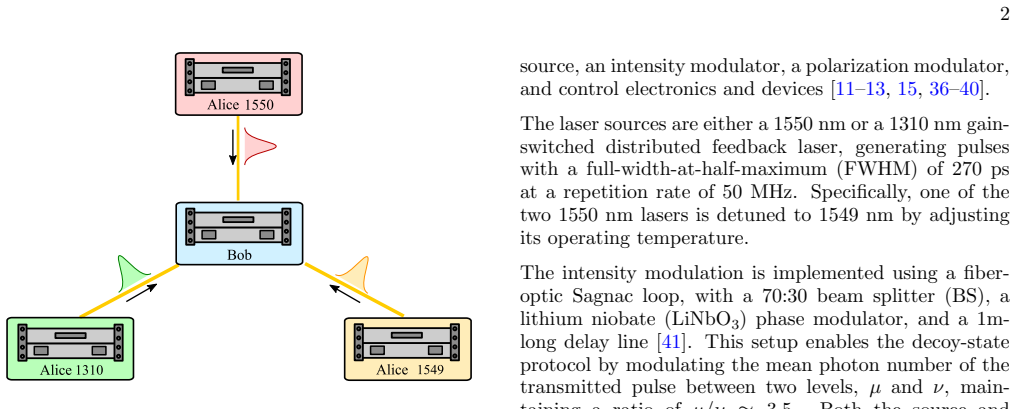
Summary. The manuscript reports a four-node WDM-QKD network in a star configuration: three transmitters at 1550.12 nm, 1549.32 nm, and 1310 nm send polarization-encoded 3-state BB84 weak coherent pulses over fiber to a single shared receiver, which uses polarization-to-time multiplexing and one SPAD per wavelength. The three links ran simultaneously for 6 hours, with average QBERs of 1.1%, 1.0%, and 2.6% and total keys of 36.4, 53.7, and 15 Mbit, respectively. Security is claimed through a finite-size decoy-state analysis. The central claim is that this is the first prepare-and-measure WDM-QKD network with simultaneous cross-band (O+C) operation using a single shared receiver whose polarization measurement is inherently broadband.
Significance. If substantiated, the demonstration is a useful step toward resource-efficient multi-user QKD: it shows that a single optical receiver can serve users in different telecom bands simultaneously, reducing cost and footprint. Strengths include a real deployed 17-km fiber link, six hours of simultaneous operation, real-time post-processing, the use of a finite-key security analysis with explicit security parameters, and a fully implemented qubit-based synchronization. The work reuses previously validated transmitter and FPGA designs, which is sensible but means the technical novelty concentrates on the shared broadband receiver. The paper would be strengthened by making the receiver's wavelength-transparency an explicit measured quantity rather than an asserted property.
major comments (2)
- [II.C and II.B] The claim that the polarization measurement is 'inherently multi-wavelength since the used components (fibers, PBS, and BS) are broadband' omits the two automatic polarization controllers (APCs), which are part of the shared receiver and whose retardance is chromatic. The alignment procedure described in Section II.B compensates any wavelength-dependent receiver rotation by adjusting the transmitter-side polarization controllers of Alice1549 and Alice1310 after Bob is aligned to Alice1550. Consequently, the reported QBERs do not isolate the receiver's broadband performance; they show that each link works after per-channel pre-compensation. To support the load-bearing novelty claim, the authors should either provide per-wavelength characterization of Bob's time-slot mapping and polarization extinction ratio with fixed APC settings, or explicitly state that the receiver is broadband only up to transmitter-side compensation and qualify the novelty claim accordingly.
- [II.C] The statement that the number of transmitters 'can be extended to arbitrary number of dWDM channels' relies on the unmeasured assumption that the polarization-to-time mapping is wavelength-independent over the whole O+C band. The experiment tests only three wavelengths (two adjacent C-band channels and one O-band channel). If the time-slot map shifts with wavelength due to the chromatic APC retardance or fiber dispersion in the delay lines, additional channels may require re-calibration or even separate mapping. The authors should temper this scalability claim or provide evidence (e.g., swept-wavelength measurements of the receiver's time-slot positions and extinction) across the relevant band.
minor comments (5)
- [II.B] There is a typo: 'in the in the efficient 3-state variant' should read 'in the efficient 3-state variant'.
- [II.C] The phrase '1310m' appears where '1310 nm' is meant; please correct this typographical error.
- [III] The paper reports average QBERs and total key lengths but no statistical uncertainties or confidence intervals. Given that the finite-key analysis uses a block size of 5e6 bits, reporting the standard deviation or at least the number of blocks would improve reproducibility.
- [II.B] The spacing in '1m' should be '1 m' for consistency with standard notation.
- [III] Figure 5 shows a negative slope in key rates for all links, attributed to lack of active polarization control for 1549 and 1310 nm. It would be helpful to state explicitly whether the 1550-nm active control also maintains QBER below 2% for the entire 6-hour run and to mention the time constant of the QBER drift in the other links.
Circularity Check
No significant circularity: the demonstration is experimental, key rates are measured, and security analysis is imported from external references.
full rationale
The paper's central claim is an experimental demonstration, and its derivation chain is self-contained in the sense required by the circularity rubric. The key results (QBER, secure key rates, total keys) are measured values from a six-hour field trial, not outputs of a fitted model that is then called a prediction. The finite-key security analysis is taken from Refs. [45,46], which are external works (Rusca et al. and Lim et al.), not self-citations, so the security statement does not reduce to the authors' own prior claims. The reuse of the group's iPOGNAC/POGNAC transmitters, Qubit4Sync synchronization, and FPGA architecture is operational reuse of tested hardware; it supports the demonstration but does not by itself force the conclusion, and no load-bearing argument in the paper depends on the truth of those self-citations in lieu of evidence. The one potentially fragile step is the assertion in Section II.C that the polarization measurement is 'inherently multi-wavelength since the used components (fibers, PBS, and BS) are broadband,' which omits the chromatic behavior of the automatic polarization controllers. That is a technical assumption that could be challenged on correctness grounds, but it is not circular: the claim is not defined in terms of the result, nor is any parameter fitted to the outcome and then renamed as a prediction. The experimental alignment procedure described in Section II.B, where Alice 1550 aligns Bob and the other transmitters then match their polarization reference frames with transmitter-side polarization controllers, could hide wavelength-dependent receiver misalignment, but that concern concerns whether the shared receiver is as wavelength-transparent as claimed, not whether the paper's derivation reduces to its inputs. No fitted input, self-citation chain, uniqueness import, or ansatz-via-citation is present. The appropriate circularity score is therefore 0.
Assumptions & free parameters
free parameters (2)
- decoy intensity mu =
0.6
- decoy intensity nu =
0.17
assumptions (4)
- standard math The finite-key security proof of Rusca et al. [45], derived from Lim et al. [46], applies to this three-state decoy-state BB84 implementation and to the measured detection counts.
- domain assumption PBS, BS, fiber, and APC components in the receiver are broadband and perform identically at 1310 nm and 1550 nm, so the polarization-to-time mapping is wavelength independent.
- domain assumption The three transmitters' pulses are time-synchronized and only one pulse occupies a measurement round, preventing cross-talk in the shared receiver's time slots.
- domain assumption Fiber polarization drift in the 1549 nm and 1310 nm links stays within tolerable QBER for the 6-hour run even without active compensation.
Cite this review
Pith. "Pith review of Versatile Wavelength-Division Multiplexed Quantum Key Distribution Network Operating Simultaneously in the O and C Bands." pith.science (2026). https://pith.science/paper/Z2PVWKZ6
@misc{pith2026250711175,
  author       = {Pith},
  title        = {Pith review of: Versatile Wavelength-Division Multiplexed Quantum Key Distribution Network Operating Simultaneously in the O and C Bands},
  year         = {2026},
  howpublished = {\url{https://pith.science/paper/Z2PVWKZ6}},
  note         = {Machine review of arXiv:2507.11175}
}
read the original abstract
Ongoing technological progress is accelerating the commercial and global-scale deployment of Quantum Key Distribution (QKD). Its ability to enable unconditionally secure communication is expected to be a key feature of future telecommunication networks, and practical demonstrations of QKD network implementations in real-world environments are crucial for ensuring reliable adoption. In this work, we demonstrate a four-node photonic QKD network that employs versatile and cost-effective wavelength-division multiplexing across three transmitters in the O and C bands to simultaneously distribute quantum-secure keys among all nodes. Specifically, the broadband central receiver node shares all optical and electronic decoding components, except for the single-photon detectors, across the three QKD links, significantly reducing system costs and enhancing compactness.
Figures


Figures from the paper (2 more)


Reference graph
Works this paper leans on
-
[1]
C. H. Bennett and G. Brassard, Quantum cryptography: Public key distribution and coin tossing, Theor. Comput. Sci. 560, 7 (2014)
work page 2014
-
[2]
Scarani, H
V. Scarani, H. Bechmann-Pasquinucci, N. J. Cerf, M. Duˇ sek, N. L¨ utkenhaus, and M. Peev, The security of practical quantum key distribution, Rev. Mod. Phys. 81, 1301 (2009)
2009
-
[3]
S. Pirandola, U. L. Andersen, L. Banchi, M. Berta, D. Bunandar, R. Colbeck, D. Englund, T. Gehring, C. Lupo, C. Ottaviani, J. L. Pereira, M. Razavi, J. Sham- sul Shaari, M. Tomamichel, V. C. Usenko, G. Vallone, P. Villoresi, and P. Wallden, Advances in quantum cryp- tography, Advances in Optics and Photonics 12, 1012 (2020)
work page 2020
-
[4]
J. S. Sidhu, S. K. Joshi, M. G¨ undo˘ gan, T. Brougham, D. Lowndes, L. Mazzarella, M. Krutzik, S. Mohapatra, D. Dequal, G. Vallone, P. Villoresi, A. Ling, T. Jen- newein, M. Mohageg, J. G. Rarity, I. Fuentes, S. Piran- dola, and D. K. L. Oi, Advances in space quantum com- munications, IET Quantum Communication , 1 (2021)
work page 2021
-
[5]
M. G. Raymer and C. Monroe, The US national quantum initiative, Quantum Sci. Technol. 4, 020504 (2019)
work page 2019
-
[6]
M. Mehic, M. Niemiec, S. Rass, J. Ma, M. Peev, A. Aguado, V. Martin, S. Schauer, A. Poppe, C. Pacher, and M. Voznak, Quantum key distribution: A networking perspective, ACM Comput. Surv. 53, 10.1145/3402192 (2020)
doi:10.1145/3402192 2020
-
[7]
Y. Cao, Y. Zhao, Q. Wang, J. Zhang, S. X. Ng, and L. Hanzo, The evolution of quantum key distribution net- works: On the road to the qinternet, IEEE Communica- tions Surveys and Tutorials 24, 839 (2022)
work page 2022
-
[8]
J. L. Duligall, M. S. Godfrey, K. A. Harrison, W. J. Munro, and J. G. Rarity, Low cost and compact quantum key distribution, New J. Phys. 8, 249 (2006)
work page 2006
Show all 46 references
-
[9]
Sibson, J
P. Sibson, J. E. Kennard, S. Stanisic, C. Erven, J. L. O’Brien, and M. G. Thompson, Integrated silicon pho- tonics for high-speed quantum key distribution, Optica 4, 172 (2017)
2017
-
[10]
X.-X. Xia, Z. Zhang, H.-B. Xie, X. Yuan, J. Lin, S.-K. Liao, Y. Liu, C.-Z. Peng, Q. Zhang, and J.-W. Pan, LED- based fiber quantum key distribution: toward low-cost 6 applications, Photon. Res. 7, 1169 (2019)
2019
-
[11]
Agnesi, M
C. Agnesi, M. Avesani, L. Calderaro, A. Stanco, G. Fo- letto, M. Zahidy, A. Scriminich, F. Vedovato, G. Vallone, and P. Villoresi, Simple quantum key distribution with qubit-based synchronization and a self-compensating po- larization encoder, Optica 7, 284 (2020)
2020
-
[12]
Avesani, L
M. Avesani, L. Calderaro, G. Foletto, C. Agnesi, F. Picciariello, F. B. L. Santagiustina, A. Scriminich, A. Stanco, F. Vedovato, M. Zahidy, G. Vallone, and P. Villoresi, Resource-effective quantum key distribution: a field trial in padua city center, Opt. Lett. 46, 2848 (2021)
2021
-
[13]
Avesani, G
M. Avesani, G. Foletto, M. Padovan, L. Calderaro, C. Agnesi, E. Bazzani, F. Berra, T. Bertapelle, F. Pic- ciariello, F. B. L. Santagiustina, D. Scalcon, A. Scrim- inich, A. Stanco, F. Vedovato, G. Vallone, and P. Vil- loresi, Deployment-ready quantum key distribution over a cl...
2022
-
[14]
Scalcon, C
D. Scalcon, C. Agnesi, M. Avesani, L. Calderaro, G. Fo- letto, A. Stanco, G. Vallone, and P. Villoresi, Cross- encoded quantum key distribution exploiting time-bin and polarization states with qubit-based synchronization, Advanced Quantum Technologies 5, 2200051 (2022)
2022
-
[15]
Picciariello, I
F. Picciariello, I. Karakosta-Amarantidou, E. Rossi, M. Avesani, G. Foletto, L. Calderaro, G. Vallone, P. Vil- loresi, and F. Vedovato, Intermodal quantum key dis- tribution field trial with active switching between fiber and free-space channels, EPJ Quantum Technology 12, 6 (2025)
2025
-
[16]
Sasaki, M
M. Sasaki, M. Fujiwara, H. Ishizuka, W. Klaus, K. Wakui, M. Takeoka, S. Miki, T. Yamashita, Z. Wang, A. Tanaka, K. Yoshino, Y. Nambu, S. Takahashi, A. Tajima, A. Tomita, T. Domeki, T. Hasegawa, Y. Sakai, H. Kobayashi, T. Asai, K. Shimizu, T. Tokura, T. Tsurumaru, M. Matsui, T....
2011
-
[17]
Liao, W.-Q
S.-K. Liao, W.-Q. Cai, W.-Y. Liu, L. Zhang, Y. Li, J.-G. Ren, J. Yin, Q. Shen, Y. Cao, Z.-P. Li, F.-Z. Li, X.-W. Chen, L.-H. Sun, J.-J. Jia, J.-C. Wu, X.-J. Jiang, J.-F. Wang, Y.-M. Huang, Q. Wang, Y.-L. Zhou, L. Deng, T. Xi, L. Ma, T. Hu, Q. Zhang, Y.-A. Chen, N.-L. Liu, X.-B...
2017
-
[18]
Y.-A. Chen, Q. Zhang, T.-Y. Chen, W.-Q. Cai, S.-K. Liao, J. Zhang, K. Chen, J. Yin, J.-G. Ren, Z. Chen, S.-L. Han, Q. Yu, K. Liang, F. Zhou, X. Yuan, M.-S. Zhao, T.-Y. Wang, X. Jiang, L. Zhang, W.-Y. Liu, Y. Li, Q. Shen, Y. Cao, C.-Y. Lu, R. Shu, J.-Y. Wang, L. Li, N.- L. Liu,...
2021
-
[19]
Li, W.-Q
Y. Li, W.-Q. Cai, J.-G. Ren, C.-Z. Wang, M. Yang, L. Zhang, H.-Y. Wu, L. Chang, J.-C. Wu, B. Jin, H.- J. Xue, X.-J. Li, H. Liu, G.-W. Yu, X.-Y. Tao, T. Chen, C.-F. Liu, W.-B. Luo, J. Zhou, H.-L. Yong, Y.-H. Li, F.-Z. Li, C. Jiang, H.-Z. Chen, C. Wu, X.-H. Tong, S.-J. Xie, F. Z...
2025
-
[20]
M. Peev, C. Pacher, R. All´ eaume, C. Barreiro, J. Bouda, W. Boxleitner, T. Debuisschert, E. Diamanti, M. Dianati, J. F. Dynes, S. Fasel, S. Fossier, M. F¨ urst, J.-D. Gautier, O. Gay, N. Gisin, P. Grangier, A. Happe, Y. Hasani, M. Hentschel, H. H¨ ubel, G. Humer, T. L¨ anger,...
2009
-
[21]
J. F. Dynes, A. Wonfor, W. W.-S. Tam, A. W. Sharpe, R. Takahashi, M. Lucamarini, A. Plews, Z. L. Yuan, A. R. Dixon, J. Cho, Y. Tanizawa, J.-P. Elbers, H. Greißer, I. H. White, R. V. Penty, and A. J. Shields, Cambridge quantum network, npj Quantum Information 5, 101 (2019)
2019
-
[22]
The European Quantum Communication In- frastructure (EuroQCI) Initiative https:// digital-strategy.ec.europa.eu/en/policies/ european-quantum-communication-infrastructure-euroqci
-
[23]
OpenQKD https://openqkd.eu/
-
[24]
Bahrami, A
A. Bahrami, A. Lord, and T. Spiller, Quan- tum key distribution integration with optical dense wavelength division multiplexing: a re- view, IET Quantum Communication 1, 9 (2020), https://ietresearch.onlinelibrary.wiley.com/doi/pdf/10.1049/iet- qtc.2019.0005
2020
-
[25]
N. A. Peters, P. Toliver, T. E. Chapuran, R. J. Runser, S. R. McNown, C. G. Peterson, D. Rosenberg, N. Dall- mann, R. J. Hughes, K. P. McCabe, J. E. Nordholt, and K. T. Tyagi, Dense wavelength multiplexing of 1550 nm qkd with strong classical channels in reconfigurable network...
2009
-
[26]
Y. Shao, Z. Shen, Y. Xu, L. Li, Z. Tan, X. Liao, P. Huang, T. Wang, and G. Zeng, Integration of classical communi- cation and quantum key distribution using frequency di- vision multiplexing, Chin. Opt. Lett. 23, 032702 (2025)
2025
-
[27]
Iqbal, M
M. Iqbal, M. Svaluto Moreolo, R. Munoz, L. Nadal, A. Villegas, J. M. Rivas-Moscoso, S. Sarmiento, A. Mel- gar, P. Adillon, J. Tabares, and S. Etcheverry, Sdn- enabled cv-qkd and classical channels coexistence: key insights for dense wavelength division multiplexing, Jour- nal ...
2025
-
[28]
A. A. E. Hajomer, I. Derkach, V. C. Usenko, U. L. Ander- sen, and T. Gehring, Coexistence of continuous-variable quantum key distribution and classical data over 120-km fiber (2025), arXiv:2502.17388 [quant-ph]
2025 arXiv
-
[29]
Wang, L.-K
L.-J. Wang, L.-K. Chen, L. Ju, M.-L. Xu, Y. Zhao, K. Chen, Z.-B. Chen, T.-Y. Chen, and J.-W. Pan, Exper- imental multiplexing of quantum key distribution with classical optical communication, Applied Physics Letters 106, 10.1063/1.4913483 (2015). 7
2015 doi
-
[30]
Terhaar, J
R. Terhaar, J. R¨ odiger, M. H¨ außler, M. Wahl, H. Gehring, M. A. Wolff, F. Beutel, W. Hartmann, N. Walter, J. Hanke, P. Hanne, N. Walenta, M. Diedrich, N. Perlot, M. Tillmann, T. R¨ ohlicke, M. Ahangarianab- hari, C. Schuck, and W. H. P. Pernice, Ultrafast quantum key distri...
2023
-
[31]
Beutel, F
F. Beutel, F. Br¨ uckerhoff-Pl¨ uckelmann, H. Gehring, V. Kovalyuk, P. Zolotov, G. Goltsman, and W. H. P. Per- nice, Fully integrated four-channel wavelength-division multiplexed qkd receiver, Optica 9, 1121 (2022)
2022
-
[32]
ichiro Yoshino, M
K. ichiro Yoshino, M. Fujiwara, A. Tanaka, S. Takahashi, Y. Nambu, A. Tomita, S. Miki, T. Yamashita, Z. Wang, M. Sasaki, and A. Tajima, High-speed wavelength- division multiplexing quantum key distribution system, Opt. Lett. 37, 223 (2012)
2012
-
[33]
Wengerowsky, S
S. Wengerowsky, S. K. Joshi, F. Steinlechner, H. H¨ ubel, and R. Ursin, An entanglement-based wavelength- multiplexed quantum communication network, Nature 564, 225 (2018)
2018
-
[34]
C.-H. F. Fung and H.-K. Lo, Security proof of a three- state quantum-key-distribution protocol without rota- tional symmetry, Phys. Rev. A 74, 042342 (2006)
2006
-
[35]
Gr¨ unenfelder, A
F. Gr¨ unenfelder, A. Boaron, D. Rusca, A. Martin, and H. Zbinden, Simple and high-speed polarization-based QKD, Appl. Phys. Lett. 112, 051108 (2018)
2018
-
[36]
Lazzarin, F
J. Lazzarin, F. Campagnaro, M. Padovan, E. Rossi, I. Karakosta-Amarantidou, F. Picciariello, F. Vedovato, G. Vallone, P. Villoresi, and M. Zorzi, Quantum key dis- tribution for secure encryption in underwater networks, in OCEANS 2024 - Singapore (2024) pp. 1–8
2024
-
[37]
Picciariello, F
F. Picciariello, F. Vedovato, D. Orsucci, P. N. Dominguez, T. Zechel, M. Avesani, M. Padovan, G. Fo- letto, L. Calderaro, D. Dequal, A. Shrestha, L. Bl¨ umel, J. Furthner, G. Vallone, P. Villoresi, T. D. Schmidt, and F. Moll, Quantum-secured time transfer between pre- cise tim...
2023
-
[38]
10, 27 (2023)
Berra, Federico, Agnesi, Costantino, Stanco, Andrea, Avesani, Marco, Cocchi, Sebastiano, Villoresi, Paolo, and Vallone, Giuseppe, Modular source for near-infrared quantum communication, EPJ Quantum Technol. 10, 27 (2023)
2023
-
[39]
Avesani, L
M. Avesani, L. Calderaro, G. Foletto, C. Agnesi, F. Picciariello, F. Santagiustina, A. Scriminich, A. Stanco, F. Vedovato, M. Zahidy, G. Val- lone, and P. Villoresi, A resource-effective qkd field-trial in padua with the ipognac encoder, in Optical Fiber Communication Conferen...
2021
-
[40]
Agnesi, M
C. Agnesi, M. Avesani, A. Stanco, P. Villoresi, and G. Vallone, All-fiber self-compensating polarization en- coder for quantum key distribution, Opt. Lett. 44, 2398 (2019)
2019
-
[41]
G. L. Roberts, M. Pittaluga, M. Minder, M. Lucamarini, J. F. Dynes, Z. L. Yuan, and A. J. Shields, Patterning- effect mitigating intensity modulator for secure decoy- state quantum key distribution, Opt. Lett. 43, 5110 (2018)
2018
-
[42]
Stanco, F
A. Stanco, F. B. L. Santagiustina, L. Calderaro, M. Avesani, T. Bertapelle, D. Dequal, G. Vallone, and P. Villoresi, Versatile and concurrent fpga-based archi- tecture for practical quantum communication systems, IEEE Transactions on Quantum Engineering 3, 1 (2022)
2022
-
[43]
Calderaro, A
L. Calderaro, A. Stanco, C. Agnesi, M. Avesani, D. De- qual, P. Villoresi, and G. Vallone, Fast and simple qubit-based synchronization for quantum key distribu- tion, Phys. Rev. Applied 13, 054041 (2020)
2020
-
[44]
Martinez-Mateo, C
J. Martinez-Mateo, C. Pacher, M. Peev, A. Ciurana, and V. Martin, Demystifying the information reconciliation protocol cascade, Quantum Info. Comput. 15, 453–477 (2015)
2015
-
[45]
Rusca, A
D. Rusca, A. Boaron, F. Gr¨ unenfelder, A. Martin, and H. Zbinden, Finite-key analysis for the 1-decoy state QKD protocol, Appl. Phys. Lett. 112, 171104 (2018)
2018
-
[46]
C. C. W. Lim, M. Curty, N. Walenta, F. Xu, and H. Zbinden, Concise security bounds for practical decoy- state quantum key distribution, Physical Review A 89, 022307 (2014)
2014
Reviewed August 6, 2026 · model on record in the stance chip above.
Discussion (0). Continue with ORCID to comment.