REVIEW 4 major objections 6 minor 2 cited by
Testing Planck 2020 and DESI data on wCDM Models
T0 review · 4 major / 6 minor · reviewed 2026-08-06 · deepseek-v4-flash
Pith's one-line read A Bayesian comparison of four dynamical dark energy models against the newest Planck and DESI data finds that ΛCDM remains the preferred model.
desk verdict Standard constraints paper that overclaims 'ΛCDM preferred'; the tables show some dynamic models winning on AIC/BIC, and the dark-energy sound speed is never reported. read the letter →
The pith
A machine-rendered reading of the paper's core claim, the machinery that carries it, and where it could break.
The reading
What carries the argument
The machinery is a set of four equation-of-state functions for dark energy—constant w, a quadratic form, a logarithmic form, and an oscillatory form—each with a present-day value w0 and a time-evolution amplitude wa. These functions enter the Friedmann equation through an integral over the dark energy density and enter the perturbation equations through the fluid sound speed, with anisotropic stress set to zero. The analysis samples the six ΛCDM parameters plus each model's w0 and wa using a Markov chain Monte Carlo, and compares models through ΔAIC and ΔBIC relative to ΛCDM. The model-comparison statistics are the instruments that carry the central claim that ΛCDM remains preferred.
What would settle it
Run the same model set with the dark energy sound speed explicitly fixed to a canonical value such as $c_s^{2}$ = 1 in the Boltzmann solver, and check whether the logarithmic model still produces H0 ≈ 57–64 km/s/Mpc and σ8 ≈ 0.7 with PR4 plus late-time data; if that outlier shifts back toward ~70 km/s/Mpc and σ8 ~ 0.8, the sound-speed assumption is the load-bearing choice behind the paper's preference for ΛCDM.
Extended reading notes
Core claim
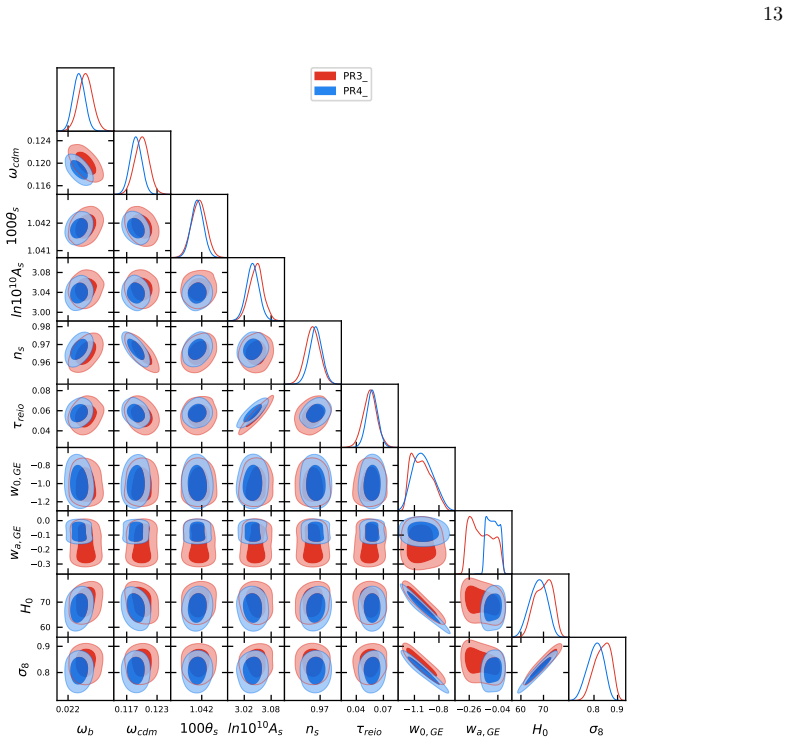
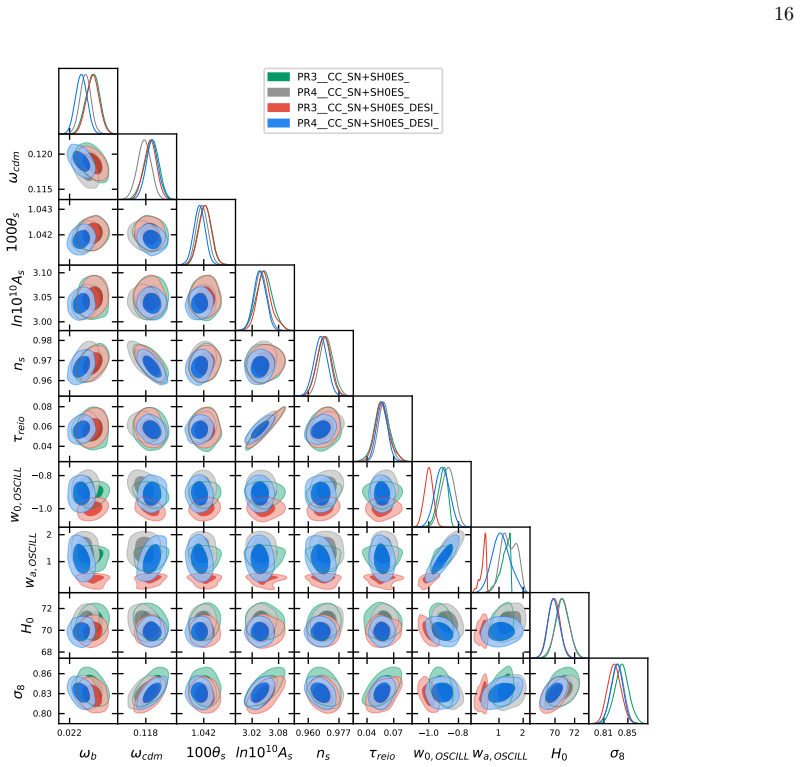
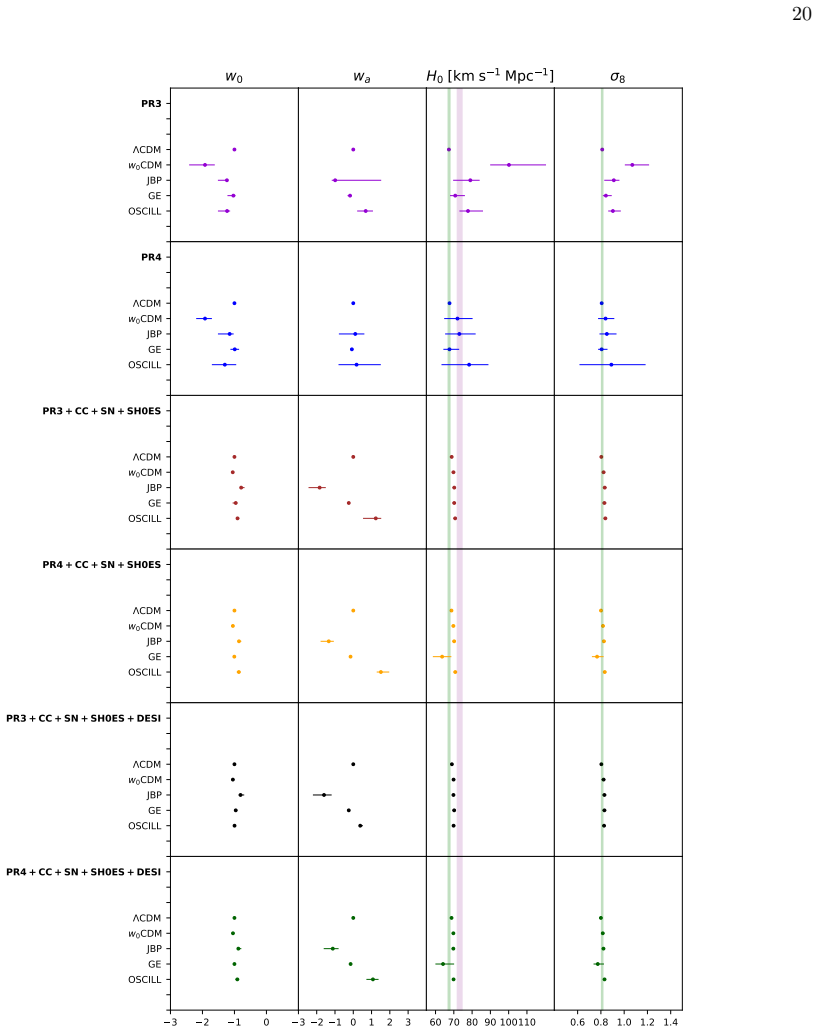
On its own terms, the paper's central discovery is that none of the tested wCDM equations of state beats the cosmological constant when the full early-plus-late-time data are analyzed with the Bayesian Information Criterion, and H0 and σ8 remain consistent with the ΛCDM values that define the tensions. For the best combined dataset (PR4 plus cosmic chronometers, Pantheon+SH0ES, and DESI), the equation-of-state parameter w0 converges near -1 for every model, H0 clusters around 70 km/s/Mpc, and σ8 sits between 0.8 and 0.9, so neither the Hubble tension nor the σ8 tension is reduced. The Akaike Information Criterion sometimes favors the dynamical models for particular data combinations, but the author reads the overall evidence as supporting ΛCDM. A secondary result is that Planck 2020 generally shrinks the parameter posteriors relative to Planck 2018, and adding DESI shrinks them further, making the new data the more discriminating baseline for future dark energy tests.
Load-bearing premise
The analysis assumes that dark energy perturbations have no anisotropic stress and that their sound speed is the adiabatic one tied to the equation of state, but it never states which sound speed is actually fed into the Boltzmann solver; for models whose equation of state crosses -1, that choice changes the predicted growth of structure and hence the inferred σ8 and H0.
Editorial extensions
If this is right
- If the central claim is correct, the cosmological constant remains the simplest viable description of dark energy; none of the four dynamical equations of state is required by current CMB, BAO, and supernova data.
- The Hubble tension, which stands at more than 4σ between early- and late-time measurements, would not be relieved by these wCDM parameterizations, since H0 stays near 70 km/s/Mpc when late-time data are included.
- The σ8 tension would likewise persist, with σ8 remaining in the 0.8–0.9 range across all models and data combinations.
- Because the newer Planck 2020 and DESI data sets yield tighter posteriors, any future search for dynamical dark energy should use them as the baseline rather than their predecessors.
- The dataset-dependence of ΔAIC and ΔBIC indicates that model preferences in this regime are fragile; claims of a detection of evolving dark energy would need to survive both statistics.
Reading between the lines
- A testable extension, not stated in the paper, is to vary the dark energy sound speed rather than tying it to the adiabatic value; for equations of state that cross w = -1, this choice can alter growth predictions and therefore shift σ8 and H0 enough to change the model ranking.
- The logarithmic model's PR4-plus-late-time outlier (H0 near 57–64 km/s/Mpc and low σ8) is exactly the pattern one would expect from a sound-speed or perturbation instability, so re-running that model with an explicitly fixed sound speed would discriminate between a real feature and a modeling artifact.
- The fact that DESI barely moves the w0 posteriors once cosmic chronometers and supernovae are included suggests that DESI's constraining power in this analysis is redundant with existing late-time data, and that detecting dynamics will require percent-level H0 or growth measurements rather than more BAO points.
- If the newer Planck likelihood systematically gives smaller errors but occasional physically odd best fits (such as the oscillatory model's degenerate σ8), the PR3-versus-PR4 comparison doubles as a stress test of the new likelihood's treatment of low- and high-multipole data; a useful check is to verify the nuisance-parameter marginalization against PR3.
Editorial analysis
A structured set of objections, weighed in public.
Referee Report
Summary. The paper constrains four dynamical dark energy equation-of-state parameterizations (constant w, Jassal-Bagla-Padmanabhan quadratic, Efstathiou logarithmic, and Zhang-Ma oscillatory) together with ΛCDM, using Planck 2018 (PR3) and Planck 2020 (PR4) CMB data, cosmic chronometers, Pantheon+SH0ES, BAO, and DESI. It reports best-fit values and posterior means for the standard cosmological parameters, H0, and σ8, and uses ΔAIC and ΔBIC to compare the models. The authors conclude that the newer PR4 and DESI data constrain the models better than earlier data and that, overall, Bayesian analysis suggests that ΛCDM remains the preferred model among the tested parameterizations.
Significance. If the conclusions were robustly established, the paper would provide a useful, up-to-date check of whether current CMB and DESI BAO data require any of the tested dynamical dark energy models, and whether those models alleviate the H0 and σ8 tensions. The work has clear strengths: it exercises the newer PR4 likelihood, includes a wide set of data combinations, considers several well-known w(a) parameterizations, and makes code publicly available. However, the principal interpretive claim is internally weakened by inconsistencies between the model-comparison table and the text, and by an under-specified treatment of dark-energy perturbations that may affect the quoted σ8 and H0 posteriors. These issues are fixable, but they currently prevent the paper from supporting its central claim as stated.
major comments (4)
- [Table S9; §5; §6; Abstract] The central claim that ΛCDM is preferred is contradicted by the paper's own model-comparison statistics. Table S9 reports ΔBIC = −9.44 for the Logarithmic model with PR3/ALL and ΔAIC = −25.52 for the same combination, indicating a strong preference for the logarithmic model over ΛCDM; negative ΔBIC values also appear for the Oscillatory model with PR3/CCSN (−1.23) and PR4/CCSN (−2.04). While §5 lists these as the only cases where models fit better than ΛCDM, §6 and the Abstract state unconditionally that Bayesian analysis suggests ΛCDM remains the preferred model. The conclusion must be qualified by data combination and by the information criterion used, and the Abstract should be revised to avoid overstating the preference.
- [§2, Eqs. (8)–(10); §3] The paper never specifies which dark-energy sound speed is used in the CLASS runs. Eq. (10) defines the adiabatic sound speed, but for a fluid with w ≠ −1 the CLASS default is a constant rest-frame sound speed rather than the adiabatic one, and the adiabatic speed is ill-defined (divergent) at w = −1, so it cannot be applied to parameterizations that cross the phantom divide without extra specification. Because the σ8 and H0 posteriors depend on the perturbation equations, the runs for the logarithmic and oscillatory models, which do cross w = −1, are not reproducible without stating the adopted c_s^2. The authors should state exactly which CLASS sound-speed parameter was used and test the sensitivity of the σ8 and H0 constraints to that choice, particularly for the anomalous PR4 logarithmic fits.
- [§4.3, Table S6, Fig. 6] The PR4+CC+SN+SH0ES logarithmic-model results are anomalously low: best-fit H0 = 57.22 km/s/Mpc and σ8 = 0.713, with means H0 = 63.6 ± 4.8 and σ8 = 0.767, while all other models with the same data give H0 ≈ 70 and σ8 ≈ 0.82. The text notes degeneracies but does not explain why the newer Planck likelihood plus late-time data drives this single model to such discrepant values, nor does it address the apparent inconsistency with the statement in the same subsection that the logarithmic model obtained a higher value of σ8 than found in past research. This anomaly is load-bearing for the σ8-tension discussion and for the claim that PR4 constrains the models better; it requires an explanation or a check for a numerical or implementation issue.
- [§5, Table S9] The statement that when only late-time data including DESI was considered, all models were statistically better than ΛCDM, is only supported by the ΔAIC column for the ALL combination; the corresponding ΔBIC values are all positive (3.45–9.06), meaning ΛCDM is preferred by BIC for that same data combination. The text should explicitly separate the AIC and BIC conclusions whenever it refers to 'better' fits, otherwise readers will conclude that dynamical dark energy is favored by both criteria when in fact the two criteria disagree.
minor comments (6)
- [§1 and Table S8 caption] There are several typos: 'w ̸= 1' in the introduction should be 'w ≠ −1'; 'combiantions' in the Table S8 caption should be 'combinations'; 'DDESI' in §5 should be 'DESI'; and the Glossary entry for 'PR4/ALL' incorrectly defines it as 'PR3+CC+SN+SH0ES+DESI' rather than 'PR4+CC+SN+SH0ES+DESI'.
- [§3] The Planck 2020 likelihood components are referred to as 'Lillipop' and 'Hillipop'; these should be typeset as LoLLiPOP and HiLLiPOP, and the text should clarify that the low-ℓ polarization data are taken from Planck 2018 while low-ℓ temperature comes from LoLLiPOP, as stated later in the same subsection.
- [§3, CC description] The sentence 'each zi with its corresponding uncertainty σ8' appears to be a typographical error; the uncertainty should refer to the Hubble parameter measurement H(zi), not to σ8.
- [§2] The text defines c_s^2 as the sound speed for an imperfect fluid but then sets the anisotropic stress to zero; a fluid with zero anisotropic stress is usually called a perfect fluid, and the gauge in which δP/δρ is evaluated should be specified for clarity.
- [§4] The analysis does not report any convergence statistics, such as the Gelman-Rubin R−1 values or effective sample sizes for the MCMC chains; without these, the quoted 1σ intervals and best-fit values cannot be fully assessed by the reader.
- [Fig. 11] The axis label 'w0 wa H0 [km s 1 Mpc 1]' is missing superscripts and separators; it should read 'w0, wa, H0 [km s⁻¹ Mpc⁻¹], σ8'.
Circularity Check
No circularity: all constraints, posterior widths, and model-comparison statistics are computed from external data; the 'ΛCDM preferred' conclusion is a data-driven ranking, not an input.
full rationale
This is an empirical fitting paper. The posterior distributions for H0, σ8, and the w parameters are generated by MontePython/CLASS from the Planck, CC, SN+SH0ES, BAO, and DESI likelihoods; none of the reported best-fit values or credible intervals are imposed by the model definitions. The model comparison uses ΔAIC and ΔBIC computed from the same fitted likelihoods, so the conclusion that ΛCDM is preferred is a data-driven ranking rather than an ansatz or a fitted parameter renamed as a prediction. The four w(a) parameterizations (constant, JBP, logarithmic, oscillatory) are imported from the literature as candidate models; citing them defines the alternatives under test, and the data decide whether they are preferred, so this is not circular. No load-bearing self-citation appears, and no uniqueness theorem is imported from the authors' prior work. The paper's own limitation statement—that a varying dark-energy sound speed is reserved for future work—acknowledges a modeling restriction rather than smuggling in the conclusion. The main weaknesses identified by a skeptical reader are reproducibility and consistency concerns, not circularity: the paper never states which effective sound speed was used in CLASS for phantom-crossing models, and Table S9's ΔBIC = −9.44 for the logarithmic PR3/ALL fit appears to conflict with the abstract's statement that ΛCDM remains preferred. These issues affect whether the central claim is supported, but they do not make any derived quantity equal to an input by construction. Because no circular step can be exhibited from the paper's equations or citations, the circularity score is 0.
Assumptions & free parameters
free parameters (8)
- w0,w0CDM (constant model dark energy equation of state) =
PR3 best-fit -2.30, PR4 best-fit -1.24; late-time combinations around -1.05
- w0,JBP (quadratic JBP model coefficient) =
PR3 best-fit -0.807, PR4 best-fit -1.05; late-time fits around -0.8 to -0.88
- wa,JBP (quadratic JBP model slope) =
PR3 best-fit -1.07, PR4 best-fit -1.00; late-time fits around -1.1 to -2.4
- w0,GE (logarithmic model coefficient) =
PR3 best-fit -1.14, PR4 best-fit -1.09; late-time fits around -0.93 to -1.00
- wa,GE (logarithmic model slope) =
PR3 best-fit -0.07, PR4 best-fit -0.014; late-time fits around -0.15 to -1.91
- w0,OSCILL (oscillatory model coefficient) =
PR3 best-fit -1.39, PR4 best-fit -0.83; late-time fits around -0.84 to -1.00
- wa,OSCILL (oscillatory model amplitude) =
PR3 best-fit 0.71, PR4 best-fit 1.52; late-time fits around -0.48 to 1.83
- six standard ΛCDM baseline parameters (ωb, ωcdm, 100θs, ln(10^10 As), ns, τreio) =
Varies by model and data combination, see Tables S1-S8
assumptions (6)
- standard math FLRW background geometry and linear perturbation equations are valid.
- domain assumption The Universe is spatially flat.
- domain assumption Dark energy, matter, and radiation do not interact and are separately conserved.
- domain assumption The dark energy fluid has zero anisotropic stress and uses the adiabatic sound speed relation in Eq. (10).
- domain assumption The likelihoods and MCMC priors used by MontePython are appropriate, although the prior ranges are not listed.
- domain assumption AIC and BIC are valid for comparing models in this setting.
Cite this review
Pith. "Pith review of Testing Planck 2020 and DESI data on wCDM Models." pith.science (2026). https://pith.science/paper/KGHCF3UM
@misc{pith2026250711237,
  author       = {Pith},
  title        = {Pith review of: Testing Planck 2020 and DESI data on wCDM Models},
  year         = {2026},
  howpublished = {\url{https://pith.science/paper/KGHCF3UM}},
  note         = {Machine review of arXiv:2507.11237}
}
read the original abstract
This work delves into the dynamical dark energy models of the wCDM parameterisation that are defined by their equation of state by comparing different, well-known parameterisation models, in an attempt to lessen the tensions of {H_0} and {\sigma_8} by using the latest observational data. This research also tested the newer Planck likelihood and compared it to the previously released dataset of Planck 2018 and the newer BAO data of DESI. The data that was used were: the Cosmic Microwave Background (CMB) data of Planck 2018 and Planck 2020 data; Cosmic Chronometers (CC), a sample of Supernovae Type Ia; and Baryonic Acoustic Oscillations (BAO). A Bayesian analysis was performed to produce the results needed for the analysis. From the analyses, the best-fit values of the parameters show that almost all models are in favour of a phantom Universe when early-time data was used and favours a quintessence Universe when combinations of early-time and late-time data was considered. This study also showed that the new tested data constrained the models better than the previous ones, while also showing that the observation data supports the {\Lambda}CDM model over the dynamical dark energy models
Figures


Figures from the paper (8 more)





Forward citations
Cited by 2 Pith papers
-
BAO miscalibration cannot rescue late-time solutions to the Hubble tension
Even after rescaling BAO data to prefer H0≈73 km/s/Mpc, none of six tested late-time dark-energy models can resolve the Hubble tension once unanchored SNeIa and CMB geometry are included.
-
Dark energy, spatial curvature, and star formation efficiency from JWST photometric and spectroscopic high-redshift galaxies
Bayesian joint constraints show that elevated star formation efficiency accounts for JWST high-z galaxy excess in flat Lambda CDM, without requiring deviations in dark energy equation of state or curvature.
Reference graph
Works this paper leans on
-
[1]
This gave rise to the possibility of an alternative model to the standard model
INTRODUCTION During this last decade, the cosmic tension has been continuously debated in modern cosmology as dis- crepancies between the values of the Hubble parameter, H0, [1] and the amplitude of the matter power spectrum, σ8, [2] derived either indirectly, through the use of models or directly, through standard candles [3, 4], still persist. This gave...
arXiv 2025
-
[2]
The background equations assume an isotropic and homogeneous Universe
wCDM MODELS The background and perturbation equations are the integral part of any model. The background equations assume an isotropic and homogeneous Universe. However, at lower scales or high modes, the cosmological principle no longer applies; therefore, the perturbation equations handle the fluctuations that are found in the Universe, such as density ...
-
[3]
OBSER V A TIONAL DA T A SAMPLES In this section, the cosmological data sets that were used in this study will be outlined, describing the statistical methodology employed to constrain the dynamical dark energy models considered in this study. • Cosmic Microwave Background (CMB) data from Planck 2020:The latest Planck CMB data was taken in this study, givi...
work page 2020
-
[4]
wCDM CONSTRAINT ANAL YSIS In this section, the key observational findings derived from all the cosmological models analysed using various datasets are presented. The primary focus is on the estimation of H0, as influenced by the underlying cosmological models driven by different dark energy parameterisations. However, the σ8 parameter will also be analyse...
-
[5]
ANAL YSIS OF RESUL TS In this section, the statistical performance of each parameterisation will be discussed, as well as how the models affect the six ΛCDM parameters. The Akaike Information Criterion (AIC) and Bayesian In- formation Criterion (BIC) statistics were taken as a measure to determine which parameterisation models are statistically better tha...
-
[6]
The simplest and most widely accepted explanation is the ΛCDM cosmological model
SUMMAR Y AND CONCLUSIONS Dark energy remains one of the greatest mysteries in modern cosmology, nearly two decades after its de- tection as the driving force behind the accelerated expansion of the Universe. The simplest and most widely accepted explanation is the ΛCDM cosmological model. While ΛCDM has proven successful in describing late-time cosmic acc...
work page 2020
-
[7]
Bernal, J. L.; Verde, L.; Riess, A. G. JCAP 2016, 10, 019, https://doi.org/10.48550/arXiv.1607.05617
-
[8]
Astrophys.2020, 641, A6, https://doi.org/10.48550/arXiv.1807.06209
Aghanim, N.; others Astron. Astrophys.2020, 641, A6, https://doi.org/10.48550/arXiv.1807.06209
Show all 54 references
- [9]
- [11]
- [12]
- [13]
- [14]
- [15]
-
[16]
Capozziello, S.; De Laurentis, M. Phys. Rept. 2011, 509, 167–321, https://doi.org/10.48550/arXiv.1108. 6266
2011 doi
- [17]
- [18]
- [19]
- [21]
- [22]
- [23]
- [25]
-
[26]
N.; Yang, W
Pan, S.; Saridakis, E. N.; Yang, W. Phys. Rev. D2018, 98, 063510, https://doi.org/10.48550/arXiv.1712. 05746
- [28]
- [29]
- [30]
- [31]
- [32]
-
[33]
Monthly Notices of the Royal Astronomical Society 2024, 528, 6861–6880, http://dx.doi.org/10.1093/mnras/stae451
Sharon, A.; Kushnir, D.; Yuan, W.; Macri, L.; Riess, A. Monthly Notices of the Royal Astronomical Society 2024, 528, 6861–6880, http://dx.doi.org/10.1093/mnras/stae451
2024 doi
-
[34]
S.; Lukovi´ c, V
Haridasu, B. S.; Lukovi´ c, V. V.; Vittorio, N. JCAP 2018, 05, 033, https://doi.org/10.48550/arXiv.1711. 03929
2018 doi
- [35]
- [36]
-
[37]
Astrophys
Ma, C.-P.; Bertschinger, E. Astrophys. J. 1995, 455, 7–25, https://doi.org/10.48550/arXiv.astro-ph/ 9506072
1995 doi
- [38]
- [39]
- [40]
- [41]
-
[42]
K.; Basilakos, S
Anagnostopoulos, F. K.; Basilakos, S. Phys. Rev. D2018, 97, 063503, https://doi.org/10.48550/arXiv.1709. 02356
- [43]
- [44]
- [45]
- [46]
- [47]
- [48]
- [49]
- [50]
- [51]
- [52]
- [53]
- [54]
- [55]
-
[56]
Journal of Cosmology and Astroparticle Physics 2011, 2011, 034–034, http://dx.doi.org/10.1088/1475-7516/2011/07/034
Blas, D.; Lesgourgues, J.; Tram, T. Journal of Cosmology and Astroparticle Physics 2011, 2011, 034–034, http://dx.doi.org/10.1088/1475-7516/2011/07/034
2011 doi
-
[57]
GetDist: a Python package for analysing Monte Carlo samples
Lewis, A. GetDist: a Python package for analysing Monte Carlo samples. 2019; https://arxiv.org/abs/1910. 13970
2019
- [58]
Reviewed August 6, 2026 · model on record in the stance chip above.
Discussion (0). Sign in to comment.